





By Jim Shimabukuro (assisted by Copilot)
Editor
DNI Tulsi Gabbard’s opening remarks present a single overarching thesis: the United States faces a rapidly evolving, multi‑domain threat environment in which homeland security, transnational crime, terrorism, state adversaries, cyber operations, and emerging technologies are converging in ways that demand vigilance, coordination, and sustained national resolve. She frames the intelligence community’s assessment as non‑political and rooted in statutory duty, emphasizing that the briefing reflects analytic judgments rather than personal opinion.
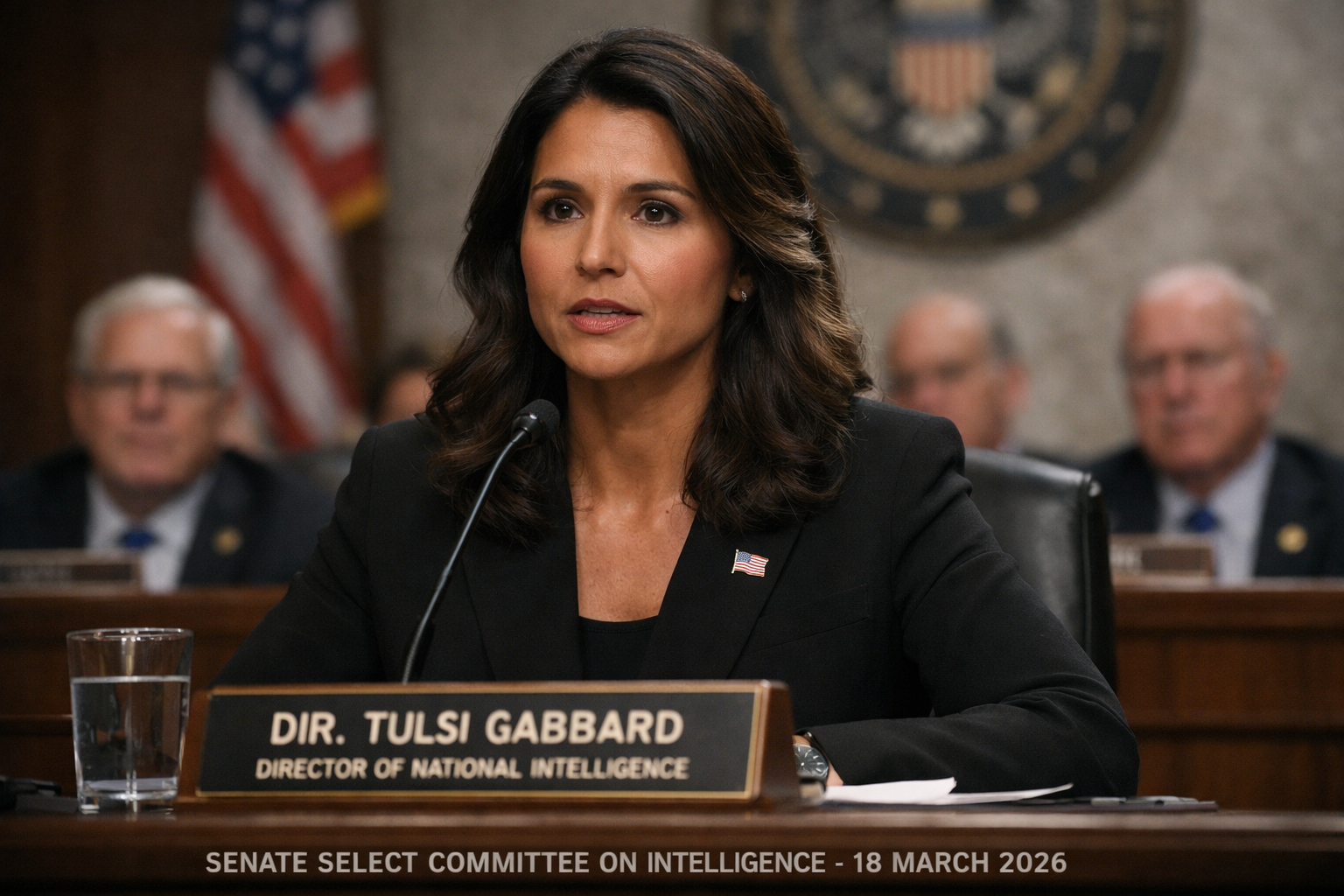
Her first major point is that the administration’s strict border enforcement has sharply reduced unlawful crossings, which she cites as an example of how policy can directly shape threat exposure. She pairs this with a warning that instability in the Caribbean and persistent smuggler networks will continue to drive migration pressures. She then argues that transnational criminal organizations—especially Mexican cartels—remain a daily threat to Americans through drug trafficking, even as fentanyl deaths have declined and precursor flows from China and India have shown signs of disruption. This framing positions cartel activity not as a distant geopolitical issue but as an immediate public‑safety concern.
Her second major theme is the persistence and evolution of Islamist terrorism. Although groups like al‑Qaeda and ISIS are weaker than at their peak, she stresses that their ideology continues to spread, sometimes through networks associated with the Muslim Brotherhood, and that these actors increasingly rely on information operations to inspire attacks in the West. She highlights recent domestic plots and attacks, including a disrupted synagogue attack in Michigan, to argue that the threat is not abstract but present within U.S. borders.
Her third major theme is the growing danger posed by state adversaries—Russia, China, North Korea, Iran, and Pakistan—whose missile programs, nuclear capabilities, and cyber operations are expanding. She warns that the number of missiles capable of reaching the U.S. homeland could quintuple by 2035 and that adversaries are developing systems designed to bypass American defenses. In the cyber domain, she describes China and Russia as the most persistent threats, with North Korea using cyber theft to fund weapons programs and ransomware groups accelerating their operations.
A fourth major theme is the transformative risk posed by emerging technologies—especially artificial intelligence and quantum computing. She argues that AI is reshaping cyber operations, weapons design, and battlefield decision‑making, and that ensuring human control over autonomous systems is essential to protecting U.S. interests. Quantum computing, she notes, could allow early adopters to break current encryption and gain extraordinary intelligence advantages.
She then surveys regional flashpoints: Russia’s continued upper hand in Ukraine, Iran’s degraded but still hostile posture after Operation Epic Fury, China’s military modernization and ambitions toward Taiwan, North Korea’s growing partnership with Russia, and instability across Africa. Throughout, she emphasizes that adversaries are increasingly willing to use force, that space is becoming a contested domain, and that strategic competitors are selectively cooperating in ways that could amplify threats to the United States.
In plain language, Gabbard is saying that the world is becoming more dangerous, more interconnected, and more technologically complex, and that the United States must remain alert, united, and proactive. Her underlying purpose is twofold: to inform Congress and the public about the intelligence community’s assessment of threats, and to reinforce the legitimacy and necessity of the IC’s work at a moment when global instability, rapid technological change, and domestic political tensions could undermine public trust.
She is also implicitly justifying the administration’s security policies—particularly on border enforcement, counter‑cartel operations, and pressure on Iran—by presenting them as effective components of a broader national‑security strategy. The remarks matter because they outline how the U.S. intelligence community understands the world in 2026, what it sees as the most urgent dangers, and how it believes the United States must prepare for a future in which adversaries are more capable, technology is more disruptive, and the line between foreign and domestic threats is increasingly blurred.
References
- Office of the Director of National Intelligence, “Annual Threat Assessment of the U.S. Intelligence Community (2025–2026)” — https://www.dni.gov
- Congressional Research Service, “Fentanyl and Synthetic Opioids: Policy Developments and Trends” (2025) — https://crsreports.congress.gov
- Center for Strategic and International Studies, “Global Cyber Threats in 2025–2026” — https://csis.org
- Brookings Institution, “AI, Autonomy, and National Security Risks in 2026” — https://brookings.edu
- International Crisis Group, “Global Conflict Tracker 2025–2026” — https://crisisgroup.org
[###]
Filed under: Uncategorized |


 Educational Technology and Change Journal

Leave a comment