


By Jim Shimabukuro (assisted by ChatGPT)
Editor
Multiple countries are actively developing what can reasonably be described as “robot tanks,” more formally called unmanned ground combat vehicles (UGCVs) or heavily armed unmanned ground vehicles (UGVs). What is striking in 2024–2026 is not just experimentation, but early operational deployment, especially in the Russia–Ukraine war, which has become the first large-scale laboratory for robotic ground warfare.
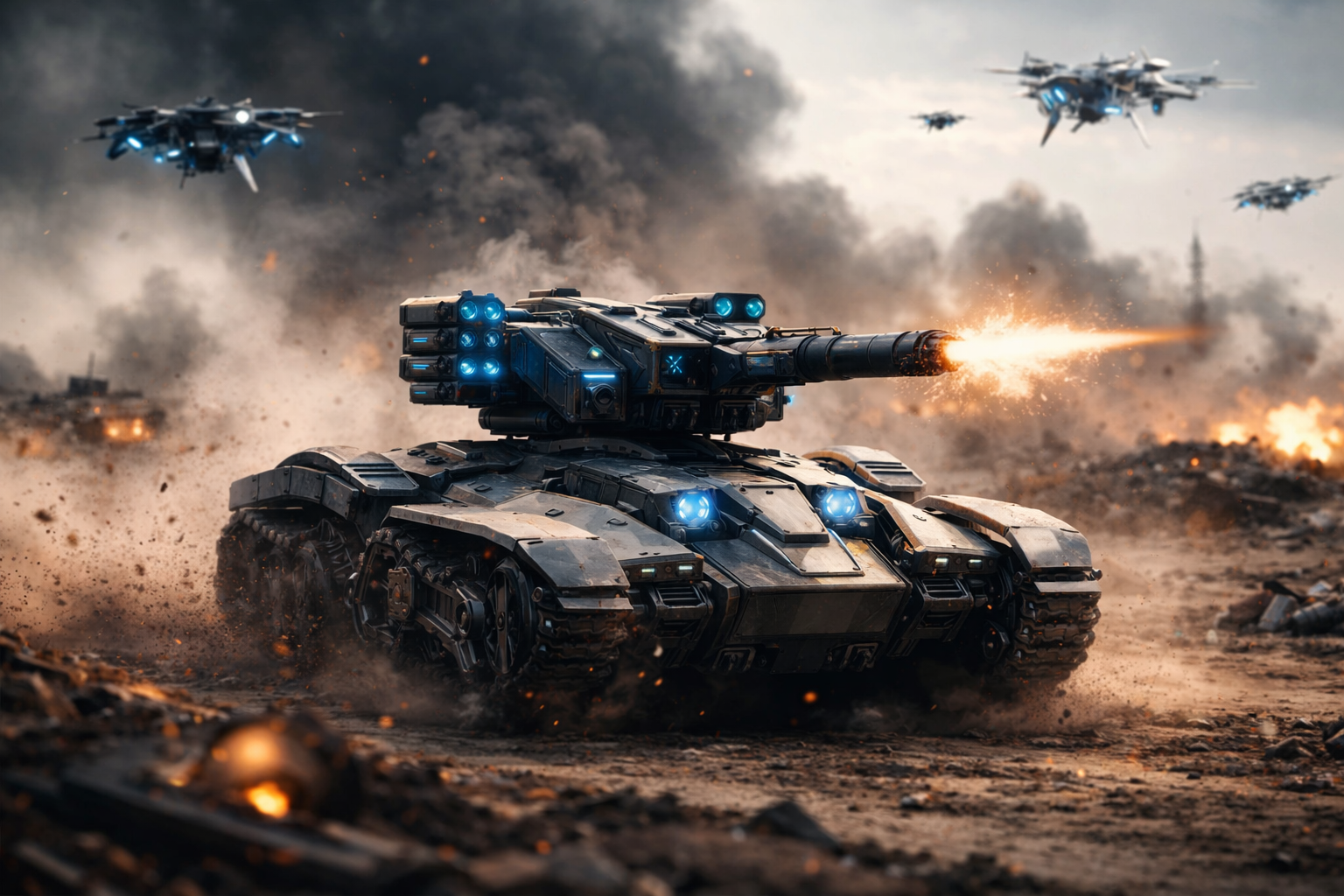
The countries most visibly engaged include the United States, China, Russia, Ukraine, Israel, South Korea, India, Iran, and several European states (notably Germany, Estonia, and Poland). Ukraine and Russia are the only nations currently using armed ground robots in sustained combat. Ukraine, in particular, has fielded hundreds of models and thousands of systems, including small tracked “mini-tanks” like the TW 12.7, which carry heavy machine guns and are remotely operated in combat; some units have even conducted fully unmanned assaults combining ground robots and aerial drones¹. By 2025–2026, Ukraine had integrated UGVs into dozens of units and planned deployments in the tens of thousands, using them for direct fire support, logistics, mine-laying, and casualty evacuation¹².
Russia, while more opaque, is following a similar trajectory with experimental deployment and limited production systems². Meanwhile, Iran unveiled the “Aria” combat robot in 2025, a tracked, AI-assisted system capable of reconnaissance and direct fire missions³. India is pursuing a much heavier concept—essentially an unmanned version of a main battle tank based on the Arjun platform, potentially armed with a 120 mm gun—indicating that true “robot tanks” in the classic sense are under development⁴. European efforts, such as the Rheinmetall–DOK-ING partnership, aim to field modular robotic vehicles that can accompany tanks, carry weapons, or perform support roles, with prototypes expected around 2025–2026⁵. South Korea and Israel are also advancing AI-enabled armed UGVs already tested with military units⁶.
The advantages of removing the crew are profound and explain the global momentum. First, survivability shifts from protecting humans to preserving machines; unmanned systems can be risked in environments—minefields, urban kill zones, heavily surveilled terrain—where crewed tanks would be prohibitively vulnerable. Ukrainian experience shows that UGVs can absorb the “first contact” in assaults, reducing casualties and performing the most dangerous tasks¹. Second, endurance increases dramatically: robots do not fatigue, require rotation, or suffer psychological stress, allowing continuous operation over days or weeks¹. Third, cost curves begin to change. Some Ukrainian combat UGVs cost tens of thousands of dollars rather than millions, enabling mass production and expendability¹. Finally, they enable new tactical combinations with aerial drones and networked sensors, creating integrated robotic formations rather than standalone platforms².
Design differences follow directly from the absence of a crew. Traditional tanks are dominated by the need to house, protect, and sustain humans—crew compartments, life-support systems, escape hatches, and heavy armor concentrated around personnel. Remove that requirement and designers can radically reallocate weight and volume. Unmanned tanks can be smaller, lower-profile, and potentially lighter, though not necessarily lightly armored; designers may redistribute armor to protect critical components like sensors, communications, and weapons rather than human occupants. They may also adopt modular payloads—swappable turrets, missile launchers, electronic warfare packages—rather than a fixed main gun. Electric or hybrid propulsion becomes more attractive because thermal and acoustic signatures matter more than crew comfort. Many current UGVs already use electric drives for stealth and reduced detectability⁷. In short, the “shape” of the tank begins to change from a heavily armored crewed vehicle into a distributed, sensor-rich weapons node.
Guidance is currently a hybrid of remote control, semi-autonomy, and increasing AI assistance. Most operational systems today are teleoperated, often via encrypted radio links, sometimes using mesh networks or relay drones to extend range in contested environments⁷. However, autonomy is advancing quickly. Modern UGV software can perform route planning, obstacle avoidance, and target detection, adapting in real time to battlefield conditions through AI-driven decision support systems⁸. The emerging model is “human-on-the-loop”: operators supervise and authorize lethal actions, while AI handles navigation, coordination, and sensor fusion. In degraded environments (e.g., GPS denial), systems increasingly rely on onboard sensors such as LiDAR, inertial navigation, and computer vision.
An “AI-native tank” would look less like a traditional armored vehicle and more like a node in a distributed combat system. It would be defined by software rather than armor thickness: persistent sensor fusion from drones, satellites, and other vehicles; autonomous navigation across complex terrain; coordinated behavior with other robotic units; and adaptive tactics based on real-time data. Instead of a single tank engaging targets independently, a swarm of smaller robotic vehicles might cooperate—one scouting, another providing fire support, another jamming communications—guided by shared AI systems. The battlefield role thus expands beyond direct fire to include reconnaissance, electronic warfare, logistics, decoy operations, and even psychological effects (as seen when Russian troops reportedly surrendered to unmanned systems)¹.
Prototypes and early systems already hint at this future. Ukraine’s “Droid” and other armed UGVs function as miniaturized tanks with remote turrets¹. Iran’s Aria integrates AI for targeting and reconnaissance³. India’s planned unmanned Arjun variant suggests a heavier, more traditional “robot MBT” path⁴. European programs emphasize modular robotic “wingmen” that accompany crewed vehicles⁵. China has tested heavier autonomous fire-support platforms, indicating interest in scaling up unmanned armor. Collectively, these efforts show two diverging design paths: small, expendable robotic assault vehicles and larger, more capable unmanned tanks.
The evidence from 2025–2026 makes one point unmistakably clear: traditional manned tanks have not disappeared from the Russia–Ukraine war—but their role has been sharply constrained, adapted, and partially displaced by unmanned systems rather than fully replaced by them. In the early phase of the war in 2022, large armored thrusts dominated, with columns of tanks attempting rapid advances. By 2025–2026, that model has largely broken down. The proliferation of inexpensive, ubiquitous drones—especially FPV attack drones—has made open movement by tanks extremely dangerous. As a result, both Russia and Ukraine still use tanks, but more cautiously, often in indirect fire roles or heavily modified for survivability. One adaptation is the so-called “hedgehog tank,” fitted with wire cages or protrusions to disrupt incoming drones, a clear sign that tanks remain in use but must evolve to survive in a drone-saturated environment⁹. In other words, tanks are still present and tactically relevant, but no longer dominant in the way they were in earlier wars.
At the same time, unmanned ground systems are expanding rapidly—but they have not yet replaced tanks as the primary armored force. Instead, they are filling specific niches and increasingly important supporting roles. Both Ukraine and Russia are deploying growing numbers of UGVs for logistics, reconnaissance, electronic warfare, and limited combat missions. These systems are especially valuable in what analysts describe as “kill zones”—areas under constant drone surveillance where human movement is extremely risky¹⁰. Ukrainian brigades, for example, now conduct significant portions of frontline resupply using robotic vehicles, reducing exposure of soldiers to artillery and drone strikes¹¹. In some cases, these systems are paired with aerial drones in tightly integrated operations, with ground robots launching drones, relaying signals, or acting as forward electronic warfare nodes¹².
There are also clear examples of armed, tank-like robotic systems being used in combat, though they remain smaller and less capable than traditional tanks. Ukraine has deployed machine-gun–armed UGVs that can hold positions for extended periods—one reportedly maintained a frontline position for 45 days with only periodic maintenance¹³. Other systems have been used for direct attack, including explosive-laden robots guided into enemy trenches, and coordinated assaults involving dozens of unmanned systems acting together¹⁴. In one striking 2026 incident, Russian soldiers surrendered to an armed Ukrainian ground robot, illustrating both the psychological and tactical impact of these systems¹⁵. Ukraine has also fielded specialized variants such as thermobaric “flamethrower” robots and compact gun platforms resembling miniature tanks, while Russia has experimented with robotic explosive carriers and electronic warfare platforms¹⁶.
Despite these advances, several limitations prevent unmanned “tanks” from becoming dominant—at least for now. Ground robots are still constrained by terrain (they struggle with rubble and obstacles), communications (they rely on vulnerable radio links), and payload capacity compared to full-sized tanks¹². They are often expendable and relatively cheap, but also short-lived, sometimes surviving only a handful of missions¹⁷. As a result, they complement rather than replace tanks. The emerging battlefield structure is hybrid: crewed tanks provide heavy firepower and command presence, while unmanned systems absorb risk, extend reach, and enable new tactics. Analysts increasingly describe this as a transition toward “robotic combined arms,” rather than a wholesale replacement of armored vehicles¹⁸.
The scale of this transition is nonetheless remarkable. Ukraine alone is moving toward industrial-scale production of UGVs—tens of thousands per year—with hundreds of designs already in circulation¹⁹. These systems have demonstrably reduced casualties (by as much as 30% in some reported cases), reinforcing their role as force multipliers rather than replacements²⁰. The war is thus becoming a proving ground for a future in which tanks are only one component of a much larger, networked ecosystem of manned and unmanned systems.
Regarding the question of a U.S.–Israel attack on Iran, there is no credible, verified evidence as of early 2026 that such an attack is underway or that unmanned “robot tanks” are being deployed or staged for such an operation. Open-source reporting and defense analysis indicate that both the United States and Israel are actively developing and testing unmanned ground combat systems, but their operational use—especially in a high-end conflict with Iran—remains speculative. Current doctrine in both militaries emphasizes unmanned systems for reconnaissance, logistics, and specialized missions, often integrated with airpower and cyber capabilities, rather than replacing armored formations outright. If such systems were used in a future conflict, they would likely serve as forward scouts, decoys, or logistics platforms in high-risk environments, much as they are being used in Ukraine today.
The broader conclusion is that we are in a transitional phase rather than a completed revolution. Traditional tanks are still on the battlefield and still matter, but their dominance has been eroded by drones and increasingly by ground robots. Unmanned “tanks” exist, but they are not yet true replacements for main battle tanks; instead, they represent the early stages of a shift toward distributed, AI-enabled ground warfare. The Ukraine war shows what that future looks like in embryonic form: not the disappearance of tanks, but their integration into a larger, more autonomous, and more expendable system of warfare.
References
- “The Evolving Landscape of Military Unmanned Ground Vehicles in the US” — https://theaiinsider.tech/2025/09/13/the-evolving-landscape-of-military-unmanned-ground-vehicles-in-the-us-beyond-ordnance-disposal-in-modern-warfare/
- “The Emerging Role of UGVs” — https://euro-sd.com/2026/03/articles/armed-forces/49643/the-emerging-role-of-ugvs/
- “Iran Aria combat robot” — https://en.wikipedia.org/wiki/Iran_Aria_combat_robot
- “Armoured Vehicle Global Market Report 2025–2029” — https://eco-cdn.iqpc.com/eco/files/event_content/11363018-armoured-vehicle-global-market-report-2025-2029WdI9kuUdSZq1AY5xo6MRlpStA43nRLuBD8CzLP6B.pdf
- “Rheinmetall, Croatia’s DOK-ING eye joint venture for unmanned military vehicles” — https://www.reuters.com/business/aerospace-defense/rheinmetall-croatias-dok-ing-eye-joint-venture-unmanned-military-vehicles-2024-10-28/
- “Setting the Right Heading for UGVs” — https://www.armadainternational.com/2024/08/setting-the-right-heading-for-ugvs/
- “Ukrainian forces turn to unmanned ground vehicles to counter drones” — https://www.lemonde.fr/en/international/article/2025/09/01/ukrainian-forces-turn-to-unmanned-ground-vehicles-to-counter-drones_6744929_4.html
- “ARGUS: A Framework for Risk-Aware Path Planning in Tactical UGV Operations” — https://arxiv.org/abs/2511.07565
- “Russia And Ukraine Adopt New Tactics And Weapons…” — https://www.forbes.com/sites/vikrammittal/2026/02/09/russia-and-ukraine-adopt-new-tactics-weapons-to-defeat-hedgehog-tanks/
- “Russia and Ukraine Deploy Unmanned Ground Vehicles Into ‘Kill Zones’” — https://www.forbes.com/sites/vikrammittal/2025/10/12/russia-and-ukraine-deploy-unmanned-ground-vehicles-into-kill-zones/
- “UGVs Resupplying the Front Line” — https://www.army.mil/article/290022/lets_make_innovative_ideas_ugvs_resupplying_the_front_line
- “Russia And Ukraine Employ Ground Robots To Support Aerial Drone War” — https://www.forbes.com/sites/vikrammittal/2026/02/05/russia-and-ukraine-employ-ground-robots-to-support-aerial-drone-war/
- “Ukraine’s robot army will be crucial in 2026…” — https://www.atlanticcouncil.org/blogs/ukrainealert/ukraines-robot-army-will-be-crucial-in-2026-but-drones-cant-replace-infantry/
- “Ukraine’s Uncrewed Air And Ground Systems Teaming…” — https://oe.t2com.army.mil/product/ukraines-uncrewed-air-and-ground-systems-teaming-marks-a-watershed-moment/
- “Russian soldiers are surrendering to Ukrainian drones and robots” — https://www.forbes.com/sites/davidkirichenko/2026/03/11/russian-soldiers-are-now-surrendering-to-ukrainian-drones-and-robots/
- “Flamethrower robots are now officially a part of Ukraine’s war” — https://www.businessinsider.com/flamethrower-robots-uncrewed-ground-vehicle-officially-approved-ukraine-war-2025-5
- “Ukrainian forces turn to unmanned ground vehicles…” — https://www.lemonde.fr/en/international/article/2025/09/01/ukrainian-forces-turn-to-unmanned-ground-vehicles-to-counter-drones_6744929_4.html
- “From tanks to robotic warfare…” — https://english.elpais.com/international/2026-02-24/from-tanks-to-robotic-warfare-the-transformation-of-the-front-lines-in-ukraine.html
- “Ukraine becomes world leader in unmanned ground vehicles” — https://jamestown.org/ukraine-becomes-world-leader-in-unmanned-ground-vehicles/
- “Networked for War: Lessons from Ukraine’s Ground Robots” — https://mwi.westpoint.edu/networked-for-war-lessons-from-ukraines-ground-robots/
Filed under: Uncategorized |


 Educational Technology and Change Journal

Leave a comment