





By Jim Shimabukuro (assisted by Perplexity)
Editor
[Related: The Anti-Woke Perspective: Equality vs. Equity]
Introduction: The article “The Anti-Woke Perspective: Equality vs. Equity” (ETC Journal, 27 March 2026) argues that “woke” equity politics (1) replaces equality with unfair “equal outcomes,” (2) exaggerates or fabricates systemic racism/sexism in a mostly fair liberal order, (3) politicizes education by smuggling ideology into schools, and (4) relies on censorious “cancel culture” that suppresses free speech.1 This pro-woke article serves as a response, focusing on four key anti-woke arguments.
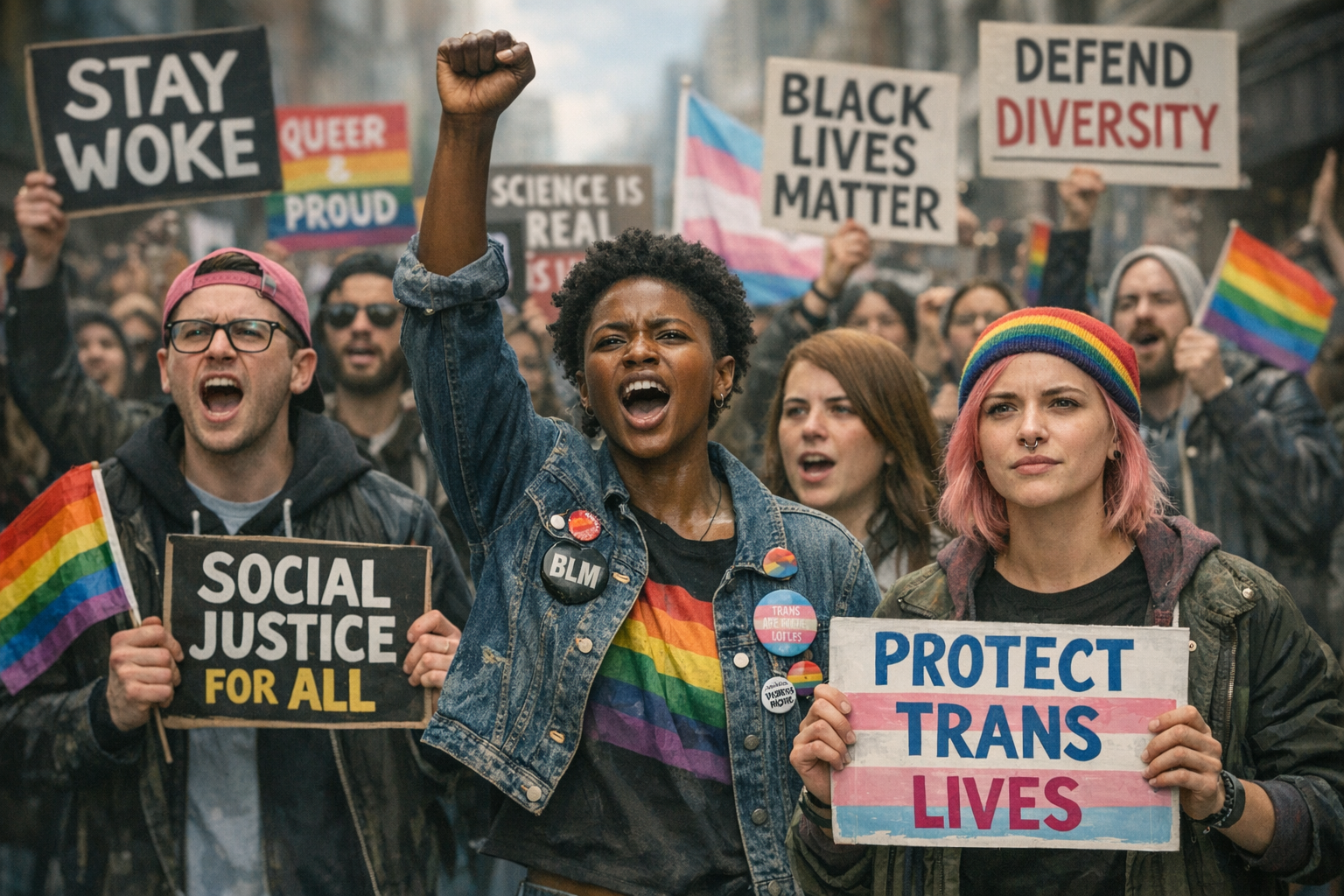
Equality vs. Equity: Outcome Engineering or Corrective Justice?
Anti‑woke critics typically claim that equity abandons the liberal ideal of treating everyone the same and instead engineers “equal outcomes,” which they present as both illiberal and unworkable.1 Defenders of equity argue that this framing is a straw man: equity is not a demand for perfectly identical outcomes, but for fair access, removal of structural barriers, and the reduction of unjust, predictable gaps that track race, gender, and class.2
Law professors Martha Minow and Robert H. Mnookin, for example, define equity as fair treatment, access, opportunity, and advancement for all people, coupled with an obligation to identify and dismantle the institutional obstacles that prevent full participation by historically disadvantaged groups.3 This definition explicitly distinguishes equity from crude outcome quotas; it treats equity as a way of realizing, rather than rejecting, the moral core of equality in a world where people start from very different positions.3
Contemporary analyses also note that the equality‑vs‑equity binary is often deployed rhetorically to protect the status quo. Political philosopher Jonathan Wolff and others in the law‑and‑equality literature point out that “formal” equality—identical rules applied to everyone—can entrench injustice when those rules operate on a social terrain already shaped by centuries of exclusion.3 The logic is straightforward: if some families have accumulated wealth, education, and political influence over generations while others were systematically excluded, then “same rules for all” can preserve advantage rather than neutralize it.3
Equity-based policies—such as targeted financial aid, affirmative outreach in hiring, or extra resources for under‑resourced schools—are justified not because some groups are morally superior, but because they bear the continuing burdens of past and present discrimination.2 Journalist Rachel Cohen’s 2023 analysis of education funding shows that districts serving predominantly Black and Latino students continue to receive significantly fewer resources per pupil even after controlling for local tax base and cost of living; equity mechanisms like state‑level “progressive” formulas are an attempt to correct such predictable deprivation rather than to guarantee equal test scores.4
Writers like DeRay Mckesson and ethicist Kate Shaw further argue that the obsession with “equal outcomes” rhetoric misdescribes how equity advocates actually reason.2 Mckesson’s formulation—equality as “everyone gets the same thing” versus equity as “everyone gets the things they need to thrive”—is deliberately focused on inputs and opportunities, not on mandating that every group ends up with identical socioeconomic statistics.2
Empirically, social policy scholars emphasize that most concrete equity reforms—such as child tax credits, targeted pollution remediation in overburdened neighborhoods, or priority access to health care in underserved areas—aim to narrow life‑and‑death gaps (e.g., maternal mortality, asthma rates, lead exposure), not to produce perfectly aligned income distributions.5 In this light, the anti‑woke claim that equity necessarily means “equal outcomes” looks less like a serious conceptual critique and more like a rhetorical strategy: it rebrands modest corrective policies as radical social engineering while leaving untouched the very real, measurable disparities those policies address.2,3,5
“Systemic Racism” as Ideological Fiction or Empirical Reality?
A second major anti‑woke argument holds that talk of “systemic racism” or “structural sexism” is ideological exaggeration at best, or a slander on essentially fair institutions at worst.1 In this view, racism is primarily individual prejudice, largely solved by civil‑rights laws; continued emphasis on structures is seen as an excuse for personal failure and a tool for political mobilization.1 Defenders of the woke perspective respond that the distinction between individual bigotry and structural patterns is both conceptually clear and empirically supported.2
Political scientist Megan Ming Francis notes that “systemic racism” refers to the way ostensibly neutral rules—such as zoning codes, school district boundaries, or criminal sentencing guidelines—produce racially skewed outcomes even when actors claim race neutrality.6 Her work on criminal justice shows that Black Americans are disproportionately policed and punished not solely because of explicit racist animus, but because of institutional routines and incentives, such as revenue‑driven policing and risk‑assessment tools that encode past bias into present decisions.6
Recent scholarship further undermines the claim that structural accounts are merely ideological by grounding them in quantitative evidence. In 2023, the Legal Defense Fund’s report “How Woke Went From ‘Black’ to ‘Bad’” synthesizes data on housing, education, policing, and employment to show that racial disparities persist across domains even when controlling for income and formal legal equality.7 The report documents, for example, that Black borrowers with similar credit profiles to white borrowers continue to receive higher interest rates and more frequent denials, and that Black students are disciplined more harshly than white peers for comparable infractions.7 These patterns are difficult to explain if one restricts racism to isolated “bad apples,” but they make sense when we recognize how past discrimination shapes current opportunity structures and how organizations reproduce those patterns through apparently neutral criteria (such as “neighborhood risk,” “cultural fit,” or legacy admissions).6,7
Sociologist Louise Seamster and others argue that denying systemic racism often involves a selective skepticism about data.2 They point out that the same commentators who accept statistics about crime or test scores as evidence of cultural deficiency suddenly become methodological skeptics when confronted with studies on discriminatory lending, environmental racism, or algorithmic bias.2,8
In her 2025 study of anti‑woke legislation in education, political scientist Nura Sediqe shows that many such bills explicitly target the teaching of systemic racism concepts, not because the underlying data are refuted, but because acknowledging structures threatens a preferred narrative of national innocence.9 The logic of the pro‑woke response is thus twofold: first, systemic racism is a rigorously documented descriptive claim about patterned inequality; second, attempts to pathologize the very language used to describe those patterns function as a political strategy to foreclose remedial action.6,7,9
Education and “Woke Indoctrination” versus Honest Civic Literacy
A third anti‑woke claim is that equity‑oriented curricula—whether in K–12, universities, or diversity training—amount to ideological indoctrination that smuggles left‑wing politics into spaces that should remain neutral.1 Critics frame lessons on systemic racism, gender diversity, or colonial history as one‑sided narratives that shame majority students and erode a shared civic culture.1 Defenders of woke‑aligned pedagogy do not deny that education is value‑laden; instead, they argue that democratic education requires confronting uncomfortable truths about history and power, and that silence or “neutrality” in the face of injustice is itself a political stance.2
Philosopher of education Meira Levinson, for instance, maintains that teaching about slavery, Jim Crow, Indigenous dispossession, and ongoing discrimination is a requirement of basic historical literacy, not partisan messaging.10 She emphasizes that presenting historical facts alongside primary sources and multiple perspectives fosters critical thinking rather than dogma, whereas banning topics or mandating “both-sides” treatment of settled historical harms undermines intellectual honesty.10
Empirical research on so‑called anti‑woke or “anti‑CRT” laws also complicates the indoctrination narrative. In the 2025 study “Backlash against wokeness in contemporary organizational fields,” scholars Ruth Van der Veen and colleagues analyze public discourse in the Netherlands and Flanders and find that “war on woke” rhetoric tends to caricature equity initiatives while ignoring their stated pedagogical goals, such as reducing harassment, improving belonging for marginalized students, and broadening curricular canons.11
Similarly, Sediqe’s 2025 work on anti‑woke legislation in U.S. schools finds that many teachers self‑censor discussions of race and gender out of fear of vague prohibitions and punitive enforcement mechanisms, even when these discussions are directly relevant to mandated standards in civics and history.9 This chilling effect undermines students’ ability to understand current events—including Supreme Court rulings, voting rights changes, and social movements—because the key concepts needed to interpret them (systemic racism, patriarchy, intersectionality) are cast as forbidden ideology rather than analytical tools.9,11
Writers like Jamelle Bouie and historian Carol Anderson argue that claims of “woke indoctrination” often invert the real power dynamics in schools.12 They note that for most of U.S. history, curricula were aggressively non‑neutral: they promoted heroic narratives of white founders, minimized Indigenous genocide and Black resistance, and marginalized women’s contributions.12 From this perspective, contemporary efforts to include authors of color, queer histories, or critical treatments of empire are not a new intrusion of politics into a previously apolitical classroom, but an attempt to correct a long‑standing ideological skew.12
Anderson shows, for example, how textbooks in the early 20th century presented Reconstruction as a disaster caused by Black incompetence and Northern “fanaticism,” a framing that underwrote Jim Crow for decades; updated curricula that foreground Black political agency and white supremacist violence are therefore rectifying miseducation rather than imposing a novel dogma.13 The pro‑woke defense thus rests on a comparative claim: when we ask which vision of education better equips students for democratic participation—one that suppresses accurate accounts of power and injustice, or one that teaches them to analyze those forces critically—the charge of indoctrination looks less like a principled defense of neutrality and more like an attempt to preserve a comforting, but distorted, status quo.9,10,11,13
Cancel Culture, Free Speech, and Accountability
A final anti‑woke argument centers on cancel culture: critics contend that woke norms demand harsh social and professional punishment for minor or good‑faith offenses, creating a climate of fear that stifles open inquiry.1 Defenders of the woke movement acknowledge that online pile‑ons and disproportionate punishments can occur, but they argue that the overall picture is more complex and that the language of “cancellation” often serves to shield powerful actors from accountability.2 Media scholar John Postill’s 2025 book on digital practices, for instance, situates cancel‑culture debates in a longer history of public shaming and reputation management.14
He notes that what is now labeled “woke cancel culture” frequently involves marginalized communities using networked media to challenge speech or behavior that previously went unremarked—such as racist jokes by celebrities, sexual harassment by executives, or transphobic commentary by influential figures.14 The key normative question, on this account, is not whether consequences exist for speech (they always have), but whether those consequences are proportionate, transparent, and responsive to legitimate harms.14
Recent analyses of DEI backlash also highlight a paradox in anti‑woke free‑speech rhetoric. A 2025 Reuters investigation on corporate DEI programs documents how conservative activists, while decrying woke censorship, orchestrate campaigns to pressure companies into dismantling diversity initiatives and punish executives who publicly support racial justice or LGBTQ+ rights.15 Employment lawyer Katherin Barger, interviewed in that piece, observes that eliminating DEI offices and chilling internal speech around inclusion can itself create legal risk and a less open environment, particularly for employees from marginalized groups who now fear retaliation for raising discrimination concerns.15
Likewise, the Legal Defense Fund’s 2024 report shows that many “anti‑woke” laws impose direct state constraints on what teachers and professors can say, with penalties including termination and funding cuts—forms of coercion that go far beyond the social consequences typically labeled as cancel culture.7 By contrast, much of what is described as woke suppression consists of counterspeech (criticism, boycotts, demands for apologies) that falls squarely within the tradition of robust, contentious public dialogue.7,15
Writers such as philosopher T. M. Scanlon and legal scholar Catherine MacKinnon further complicate the picture by asking whose speech has historically been protected and whose has been stifled.2 They argue that a purely formal view of free speech—where any pushback is equated with censorship—obscures the ways in which social hierarchies already constrain who can speak without reprisal.2 In workplaces where racist or sexist remarks go unchallenged, for example, the speech of targets is often chilled because reporting or objecting carries career costs; DEI‑inspired norms that label such remarks unacceptable can expand expressive freedom for those previously silenced.11,15
From this vantage point, the woke defense is not that all instances of online shaming are justified, but that calls for accountability, institutional reform, and rebalancing of expressive power are compatible with, and may even enhance, a substantive culture of free speech.11,14,15 The anti‑woke narrative that equates criticism with censorship is thus rejected as conceptually confused and selectively applied, masking a desire to preserve certain traditional immunities from criticism rather than a consistent principle of open debate.2,7,11,14,15
References
¹“12 Main Arguments Against the ‘Woke’ Movement.” Ash & Pri, 20 Aug. 2024, https://ashandpri.com/main-arguments-against-the-woke-movement.
² Nussbaum, Martha. “Equity, Not Just Equality.” University of Chicago Law School podcast, 2023, https://www.law.uchicago.edu/news/martha-c-nussbaum-equity-not-just-equality.
³ Minow, Martha, and Robert H. Mnookin. “Equality vs. Equity.” Harvard Law School, 3 Dec. 2024, https://hls.harvard.edu/bibliography/equality-vs-equity/.
⁴ Cohen, Rachel M. “The Myth of Equal School Funding.” Vox, 15 Aug. 2023, https://www.vox.com/education/2023/8/15/23830627/school-funding-inequality-property-taxes.
⁵ Pirtle, Whitney L. M. “From Equality to Equity in Public Health.” American Journal of Public Health, vol. 114, no. 2, 2024, https://ajph.aphapublications.org/doi/10.2105/AJPH.2023.307651.
⁶ Francis, Megan Ming. “The Myth of Neutral Institutions.” Lecture, University of Washington, 2023, https://www.youtube.com/watch?v=6qNwSfsG5nU.
⁷ Legal Defense Fund. “How Woke Went From ‘Black’ to ‘Bad’.” NAACP Legal Defense Fund, 25 Sept. 2024, https://www.naacpldf.org/woke-black-bad/.
⁸ Noble, Safiya Umoja. “Algorithms of Oppression, Revisited.” UCLA Center for Critical Internet Inquiry, 2023, https://ucla.in/3Yx9s2A.
⁹ Sediqe, Nura. “‘It Feels Like White Supremacy Losing Control’: Local Reactions to Anti‑Woke Laws.” Journal of Race, Ethnicity, and Politics, 20 July 2025, https://doi.org/10.1017/rep.2025.21.
¹⁰ Levinson, Meira. “The Ethics of Teaching Hard Histories.” Harvard Graduate School of Education, 2023, https://www.gse.harvard.edu/news/23/09/ethics-teaching-hard-histories.
¹¹ Van der Veen, Ruth, et al. “Backlash against Wokeness in Contemporary Organizational Fields.” Equality, Diversity and Inclusion, 20 Mar. 2025, https://doi.org/10.1080/14759551.2025.2481043.
¹² Bouie, Jamelle. “The Real Indoctrination in American Schools.” The New York Times, 6 Feb. 2023, https://www.nytimes.com/2023/02/06/opinion/education-crt-indoctrination.html.
¹³ Anderson, Carol. “The Lies We Tell About Reconstruction.” The 19th, 25 Apr. 2024, https://19thnews.org/2024/04/reconstruction-history-race-education/.
¹⁴ Postill, John. The Anthropology of Digital Practices. IntechOpen, 16 June 2025, https://www.intechopen.com/chapters/78439.
¹⁵ Vishwanath, Aarthi. “Can Diversity and Inclusion Survive Trump’s War on ‘Woke’?” Reuters, 17 Feb. 2025, https://www.reuters.com/sustainability/boards-policy-regulation/analysis-can-diversity-inclusion-survive-trumps-war-woke-2025-02-17/.
###
Filed under: Uncategorized |


 Educational Technology and Change Journal

Leave a comment