




By Jim Shimabukuro (assisted by Grok, Copilot, Gemini, DeepSeek)
Editor
[Related: Response to ‘The Anti-Woke Perspective’]
Christopher F. Rufo
[GROK] Christopher F. Rufo, a filmmaker turned senior fellow at the Manhattan Institute and a leading figure in exposing critical race theory and diversity, equity, and inclusion (DEI) programs in American institutions, published the essay “DEI and the ‘Lost Generation’” in December 2025, in which he dissects how woke-driven policies have engineered a systematic purge of white millennial men from elite sectors like media, academia, publishing, and entertainment during the “Great Awokening” of 2014–2024. Rufo traces the roots of this discrimination to mid-1960s affirmative action, which he describes as “a euphemism for anti-white-male discrimination,” and demonstrates its acceleration under woke frameworks through stark statistical declines, such as white men falling from 48 percent to 11.9 percent of lower-level TV writers between 2011 and 2024 or comprising just 7.7 percent of Los Angeles Times internships since 2020.
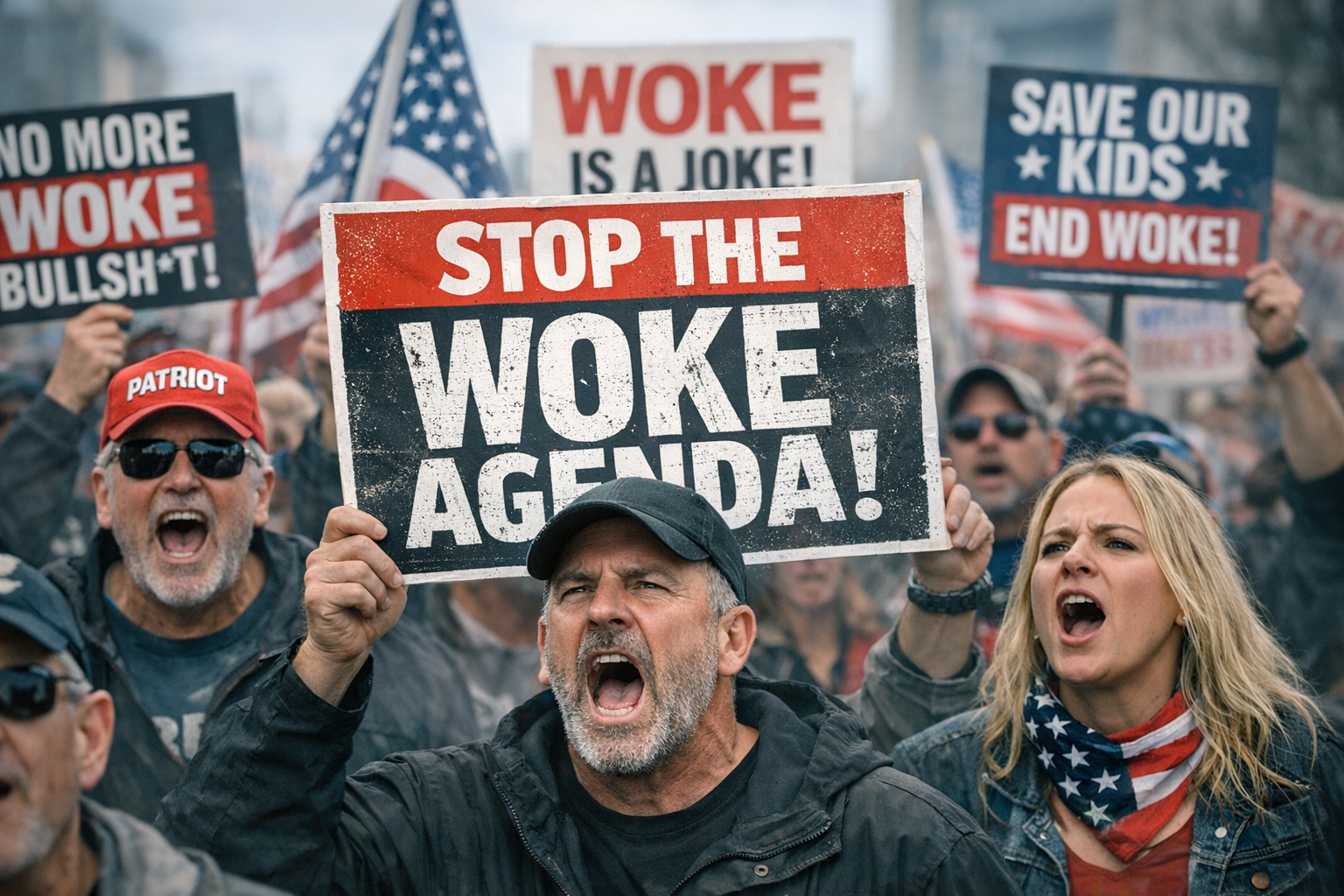
Rufo’s strongest arguments against woke adversaries center on their hypocrisy and denialism: once aggressive in labeling any criticism of DEI as racist or immoral, progressives now feign ignorance as the backlash mounts, with Rufo observing that “the Left spent the ‘woke’ era denying the basic facts about DEI, but now they are starting to admit it…with a heavy dose of feigned ignorance” and that “anyone who has spent time in these institutions knew it all along” while the “risk calculus” has simply shifted. This framing exposes woke ideology not as a benign push for equity but as a calculated power grab that has hollowed out meritocracy, incentivized racial fraud in contracting, and produced a generation of sidelined talent, thereby validating anti-woke calls to restore color-blind standards as a moral and practical imperative for institutional renewal. 1
[COPILOT] Christopher F. Rufo’s “America’s Cultural Revolution: How the Radical Left Conquered Everything” (2023) tells a different origin story, locating wokeness in the long march of neo‑Marxist and critical‑race theorists through American institutions. In a promotional excerpt, Rufo declares that “there is a rot spreading through American life,” a “new nihilism” that now surrounds ordinary citizens “in all of the institutions that matter: his government, his workplace, his church, his children’s school, even his home.”5 The book, as one academic review puts it, is “a history of the spread of neo‑Marxism in the United States culminating with an examination of Critical Race Theory,” tracing how ideas once “well outside the public sphere” became “conventional wisdom today.”16
Rufo profiles figures such as Herbert Marcuse, Angela Davis, Paulo Freire, and Derrick Bell, arguing that they fused Marxist categories with racial and cultural grievances to create an ideology that “replaced ‘equality’ with ‘equity’” and recast the United States as a “system of white supremacy” requiring race‑based redistribution administered by “diversity and inclusion commissars.”5 In a Fox News excerpt from the book, he uses Aleksandr Solzhenitsyn’s denunciation of Angela Davis to dramatize what he sees as the moral core of the problem: a revolutionary politics that “sacrific[es] the human being in service of ideology,” willing to excuse repression and imprisonment so long as it is carried out in the name of liberation.4
Rufo’s strongest argument is genealogical and institutional: he contends that the pamphlets of the Weather Underground and Black Liberation Army have been “sanitized and adopted as the official ideology of America’s prestige institutions,” from Ivy League universities to corporate boardrooms, and that this ideological capture explains why DEI bureaucracies, racial affinity groups, and “equity” mandates have become so entrenched.5,19 Where Hanania targets law, Rufo targets the intellectual and activist networks that, in his telling, turned civil‑rights ideals into a permanent cultural revolution.
Coleman Hughes
[GROK] Coleman Hughes, the writer, podcaster, and host of Conversations with Coleman who has emerged as one of the clearest voices advocating color-blind public policy, advanced his critique in the January 2025 Substack essay “The End of DEI,” which celebrates and analyzes President Trump’s Executive Order 14171 as a decisive strike against race-based preferences that have warped hiring, promotion, and training across society. Hughes, drawing on his own book The End of Race Politics, argues that modern DEI has perverted the original civil rights vision by replacing efforts to stop discrimination against Black Americans with mandates to discriminate in their favor, creating a “racial spoils system” that fosters fraud and distorts merit.
He underscores this with historical precision, noting that “the phrase affirmative action…has come to have a profoundly different meaning for us than it did during the 1960s civil rights era,” when it meant simply ceasing discrimination rather than enforcing quotas, and that Senator Hubert Humphrey promised during the 1964 Civil Rights Act debate to “eat the entire bill page by page” if it required preferential hiring by percentages.
Hughes’s most potent claims against woke adversaries highlight the immorality and self-undermining nature of their project: DEI “infuses race into hiring, promotion, and training in an immoral and discriminatory way,” generating “incentives for business owners to commit racial fraud, or else to legally restructure so as to be technically ‘minority-owned,’” while public referendums and the unpopularity of quotas reveal widespread rejection of its core tenets. By aligning Trump’s order with the true intent of color-blind civil rights—“we will forge a society that is color-blind and merit-based”—Hughes demonstrates that woke ideology betrays its own professed goals, entrenching division and mediocrity where genuine equality once promised unity.2
Thomas Chatterton Williams
[GROK] Thomas Chatterton Williams, a nonresident fellow at the American Enterprise Institute and an accomplished essayist known for his incisive writings on race, identity, and culture, delivered a pointed examination of woke discrimination’s ideological underbelly in his December 2025 AEI op-ed “The Other Way the ‘Super Woke’ Left Discriminates.” Williams, himself a mixed-race Millennial who has benefited from some post-2014 trends yet suffered professionally for dissenting views, contends that elite gatekeepers in media, publishing, and academia do not elevate minorities or women indiscriminately but only those who parrot progressive orthodoxies on topics like police abolition, pronouns, and systemic privilege.
He illustrates this through a predictable four-step cycle of progressive response to criticism—denial, minimization, reframing as positive, and blaming the critic—while recounting personal experiences of ostracism, rescinded opportunities, and explicit rejection because “my views…did not align with the kind of Black perspective that presses wanted to publish.” Williams’s strongest arguments against woke adversaries expose the conditional and coercive nature of their identity politics: “being Black (or any number of protected identities) affords you special privileges only if you think and speak how gatekeepers believe you’re supposed to,” resulting in a landscape where heterodox Black intellectuals like Coleman Hughes or the late Stanley Crouch are sidelined despite talent, while conformity trumps race or gender.
He further notes that “if minorities were simply elevated tout court…one would expect to find at least a modicum of parity at elite institutions between young Black intellectuals who criticize modern progressivism and those who embrace it,” yet the absence of such parity proves ideology, not identity, dictates access. This analysis reveals woke ideology as a new form of litmus-test authoritarianism that punishes independent thought even among its supposed beneficiaries, reinforcing the anti-woke case that true pluralism demands rejecting such ideological gatekeeping in favor of open debate and individual merit.3
Richard Hanania
COPILOT: Richard Hanania’s book “The Origins of Woke” (2023) is probably the most explicit attempt to define wokeness as a legal‑bureaucratic system rather than a vague cultural mood. In a widely circulated summary of the book, he is quoted as defining wokeness through three core tenets: “The belief that disparities equal discrimination,” “speech restrictions,” and “human resources (HR) bureaucracy.”1 The first, he argues, treats “practically any disparity that appears to favor men over women, or whites over non‑whites” as the product of discrimination, while disparities that favor women or non‑whites are “either ignored or celebrated.”1
The second and third tenets follow from the first: if disparities are presumptively unjust, then speech that questions that premise must be restricted, and a permanent HR apparatus must police organizations to enforce “correct thought and action.”1 Hanania’s central claim is that this regime did not arise primarily from radical intellectuals but from the unintended consequences of U.S. civil‑rights law, especially the Civil Rights Act of 1964 and its later extensions. Reviewers note that he presents wokeness as a “byproduct of well‑intended legislation,” a kind of “shadow constitution” in which anti‑discrimination rules gradually override older liberal norms like freedom of association and the presumption of innocence.1,3
From this perspective, the strongest anti‑woke argument is not just cultural complaint but a legal one: as long as civil‑rights enforcement is interpreted to require statistical parity and to punish “disparate impact,” institutions will be compelled to adopt DEI bureaucracies, speech codes, and preferential policies, regardless of public opinion. The book’s most provocative claim is that rolling back this legal architecture—rather than fighting symbolic culture‑war skirmishes—is the only realistic way to weaken wokeness at its root.2,3
Yascha Mounk
[COPILOT] Yascha Mounk’s “The Identity Trap: A Story of Ideas and Power in Our Time” (2023) is often grouped with anti‑woke literature, though Mounk writes as a self‑described liberal rather than a conservative. He prefers the term “identity synthesis” for the ideology often called wokeness, and defines it as a set of ideas that “prioritize identity categories over individual agency,” advocating policies and norms that “reinforce group‑based distinctions.”24 In an excerpt published by the Harvard Gazette, Mounk illustrates what he calls the “identity trap” through the story of Eboo Patel, who, after encountering concepts like “institutionalized racism” and “structures of oppression,” came to see “the entire world through that lens” and concluded that “racism permeated everything” and that his “principal identity was as a victim of racism.”22
For Mounk, the trap lies in how this worldview can obscure genuine privilege and opportunity, encourage a censorious moralism, and reduce people to their marginalization. He traces the intellectual roots of the identity synthesis to postmodernism, postcolonial theory, and critical race theory, but his main target is its practical impact: he argues that it leads to “a rigid understanding of social justice that discourages open debate and reinforces social divisions,” in contrast to liberal universalism, which seeks to “address inequality while preserving free speech and democratic norms.”24
The book’s strongest anti‑woke claim is that identity‑centered politics, even when motivated by concern for the marginalized, ultimately undermines the very possibility of a shared civic project. Against calls for race‑segregated spaces, speech policing, and the sacralization of subjective harm, Mounk defends “the case for integration,” “the joys of mutual influence,” and the imperative to “speak freely” as the only sustainable path to equality in diverse democracies.23,25
[GEMINI] Yascha Mounk, a political scientist who gained significant attention with his 2023 book The Identity Trap, argues that the current focus on identity is a strategic and moral error for modern democracies. Mounk posits that the “identity synthesis”—his term for the collection of ideas stemming from postmodernism and critical race theory—encourages people to see themselves primarily as members of a group rather than as individuals. He contends that this shift “encourages all of us, including white people, to ‘embrace our racial identity’ in a way that will actually undercut solidarity between different groups.”¹
#Mounk’s core argument is that by abandoning universalist principles, the movement creates a “political trap” that inadvertently fuels right-wing populism while making it harder for progressive institutions to fulfill their missions. He asserts that a “true sense of belonging in society cannot come from being primarily understood and seen as a function of the groups into which we were born,” emphasizing that human progress has historically relied on the “unwavering defense of precisely what the identity synthesis breaks with—universal liberal principles.”²,³
Eric Kaufmann
[COPILOT] Eric Kaufmann’s “The Third Awokening” (2024) offers a more data‑driven, sociological critique of wokeness, which he conceptualizes as part of a broader phenomenon of “cultural socialism.” A major review in the National Association of Scholars summarizes his definition of woke as “the sacralization of historically‑marginalized identity groups,” an ideology that “prioritizes equal outcomes and psychological harm‑protection for marginalized identity groups above competing values,” producing “free speech limitations and ‘cancel culture,’ as well as deculturation signified by the toppling of public statuary and vandalization of historic buildings.”13
Kaufmann distinguishes his approach from more conspiratorial accounts by emphasizing that wokeness is embedded in “the usually unexamined taboos of progressive polite society” rather than in a cabal of revolutionaries, and he supports his claims with “over sixty charts, graphs, and graphics” drawn from political‑science and social‑psychology research, much of it his own.13 His strongest argument against wokeness is empirical: he shows how attitudes associated with what he calls “cultural socialism”—such as support for speech restrictions to protect minorities from offense, or for removing historical monuments—are concentrated among highly educated, younger, urban progressives, and how these groups have disproportionate influence in universities, media, and professional organizations.
This, he argues, explains why institutional norms have shifted toward DEI mandates and speech codes even when broader publics remain attached to more traditional liberal values. Kaufmann also advances a “vision of a post‑woke world” and a “12‑point plan” for getting there, which includes strengthening academic freedom laws and reasserting liberal‑democratic principles against both identitarian left and populist right.13 In his hands, the anti‑woke case is less a moral jeremiad than a political‑sociological diagnosis of how a minority ideology captured key cultural levers.
Andrew Doyle
[COPILOT] Andrew Doyle’s “The End of Woke: How the Culture War Went Too Far and What to Expect from the Counter‑Revolution” (2025) is a polemical but philosophically self‑aware reflection on the rise and (possible) fall of wokeness. A review in Compact magazine notes that Doyle’s “central argument is simple but too often missed: ‘Wokeness is not an extension of liberalism; it is its opposite.’”12 Doyle catalogues what he sees as the “absurdities” of the era—“compulsory pronouns, the protest theater, the police knocking at the door to ‘check your thinking’”—to argue that woke movements “cloaked themselves in the language of liberal tolerance, inclusion, and anti‑racism,” but that this was “only ever a ruse.”12
What distinguishes wokeness, he insists, is its “authoritarian aspect”: it “demanded not moral agreement, but ideological submission.”12 Yet Doyle’s most interesting move is to turn this critique back on some of his own anti‑woke allies. As the publisher’s description puts it, he warns that “in a desperate power struggle to re‑assert liberal values, some leaders of the anti‑woke movement have found themselves adopting a different kind of authoritarian approach—one which also promotes censorship and erodes our freedoms,” and he argues that “replacing one form of tyranny with another will not end the culture wars.”15
The book’s strongest claim, then, is that the only coherent anti‑woke position is a recommitment to “true liberalism”—the Enlightenment tradition of free speech, due process, and individual rights—which must resist authoritarian temptations “wherever [they] emerge,” whether in DEI bureaucracies or in state‑driven “anti‑woke capitalism” laws.12,14,15 In this sense, Doyle’s work functions both as an indictment of woke excesses and as a cautionary tale about how easily anti‑woke politics can mirror the illiberalism it opposes.
Nellie Bowles
[GEMINI] Journalist Nellie Bowles provides a more ethnographic and personal critique in her 2024 book Morning After the Revolution: Dispatches from the Wrong Side of History. Bowles, a former New York Times reporter, documents the practical and often chaotic consequences of “New Progressivism” in American cities and newsrooms. She highlights the “suffocating impact of groupthink” and the “self-destructive excesses” of movements like Defund the Police and certain DEI initiatives.⁸ Bowles’s method is “death by quotation,” allowing the movement’s most extreme proponents to speak for themselves, which she argues reveals a “chronological snobbery” where any notion of truth is “inherently fluid.”⁹ Her reporting on the Capitol Hill Autonomous Zone (CHAZ) and various “whiteness” workshops suggests that the movement has replaced objective justice with a “worldview that can never work” because it misunderstands the human condition and demands a “rabid resistance to internal diversity.”¹⁰
Lionel Shriver
[GEMINI] In the realm of satirical fiction, Lionel Shriver’s 2024 novel Mania offers a speculative exploration of where these ideological trends might lead. Shriver imagines a world where the “Mental Parity movement” has made the concept of intelligence a taboo, outlawing IQ tests and exams in the name of egalitarianism. In this world, “everyone is equally smart” and to suggest otherwise is a “hate crime punishable by professional ruin.”¹¹ Through this allegory, Shriver attacks what she views as the “policing of opinion and intellect” and the “dystopia” that results when meritocracy is discarded for “woke language” and “tone policing.”¹² Shriver’s work serves as a warning that the obsession with removing all forms of “elitism” eventually results in a “brain drain” and the “tyrannical power” of mediocrity, where the pressure to conform overrides the pursuit of excellence.¹³
Douglas Murray
[GEMINI] Douglas Murray has remained a prominent voice through 2025 and 2026, delivering lectures and articles that frame “anti-woke” sentiment as a necessary defense of Western civilization. Murray warns against a “self-criticism [that] turns into self-laceration, then self-hatred, and eventually… self-destruction.”¹⁴ He critiques “victimhood culture” and argues that the current “war against the West” involves a selective rewriting of history that ignores the West’s unique role in developing “principles and practice of political liberty, of freedom of thought… and of freedom of speech.”¹⁵,¹⁶ Murray asserts that the “woke anti-racist obsession” often leads to a “necrophilic boast of the adoration of death” in foreign policy contexts, contrasting this with a “willingness to fight for life” and for the values that built the modern world.¹⁷
Nigel Biggar
[DEEPSEEK] The British theologian and ethicist Nigel Biggar emerged as one of the most formidable anti-woke intellectuals during this period, leveraging his academic credentials from Oxford to launch a two-pronged assault on progressive historiography and contemporary academic culture. Biggar, who prior to 2023 was little known outside the United Kingdom, gained prominence through his 2023 book “Colonialism: A Moral Reckoning,” in which he dared to weigh the ethical complexities of the British Empire against the prevailing academic consensus of total moral repudiation. His subsequent work, “The New Dark Age: Why Liberals Must Win the Culture Wars” (2026), represents a polemical distillation of his arguments, directed specifically at the pathologies he sees plaguing Western academia.
Biggar defines liberalism not in its contemporary progressive guise, but as “the idea that a free marketplace of ideas is the best way of testing and correcting prevailing orthodoxies,” and he argues that the woke left poses a direct threat to this conception of open society. Central to his critique is the left’s tendency to divide society into oppressor and oppressed categories, which, he writes, “permits the self-styled champions of the ‘oppressed’ to shield themselves from any criticism and rational accountability. And it legitimates the no-holds-barred use of coercive power to silence opponents. This amounts to a recipe for tyranny.” Biggar systematically catalogues what he terms the “vices” of left-wing academics, including “playing the man, not the ball,” “pulling rank,” “misrepresentation,” and “setting up a straw man,” arguing that these tactics have replaced genuine scholarly engagement.
In one striking passage, he observes that “those on the ‘progressive’ left seldom get as far as disagreeing, since they are determined not to listen in the first place.” Biggar’s broader project is to expose the intellectual dishonesty he finds pervasive in academic discourse, exemplified by his critique of historians who use loaded language to describe European imperialism while employing sanitized terms like “drew people into their orbit” when describing Mesoamerican empires. His solution is a recommitment to institutional courage, arguing that university leaders must model appropriate behavior by defending the search for truth unhindered by the political dogmas of DEI, gender ideology, or decolonialism.1
David Horowitz
[DEEPSEEK] David Horowitz, a longtime veteran of America’s culture wars and a New York Times bestselling author, published “The Radical Mind: The Destructive Plans of the Woke Left” in 2023, a work that synthesizes decades of anti-left critique into a stark warning about the existential threat he believes wokeness poses to American democracy. Horowitz frames the crisis facing the nation as fundamentally a “crisis of faith—faith in the Constitution that has shaped our destiny, faith in individual freedom and accountability, faith in the principle of equality before the law.” For Horowitz, the stakes could not be higher: “Nothing less than the American way of life and the liberty and freedoms all Americans enjoy” are at risk.
His book attempts to “pull back the curtain of secrecy and lies” to expose what he characterizes as the dangerous methods and agendas of a “woke left mob.” Horowitz’s specific targets include what he sees as radical efforts to “debase Judeo-Christian values,” promote “false racist narratives that America is a racist country,” and transform the Democratic Party into an entity that has made “dialogue, compromise, and bipartisanship impossible.” His arguments are organized around a series of prescriptions for renewal: defending families against ideological intrusion, protecting religious communities, rejecting progressive narratives about race, and renewing faith in constitutional principles.
Horowitz’s credibility within anti-woke circles stems from his long history as a former leftist radical who underwent a celebrated political conversion, lending his critiques the perceived authenticity of someone who claims to have seen the destructive potential of leftist ideology from the inside. His work in this period represents a culmination of themes he has developed over decades, now reframed explicitly around the concept of wokeness as the latest iteration of a perennial radical threat to American institutions.3
Wanjiru Njoya
[DEEPSEEK] The Kenyan legal scholar Wanjiru Njoya, a research fellow at the Mises Institute, offered a distinctive contribution to anti-woke literature in 2026 by challenging the thesis that capitalism and wokeness are causally linked. Writing in response to conservative critics who argued that free markets inevitably produce progressive social outcomes, Njoya’s essay “Capitalism Is Not To Blame For Wokeness” (2026) advanced a nuanced defense of market principles against what she termed “terminological” critiques.
Njoya engaged directly with the argument that capitalism’s emphasis on the sovereign individual and consumer choice creates conditions favorable to identity politics, citing the example of a man who claims to be a woman on the grounds that “who are you to tell me otherwise?” While acknowledging the intuitive appeal of this critique, Njoya insisted on the distinction between voluntary exchange—the essence of genuine capitalism—and the coercive enforcement mechanisms that actually characterize woke policies. She argued that “a forced exchange—the baker being forced to bake cakes against his will—surely cannot be blamed on capitalism, which is based on voluntary exchange.”
However, Njoya went beyond mere terminological defense, acknowledging that such arguments often fail to persuade because “answering critics of capitalism by simply pointing out that their definitions are wrong” can appear as deflection. She conceded a deeper problem: that many self-proclaimed defenders of capitalism themselves promote “open borders, mass immigration, feminism, equality laws,” thereby lending credence to the idea that these policies are inherent to market liberalism. Njoya’s more sophisticated contribution lies in her recognition that the capitalism-wokeness debate is not merely semantic but reflects genuine tensions within liberal thought about the relationship between markets, tradition, and social cohesion.
She observed that many conservatives see market mechanisms as eroding the incentive “to care about other people and to avoid antisocial behavior,” precisely because the market allows ostracized individuals to “still buy their daily bread.” Rather than resolving these tensions, Njoya argued that defenders of capitalism must accept that the system does not answer “questions about what moral, religious, or social values one ought to uphold,” a point she traced to Ludwig von Mises’s insistence that “liberalism does not purport to be a theory of everything.” This argument positioned Njoya as a distinctive voice who could critique wokeness while simultaneously rejecting the tendency among some conservatives to blame capitalism itself for progressive cultural shifts.2
References
Grok
1 Rufo, Christopher F. “DEI and the ‘Lost Generation’.” christopherrufo.com, December 20, 2025, https://christopherrufo.com/p/dei-and-the-lost-generation.
2 Hughes, Coleman. “The End of DEI.” colemanhughes.substack.com, January 26, 2025, https://colemanhughes.substack.com/p/the-end-of-dei.
3 Williams, Thomas Chatterton. “The Other Way the ‘Super Woke’ Left Discriminates.” aei.org, December 24, 2025, https://www.aei.org/op-eds/the-other-way-the-super-woke-left-discriminates/.
Copilot
1 Graham Seibert, “The Origins of Woke,” Substack (October 4, 2023), https://grahamseibert.substack.com/p/the-origins-of-woke (grahamseibert.substack.com in Bing)
2 “The Origins of Woke – Summary,” Bookey (2023), https://cdn.bookey.app/book/the-origins-of-woke-richard-hanania.pdf (cdn.bookey.app in Bing)
3 Oliver D. Smith, “Book Review: The Origins of Woke (Broadside Books, 2023),” ResearchGate preprint (2024), https://www.researchgate.net/publication/376035046_Book_Review_The_Origins_of_Woke_Broadside_Books_2023 (researchgate.net in Bing)
4 Christopher F. Rufo, “‘America’s Cultural Revolution’: How the radical left conquered our culture,” Fox News excerpt (July 18, 2023), https://www.foxnews.com/opinion/americas-cultural-revolution-how-radical-left-conquered-our-culture (foxnews.com in Bing)
5 Manhattan Institute, “America’s Cultural Revolution: How the Radical Left Conquered Everything,” press page (2023), https://manhattan.institute/article/americas-cultural-revolution (manhattan.institute in Bing)
6 Alexander Robbin Marks‑Katz, “Book Review: Christopher F. Rufo. America’s Cultural Revolution: How the Radical Left Conquered Everything,” Bound Away: The Liberty Journal of History 6:2 (2024), https://digitalcommons.liberty.edu/ljh/vol6/iss2/7
7 Yascha Mounk, “Book excerpt: ‘The Identity Trap’,” Harvard Gazette (December 19, 2023), https://news.harvard.edu/gazette/story/2023/12/book-excerpt-the-identity-trap-by-yascha-mounk (news.harvard.edu in Bing)
8 Yascha Mounk, “The Identity Trap: A Story of Ideas and Power in Our Time,” Penguin Random House excerpt (2023), https://www.penguinrandomhouse.com/books/688957/the-identity-trap-by-yascha-mounk/excerpt (penguinrandomhouse.com in Bing)
9 “The Identity Trap,” Wikipedia (last updated 2024), https://en.wikipedia.org/wiki/The_Identity_Trap (en.wikipedia.org in Bing)
10 Jacob Williams, “The Rise of ‘Woke’: Is Kaufmann’s Account the Best?,” National Association of Scholars (Review of Eric Kaufmann, The Third Awokening, 2024), https://www.nas.org/blogs/article/the-rise-of-woke-is-kaufmanns-account-the-best (nas.org in Bing)
11 Ashley Frawley, “Woke Lost, but Freedom Didn’t Win,” Compact (Review of Andrew Doyle, The End of Woke, May 30, 2025), https://compactmag.com/article/woke-lost-but-freedom-didn-t-win (compactmag.com in Bing)
12 “The End of Woke: How the Culture War Went Too Far and What to Expect from the Counter‑Revolution,” publisher page (2025), https://www.barnesandnoble.com/w/the-end-of-woke-andrew-doyle/1144690280 (barnesandnoble.com in Bing)
13 Stephen Masterson, “Anti‑Wokeism and the Rise of Identitarian Regulation,” The Regulatory Review (December 26, 2024), https://www.theregreview.org/2024/12/26/masterson-anti-wokeism-and-the-rise-of-identitarian-regulation (theregreview.org in Bing)
Gemini
1 Yascha Mounk, “The Identity Trap: A Story of Ideas and Power in Our Time,” Next Big Idea Club (October 2023). https://nextbigideaclub.com/magazine/identity-trap-story-ideas-power-time-bookbite/45829/
2 “The Identity Trap,” Wikipedia (March 2026). https://en.wikipedia.org/wiki/The_Identity_Trap
3 “Review: The Identity Trap by Yascha Mounk,” World Literature Today (May 2024). https://worldliteraturetoday.org/2024/may/identity-trap-story-ideas-and-power-our-time-yascha-mounk
4 “The End of Race Politics Summary,” Blinkist (2024). https://www.blinkist.com/en/books/the-end-of-race-politics-en
5 Sean Jacobs, “The End of Race Politics Review,” SeanJacobs.com.au (September 2024). https://www.seanjacobs.com.au/the-end-of-race-politics/
6 “SNQ: Coleman Hughes’s The End of Race Politics,” Words and Dirt (February 2024). https://www.words-and-dirt.com/words/snq-coleman-hughess-the-end-of-race-politics/
7 Coleman Hughes, “The End of Race Politics,” Penguin Random House (2024). https://www.penguinrandomhouse.com/books/712340/the-end-of-race-politics-by-coleman-hughes/
8 Rachel Cooke, “Morning After the Revolution by Nellie Bowles review,” The Guardian (May 2024). https://www.theguardian.com/books/article/2024/may/19/morning-after-the-revolution-dispatches-from-wrong-side-of-history-by-nellie-bowles-review
9 “Review: Morning After the Revolution by Nellie Bowles,” The Gospel Coalition (May 2024). https://www.thegospelcoalition.org/reviews/morning-after-revolution/
10 “Morning After the Revolution review: a bad faith attack on ‘woke’,” The Guardian (May 2024). https://www.theguardian.com/books/article/2024/may/11/morning-after-the-revolution-review-nellie-bowles
11 “Mania by Lionel Shriver Review,” The Mallard (May 2024). https://mallarduk.com/2024/05/mania-by-lionel-shriver-book-review/
12 “Mania by Lionel Shriver,” Goodreads (April 2024). https://www.goodreads.com/book/show/199618154-mania
13 Lionel Shriver, “Mania,” HarperCollins (2024). https://www.harpercollins.com/products/mania-lionel-shriver
14 “Douglas Murray Discusses the West at Buckley Event,” Buckley Beacon (November 2025). https://buckleybeacon.com/2025/11/07/douglas-murray-discusses-the-west-criticizes-its-self-destruction-at-buckley-event/
15 “A warning against woke and a call to defend the West,” Catholic World Report (December 2022/Update 2023). https://www.catholicworldreport.com/2022/12/11/a-warning-against-woke-and-a-call-to-defend-the-west/
16 “Douglas Murray Delivers 2025 Rabbi Allan Mirvis Lecture,” Yeshiva University (April 2025). https://www.yu.edu/news/straus/jews-israel-and-future-freedom-douglas-murray-delivers-2025-rabbi-allan-mirvis-lecture
17 Douglas Murray, “The War on the West,” HarperCollins (Latest articles and updates 2023-2026). https://www.harpercollins.com/products/the-war-on-the-west-douglas-murray
DeepSeek
1 Carson Jerema, “Resist the dark age of wokeness,” Yahoo News Canada, March 23, 2026. https://ca.news.yahoo.com/carson-jerema-resist-dark-age-184015123.html
2 Wanjiru Njoya, “Capitalism Is Not To Blame For Wokeness,” Tipp Insights, February 20, 2026. https://tippinsights.com/capitalism-is-not-to-blame-for-wokeness/
3 David Horowitz, “The Radical Mind: The Destructive Plans of the Woke Left,” Humanix Books, 2023. https://cambridge.minlib.net/Hoopla/16339021
###
Filed under: Uncategorized |


 Educational Technology and Change Journal

Leave a comment