




By Jim Shimabukuro (assisted by ChatGPT)
Editor
Processing massive amounts of data at extraordinary speed and detecting patterns beyond human perception is indeed one of the core power asymmetries between AI and humans, but current research suggests it is only one part of a broader cluster of advantages that, together, constitute AI’s real “power profile.” Contemporary literature consistently frames AI not as superior in a single dimension, but as dominant across a system of capabilities: speed, scale, consistency, and integration.1,2
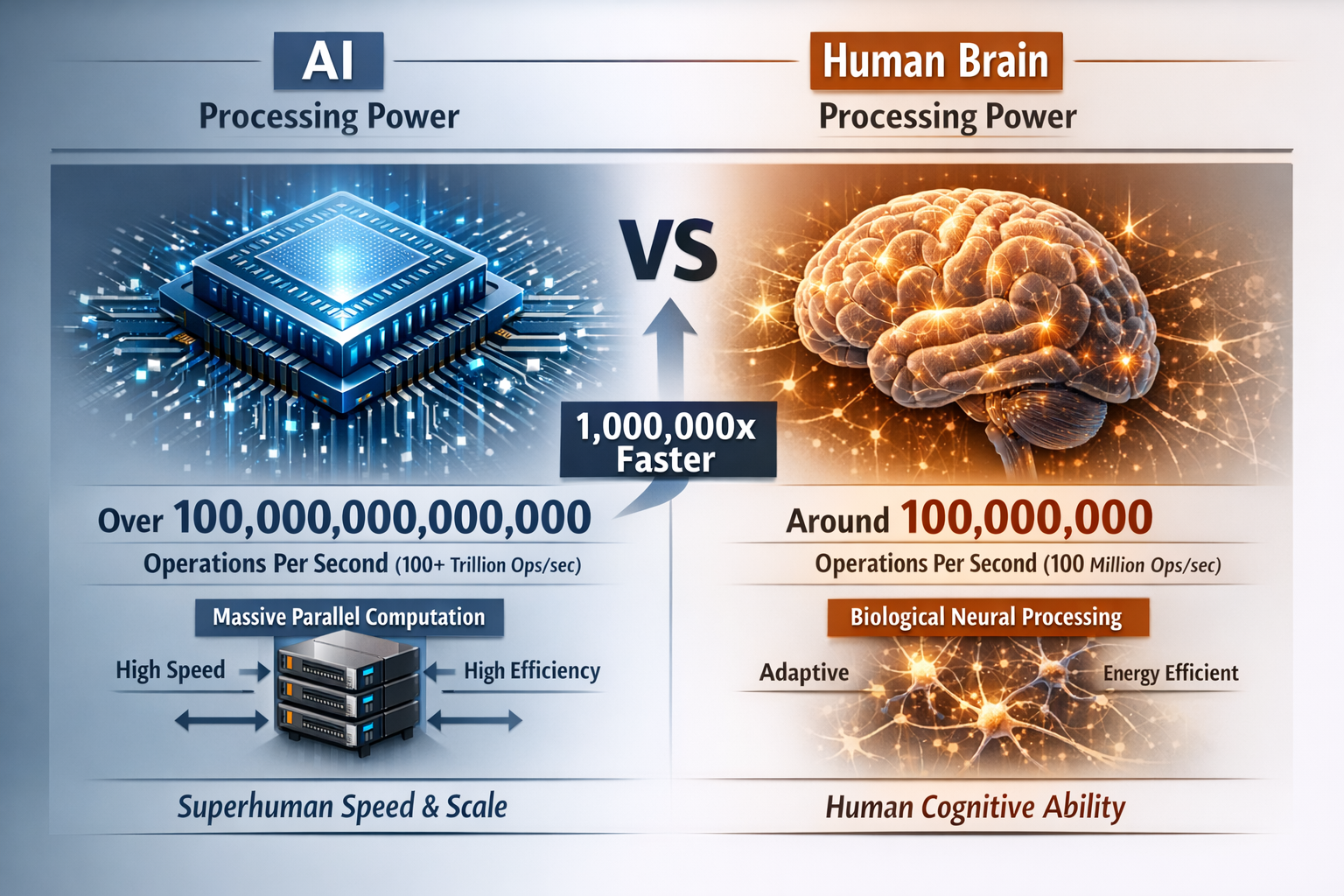
First, computational speed and large-scale pattern recognition remain foundational. Modern AI systems can perform millions of calculations per second, analyze vast multimodal datasets, and identify subtle correlations that humans would never perceive unaided.1,2 This enables breakthroughs in areas like genomics, fraud detection, and medical diagnostics, where AI can detect weak or atypical signals across enormous datasets.7 However, speed alone is not the full story; what matters more is the combination of speed with scale and automation. AI systems can operate continuously without fatigue, delivering consistent performance across billions of decisions—something no human workforce can replicate.1,5
Second, AI’s scalability and parallelization represent a distinct advantage beyond raw speed. Unlike humans, whose cognition is inherently serial and resource-constrained, AI systems can be deployed simultaneously across millions of tasks, locations, or users. This allows organizations to replicate expertise instantly and globally, compressing work that once took months into minutes or seconds.5 In practice, this has led to dramatic compression of innovation cycles—sometimes by an order of magnitude—fundamentally changing the tempo of scientific discovery and business decision-making.2,5
Third, AI exhibits a form of consistency and bias mitigation that contrasts with human cognition. Human reasoning is shaped by fatigue, cognitive load, and heuristics that introduce systematic errors; AI, by contrast, can apply the same analytical framework repeatedly without degradation.1,7 While AI can inherit biases from data, it does not suffer from situational inconsistency in the way humans do, making it especially powerful in high-reliability environments such as medical diagnostics or contract analysis.7
Fourth, AI’s emerging advantage lies in integration and synthesis across domains of data. AI systems can simultaneously process text, images, numerical data, and real-time signals, integrating them into unified outputs.1,2 This multimodal synthesis allows AI to function as a kind of “cognitive aggregator,” combining sources of information that humans typically process separately. In fields like medicine or climate science, this integrative capacity can produce insights that are not merely faster, but qualitatively different from human analysis.2,7
Fifth, AI increasingly accelerates collective intelligence and innovation. Rather than replacing human thinking, AI amplifies it by enabling rapid iteration, simulation, and idea generation. Studies show that AI-assisted teams can generate significantly more ideas and complete complex analytical tasks far faster than traditional workflows.5 In this sense, AI’s advantage is not only individual (machine vs. human) but systemic (human–AI networks vs. human-only systems), shifting the bottleneck from computation to imagination and governance.5
At the same time, the latest research underscores that these advantages coexist with critical limitations that define the boundary of AI power. AI still lacks robust causal reasoning, cross-domain generalization, and deep contextual understanding, meaning it remains fundamentally a “statistical pattern learner” rather than a fully autonomous thinker.3,6 Humans retain decisive advantages in abstraction, ethical judgment, adaptability, and meaning-making—capacities that are essential in ambiguous or novel situations.6
Taken together, the most accurate conclusion is that AI’s greatest power advantage is not any single capability—such as rapid data processing—but the compound effect of speed, scale, consistency, and integration operating simultaneously. This creates a qualitatively new form of intelligence: one that is not broadly human-like, but is extraordinarily powerful within structured, data-rich domains. The frontier, as current 2025–2026 research suggests, is not a simple competition between human and machine intelligence, but the emergence of hybrid systems in which AI handles computation, pattern detection, and scale, while humans provide context, judgment, and meaning.2,5,6
References
1 “Human and Artificial Intelligence: A Review of Comparative Strengths” (2025) — https://pmc.ncbi.nlm.nih.gov/articles/PMC12768574/
2 “AI Index Report 2025” — Stanford HAI — https://hai.stanford.edu/ai-index/2025-ai-index-report
3 “Current AI Capabilities and Limitations (2026)” — https://thestrategystack.substack.com/p/does-ai-behave-like-a-black-hole
4 “Beyond Human-in-the-Loop: Sensemaking Between AI and Humans” (2025) — https://www.sciencedirect.com/science/article/pii/S2666188825007166
5 “How Emerging Technologies Are Enabling the Human-Machine Economy” (2025) — https://www.ey.com/en_us/megatrends/how-emerging-technologies-are-enabling-the-human-machine-hybrid-economy
6 “In a World of Reasoning AI, Where Does That Leave Human Intelligence?” (2025) — World Economic Forum — https://www.weforum.org/stories/2025/01/in-a-world-of-reasoning-ai-where-does-that-leave-human-intelligence/
7 “Transforming Clinical Reasoning—The Role of AI in Healthcare” (2025) — https://www.frontiersin.org/journals/digital-health/articles/10.3389/fdgth.2025.1715440/full
###
Filed under: Uncategorized |


 Educational Technology and Change Journal

Leave a comment