




By Jim Shimabukuro (assisted by Perplexity)
Editor
[Related: Probability of War in Iran Becoming a Second Vietnam: A Cautionary Low]
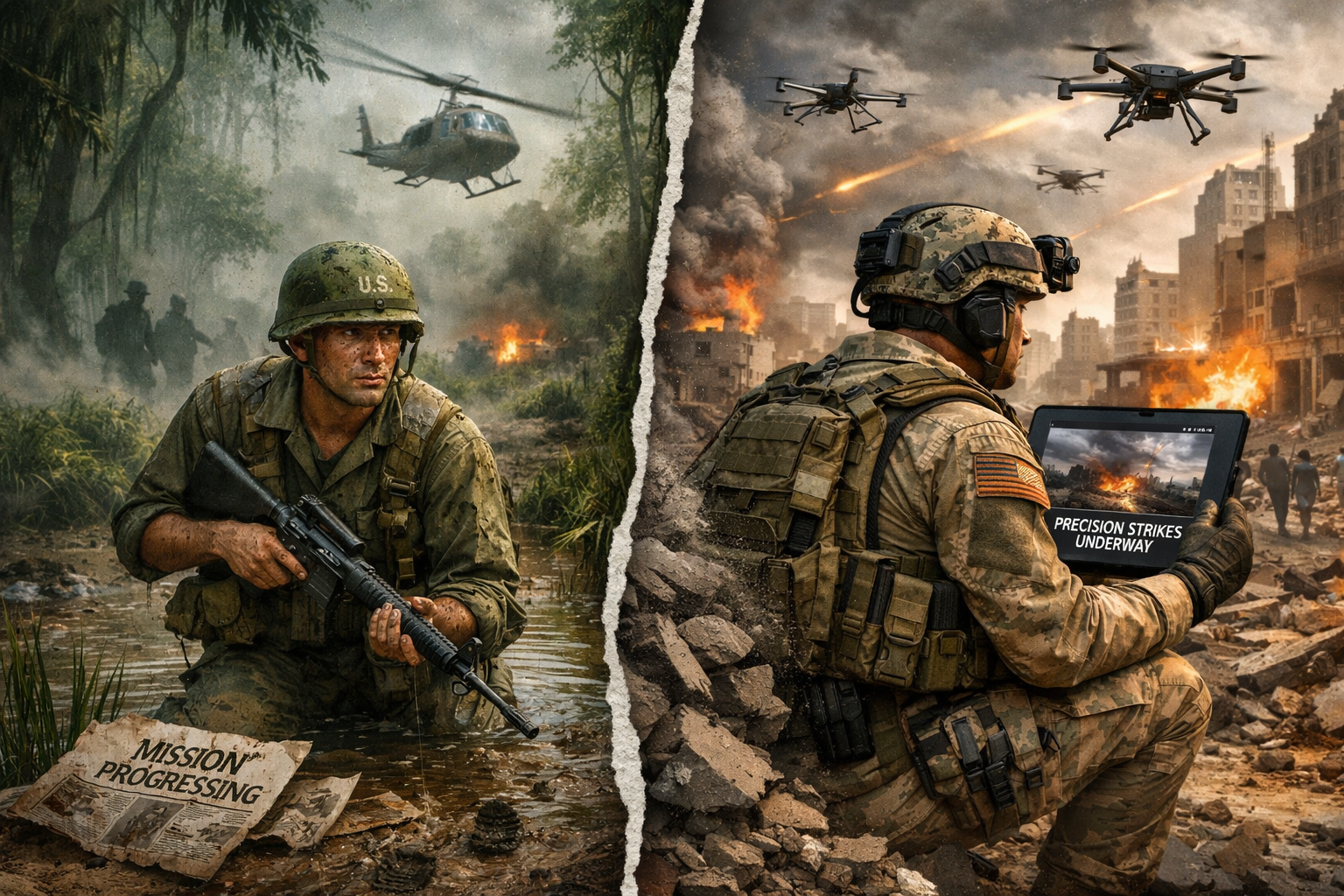
Introduction: What are the possible ways the war in Iran could escalate into a second Vietnam? This article presents five scenarios explaining how this catastrophe could occur. Hopefully, these previews will provide insights into how escalation could be avoided.
Scenario 1: Regime decapitation does not end the war
A Vietnam-like catastrophe could begin if leadership strikes produce the opposite of what their planners expect: not collapse, but a hardened, decentralized, and longer-lasting war effort. Brookings argues that even after severe leadership losses, Iran’s institutions and coercive networks may remain resilient, while the regime’s survival instinct could drive intensified repression and continued asymmetric retaliation across the region.1 This is the classic trap of confusing tactical success with strategic resolution: the battlefield may look decisive, yet the political war becomes longer, costlier, and harder to terminate. In this scenario, U.S. and Israeli leaders declare victory early, but Iran’s surviving security apparatus shifts to dispersed retaliation, proxy activation, cyber disruption, and attritional strikes on regional bases and infrastructure, making withdrawal politically difficult without achieving any real settlement.1
The Vietnam parallel is not that Iran becomes identical to North Vietnam, but that an apparently weaker opponent converts resolve, nationalism, and asymmetric methods into strategic endurance. The Brookings analysis explicitly warns that war aims centered on regime change are vulnerable to “unintended consequences” and that a weakened or leaderless regime may still remain capable of sustained conflict.1 CFR similarly notes that the war is being judged less by battlefield claims than by whether it settles into “ongoing chaos and conflict.”2 If that happens, the United States could find itself in a long campaign whose costs keep rising while the definition of success keeps shrinking, which is how quagmires often begin.
Scenario 2: A regional spillover war creates an open-ended insurgent battlefield
A second path to a Vietnam-like catastrophe is regional diffusion: the war stops being “in Iran” and becomes a multi-theater conflict spanning Iraq, Syria, Lebanon, the Gulf, and the Red Sea. Brookings describes Iranian retaliation as already extending beyond Iran’s borders, with attacks on Gulf states and other regional targets, and warns that escalation may be shaped by political fragmentation as much as military logic.1 The Atlantic Council also stresses that Gulf states sit at the center of the next phase of the conflict because they are both likely targets and indispensable logistical and diplomatic actors.3 Once outside actors begin suffering casualties or infrastructure damage, they will pull the conflict wider, and then every attempt to control escalation can itself generate new entry points for escalation.
This is where the Vietnam analogy becomes especially apt: the war becomes less a bounded campaign than a region-wide contest of wills in which the stronger side cannot easily translate firepower into political closure. The CFR piece highlights how prolonged energy disruption and retaliatory attacks would make the war a global economic issue, not just a military one.2 If shipping, oil infrastructure, bases, and partner states are all regularly attacked, the conflict can become self-sustaining, with each side claiming escalation is necessary for deterrence. That is how a regional war acquires the logic of endlessness: no actor wants the war to spread, yet every actor’s response helps spread it.
Scenario 3: Airpower achieves destruction but not political control
A third scenario is a familiar one in U.S. military history: airpower damages targets quickly, but the absence of a viable political end state turns apparent victory into an unstable aftermath. Brookings and CFR both emphasize that regime change in Iran is not the same as destroying military infrastructure, and that the United States and Israel have not clearly explained what the replacement order would be.1,2 The war may begin with impressive strikes on nuclear, missile, and command targets, but if the state fragments or the ruling coalition splinters, there is no guarantee that a better alternative will emerge. Brookings warns that even a post-collapse transition could produce “a period of sustained conflict and political instability” difficult to contain within Iran’s borders.1
This scenario is Vietnam-like because the intervening power’s military superiority proves irrelevant to the core political problem. The war could become a long test of endurance in which the external coalition dominates the skies but cannot secure legitimacy, order, or a durable settlement. The Brookings contributors repeatedly stress that the current campaign risks being judged by its long-term outcome rather than its opening phase, and that a dubious outcome would likely invite second-guessing rather than strategic closure.1 If the military campaign succeeds only in weakening the regime enough to create fragmentation, then the result may resemble the most damaging wars of intervention: not defeat in a formal sense, but a long, unresolved contest that drains credibility and resources.
Scenario 4: Domestic politics in Washington locks the war into escalation
A fourth route to catastrophe is political rather than purely military: the war becomes trapped inside domestic incentives that reward escalation and punish compromise. CFR notes that the conflict is already being watched through the lens of global markets, allied comfort, and the possibility of a “quagmire with ongoing chaos and conflict.”2 Brookings likewise points out that Trump’s political calculus may shift if casualties mount or if the war’s outcome appears dubious, but by then the conflict itself may already have generated momentum independent of strategy.1 In that environment, leaders may continue operations because stopping looks weaker than continuing, even when continuing no longer improves the strategic position.
That dynamic is very close to how the Vietnam analogy should be understood: not as a simple military comparison, but as a political pathology in which leaders keep raising the stakes because they cannot afford to be seen as losing. If the war’s legitimacy becomes a domestic partisan issue, off-ramps narrow and each concession becomes more expensive than the last. The result can be a long, morally corrosive stalemate in which military action continues because no one can define a politically survivable end. Brookings warns that appeals to regime change may leave “no one, least of all the Iranian people, better off,” which is precisely the kind of outcome that turns a war into a strategic catastrophe rather than a win.1
Scenario 5: The war normalizes force and triggers repeated future interventions
A final scenario is broader and more dangerous: the Iran war becomes the precedent that makes future interventions easier. Brookings’ legal and policy contributors warn that the strikes risk normalizing unilateral force as routine statecraft and eroding constraints that have long limited escalation.1 If this war is seen as successful in the short term, it may encourage further decapitation-style operations against hostile states or leaders, while also convincing adversaries that the only reliable deterrent is harder-to-detect weapons, tighter repression, and faster escalation doctrines. That is how a single war can reshape the strategic environment far beyond its borders.
The Vietnam-like element here is cumulative exhaustion. One conflict does not merely drag on; it changes the habits of policy so that each subsequent crisis is interpreted through the same flawed template. Brookings’ discussion of civilian tools, legitimacy, and long-term instability underscores that the postwar environment matters as much as the fighting itself.1 If policymakers conclude that bombing can substitute for strategy, the next crisis is likely to repeat the same pattern with even less caution. In that sense, the “second Vietnam” danger is not only getting stuck in Iran; it is learning the wrong lesson from Iran and entering a future of recurring, unwinnable wars.
References
- After the strike: The danger of war in Iran — Brookings Institution. https://www.brookings.edu/articles/after-the-strike-the-danger-of-war-in-iran/
- The Iran War’s Global Economic Impact — Council on Foreign Relations. https://www.cfr.org/articles/the-iran-wars-global-economic-impact
- How the Iran war could change the US relationship with Gulf states — Atlantic Council. https://www.atlanticcouncil.org/dispatches/how-the-iran-war-could-change-the-us-relationship-with-gulf-states/
Filed under: Uncategorized |


 Educational Technology and Change Journal

Leave a comment