




By Jim Shimabukuro (assisted by Copilot)
Editor
[Related: Iran as a Second Vietnam: Five Scenarios]
The late‑March 2026 build‑up of U.S. ground forces around Iran is clearly designed to give Washington options beyond the ongoing air and naval campaign, with elements of the 82nd Airborne Division and at least two Marine Expeditionary Units moving toward the region, alongside the USS Abraham Lincoln carrier strike group and extensive air assets already engaged in Operation Epic Fury.1,2 This comes after weeks of intensive strikes on more than 9,000 targets across Iran, including IRGC headquarters, missile and drone facilities, and naval assets, and amid Iranian missile and drone retaliation against Israel, Gulf states, and U.S. bases, as well as effective closure of the Strait of Hormuz to most commercial shipping.1,2,6 Open‑source assessments describe this as the largest U.S. deployment to the area since the Iraq War, but still far short of the hundreds of thousands of troops seen in 1991 and 2003.1,3,4
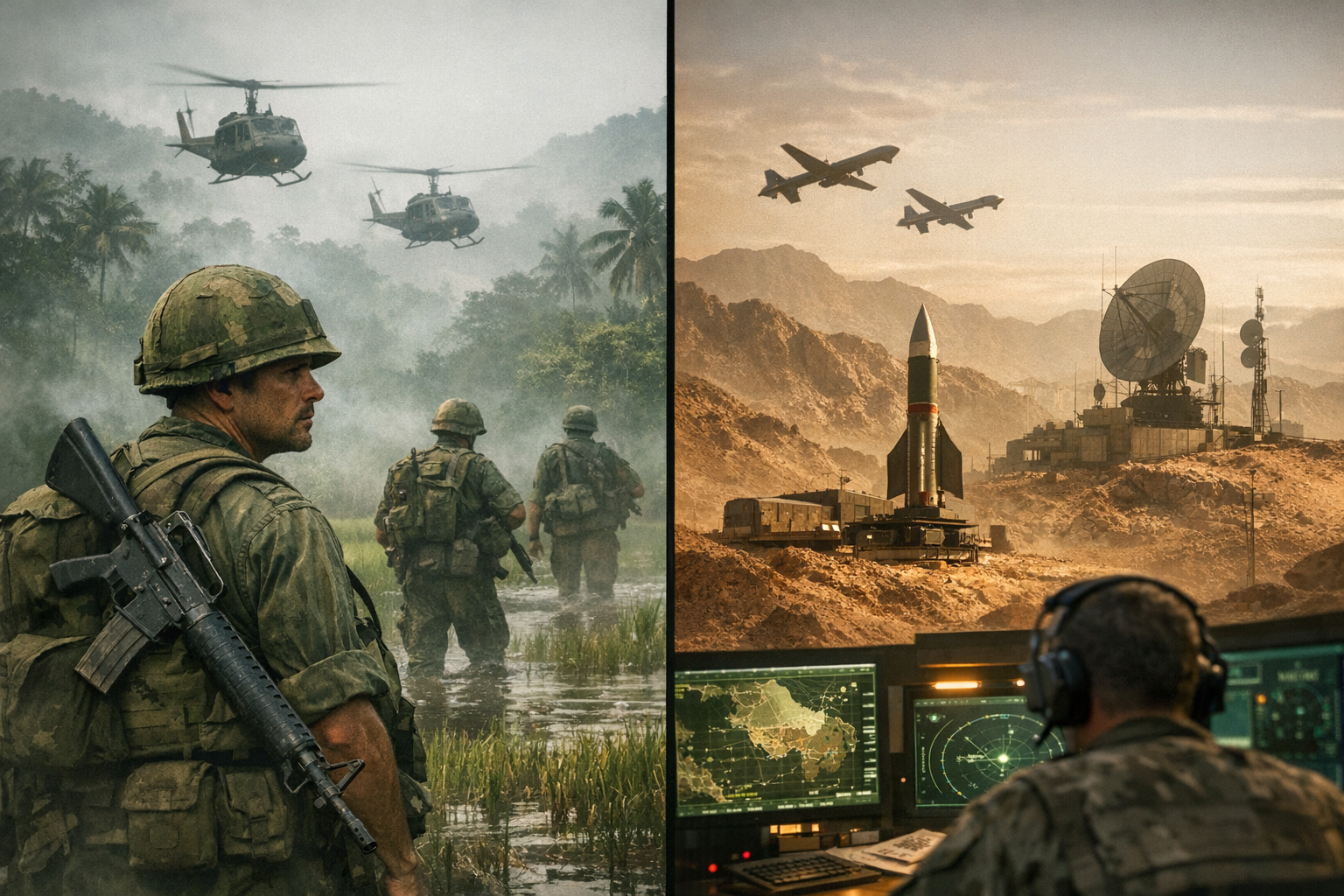
Comparing this trajectory to Vietnam, the most important differences are scale, political context, and military technology. Vietnam involved a gradual but massive escalation to more than 500,000 U.S. troops on the ground, a conscript army, and a long, attritional counterinsurgency against a deeply rooted nationalist movement backed by major powers, over jungle terrain that favored guerrilla warfare. In contrast, current U.S. planning around Iran appears focused on coercive strikes, limited ground contingents, and the use of highly capable air, naval, and missile forces to shape the battlefield, with analysts emphasizing a “much smaller footprint” that can be scaled up or down and a warfighting approach that has changed “dramatically” since even 2003.3-5 Iran’s geography and society could certainly sustain asymmetric resistance if occupied, but the U.S. has already absorbed the lessons of Iraq and Afghanistan about the costs of large‑scale, open‑ended occupations.
Domestic and international constraints also push against a full‑blown Vietnam‑style quagmire. U.S. public tolerance for long, high‑casualty ground wars has been sharply reduced by the experiences in Iraq and Afghanistan, and there is no clear appetite in Congress or among key allies for a multi‑year occupation of Iran’s heartland. Current reporting frames the build‑up as providing leverage for negotiations and contingency options rather than a declared plan for regime‑change invasion, even as the conflict has already crossed into open war and talk of “regime change” and “preparing for strikes on Iran” features in some strategic discourse.2-5 At the same time, Iran’s demonstrated ability to strike U.S. bases and regional infrastructure, and to weaponize the Strait of Hormuz, raises the risk of escalation, miscalculation, and a drawn‑out regional conflict that could be politically and economically costly even without Vietnam‑level troop numbers.1,2,6
Putting this together, the probability that the current war in and around Iran evolves into “another Vietnam” in the strict sense—a decade‑long conflict with several hundred thousand U.S. ground troops deployed, tens of thousands of American combat deaths, and a large‑scale counterinsurgency occupation—is, on present evidence, relatively low, though not zero. The force posture, emphasis on air and naval power, and political constraints all point toward a preference for limited or episodic ground operations rather than a massive, sustained land war.1,3,4,5
However, the risk of a protracted, messy, and strategically draining conflict—more akin to a hybrid of the later Iraq and Afghanistan wars than to Vietnam—should be considered significant, especially if initial limited ground operations expand in response to Iranian resistance, regional spillover, or shifting political calculations in Washington. In probabilistic terms, a reasonable judgment based on current deployments and politics is that the chance of a true Vietnam‑scale quagmire remains well below that of a shorter, more limited but still dangerous regional war—plausibly in the low‑to‑mid single‑digit to low‑teens percentage range, contingent on whether the U.S. crosses the threshold from coercive strikes and limited ground presence to large‑scale occupation of Iranian territory.
References
- “War on Iran: What troops is the US moving to the Gulf?” Al Jazeera (25 March 2026).
https://www.aljazeera.com/news/2026/3/25/war-on-iran-what-troops-is-the-us-moving-to-the-gulf(aljazeera.com in Bing) - “2026 United States military buildup in the Middle East.” Wikipedia.
https://en.wikipedia.org/wiki/2026_United_States_military_buildup_in_the_Middle_East(en.wikipedia.org in Bing) - “America’s Military Buildup Around Iran: What We Know and What It Means.” Middle East Forum (28 January 2026).
https://www.meforum.org/65432/americas-military-buildup-around-iran(meforum.org in Bing) - “‘Robust’ US Military Deployment To Gulf Ahead Of Possible Iran Strikes.” Radio Free Europe/Radio Liberty (11 February 2026).
https://www.rferl.org/a/us-military-deployment-gulf-iran-strikes/32834677.html(rferl.org in Bing) - “‘Robust’ US Military Deployment To Gulf Ahead Of Possible Iran Strikes.” GlobalSecurity.org (11 February 2026).
https://www.globalsecurity.org/military/library/news/2026/02/mil-260211-rferl01.htm(globalsecurity.org in Bing) - “US, Israel Keep Up Strikes on Iran After Troops Arrive in Region.” Bloomberg (30 March 2026).
https://www.bloomberg.com/news/articles/2026-03-30/us-israel-keep-up-strikes-on-iran-after-troops-arrive-in-region(bloomberg.com in Bing)
###
Filed under: Uncategorized |


 Educational Technology and Change Journal

Leave a comment