


By Jim Shimabukuro (assisted by ChatGPT)
Editor
In April 2026, artificial intelligence is no longer a peripheral tool in U.S. marketing—it is reshaping the profession at a structural level, altering not only how work is done but what “marketing expertise” means. Across industries, executives increasingly describe marketing as an “AI-first” function at a turning point, where human labor is being reorganized around intelligent systems rather than merely assisted by them.1 This shift is visible in both organizational strategy and day-to-day workflows: companies such as Apple are now appointing senior leaders specifically to oversee AI-driven marketing transformation, signaling that AI is not a niche capability but a core strategic domain.2 At the same time, major advertising firms like WPP are restructuring and cutting jobs explicitly to become “AI-enabled businesses,” underscoring that AI adoption is directly tied to workforce redesign.3
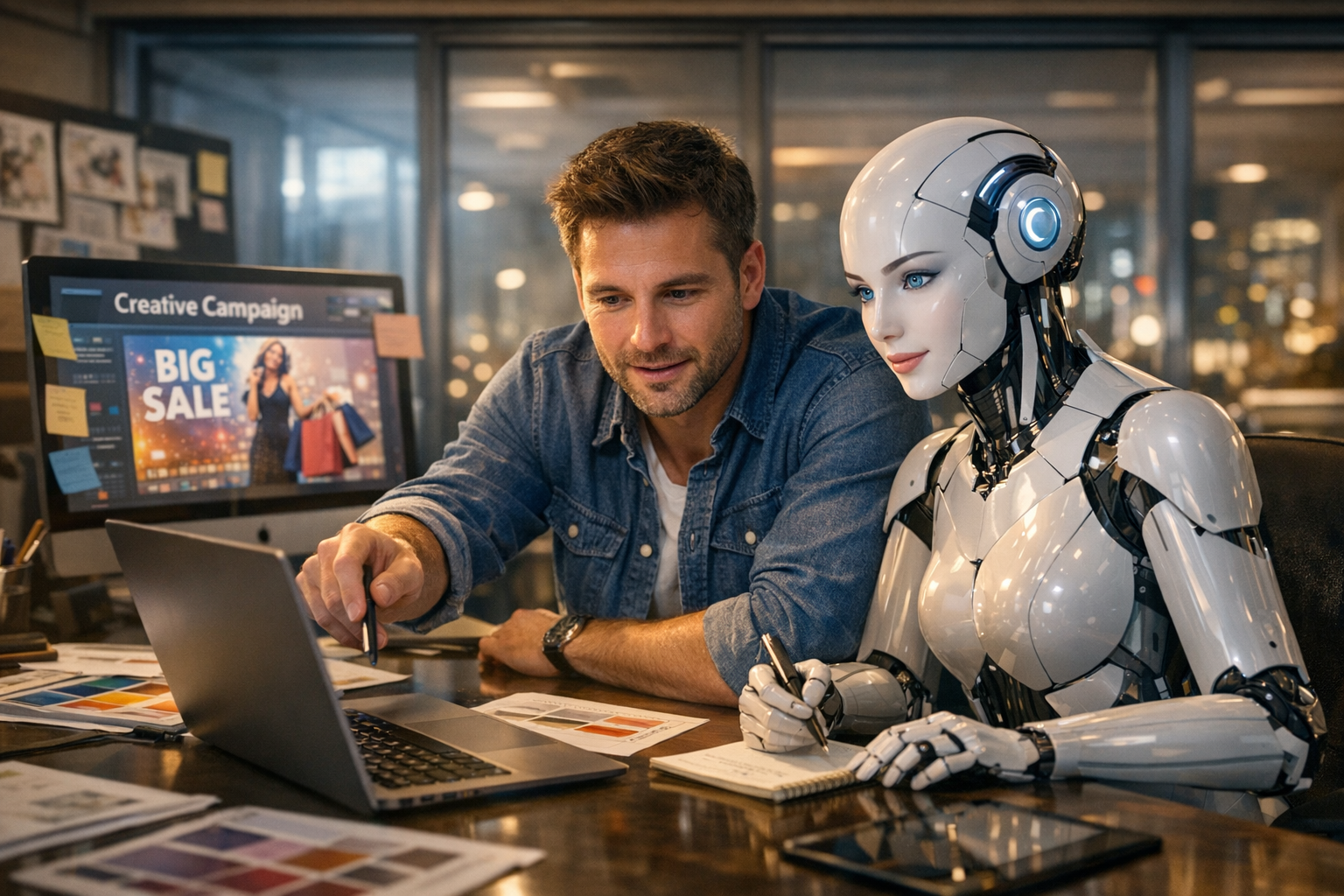
At the level of the individual marketing specialist or manager, the most immediate change is the automation of foundational tasks that historically defined entry-level and mid-level roles. Activities such as drafting ad copy, generating campaign variations, conducting competitor research, and producing analytics reports are increasingly handled by generative AI systems, often in minutes rather than hours.4 This has compressed the traditional career ladder: tasks that once served as training grounds for junior marketers are disappearing, forcing new entrants to contribute at a more strategic level from the outset. Rather than executing campaigns, marketers are now expected to orchestrate AI systems—designing prompts, evaluating outputs, and integrating insights across channels. As a result, the role is shifting from “content producer” to “AI-augmented strategist,” with a premium on judgment, brand voice, and cross-functional thinking.
A second major transformation lies in the rise of hyper-personalization and real-time optimization. AI systems now ingest massive datasets—consumer behavior, browsing patterns, transaction histories—and dynamically tailor messaging, pricing, and content at the individual level. This has fundamentally altered campaign design: instead of launching a single creative concept, marketers deploy adaptive systems that continuously test, learn, and refine messaging. Academic and industry research shows that AI-driven marketing platforms can operate across the full campaign lifecycle, from persona generation to live optimization, with significant efficiency gains.5 Consequently, marketing managers are becoming supervisors of feedback loops rather than planners of static campaigns, responsible for interpreting algorithmic outputs and ensuring alignment with brand strategy.
Third, the integration of AI into marketing has redefined the creative process itself. Rather than replacing creativity, AI is increasingly functioning as a co-creator. Studies of human–AI collaboration in marketing tasks demonstrate that AI can enhance ideation, expand narrative possibilities, and improve campaign performance when paired with human oversight.6 However, this has also introduced new tensions. As seen in industries like fashion and luxury marketing, consumers are beginning to resist purely AI-generated content, perceiving it as generic or inauthentic.7 This has elevated the importance of human-authored storytelling, emotional resonance, and authenticity as differentiators, pushing marketers to balance efficiency with cultural and aesthetic judgment. In effect, AI is commoditizing certain forms of creativity while making others more valuable.
The trajectory for 2027 points toward deeper integration, not stabilization. Marketing is likely to become one of the most fully AI-integrated business functions, with large language models and multimodal systems embedded across every stage of the customer journey—from discovery to post-purchase engagement.1 The emerging frontier includes “digital twins” of consumers, predictive intent modeling, and autonomous campaign systems that require minimal human intervention for execution.8 At the same time, the human role is expected to consolidate around higher-order capabilities: strategic synthesis, ethical oversight, brand stewardship, and cross-channel orchestration. Importantly, the distinction between marketing, data science, and product management is beginning to blur, suggesting that future marketing leaders will need hybrid skill sets that combine technical fluency with creative leadership.
Universities are responding to these changes unevenly, but a subset of leading business schools has begun to redesign marketing education in ways that align closely with industry transformation. At the Wharton School of the University of Pennsylvania, faculty have developed executive and degree-linked programs explicitly focused on AI in marketing, integrating topics such as recommender systems, generative AI, and AI-driven pricing into the core curriculum. What distinguishes Wharton’s approach is its emphasis on the full marketing value chain: students are not simply learning tools but are examining how AI reshapes segmentation, branding, and customer value creation in a systemic way.8 The program’s connection to the Wharton AI & Analytics Initiative ensures that teaching is grounded in ongoing research, enabling students to engage with emerging concepts such as large language model optimization and AI-mediated customer experiences.
At the University of Maryland Robert H. Smith School of Business, the response has been to embed AI directly into foundational marketing concepts rather than treating it as an elective specialization. Programs such as “Marketing in the Age of AI” begin with traditional frameworks—segmentation, targeting, positioning—and then reinterpret them through the lens of AI technologies, including personalization algorithms and generative systems.9 This pedagogical structure reflects a recognition that AI is not replacing marketing theory but transforming its application. Students are trained to understand both the technical mechanics of AI tools and their strategic implications, positioning them to navigate hybrid human–machine workflows.
At Hult International Business School, the emphasis is on experiential learning and global adaptability. Its Master’s in Marketing integrates AI-driven tools directly into coursework, requiring students to apply them in live projects that simulate real-world campaigns.10 The program’s design reflects the pace of industry change: rather than focusing on static knowledge, it prioritizes adaptability, experimentation, and continuous learning. Students graduate with hands-on experience using AI for market analysis, campaign design, and consumer behavior modeling, aligning closely with employer expectations for “AI-native” marketers.
A fourth example can be found at the Columbia Business School, where marketing analytics and AI have been deeply integrated into both MBA and executive education offerings. Columbia’s approach is distinguished by its strong emphasis on data science and quantitative modeling, reflecting the increasing importance of analytics in marketing decision-making. Students engage with machine learning techniques, causal inference, and experimentation frameworks, preparing them to lead in environments where marketing decisions are driven by continuous data streams and algorithmic insights.
Similarly, the Northwestern University Kellogg School of Management has expanded its curriculum to include AI-focused marketing pathways, combining its traditional strengths in brand management with new capabilities in digital platforms, automation, and analytics. Kellogg’s programs emphasize the integration of creativity and technology, training students to use AI as a tool for enhancing—not replacing—brand storytelling and customer engagement.
Taken together, these leading programs reveal a common pattern: successful adaptation requires integrating AI across the curriculum, combining theory with hands-on application, and fostering interdisciplinary skill sets. Graduates from such programs are generally faring well in the job market, as employers increasingly prioritize candidates who can bridge marketing strategy and AI implementation. Internship postings and early-career roles now routinely emphasize AI enablement, automation, and data-driven decision-making as core responsibilities, indicating that AI fluency has become a baseline expectation rather than a differentiator.11 These graduates are often able to enter roles with greater strategic responsibility earlier in their careers, reflecting the compression of traditional entry-level pathways.
By contrast, universities that fail to keep pace face significant repercussions. As recent surveys suggest, many students perceive a gap between the rapid adoption of AI in industry and the slower integration of AI into academic curricula.12 Institutions that do not adapt risk producing graduates whose skills are misaligned with employer needs, leading to weaker placement outcomes and diminished program relevance. For students, the consequences are equally stark: those without AI literacy may find themselves competing for a shrinking pool of roles defined by tasks that are increasingly automated. Over time, this divergence is likely to widen, creating a stratified landscape in which AI-integrated programs feed into high-value strategic roles, while traditional programs struggle to maintain their footing in an AI-driven economy.
References
1. “EY’s chief digital officer says marketing is at an AI ‘inflection point’” – Business Insider (2026) https://www.businessinsider.com/ai-transformation-marketing-says-eys-lou-cohen-2026-2
2. “Apple hires ex-Google executive to head AI marketing” – Reuters (2026) https://www.reuters.com/business/apple-hires-ex-google-executive-head-ai-marketing-amid-push-improve-siri-2026-03-27/
3. “WPP to sell assets and cut jobs in radical shake-up to counter AI threat” – The Guardian (2026) https://www.theguardian.com/business/2026/feb/26/wpp-merge-ad-agencies-cut-jobs-ai-threat-advertising
4. “AI at Work: The Future of Marketing Jobs” – McGraw Hill (2025) https://www.mheducation.com/content/mheducation/us/en/highered/blog/2025/12/ai-at-work-the-future-of-marketing-jobs.html
5. “MindFuse: Towards GenAI Explainability in Marketing Strategy Co-Creation” – arXiv (2025) https://arxiv.org/abs/2512.04112
6. “Personalized AI Scaffolds Synergistic Multi-Turn Collaboration in Creative Work” – arXiv (2025) https://arxiv.org/abs/2510.27681
7. “The Anti-AI Slop Playbook” – Vogue (2026) https://www.vogue.com/article/the-anti-ai-slop-playbook
8. “AI in Marketing: Creating Customer Value in an AI-Driven Enterprise” – Wharton Executive Education (2026) https://executiveeducation.wharton.upenn.edu/for-individuals/all-programs/ai-in-marketing-creating-customer-value-in-an-ai-driven-enterprise/
9. “Marketing in the Age of AI” – University of Maryland (2025–2026) https://www.rhsmith.umd.edu/programs/executive-education/learning-opportunities-individuals/marketing-age-ai-website
10. “Master’s in Marketing (Generative AI focus)” – Hult International Business School (2026) https://www.hult.edu/masters/marketing/generative-ai/
11. “Marketing AI Enablement & Automation Internship” – Lumen (2025–2026) https://careercenter.bauer.uh.edu/jobs/lumen-intern-marketing-ai-enablement-automation-summer-2026-3/
12. “AI is making college students change majors” – Axios (2026) https://www.axios.com/2026/04/02/ai-college-students-change-majors-poll
Filed under: Uncategorized |


 Educational Technology and Change Journal

Leave a comment