


By Jim Shimabukuro (assisted by ChatGPT)
Editor
Considering the AI-dominated direction that modern warfare is taking on a global scale, military leaders and heads of state are transforming their expectations of future soldiers. The deep reality is unsettling and historically significant: militaries are not merely updating training or adding new technical specialties; they are beginning to redefine the ontology of the “soldier” itself. Across doctrine, training pipelines, force structure, and civil-military boundaries, evidence from 2024–2026 suggests the early stages of a systemic transformation comparable to the shift from industrial warfare to nuclear-era deterrence—except this time the change is diffused, software-driven, and deeply entangled with civilian technological ecosystems.
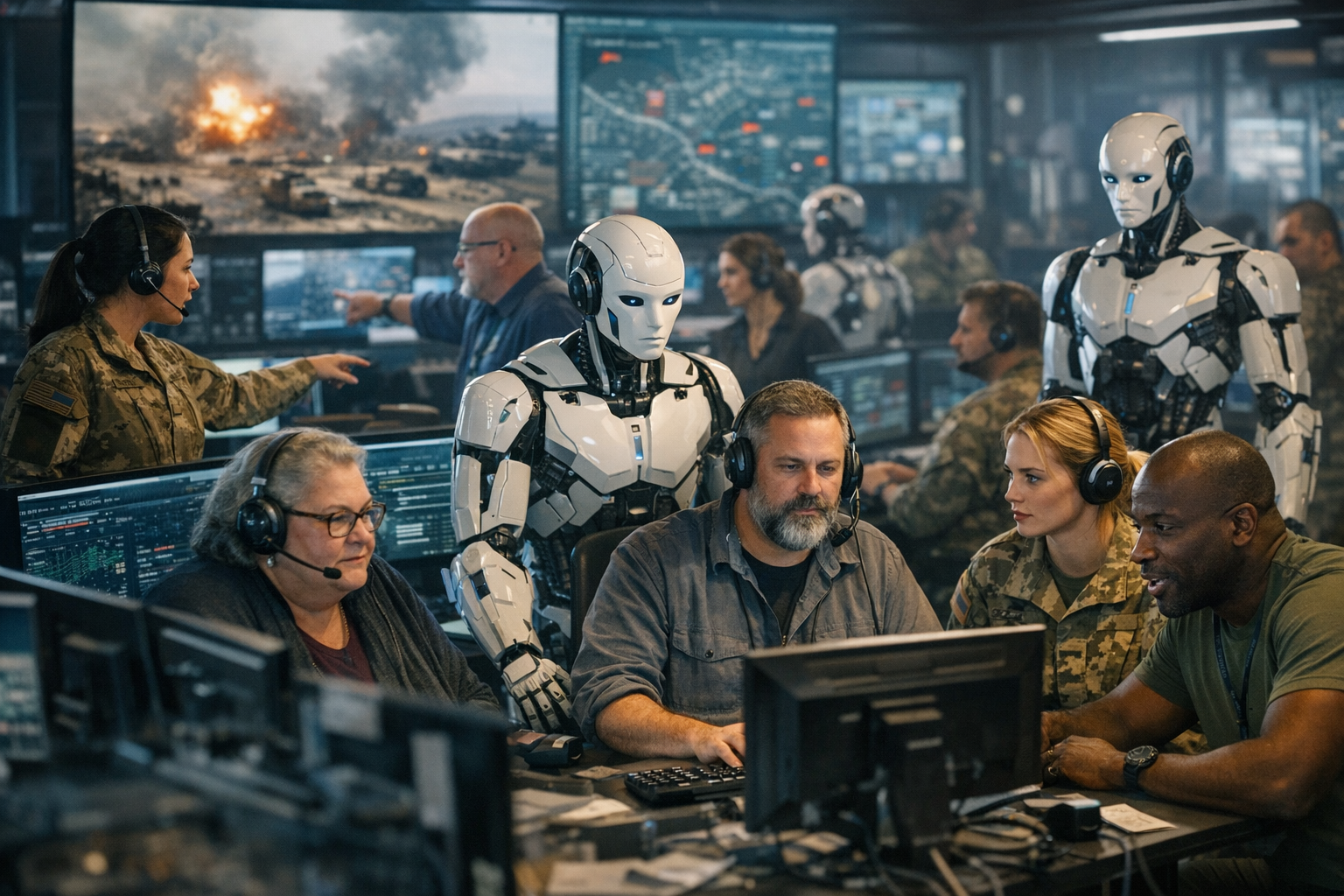
At the doctrinal level, military leaders increasingly describe artificial intelligence not as a support tool but as a central determinant of combat power and decision-making speed. A 2026 analysis from the Institute for National Strategic Studies explicitly frames AI as reconfiguring “decision-making authority, informational control, and strategic agency,” indicating that command itself is being reshaped by machine-augmented cognition.1 This is reinforced by operational reporting: AI systems now fuse satellite imagery, signals intelligence, social media, and battlefield data to generate targeting and planning outputs at speeds that compress decision cycles from days or weeks into hours or minutes.2 In such an environment, the defining trait of a future officer is no longer simply leadership under uncertainty, but the ability to interpret, supervise, and contest machine-generated options in real time. The locus of military excellence is shifting from physical courage and procedural mastery toward cognitive integration with algorithmic systems.
These expectations are already being projected into military education. At institutions such as the U.S. Army’s School of Advanced Military Studies, officers are now explicitly trained to “lead formations powered by AI,” with hands-on modules requiring students to use AI tools for planning, analysis, and organizational leadership.3 What is striking is not merely the inclusion of AI coursework, but the pedagogical inversion it represents: students are co-designing curricula, experimenting with live AI systems, and being evaluated on their ability to operate within AI-enabled command environments rather than traditional hierarchical structures.3 Across the services, training itself is becoming algorithmic. Adaptive simulations, AI-generated scenarios, and data-driven feedback loops are replacing static exercises, producing a model of readiness built on continuous interaction with intelligent systems rather than periodic drills.4 This suggests that future soldiers will be trained less like operators of equipment and more like participants in evolving human-machine ecosystems.
Force structure is evolving in parallel. The creation of a dedicated U.S. Army AI and machine learning officer career field (Functional Area 49B) signals institutional recognition that technical expertise in data and algorithms is now a core warfighting competency, not a niche support function.5 This is a profound shift: historically, militaries separated “operators” from “technologists.” That boundary is dissolving. The emerging expectation is that officers themselves must be conversant in AI systems, capable of integrating them into operations, and accountable for their outputs. In effect, the “combat arms vs. support” distinction is being partially replaced by a new axis: AI-native versus AI-dependent forces.
At the same time, the definition of the “warfighter” is expanding beyond uniformed personnel. Modern military AI systems—from targeting platforms like Project Maven to generative AI tools embedded in planning workflows—are increasingly developed, maintained, and iterated by civilian technologists working in partnership with defense institutions.2 The Pentagon’s accelerating collaboration with companies such as OpenAI, Google, and Palantir reflects a structural dependence on private-sector innovation that cannot be replicated by traditional military pipelines.2 As one 2026 report notes, the push toward an “AI-first” force explicitly relies on commercial technologies and rapid deployment cycles, effectively merging defense and civilian tech ecosystems.2 This creates a new category of participant in warfare: individuals who may never wear a uniform yet contribute directly to targeting, intelligence, cyber operations, and strategic planning.
This blurring of boundaries raises the possibility—already visible in early form—that civilian technologists could become de facto warfighters. Not in the legal sense of combatant status, but in functional terms: writing code that shapes targeting decisions, training models that influence battlefield perception, or maintaining systems that determine operational tempo. Academic and policy literature increasingly argues that AI-enabled weapons and decision systems require continuous involvement from technical experts, including in oversight, validation, and regulation.6 In other words, participation in war is no longer confined to those physically present on the battlefield; it extends to those embedded in the data pipelines and algorithmic infrastructures that make modern operations possible.
Perhaps the most consequential shift, however, lies in how militaries are reimagining human roles relative to machines. Rather than replacing humans, current doctrine emphasizes a redistribution of cognitive labor: AI handles data processing, pattern recognition, and rapid option generation, while humans focus on judgment, ethics, and strategic intent.7 Yet this division is inherently unstable. As AI systems improve, the temptation—and in some cases the operational necessity—to delegate more decision-making authority to machines increases. Reports on AI-enabled targeting systems already describe workflows in which thousands of potential targets are identified daily, far exceeding what human analysts alone could manage.2 The human role risks becoming supervisory rather than decisional, raising profound questions about accountability and control.
Taken together, these developments suggest that we are indeed on the brink of a sea change in what “military service” means. The traditional image of the soldier—as a physically present, uniformed individual operating within a clearly bounded institution—is giving way to a more diffuse and networked conception. Future military service may encompass a spectrum of roles: uniformed operators embedded with AI systems, officers acting as human-machine integrators, civilian engineers contributing to operational capabilities, and hybrid professionals moving between public and private sectors. The battlefield itself is expanding into data centers, cloud infrastructures, and algorithmic environments.
What emerges is not simply a more technologically advanced military, but a qualitatively different institution—one in which the boundaries between soldier and system, civilian and combatant, and decision and computation are increasingly porous. The transformation is incomplete and contested, shaped by ethical concerns, institutional inertia, and technical limitations. But the trajectory is clear: warfare is becoming as much about designing, training, and governing intelligent systems as it is about deploying human forces. In that sense, the question is no longer whether civilian technologists could become warfighters, but whether the very category of “warfighter” is being redefined to include them.
References
- Artificial Intelligence and a Reconfiguration of Military Power — https://inss.ndu.edu/Research-and-Commentary/View-Publications/Article/4382869/artificial-intelligence-and-a-reconfiguration-of-military-power/
- Warfare Revolution: How The Military Uses AI — https://www.kiplinger.com/politics/warfare-revolution-how-the-military-uses-ai
- Lethality, innovation, and transformation through AI education at the U.S. Army School of Advanced Military Studies — https://www.tradoc.army.mil/2025/09/12/lethality-innovation-and-transformation-though-ai-education-at-the-u-s-army-school-of-advanced-military-studies/
- Artificial Intelligence Comes to the Ranks: The Next Wave of Military Training Tech — https://www.military.com/feature/2025/10/31/artificial-intelligence-comes-ranks-next-wave-of-military-training-tech.html
- Army Creates New AI Officer Corps as Warfare Enters the Algorithmic Age — https://thunderreport.org/2026/01/02/army-ai-machine-learning-officer-career-path/
- Military AI Needs Technically-Informed Regulation to Safeguard AI Research and its Applications — https://arxiv.org/abs/2505.18371
- Military Implications in the Age of AI — https://www.military.com/feature/2025/12/20/military-implications-age-of-ai.html
###
Filed under: Uncategorized |


 Educational Technology and Change Journal

Leave a comment