


By Jim Shimabukuro (assisted by Perplexity)
Editor
AI is changing journalism quickly, but the strongest evidence from 2025–2026 points to augmentation, workflow redesign, and selective automation rather than wholesale replacement of human reporters.1-3 The clearest pattern is that AI is taking over repetitive, structured, or high-volume tasks while journalists retain responsibility for verification, judgment, interviews, and accountability.1,4,5
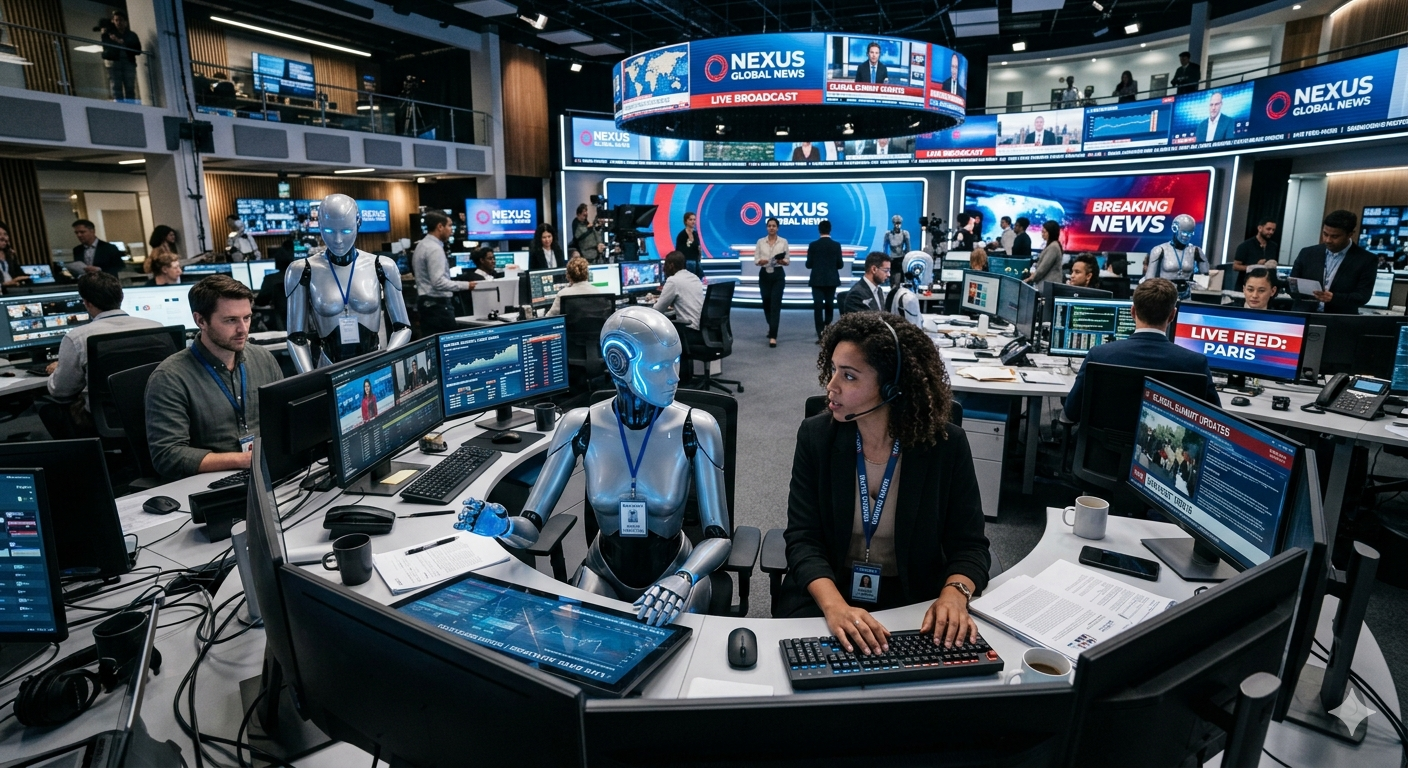
Newsrooms
The biggest change is the shift from “AI as a tool” to “AI as infrastructure.” Reuters Institute’s 2026 forecast says newsrooms are moving toward embedded AI in CMS and workflows, with automation and agents handling more of the production pipeline, while AI-assisted search and answer engines increasingly mediate how audiences encounter news.4 Reuters’ 2026 coverage of its own predictions says back-end automation was already seen as important by 97% of respondents, and that the gap between early adopters and everyone else is widening.6
A second major change is the automation of routine reporting, especially in sports, finance, weather, elections, and public notices. This is not new in principle, but the scale is expanding in 2026: Reuters Institute forecasts more agentic automation, and AP’s AI strategy explicitly says AI is being explored to streamline news production, news gathering, and distribution.3,4 AP’s newsroom AI work includes automated public safety incidents, translation of weather alerts, video transcription and summaries, sorting email pitches, and keyword alerts for meeting transcripts.7 These are concrete examples of AI substituting for portions of editorial labor, but not for the reporter’s broader role.
A third change is that AI is becoming a research and verification accelerator. Reuters Institute’s forecast says demand for verification work is rising, and that AI will further empower data journalists.4 At AP, the emphasis is on efficiency with human oversight, and the AP’s own AI materials stress careful deployment, editorial efficiency, and training rather than autonomous publication.3 Newsrooms are using AI to scan large datasets, summarize long documents, and help detect patterns that would take humans much longer to surface.
A fourth change is audience access shifting toward AI-mediated channels. Reuters Institute says audiences will increasingly access news through AI, while answer engines and chatbots threaten publisher traffic.4,8 That matters because journalists may spend more time producing content optimized for machine summarization, source transparency, and direct audience relationships, instead of writing only for homepage or search-driven discovery.8 Reuters Institute and related coverage also say publishers are responding by investing more in original investigations and contextual analysis while trimming generic news that AI can easily reproduce.9
A fifth change is the growth of newsroom “AI governance” and new hybrid roles. Newsroom commentary for 2026 points to AI ethics specialists, workflow architects, and output auditors as emerging functions, and Reuters Institute forecasts more upskilling and AI infrastructure building across news organizations.1,4 This is a genuine role transformation: the journalist’s job increasingly includes supervising machine output, selecting when not to use AI, and explaining process and provenance to audiences.
A sixth change is the use of AI for personalization, packaging, and product work. Reuters Institute’s 2026 forecasts and other newsroom reporting point to AI-generated audience models, newsletter support, headline testing, and story adaptation for different platforms.4,10 Semafor’s AI workflow reporting says its tools support copy editing, proofreading, dataset suggestions, and surfacing related reporting across outlets and languages.10 In practice, that pushes journalists closer to product thinking and closer to audience analytics.
A seventh change is the intensification of fact-checking and authenticity work because AI slop, manipulated media, and deepfakes are increasing. Reuters Institute’s 2026 materials explicitly flag deepfakes and misinformation as major issues, while other coverage says verification has become more important, not less.4,8 The paradox is that AI creates more synthetic content, which raises the premium on human judgment, source checking, and trust signals.
An eighth change is language reach and localization. AP’s projects include Spanish translation of National Weather Service alerts, and broader newsroom AI reporting shows translation and multilingual production as a practical use case.7 This helps large news organizations reach more audiences at lower cost, but it also changes editorial work: journalists increasingly edit and verify machine-translated or machine-localized output instead of producing every version from scratch.
Are journalists being replaced? Sometimes, partially, in limited workflows; generally, no. The strongest evidence from the 2025–2026 sources is that AI is replacing tasks, not the core profession.1,3,4 Human journalists remain essential because news still requires interviews, source trust, legal and ethical accountability, contextual judgment, and the ability to report unfolding events where facts are still being established.6 Reuters’ AP coverage even notes that breaking news remains hard for AI to replace because AI struggles when facts are changing in real time.6
Replacement Pattern
When AI does displace human work, it is usually in formulaic or low-margin content. That includes templated sports recaps, earnings summaries, weather alerts, transcription, captioning, document sorting, and first-draft copy that is then reviewed by editors.2,7,10 In some organizations, AI also pre-drafts or restructures text so humans can spend more time on higher-value reporting.5,10
What AI is not doing well enough, based on the 2026 evidence, is replacing source cultivation, accountability, investigative persistence, and judgment under uncertainty.4,6 Newsrooms are also wary of quality, bias, hallucination, and legal exposure, which is why most implementations still keep humans in the loop, even if some experts think that human-in-the-loop may become less visible in agentic workflows.4
Trajectory Ahead
For 2026–2027, the likely trajectory is deeper integration, not dramatic substitution.4,8 Newsrooms are expected to build AI into routine production systems, use more agents for multi-step work, expand verification and provenance practices, and shift editorial energy toward original reporting, analysis, and distinctiveness.4,9 The biggest strategic risk for publishers is not that AI writes every story, but that AI intermediates distribution and commoditizes generic news faster than legacy organizations can adapt.8,9
University Programs
The leading university response is most visible in professional and practice-oriented programs rather than in traditional lecture-based curricula. The Craig Newmark Graduate School of Journalism at CUNY is one of the clearest leaders: in 2026 it launched AI Journalism Lab: Leaders and AI Journalism Lab: Builders, with Microsoft support and a partnership with Nordic AI Journalism, focusing on newsroom leadership, product building, ethical deployment, and real newsroom problems.11,12 Those labs are designed for working journalists and operators, which makes them especially relevant to the current transition.
Northeastern University’s College of Arts, Media and Design is another leader. Its AI and Journalism work emphasizes research, hands-on learning, risk analysis, AI literacy, and teaching use cases in reporting, showing a model that blends scholarship with applied newsroom skills.13 That matters because graduates need both conceptual understanding and practical competence if they are going to supervise AI systems responsibly.
Columbia University’s Brown Institute for Media Innovation, working with Hearst and OpenAI, convened the AI and Journalism Summit in late 2025 to connect reporters, editors, technologists, researchers, and executives around the lab-to-newsroom transition.14 Columbia’s role is important because elite journalism education is increasingly being judged not only by reporting instruction, but by whether it can convene cross-functional AI collaboration at the frontier of practice.14
University of North Carolina’s journalism and media resources also reflect an early adaptation model. Its media-and-journalism AI guidance frames AI as useful for automated reporting and data analysis, which mirrors the actual newsroom use cases that are now becoming mainstream.15 While not as programmatic as CUNY or Columbia, this kind of curricular framing helps normalize AI literacy for undergraduate and graduate journalists entering the field.
A fifth notable effort is the Reuters Institute-linked educational and convening ecosystem around Oxford, which in 2026 is actively hosting and publishing on “AI and the Future of News.”16 Though not a degree program in the usual sense, this matters because it shapes the intellectual agenda that many journalism schools and professionals follow. In effect, it functions as a global reference point for how journalism education should respond.
Job Market
Graduates from programs that are keeping pace should have an advantage in a market where employers increasingly want journalists who can verify AI output, use AI tools for research, understand audience analytics, and work across editorial, product, and data functions.4,10 The labor-market advantage is not just technical; it is strategic, because news organizations are rewarding people who can help them move from generic reporting toward distinctive investigations, contextual analysis, and workflow design.9
Graduates from schools that do not adapt may face a narrower set of opportunities, especially in entry-level roles that are most exposed to automation, tooling, and content commoditization.4,8 Universities that fail to teach AI literacy, verification discipline, and product-oriented journalism risk graduating students who know how journalism used to work, but not how modern newsrooms actually operate.11,13 That can weaken both employability and institutional reputation, especially as employers increasingly expect graduates to arrive ready to work in AI-augmented environments.4,11,13
References
- From Hype to Help: What Newsrooms Expect from AI in 2026 — https://www.octopus-news.com/from-hype-to-help-what-newsrooms-expect-from-ai-in-2026/
- How AI is Transforming Modern Journalism: Tools, Trends, and Challenges — https://newsdata.io/blog/how-ai-is-transforming-modern-journalism-tools-trends-and-challenges/
- Artificial Intelligence | The Associated Press — https://www.ap.org/solutions/artificial-intelligence/
- Journalism, media, and technology trends and predictions 2026 — https://reutersinstitute.politics.ox.ac.uk/journalism-media-and-technology-trends-and-predictions-2026
- 26 AI and Journalism Links for 2026 — https://olereissmann.com/26-ai-and-journalism-links-for-2026/
- Reuters Institute Predictions 2026: The Scorecard — https://workflow.ap.org/news/reuters-institute-predictions-2026/
- Meet the 24 Practitioners Selected for AI J Lab: Builders — https://www.journalism.cuny.edu/2026/01/meet-the-24-practitioners-selected-for-the-ai-journalism-lab-builders-cohort-in-partners…
- #IFJBlog: Reuters digital report 2026: journalism’s pivot – navigating the AI and creators squeeze — https://www.ifj.org/media-centre/blog/detail/category/ai/article/reuters-digital-report-2026-journalisms-pivot-navigating-the-ai…
- Reuters Institute: How AI could redefine journalism in 2026 — https://lab.imedd.org/en/reuters-institute-how-ai-could-redefine-journalism-in-2026/
- Building the Newsroom AI Playbook Without Turning Journalism into Slop — https://www.youtube.com/watch?v=eG1CdGsm_Vk
- Announcing two new AI Journalism Labs at the Newmark J-School in 2026 — https://www.journalism.cuny.edu/2025/09/announcing-two-new-ai-journalism-labs-at-the-newmark-j-school-in-2026-and-an-unprecedented-partnership-with-the-network-nordic-ai-journalism-naij/
- 23 News Leaders Chosen for AI Journalism Lab: Leaders Cohort — https://www.journalism.cuny.edu/2026/01/23-news-leaders-chosen-for-ai-journalism-lab-leaders-cohort/
- AI and Journalism — Northeastern University College of Arts, Media and Design — https://camd.northeastern.edu/journalism/featured-work/ai/
- Announcing the AI and Journalism Summit for News and … — https://brown.columbia.edu/ai-summit/
- Artificial Intelligence and Generative AI for Media & Journalism — https://guides.lib.unc.edu/generativeAI/ai-journalism
- AI and the Future of News 2026 — Reuters Institute — http://reutersinstitute.politics.ox.ac.uk/calendar/ai-and-future-news-2026-0
###
Filed under: Uncategorized |


 Educational Technology and Change Journal

Leave a comment