


By Jim Shimabukuro (assisted by Copilot)
Editor
Projecting 2028 primaries this far out is inherently speculative, but there is already a surprisingly rich ecosystem of reporting, early polling and “invisible primary” maneuvering to work with. What follows is a rank-ordered snapshot as of 5 April 2026, grounded in Ballotpedia’s lists of potential contenders and cross‑checked against recent, non‑paywalled analyses of who appears best positioned inside each party. Be sure to confirm any specific claims, especially about polling and offices held, with up‑to‑date trusted sources as the cycle evolves.
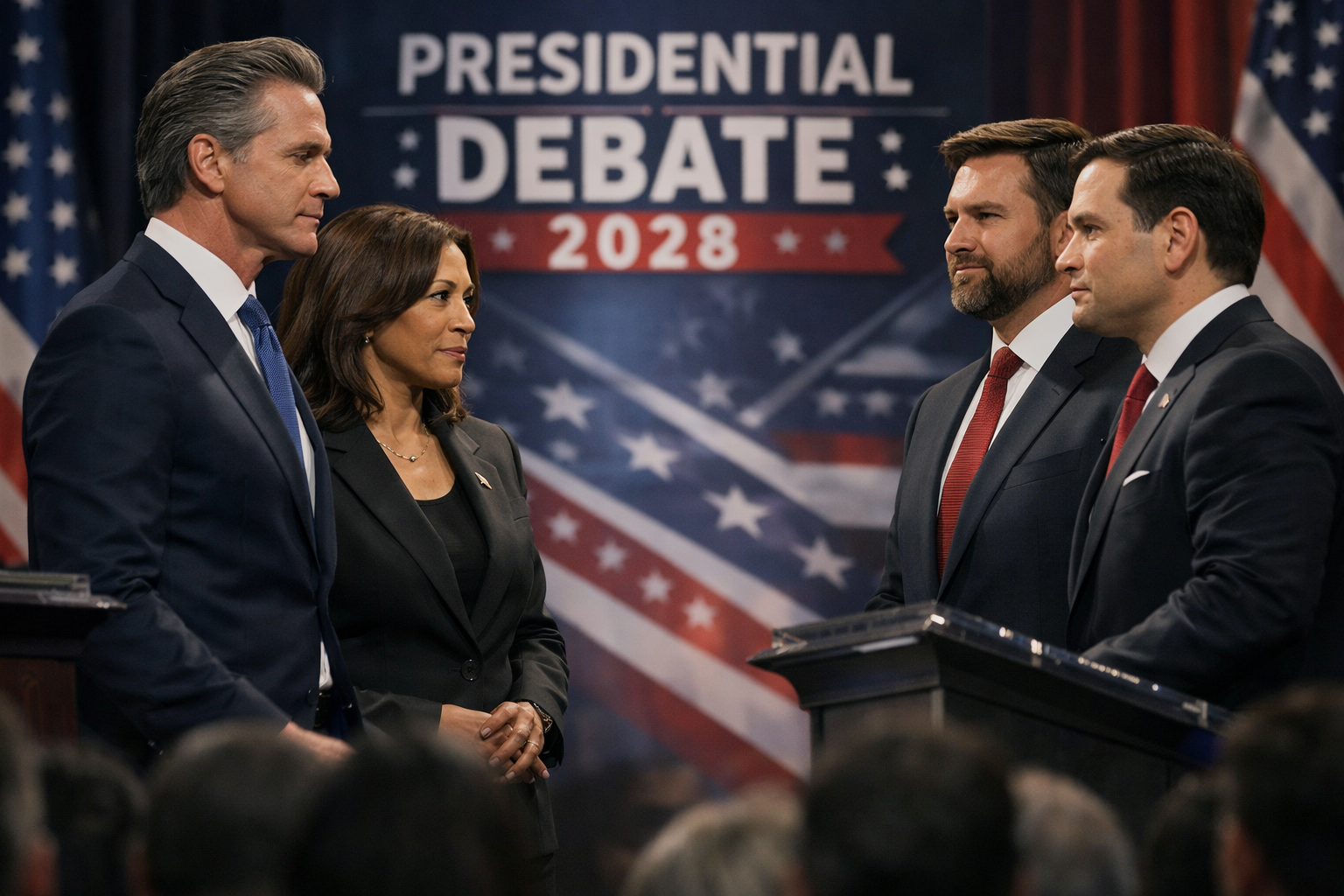
Democratic Party: top 10 likely primary contenders
- Gavin Newsom ranks first because he combines national name recognition, a large donor base, and a clear strategy of positioning himself as the party’s chief foil to Donald Trump’s second term. Ballotpedia lists him among the core group of governors frequently mentioned for 2028, and NBC News notes that he is already considered a “household name” for most Democrats alongside Gretchen Whitmer, Josh Shapiro and J.B. Pritzker.1,2 Politico and The Hill both describe Newsom as having “catapulted himself to front‑runner status,” highlighting his aggressive media presence, his trolling of Trump, and his strong standing in early national primary polling of Democratic voters.3,4 That mix of ideological mainstream appeal, executive experience in the nation’s largest Democratic state, and early polling leads makes him, as of early 2026, the most plausible favorite in an open field.
- Kamala Harris, despite losing to Trump in 2024, remains unusually strong for a defeated nominee, which keeps her near the top of any 2028 ranking. Ballotpedia lists her as a potential 2028 candidate, and multiple post‑election analyses emphasize that Democratic voters largely blamed Biden and the broader environment rather than Harris personally for the loss.1,3 Politico reports that late‑2024 and early‑2025 polling showed Harris leading other potential contenders by wide margins among Democrats, with one Echelon Insights survey giving her 41 percent support when no one else reached double digits.3 The Hill likewise notes that she tops early preference polls and benefits from having already run a billion‑dollar national campaign, even as some Democrats worry about relitigating 2024 and the party’s track record with female nominees.4,5 That combination of residual base loyalty, name recognition and campaign infrastructure keeps her a top‑tier contender, even if not the consensus favorite.
- Gretchen Whitmer’s ranking reflects her status as a popular Midwestern governor from a critical “blue wall” state, with a record that appeals to both moderates and progressives. Ballotpedia includes her among the most frequently cited governors for 2028, and NBC News highlights her as one of the Democratic executives who have become “household names” and are well‑positioned to lead the party’s pushback against Trumpism.1,2 Analyses focused on 2028—such as Axios and New York Magazine—regularly place Whitmer in the top tier, emphasizing her electoral success in Michigan, her handling of crises like COVID‑19 and infrastructure, and her ability to speak to working‑class voters in the industrial Midwest.6,7 A later synthetic ranking of “Democrats who make the most sense for 2028” also underscores Whitmer’s appeal as a Rust Belt governor with a pragmatic, results‑oriented brand that could rebuild the party’s coalition in key swing states.8 Those factors make her one of the most plausible nominees if Democrats decide they want a governor from the Midwest rather than a coastal figure.
- Josh Shapiro, governor of Pennsylvania, ranks just behind Whitmer because he occupies a similar strategic lane but in what is arguably the single most important swing state in modern presidential politics. Ballotpedia lists him as a potential candidate, and NBC News singles him out as part of the “deep bench” of Democratic governors who are already using their offices to define opposition to Trump’s second term.1,2 USA Today and Axios both describe Shapiro as a rising star whose decisive handling of crises—such as the rapid rebuilding of a collapsed section of I‑95—has bolstered his reputation as a competent, get‑things‑done executive in a purple state.6,8 Commentaries that group “Rust Belt heavyweights” for 2028 often put Shapiro at or near the top, arguing that his moderate tone, prosecutorial background and strong statewide performance make him especially attractive to swing voters.8 If Democrats prioritize electability in the industrial heartland, Shapiro’s profile could quickly elevate him into the top two or three contenders.
- Pete Buttigieg remains one of the party’s most visible national figures and is widely seen as a likely 2028 candidate, which justifies his mid‑top‑tier ranking. Ballotpedia lists him as a potential contender, and The Advocate’s early 2025 ranking of Democratic prospects places him prominently, emphasizing his communication skills, appeal to younger and suburban voters, and his historic role as the first openly gay Senate‑confirmed Cabinet member.1,9 Newsweek and USA Today both note that Buttigieg has been taking steps consistent with a future presidential run, including maintaining a national media presence and declining to run for the open Michigan Senate seat in a way that many observers interpreted as keeping his options open for 2028.6,10 Fox News’ “2028 Watch” coverage similarly highlights his travel to early states and continued fundraising as signs that he is quietly building a national network.11 While he lacks a governorship or Senate seat, his prior presidential run, Cabinet experience and strong brand keep him firmly in the top tier.
- Andy Beshear’s ranking reflects the powerful narrative of a Democrat repeatedly winning statewide in deep‑red Kentucky, which many strategists see as a proof point for broader national appeal. Ballotpedia includes him among the potential 2028 contenders, and NBC News and USA Today both highlight Beshear as part of the “deep bench” of governors who can distance themselves from Biden while demonstrating executive competence.1,2 Analyses of 2028 prospects often emphasize that Beshear’s success rests on a focus on jobs, infrastructure and disaster response rather than culture‑war politics, suggesting he could appeal to swing and rural voters who have drifted away from Democrats.8 Fox News and other outlets covering early 2028 maneuvering note that his new role as chair of the Democratic Governors Association gives him a national platform and donor network that could be quickly repurposed into a presidential campaign.11 Those assets make him a strong dark‑horse contender who could rise rapidly if early polling shows appetite for a red‑state governor.
- Alexandria Ocasio‑Cortez (AOC) ranks seventh because she is arguably the single most prominent progressive in the party and would begin any primary with an enormous grassroots and small‑dollar fundraising base, even if questions remain about her national electability. Ballotpedia lists her as a potential 2028 candidate, and The Hill’s 2025 ranking of Democratic contenders places her second only to Newsom, noting that she is the obvious choice if Democrats want to make a generational and ideological break with the party establishment.1,4 Vanity Fair and other outlets have argued that Democrats “need star power to win in 2028,” explicitly floating “President AOC” as a scenario and emphasizing her ability to energize younger and left‑leaning voters.12 At the same time, more cautious analyses—such as New York Magazine’s preview of the 2028 field—stress that her polarizing image among moderates and conservatives could make her a risky general‑election nominee.7 That mix of extraordinary upside and significant downside keeps her in the top ten but below the more conventional governors and former nominees.
- J.B. Pritzker, Illinois governor, ranks eighth as a wealthy, progressive‑leaning executive who has already invested heavily in building a national profile and could self‑fund a substantial portion of a presidential campaign. Ballotpedia lists him among the potential 2028 contenders, and NBC News notes that he is part of the group of governors—alongside Newsom, Whitmer and Shapiro—who are already using their offices to confront Trump and frame themselves as defenders of democracy.1,2 Coverage of his “Governors Safeguarding Democracy” initiative with Colorado governor Jared Polis underscores his interest in national issues and his willingness to lead multi‑state efforts that resonate with Democratic primary voters.13 Analyses of 2028 prospects often point out that his personal wealth, strong ties to progressive donors and record on issues like abortion rights and gun control could make him a formidable contender if he chooses to run, even if his Midwestern but strongly blue‑state profile is less obviously tailored to swing‑state sensibilities than Whitmer’s or Shapiro’s.7,8
- Raphael Warnock, senator from Georgia, ranks ninth because he combines a compelling personal story, proven electoral strength in a rapidly changing Sun Belt state, and a national profile built through high‑stakes Senate races. Ballotpedia includes him on its list of potential 2028 Democratic candidates, and early post‑2024 analyses frequently mention him as a plausible standard‑bearer if Democrats want a Southern, Black, faith‑rooted voice at the top of the ticket.1,14 The Advocate and other outlets that survey the 2028 field highlight Warnock’s ability to win in Georgia in both special and regular elections, arguing that his coalition of Black voters, suburban moderates and younger progressives could be a template for national success.9 At the same time, he has been less aggressive than some governors in positioning himself for 2028, which is why he ranks below figures like Newsom and Whitmer who are already clearly engaged in the invisible primary.6,7
- Ruben Gallego, senator from Arizona, rounds out the Democratic top ten as a representative of the party’s emerging Southwestern coalition and as someone whose 2024 and 2025 moves have drawn increasing national attention. Ballotpedia lists him as a potential 2028 candidate, and USA Today and Newsweek both note that he is part of a diverse group of post‑Harris hopefuls, alongside Harris, Newsom and others, who are “tiptoeing toward the starting 2028 line.”1,6,10 His profile as a Latino Marine veteran who flipped a key Senate seat in a battleground state gives him a compelling biography and strategic appeal, particularly if Democrats want to shore up their standing with Latino voters and in the Sun Belt.6,8 While he currently lacks the national name recognition of figures like Buttigieg or AOC, his trajectory and the importance of Arizona in recent presidential cycles justify including him in the top tier of plausible nominees.
Republican Party: top 10 likely primary contenders
- J.D. Vance, the sitting vice president, is the clear Republican frontrunner for 2028 as of early 2026, which makes him the obvious top choice. Ballotpedia lists him among the leading potential GOP contenders, and multiple analyses—from Fox News to The Hill—describe him as being in the “catbird seat” as Trump’s heir apparent, with Trump allies openly touting “four more years of Trump and then eight years of J.D. Vance.”1,15,16 Fox News reports that veteran GOP strategists view Vance as “the guy to beat,” emphasizing both his close relationship with Trump and his role as a liaison to the Senate and key policy initiatives.15 The Hill’s ranking of “most likely GOP successors to Trump” likewise places Vance at or near the top, noting his youth, his appeal to the MAGA base and his growing foreign‑policy profile.16 While some commentators caution that no one will completely defer to him, the combination of incumbency as vice president, Trump’s likely endorsement and his alignment with the party’s dominant faction makes him the prohibitive early favorite.
- Marco Rubio ranks second because he has successfully reinvented himself within the Trump‑Vance era as a loyal but establishment‑friendly figure with deep foreign‑policy experience and broad appeal across the party. Ballotpedia lists him as a potential 2028 candidate, and The Hill’s ranking of GOP successors highlights Rubio’s smooth confirmation as secretary of state and his bipartisan respect in the Senate as assets that could make him a strong contender if Republicans want a more traditional conservative after Trump.1,16 Fox News and other outlets note that Rubio was on Trump’s 2024 vice‑presidential shortlist and has remained a prominent surrogate, suggesting he could inherit parts of the MAGA coalition while also appealing to more hawkish and business‑oriented Republicans.15 Analyses of “heir apparent” Republicans often place Rubio in the top tier alongside Vance, DeSantis and Haley, emphasizing his experience, his Cuban‑American background and his ability to communicate in both English and Spanish as potential general‑election strengths.12,17
- Ron DeSantis, governor of Florida, remains a major figure in Republican politics despite his failed 2024 presidential bid, which keeps him high in the 2028 pecking order. Ballotpedia lists him among the potential 2028 contenders, and Associated Press coverage of “Project 2028” at the 2024 Republican National Convention notes that DeSantis was still treated as a serious future presidential prospect, with a strong base among conservative activists.1,18 The Washington Post’s analysis of “Republicans who could be Trump’s heir apparent” (reproduced on non‑paywalled sites) continues to include DeSantis, arguing that his record in Florida on culture‑war issues and COVID‑19 policy still resonates with a large segment of the GOP electorate.12 At the same time, his earlier presidential run exposed some weaknesses in retail politics and debate performance, which may make him more vulnerable to a sitting vice president like Vance than he would have been in an open field.17,18
- Nikki Haley ranks fourth as a former U.N. ambassador and governor of South Carolina who retains a distinct brand as a more traditional, internationalist Republican with some distance from Trump. Ballotpedia lists her as a potential 2028 candidate, and Associated Press and Fox News coverage of the 2024 GOP convention describe her as one of the figures using that stage to keep future presidential options open.1,18 Analyses of 2028 successors often place Haley in the second tier behind Vance, noting that she has a strong donor network, appeal to suburban and college‑educated voters, and a compelling personal story as the daughter of Indian immigrants.12,16 However, her strained relationship with Trump and her positioning as a critic of some aspects of MAGA politics may limit her ceiling in a party still dominated by Trump’s base, which is why she ranks below Vance and Rubio but remains a serious contender if the party’s mood shifts.
- Tim Scott, senator from South Carolina, ranks fifth as a respected conservative with a positive, optimistic message and strong ties to both the party establishment and evangelical voters. Ballotpedia includes him among the potential 2028 contenders, and The Hill’s list of likely GOP successors notes that Scott’s previous presidential run, though short‑lived, left him with a national network and a reputation as a unifying figure.1,16 Fox News and other outlets covering the 2024 convention and its “Project 2028” subtext highlight Scott’s prominent speaking roles and his continued fundraising for other Republicans as signs that he is keeping his options open.18 While he has not yet demonstrated the ability to consolidate the MAGA base, his personal story and appeal to religious conservatives could make him a strong alternative if Vance falters or if the party seeks a less combative standard‑bearer.
- Greg Abbott, governor of Texas, ranks sixth because he leads one of the largest and most reliably Republican states and has built a national profile through aggressive policies on immigration and border security. Ballotpedia lists him as a potential 2028 candidate, and Associated Press coverage of “Project 2028” notes that Abbott used the 2024 convention and subsequent events to showcase his leadership on issues central to the GOP agenda.1,18 The Washington Post’s ranking of 2028 Republican contenders includes Abbott among the top names, emphasizing his long tenure, his strong fundraising and his ability to appeal to both business conservatives and hard‑liners on immigration.19 However, his relatively low charisma compared with figures like Vance or DeSantis and the possibility that Texas will remain safely Republican regardless of the nominee may limit the urgency some activists feel about elevating him to the national ticket.
- Katie Britt, senator from Alabama, ranks seventh as one of the youngest and fastest‑rising Republicans in the Senate, with a profile that many in the party see as the future of conservative politics. Ballotpedia lists her as a potential 2028 contender, and The Hill’s “7 most likely GOP successors to Trump” includes Britt, highlighting her communication skills, her appeal to suburban women and her alignment with core conservative positions.1,16 Coverage of her high‑profile speeches and media appearances emphasizes that she has quickly become a go‑to surrogate for the party on issues like border security and the economy, suggesting that she is being groomed for higher office.16,19 While she lacks executive experience and has not yet been tested in a national campaign, her youth and potential to broaden the party’s appeal justify her inclusion in the top ten.
- Elise Stefanik, House Republican Conference chair and representative from New York, ranks eighth as a prominent MAGA‑aligned lawmaker who has carefully positioned herself as a loyal defender of Trump and Vance while also cultivating her own national profile. Ballotpedia lists her among the potential 2028 candidates, and The Washington Post’s and The Hill’s discussions of “heir apparent” Republicans note that she has become one of the most visible women in GOP leadership, especially through her role in high‑profile hearings and media appearances.1,12,16 Her transformation from a moderate to a staunch Trump ally has endeared her to the base, and some analysts suggest she could be a vice‑presidential or presidential contender in a post‑Trump GOP that still values combative media skills.17 However, the historical difficulty House members face in winning presidential nominations and the presence of more senior senators and governors keep her in the lower half of the top ten.
- Vivek Ramaswamy ranks ninth as a businessman and 2024 presidential candidate who has remained in the political spotlight by running for governor of Ohio and aligning himself closely with the MAGA movement. Ballotpedia lists him as a potential 2028 contender, and Washington Post and Fox News analyses of “heir apparent” Republicans continue to include him, noting that his anti‑“woke” rhetoric and outsider persona resonate with a segment of the base.1,12,15 The Washington Post’s piece on Trump’s potential successors describes Ramaswamy as someone who could leverage a successful gubernatorial term in a red‑leaning state into a renewed presidential bid, especially if he can present himself as a more disciplined version of his 2024 self.12 His lack of governing experience to date and the mixed reviews of his first presidential run keep him below more established figures, but his ambition and media savvy make him hard to ignore.
- Glenn Youngkin, former governor of Virginia, rounds out the Republican top ten as a business‑friendly conservative who has shown an ability to win in a purple state while navigating between Trumpism and traditional Republicanism. Ballotpedia lists him as a potential 2028 candidate, and Associated Press and USA Today coverage of “Project 2028” and early 2028 jockeying frequently mention Youngkin as a plausible contender if the party seeks a less overtly MAGA‑branded nominee.1,18,20 Analyses of 2028 prospects emphasize his success in Virginia’s 2021 gubernatorial race, where he managed to energize the base without fully alienating suburban moderates, as a potential model for a post‑Trump GOP.17,20 However, his relatively low national profile compared with Vance, DeSantis or Haley and his more cautious approach to national politics keep him in the lower tier of likely contenders for now.
References
- “Presidential candidates, 2028 – Ballotpedia” – https://ballotpedia.org/Presidential_candidates,_2028
- “Democratic jockeying for the 2028 presidential election is already underway” – NBC News – https://www.nbcnews.com
- “The Democrats and Republicans Best Positioned — Right Now — for 2028” – Politico – https://www.politico.com
- “Ranking the Democratic contenders for president in 2028” – The Hill – https://thehill.com
- “Ranking the Democrats: Here’s who the party could nominate next as president” – The Hill (syndicated) – https://www.nbc4i.com / https://thehill.com
- “After 2024 wipeout, Democrats’ shadow 2028 primary has begun” – USA Today – https://www.usatoday.com
- “2028 Election Preview: Who Will Be the Democrats’ Candidate?” – New York Magazine (accessible summary) – https://nymag.com
- “The 12 Democrats who make the most sense for 2028: What the media gets wrong” – Imagehaul (analysis of 2028 field) – https://imagehaul.com
- “12 Democrats who are early 2028 presidential contenders” – The Advocate – https://www.advocate.com
- “The 2028 Democratic Field Is Coming Into View” – Newsweek (via Northeastern Global News / Network Today) – https://news.northeastern.edu and https://networktoday.org
- “2028 Watch: Here are the Democrats who may eventually jump into the next White House race” – Fox News – https://www.foxnews.com
- “The 10 Republicans who could be Trump’s heir apparent in 2028” – Aaron Blake, The Washington Post (reproduced at Jewish World Review) – https://www.jewishworldreview.com
- “Democratic jockeying for the 2028 presidential election is already underway – NBC News (Wirepoints summary on ‘Governors Safeguarding Democracy’)” – https://wirepoints.org
- “The 2028 Democratic Field Is Coming Into View” – Network Today – https://networktoday.org
- “Vance is the likely 2028 frontrunner, but these Republicans may also run for president” – Fox News – https://www.foxnews.com
- “7 most likely GOP successors to Trump in 2028” – The Hill – https://thehill.com
- “Trump has a lock on the 2024 nomination. But the race for 2028 is already underway.” – The Washington Post (summarized in secondary outlets) – various non‑paywalled summaries
- “Project 2028: GOP officials jockey during Republican National Convention for future White House runs” – Associated Press – https://apnews.com
- “Ranking the 2028 Republican presidential contenders” – The Washington Post (summarized in secondary outlets) – various non‑paywalled summaries
- “Who Will Run for President in 2028? Rumored Democratic and Republican Candidates” – People – https://people.com
Again, all of these rankings are provisional and depend heavily on events between now and 2028; checking updated polling and reporting from trusted, up‑to‑date sources will be essential as the real primary season approaches.
###
Filed under: Uncategorized |


 Educational Technology and Change Journal

Leave a comment