


By Jim Shimabukuro (assisted by Copilot)
Editor
[Related: Trump as Shadow Ruler in 2028–2032?, Dark Horse 2028 Presidential Candidates: As of 5 April 2026, Top Republican and Democratic Presidential Candidates for 2028: As of 5 April 2026]
To have a real shot in 2028, Democrats need to start from a sober account of why Trump’s power has grown rather than treating it as a temporary aberration or as purely a story about prejudice. Trump’s 2024 coalition was not only large but more racially and ethnically diverse than in 2016 or 2020, with measurable gains among Hispanic and Black voters, especially men, while retaining strong support among noncollege and rural voters.1,3 His strength rests on three intertwined pillars: a durable identification with “forgotten” working‑class communities, especially outside major metros; a sense that he channels anger at economic and cultural elites; and a style that fits what researchers describe as “authoritarian populism”—a leader claiming to embody “the people,” promising order and national restoration, and attacking institutions that constrain him.4,9,14 If Democrats misdiagnose this as a fringe phenomenon or as purely a matter of disinformation, they will keep designing campaigns for the electorate they wish existed rather than the one that actually turned out in 2024.
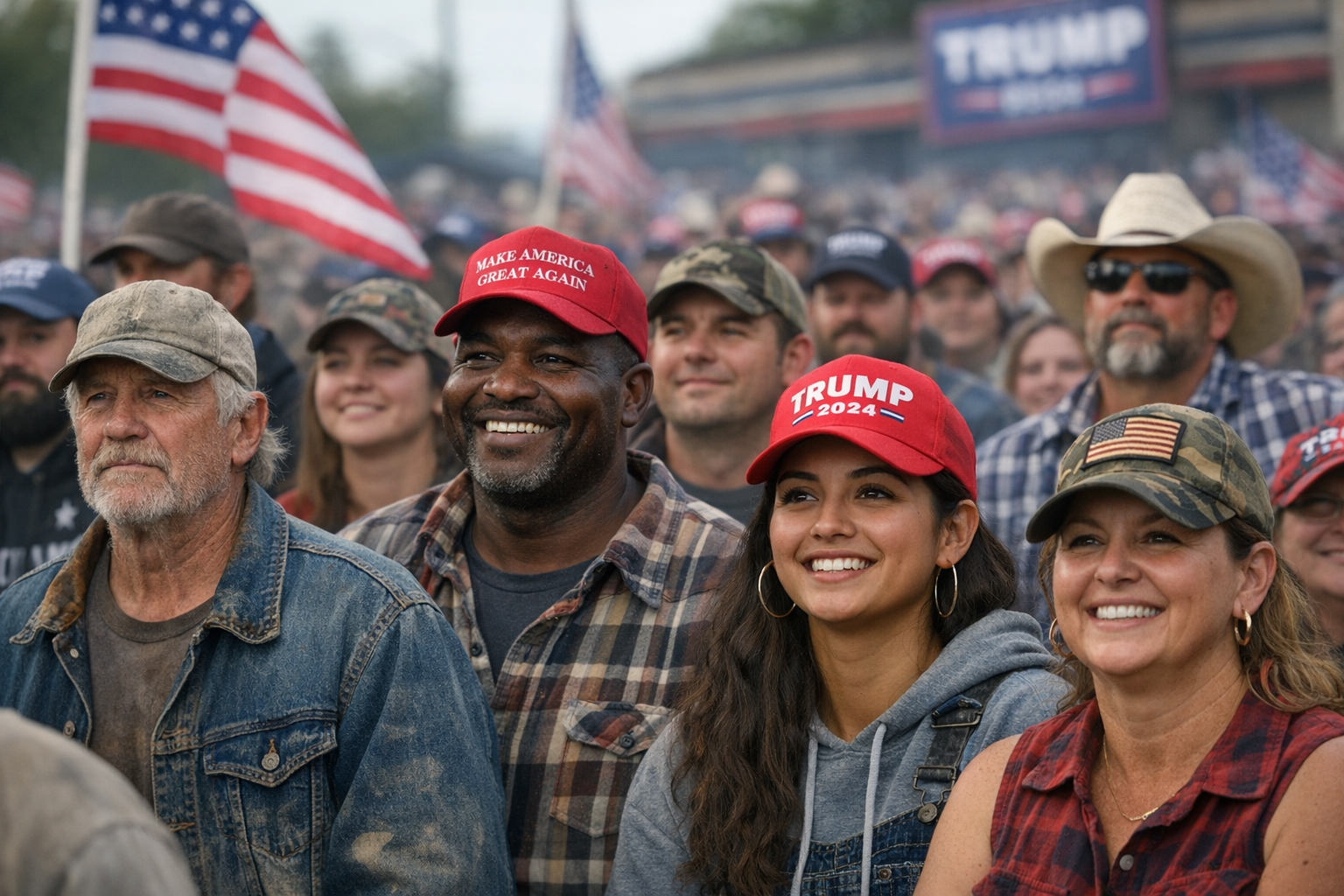
Post‑2024 analyses show that Trump’s victory depended less on mass party‑switching than on turnout and margin: Republican‑leaning eligible voters, especially noncollege and rural, simply showed up at higher rates than Democratic‑leaning ones, and Trump expanded his share among key nonwhite and younger male groups.1,3 Brookings work on the “four working‑class votes” underscores that Trump’s biggest 2024 gain was among white evangelical women with college degrees, while he continued to dominate among white working‑class voters and improved with working‑class Black and Latino voters.2 At the same time, Democrats consolidated support among college‑educated, urban, and affluent suburban voters, deepening the perception that they are the party of professionals rather than wage earners.1,2,7 Analysts of rural politics argue that national Democrats have often sounded dismissive or exasperated toward rural and noncollege communities, treating them as lost causes while focusing on high‑income suburbs—an approach that has accelerated working‑class realignment toward Republicans.5,6,8 This mix of structural turnout disadvantage, cultural distance, and perceived disrespect is the terrain on which any 2028 strategy has to be built.
A first pillar is credible economic populism rooted in place, not just in national talking points. Research on 2024 county‑level shifts finds that Trump improved his vote share in nine out of ten counties, with especially strong gains in populous, expensive urban counties and in places with higher immigrant shares, suggesting that economic stress and perceived competition are being channeled through his narrative of grievance and protection.4,14 Brookings and other analysts note that Democrats who emphasize concrete pro‑worker and pro‑family policies—wages, benefits, child care, union rights, local investment—tend to outperform those who lean on abstract macroeconomic claims, even in tough territory.2,5 A 2028 platform that foregrounds visible, local economic wins (factories reopened, broadband built, hospitals saved, apprenticeships funded) and pairs them with a clear story about taking on corporate power and price‑gouging could resonate with both Democratic voters and economically anxious Republicans who feel the system is rigged.2,4,7
A second pillar is integrating democracy protection with order, security, and fairness rather than treating them as separate conversations. Scholars of authoritarian populism emphasize that leaders like Trump gain traction by presenting themselves as the only ones strong enough to restore order against corrupt elites and threatening outsiders, while simultaneously eroding democratic norms.9,11,14 When Democrats talk about democracy solely in procedural terms—norms, institutions, rule of law—they often fail to connect it to everyday concerns about safety, borders, and social stability that many Trump‑leaning voters prioritize. Post‑2024 Democratic autopsies already point to the need to “lean into” economic issues and border security alongside democracy, instead of allowing Republicans to monopolize those themes.8 A 2028 message that frames democracy as the way ordinary people keep both billionaires and politicians in check, choose how safe their communities are, and decide how the border is managed—rather than as an abstract civics lesson—has a better chance of appealing to both Democrats and some Republicans who are uneasy with Trump’s disregard for institutions but still want toughness on crime and immigration.8,9
A third pillar is cultural humility and sustained presence in Trump‑country communities. Field research with Democratic candidates who overperformed in rural and small‑town districts found that their “secret sauce” was not ideological triangulation but deep attentiveness to local concerns, constant in‑person engagement, and a refusal to treat voters as stereotypes.5,6 They focused on “kitchen‑table” issues—jobs, health care, infrastructure, schools—while showing respect for local culture, including gun ownership, faith communities, and skepticism of distant bureaucracies.5,6,8 This does not require abandoning core Democratic commitments on race, gender, or climate, but it does require changing tone: less moralizing, more listening; fewer sweeping cultural judgments, more concrete problem‑solving. If Democrats want to fold knowledge of Trump’s base into their platform, they need to treat those voters as persuadable neighbors with legitimate grievances, not as a monolith of extremists.
Translating these pillars into a 2028 platform means organizing the campaign around a few cross‑cutting themes that can hold the Democratic coalition while inviting in disaffected Republicans and independents. One such theme is “dignity at work and at home”: raising wages, protecting unions, expanding the child tax credit, lowering health‑care and drug costs, and investing in domestic manufacturing and clean‑energy jobs in places that have lost factories and mines.2,4,7 When tied to specific local projects and framed as standing up to corporate price‑gouging and offshoring, this agenda can appeal to progressive Democrats and to Trump‑leaning workers who feel exploited by both parties.2,4 Another theme is “reviving communities”: saving rural hospitals, funding addiction and mental‑health treatment, fixing roads and bridges, and guaranteeing high‑speed internet—policies that rural strategists argue are essential to rebuilding trust.5,6,8
A third theme could be “fair rules for everyone,” which links democracy, law enforcement, and immigration. That would mean promising to enforce anti‑corruption rules on politicians of both parties, protect the integrity of elections, and support law enforcement while insisting on accountability and constitutional limits.8,9 On immigration, it would mean acknowledging border chaos and proposing tougher, more efficient enforcement and asylum processing alongside legal pathways and humane treatment—an approach that research suggests can resonate with a broad swath of voters, including many Latinos who have moved toward the GOP.3,4,73,4,7 If Democrats can talk about democracy, crime, and immigration in a vocabulary of fairness and order rather than only of rights and symbolism, they are more likely to reach Republicans who are uncomfortable with Trump’s extremes but still want a sense of control over national boundaries and local safety.
Substance alone will not be enough; style and organization matter. Analysts of Trump’s appeal stress that his power lies partly in emotional connection: he validates anger and resentment, uses simple, repetitive language, and offers a clear “us versus them” story in which his supporters are the virtuous people betrayed by elites.11,12,14 Democrats do not need to imitate that style, but they do need a narrative that is equally legible and emotionally grounded. That might center on “the people who keep America running”—nurses, truck drivers, teachers, line workers, small‑business owners—and on a promise to put them ahead of “the people who rig the rules”—lobbyists, monopolies, and corrupt politicians.2,7,14 It also requires investing early and consistently in local organizing in rural, exurban, and working‑class communities, not just parachuting in during presidential years. Post‑2024 reporting already shows Democratic officials poring over data, reevaluating digital strategy, and acknowledging the need to rebuild relationships with working‑class voters, especially Latino men and others without college degrees.8,10 Turning that recognition into a 2028 advantage will mean shifting resources from persuasion ads aimed at already‑engaged college‑educated voters toward long‑term organizing and candidate recruitment in places where Trump’s base lives.
Taken together, the recent research suggests that Trump’s power is not a mysterious wave but a durable coalition anchored in working‑class discontent, cultural anxiety, and a desire for strong leadership that “fights for us” against elites.1,2,9,14 For Democrats to stand a serious chance in 2028, they need to accept that many of Trump’s voters are not moving back automatically; they must be given a concrete, emotionally resonant alternative that respects their experiences while drawing a sharp line on authoritarianism. That means centering a pro‑worker, pro‑community economic agenda; integrating democracy with order and fairness; practicing cultural humility; and building a simple, hopeful story about shared dignity and honest rules. If Democrats can do that consistently over the next four years, the data from 2024—where shifts of less than a percentage point in key states could have changed the outcome—suggest that they do not need to win Trump’s base outright; they need to narrow his margins, boost their own turnout, and peel off a modest but meaningful share of voters who are open to a different kind of strength.1,2,4,10
References
- Pew Research Center, “Behind Trump’s 2024 Victory, a More Racially and Ethnically Diverse Voter Coalition,” June 26, 2025.
https://www.pewresearch.org/politics/2025/06/26/behind-trumps-2024-victory-a-more-racially-and-ethnically-diverse-voter-coalition/(pewresearch.org in Bing) - John J. DiIulio Jr., “The 4 Working-Class Votes,” Brookings, December 2, 2024.
https://www.brookings.edu/articles/the-4-working-class-votes/(brookings.edu in Bing) - Associated Press, “How 5 Key Demographic Groups Voted in 2024: AP VoteCast,” November 2024.
https://apnews.com/article/2024-election-trump-harris-votecast-demographics-(apnews.com in Bing) - Sarah Eckhardt, Connor O’Brien, and Ben Glasner, “The Economic Geography of the 2024 Elections,” Economic Innovation Group, November 15, 2024.
https://eig.org/news/the-economic-geography-of-the-2024-elections/(eig.org in Bing) - Erica Etelson and Anthony Flaccavento, “It’s Not Too Late for Democrats to Win Back Rural Voters,” The Democratic Strategist (reposted from The Nation), May 17, 2024.
https://thedemocraticstrategist.org/2024/05/etelson-and-flaccavento-how-dems-can-win-back-rural-voters/(thedemocraticstrategist.org in Bing) - Christian Paz, “Democrats Have a Huge Opportunity to Win Back Rural Voters,” Vox, May 12, 2023.
https://www.vox.com/politics/2023/5/12/23718252/democrats-rural-voters-2024-election(vox.com in Bing) - Alex Seitz-Wald, “Democrats Have Been Losing Working-Class Voters. Here’s One Playbook to Win Them Back,” NBC News, September 16, 2024.
https://www.nbcnews.com/politics/2024-election/democrats-losing-working-class-voters-playbook-win-back-rcna95230(nbcnews.com in Bing) - Nick Reisman, Shia Kapos, and Holly Otterbein, “Democrats Begin Plotting Their Post-Trump Comeback,” Politico, November 24, 2024.
https://www.politico.com/news/2024/11/24/democrats-plot-post-trump-comeback-00179843(politico.com in Bing) - Lila Thulin, “There’s a Term for Trump’s Political Style: Authoritarian Populism,” Berkeley News, January 21, 2025.
https://news.berkeley.edu/2025/01/21/theres-a-term-for-trumps-political-style-authoritarian-populism/(news.berkeley.edu in Bing) - Frank Faiola, “Trump’s Appeal & the Future of US Democracy?” November 11, 2024.
https://www.frankfaiola.com/post/trump-s-appeal-the-future-of-us-democracy(frankfaiola.com in Bing)
###
Filed under: Uncategorized |


 Educational Technology and Change Journal

Leave a comment