


By Jim Shimabukuro (assisted by Claude)
Editor
[Related: Top Republican and Democratic Presidential Candidates for 2028: As of 5 April 2026, Dark Horse 2028 Presidential Candidates: As of 5 April 2026]
“Shadow Ruler”: Does the Term Fit?
The phrases “shadow ruler” and “shadow government” are already circulating in mainstream political discourse, though they have been applied so far primarily to figures operating within Trump’s current administration rather than to Trump himself as a future out-of-office actor. ProPublica investigative reporter Andy Kroll has used the precise term “shadow president” to describe Russell Vought, Trump’s director of the Office of Management and Budget, characterizing him as “basically a second commander-in-chief, a shadow president” within the second Trump term.1 Brewminate, drawing on that reporting, extended the concept further, describing how Vought has built what some in Washington describe as a “government-in-waiting,” a network of conservative think tanks, legal operatives, and former staffers who now serve as the brain trust for Trump’s second term.2 If such a structure already exists around Trump while he is in office, the question of whether Trump himself could assume a comparable shadow role after January 2029 is not merely hypothetical — it follows a logic already visible in the architecture of MAGA governance.
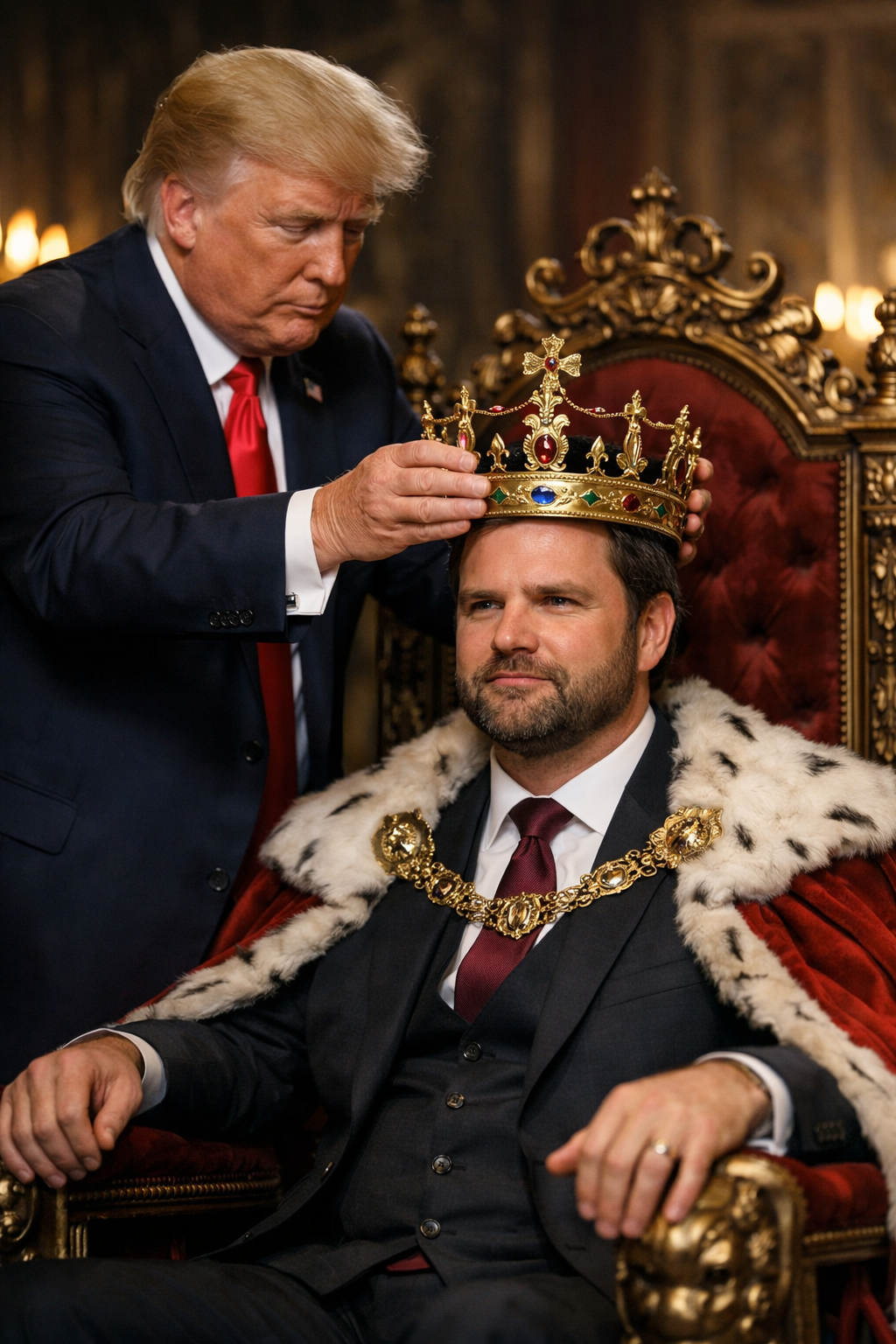
Should Trump play a decisive role in electing his chosen successor in 2028, the phrases “shadow ruler” and “shadow government” would apply with reasonable accuracy to his post-presidential configuration of power, with important caveats. A “shadow government” in the strictest political science sense refers to a parallel governing structure that exercises real decision-making authority while remaining outside formal constitutional channels. What Trump would represent in 2029–2032 is something closer to a “shadow ruler” — a figure whose personal authority, ideological brand, and control over the Republican Party’s primary infrastructure would give him leverage over a nominally independent president. The distinction matters: Trump would not be governing through bureaucratic machinery he controls (as Vought does now) but rather through a more diffuse, personality-driven web of loyalty, media access, and implicit threat.
The 2028 Election as Succession Contest
The 2028 presidential election is already being shaped by Trump’s gravitational pull, even as his formal eligibility for that office is constitutionally foreclosed. Trump is ineligible for a third term, as the term limits imposed by the Twenty-second Amendment to the United States Constitution prohibit presidents from being elected more than twice.3 Despite this, when the 2028 Republican National Convention takes place, 16 years will have passed since the party nominated someone other than Trump. In this new era, the measure for Republican candidates is whether they support or oppose Trump.4 This means the 2028 Republican nomination contest is, in effect, a competition for Trump’s blessing rather than a contest of independent political visions.
As of early 2026, for months, Vance has been seen as the front-runner to become the 2028 GOP nominee, a dynamic underscored by most public polling and Trump’s own comments.5 Secretary of State Marco Rubio has also been elevated by the Iran conflict and other high-profile foreign policy moments. Despite signaling that Vice President JD Vance and Secretary of State Marco Rubio could be the heirs to his coalition, Trump this week evaded pointing to either man directly, simply saying he believes Republicans have a strong bench for 2028.6 A Republican political consultant aptly captured Trump’s motive in this ambiguity: “Trump also wants to play kingmaker,” with the dangled endorsement serving as a lever of control over the entire field.6 One analysis from The Hill argued that Trump will be “the most vocal, intrusive lame-duck president in history” once the race to crown a 2028 GOP nominee begins in the wake of this year’s midterms.7
How the Shadow Role Might Play Out, 2029–2032
If Trump successfully installs a loyalist — most likely Vance, Rubio, or another proven MAGA figure — in the White House in January 2029, the mechanics of his shadow influence would operate through several interlocking channels. The first and most immediate is the endorsement and primary threat mechanism. Trump’s endorsements still carry immense weight in solid-red districts, and whether Trump still holds the power to make or break Republican hopefuls will define not only the 2026 primaries but also the GOP’s readiness for 2028.8 A successor who owes their presidency to Trump’s imprimatur would enter office knowing that a public break with the former president could invite a primary challenge, a media assault via Truth Social, or a fracturing of the MAGA base ahead of a reelection bid in 2032. This creates structural deference without requiring any formal arrangement.
The second channel would be media and rally power. Trump’s relationship with conservative media — and his capacity to convene enormous physical audiences — would remain potent throughout any successor’s term. For MAGA supporters, that leadership is personalized almost entirely in Trump. His dominance is not ideological, but symbolic. It is a projection of strength, revenge, and transgression against political correctness and institutional norms.9 This means that a successor president’s political standing among the Republican base would remain partly contingent on Trump’s continued approval, creating a feedback loop in which the new president must constantly manage the former president’s ego and preferences. When asked who they believe tells them the truth, 71% of Trump voters picked him, more than picked friends and family members (63%), right-wing media commentators (56%), and religious leaders (only 42%).10 That level of epistemic authority over tens of millions of voters is precisely what transforms Trump into a potential shadow ruler: he would retain the power to define reality for the Republican electorate regardless of what the elected president says or does.
Third, Trump’s shadow would extend through personnel and ideological infrastructure. The Center for Renewing America, Vought’s think tank, and the broader Project 2025 apparatus — a think tank devoted to keeping the MAGA movement alive and preparing for a second Trump presidency — would likely be repurposed as vehicles for keeping loyalists embedded throughout the executive branch and for providing policy blueprints to whichever Republican wins in 2028.11 Figures who rose to prominence under Trump would populate a successor administration, ensuring that ideological continuity is maintained structurally even if Trump himself has no formal role. In 2025, the president consolidated executive authority by pushing the boundaries of the law, usurping powers traditionally left to Congress, the courts, and the states, and launching a sweeping purge of America’s professional bureaucracy, replacing career civil servants with political appointees personally loyal to the President.12 Those loyalists, once placed, would not necessarily depart simply because Trump left office; they would constitute a durable MAGA administrative state.
Fourth, Trump could leverage family political dynasty as a secondary vehicle of influence. Trump Jr. has repeatedly flirted with the idea of a future presidential run. “I don’t know. Maybe one day, you know, that calling is there,” Trump Jr. said at the Qatar Economic Forum. “Maybe. You never know,” he added when pressed about 2028 ambitions.13 While he has since walked those comments back, the mere possibility of a dynastic succession keeps the Trump brand central to Republican politics well beyond any individual term.
The Twenty-Second Amendment: Barrier, Loophole, and Long-Term Outlook
The single greatest threat to Trump’s formal return to office is the Twenty-Second Amendment, and the consensus among constitutional law scholars is that it presents a near-insurmountable obstacle. “I don’t think there’s any realistic possibility that the 22nd Amendment could be repealed,” said Kermit Roosevelt, a constitutional law professor at the University of Pennsylvania. “That would take another amendment and I don’t think it would get 2/3 of both houses of congress, much less 3/4 of the states.”14 The formal amendment process requires a two-thirds vote of both chambers of Congress and ratification by three-quarters of all states — a threshold that even Trump’s current congressional majority cannot approach. Amending the Constitution to abolish the two-term limit would be exceedingly difficult, requiring either a two-thirds vote of Congress or two-thirds of the states agreeing to call a constitutional convention to propose changes.15
Several theoretical workarounds have been floated and subsequently dismissed. Trump himself ruled out the vice-presidential succession maneuver — in which Vance would win the presidency, then resign to make Trump president — calling it “too cute,” saying people “wouldn’t like that” and that “it wouldn’t be right.”16 The Columbia Undergraduate Law Review identified three theoretical avenues — direct repeal, the VP succession path, and a war-powers claim — but noted that the 12th Amendment’s language complicates each of them.17 Professor Paul Gowder of Northwestern’s Pritzker School of Law characterized the vice-presidential “loophole” argument as “pretty implausible,” adding that it “defeats the clear intent of the 22nd Amendment.”14 The university-level analysis in LSE USAPP Blog catalogued how global leaders have historically overcome term limits, finding that a constitutional amendment is the most common method but succeeds only about 60 percent of the time even in countries with far weaker constitutional protections than the United States.18
The realistic long-term outlook, then, if the amendment repeal effort fails — as virtually all serious observers expect — is that Trump’s post-2028 power will be of the informal, influence-broker variety rather than the formal, office-holding variety. More conceivable is that he handpicks a successor, plays kingmaker, and retains some measure of control from the sidelines. This preserves his influence while allowing him to appear magnanimous, even as he continues to shape the Republican agenda.19 The Atlantic Council’s analysis of Trump’s legacy noted a structural vulnerability in that model: “Successful political movements outlive their founders. New Deal liberalism outlasted Roosevelt. Postwar conservatism survived Reagan. Trumpism appears to be dependent on Mr. Trump” himself — suggesting that the movement’s durability without him as its living center is genuinely uncertain.20
The Sources of Trump’s Political Power: Best Explanations
Any credible analysis of Trump’s shadow influence must grapple with the question of why his power is so durable. Several explanations, grounded in peer-reviewed research and credible reporting, stand out.
The most compelling explanation is the personality cult dynamic. Research published in Political Psychology and summarized in Scientific American found that support from a “personality cult” — something his would-be successors lack — has been essential for Trump’s political success, with an identifiable hard core of extremely loyal Trump supporters showing unquestioning loyalty to a strong leader whom they perceive as infallible and truthful, with devotion that has religious parallels.21 A January 2025 CNN-SSRS poll found that 53% of Republicans viewed loyalty to Trump as central to their political identity and very important to what being a Republican is, beating values such as “a less powerful federal government (46%), supporting congressional Republicans (42%) or opposing Democratic policies (32%).”22 This data point is perhaps the single most important structural explanation for Trump’s enduring power: his hold on Republican identity is not issue-based but identity-based, which means economic setbacks, policy failures, or legal difficulties alone are unlikely to dissolve it.
A second explanation is charismatic authority rooted in transgression. Scholars Elizaveta Gaufman and Adrian Favero, writing in The Loop (ECPR), argue that it is precisely his transgressive behaviour that feeds Trump’s charismatic authority, noting that the cult-like devotion of Trump loyalists “is reminiscent of darker times in US history.”23 To sustain charismatic authority, a leader must constantly prove that he is “the master willed by God,” and Trump’s public persona — confrontational, victimized, and defiant — perpetually generates the theatrical moments required to sustain that perception.
Third is the asymmetric information loyalty effect. Empirical research published in the journal Societies found that Trump’s supporters consistently shifted their attitudes to more closely match ostensible opinions and the real-life interests of Trump, whereas even Trump’s strongest detractors did not reflexively oppose Trump, demonstrating a measurable and systematic bias in how his base processes information.24 This asymmetry means that Trump can shift positions, contradict himself, or endorse contradictory policies without losing core supporters — a cognitive flexibility that no other Republican politician commands.
Fourth, Trump’s power derives from his control over the Republican primary system. Sitting presidents going back to former Presidents Richard Nixon and Franklin Roosevelt have played the role of power broker when it comes to picking and choosing candidates in key races, but Trump’s approach is being done in a much more public fashion.25 His endorsement record in Republican primaries has been formidable, and the fear of a primary challenge backed by Trump functions as a disciplinary mechanism across the entire congressional Republican caucus, ensuring that elected officials govern with one eye on his approval at all times.
Structural Limits and the Twilight of Trumpism
Despite the architecture of shadow influence described above, there are genuine structural reasons to expect Trump’s post-presidential power to erode. Approval of his current presidency has already slipped significantly: approval of Trump’s presidency has fallen by 8 points to 42.4%, while disapproval has risen by 10 points to 54.9%, with the decline seeming to accelerate, and with the groups that shifted toward Trump during the 2024 election — especially Hispanics, independents, and young adults — expressing their disappointment with his performance.26 An aging and ailing former president, without the authority of the Oval Office, the power of executive orders, or control over the federal budget, would be a diminished figure compared to what he is today. As Time’s Ian Bremmer observed, in 2025, 2025 marked the peak of unilateral Trump on the global stage.12
Moreover, a successor president would face intense pressure from their own political incentives to gradually differentiate themselves from Trump. Vance, Rubio, or any other 2028 winner would need to build their own independent political brand to win reelection in 2032 — and that process inherently involves a slow distancing from the previous president. The successor’s need for autonomy and Trump’s need for dominance are structurally in tension, and that tension would likely produce a gradual but real erosion of Trump’s shadow authority over the 2029–2032 period, accelerating as the 2032 election approaches and the new president seeks to claim the MAGA mantle as their own rather than as a borrowed one.
The long-term outlook, absent a successful constitutional amendment, is a Trump who begins 2029 as the most powerful figure in Republican politics short of the sitting president, who retains the capacity to intervene disruptively in the 2030 midterms and the early 2032 primary season, but whose influence contracts as the successor consolidates power, as the MAGA movement’s internal succession dynamics play out, and as the actuarial realities of a man who would be 86 years old at the end of a 2032 presidential term become unavoidable. The shadow would be long, but not permanent.
References
- Andy Kroll, “Shadow President: Project 2025 Architect Russell Vought Is Using Shutdown to Gut Federal Agencies,” Democracy Now! — https://www.democracynow.org/2025/10/21/russell_vought_propublica_shadow_president
- “Trump’s Decline and the Rise of a Shadow Government,” Brewminate — https://brewminate.com/the-nodfather-trumps-decline-and-the-rise-of-a-shadow-government/
- “2028 United States Presidential Election,” Wikipedia — https://en.wikipedia.org/wiki/2028_United_States_presidential_election
- Myra Adams, “2028 GOP Nomination: Chaos, Trump, and Contenders,” The Hill — https://thehill.com/opinion/campaign/5813119-trump-era-gop-chaos-2028/
- Jonathan Allen et al., “Iran War Elevates Marco Rubio in Trump’s 2028 Succession Jockeying,” NBC News — https://www.nbcnews.com/politics/2028-election/iran-marco-rubio-trump-2028-succession-jd-vance-rcna261794
- “Trump Plays Coy Again on 2028 GOP Successor,” Washington Examiner — https://www.washingtonexaminer.com/news/white-house/3910277/trump-lame-duck-era-2028-gop-field/
- “‘Cue the Chaos’: How Trump’s Successor Could ‘Blow Up’ MAGA’s 2028 Decision,” Alternet — https://www.alternet.org/trump-successor-2676661411/
- “Is the Trump Endorsement Kingmaker or Kiss of Death in 2026?” Campaign Now — https://www.campaignnow.com/blog/is-the-trump-endorsement-kingmaker-or-kiss-of-death-in-2026
- “When a Cult Goes Mainstream: Inside the Toxic Psychological Engine of Trump’s MAGA Movement,” Milwaukee Independent — https://www.milwaukeeindependent.com/explainers/cult-goes-mainstream-inside-toxic-psychological-engine-trumps-maga-movement/
- “The MAGA Cult,” The Politics Shed — https://sites.google.com/site/thepoliticsteacherorg/the-maga-cult
- Andy Kroll, “What You Should Know About Russ Vought, Trump’s Shadow President,” ProPublica — https://www.propublica.org/article/about-russell-vought-trump-shadow-president
- Ian Bremmer, “How Trump’s Power Will Be Checked in 2026,” TIME — https://time.com/7340453/trump-2026-look-ahead/
- “7 Most Likely Successors to Trump in 2028,” The Hill — https://thehill.com/homenews/campaign/5316981-trump-2028-successor-candidates-rumors/
- “Legal Scholars Dispute Constitutional ‘Loophole’ for a Third Trump Term,” FactCheck.org — https://www.factcheck.org/2025/04/legal-scholars-dispute-constitutional-loophole-for-a-third-trump-term/
- “Trump Tells NBC News ‘There Are Methods’ for Seeking a Third Term,” NBC News — https://www.nbcnews.com/politics/donald-trump/trump-third-term-white-house-methods-rcna198752
- “Trump Keeps Flirting with the Idea of a Third Term. That Would Be Unconstitutional,” NPR — https://www.npr.org/2025/10/30/nx-s1-5590293/trump-2028-third-term-constitution
- “The 22nd Amendment and Trump’s Possible Path to Reelection,” Columbia Undergraduate Law Review — https://www.culawreview.org/current-events-2/the-22nd-amendment-and-trumps-possible-path-to-reelection
- Tim Horley and Mila Versteeg, “How Donald Trump Could Overcome the 22nd Amendment and Get a Third Term in 2028,” LSE USAPP Blog — https://blogs.lse.ac.uk/usappblog/2025/11/11/how-donald-trump-could-overcome-the-22nd-amendment-and-get-a-third-term-in-2028/
- Phil Chen, “How President Trump Could Get a Third Term,” The Hill — https://thehill.com/opinion/5229276-trump-third-term-potential/
- Frederick Kempe, “The Most Significant Question for Trump’s America in 2026: What Sticks?” Atlantic Council — https://www.atlanticcouncil.org/content-series/inflection-points/the-most-significant-question-for-trumps-america-in-2026-what-sticks/
- “Trump’s Personality Cult Plays a Part in His Political Appeal,” Scientific American — https://www.scientificamerican.com/article/trumps-personality-cult-plays-a-part-in-his-political-appeal/
- “Trumpism,” Wikipedia — https://en.wikipedia.org/wiki/Trumpism
- Elizaveta Gaufman and Adrian Favero, “Explaining the Trump Loyalty Cult Phenomenon,” The Loop (ECPR) — https://theloop.ecpr.eu/explaining-the-trump-loyalty-cult-phenomenon/
- “Seeking Evidence of the MAGA Cult and Trump Derangement Syndrome,” Societies (MDPI) — https://www.mdpi.com/2075-4698/11/3/113
- “Trump’s Influence Grows in GOP Primary Races,” The Hill — https://thehill.com/homenews/campaign/5770185-trump-endorsements-gop-primaries/
- William A. Galston, “As President Trump Loses Support, Republican Prospects in the 2026 Midterms Grow Darker,” Brookings Institution — https://www.brookings.edu/articles/as-president-trump-loses-support-republican-prospects-in-the-2026-midterms-grow-darker/
###
Filed under: Uncategorized |


 Educational Technology and Change Journal

Leave a comment