


By Jim Shimabukuro (assisted by Claude)
Editor
When Donald Trump published The Art of the Deal in 1987 — a memoir and business-advice hybrid ghost-written by journalist Tony Schwartz — few could have predicted that its eleven negotiating principles would one day be road-tested against a geopolitical chokepoint carrying a fifth of the world’s oil supply.1 Yet that is precisely what has unfolded in the spring of 2026, as Trump cycled through threats, deadlines, retreats, and ultimatums in his effort to reopen the Strait of Hormuz after a U.S.-Israeli military campaign against Iran effectively closed it to commercial shipping.2 The episode has galvanized a body of serious scholarship that identifies a direct throughline between Trump’s boardroom instincts and his conduct of international conflict resolution — and has surfaced instructive historical parallels in the careers of past American presidents and world leaders.
The most rigorous academic treatment of Trump’s negotiating DNA comes from Eugene B. Kogan, writing in the Negotiation Journal (published by MIT Press), who argues that Trump’s coercive style is best understood through four overlapping public roles: observer, performer, controller, and disrupter.3 In Kogan’s framework, Trump’s primary tool is the identification and exploitation of vulnerability — he spots what his counterpart most needs, then uses leverage to threaten that weakness while deploying bravado to dramatize the benefits of capitulation on his terms.3 Kogan also documents that strategic ambiguity has been a defining element of this toolkit from the beginning. Before running for president, Trump wrote: “never let anyone know exactly where you’re coming from,” and declared on the campaign trail, “I want to be unpredictable.”3 This cultivated unpredictability — keeping adversaries uncertain about how far he will actually go — is the connective thread running through almost every international confrontation he has entered.
Jim Schleckser, writing for Inc. magazine, identifies the technical term for Trump’s opening-bid strategy: “anchoring high.”4 Studies have found that extreme opening positions — however unrealistic — can shift the final settlement toward that starting point, and extreme positions are Trump’s acknowledged speciality.4 Australian journalist Aaron Patrick, writing in The Nightly, applies this concept directly to the Iran-Hormuz crisis, noting that Trump’s threats — including a pledge to destroy Iran’s largest nuclear power plant within 48 hours if the strait was not reopened — follow the classic pattern of shock positions designed to shift the eventual settlement point toward the aggressor’s preference.5 Patrick further observes that Trump employs what The Art of the Deal calls “truthful hyperbole”: calculated exaggeration wielded to make an adversary perceive the threatener as stronger and more committed than he may actually be.4 In the Iran case, Trump threatened that “a whole civilization will die tonight, never to be brought back again” if no deal materialized by his self-imposed deadline — language that, as Axios reported, may have temporarily disrupted rather than advanced negotiations by prompting Tehran to sever direct communications.6
A broader political-science analysis published in Congress & the Presidency argues that the success of Trump’s deal-making approach depends on three structural variables: the nature of his counterpart, the expected frequency of future interactions, and the respective positions of the status quo and reversion points in a given negotiation.7 The study posits that Trump’s approach is most likely to produce results in foreign policy — where the president enjoys wide executive latitude and the counterpart is a discrete sovereign actor — and least likely to succeed in domestic lawmaking, where veto players are numerous.7 The Iran crisis offers a complex verdict on this hypothesis. Trump commanded overwhelming military and economic leverage, yet Iran — unlike a real-estate counterparty — held an asymmetric card his philosophy was never designed to handle: the ability to impose costs on the global economy simply by mining a narrow waterway, regardless of the bilateral negotiation’s outcome.8 Fortune magazine encapsulated the paradox memorably: the Strait of Hormuz “has no CEO to bully, no bondholder to threaten, and no shareholders to absorb the loss. It cannot be restructured. It cannot be taken into bankruptcy.”8
The academic journal Negotiation and Conflict Management Research published a multi-author symposium in 2025 examining Trump’s tariff campaign through the same analytical lens, with contributors including Horacio Falcão, Rodrigo Gouveia, and Chin-Chung Chao identifying a cluster of classical negotiation mechanisms at work: distributive framing, anchoring and reference-point manipulation, BATNA management, coercive diplomacy, deadline pressure, and strategic unpredictability.9 The symposium’s editors note that Trump makes otherwise abstract academic concepts “unusually visible” precisely because he deploys them so overtly and at such consequential stakes.9 CNN’s Stephen Collinson frames the central tension: Trump’s dealmaking works well when the counterpart is a fellow businessperson who understands the game and has clear financial interests — as when Trump offered Apple CEO Tim Cook an exemption from steep Chinese tariffs following a personal call — but encounters its limits when the opposing party is a sovereign government with domestic constituencies and points of national honor that no financial pressure can dissolve.10
It is important to recognize that Trump did not invent coercive, pressure-first diplomacy. Several prior American presidents employed structurally similar methods, though with different philosophical underpinnings. The most frequently cited historical parallel is Richard Nixon, who — guided by National Security Advisor Henry Kissinger — developed what Kissinger theorized as “linkage”: making progress in one area of U.S.-Soviet relations explicitly conditional on concessions in another, wielding the permanent threat of disengagement as a lever.11 Nixon also deliberately cultivated the “Madman Theory,” a strategy of feigning irrationality and unpredictability so that adversaries — North Vietnam and the Soviet Union foremost among them — would fear an unhinged nuclear response and moderate their own behavior accordingly.12
Nixon’s chief of staff H.R. Haldeman recorded Nixon explaining the logic directly: “I want the North Vietnamese to believe I’ve reached the point where I might do anything to stop the war.”12 The structural kinship with Trump’s approach is plain; scholars have explicitly grouped Nixon and Trump as practitioners of this posture, though analysts such as Jonathan Stevenson have argued in The New York Times that Trump’s version may be less effective precisely because extreme threats are his routine “standard operating procedure,” rather than a departure from an otherwise rational baseline that might lend such threats more credibility.12
Nixon’s triangular diplomacy — playing China and the Soviet Union against each other to extract concessions from both — is another structural ancestor of Trump’s multi-front pressure tactics. As the U.S. State Department’s Office of the Historian documents, Kissinger and Nixon used the “China card” so adroitly that, immediately after announcing Nixon’s planned Beijing visit, Soviet Ambassador Anatoly Dobrynin conveyed Moscow’s suddenly renewed interest in a summit that had previously been stalled.13
Reagan, for his part, employed a version of negotiate-from-strength diplomacy, rebuilding American military capacity in his first term specifically to increase leverage before engaging Mikhail Gorbachev, ultimately producing the 1987 Intermediate-Range Nuclear Forces Treaty — the deepest nuclear weapons cuts ever achieved at that time.14 The Heritage Foundation has argued, however, that Trump’s engagement with Russia differs fundamentally from Kissinger’s model because the geopolitical triangles have rotated: where Nixon used China to pressure Russia, Trump is exploring the inverse — using Russia to complicate China’s position in the Indo-Pacific.15
Among contemporary world leaders, the figure most frequently compared to Trump’s Art of the Deal style is Israeli Prime Minister Benjamin Netanyahu, whose maximalist opening positions, manipulation of deadlines, and use of military action as a bargaining instrument mirror Trump’s methods closely. This convergence was on vivid display throughout the Iran campaign, where the two leaders coordinated both military strikes and diplomatic ultimatums.16 The Arab Center DC has noted that it was apparently Israel’s fear of a diplomatic settlement — one that might have foreclosed military options — that reportedly drove the timing of the February 28, 2026 attack on Iran even as negotiations were making genuine progress.16 This itself reflects a classic dealmaker’s logic: destroy the opponent’s best alternative before they can exercise it.
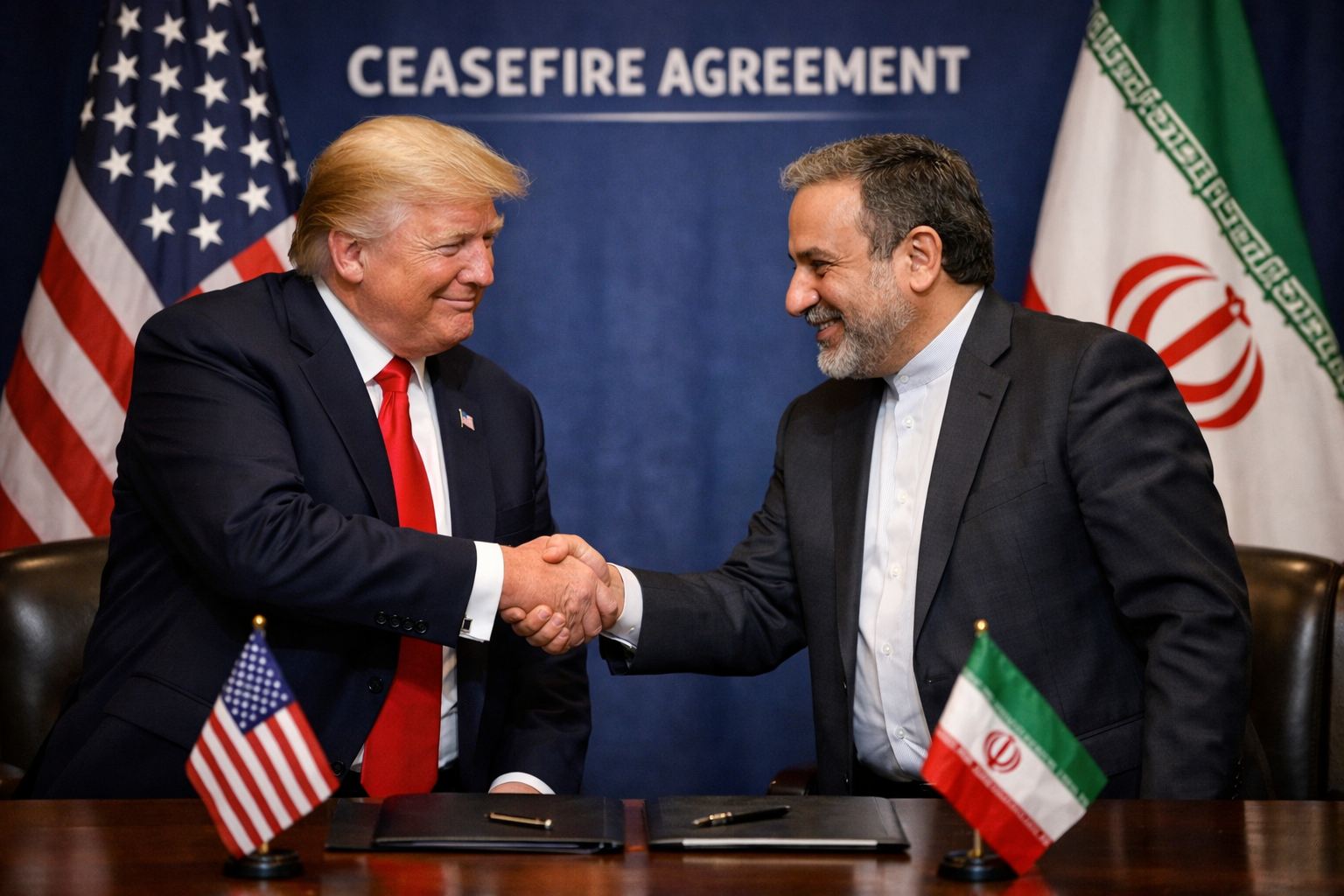
Across the full arc of the Iran crisis — from Trump’s maximum pressure campaign reinstated in February 2025,17 through five rounds of nuclear talks in Oman and Rome,18 through the military strikes, the mining of the strait, the apocalyptic threats, and the two-week ceasefire brokered by Pakistan on April 7–8, 202619 — the Art of the Deal template is legible at every stage. Trump made maximalist demands (zero uranium enrichment), applied overwhelming military and economic pressure, set a hard deadline, threatened annihilation, received Iran’s ten-point counter-proposal, declared it “not good enough,” and then within hours accepted it as “a workable basis on which to negotiate”20 — a pivot that looks, to the trained eye, exactly like a negotiator who has achieved his anchoring effect and is now prepared to make visible concessions toward a pre-determined middle ground.4 White House press secretary Karoline Leavitt framed it in pure deal-making terms: “The success of our military created maximum leverage, allowing President Trump and the team to engage in tough negotiations that have now created an opening for a diplomatic solution and long-term peace.”21
Whether the two-week pause leads to a durable resolution, or whether — as Foreign Affairs analysts Ilan Goldenberg and Nate Swanson cautioned in January 2026 — Trump’s oscillation between diplomacy and belligerence will once again produce “performative negotiations” rather than a real settlement, remains to be seen.22 What is beyond serious dispute is that the Iran/Strait of Hormuz confrontation has become the most consequential and best-documented case study yet of The Art of the Deal as a framework for international conflict resolution — its methods visible, its limits exposed, and its outcome still unwritten.
References
1. The Art of the Deal, Wikipedia, continuously updated. https://en.wikipedia.org/wiki/The_Art_of_the_Deal
2. 2025–2026 Iran–United States Negotiations, Wikipedia, continuously updated. https://en.wikipedia.org/wiki/2025%E2%80%932026_Iran%E2%80%93United_States_negotiations
3. Art of the Power Deal: The Four Negotiation Roles of Donald J. Trump, Negotiation Journal (MIT Press), vol. 35, no. 1, pp. 65–83, 2019. https://direct.mit.edu/ngtn/article/35/1/65/121440/Art-of-the-Power-Deal-The-Four-Negotiation-Roles
4. Negotiating Like Trump: Power, Pressure, and Unpredictability, Inc., March 5, 2025. https://www.inc.com/jim-schleckser/negotiating-like-trump-power-pressure-and-unpredictability/91155929
5. Donald Trump Is Playing the Art of the Deal with Iran on a World Scale, The Nightly, April 1, 2026. https://thenightly.com.au/opinion/aaron-patrick-donald-trump-is-playing-the-art-of-the-deal-with-iran-on-a-world-scale-c-22086233
6. Iran Talks Show Glimmer of Progress as Trump Deadline Looms, Axios, April 7, 2026. https://www.axios.com/2026/04/07/iran-negotiations-trump-threat-progress
7. Trump and the Art of Presidential Deal Making, Congress & the Presidency, vol. 51, no. 2, 2024. https://www.tandfonline.com/doi/abs/10.1080/07343469.2024.2329939
8. Trump’s ‘Art of the Deal’ Can’t Reopen the Strait of Hormuz — and It’s Threatening a Recession, Fortune, March 16, 2026. https://fortune.com/2026/03/16/trump-strait-of-hormuz-iran-war-oil-prices-economy/
9. Expert Perspectives on Trump’s Tariff Negotiations, Negotiation and Conflict Management Research, vol. 18, no. 4, 2025. https://ncmr.lps.library.cmu.edu/article/id/1001/
10. Analysis: ‘The Art of the Deal’ Meets Global Reality, CNN Politics, April 24, 2025. https://www.cnn.com/2025/04/24/politics/trump-art-of-the-deal-china-tariffs-russia-ukraine
11. Foundations of Foreign Policy, 1969–1972, U.S. State Department Office of the Historian. https://history.state.gov/historicaldocuments/frus1969-76v01/summary
12. Madman Theory, Wikipedia, continuously updated. https://en.wikipedia.org/wiki/Madman_theory
13. Foundations of Foreign Policy, 1969–1972 — Triangular Diplomacy, U.S. State Department Office of the Historian. https://history.state.gov/historicaldocuments/frus1969-76v01/summary
14. Some Summits Soar, Some Plunge, Foreign Policy, June 11, 2018. https://foreignpolicy.com/2018/06/11/some-summits-soar-some-plunge/
15. No, Trump Is Not Attempting a “Reverse Nixon”, The Heritage Foundation, March 27, 2025. https://www.heritage.org/china/commentary/no-trump-not-attempting-reverse-nixon
16. Trump and Netanyahu’s Iran Gambit: The Strategic Calculations behind Epic Fury, Arab Center DC, March 6, 2026. https://arabcenterdc.org/resource/trump-and-netanyahus-iran-gambit-the-strategic-calculations-behind-epic-fury/
17. Fact Sheet: President Donald J. Trump Restores Maximum Pressure on Iran, The White House, February 4, 2025. https://www.whitehouse.gov/fact-sheets/2025/02/fact-sheet-president-donald-j-trump-restores-maximum-pressure-on-iran/
18. 2025–2026 Iran–United States Negotiations — Nuclear Talks Chronology, Wikipedia, continuously updated. https://en.wikipedia.org/wiki/2025%E2%80%932026_Iran%E2%80%93United_States_negotiations
19. Trump, Iran Agree to Two-Week Ceasefire, Plan to Open Strait of Hormuz, CNBC, April 7, 2026. https://www.cnbc.com/2026/04/07/trump-iran-ceasefire-hormuz-strait.html
20. Trump Pivots from Military Victory to Negotiation with Iran, Dispatches Vance to Pakistan, The Washington Times, April 8, 2026. https://www.washingtontimes.com/news/2026/apr/8/trump-pivots-military-victory-negotiation-iran-dispatches-vance/
21. How Trump Went from Threatening Iran’s Annihilation to Agreeing to a Two-Week Ceasefire in a Day, PBS NewsHour, April 8, 2026. https://www.pbs.org/newshour/world/how-trump-went-from-threatening-irans-annihilation-to-agreeing-to-a-two-week-ceasefire-in-a-day
22. America’s Best Chance to Transform Iran, Foreign Affairs, January 31, 2026. https://www.foreignaffairs.com/iran/americas-best-chance-transform-iran-trump
Filed under: Uncategorized |


 Educational Technology and Change Journal

Leave a comment