Sugata Mitra, MOOCs, and Minimally Invasive Education

Jim ShimabukuroBy Jim Shimabukuro
Editor

Sugata Mitra, winner of the 2013 TED Prize, reminds us that, as educators, we may be so consumed by teaching that we ignore learning, that there’s a fundamental difference between teaching-centered and learning-centered. Mitra is his own best model for his vision of education, or SOLE, for self-organized learning environment. SOLE is a more formal school-based version of Mitra’s earlier hole-in-the-wall (HIW) street learning environment. Both, however, are grounded in his theory of minimally invasive education (MIE).

Mitra is, by training, a physicist, but by temperament, a self-organized learner. The heart of his gift is curiosity, and his scientific training provides the rest. He didn’t begin by studying teaching. Instead, he studied learning. He placed a web-connected computer in a kiosk in a Delhi slum, left it on, invited children to play with it, stepped away, and watched. The question, simply stated, was: Can students learn without teachers?

Hole in the wall

He was amazed to learn that, yes, they can. They learn individually and in small groups, and they teach one another what they have learned. Out of his observations, he drew implications, and the most important is that both teachers and computers are technologies, or media for learning. That is, children can learn from either or both. With this awareness, he realized that in cases where schools and teachers are scarce or unavailable, computers could suffice. The question that remained, however, was: What does this mean, if anything, for traditional models of learning that rely on schools and teachers?  Continue reading

An Online Physical Education Class

[Note: The following was first posted in the ETCJ listserv on 25 March 2013. It was prompted by a discussion in the WCET listserv on “a new online theater course” earlier that morning. -Editor]

It can actually be surprisingly easy to create effective online courses in the “trouble” areas. More than a decade ago the school I directed had an online physical education class. People would pooh-pooh it as ridiculous, and then after I described the content, they would usually say, “Wow! Can I take it?”

A lot of the course was academic, teaching concepts related to fitness. Students started the class with a fitness test. They set goals for improving their fitness, and they set a personal path toward those goals. It was possible that no two students would be doing the same activities. They had periodic tests along the way to check their progress, and they then adjusted their goals and their plans appropriately. There was a final test to see how they had met their goals, and they had to write a reaction and a self-evaluation. What they ultimately learned was how to apply principles of physical fitness to their lives for the rest of their lives.  Continue reading

Don’t Blame Teachers for the Poor State of STEM

[The following is a response to colleagues’ comments, in ETCJ’s staff listserv, re the need for change in the way science is traditionally taught. The discussion was spurred by the 2 Feb. 2013 report, “For Each and Every Child: A Strategy for Education Equity and Excellence,” by the Department of Education’s Equity and Excellence Commission. -Editor]

You have to remember, I got thrown out of schools for doing all of the things that we talk about that are going to be the future. I worked with the White House. The principal called me in and said, “You can’t do this technology stuff in Arlington Schools if you want to stay.” That was not a choice to me. Teachers who did what they were told are still probably working. I was not what the schools wanted, an innovator using technology. You are preaching to the wrong person.

I can’t demonstrate my skills right now. I don’t have a place to do it. Tracy Learning Center in Tracy, CA, is where I worked to help establish advocacy. My benefactor died.

Nysmith School in Herndon, VA, and a few other schools and projects do what I love. NCLB took the steam out of STEM, the science out of the classroom, and the focus away from what was called SMET, now STEM. NCLB took me out of the classroom. I will always remember the discussion.

I was with people who are STEM evangelists in the Nysmith School, which I visited in the NIIAC times. We as a council visited the school back then. Both of the schools are not mainstream. Tracy School is a charter school, K-12, mostly minority kids, very minority. Because the school has a longer day, with another month in the school year, it has to be a charter school. We had a plan.  Continue reading

‘For Each and Every Child’ – A Strategy for Yesterday’s Child

Frank B. WithrowBy Frank B. Withrow

[Note: The following is a response to the 2 Feb. 2013 report, “For Each and Every Child: A Strategy for Education Equity and Excellence,” by the Department of Education’s Equity and Excellence Commission. -Editor]

For some time we have been working around an obsolete model of education with the idea that, if we just somehow make the old model better, education will be better. I do not believe technology blindly applied is the answer, but look at three to five year olds and how they have learned to use iPads without a course in iPad usage.

For Each and Every

Real reform will include the following:

  1. Every child will have an Individual Learning Plan.
  2. Every child will have a mentor teacher.
  3. Schools and educational staff will be open at least ten hours each day and open year round.
  4. High quality digital libraries will be accessible to learners at home and at schools.
  5. Schools will offer laboratories and facilities where learners can work together in teams or individually.
  6. Significant federal research and development funds will be available to create high quality digital learning materials.
  7. Teachers will participate in continuous learning with respect to new curricula materials.
  8. Learners will be scheduled for learning experiences as needed.

WE need to stop tinkering around the old school model that did us well yesterday but is inadequate for today’s digital world.

Continue reading

Impact of Facebook on Deaf Language Users?

Frank B. WithrowBy Frank B. Withrow

It is a sophomoric question, but I will ask it anyway. Is it better to be blind, deaf, or crippled? Of course, the answer is it is better not to have any of these disabilities.

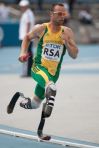
Crippled means that you will have ambulatory limitations. However, if you have lost a leg there are prosthetic legs that can allow you to walk and even to run. Or wheelchairs can restore a degree of mobility. Blindness is also an ambulatory disability. You are to an extent limited in your mobility. You are not likely to own or drive a car, but even this is being made obsolete by modern technologies that are demonstrating self-driving cars. If you are blind you may not become an artist, but even that is marginal.

Oscar Pistorius.

Oscar Pistorius.

In a sense deafness is the hidden disability. Unless a neighbor stops to talk with you, you appear as just another person in the neighborhood. You drive a car, you play catch baseball with friends, and you dance with your girl friend on the patio after eating the steak cooked on the outdoor barbecue set. For all practical purposes you do not appear any different than the average neighbor.

But you are! You did not learn the English language from your mother’s knee. Whether you use American Sign Language or speech read, your language is visual. It requires an ample light source. As a deaf person you cannot easily multitask, that is, carry on a conversation while washing your car because you must see and concentrate on the speaker. Visual-based communication has different parameters than auditory-based language. As a deaf communicator, there must be enough light and you must concentrate on the speaker.

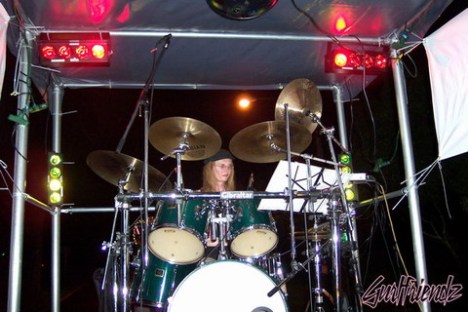
Stephanie Ellison, "a percussionist who happens to be deaf."

Stephanie Ellison, “a percussionist who happens to be deaf.”

As a hearing person I can multitask. I can talk and listen to you while I paint your portrait. As a hearing person I can carry on a conversation with you while I brush my shoes or I can listen to the radio in the dark. Since sounds surround me globally I can carry on a conversation in many different environments. If I am deaf I must have light and I must look at the sender I am communicating with whatever system I use ASL, finger spelling or speech reading. Even captioned TV requires my full attention whereas a hearing person can multitask and still get the meaning of what is on TV. I can iron my shirt and follow the latest news on TV.  Continue reading

Study Suggests the Need for an Intergrated Learning Styles Approach to Calculus

By Jessica Knott
Associate Editor
Editor, Twitter

This week, I had the chance to talk with Dr. Daniel McGee (CV), former middle and high school teacher in Francistown, Botswana, Peace Corps volunteer, and researcher/biostatistician for the Centers for Disease Control in Atlanta, Georgia. Dr. McGee’s work in creating a free, public access online learning system for primary and secondary students in Puerto Rico has gained traction in recent years, becoming the basis for online pre-calculus materials that will now be used in schools throughout Puerto Rico.

As his projects began generating larger and larger data sets, he became interested in exploring the insights they might provide on learning styles, learning types, and learning in general. This interview provides an overview of the motivations behind the study as well as a brief discussion of some of his key findings.

Daniel Lee McGee, Professor, Mathematics, University of Puerto Rico

Daniel Lee McGee, Professor, Mathematics, University of Puerto Rico

JK: What did this study find, exactly? Why is this important?

DM: There were two important results of this study.

Result 1: In general, most efforts to define the categories for learning types have been a priori in nature. Researchers will start with a set of learning types and then will categorize students. This study takes an a posteriori approach to student learning types. We gather a great deal of data on a lot of students. The data comes from questionnaires and results on quizzes and exams from an online learning system. Rather than starting with predefined categories for students, we look for natural groups of students based on similar responses to questionnaires and similar results on quizzes and exams. These natural groupings lend insight into the natural learning styles of the students taking the course. The first result of the study was that students were not scattered randomly, they did form natural groupings. So the vast amount of information available with online learning systems does allow us, at least in Puerto Rico, to identify student learning types in an a posteriori manner.

The vast amount of information available with online learning systems does allow us, at least in Puerto Rico, to identify student learning types in an a posteriori manner.

Importance of result 1: Our results indicate that large groups of students seem to organize themselves into distinct clusters. The ability to identify these clusters and their associated strengths and weaknesses will allow professors with large groups of students using online systems to better address the particular needs of the distinct learning types that are in their class at a particular time.  Continue reading

What Can a Mind Do?

Frank B. WithrowBy Frank B. Withrow

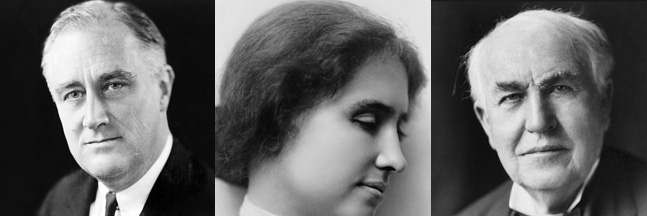
A mind in a crippled body can explore the heights of science and move all mankind forward into new scientific knowledge. Stephen Hawking opens up new scientific vistas. Helen Keller, out of darkness and silence, through words opens new avenues of interpersonal relationships. Blind musicians like Ray Charles and Stevie Wonder bring new melodies into our lives. In yesteryears a President who could not walk bonded us together and inspired us to weather our economic woes and then fight our way through World War II. A deaf man invented electric lights.

Stevie Wonder, Ray Charles, Stephen Hawking

Stevie Wonder, Ray Charles, Stephen Hawking

Electric lights and wearable glasses moved mankind forward. Electric lights enable man to read 24 hours each day, and wearable glasses allow us to see well enough to read throughout our life times. Books and wearable glasses enable mankind to search the wisdom and knowledge of the past.

Franklin Roosevelt, Helen Keller, Thomas Edison

Franklin Roosevelt, Helen Keller, Thomas Edison

The mind can solve the most intricate problem or puzzle. To see, to hear, to feel, to smell and to taste enable the human to know his or her world. The mind organizes these sensory experiences into words and language. Speech and language are public expressions of our private sensory experiences. The voice in our minds organizes our world. If I am blind the world is auditory. If I am deaf my word is visual.

Continue reading