A Caltech Grad in a Caltech MOOC, Part 5

picture of Harry KellerBy Harry Keller
Editor, Science Education

[Note: Harry, who holds a BS in chemistry from the California Institute of Techology and a PhD in analytical chemistry from Columbia University, is sharing his first MOOC experience in this series. See part 1, 2, 3 and 4. -Editor]

The End of My First MOOC Journey

As an audit student, my motivation to finish is not great. I have to ask if drop-out rates mean not taking the final exam because I never intended to punish myself that way when I began. I already have a very good doctorate in science and have no incentive to acquire more initials after my name today.

The last two lectures of the course were both quite technical and, once you penetrate the jargon, quite illuminating. They brought me to the state of the art in machine learning: SVM and RBF.

I was introduced to machine learning decades ago and was interested enough to obtain a book on it, the only book available at the time. This book was heavy on theory and not very useful to a practitioner. Machine learning in those days consisted of just one approach, known today as PLA or Perceptron Learning Algorithm. It was adequate for simpler learning situations and was adjusted to work in others but was not really sufficient.

The machine learning universe expanded with the advent of neural networks, a learning concept that sprang from biological work at the time. Neural networks are still used but not very often.

Today, support vector machines (SVM) and radial basis functions (RBF) represent where machine learning lies. The former requires an advanced mathematics known as quadratic regression (QR). The latter only requires matrix manipulation and iterative processing, both readily available with software.  Continue reading

Proposal for a Holistic Emphasis in K-12

Bob Hoffmann80aBy Bob Hoffmann*

[Note: This article was written in response to Harry Keller’s “Acronym in Cheek: STEM, STEAM…” (11/11/13). -Editor]

Thanks for your insightful article.

This exact question was presented as New Business Item (NBI) #43 to the delegates of the National Education Association (NEA) Representative Assembly (RA) in terms of “ways to integrate the arts into STEM.” The Vocational, Career, and Technical Educators’ Caucus (of which I am a past-chair) looked into the claims by supporters of the “Put the Arts into STEM” (STEAM) initiative and found that the motion would give an NEA endorsement to massive changes in our courses. We organized an effective response, which defeated the motion among the 9000+ delegates.

The STEAM Initiative advocates claimed that “art is used everywhere in STEM,” from the Fibonacci series in math and nature to the “Harmony of the Spheres” of the solar system orbits, from design in architecture to the “form factor of the iPad in your hands.” We should certainly recognize that this is true in specific historical cases, yet our challenge now is to encourage similar innovations from our students, keeping in mind that such grand new ideas are the exception, not the rule.

The maker of the proposal, Mr. Tom McLaughlin, identified the source of many of their arguments for STEAM as a book by Robert S. and Michele M. Root-Bernstein titled Sparks of Genius: The Thirteen Thinking Tools of the World’s Most Creative People. While the authors clearly support the integration of creative thinking skills with the arts, the inverse does not seem to hold — that students must learn the arts to become creative thinkers.  Continue reading

The Symbiosis of College and Massive Open Online Courses (MOOCs)

kenji mori80ABy Kenji Mori
Student at Kapi’olani Community College
University of Hawai’i

Information Technology has great potential for education. As one college student says, “It allows for a plethora of knowledge to be shared, as well as content that is created by other users to reach a wider audience than would ordinary [SIC] be possible” (Taylor). In recent years, Massive Open Online Courses (MOOCs) have taken advantage of this in order to offer free courses over the Internet. Unlike most online college classes, these courses allow tens or even hundreds of thousands of students around the globe to widen their knowledge. MOOCs have much to offer students. The integration of MOOCs in college courses will lead to a better learning experience.

Recently, when I was introduced to the concept of MOOCs, I created an account on Udacity and edX – two of the leading providers of MOOC content. My eyes lit up as I found courses not only on introductory level subjects but also on more advanced topics such as artificial intelligence and cryptography. These courses are offered by top universities such as Harvard and MIT and conducted by world-renowned professors.

MOOCs generally follow the format of a series of video lectures interspersed with quizzes. They do not derive most of their appeal from the use of innovation. After all, they are not far different from the lectures we see in today’s classrooms. Rather, they are revolutionary in that they make education available in a way thus unprecedented. Free, quality education is being made available to all. According to one national poll, about half of the families in the United States cannot afford college (Allebrand). For them, MOOCs are a godsend. For graduates, MOOCs give the opportunity to become life-long learners. Even for college students, there is much to gain.  Continue reading

Breakthrough: Online Bachelor’s Degree for $19,200

Jim ShimabukuroBy Jim Shimabukuro
Editor

Mount Washington College, accredited by the New England Association of Colleges and Schools, is offering Bachelor’s Degrees in Accounting, Business Administration, Business Administration: Management, Business Administration: Marketing, Information Technology. It’s also offering Associate’s Degrees in Accounting, Business Administration, and Information Technology. The following are excerpts from the press release, 11/18/13:

With a tuition structure starting as low as $4,800 per academic year ($2,400 per term), students can complete an IT bachelor’s degree for less than $20,000, making it among the most affordable regionally accredited programs in the United States. Mount Washington College also offers business degree programs within the same highly affordable tuition structure.

 Mount Washington College, 3 Sundial Ave, Manchester, NH ‎

Mount Washington College, 3 Sundial Ave, Manchester, NH ‎

Consistent with Mount Washington College’s instructional philosophy, the IT degree program allows students to pace themselves, managing the intensity of work and completion of their degree based on their individual timetable. The curriculum is designed to meet the needs of adult learners who are often balancing a full-time job and raising a family with other scheduling demands and life commitments. Student Mentors are there to help right from the start, serving as a resource to students from the time of admission through graduation.  Continue reading

The Finnish Education System May Not Be the Answer to Our Woes

Jim ShimabukuroBy Jim Shimabukuro
Editor

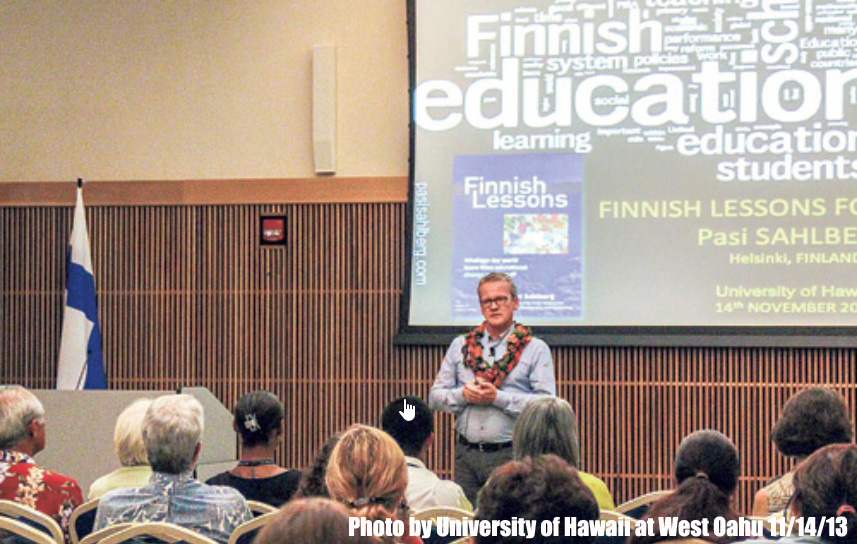
Pasi Sahlberg1 talked about the Finnish comprehensive public education system at the University of Hawaii at West Oahu on 14 November 2013 (Essoyan2). The system ranks among the highest in the world in PISA (Programme for International Student Assessment) and other international tests. It is free for students from preschool through higher education and is considered a model for the rest of the world.

Pasi Sahlberg at the University of Hawaii at West Oahu on 11/14/13.

Pasi Sahlberg at the University of Hawaii at West Oahu on 11/14/13.

Features of the system have been widely covered for years3, so I won’t go into them. What’s worth highlighting in Sahlberg’s talk at West Oahu, however, is his caveat that “‘what works in Finland doesn’t necessarily work someplace else.'” In other words, we can’t and shouldn’t simply port Finnish practices over to the U.S. and hope for the same results.

Sahlberg presented “slides showing that the more unequal the distribution of wealth in a country, the lower the test scores tend to be.” The United States, he said, “has high inequality and relatively low academic performance, while the reverse is true for Finland.” According to Sahlberg, the U.S. is “‘one of the most unequal countries in the developed world. There is a big gap between those who have and don’t have.'” He characterized Finland as a lot more egalitarian. “‘Somehow,'” he said, “‘the equity and excellence go hand in hand'” (Essoyan).  Continue reading

A Caltech Grad in a Caltech MOOC, Part 4 (updated 12/8/13)

picture of Harry KellerBy Harry Keller
Editor, Science Education

[Note: Harry, who holds a BS in chemistry from the California Institute of Techology and a PhD in analytical chemistry from Columbia University, is sharing his first MOOC experience in this series. See part 1, 2, 3 and 5. -Editor]

November 12, 2013

Week six was not an easy week. Some emergencies took away time I had expected to spend on the course. The material was interesting but difficult. The pace was rapid.

This week, we learned about the crucial issue of overfitting in machine learning and about its cure, regularization. These are not topics for the faint at heart because they go deep into the world of machine learning and involve a great deal of mathematics.

The homework was both hard and easy. Once again, I was tested on my programming ability more than on my understanding of the topics in a few of the questions. I’m not sure how one might create a course on machine learning that did not include writing software because machine learning, by definition, uses computer algorithms.

I find the homework deadlines both useful and frustrating. Were it not for the deadlines, I’d have plenty of higher-priority things to do and probably never get it done. However, I constantly have to deal with being unable to plumb the depths of the material or even complete the homework satisfactorily in the time available. This course certainly does not allow one to proceed at one’s own pace, although it does allow you to set your own schedule within the course calendar.

The mathematics continues to use the full panoply of mathematics symbols and expressions. Do not go near this course without a very good background in advanced mathematics: calculus, set theory, matrix algebra, and more.

I feel that I’m being asked to learn much more than I have to learn. This is supposed to be an introduction to machine learning. I’m rather intimidated by the prospect of an advanced course. Yet, the pearls of learning are there to be gathered, scattered among all of the mathematics, abstruse concepts, and software writing. This is not a mere aggregation of tools. This course provides a sound mathematical footing for every tool provided — if you can hack the math.

I had absolutely no time to even peek at the discussions this week but didn’t really have to because the material was clear enough, and the homework was also clear while being mostly tough. One or two questions were fairly easy to answer, but the rest took some work.

Looking at the answer key, I discovered that I shouldn’t have changed my answer to one of the questions, but I do not understand why. I still think I had the right answer the second time.

The final grade on the MOOC is not in yet, but I’m guaranteed a homework grade of at least a B and a course grade of a C at this point. The next lecture, on validation, looks like it will be one of the most valuable yet. I just wish I knew that I am learning everything well. With this sort of MOOC, that’s a real challenge.

[Update 12/8/13 – Harry submitted the following report on 11/18/13, but I didn’t see it in my mailbox until this morning. My apologies to Harry and to you, the readers. -Editor]

November 18, 2013

The lectures this week were very informative. The homework was another matter entirely. Possibly, I’ve topped out here, but there was a significant issue that should be addressed. Continue reading

Can America’s Wasted Talent Be Harnessed Through the Power of Internet Based Learning?

Jim_Riggs80By Jim Riggs
Professor, Advanced Studies in Education
College of Education
CSU Stanislaus
President Emeritus, Columbia College (1997-2007)

For nearly 150 years, the American dream of a better life of economic success and advancement has been found largely through the narrow path of higher education. However, access to traditional higher education has always been limited to the top one-third of the adult population and by all indications will continue to be rationed at this level or less into the foreseeable future. Peter Smith, in his 2010 book, Harnessing America’s Wasted Talent: A New Ecology of Learning, points out that while traditional higher education will continue to serve this segment of the population, educational leaders must find alternative ways that will effectively meet the postsecondary education needs of a much larger segment of the adult population.

Smith is not alone in this thinking. There have been numerous reports in recent years that have also called for greater access, flexibility, credit portability and increasing degree completion for a much larger percentage of the adult population. In addition, many of these reports place a special emphasis on closing the growing achievement gap, which is increasingly leaving Latinos and African-Americans behind other groups when it comes to earning college degrees. Why is this important? There is a strong and growing consensus among policy makers, educators, economists and scholars that, if this country is to remain an economic superpower, a much larger and more diverse segment of the adult population must be better educated.

America’s current workforce is aging and retiring, and 85% of all new jobs now require some college education. A real crisis is rapidly developing  — America is finding itself with an escalating gap between the increasingly sophisticated workforce skill demands of the new economy and what the average American worker has to offer. In a 2011 report, The Undereducated American, Georgetown University professors Anthony Carnevale and Stephen Rose provide a strong argument that America will need a dramatic increase in the number of individuals with college degrees within the next decade. This increase in college graduates, according to Carnevale and Rose, is not only needed to help sustain the nation’s economic growth but will also help reverse the 30 year trend of growth in income inequity.

However, with the downturn in the economy over the past six years, we are once again reminded that a college degree alone is not a complete guarantee against economic challenges or underemployment. Economic growth and viability cannot solely depend on education. Nonetheless, according to the Bureau of Labor Statistics, the greatest predictor of personal income and employability for Americans still is, and will continue to be, their level of educational attainment.  Continue reading

Acronym in Cheek: STEM, STEAM…

picture of Harry KellerBy Harry Keller
Editor, Science Education

[Note: See Bob Hoffmann’s response in “Proposal for a Holistic Emphasis in K-12” (11/24/13). -Editor]

STEM (Science, Technology, Engineering, and Mathematics) has taken over from simple, unadorned “science” as the term describing our science classes. Because most of these classes use technology and mathematics already, the major change is the addition of engineering. Many science classes already had some sort of engineering-oriented activities they call projects. The NGSS (Next Generation Science Standards) has increased the emphasis on engineering.

STEM, as a moniker, has had such success that it has resulted in some copycat acronyms. Preeminent among these is STEAM, which adds art to the list. I have absolutely nothing against inserting art into science classes and even support the idea. However, the creeping growth of an acronym does bother me as does the omission of equally important areas of learning for students in science classes.

I also happen to think that that putting technology into the acronym is superfluous. I’d much prefer, for example, thinking as the T in STEM if you have that letter at all.

I have read many spirited discussions about STEAM replacing STEM, and they all seem to originate from teachers of traditional art classes where drawing, painting, and sculpting is taught. What about performance arts? What about music? I have not seen anyone agitating to add those to science classes. Why not?

There’s also the crucial role of history and social science in general to learning. There certainly is much history in science, both the history of science and the historical context. Our children can learn much from this analysis, possibly more than memorizing the names of U.S. Presidents or of the Kings of England along with dates. Why do we not see agitation for SHTEM or HEMST? Not a clever enough acronym? That’s hardly a sufficient excuse.  Continue reading

The Surface Pro 2 Will Be the Death of Notebooks

Jim ShimabukuroBy Jim Shimabukuro
Editor

Updated 11/19/13, 9/6/14

(Related articles: “Thoughts on the Surface Pro 2 After 8 Months” and “Why the Surface Pro 2 Will Be a Game Changer in the Tablet World Series.”)

About three weeks ago, when all I had to go on was reviews, I predicted that the Microsoft Surface Pro 2 (SP2) would be a game changer. I had just put in my order then and was told that shipment would be in mid- or late-December. Thus, I was surprised and happy to learn, in late-October, that it had been shipped for next-day delivery. It arrived on schedule, and in the time it took to remove it from the packaging, plug it in, and turn it on, I knew that the notebook was dead.

Surface Pro 2 with type cover and digital pen.

Surface Pro 2 with detachable type cover and digital pen.

I’ve had it for about a week and haven’t had time to do more than a few things, but what I’ve seen is impressive. The look and feel reminds me of the original iPad and iPhone4 — which I’m still using. Rock solid and sleek, beautifully engineered. In contrast, the clamshell notebook with its hinged keyboard suddenly seems odd, anachronistic, looking more like yesterday’s typewriter than tomorrow’s computer.

Don’t get me wrong. The SP2, like the original iPad, is far from perfect, and better and less expensive models from Microsoft and competitors will soon be flooding the market. However, it’s more than done its job as a groundbreaker. In short, it’s the first viable full-blown Windows PC in a tablet chassis.

Form factor alone, however, wouldn’t be worth much if the tablet couldn’t perform. The big question for me was — and still is, to some extent — will it perform?

In size, it’s slightly larger than the original iPad and only a half pound heavier. But the difference in terms of sheer power is huge. The SP2 runs the 64-bit version of Windows 8.1, MS Office 2013, and everything else you can run on a notebook or desktop. It has a high-resolution 1080p display and an HDMI port. Plug in a 26″ 1920 x 1080 monitor and you have all the size you’ll need. It has a standard USB 3.0 port and a micro-SD card slot. Plug in an external two-terabyte drive, a CD/DVD player-recorder, a thumb drive, or an SD card for more onground storage.  Continue reading

An Interview with Tom Preskett: The Evolving Role of a Learning Technologist

Jim ShimabukuroBy Jim Shimabukuro
Editor

Updated 11/6/13, 5:40am HST.

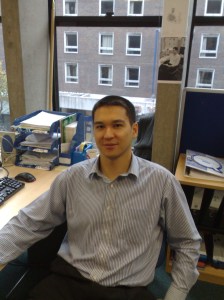
Introduction: Tom Preskett was a staff writer with ETCJ from 2008-2011, and we make it a point to touch bases with him from time to time. For example, in 2012, he wrote A Londoner’s View of the 2012 Olympics: Live Feed of All Sports at Any Time!. He brings a reflective insider’s view of what it means to be a learning technologist in the most exciting period in the history of the field. The following interview, conducted via email over the last few days, is prompted by his recent move from the London Centre for Leadership in Learning, Institute of Education, to Nord Anglia Education, Oxford.

JS: Tell us about Nord Anglia Education.

TP: Nord Anglia Education is a premium schools organisation. We own 27 schools located in South East Asia, China, Europe, North America and the Middle East. Most of our schools follow a curriculum based on the National Curriculum of England, adapted country by country to meet local culture and conditions.

Tom Preskett

Tom Preskett, Learning Technologist, Nord Anglia Education.

To support these schools are two online environments. One aimed at the students, the Global Classroom, and one aimed at the teachers, Nord Anglia University. Both are moodle environments although they don’t act like traditional virtual learning environments. Our online environments tie together as each school has a moodle, and authentication carries across the Global Classroom and Nord Anglia University. The ethos is one of High Performance Learning as created by our educational director, Professor Deborah Eyre. You can read all about this in her paper “Room at the Top.”

Continue reading

A Caltech Grad in a Caltech MOOC, Part 3

picture of Harry KellerBy Harry Keller
Editor, Science Education

[Note: Harry, who holds a BS in chemistry from the California Institute of Techology and a PhD in analytical chemistry from Columbia University, is sharing his first MOOC experience in this series. See part 1, 2, 4 and 5. -Editor]

November 2, 2013

The discussions should play a larger role, but I have found them to be unsatisfying. Either they’re about esoterica or trivia. Perhaps, I’m too pragmatic for this course. It’s not just about the course; it’s also about the students. It’s clear that not all students and courses go together.

I think that I’ve already gained the most important insights into machine learning from this course, how to know whether a given situation lends itself to this valuable tool. Completing the course will expand the machine learning options and my depth of understanding of how to use them.

Last week, I didn’t have the time to visit the discussion groups. This week, I don’t feel the necessity but may do so just to see what’s going on.

November 4, 2013

As I work on the fifth homework assignment, I’m not sure whether I’ve become smarter or the homework has become easier. Last week was very hurried, and I stumbled badly. This week went along nicely. There’s still plenty of mathematics, more than you might imagine, but the concepts seem more manageable.

When I began, I only knew a bit about this field from my days as a university professor when a colleague published papers about machine learning used to identify compounds in gas chromatograph tracings and spectroscopy. It was a promising area then.

Continue reading