


 By Jim Shimabukuro
Editor
For college students in general, a 2011 survey found that 75% are part-time. Of these, “Even when given twice as long to complete certificates and degrees, no more than a quarter ever make it to graduation day.”1 Another study in 2012, focusing on community college students, found that 59% are part-time. Of these, 42% work more than 30 hours a week, 37% care for dependents 11 or more hours a week, and 40% take evening or weekend classes.2
In comparison to full-time students, part-timers fail at over twice the rate in completing certificate and degree programs. Here’s a breakdown from the 2011 survey:
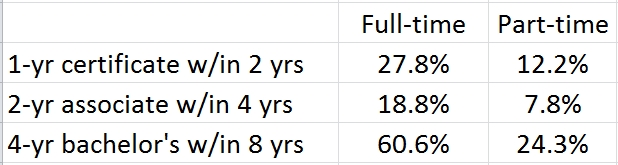
Considering their numbers and their low completion rates, it’s a wonder that community colleges continue to do business as usual, with little or no change in practices that date back over half a century.
Thus, I was pleasantly surprised to find, in my college emailbox, an announcement that I’ve been returning to, off and on, for the past few days. It is a call for proposals to address the problem of part-timers. The proposed plan has to either (1) assist part-time students earn 12 credits in an academic year or (2) shorten their time-to-degree. The deadline is close and the form is complicated, so I won’t be submitting a proposal. But I do have some thoughts on this subject.
From a part-time student’s perspective, college is only one of a handful of other responsibilities with higher priorities. S/he has to be able to fit it into her life, and not the other way around. The problem is that colleges are set up for traditional students whose main priority is to complete a program. So, like a square peg, she’s trying to fit into a round hole.
The courses she needs are either filled or offered at a time that’s not convenient for her. Offerings at night or on weekends are slim pickings. Even when she can fit a class in, she finds it difficult to meet deadlines, complete learning activities, or obtain learning assistance. Competing for her time are work and family demands. Furthermore, the commute to campus is all too often time-consuming and, if she drives, the cost of gas and limited parking stalls are an ongoing concern.
The fact that our hypothetical part-timer is among the majority of students who are poorly served should be an incentive to change, from a perspective that’s campus-centered to one that’s student-centered. In other words, colleges ought to be asking, How can we accommodate part-timers with their unique needs?
The title of the 2011 report mentioned above goes to the heart of the problem — “Time Is the Enemy.” The traditional college schedule is the enemy of the part-time student. It’s in one dimension, while part-timers are in another. Put another way, part-timers make up a completely different population that isn’t being served by the colleges as they are now. Put in still another way, part-timers are an open invitation for disruption, for a disruptive approach that will accommodate the needs of a large population of students who are currently being ignored. Continue reading
Filed under: Higher Education, MOOC, Theory | 15 Comments »










 Carmel DeAmicis, “
















 Educational Technology and Change Journal
