MOOC Sightings 005: Wharton School and Universiti Teknikal Malaysia

MOOC Sightings2

Rapid change is the norm, and for professional development in business, MOOCs are the answer. “Wharton School recently teamed up with Coursera . . . and tech start-ups Snapdeal and Shazam to launch $595 online courses with certificates.” This unbundled or certificate model underscores the MOOC’s disruptive force. “‘For adults who have limited resources – whether that’s time or money,'” says Rick Levin, Coursera chief executive, “‘the Specialization [industry project] model works well.'”1

As change approaches warp speed, the shelf life of knowledge decreases and the need for constantly accessible modules of new knowledge increases. The watchword here is accessible, and this is the MOOC’s domain.

This fact is becoming increasingly obvious in the world of business where you’re either on the leading edge or out of the picture, and the critical factor is time. You can’t pause or stop to learn. Learning has to be on the go, and this means anytime-anywhere.

Will this disruption creep into our college campuses? Will traditional students take to learning in MOOC modules to keep pace with the latest developments in their field? How will this impact courses in the more traditional semester mold?

Most expect professors to gradually blend modules into their curricula, but this is an institutional perspective. My guess is that students will self-modularize and independently flow toward MOOCs that give them the edge, regardless of what professors and colleges decide to do.

In fact, this is already happening, but this disruption doesn’t show up on the campus-richter scale because, from all appearances, the students are on campus and sitting in lecture halls.

On college campuses in other parts of the world, the disruptive power of MOOCs is being embraced. Shahrin Sahib, vice-chancellor of Universiti Teknikal Malaysia Melaka (UTeM), sees MOOCs as a window for “‘students to work collaboratively and closely with colleagues around the world and to have access not only to course instructors, but to textbook authors and experts from other institutions.'”2

For Sahib, the playing field is no longer just the university campus or Malaysia but the globe. He says, “‘If students are to fully assume positions of leadership and responsibility in specific organizations and in society as a whole, then they must be prepared to deal with the global environment.'” For college students, regardless of location, MOOCs are an interactive and accessible portal to that environment.
__________
1 Seb Murray, “Technology Expands Business Education As Students Opt for Digital Route,” BusinessBecause, 10 Mar. 2015.
2 Kelly Koh, “MOOC Can Help Create Global-ready Graduates,” New Straits Times, 10 Mar. 2015.

Preparing Your Child for a Robotic Future

Don’t Let a Robot Take Your Child’s Future Career: Roboticist’s Book Offers Educational Advice for Parents

Illah NourbakhshIllah Nourbakhsh says robots and artificial intelligence will increasingly displace people from many conventional jobs. The professor of robotics at Carnegie Mellon University has even written a book about it, called “Robot Futures.”
It’s enough to make parents despair over their children’s career prospects, he acknowledged, and that’s why he’s publishing a pair of follow-up books, “Parenting for Robot Futures.” Part 1: Education and Technology is now available on Amazon.com.

The key, he said, is to raise children who are “technologically fluent.”

“If we want our children to flourish in a technology-rich future, we need them to understand technology deeply— so deeply that our kids influence the future of technology rather than simply being techno-consumers, along for the ride,” he writes.

“There are no shortcuts to developing tech fluency, and there is no way to outsource the parent’s role to school, after-school or video games,” Nourbakhsh writes.

In the 64-page first volume, Nourbakhsh provides an overview to help parents understand the strengths and shortcomings of technology education in schools, including the movement to STEM (science, technology, engineering and mathematics) education, digital learning and massive open online courses, or MOOCs.

Continue reading

TCC Online Conference 20th Anniversary – Final Call for Registration

TCC2015 header

Final Call for Registration
Register now to save your spot!

TCC, Technology, Colleges and Community, is a worldwide online conference attended by university and college personnel including faculty, academic support staff, counselors, student services personnel, students, and administrators.

Join our special 20th Edition of this annual event to share your expertise, experiences, and knowledge relevant to the use of information technology in learning, teaching, innovation, and academic services. 

Seats are still available to participate online or onsite (this year only).
 

This event is very helpful and novice friendly by providing a strong foundation about learning with technology. For more information, visit:

http://2015.tcconlineconference.org/

TCCHawaiiLTEC (University of Hawaii) • LearningTimes
To unsubscribe to this mailing list
Send a message from this email address to listserv@hawaii.edu. In the BODY of the message,
type: SIGNOFF TCCOHANA-L. For assistance, contact Bert Kimura <bert@hawaii.edu>.

To join our mailing list

MOOC Sightings 004: Outside the Box with Ontario’s Judy Morris

MOOC Sightings2
Updated 3/1/15
As in all things MOOC, look northward to Canada for the prevailing winds, and this time it’s to Ontario, and more specifically, to president and CEO of Lambton College Judy Morris. “Over the last few years,” she says, “Ontario colleges have seen enrollment in online learning grow ‘exponentially higher than on-ground learning.'”1

 Judy Morris, President and CEO of Lambton College, Ontario.

Judy Morris, President and CEO of Lambton College, Ontario.

Granted, she’s talking about online courses and not MOOCs, but the difference is superficial. In all but name, online courses are MOOCs that have been literally stuffed into the concrete and glass boxes that define traditional classrooms. In the box, they are subject to the same start and finish dates, registration requirements, enrollment caps, credit policies, fees, and even pedagogy that fail miserably at mimicking F2F (face-to-face) interactions.

Is it any wonder, then, that online courses fare so poorly in comparison to blended courses? As they’re currently positioned, completely online courses are simply poor copies lacking the features that make onground courses so effective for those who can afford to be on campus and attend classes in person for four to six years.

For the promise of online courses, we need look no further than MOOCs. There are some obvious differences: MOOCs attract huge enrollments and there’s usually no cap to class size, registration is free, anyone can register, they’re usually shorter than the standard quarter or semester, there’s no F2F requirement, feedback is provided by peers, they don’t count toward a degree, and they appeal primarily to nontraditional students.  Continue reading

MOOC Sightings 003: FutureLearn, Microdegrees, ‘Open Internet’

MOOC Sightings2
Updated 3/3/15
UK’s FutureLearn, a part of Open University, “now hosts over 220 [MOOCs] from 44 partners.” Noteworthy is their completion and participation figures: “Of those that begin a FutureLearn course, 23% go on to complete the majority of steps and all of the assignments, while 39% of them interact with other users through social media, comments and conversations.”1 Takes the wind out of the less-than-10% completion argument, doesn’t it?

Right now, the MOOC’s disruptive path is being carved out in nanodegrees and microdegrees by developers and employers. “By forming partnerships and designing programs in conjunction with employers, ventures with new business models are offering their students programs and degrees that will make them more attractive job candidates.”2

The implications are enormous for colleges that understand this trend. Stuart M. Butler, senior fellow at Brookings, dubs it the “‘general contractor’ model of college education,” and says, “It is only a matter of time before enterprising colleges or other entrepreneurs start assembling comprehensive degree programs consisting of microdegrees supplemented by other experiences, such as a semester abroad and time at a small liberal arts college.” Adding employer-designed microdegrees to one’s transcript and resume seems like a no-brainer for college graduates entering the job market.

An alert from Claude Almansi: Open Internet, a 12-week MOOC that begins on March 6, 2015, is designed to “train a new generation of thinkers and actors to advocate for positive open and free internet policies and agendas from a human rights and public interest approach.” The course is free and offered in the Spanish language. Each week will feature a different module, and “each module will take approximately 2-5 hours of study time, including reading and completing assignments.” It will be hosted on the Peer 2 Peer University platform.

MOOCs appear to be a natural medium for social justice programs such as Open Internet, and I believe it’s only a matter of time before we see an explosion of similar MOOCs worldwide and in many different languages. In the end, MOOCs may just be the great equalizer, serving as the training medium for the world’s human rights activists.

__________
1Growth in online courses shows need for universities to incorporate new technology in their teaching models, says expert,” Out-Law.com, Pinsent Masons, 24 Feb. 2015.

2 Stuart M. Butler, “How Google and Coursera may upend the traditional college degree,” TechTank, Brookings, 23 Feb. 2015.

MOOC Sightings 002: Oxford Professor Declares MOOCs the Loser

MOOC Sightings2

William Whyte, professor of social and architectural history at St John’s College Oxford, assures us that in the “battle” of MOOCs vs traditional campus-based universities, “The MOOC will prove to [be] the loser.”1 He parades the usual suspects for their demise: low completion rates and absence of credits and degrees.

He tosses Britain’s E-University and Open University in with MOOCs for what amounts to a clean sweep of online programs. Two birds with one stone, as it were. He cites E-University as a costly failure and Open University as “actually a rather traditional university.” Convenient, but what these institutions have in common with MOOCs is baffling.

He bolsters his prediction with survey results: “Only 6% of prospective undergraduates surveyed last year [want] to stay at home and study. The other 94% expected and hoped to move away to a different place for their degrees.”

Whyte declares traditional universities the winner because “people want and expect something rather more than a purely virtual, entirely electronic experience of university. They expect it to be a place.”

Strong reassurance, indeed, for those who see MOOCs as “a horrible sort of inevitability.” Traditional universities have not only withstood the MOOC challenge but actually emerged stronger.  Continue reading

MOOC Sightings 001: UNC and Cornell

MOOC Sightings2

Despite wholesale announcements by powerful academic leaders throughout the U.S. that MOOCs are dead, sightings continue to pour in from around the country and the rest of the world. For skeptics, the problem is physical evidence. People can offer them and take them, but no one seems to know what a MOOC looks like. Some point to Coursera and edX, but in the opinion of most MOOC experts, who are primarily from Canada and the UK, these are hoaxes.

So, in the interest of determining once and for all whether MOOCs are fo’ real, I’ll be opening Project White Book to publish promising sightings and photos of MOOCs. In this inaugural post, I’m sharing the photo, below, of what appears to be one person’s conception of a MOOC. I recently found it in the ETC spam queue. It was posted anonymously with the header “Da MOOC!” I’ll post photos as I receive them, so if you have one, email it to me (jamess@hawaii.edu) and I’ll publish the most interesting.

Is this a MOOC, a hoax, or just another weather-related phenomenon?

Is this a MOOC, a hoax, or just another weather-related phenomenon?

I’m also sharing promising sightings by Sarah Kaylan Butler, “50,000 Enroll in UNC Online Course” (Daily Tarheel, 2/19/15), and Blaine Friedlander, “Cornell Sinks Teeth into Four New MOOCs” (Cornell Chronicle, 2/19/15).

Butler reports that “almost 50,000 students have enrolled in a massive open online course on positive psychology taught by UNC professor Barbara Fredrickson.” Evidence that this Coursera-based course might be a real MOOC is very strong. It’s six weeks long, a departure from the usual quarter or semester time frame. It’s comfortably aimed at interest rather than college credit. According to Fredrickson, “Most people that are enrolled — 95 percent of them — say that they’re interested out of their own curiosity.” And the professor is on firm MOOC footing, looking for pedagogical guidance from the future rather than the past. She says, “I’ve written a couple of books for general audience and one of the things that’s clear about our changing audience is that people don’t necessarily want to read books, but they like ideas.”

Another promising sighting is from Cornell. Friedlander reports that “Cornell will offer four new [MOOCs] in 2016: shark biodiversity and conservation, the science and politics of genetically modified organisms (GMOs), an introduction to engineering simulations, and how deals get done – mergers and acquisitions principles.” They’re still in the planning stages, so I’ll keep an eye out for more details as they become available.

Are MOOCs fo’ real? In this series, I’ll be looking at the evidence through a lens that’s forged from constructivist and disruptive theory as well as a dash of whimsy. In this process, I look forward to hearing your thoughts. Please share them in the discussion below. If you’re logging in from an address that has been previously approved, your reply will be posted automatically. If not, your first reply will be published within 24-48 hours. Subsequent replies from your address will be published immediately.

Free Webinar: ‘Using Technology to Engage Students’ 2/23/15 3pm EST

From Macmillan Higher Education 2/17/15:

Join us on Monday, February 23rd at 3pm EST for a complimentary webinar on “Using Technology to Engage Students” with Solina Lindahl of Cal Poly San Luis Obispo!

The 21st century classroom is getting larger, more tech-laden and full of students weaned on digital devices. How should our teaching change (or NOT change) in light of this? This talk is aimed at showing how iPads, iClickers and more can engage the face-to-face large class. Included are a brief discussion of some of the more innovative (and easy) visual presentation apps, as well as a look at using iPads to do the most old-fashioned of practices: worked problems.

edtech week

To learn more about all of our EdTech Week sessions and our presenters, please visit our EdTech Week website. You can also join our event on Facebook for the latest updates and information! We hope to see you there!

Changing Face of Healthcare: The Role Mobile Apps Will Play in Medicine

frida-cooper 80By Frida Cooper

Judging by the sheer popularity of smartphones in modern times, it’s safe to say that this multi-faceted and dynamic invention may just be the best thing since sliced bread. Maybe even better, if sales figures from smartphone manufacturers are anything to go by. The Smartphone’s utility isn’t restricted to the quintessential teenager texting all day or for showing the world what you had for lunch earlier that day. The advent of smartphones and their ability to connect to the veritable hoard of information that is the Internet has revolutionized life in general and pretty much every profession on the face of this world too.

The substantial healthcare industry here in the United States is most definitely one such example. The truth of the matter, though, is that the total impact of smartphones and mobile apps hasn’t even hit the industry yet, but that’s all about to change. Traditionally, the whole dynamic between healthcare professionals and the general population was that of blind faith. The knowledge and expertise of healthcare professionals wasn’t ever questioned, for better or for worse.

The origins

Things all began to change with the advent of the Internet in households across the USA. People started to conduct research on medical maladies that they were suffering from. They started to question the choice of medication, course of treatment taken, and potential side effects. These and many other things that would have been left to the professional’s judgment but a few years earlier were being challenged now that the patient was armed with information.

Where apps fit in

Whether this situation was and is good or bad is still up for debate, but this is where this revolution originated from. When smartphones came to the fore, this situation was taken up a few notches. A study conducted by IMS Institute for Healthcare Informatics in 2013 pointed at over 40,000 healthcare-related apps available for download then in the iTunes App Store. Imagine how many more there are when taking platforms like Windows and Android into account. The sheer diversity of topics, too, covered under the healthcare ambit is staggering.  Continue reading

Secretary Duncan’s Discussion with Maryland Teachers to Be Streamed Live 9:50AM (ET) 2/18/15

Secretary Arne DuncanU.S. Secretary of Education Arne Duncan will visit Maryland on Wednesday to highlight the progress that the state’s schools and students have made through the hard work and leadership of parents, teachers, principals, as well as local and state officials.

He will visit two schools and then end his day with a speech about the importance of local and school-level leadership in continuing efforts to improve education. In his speech, Duncan will talk about the need to support states’ efforts and expand investments, progress and opportunity for all children through reauthorizing a new Elementary and Secondary Education Act.

Earlier in the day, Duncan and State Superintendent of Schools Lillian Lowery will visit classrooms at Ducketts Lane Elementary School and meet with teachers from there and Thomas Viaduct Middle Schools to hear how teaching and learning is changing during the transition to higher standards and how that has contributed to schools’ and students’ success in Maryland. The discussion with teachers will be streamed live on the Howard County Public School System website, www.hcpss.org.   Continue reading

The Science of Deflategate

picture of Harry KellerBy Harry Keller
Editor, Science Education

The New England Patriots have muddled up the Super Bowl in a grand fashion. It might as well be an MIT prank but on a national scale. We haven’t see the like since Caltech (MIT’s famous rival in the prank world) jimmied the Rose Bowl’s card stunts half a century ago. (Personal note: I was a member of the Caltech group of twelve that did that. Also see this LA Times article.)

Denials are not going to change any fan’s mind. If you’re a Patriot fan, you probably don’t think it’s important. If you’re not, then you will believe any evil of the New England dynasty.

Before delving into the science, I should note that reporters have said that the ball deflation was discovered during halftime and rectified. As the final score was 45-7, and the second half score was 28-0, even if every Patriot point in the first, seemingly flawed half were rescinded, the score would still be 28-7 in favor of the Patriots. We are not discussing, therefore, who should play in the Super Bowl. We are instead discussing how balls would have become low in pressure.

As any high school physics teacher will tell you, PV=nRT, the ideal gas law. Okay, that’s gibberish to many, but it’s really very simple. So simple in fact that you can do the calculations yourself with calculator or even readily with paper and pencil. Let’s deconstruct this equation.  Continue reading

Register for TCC 2015 – The Future Is Now

kimura80By Bert Kimura

Aloha,

Register for the TCC 2015 Worldwide Online Conference, The Future Is Now:

http://tcconlineconference.org/

Enjoy KEYNOTE sessions by:

  • Dr. Howard Rheingold, Author, Critic, Journalist & Educator
  • Alan Levine, Pedagogical Technologist, Architect of Open & Connected Learning
  • Dr. Stella Perez, Sr. VP Communications and Advancement, American Association of Community Colleges

This year, our 20th conference features an ONSITE option to participate in-person at the University of Hawai’i at Manoa campus. There is also an option to participate virtually ONLINE as in previous years.

For further information (including low-cost housing and an optional educational tour), see:

http://2015.tcconlineconference.org/register/

Site licenses for unlimited participation from a campus or system are available. Special rates apply to University of Hawai’i faculty and staff. For more info, contact Sharon Fowler <fowlers@hawaii.edu>.

We look forward to seeing you at TCC 2015.

Warm regards,
Bert Kimura
For the TCC Conference Team

College and Other Lies

vb0-80By Veronica Brockschmidt
Student at Kapi’olani Community College
University of Hawai’i

Starting in elementary school, the importance of finding the perfect career for you is introduced with fun little surveys that point you in the direction of possible future jobs based on your interests and selected answers. Kids would get career options like Model, Painter, Teacher, Doctor, etc, and a statistic on salary ranges for each position. In high school, the importance of graduating and attending college is drilled in from day one. By the age of 16 you were expected to know, without a doubt, what you wanted to be when you “grow up.” By the time you actually graduated high school, you needed to know exactly what you wanted to major in and the career you wanted for the rest of your life. That’s some intense pressure, especially for still technically being a kid and not actually accepted into any colleges yet.

You were given more statistics about the financial lives of Americans with college degrees and how much better their lives were than those with only a high school diploma. The implication was that if you go on to finish college, you’d be a millionaire (Kristof), but if you stop now with only your high school diploma, you’ll be stuck at McDonald’s asking your old classmates if they “Want fries with that?” The fear tactic worked. Plus, who doesn’t want to make up to $1,000,000.00 more than someone with just a high school education?

So you do the whole college thing because it’s the new societal norm and you want to make your parents proud. You feel like you have your life together because you’re getting good grades and you have the career major that you truly love and could happily do for the rest of your life. Little do you know that you were severely overpromised on realistic job opportunities and, suddenly, being a college graduate seems like it has nothing to do with how successful you actually are (9gag).

Perhaps it was that, at the time of you declared a major, that industry was hiring a lot of people and that the promise of success even had something to do with your decision. But now that three to five years have passed, those positions have filled up due to the overwhelming flood of qualified applicants who all had the same idea as you. Either way, you, “the successful college graduate,” are somehow unemployed, still eating Top Ramen, and sharing a bedroom to be able to afford rent.  Continue reading

From ‘Yes Ma’am’ to ‘F*** You’

Tracey kashiwa 80By Tracey Kashiwa
Student at Kapi’olani Community College
University of Hawai’i

Justin Bieber Eggs His Neighbor’s House.” “Kendall Jenner…Calls [Her Mother] a…Whore.” “Miley Cyrus Twerks on Married Man.” In American society today, the media is filled with incidents of youths disrespecting their elders. In fact, even the idea that children should respect their elders seems nonexistent (“Respect for Others”). I’m only thirty-two, but even I wonder what happened to respecting our elders.

When I was a child, I looked to my parents and grandparents for advice and to learn about the past. I viewed them as wise old owls who had a wealth of knowledge and experience that I could tap into. Disrespecting my parents was never an option, and if I didn’t show respect, they would ground me for weeks or, even worse, break out the back scratcher. What has changed from my generation to this? Has the internet ruined our need to look to elders as knowledge keepers? Has social media eliminated our need for social pleasantries? Has the frown on spanking created an uncrossable barrier for parents and discipline?

To better understand youth, I interviewed my twenty-year-old housemate, John, a young man plagued by the need to disregard others. John is the kind of person who, if you asked how his day went, walks past you without eye contact or acknowledgement of your existence. He acts as though he is royalty and can’t be bothered by the peasants around him, and he always has music blaring through headphones to drown us out. I doubt he would behave so arrogantly if he knew how much he resembles a chicken pecking the ground for food when he bobs his head to the beat. Like I said, he is the epitome of a disrespectful youth.  Continue reading

‘Better Than Earth’? – Baloney

picture of Harry KellerBy Harry Keller
Editor, Science Education

“Superhabitable” worlds may be common in our galaxy, making ideal homes for extraterrestrial life — Scientific American cover, January 20151.

Years ago, Carl Sagan famously wrote about a scientist’s “baloney detection kit” in The Demon-Haunted World (1995). You can learn all about this storied chapter by searching on the Internet for “baloney detection kit.” His point was that scientists obtain this mental tool kit as a side effect of their training and that we should similarly train everyone.

Scientific American magazine just published an article, “Better than Earth,” which shows us that scientists are not immune from broadcasting baloney themselves at times. The article is really quite good and interesting. Its statements are, as far as we can tell, accurate. Where is the baloney then?

At one point, the article states, “[T]he more closely we scientists study our own planet’s habitability, the less ideal our world appears to be.” The article also faults our own star’s “short” lifetime of about 10 billion years. “By some 1.75 billion years from how, the steadily brightening star will make our world hot enough for the oceans to evaporate, exterminating any simple life lingering on the surface.”

Looks as though we evolved just in time to enjoy our planet for a billion years or so before we are all steamed to death. Slower evolution may not have left enough time for us to exist here.

We circle a G-class star. According to the author, the next step down in star size, “K dwarfs[,] appear to reside in the sweet spot of stellar superhabitability.” K dwarf stars will shine for tens of billions of years, many times longer than our star. However, the author cautions that our planet is too small for conditions suitable for life to exist for that long period of time. Our core would have cooled too much to sustain our magnetic field and plate tectonics, both necessary to life.  Continue reading

Weary Professors Abandon Technology?

picture of Harry KellerBy Harry Keller
Editor, Science Education

According to US News & World Report, “[P]rofessors say they don’t have enough help to use this technology effectively, haven’t seen results from it, and fear that the cost savings administrators keep insisting that technology will bring could mean their own careers are on the line.”

Just take a moment to break this sentence down and understand what’s being asserted here.

Professors don’t have enough help to use the technology. This comment implies that the technologies under consideration do not have an easily used interface. Good technology should not require any but the most rudimentary training that you can receive from, for example, watching a video.

Professors haven’t seen results from it. Some technologies in education do not generate results. They may be used inappropriately for the course. The results may not match what the technologies enhance. Many professors may be working with anecdotal data from others that could be quite unscientific. The fact that you haven’t seen results from some set of technologies does not mean that all technologies are useless in education.

Professors fear losing their jobs to technology. Some technologies in some institutions could be used that way. If the professor provides no added value, then what is that person doing teaching anyway? Almost no students can guide themselves effectively through the educational process. They don’t know enough to make the necessary choices. Educators will not become obsolete soon. Nevertheless, some institutions may reduce faculty in the mistaken idea that technology can replace them. Fear should not be a determining factor in what to do or not to do. Fearing the inevitable is foolish; fearing the impotent is abandoning yourself to fear.  Continue reading

Literacy, Bullying, North Korea

lynnz_col2
Literacy Through Photography for English-Language Learners by Tabitha Dell’Angelo in Edutopia (12/1/14)
The author explores the link between imagery and language and promotes a broader definition of literacy.

Digital literacy an elementary skill by Ellen Ciurczak in The Clarion-Ledger (11/30/14)
The teachers at Petal Upper Elementary School believe that you can’t start too early teaching students how to acquire a variety of skills using computers, from Internet safety to keyboarding skills.

A valuable lesson on bullying in observer-reporter.com (11/30/14)
Bullying and cyber-bullying are serious problems that many young people have to deal with.  Elissa McCracken, Miss Ohio 2012, chose cyberbullying as the issue she would focus on during her term because she was a victim of bullying herself.

North Korea’s Cyber Skills Get Attention Amid Sony Hacking Mystery by Elise Hu at NPR All Tech Considered (12/4/14)
A rather bizarre hacking story related to Sony, North Korea, and the soon-to-be released movie, The Interview.

What Sort of Intelligence?

picture of Harry KellerBy Harry Keller
Editor, Science Education

You may have noticed recent news about Stephen Hawking predicting the demise of the human race due to the rise of artificial intelligence (AI)1. Others of genius rank, such as Elon Musk and Ray Kurzweil2, have also made this prediction. With “The Theory of Everything” (biopic about Prof. Hawking) in theaters right now, this prediction is resonating across the English-speaking world.

Before digging your shelters or heading for the hills, you should ask, “What is artificial intelligence?” A bit of history may help put this entire subject into perspective. The term was coined in 1955 by John McCarthy, who called it “the science and engineering of making intelligent machines.”3 “When?” you ask. “That’s nearly 60 years ago! Before I was born!” (I actually was born well before then, but statistically you probably weren’t.)

Funny how AI has not taken over the world in the 60 years it’s had so far. Why the sudden worry? Computers are becoming more powerful and less expensive. Computer memory is dirt cheap, speaking historically. This trend of more computer power and more memory shows no signs of abating soon. Could it eventually reach the tipping point where machines are sentient and self-reproducing? Would they then remove the “scourge” of humans from the Earth’s surface? Might the end be less dramatic in that they would render people superfluous? Imagine a world in which all work, including creative work, is done by machines. Who needs Beethoven when you have the Ultra-Composer Mark IV?

This entire discussion circles around to defining machine intelligence and estimating exactly how smart machines might become. Right off the bat, understand that intelligence, as we commonly understand it, has not been seen in machines yet. No one truly knows if it ever will be. To comprehend why, you must have a feeling for the nature of computers and computing.  Continue reading

Who Dat? It’s E-Learn 2014! Come, Learn, Share, Connect

By Stefanie Panke
Editor, Social Software in Education

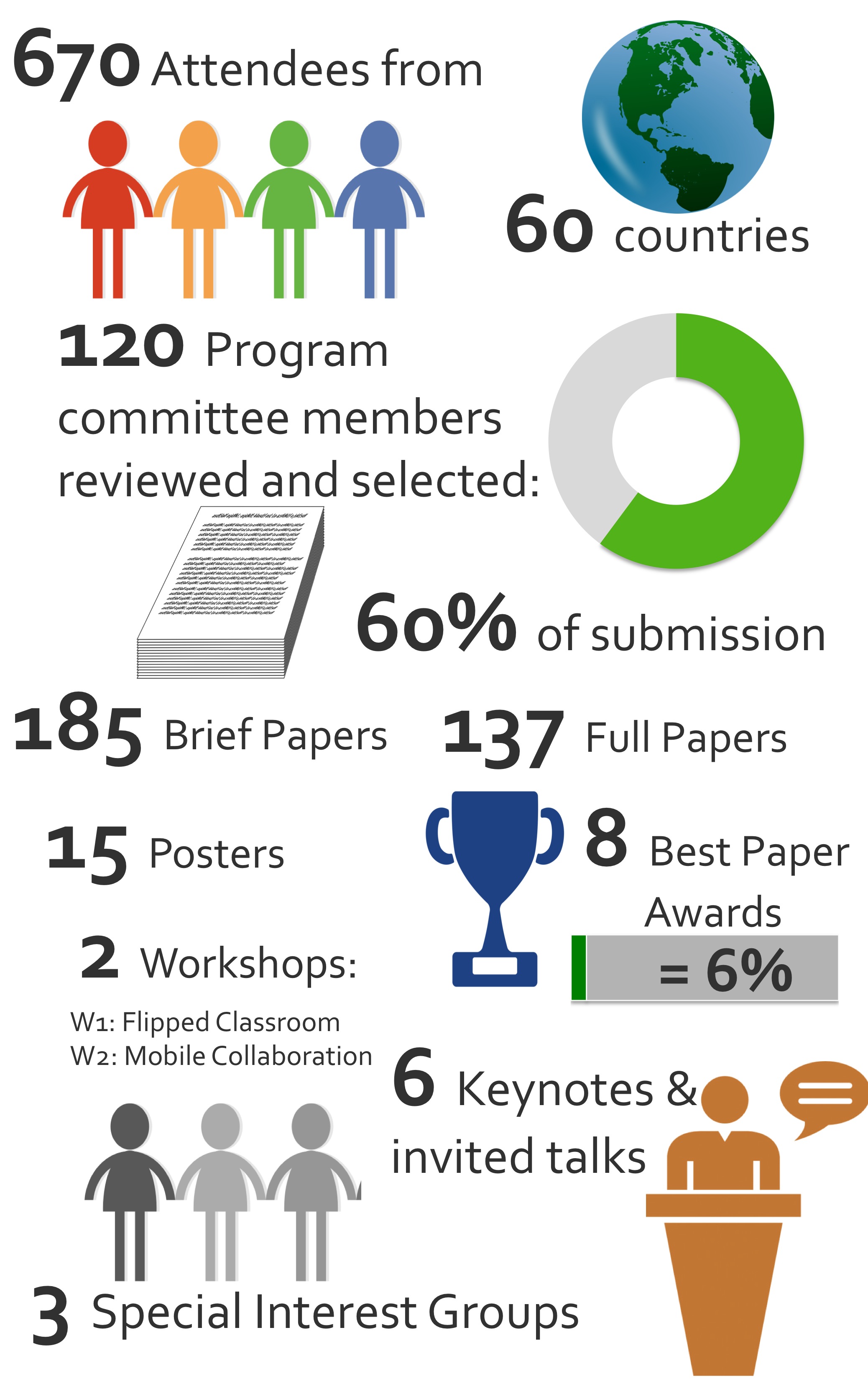
The 19th annual international conference AACE E-Learn took place from October 27-30 in the sunny, warm and welcoming climate of the city of New Orleans. The conference attracted 670 participants from 60 different countries who enjoyed four days of workshops, keynotes, presentations, symposia, SIG meetings, posters, and, last but not least, informal discussions and networking opportunities during the session breaks.

Conference infographic by Stefanie Panke.

Conference infographic by Stefanie Panke.

AACE E-Learn Conference

What sets AACE conferences apart from other events in the educational technology community is the rigorous peer review process in the selection of presentations. Instead of simply submitting an abstract, AACE requires a full manuscript of 6-10 pages. While writing skills do not always and certainly not necessarily translate into great presentations, the quality off contributions is generally high. This also makes the conference proceedings (available in the AACE digital library EditLib) a really great resource for an up-to-date overview of the current state-of-the-art in educational technology. While access to the proceedings is generally restricted to conference participants and subscribers, several papers that were honored with an outstanding paper award are openly accessible:

The best paper awards mirror the diverse spectrum of the conference. E-Learn is a place where educational technology researchers, developers, and practitioners from higher education, K-12, nonprofit and industry sectors meet – brought together by a joint focus on leveraging technology for achieving instructional goals.

My Conference Experience

This conference report is my personal eclectic account of E-Learn 2014. My schedule was packed this year: Not only did I, in a hyperactive mood, choose to deliver three talks, but I also had a symposium and a special interest group meeting to moderate and an executive committee meeting to attend. Luckily, the overall conference atmosphere, the great discussions during the special interest group meeting, and the thoughtful feedback, ideas, encouragement and contributions by numerous conference participants made all of this fun.  Continue reading

TCC Worldwide Online Conference 2015: Call for Proposals

Updated 12/1/14, 12/12/14
TCC2015A
20th Annual
TCC WORLDWIDE ONLINE CONFERENCE
March 17-19, 2015

Hawaii 2-0 : The Future is Now

Submission deadline: December 15, 2014  December 23, 2014
Submission form: http://bit.ly/tcc2015-proposal
Homepage & latest updates: tcchawaii.org

CALL FOR PROPOSALS
Please consider submitting a proposal for a paper or general session relating to all aspects of educational technology, including but not limited to e-learning, open education, ICT, online communities, social media, augmented reality, educational gaming, faculty & student support, Web 2.0 tools, international education and mobile learning. We also encourage retrospective presentations, personal experiences, and forecasting the future.

FULL DETAILS
http://tcchawaii.org/call-for-proposals-2015

SUBMISSIONS
http://bit.ly/tcc2015-proposal

VENUE
For our 20th anniversary celebration, there are two options: (1) ONLINE only or (2) ONSITE. Onsite sessions will run from March 18-19 at the University of Hawaii at Manoa Campus Center, and participants will also have access to all online sessions from March 17-19. All onsite sessions will be streamed to online participants.

For onsite participants: We’re offering an optional educational tour of Kamehameha Schools and a stopover at Kapiolani Community College for lunch and a talk at CELTT (Center for Excellence in Learning, Teaching and Technology). We’ve also arranged for a block of low cost housing options at the East-West Center (Lincoln Hall) and at Ala Moana Hotel.

KEYNOTE SPEAKERS
Alan Levine – cogdogblog.com
Howard Rheingold – rheingold.com

MORE INFO
Bert Kimura <bert@hawaii.edu> or Curtis Ho <curtis@hawaii.edu>

TCC Hawaii, LearningTimes, & the Learning Design and Technology Department, College of Education, UH-Manoa collaborate to produce this event. Numerous volunteer faculty and staff worldwide provide additional support.

—To join our TCCOHANA-L mailing list —
http://tcchawaii.org/tccohana-l/

The iPhone 6 Plus and Tablets: A Tectonic Drift

Jim ShimabukuroBy Jim Shimabukuro
Editor

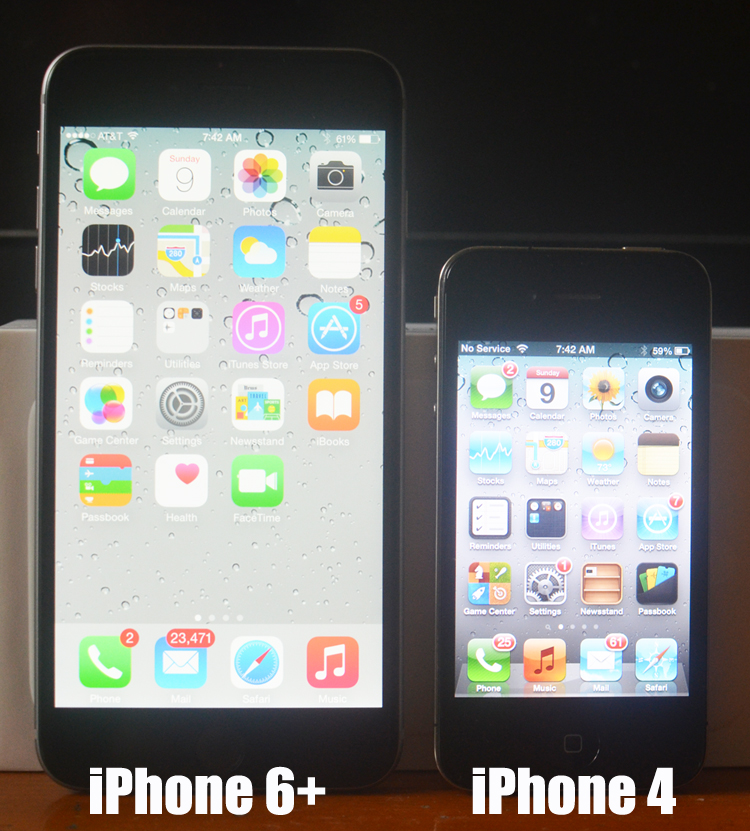
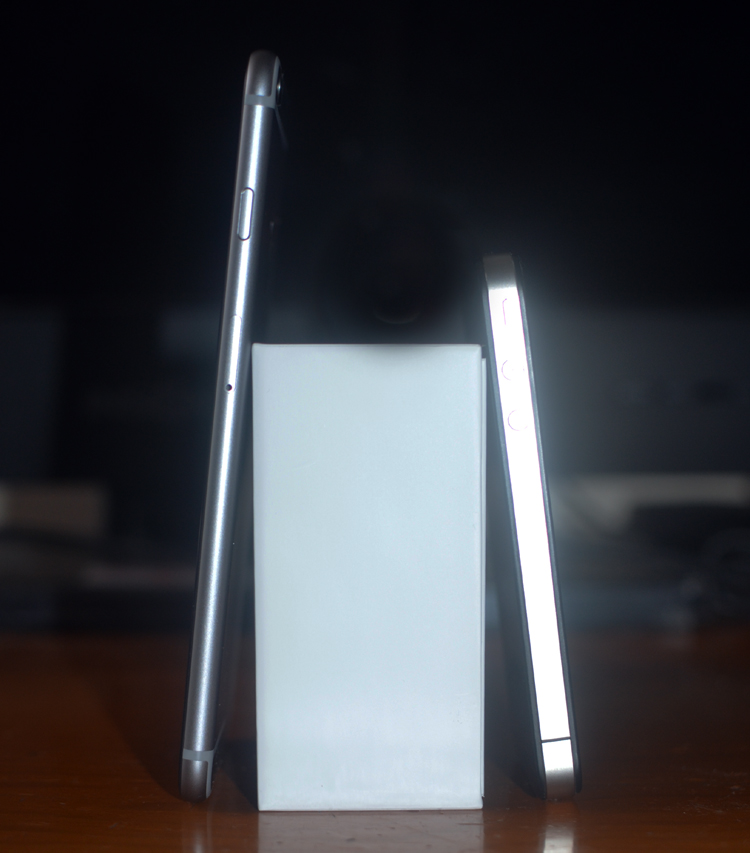
The iPhone 6 Plus arrived via USPS priority mail yesterday, so I’ve had it for a little over a day. My first impression is that it has a completely different look and feel from the iPhone 4, which I reviewed in July 2011. The 4 has a solid industrial feel that’s enhanced by sharply beveled edges. I like the way it looks and feels in my hand. The 6+, in comparison, feels fragile, perhaps because of its thinness and rounded edges. This sense of fragility, however, is gradually fading the more I handle it. My guess is that it will take a few days for a new muscle memory to replace the old.

IPhone 6+ and iPhone 4.

iPhone 6 Plus: 6.22 x 3.06 x 0.28 inches, 6.07 ounces. iPhone 4: 4.5 x 2.31 x 0.37 inches, 4.8 ounces.

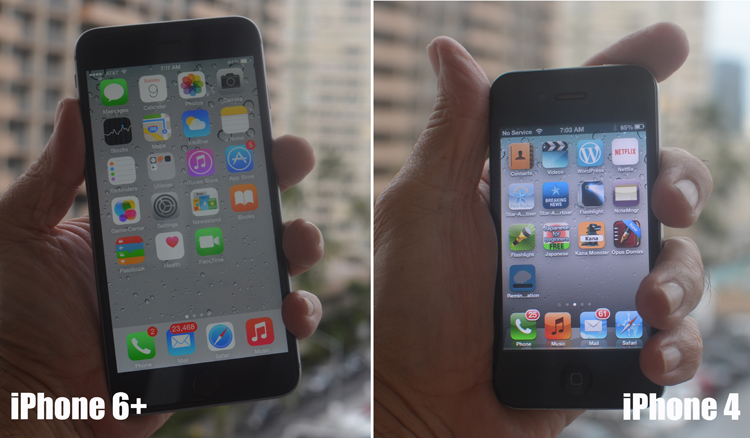
The most critical factor for me is hand fit. It has to feel comfortable. It took a few hours to adjust to the size difference, especially the length, 6.22″ vs 4.5″. The width difference, 3.06″ vs 2.31″, is noticeable, but it’s surprisingly comfortable in my hand. My immediate thought was that the next version of the plus could easily be an inch wider (4″ instead of 3″) and still fit the average-sized hand.

iPhone 6+ and iPhone 4.

iPhone 6+ and iPhone 4 width: 3.06″ vs 2.31″.

The next critical factor for me is pocketability. It has to fit comfortably in my pants pocket. The 4 fits in any and every pocket. The 6+ fits best in the front pockets. It’s slightly heavier than the 4, 6.07 vs 4.8 ounces, but it actually feels lighter in my pocket. This sensation is probably caused by its dimensions. It’s less dense. Taller, wider, and thinner, the weight is spread out whereas the 4 is concentrated in a smaller area.

Side View iPhones

iPhone 6+ and iPhone 4 thickness: 0.28″ vs 0.37″.

I take my iPhone with me on walks and use it as a music player with in-ear headphones. The 6+ felt comfortable in my right front pocket. I slipped it in upside down because the 1/8″ headphone jack is on the bottom edge. The +/- volume buttons are in the same place as the 4’s, and I’m able to adjust volume from outside the pocket while walking.  Continue reading

MOOCs, Skills vs. Tools, Games, Learning in the Digital World

lynnz_col2Impacts of MOOCs on Higher Education by Allison Dulin Salisbury, from Inside Higher Ed
Although she comments that they are much criticized, the author focuses on positive outcomes of MOOCs such as the increased awareness by institutions of higher education that the digital age is here to stay. Read the comments, too, because a reader takes her to task for ignoring some data and this sparked a lively discussion.

When Students Get Creative With Tech Tools, Teachers Focus on Skills by Jennifer Carey from MindShift
All students need to learn how to use reading, writing, speaking and listening skills. The skill(s) the teacher wants the students to work with should be central to any lesson, including one infused with technology. Carey reminds readers that focusing on the skills rather than the tools results in effective learning. Digital tools should be used like any other teaching strategy; identify the skills you want your students to learn then decide how they will do it.

Latest games are finally unlocking the key to making learning more fun by Emmanuel Felton from Hechinger Report
Kids learn from games without realizing they are learning. Some educational game developers assert that gaming can go beyond using games to students’ actually designing and building games, using higher order thinking skills as they work collaboratively.

What Are the Most Powerful Uses of Tech for Learning? By Katrina Schwartz  from MindShift
In order for technology to be an effective learning tool, the learner first needs access. Then they need the knowledge to go beyond just being a consumer of information to being an active participant in the digital world. Teachers can be and are at the center of this type of deeper and more meaningful learning.

The Future of Tablets — and More

picture of Harry KellerBy Harry Keller
Editor, Science Education

Recent news of a drop in iPad sales1 by Apple triggered some thoughts. Reporting that educational sales of iPads are still on the rise prompted more thinking. Then, I found that some of our customers had a very interesting response to our queries about this area.

We deliver our software as HTML5, making updates unnecessary and allowing for the software to run on any platform: iPad, iPhone, Android device, Chromebook, MacBook, MS Surface, Linux desktop, etc. We can readily convert the software to an iOS app and to an Android app. The question we asked is, “Should we?” The answer, at least from schools, was as resounding “No!”

ipad oct2014

Making predictions is a very risky business, if you care about your credibility. I am going out on a very long limb by making two predictions for the future. Any number of new developments can make these predictions wildly inaccurate or could cement their certainty.

The first prediction is that iPads will continue the decline in sales and eventually level off. There will be some bumps in this path, of course, but the overall process is one of stagnation at best. The article gives some reasons. For example, people are not upgrading their old iPads as quickly as Apple had anticipated. An iPad is not an iPhone and does not engender the mass hysteria with respect to new versions that you see with such a constantly visible status symbol as your cell phone.

Those tablets also don’t have as many preferred uses as many had predicted. Most who can afford an iPad also have a “real” computer that they use for power applications such as word processing. The tablet is mostly used for videos, music, email, texting (when not using the cell phone for that), and so on. In brief, tablets are not supplanting computers in large numbers. Given a computer and a cell phone, with screen size growing apace, the tablet is the “middle child” and is unnecessary to everyday functioning. It’s too large to carry in your pocket and too small for many serious uses.

The above is not to suggest that tablets will vanish, only that they will settle into a niche market until someone radically changes the interface. The touchscreen is magic for young children and some applications. My grandchildren took to them like kids to candy, even at ages 3 and 5. Still, a touchscreen interface can only take you so far. Adding three-finger gestures really doesn’t make it that exciting. The problems lie in two primary areas: screen size and computing power (CPU and memory). The apps for them have been designed to use what’s available.  Continue reading

Global Literacy XPRIZE Invites Comments

picture of Harry KellerBy Harry Keller
Editor, Science Education

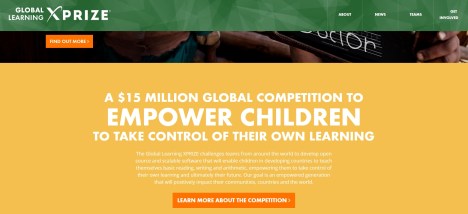
On Monday, September 22, the XPRIZE Foundation announced the Global Literacy XPRIZE in New York City. This newest XPRIZE may, in some ways, be more ambitious than the previously announced $30 million Google Lunar XPRIZE. It seeks to bring literacy to more than 300 million children who cannot read, write, or do arithmetic.

The XPRIZE Foundation, in the last part of its proposed rules, says, “At XPRIZE, we don’t believe that we have all the answers, but we believe passionately in inspiring and incentivizing people to find solutions to our Grand Challenges… But we want to hear from you… You can email us your feedback at global.learning@xprize.org…” This article summarizes my comments and should stimulate readers to provide theirs. If you have comments for the XPRIZE Foundation, please leave a reply here, in the discussion at the end of this article, for all of our readers to see. Likewise, should you have remarks about my comments, I would love to hear from you. The following comments are my own opinions informed by my own experiences. A good argument may well persuade me to change them. In any event, I look forward to an excellent discussion.

xprize1

Quickly summarizing the competition: Teams will compete to develop software solutions to learning literacy that can be applied worldwide using Android tablets with nearby servers. Literacy includes reading, writing, and numeracy. The language to be learned will be English. The software will be open source. The software and content, ready for trial in the real world, must be completed within 18 months of selection of the finalists. The overall time frame from announcement to final award is 4-1/2 years. Read the official guidelines for all details.

I’ll begin by praising the XPRIZE Foundation for this bold effort to eliminate illiteracy across the entire globe. Education may well be our most serious problem today because a well educated world (really educated and not just schooled) will address all of our other problems such as clean water, climate change, terrorism, poor nutrition, preventable disease, ocean health, renewable resources, and so on. The Foundation is approaching problems that others ignore or give up on but that must be solved. Their competitions to date have energized entrepreneurs and those with entrepreneurial spirit to attack serious, nearly intractable problems. The technologies being developed are likely to have an impact far removed from the competition in which they are created.

I think that the “Proposed Guidelines, V.1” for this Global Literacy XPRIZE competition, have a number of controversial parts and am highlighting the ones that I believe should be altered. While the comments below are intended to be constructive, they are also definite, blunt, and tough. I feel that they should be if they are to get any attention. The controversial parts I see are: open source, teaching English, writing, and the Android platform. I wrap up with two comments: a contrarian view and literacy as fire.

1. OPEN SOURCE

The rules require that the five finalists, each of whom receives $1 million dollars and a chance at the $10 million grand prize, place their software source code in open source. This requirement is unusual in XPRIZE competitions. I think that it creates problems. Here is what the guidelines say:

An essential component of the Competition design is a commitment not only to open source software solutions, but also to an open source development process. In order to maximize the potential for the growth of this solution beyond XPRIZE, the Finalist Entries will be released under permissive licenses allowing both commercial and non-commercial use.

Software must be released on the Apache License, 2.0. Content and assets must be licensed under the Creative Commons CC BY (4.0) license. In essence, all work must be made available to anyone anywhere for free. Anyone can use the sources to build a copy and load it onto tablets without paying any fee at all.  Continue reading

Thoughts on the Surface Pro 2 After 8 Months

Jim ShimabukuroBy Jim Shimabukuro
Editor

Updated 7/21/14, 7/26/14

(Related articles: “The Surface Pro 2 Will Be the Death of Notebooks” and “Why the Surface Pro 2 Will Be a Game Changer in the Tablet World Series.”)

Steven Brown, in a 15 July 2014 comment, asked, “Curious to hear how it went after 8 months –- any updates?” His question refers to my October 2013 article, Why the Surface Pro 2 Will Be a Game Changer in the Tablet World Series, and the follow-up in November, The Surface Pro 2 Will Be the Death of Notebooks.

Steven, thanks for the question. Microsoft’s recent offering of SP3 means that the SP2 is no longer a viable purchase option — except for those interested in picking up a bargain. Used, they’re currently going on eBay for about half the original price. However, the differences between the 2 and the 3 are small enough to justify this article update.

For me, the critical variable is weight. The quarter pound difference between the 3 and 2 is negligible. To put this in perspective, it’s the difference between my first-gen iPad and the SP2. They’re both equally heavy — or light, depending on your perspective. The SP3 screen size is touted as a breakthrough, but the 1.4″ difference isn’t that impressive considering the bulk that it adds to the overall size. By desktop and notebook standards, it’s still far too small for serious work for prolonged periods.

The 2160 x 1440 resolution seems enormous compared to the SP2’s 1080 x 1920, but it’s negligible considering the pixels per inch, which is 216 vs. 208. The SP2’s resolution is excellent. I’m using it right now, with the power cover, to write this article. I have it connected to a 32″ 1080P monitor via the SP2’s proprietary HDMI adaptor, and the clarity is equal to my desktop’s.  Continue reading