Bresnick, Probasco, and McFaul’s core thesis in “China’s AI Arsenal: The PLA’s Tech Strategy Is Working” (2 March 2026) is that the People’s Liberation Army has moved beyond aspirational rhetoric about “intelligentized warfare” and is now systematically translating AI ambitions into concrete capabilities across command-and-control, sensing, targeting, and unmanned systems, in ways that are beginning to work at scale and that the United States has not yet fully internalized in its own strategy.1 This argument builds directly on their recent empirical mapping of more than 9,000 AI-related PLA requests for proposals and nearly 3,000 AI-related defense contract awards between 2023 and 2024, which reveal a broad, coherent, and rapidly growing demand signal for AI in every warfighting domain.2,3
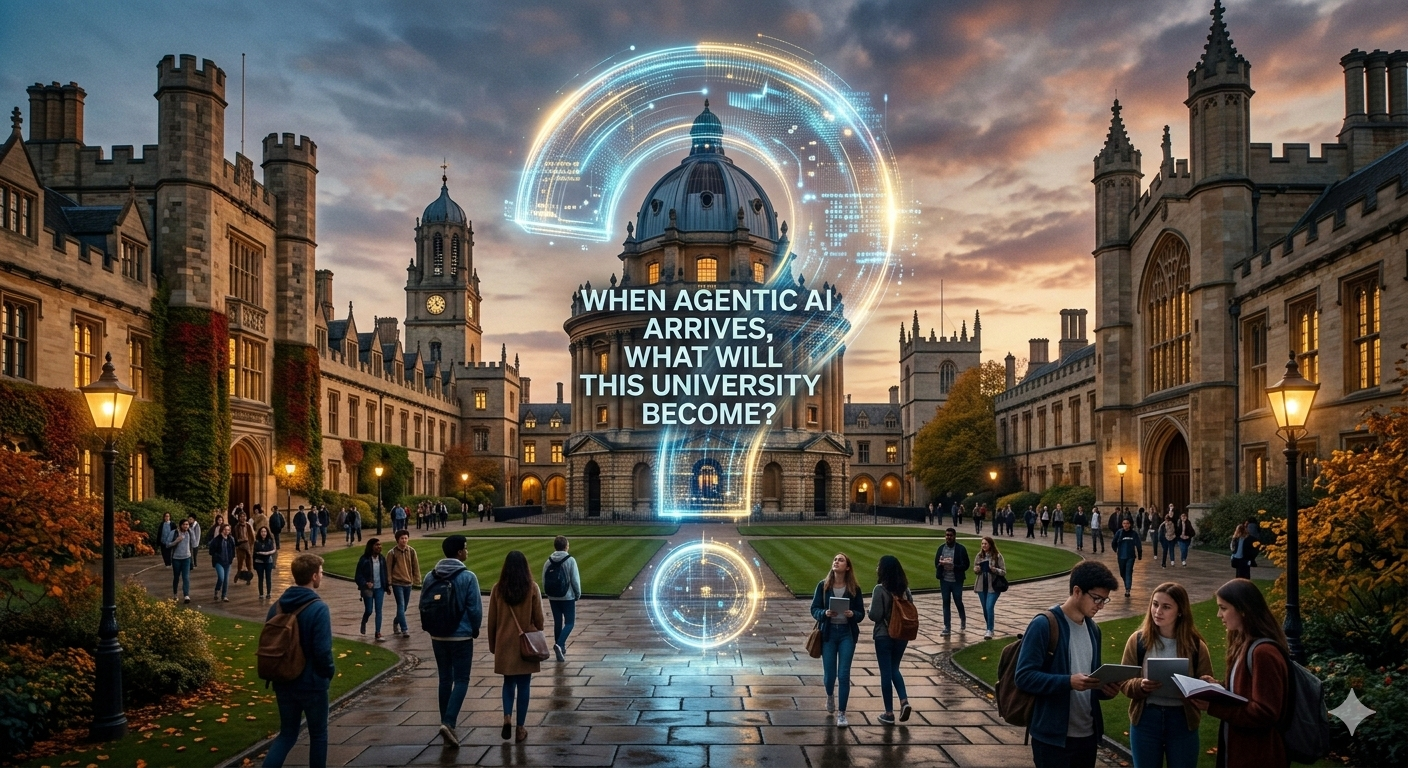
The transformation of university pedagogy that agentic AI demands is perhaps the most visible and immediate of the three domains, and it begins with a fundamental rethinking of what learning is supposed to produce. Commentators inside higher education have described the emerging shift as the move “from generative assistant to autonomous agent,” emphasizing that generative models will increasingly sit behind agentic layers that decide when and how to use them.1 This means that course designs built around the submission of finished products — essays, problem sets, take-home exams — are structurally vulnerable in ways that syllabi policies cannot patch.
Agentic AI in higher education is in a visible but early, uneven phase: it is talked about as “the next evolution” beyond prompt‑driven generative tools, yet most campuses still treat it as a set of pilots and thought experiments rather than core infrastructure. A widely used working definition frames agentic AI as systems that can pursue complex, often long‑horizon goals with minimal human intervention, planning multi‑step actions, using tools, maintaining memory, and adapting to changing contexts—what some researchers call a “qualitative leap” from static chatbots and rule engines.1 In practice, this means moving from “AI that answers” to “AI that acts”: agents that can orchestrate tasks across learning platforms, student information systems, and communication channels, rather than simply generating text on demand. Commentators inside higher ed have started to describe this shift as the move “from generative assistant to autonomous agent,” emphasizing that generative models will increasingly sit behind agentic layers that decide when and how to use them.6
1. The Attack Violated the UN Charter and International Law
The most foundational and broadly shared criticism of Operation Epic Fury is that it constitutes an illegal use of force under international law. Article 2(4) of the United Nations Charter prohibits the threat or use of force against the territorial integrity or political independence of any state. Two exceptions exist: Security Council authorization under Chapter VII, and individual or collective self-defense in response to an armed attack under Article 51. Neither applies here. The Security Council did not authorize the use of force against Iran. The United States did not request such authorization. Iran was not attacking the United States or Israel at the time of the strikes.
On February 28, 2026, the United States and Israel began conducting extensive strikes against a wide range of targets in Iran. The strikes were dubbed Operation Epic Fury by the United States and Operation Roaring Lion by Israel. President Trump announced the operation in an eight-minute video posted to Truth Social around 2:30 a.m. ET, saying the United States had begun “major combat operations in Iran.” There was no address to the media or public briefing to Congress beyond a notification to the Gang of Eight shortly before strikes commenced. The video concluded with a direct message from Trump to Iranians, stating “the hour of your freedom is at hand.” (White House | CSIS | The Hilltop)
The publicly available record since 28 February 2026 shows that drones played a central, visible role in the opening waves of the joint U.S.–Israeli strikes on Iran, while the role of artificial intelligence is more indirect and mostly inferred from the types of systems and operations described. The Institute for the Study of War’s running assessment of the campaign notes that U.S. and Israeli forces launched a broad strike effort aimed at Iranian leadership, air defenses, missile and drone infrastructure, and command-and-control nodes, implying a heavy reliance on networked surveillance, targeting, and battle management systems that almost certainly incorporate AI-enabled data fusion and decision-support, even if officials do not label them as such in public statements.1 Chatham House’s early expert commentary similarly frames the operation as a technologically sophisticated attempt to decapitate Iran’s leadership and degrade its strike capabilities, but it does not provide granular detail on specific AI tools, underscoring how the most sensitive aspects of targeting and command systems remain classified.2
The three best uses of AI in education in 2026, judged by convergence across recent systematic reviews, major policy guidance (UNESCO, OECD) and large‑scale survey/analytic work, are: first, AI‑driven personalized tutoring and adaptive learning; second, AI‑supported assessment and feedback for learning; and third, AI as an assistant that offloads teachers’ routine workload so they can focus on higher‑value human work.1-8 These uses recur at the top of expert syntheses as the clearest cases where AI capabilities align with robust evidence of learning gains, better formative information, and improved teaching conditions, while remaining compatible with ethical, human‑centered principles.1,2,5,6
To discuss this matter, I must consider the past, present, and future of artificial intelligence and the growth of technology. I was there when the phrase “artificial intelligence” first appeared in 1955, but I encountered it much later in the early 1960s. Its earliest incarnation was as learning machines. I was so fascinated by the topic that I purchased Nils Nilsson’s “Learning Machines” and studied it closely. I still have the book and my notes. Much more recently, I took a MOOC from Caltech, my alma mater, on artificial intelligence to gain greater insight into the subject.
Introduction: Taken together, these four documents form a complementary quartet. RAND tells you what is already happening in U.S. schools at scale. UNESCO situates the pedagogical and governance challenges in global theoretical and comparative context. UNICEF grounds the analysis in children’s rights and provides actionable design standards for governments and the private sector. And Brookings supplies the developmental science framework and the precautionary logic that justifies urgent policy intervention. No single document suffices on its own; each fills gaps the others leave open.
The proposition of relocating AI data centers to orbit faces significant skepticism from leading figures in aerospace engineering, climate science, and cloud infrastructure, many of whom argue that the physical and economic barriers remain insurmountable within Musk’s projected timeline. Dr. Josef Aschbacher, Director General of the European Space Agency (ESA), has expressed profound caution regarding the environmental and operational logistics of such a shift. Aschbacher has noted that while space-based infrastructure is evolving, the “unprecedented thermal management challenges” posed by high-density AI chips in a vacuum—where heat can only be dissipated via radiation rather than convection—make the immediate scalability of orbital compute centers highly questionable.1
Elon Musk envisions solar-powered orbital AI data centers as a constellation of up to one million satellites positioned in low Earth orbit, around 310 to 1,000 kilometers above the surface, where they would harness continuous solar energy through advanced panels to power AI computing without the interruptions of night, weather, or atmospheric filtering that reduce efficiency on Earth.1 These satellites would form a networked cluster connected via laser links for seamless data transfer, allowing them to process massive AI workloads like those for xAI’s Grok chatbot, while radiating excess heat directly into the vacuum of space for natural cooling, eliminating the need for water or energy-intensive terrestrial systems.2
Foundation models are large machine-learning systems trained on extremely broad, often multimodal datasets (text, images, code, scientific data and more), usually with self‑supervision at scale, and then adapted to many different downstream tasks such as question answering, prediction, and content generation.1,2 This makes them “foundations”: incomplete but general models that can be further specialized for particular domains, from science and medicine to law, education, the arts, and public policy.2
1. Ray Kurzweil and the Law of Accelerating Returns
Ray Kurzweil is perhaps the most consequential and controversial prophet of the technological singularity. An inventor, entrepreneur, and director of engineering at Google, Kurzweil has spent more than six decades building and studying artificial intelligence systems, earning recognition from figures ranging from President Clinton to Bill Gates, who has called him the person he trusts most when it comes to predicting the future of AI. In 2024, Kurzweil published The Singularity Is Nearer: When We Merge with AI, a sequel to his landmark 2005 book, in which he updated his analysis in light of the extraordinary advances that have occurred in the intervening two decades. The work became an instant New York Times bestseller and renewed global debate about when and how machine intelligence will eclipse our own.
1: Noam Chomsky and the Limits of Statistical Learning
One of the most vocal opponents of the current AI and LLM hype is Noam Chomsky, a luminary in the fields of linguistics and cognitive science. Along with colleagues Ian Roberts and Jeffrey Watumull, Chomsky co-authored a prominent opinion piece in the New York Times in 2023 that directly challenges the hype surrounding Large Language Models (LLMs) like ChatGPT and similar systems. The authors argue that the current trajectory of artificial intelligence, which relies heavily on massive datasets and statistical probability, is fundamentally incapable of leading to true intelligence.
We are excited to announce that TCC Hawaii and LTEC will be co-hosting ICoME 2026 (International Conference on Media in Education 2026) August 6-8 right here on the UH Mānoa Campus. ICoME 2026 serves as a premier platform for international collaboration, knowledge exchange, and innovation in the design and use of media for learning. The theme for 2026 is “Learning with Purpose: Building Futures Through Care, Connection, and Innovation.” We invite you to share your expertise and innovations by submitting a presentation proposal. Please find the full conference details and submission guidelines below.
Mahalo, Curtis Ho and Bert Kimura ICoME 2026 co-chairs
One important caveat before diving in: among 2025–2026 sources, you find many strong claims that LLMs and agentic systems are at or near human level on specific creative or reasoning benchmarks, but almost nobody in peer‑reviewed work straightforwardly says “they think as critically and creatively as humans across the board.” The closest matches are: empirical papers where AI equals or surpasses average human performance on creativity tests, essays or industry pieces asserting AGI is already here, and investor or practitioner pieces framing current long‑horizon agents as “functionally AGI.” The following five cases, taken together, showcase the strongest public claims that today’s generative or agentic systems are at human level in critical and creative thinking.
Is it just me? I moved to Wrightwood, CA, on July 27, 2022. Since then, we’ve experienced a hundred-year blizzard, a wildfire (the Bridge Fire) that moved with astonishing speed and destroyed thirteen structures, and record rainfall that caused unprecedented mudflows, burying parts of the town and eroding others. During this same period, I also lost my wife unexpectedly. This friendly, quiet village did nothing to deserve these disasters. These three calamities over three years share only two things, as far as I know: I moved here, and global warming has hit record levels. It certainly isn’t Wrightwood’s fault. I hope it’s not me! At least, no one has blamed me yet.
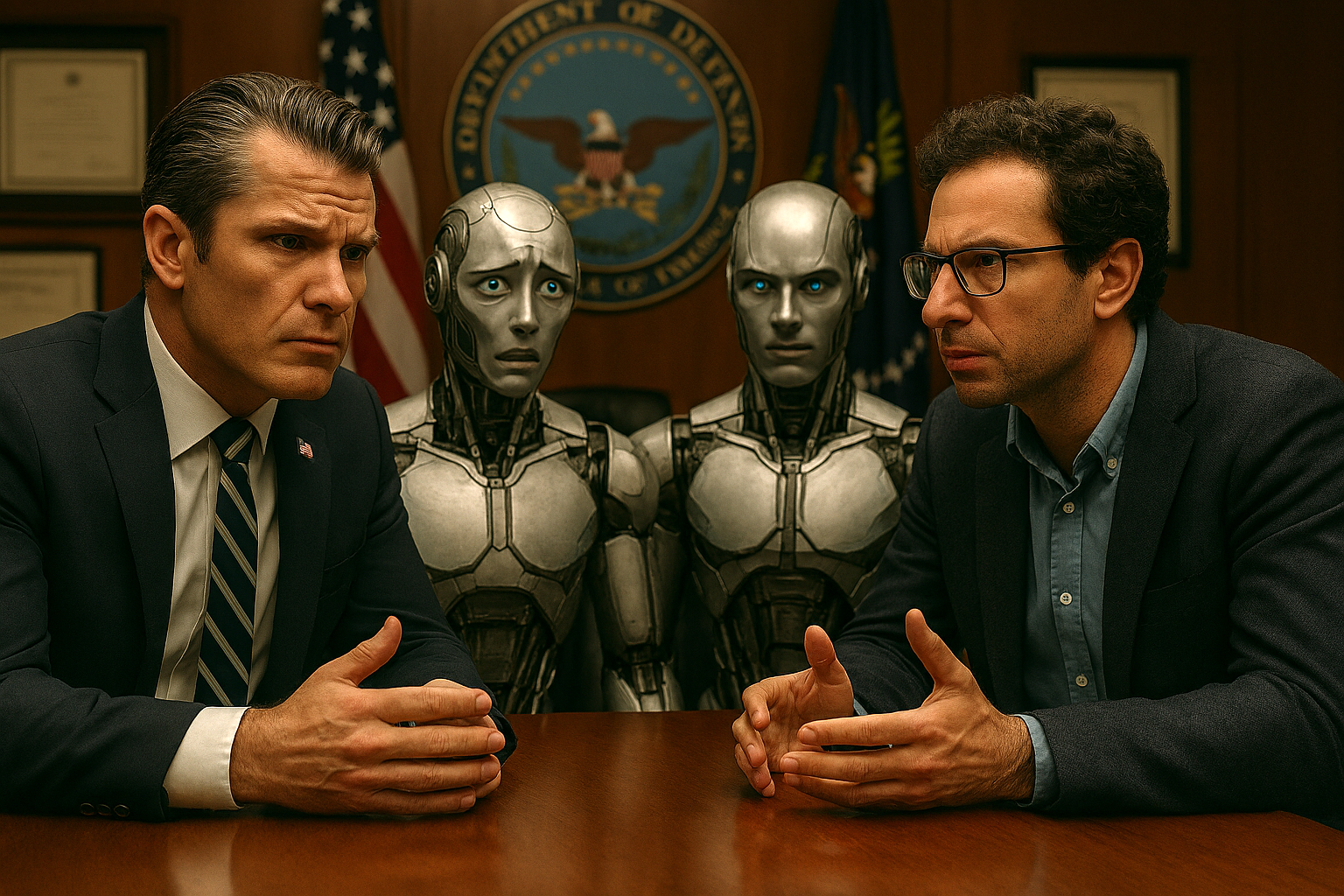
The standoff between Defense Secretary Pete Hegseth and Anthropic CEO Dario Amodei escalated into a public ultimatum on February 24, 2026, when Hegseth gave the AI firm until 5:00 p.m. this coming Friday to abandon its internal safety guardrails or face severe federal retaliation. During a tense meeting at the Pentagon, Hegseth demanded that Anthropic grant the military unrestricted access to its Claude models for “all lawful use cases,” a standard that would override the company’s existing prohibitions on mass domestic surveillance and fully autonomous lethal targeting.¹ The Defense Department argues that it is the sole arbiter of what constitutes lawful military activity and that private corporations should not impose “ideological constraints” or “woke” safeguards on tools used by warfighters to win conflicts.² In contrast, Amodei has maintained that state-of-the-art AI is currently too unreliable to operate without a “human in the loop” and that the potential for AI-driven surveillance to suppress dissent represents a catastrophic risk to democratic values.³
If Alexis de Tocqueville were somehow transported from the bustling, youthful republic he toured in 1831 to the polarized and digitally saturated America of 2026, his reaction would likely be a complicated mixture of vindication, anguish, and grim recognition. He would not be entirely surprised by what he found — his two volumes of Democracy in America read, as one contemporary reviewer has noted, like a diagnosis of the United States in 20251 — but the sheer scale and speed of the republic’s drift from its original character would surely alarm him. Three observations, rooted in his deepest preoccupations, would dominate his assessment: the transformation of the tyranny of the majority into new and subtler forms of domination; the near-fulfillment of his prophecy of “soft despotism” through the growth of administrative centralization; and the catastrophic erosion of the civic associations and habits of the heart that he believed were democracy’s best safeguard.
Alexis de Tocqueville (Théodore Chassériau – Versailles), 1 January 1850 [Public Domain]
Car homelessness has emerged as a significant and expanding crisis within the United States, transitioning from a localized issue in high-cost coastal cities to a nationwide emergency. By 2024, the total population of people experiencing homelessness reached a record high of over 771,000, representing an 18% increase from the previous year—the largest single-year jump ever recorded¹. Within this broader crisis, vehicular homelessness (living in cars, vans, or RVs) has become a primary “shelter of last resort” for many, as official counts indicate that approximately half of the unsheltered population in major urban centers like Los Angeles now reside in vehicles².
Introduction: After baking whole wheat bread loaves for the last two years, I found weevils in my two flour containers. I store flour in these air-tight containers as soon as I get home from the market, so they were more than likely already in the flour. I threw out the infested flour and cleaned the containers. I was surprised to learn that, for storage, baking flour at low temperatures is an effective solution. -js
As of 22 February 2026, there is no single, unified “grand” hierarchical developmental theory that simultaneously and symmetrically models how humans learn to work with AI, how AI learns to work with humans, and how AIs learn to work with other AIs. What we do have is a patchwork of emerging, partly hierarchical frameworks: (a) stage‑based models of human–AI teaming and human learning with AI; (b) hierarchical and curriculum‑based training schemes for AI systems adapting to humans; and (c) hierarchical multi‑agent reinforcement learning and curricula for AI–AI cooperation. Together, they form the beginnings of a developmental science of human–AI–AI collaboration, but they are still fragmented, domain‑specific, and rarely integrated into a single cross‑species developmental theory.
Introduction: As artificial intelligence shifts from an emerging technology to a foundational layer of global economic and political power, understanding where AI research and development are most concentrated becomes essential. This list of the top ten countries in AI R&D in February 2026 does more than rank national capabilities; it reveals the evolving geography of intelligence production itself. By examining investments, compute capacity, publication output, patent activity, corporate ecosystems, and policy frameworks, the list maps the infrastructures that shape who builds frontier models, who governs them, and who benefits from their deployment. In an era defined by large-scale models, semiconductor supply chains, and AI-enabled public services, national ecosystems function as interconnected nodes in a worldwide network of innovation and influence. The significance of this compilation lies in its ability to clarify both competition and interdependence: the United States and China anchor rival centers of gravity, while countries such as the United Kingdom, Canada, Israel, Germany, France, South Korea, Singapore, and India demonstrate diverse pathways to relevance. For scholars, policymakers, and industry leaders alike, this ranking offers a strategic snapshot of how AI’s growth is being structured—and where its next breakthroughs are likely to emerge. -Introduction by ChatGPT
Dr. Kai-Fu Lee, Chairman and CEO, Sinovation Ventures
A video of Alicia Tournebize, an 18-year-old, 6’7″ freshman from Vichy, France, who joined Dawn Staley’s South Carolina Gamecocks in January 2026, is going viral on YouTube. She had already made history before setting foot on a college court. She became the first Frenchwoman to perform a dunk in an official game in September 2024, during an NF2 contest between Bourges and Beaumont, with that milestone only formally recognized after video of the dunk was published in March 2025. That first dunk was followed by a two-handed slam at the 2025 FIBA U18 EuroBasket tournament that went viral worldwide.
John Dewey would likely see AI not as a replacement for teachers or a new delivery channel for standardized content, but as a powerful set of tools that must be organized to enrich students’ experiences, deepen inquiry, and widen participation in democratic life. He would judge AI by whether it makes school more “educative” in his technical sense: promoting further growth, reflective thinking, and social engagement, rather than passive dependence or narrow skill training. [dewey.pragmatism.org, schoolofeducators.com]













































 Educational Technology and Change Journal
