MOOC Sightings 002: Oxford Professor Declares MOOCs the Loser

MOOC Sightings2

William Whyte, professor of social and architectural history at St John’s College Oxford, assures us that in the “battle” of MOOCs vs traditional campus-based universities, “The MOOC will prove to [be] the loser.”1 He parades the usual suspects for their demise: low completion rates and absence of credits and degrees.

He tosses Britain’s E-University and Open University in with MOOCs for what amounts to a clean sweep of online programs. Two birds with one stone, as it were. He cites E-University as a costly failure and Open University as “actually a rather traditional university.” Convenient, but what these institutions have in common with MOOCs is baffling.

He bolsters his prediction with survey results: “Only 6% of prospective undergraduates surveyed last year [want] to stay at home and study. The other 94% expected and hoped to move away to a different place for their degrees.”

Whyte declares traditional universities the winner because “people want and expect something rather more than a purely virtual, entirely electronic experience of university. They expect it to be a place.”

Strong reassurance, indeed, for those who see MOOCs as “a horrible sort of inevitability.” Traditional universities have not only withstood the MOOC challenge but actually emerged stronger.  Continue reading

MOOC Sightings 001: UNC and Cornell

MOOC Sightings2

Despite wholesale announcements by powerful academic leaders throughout the U.S. that MOOCs are dead, sightings continue to pour in from around the country and the rest of the world. For skeptics, the problem is physical evidence. People can offer them and take them, but no one seems to know what a MOOC looks like. Some point to Coursera and edX, but in the opinion of most MOOC experts, who are primarily from Canada and the UK, these are hoaxes.

So, in the interest of determining once and for all whether MOOCs are fo’ real, I’ll be opening Project White Book to publish promising sightings and photos of MOOCs. In this inaugural post, I’m sharing the photo, below, of what appears to be one person’s conception of a MOOC. I recently found it in the ETC spam queue. It was posted anonymously with the header “Da MOOC!” I’ll post photos as I receive them, so if you have one, email it to me (jamess@hawaii.edu) and I’ll publish the most interesting.

Is this a MOOC, a hoax, or just another weather-related phenomenon?

Is this a MOOC, a hoax, or just another weather-related phenomenon?

I’m also sharing promising sightings by Sarah Kaylan Butler, “50,000 Enroll in UNC Online Course” (Daily Tarheel, 2/19/15), and Blaine Friedlander, “Cornell Sinks Teeth into Four New MOOCs” (Cornell Chronicle, 2/19/15).

Butler reports that “almost 50,000 students have enrolled in a massive open online course on positive psychology taught by UNC professor Barbara Fredrickson.” Evidence that this Coursera-based course might be a real MOOC is very strong. It’s six weeks long, a departure from the usual quarter or semester time frame. It’s comfortably aimed at interest rather than college credit. According to Fredrickson, “Most people that are enrolled — 95 percent of them — say that they’re interested out of their own curiosity.” And the professor is on firm MOOC footing, looking for pedagogical guidance from the future rather than the past. She says, “I’ve written a couple of books for general audience and one of the things that’s clear about our changing audience is that people don’t necessarily want to read books, but they like ideas.”

Another promising sighting is from Cornell. Friedlander reports that “Cornell will offer four new [MOOCs] in 2016: shark biodiversity and conservation, the science and politics of genetically modified organisms (GMOs), an introduction to engineering simulations, and how deals get done – mergers and acquisitions principles.” They’re still in the planning stages, so I’ll keep an eye out for more details as they become available.

Are MOOCs fo’ real? In this series, I’ll be looking at the evidence through a lens that’s forged from constructivist and disruptive theory as well as a dash of whimsy. In this process, I look forward to hearing your thoughts. Please share them in the discussion below. If you’re logging in from an address that has been previously approved, your reply will be posted automatically. If not, your first reply will be published within 24-48 hours. Subsequent replies from your address will be published immediately.

Free Webinar: ‘Using Technology to Engage Students’ 2/23/15 3pm EST

From Macmillan Higher Education 2/17/15:

Join us on Monday, February 23rd at 3pm EST for a complimentary webinar on “Using Technology to Engage Students” with Solina Lindahl of Cal Poly San Luis Obispo!

The 21st century classroom is getting larger, more tech-laden and full of students weaned on digital devices. How should our teaching change (or NOT change) in light of this? This talk is aimed at showing how iPads, iClickers and more can engage the face-to-face large class. Included are a brief discussion of some of the more innovative (and easy) visual presentation apps, as well as a look at using iPads to do the most old-fashioned of practices: worked problems.

edtech week

To learn more about all of our EdTech Week sessions and our presenters, please visit our EdTech Week website. You can also join our event on Facebook for the latest updates and information! We hope to see you there!

Changing Face of Healthcare: The Role Mobile Apps Will Play in Medicine

frida-cooper 80By Frida Cooper

Judging by the sheer popularity of smartphones in modern times, it’s safe to say that this multi-faceted and dynamic invention may just be the best thing since sliced bread. Maybe even better, if sales figures from smartphone manufacturers are anything to go by. The Smartphone’s utility isn’t restricted to the quintessential teenager texting all day or for showing the world what you had for lunch earlier that day. The advent of smartphones and their ability to connect to the veritable hoard of information that is the Internet has revolutionized life in general and pretty much every profession on the face of this world too.

The substantial healthcare industry here in the United States is most definitely one such example. The truth of the matter, though, is that the total impact of smartphones and mobile apps hasn’t even hit the industry yet, but that’s all about to change. Traditionally, the whole dynamic between healthcare professionals and the general population was that of blind faith. The knowledge and expertise of healthcare professionals wasn’t ever questioned, for better or for worse.

The origins

Things all began to change with the advent of the Internet in households across the USA. People started to conduct research on medical maladies that they were suffering from. They started to question the choice of medication, course of treatment taken, and potential side effects. These and many other things that would have been left to the professional’s judgment but a few years earlier were being challenged now that the patient was armed with information.

Where apps fit in

Whether this situation was and is good or bad is still up for debate, but this is where this revolution originated from. When smartphones came to the fore, this situation was taken up a few notches. A study conducted by IMS Institute for Healthcare Informatics in 2013 pointed at over 40,000 healthcare-related apps available for download then in the iTunes App Store. Imagine how many more there are when taking platforms like Windows and Android into account. The sheer diversity of topics, too, covered under the healthcare ambit is staggering.  Continue reading

Secretary Duncan’s Discussion with Maryland Teachers to Be Streamed Live 9:50AM (ET) 2/18/15

Secretary Arne DuncanU.S. Secretary of Education Arne Duncan will visit Maryland on Wednesday to highlight the progress that the state’s schools and students have made through the hard work and leadership of parents, teachers, principals, as well as local and state officials.

He will visit two schools and then end his day with a speech about the importance of local and school-level leadership in continuing efforts to improve education. In his speech, Duncan will talk about the need to support states’ efforts and expand investments, progress and opportunity for all children through reauthorizing a new Elementary and Secondary Education Act.

Earlier in the day, Duncan and State Superintendent of Schools Lillian Lowery will visit classrooms at Ducketts Lane Elementary School and meet with teachers from there and Thomas Viaduct Middle Schools to hear how teaching and learning is changing during the transition to higher standards and how that has contributed to schools’ and students’ success in Maryland. The discussion with teachers will be streamed live on the Howard County Public School System website, www.hcpss.org.   Continue reading

Mars One: 100 Still in Running to Be First Humans on Mars

Amersfoort, 16th February 2015From the initial 202,586 applicants, only 100 hopefuls have been selected to proceed to the next round of the Mars One Astronaut Selection Process. These candidates are one step closer to becoming the first humans on Mars.

“The large cut in candidates is an important step towards finding out who has the right stuff to go to Mars,” said Bas Lansdorp, Co-founder & CEO of Mars One. “These aspiring martians provide the world with a glimpse into who the modern day explorers will be.”

The Mars 100 Round Three candidates were selected from a pool of 660 candidates after participating in personal online interviews with Norbert Kraft, M.D., Chief Medical Officer. During the interviews the candidates had a chance to show their understanding of the risks involved, team spirit and their motivation to be part of this life changing expedition.

Dr. Norbert Kraft said, “We were impressed with how many strong candidates participated in the interview round, which made it a very difficult selection.”

There are 50 men and 50 women who successfully passed the second round. The candidates come from all around the world, namely 39 from the Americas, 31 from Europe, 16 from Asia, 7 from Africa, and 7 from Oceania. The complete list of Mars One Round Three Candidates. Statistics on the candidates can be found here.

The following selection rounds will focus on composing teams that can endure all the hardships of a permanent settlement on Mars. The candidates will receive their first shot at training in the copy of the Mars Outpost on Earth and will demonstrate their suitability to perform well in a team. More information about the selection process can be found here: Mars One Selection ProcessContinue reading

Technology and Our Health

lynnz_col2

Technology is rapidly morphing and changing, but what about the humans who use it? Numerous research studies as well as reports on various aspects of the connection between technology and our physical, mental, and emotional health are examining the various factors that may impact our lives.

box Can A Computer Change The Essence Of Who You Are?, by Lulu Miller and Alix Spiegel, NPR, Feb. 13, 2015.

In this essay, the authors explore the ways that technology can impact our lives in various ways. They focus on social media and how an individual used Twitter to document and call out people on bad behavior. Pete, who set up the Twitter account, soon found that over time, his tweets became harsher and harsher. The authors report that quite a few psychologists are trying to figure out how socializing is different online. For instance, when you have a bad day and post about it on social media, you are validated by not just one friend, but many “friends” who tell you that you are all right. This type of mass positive feedback can be addictive and can change the social dynamic. This post created a pretty lively exchange of comments, so be sure to read them, too.

box Internet Trolls Are Narcissists, Psychopaths, and Sadists: Trolls will lie, exaggerate, and offend to get a response, by Jennifer Golbeck Ph.D.Psychology Today, Sep. 18, 2014.

In this article, Golbeck reports on a study by some Canadian researchers published in Personality and Individual Differences which looked at people who purposely disrupt online discussion, so-called trolls. The researchers gave personality tests to over 1,200 people and surveyed their Internet commenting behavior. They found that respondents who scored high for narcissism, Machiavellianism, psychopathy, and sadism also reported that “trolling was their favorite Internet activity.’ Trolls use the Internet to harm other people for their own pleasure.

box Long-term health outcomes and cost-effectiveness of a computer-tailored physical activity intervention among people aged over fifty: modelling the results of a randomized controlled trial, by Denise A. Peels et al., BMC, Oct. 23, 2014.

Rather than focusing on possible negative influences of technology, in this study a group of Dutch researchers examined how technology in the form of a computer-tailored physical activity program can improve long-term health outcomes among adults aged over fifty. “[S]timulating people to become more physically active… can result in better public health and thereby reduce health care costs.”

Serve the Nation as a Presidential Innovation Fellow

PIF logo

Calling All Innovators: Apply to Serve the Nation as a Presidential Innovation Fellow
by Ryan Panchadsaram, Garren Givens on February 12, 2015 at 11:00 AM EST

Today, we are very excited to announce that we are on the lookout for more innovators and technologists to serve the nation as Presidential Innovation Fellows.

The Fellowship brings talented, diverse individuals from outside government to team up with top federal innovators to tackle some of our country’s most pressing challenges. Acting as a small team alongside federal agency “co-founders,” Fellows will work quickly and iteratively to turn promising ideas into game-changing solutions.

As always, the Fellows will focus on national priorities, leveraging the best principles and practices of the innovation economy to help create positive impact in the span of months, not years. This is an opportunity to truly transform how government works for the people it serves.

Projects will focus on topics such as:

  • Education: Fellows will work with myriad agencies to help make education more accessible to more Americans.
  • Jobs and the economy: Fellows will work on fueling the economy and stimulating job growth through innovation and improved opportunities for entrepreneurs and businesses of all sizes.
  • Climate change: Fellows will help our country and its communities prepare for the impacts of climate change.
  • Health and patient care: Fellows will leverage innovation to save lives, provide better access to benefits and programs promoting quality of life.

Fellows selected for this highly competitive program will serve for 12 months as entrepreneurs-in-residence to our federal agencies. Over the course of the Fellowship, individuals work as part of a small team of three to four. These teams of designers, developers, and product managers will participate in two to three “deep dives,” with the goal of “accelerating” initiatives chosen by the Program for their potential impact.

The first step is to apply online. Candidates can apply anytime, throughout the year, and applications will be evaluated on a rolling basis.

We look forward to kicking off another exciting year of projects.

Ryan Panchadsaram is the U.S. Deputy Chief Technology Officer. Garren Givens is Director of the Presidential Innovation Fellows and Deputy Executive Director of 18F.

New Exoplanets Very Old

picture of Harry KellerBy Harry Keller
Editor, Science Education

With all of the hoopla over exoplanet discoveries in recent years, it’s a big surprise that this one did not receive more attention. Kepler-444 is a small star, about 25% smaller than ours, and is 11.2 billion years old. According to measurements made by the 600-million dollar Kepler space telescope, it has five rocky planets ranging in size from Mercury to Venus.

Artist's concept of the 11.2-billion-year-old star Kepler-444, which hosts five known rocky planets. Credit: Tiago Campante/Peter Devine.

Artist’s conception of Kepler-444, an 11.2-billion-year-old star, and its five orbiting rocky planets. By Tiago Campante/Peter Devine.

The above information is sufficient to generate great excitement. When you realize that the universe is only about 13.6 billion years old, you know that this star and its planets formed in the early days of a very young, only about 2.5 billions years old, universe. Our own star is less than half as old at 4.6 billion years and has an expected lifespan of around 10 billion years.  Continue reading

The Science of Deflategate

picture of Harry KellerBy Harry Keller
Editor, Science Education

The New England Patriots have muddled up the Super Bowl in a grand fashion. It might as well be an MIT prank but on a national scale. We haven’t see the like since Caltech (MIT’s famous rival in the prank world) jimmied the Rose Bowl’s card stunts half a century ago. (Personal note: I was a member of the Caltech group of twelve that did that. Also see this LA Times article.)

Denials are not going to change any fan’s mind. If you’re a Patriot fan, you probably don’t think it’s important. If you’re not, then you will believe any evil of the New England dynasty.

Before delving into the science, I should note that reporters have said that the ball deflation was discovered during halftime and rectified. As the final score was 45-7, and the second half score was 28-0, even if every Patriot point in the first, seemingly flawed half were rescinded, the score would still be 28-7 in favor of the Patriots. We are not discussing, therefore, who should play in the Super Bowl. We are instead discussing how balls would have become low in pressure.

As any high school physics teacher will tell you, PV=nRT, the ideal gas law. Okay, that’s gibberish to many, but it’s really very simple. So simple in fact that you can do the calculations yourself with calculator or even readily with paper and pencil. Let’s deconstruct this equation.  Continue reading

The Imitation Game: A Cautionary Tale

picture of Harry KellerBy Harry Keller
Editor, Science Education

With The Imitation Game having academy award nominations, it’s a good movie to consider for science learning. Benedict Cumberbatch and Keira Knightly star in this story of Alan Turing. Turing is famous in computer science for the Turing Machine and the Turing Test. The latter was named by him as “the imitation game.”

A Turing Machine is a concept created by Turing that says that anything computable can be computed by a ridiculously simple machine consisting of a tape of indefinite length that contains only ones and zeroes and a reader that decides what to do upon reading the tape — to move forward or backward and how much. This decision depends on the state of the machine and the number read on the tape. Turing’s machine can, in theory, perform any computation being done today by any computer. You can say that Turing invented the modern computer — in theory anyway.

Alan Mathison Turing at the time of his election to a Fellowship of the Royal Society. Photograph was taken at the Elliott & Fry studio on 29 March 1951.

Alan Mathison Turing at the time of his election to a Fellowship of the Royal Society. Photograph was taken at the Elliott & Fry studio on 29 March 1951.

As Alan Turing sat and thought about computers, he asked himself what is the potential of computing machines in the indefinite future. He decided that it’s possible for a machine, in theory, to mimic human behavior. He then asked how can you tell if the machine truly is behaving as a human. In those days, all communication with machines was by writing or, worse, by looking at lights or blips on a CRT. His test involved writing to a machine and receiving written replies. If, no matter how much you wrote and read, you could not tell whether the replies were coming from a human or a machine, then the machine passed the test, “the imitation game,” and should be considered for all intents and purposes as human.  Continue reading

Register for TCC 2015 – The Future Is Now

kimura80By Bert Kimura

Aloha,

Register for the TCC 2015 Worldwide Online Conference, The Future Is Now:

http://tcconlineconference.org/

Enjoy KEYNOTE sessions by:

  • Dr. Howard Rheingold, Author, Critic, Journalist & Educator
  • Alan Levine, Pedagogical Technologist, Architect of Open & Connected Learning
  • Dr. Stella Perez, Sr. VP Communications and Advancement, American Association of Community Colleges

This year, our 20th conference features an ONSITE option to participate in-person at the University of Hawai’i at Manoa campus. There is also an option to participate virtually ONLINE as in previous years.

For further information (including low-cost housing and an optional educational tour), see:

http://2015.tcconlineconference.org/register/

Site licenses for unlimited participation from a campus or system are available. Special rates apply to University of Hawai’i faculty and staff. For more info, contact Sharon Fowler <fowlers@hawaii.edu>.

We look forward to seeing you at TCC 2015.

Warm regards,
Bert Kimura
For the TCC Conference Team

Practical Reasoning – Challenges for Teaching and Assessment

By Stefanie Panke
Editor, Social Software in Education

In a faculty brown bag lunch, Molly Sutphen, Associate Director of the UNC Center for Faculty Excellence and author of the seminal book Educating Nurses: A Call for Radical Transformation, delivered a talk on Practical Reasoning at the School of Government. The talk was a nice follow-up to the Teaching Palooza that our faculty organized last summer. Since the School’s focus is on teaching adult learners, enhancing practical reasoning skills is an important objective of my instructional design work.
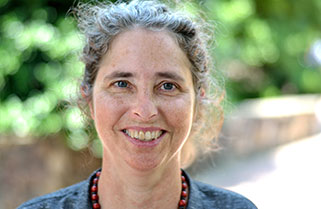
Molly Sutphen, Associate Director of the UNC Center for Faculty Excellence

Molly Sutphen, Associate Director and Teaching and Learning Coordinator, UNC Center for Faculty Excellence

Characteristics of Effective Practical Reasoning

  • To be able to draw on knowledge from different areas, courses, or types of knowledge and use it
  • To develop a sense of salience about a situation
  • To realize the stakes of a situation
  • To put boundaries around a problem or question
  • To be able to envision different outcomes
  • To be able to construct a narrative forward and backward

Assessment and Practical Reasoning

With the pressure of constantly demonstrating impact, assessing the short term learning outcomes of practical reasoning is problematic. “Practitioners may learn, but we don’t know it – what you teach, someone will perhaps not use for another five months – or ten years,” said Dr. Sutphen. She recommends taking “a long view” instead.

Instructional Strategy: Unfolding Cases

Dr. Sutphen introduced unfolding cases as an instructional strategy to teach practical reasoning skills. Unfolding cases are underdetermined (no obvious plan or resolution), scaffolded (controlled amount of information), and orchestrated (prompting specific, relevant questioning). In a plenary exercise, she presented a list of questions to help teachers construct unfolding cases.

  • What is this a case of?
  • Where do you want to start and end?
  • How underdetermined do you want the case to be?
  • Who are the actors? At which point will they be revealed?
  • What is the arc of the narrative?
  • What information will you provide or conceal?
  • Will you give boundaries or expect them to be discovered?

Further Reading

Benner, P., Sutphen, M., Leonard, V., & Day, L. (2009). Educating nurses: A call for radical transformation (Vol. 15). John Wiley & Sons.

Colby, A., Ehrlich, T., Sullivan, W. M., & Dolle, J. R. (2011). Rethinking undergraduate business education: Liberal learning for the profession (Vol. 20). John Wiley & Sons.

Schwartz, B., & Sharpe, K. (2010). Practical wisdom: The right way to do the right thing. Penguin.

Gherardi, S. (2012). “Docta ignorantia”: Professional Knowing at the Core and at the Margins of a Practice. Journal of Education and Work, 25(1), 15-38.

Seed Wins the Mars One University Competition to Germinate Life on Mars in 2018

Mars One Press Release: Amersfoort, 5 Jan. 2015:

Mars One is proud to present the winner of the Mars One University Competition: Seed. The Seed team is an important step closer to sending their payload to Mars. The winning payload will fly to the surface of Mars on Mars One’s 2018 unmanned lander mission. Seed was selected by popular vote from an initial 35 university proposals and this is the first time the public has decided which payload receives the extraordinary opportunity to land on Mars.

Photo courtesy of Bryan Versteeg and Mars One.

Photo courtesy of Bryan Versteeg and Mars One.

“We were generally very pleased with the high quality of the university proposals and the amount of effort associated with preparing them,” said Arno Wielders, co-founder and Chief Technical Officer of Mars One. “Seed itself is uniquely inspiring since this would be the first time a plant will be grown on Mars.”

The Winning Team – Seed aims to germinate the first seed on Mars in order to contribute to the development of life support systems and provide a deeper understanding of plant growth on Mars. The payload will consist of an external container, which provides protection from the harsh environment, and interior container, which will hold several seed cassettes. The seeds will stem from the plant Arabidopsis thaliana, which is commonly used in space plant studies. After landing, the seeds inside the cassette will be provided with conditions for germination and seedling growth. The growth will then be recorded using images transmitted back to Earth.

“We are really pleased to be the selected project among so many excellent ideas. We are thrilled to be the first to send life to Mars! This will be a great journey that we hope to share with you all!” said Teresa Araújo, Seed team member.

Seed consists of four bioengineering students from the University of Porto and two PhD students from MIT Portugal and the University of Madrid. The team is supported by Dr. Maria Helena Carvalho, plant researcher at IBMC and Dr. Jack van Loon, from the VU Medical Center, VU-University in Amsterdam, and support scientist at ESTEC-ESA. Seed benefits from scientific and technical support from several advisers, whose expertise range from biological systems to spacecraft development and validation. Read more about Seed here.

An in-depth technical analysis of the winning proposal will be conducted to ensure that the winner has a feasible plan and that their payload can be integrated on the 2018 Mars lander. Mars One and its advisers will contribute to the analysis by thoroughly and critically examining the Seed proposal.

If Seed runs into any issues regarding feasibility or can not stick to the schedule, Mars One will fall back on the runner ups of the university competition. The second and third placed projects are Cyano Knights and Lettuce on Mars.

More information

About Mars One

Mars One is a not-for-profit foundation that will establish permanent human life on Mars. Human settlement on Mars is possible today with existing technologies. Mars One’s mission plan integrates components that are well tested and readily available from industry leaders worldwide. The first footprint on Mars and lives of the crew thereon will captivate and inspire generations. It is this public interest that will help finance this human mission to Mars.

For more information visit www.mars-one.com

College and Other Lies

vb0-80By Veronica Brockschmidt
Student at Kapi’olani Community College
University of Hawai’i

Starting in elementary school, the importance of finding the perfect career for you is introduced with fun little surveys that point you in the direction of possible future jobs based on your interests and selected answers. Kids would get career options like Model, Painter, Teacher, Doctor, etc, and a statistic on salary ranges for each position. In high school, the importance of graduating and attending college is drilled in from day one. By the age of 16 you were expected to know, without a doubt, what you wanted to be when you “grow up.” By the time you actually graduated high school, you needed to know exactly what you wanted to major in and the career you wanted for the rest of your life. That’s some intense pressure, especially for still technically being a kid and not actually accepted into any colleges yet.

You were given more statistics about the financial lives of Americans with college degrees and how much better their lives were than those with only a high school diploma. The implication was that if you go on to finish college, you’d be a millionaire (Kristof), but if you stop now with only your high school diploma, you’ll be stuck at McDonald’s asking your old classmates if they “Want fries with that?” The fear tactic worked. Plus, who doesn’t want to make up to $1,000,000.00 more than someone with just a high school education?

So you do the whole college thing because it’s the new societal norm and you want to make your parents proud. You feel like you have your life together because you’re getting good grades and you have the career major that you truly love and could happily do for the rest of your life. Little do you know that you were severely overpromised on realistic job opportunities and, suddenly, being a college graduate seems like it has nothing to do with how successful you actually are (9gag).

Perhaps it was that, at the time of you declared a major, that industry was hiring a lot of people and that the promise of success even had something to do with your decision. But now that three to five years have passed, those positions have filled up due to the overwhelming flood of qualified applicants who all had the same idea as you. Either way, you, “the successful college graduate,” are somehow unemployed, still eating Top Ramen, and sharing a bedroom to be able to afford rent.  Continue reading

From ‘Yes Ma’am’ to ‘F*** You’

Tracey kashiwa 80By Tracey Kashiwa
Student at Kapi’olani Community College
University of Hawai’i

Justin Bieber Eggs His Neighbor’s House.” “Kendall Jenner…Calls [Her Mother] a…Whore.” “Miley Cyrus Twerks on Married Man.” In American society today, the media is filled with incidents of youths disrespecting their elders. In fact, even the idea that children should respect their elders seems nonexistent (“Respect for Others”). I’m only thirty-two, but even I wonder what happened to respecting our elders.

When I was a child, I looked to my parents and grandparents for advice and to learn about the past. I viewed them as wise old owls who had a wealth of knowledge and experience that I could tap into. Disrespecting my parents was never an option, and if I didn’t show respect, they would ground me for weeks or, even worse, break out the back scratcher. What has changed from my generation to this? Has the internet ruined our need to look to elders as knowledge keepers? Has social media eliminated our need for social pleasantries? Has the frown on spanking created an uncrossable barrier for parents and discipline?

To better understand youth, I interviewed my twenty-year-old housemate, John, a young man plagued by the need to disregard others. John is the kind of person who, if you asked how his day went, walks past you without eye contact or acknowledgement of your existence. He acts as though he is royalty and can’t be bothered by the peasants around him, and he always has music blaring through headphones to drown us out. I doubt he would behave so arrogantly if he knew how much he resembles a chicken pecking the ground for food when he bobs his head to the beat. Like I said, he is the epitome of a disrespectful youth.  Continue reading

‘Better Than Earth’? – Baloney

picture of Harry KellerBy Harry Keller
Editor, Science Education

“Superhabitable” worlds may be common in our galaxy, making ideal homes for extraterrestrial life — Scientific American cover, January 20151.

Years ago, Carl Sagan famously wrote about a scientist’s “baloney detection kit” in The Demon-Haunted World (1995). You can learn all about this storied chapter by searching on the Internet for “baloney detection kit.” His point was that scientists obtain this mental tool kit as a side effect of their training and that we should similarly train everyone.

Scientific American magazine just published an article, “Better than Earth,” which shows us that scientists are not immune from broadcasting baloney themselves at times. The article is really quite good and interesting. Its statements are, as far as we can tell, accurate. Where is the baloney then?

At one point, the article states, “[T]he more closely we scientists study our own planet’s habitability, the less ideal our world appears to be.” The article also faults our own star’s “short” lifetime of about 10 billion years. “By some 1.75 billion years from how, the steadily brightening star will make our world hot enough for the oceans to evaporate, exterminating any simple life lingering on the surface.”

Looks as though we evolved just in time to enjoy our planet for a billion years or so before we are all steamed to death. Slower evolution may not have left enough time for us to exist here.

We circle a G-class star. According to the author, the next step down in star size, “K dwarfs[,] appear to reside in the sweet spot of stellar superhabitability.” K dwarf stars will shine for tens of billions of years, many times longer than our star. However, the author cautions that our planet is too small for conditions suitable for life to exist for that long period of time. Our core would have cooled too much to sustain our magnetic field and plate tectonics, both necessary to life.  Continue reading

Weary Professors Abandon Technology?

picture of Harry KellerBy Harry Keller
Editor, Science Education

According to US News & World Report, “[P]rofessors say they don’t have enough help to use this technology effectively, haven’t seen results from it, and fear that the cost savings administrators keep insisting that technology will bring could mean their own careers are on the line.”

Just take a moment to break this sentence down and understand what’s being asserted here.

Professors don’t have enough help to use the technology. This comment implies that the technologies under consideration do not have an easily used interface. Good technology should not require any but the most rudimentary training that you can receive from, for example, watching a video.

Professors haven’t seen results from it. Some technologies in education do not generate results. They may be used inappropriately for the course. The results may not match what the technologies enhance. Many professors may be working with anecdotal data from others that could be quite unscientific. The fact that you haven’t seen results from some set of technologies does not mean that all technologies are useless in education.

Professors fear losing their jobs to technology. Some technologies in some institutions could be used that way. If the professor provides no added value, then what is that person doing teaching anyway? Almost no students can guide themselves effectively through the educational process. They don’t know enough to make the necessary choices. Educators will not become obsolete soon. Nevertheless, some institutions may reduce faculty in the mistaken idea that technology can replace them. Fear should not be a determining factor in what to do or not to do. Fearing the inevitable is foolish; fearing the impotent is abandoning yourself to fear.  Continue reading

Literacy, Bullying, North Korea

lynnz_col2
Literacy Through Photography for English-Language Learners by Tabitha Dell’Angelo in Edutopia (12/1/14)
The author explores the link between imagery and language and promotes a broader definition of literacy.

Digital literacy an elementary skill by Ellen Ciurczak in The Clarion-Ledger (11/30/14)
The teachers at Petal Upper Elementary School believe that you can’t start too early teaching students how to acquire a variety of skills using computers, from Internet safety to keyboarding skills.

A valuable lesson on bullying in observer-reporter.com (11/30/14)
Bullying and cyber-bullying are serious problems that many young people have to deal with.  Elissa McCracken, Miss Ohio 2012, chose cyberbullying as the issue she would focus on during her term because she was a victim of bullying herself.

North Korea’s Cyber Skills Get Attention Amid Sony Hacking Mystery by Elise Hu at NPR All Tech Considered (12/4/14)
A rather bizarre hacking story related to Sony, North Korea, and the soon-to-be released movie, The Interview.

What Sort of Intelligence?

picture of Harry KellerBy Harry Keller
Editor, Science Education

You may have noticed recent news about Stephen Hawking predicting the demise of the human race due to the rise of artificial intelligence (AI)1. Others of genius rank, such as Elon Musk and Ray Kurzweil2, have also made this prediction. With “The Theory of Everything” (biopic about Prof. Hawking) in theaters right now, this prediction is resonating across the English-speaking world.

Before digging your shelters or heading for the hills, you should ask, “What is artificial intelligence?” A bit of history may help put this entire subject into perspective. The term was coined in 1955 by John McCarthy, who called it “the science and engineering of making intelligent machines.”3 “When?” you ask. “That’s nearly 60 years ago! Before I was born!” (I actually was born well before then, but statistically you probably weren’t.)

Funny how AI has not taken over the world in the 60 years it’s had so far. Why the sudden worry? Computers are becoming more powerful and less expensive. Computer memory is dirt cheap, speaking historically. This trend of more computer power and more memory shows no signs of abating soon. Could it eventually reach the tipping point where machines are sentient and self-reproducing? Would they then remove the “scourge” of humans from the Earth’s surface? Might the end be less dramatic in that they would render people superfluous? Imagine a world in which all work, including creative work, is done by machines. Who needs Beethoven when you have the Ultra-Composer Mark IV?

This entire discussion circles around to defining machine intelligence and estimating exactly how smart machines might become. Right off the bat, understand that intelligence, as we commonly understand it, has not been seen in machines yet. No one truly knows if it ever will be. To comprehend why, you must have a feeling for the nature of computers and computing.  Continue reading

‘Free the Nipple’ – on 12 Dec. 2014

Sundance SelectsPresents

FREE THE NIPPLE

The film that inspired the empowering real-life movement supported by celebrities such as Miley Cyrus, Lena Dunham,
Russell Simmons, Rihanna, Cara Delevingne and many more!

#FREETHENIPPLE

Starring Lina Esco (LOL), Lola Kirke (Gone Girl),
Monique Coleman (High School Musical) and Zach Grenier (“The Good Wife”)

Free the NippleDirected by Lina Esco

SUNDANCE SELECTS WILL RELEASE FREE THE NIPPLE ON
DECEMBER 12, 2014, THEATRICALLY AND ON VOD.

WHAT IS FREE THE NIPPLE: Today, in the USA it is ILLEGAL for a woman to be topless in 37 of the United States of America in some states that includes breastfeeding. In less tolerant places like Louisiana, a woman exposing her nipples can carry a sentence of up to three years in jail and a $2,500 fine. In New York City, in 1992 it became LEGAL for women to be topless in public, but the NYPD continued to arrest women, so we took to the streets with cameras and our cast to fight these Puritanical injustices first hand. By the end the production, Free The Nipple morphed into a “real life” revolution that transcended the bounds of mere entertainment. Famous graffiti artists, mobs of dedicated women, and celebrities from Miley Cyrus to Liv Tyler and Lena Dunham jumped on board and ignited a national media blitz that has transformed into a powerful movement to Free The Nipple in America. Other celebrity supporters include Cara Delevingne, Shepard Fairey, Kendall Jenner, Adrian Grenier, Rihanna, Elizabeth Jagger, Scout Willis, Rumer Willis, Soko, Suki Waterhouse, Kellan Lutz, Dree Hemingway, Russell Simmons.

ABOUT THE FILM: A group of fearless women fight for their right to go topless in public, as they smash societal taboos one bare breast at a time. Based on a true story, this spirited satire follows New York City activists Liv and With, who take their crusade for gender equality from the streets of the urban jungle to the courts. More than just a movie,Free the Nipple has launched an empowering real-life movement, inspiring women across the globe to take back their bodies.

Director: Lina Esco
Writer: Hunter Richards
Producers: Lina Esco, Hunter Richards, Lisa Azuelos, Julien Madon
Co-Producer: Gigi Graff
For more information please visit http://www.freethenipple.com

Mars One: 10 Potential University Payloads to Mars in 2018

Photo courtesy of Bryan Versteeg and Mars One www.mars-one.com

Photo courtesy of Bryan Versteeg and Mars One.

Amersfoort,1st December 2014 – Mars One is proud to present the ten Mars One University Competition finalists eligible to fly to Mars. One of these ten payloads will receive the once in a lifetime opportunity to fly on Mars One’s first unmanned Lander mission to Mars in 2018. For the first time ever the public will be able to decide which payload receives the extraordinary opportunity to fly to Mars.

The ten remaining projects from an initial 35 submissions were submitted by diverse universities worldwide. In order to get this far, the payload proposals needed to meet all requirements as described by Mars One supplier Lockheed Martin. Mars One community members, social media followers, and the general public will have the opportunity to vote on and select the winning payload. Voting opportunities for the public will be opened in the first weeks of December, 2014. Voting submission will be accepted until December 31st, 2014.

The winning university payload will be announced on January 5th, 2015. The winning payload needs to be feasible and meet the requirements and restrictions as outlined in the Proposal Information Package (PIP) and on-going discussions with Lockheed Martin, who will build the 2018 lander. Additionally, if in any case the winning team can not perform or adjust to additional requirements the runner-up will be chosen instead.

Arno Wielders, Co-founder & CTO of Mars One said, “These ten final projects are unique and creative and we are very happy with the payload proposals these teams have presented. It would be highly interesting to see each and every one of these projects being launched to Mars. Now it is up to the public to decide which project they would like to have on Mars.”  Continue reading

Video Games, Smartphones, Language Learning, Technology and Learning

lynnz_col2Playing High-Action Video Games May Speed Up Learning, Studies Say by Sarah D. Sparks in Education Week 11/13/14
Sparks reports on a study in the December issue of Human Movement Science that contradicts earlier research which connects extensive video game play to attention-deficit disorders and other impulsiveness disorders. The authors contend that “game playing can improve students’ attention control” and create better learners.

Smartphone addicts: A project-based learning activity by Alexandra Lowe in TESOL blog 11/5/14
Lowe describes how she used the idea of a Smartphone survey to move English language use outside the classroom. In groups students developed and conducted surveys about Smartphone use.

Learning languages is a workout for brains, both young, old by Victoria M. Infivero from Science Daily 11/12/14
Using MRI scans, researchers at Penn State have demonstrated that even the adult brain grows and changes when learning a new language. They are also using “virtual 3-D-like environments with situation-based learning to help the brain make some of those new connections more effectively.”

Report Urges Caution on Approaches Equating Technology in Schools with Personalized Learning by William J. Mathis and Noel Enyedy,  from NEPC 11/24/14
This policy brief addresses the increased use of technology in schools and questions its effectiveness. The authors point to a number of factors, including the fact that teaching practices and learning outcomes often have not changed.

Who Dat? It’s E-Learn 2014! Come, Learn, Share, Connect

By Stefanie Panke
Editor, Social Software in Education

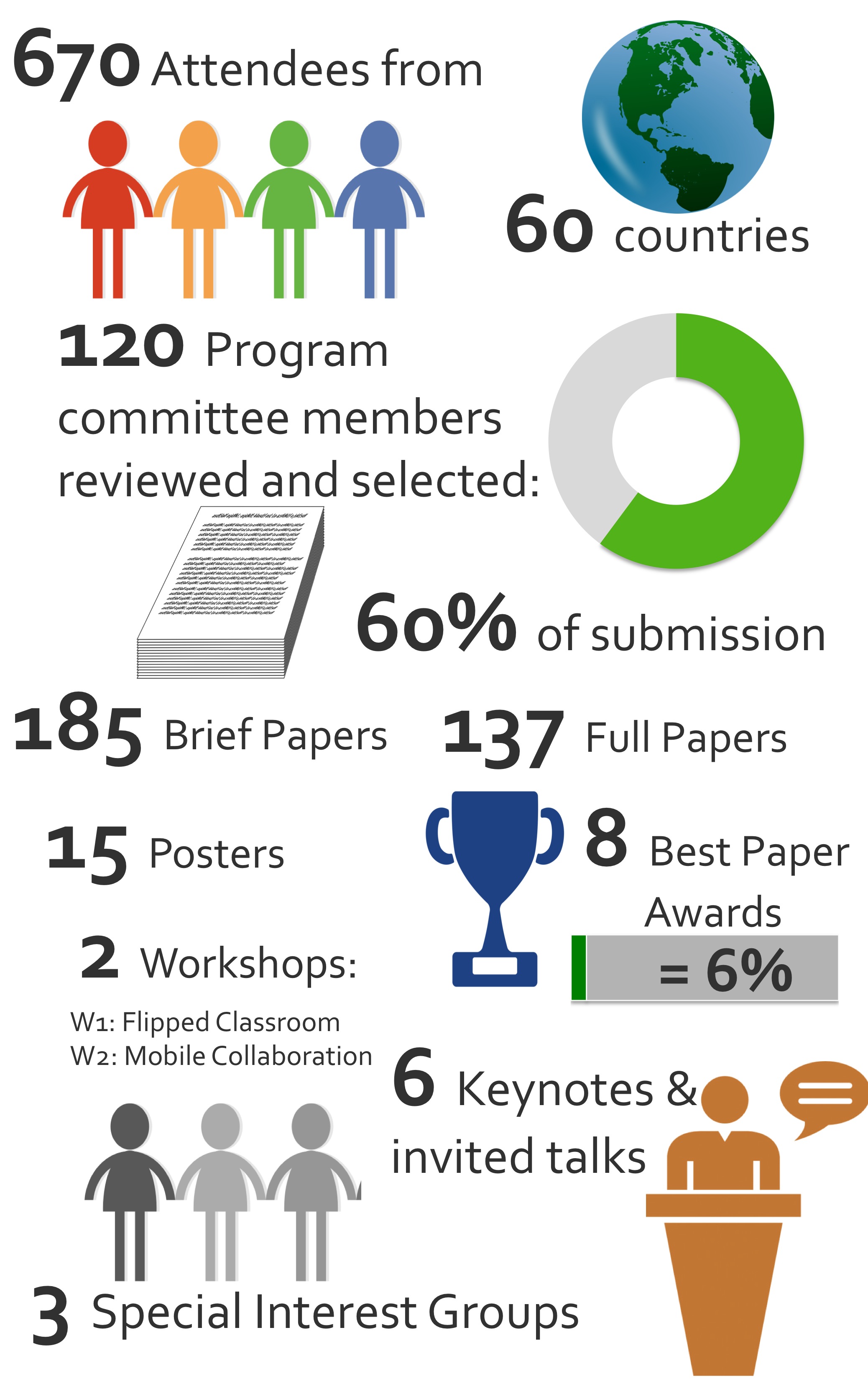
The 19th annual international conference AACE E-Learn took place from October 27-30 in the sunny, warm and welcoming climate of the city of New Orleans. The conference attracted 670 participants from 60 different countries who enjoyed four days of workshops, keynotes, presentations, symposia, SIG meetings, posters, and, last but not least, informal discussions and networking opportunities during the session breaks.

Conference infographic by Stefanie Panke.

Conference infographic by Stefanie Panke.

AACE E-Learn Conference

What sets AACE conferences apart from other events in the educational technology community is the rigorous peer review process in the selection of presentations. Instead of simply submitting an abstract, AACE requires a full manuscript of 6-10 pages. While writing skills do not always and certainly not necessarily translate into great presentations, the quality off contributions is generally high. This also makes the conference proceedings (available in the AACE digital library EditLib) a really great resource for an up-to-date overview of the current state-of-the-art in educational technology. While access to the proceedings is generally restricted to conference participants and subscribers, several papers that were honored with an outstanding paper award are openly accessible:

The best paper awards mirror the diverse spectrum of the conference. E-Learn is a place where educational technology researchers, developers, and practitioners from higher education, K-12, nonprofit and industry sectors meet – brought together by a joint focus on leveraging technology for achieving instructional goals.

My Conference Experience

This conference report is my personal eclectic account of E-Learn 2014. My schedule was packed this year: Not only did I, in a hyperactive mood, choose to deliver three talks, but I also had a symposium and a special interest group meeting to moderate and an executive committee meeting to attend. Luckily, the overall conference atmosphere, the great discussions during the special interest group meeting, and the thoughtful feedback, ideas, encouragement and contributions by numerous conference participants made all of this fun.  Continue reading

TCC Worldwide Online Conference 2015: Call for Proposals

Updated 12/1/14, 12/12/14
TCC2015A
20th Annual
TCC WORLDWIDE ONLINE CONFERENCE
March 17-19, 2015

Hawaii 2-0 : The Future is Now

Submission deadline: December 15, 2014  December 23, 2014
Submission form: http://bit.ly/tcc2015-proposal
Homepage & latest updates: tcchawaii.org

CALL FOR PROPOSALS
Please consider submitting a proposal for a paper or general session relating to all aspects of educational technology, including but not limited to e-learning, open education, ICT, online communities, social media, augmented reality, educational gaming, faculty & student support, Web 2.0 tools, international education and mobile learning. We also encourage retrospective presentations, personal experiences, and forecasting the future.

FULL DETAILS
http://tcchawaii.org/call-for-proposals-2015

SUBMISSIONS
http://bit.ly/tcc2015-proposal

VENUE
For our 20th anniversary celebration, there are two options: (1) ONLINE only or (2) ONSITE. Onsite sessions will run from March 18-19 at the University of Hawaii at Manoa Campus Center, and participants will also have access to all online sessions from March 17-19. All onsite sessions will be streamed to online participants.

For onsite participants: We’re offering an optional educational tour of Kamehameha Schools and a stopover at Kapiolani Community College for lunch and a talk at CELTT (Center for Excellence in Learning, Teaching and Technology). We’ve also arranged for a block of low cost housing options at the East-West Center (Lincoln Hall) and at Ala Moana Hotel.

KEYNOTE SPEAKERS
Alan Levine – cogdogblog.com
Howard Rheingold – rheingold.com

MORE INFO
Bert Kimura <bert@hawaii.edu> or Curtis Ho <curtis@hawaii.edu>

TCC Hawaii, LearningTimes, & the Learning Design and Technology Department, College of Education, UH-Manoa collaborate to produce this event. Numerous volunteer faculty and staff worldwide provide additional support.

—To join our TCCOHANA-L mailing list —
http://tcchawaii.org/tccohana-l/