Teaching and Learning Conference at Elon University: Technology As a Prop – Not at Center Stage

By Stefanie Panke
Editor, Social Software in Education
Instructional Analyst, School of Government, University of North Carolina
Rob Moore
Instructional Designer, SOG, UNC
Greg Whisenhunt
Multimedia Developer, SOG, UNC

[updated 8.27.12]

The annual Teaching and Learning Conference at Elon is a regional event that attracts professors, instructional designers, postdocs and other academic personnel from North Carolina colleges and universities  The 9th edition of this free, one-day conference took place on August 16. As instructional designers at UNC School of Government, we seized the opportunity to spend a day of professional development and took home new ideas, concepts and insights.

Morning Plenary

The keynote address by Ashley Finley, Director of Assessment and Research from the Association of American Colleges and Universities (AAC&U), set the pace for a stimulating day. Her talk, “How to Hit a Moving Target: Assessing Engaging Learning in Changing Environments,” emphasized the application of student-centered rubrics. She presented the “Integrative Learning Value Rubric,” a set of rubrics developed in the context of the VALUE (Valid Assessment of Learning in Undergraduate Education) project.

In this project, expert teams developed rubrics for fifteen learning outcomes. Finley paired the use of carefully designed rubrics with examples of creative assessment using web 2.0 tools. “I am not at all tech savvy,” Ashley Finley admitted, “but I am thrilled by the possibilities for reflective practice.” She added, “Obviously, without creative assignments, the technology is just that, a technology.” Finley illustrated her point by showing several examples of e-portfolios and other student-centered activities. A particularly interesting example came from Georgetown University’s collaboration space.

Students in the course “Bioethics and the Moral Imagination” at Georgetown used Youtube Analytics to annotate Obama’s speech on the contraception mandate. After Rush Limbaugh’s derogatory comments about a Georgetown student, this topic was going to dominate the class anyway – the instructor used innovative tools to steer the debate towards an analytical approach.

Continue reading

Mapping Dragons: Esri 2012 Conferences

By Charlie Fitzpatrick

[Note: This article was coordinated by ETCJ associate editor Bonnie Bracey Sutton. See her related article, The ESRI Conferences: A GIS Journey Toward Citizen Science, 8/2/12. – Editor]

Today we face dragons. Some were here when we arrived, others we ourselves unleashed, inattentively, perhaps even mindfully. But they are here, growing in strength, in spread, in number. Tomorrow, we must rely on our children to protect us. For that, they must understand the world, its countless patterns and fractal details, and be able to focus on the key elements of a given puzzle, yet grasp how it fits in the larger whole.

Geography is the study of the world and all that is in it, or was, or could be, at infinitely varied scale. These infinite details link together to make patterns in interlocking systems. If we can tease out the patterns – assemble the vast galaxies of data and classify, symbolize, query, analyze, and model – we can find the keys that help us answer questions, solve problems, design solutions.

Geographic information system (GIS) technology allows us to find, generate, integrate, analyze, manage, and display data, illuminating the patterns and relationships large and small. The tools come in all sizes, shapes, and powers. As children explore and analyze their world, they build the capacity and disposition to see patterns, integrate information, discover relationships, make decisions, solve problems. Like a fire, it grows, slowly at first, needing consumable tinder before sticks, logs, and trunks. But kids devour content like web-based maps, use the tools to leap from the near and familiar to farther afield, bringing along their skills and knowledge, testing those against new situations. They poke into interesting worlds, find crevices, explore ideas, inhale new details. Restlessly, they seek the next challenge, take the larger step, find the next hill to climb and peer over, discovering new concepts and perspectives with which to build capacity.

Around the world, GIS is used in countless jobs, in hundreds of careers, because people need to solve problems and have to understand the nature of things to do that. Esri makes GIS software, and every year we have a conference at which people from around the world meet to celebrate their victories and learn from each other how to do a little more. This year, 14,000 practitioners assembled, including over 800 educators. The International Conference grows every year, and the Education Conference this year grew like wildfire. People are finding hope in problem-based learning, in helping youth from elementary school to graduate school think critically, work collaboratively, dig for answers, extract patterns, and see how to make a difference in their lives, their community, and the planet. They build background in tackling unfamiliar problems, bulking up in STEM fields and social studies content, in communication skills, opening doors to more and more future jobs as they grow.

We will never run out of problems. But, through the power of maps – our common language – we can explore, analyze, and understand our world, and diminish those dragons around us.


Pinterest: A Quick and Easy Tool to Gather Web Materials

Lynn ZimmermannBy Lynn Zimmerman
Associate Editor
Editor, Teacher Education

After reading an article about it, I decided to sign up for a Pinterest (http://pinterest.com/) account. It is touted as a virtual bulletin board, and the article I read especially recommended it for teachers. I have been looking for a simple way to create a “swipe” file for online materials related to TESOL (Teaching English to Speakers of Other Languages), and it looks like Pinterest may be what I was looking for.

Setting up a free account on this social networking site is quick and easy. Then you can create boards to organize items you “pin.” These items are web pages that must have graphics on them. I created a board called “TESOL” on which I am pinning related links. I have pinned some websites that I found by searching the Pinterest site using the search terms “esl” and “tesol.”

Since you can also add a “Pin It” button to your favorites bar in Internet Explorer, you can pin sites that you run across yourself. In turn, these can also be re-pinned by others who see them on your board. Editing the board and editing your pins, deleting, renaming, etc. are simple and easy to do. Time will tell if this site continues to serve my needs, but for now, I am satisfied that it is easier to manage than my desktop folder where I stored articles and information from websites.

I intend to share Pinterest with my students so they can add it to their teaching toolbox along with some other free sites that I think teachers would find useful. For example, I have found electronic post-its that can be downloaded to your desktop. Another useful tool for teachers is Penzu (http://penzu.com/), a free online journal/diary application that is fairly easy to use.

Has anyone else found quick and easy sites that meet a specific need and/or that teachers and students could use?

August 21, 2012 – Education in 2020, DCL, Tech Costs

What Higher Education Will Look Like in 2020 – A report from Pew Internet says, among other things, that it won’t look too different from how it does now.

Deep Conceptual Learning: Creating Connections That Last – Tim Ham says that DCL is critical to students’ success in and out of the classroom. He highlights how Common Core State Standards (CCSS) can connect students, teachers, and content, transform not just assessment but “requires a shift in the way teachers teach and students learn.” Technology has an important role to play as one of the tools for student success.

Affording the Classroom of the Future – Bridget McCrea looks at the logistics and costs of setting up and maintaining technology-intensive classrooms. “As the nation’s K-12 schools consider the equipment and space requirements of tomorrow’s classrooms, many of these institutions are also looking at how to pay for the new learning spaces.”

Home Schooling As the 21st Century Model for Public Schools?

Jim ShimabukuroBy Jim Shimabukuro
Editor

Blake Binkley may very well be the emerging face of learning. “He has taken classes through Truckee Meadows Community College, the University of Nevada, Reno, through the Washoe County School District’s online learning program, the Stanford University Online High School and even the high school he is zoned to attend, Galena [in Reno].”[1] Binkley is 18 and a home-school student, but, he says, “‘It isn’t the traditional view of … being taught at home by my mommy.'” He says, “‘It’s basically given me the opportunity to choose what I want to do.'”

Binkley should have educators, with an eye on the big e-picture, connecting the dots and realizing that the trend toward home schooling, on the one hand, and MOOCs, on the other, may be merging. Against the backdrop of MOOCs that are sprouting all over the virtual landscape, Binkley’s technologically enabled “opportunity to choose” courses to construct a learning program geared to his personal interests and needs may be an indication that land-based, lock-step, one-size-fits-all schools are becoming less relevant by the day.

Obviously, the gap between schools as they are and home schooling as the dominant model is enormous and the dots joining them are spaced far apart, but, a constructivist point of view notwithstanding, the trend seems both natural and inevitable. The major obstacle is the land-based district boundaries that are used to define and finance schools. As Michael Van Beek observes, “Even though the Internet is without boundaries, under current law a student’s ability to enroll in online programs is still limited by local and intermediate school district boundaries.” His conclusion is compelling: “These ‘schools-of-choice’ boundaries just don’t make sense when any school in the state can easily provide instruction to any student with the help of technology.”[2]

This problem of boundaries is not insurmountable. Creative decision makers will be able to come up with solutions, and one is to simply have the funds follow the students’ choices. For example, students are allocated a certain amount, and they are free to choose courses within that budget. If they exceed it, then the the remainder is paid out of pocket. In this scenario, there are no district or state boundaries. The courses can originate from anywhere on the planet. A method for approving courses and credits will also need to be factored in. Continue reading

A Sign of How MOOCs Will Impact Colleges

Jim ShimabukuroBy Jim Shimabukuro
Editor

In the wake of the recent onslaught of MOOCs in higher ed, the word “tsunami”* is often used to describe their potential impact. It evokes images of the 2004 Indian Ocean and 2011 Tohoku disasters, and fear and panic are widespread among faculty and administrators who cannot begin to fathom the threat to their ivory towers. To fully appreciate the analogy, however, we need to consider the speed of a tsunami. At 500 miles per hour, it can travel thousands of miles over open ocean in a matter of hours. But what’s truly sinister about this movement is that we usually don’t notice it until it hits our shores. By then, it’s too late. It’s difficult to detect. To our naked eye, the surface of the ocean may appear to be a bit darker and rougher, but it’s still relatively calm compared to the huge waves that we associate with tsunamis. Thus, we don’t see it coming unless we know what to look for.

As far as tsunamis go, the MOOCs that are lapping at our campus borders today are minuscule, perhaps a few inches high at most. But many are taking the threat seriously and believe the worst is yet to come. Is it? To answer this question, we need to look for signs. Not surprisingly, we turn to the most visible figures on our college campuses — administrators. As leaders, they should know. Right?

Well, no. That is, unless they’re in very close touch with teachers in the classroom and students. And this is especially true at the junctures where students, who are comfortable with the latest communications technology, and teachers, who are independently exploring and implementing strategies that are in sync with the open online learning environment, intersect.

The signs are easy to miss, like the subtle surface changes in the open ocean that indicate a massive tsunami is racing toward land, just below the surface, at the speed of a jet plane. For the full impact of MOOCs, what are the signs that we need to look out for?

We get a hint from an article by Laura Pasquini, “Online Learning: More Than Just a MOOC” (TechKNOW Tools, 28 July 2012). Pasquini is an education professional and a doctoral student in learning technologies at the University of North Texas. She turned to MOOCs to connect with “new concepts, research ideas, learning networks.” She says, “My intention when signing up for this type of free, online learning was to support my own professional development and expose myself to new learning concepts.”

Student interest in MOOCs is definitely an indicator, but what really caught my attention was this comment: “I reflected my MOOC experiences to my faculty advisor and he believed that participation in any one of these classes could be an added elective for my doctoral degree plan since this informal learning environment was contributing to my research design.”

Continue reading

Constructing a Sustainable Model for Higher Education: Part 1 – Disaggregation of Teaching

By Brian Mulligan

[Note: In his series, Constructing a Sustainable Model for Higher Education, Brian will explore and propose a process and apply it to generate a viable model. In this first part, he begins with an analysis of the major elements or factors that define teaching and asks readers to participate in the discussion that’s attached to this article. In part 2, he plans to discuss criteria for disaggregating teaching functions into different institutions; in part 3, a green-field design of disaggregated higher education; and in part 4, the inhibitors, or economic and sociological barriers, to moving from here to there. – Editor]

You can learn virtually anything online. So why go to college? It does seem that more and more people are asking that question, the most famous (or infamous) recently being Peter Thiel in his description of a higher education bubble. There are, of course, plenty who disagree, particularly those with “skin in the game.” So who is right? Is higher education too expensive? Does it represent a good Return On Investment for students and the country? Is it sustainable in the long run?

To paraphrase Yogi Berra, making predictions is difficult, especially about the future. That has not stopped the many, including myself, who are making predictions on the future of higher education. A particularly dramatic example of such predictions is on the epic2020.org site. Amara’s Law states “We tend to overestimate the effect of a technology in the short run and underestimate the effect in the long run.” So it may be some time before we see these predictions coming true, but when they do, they may well be as dramatic as some have predicted.

So, is higher education, as it currently exists, sustainable in the long run? How would we go about answering that question? Those of us of an analytical bent would probably look at this as a design problem. We might define what we are trying to achieve, list all the tools and techniques available to us, and then try to come up with the best solution. To be honest, we’d probably start again from scratch. In a truly competitive world, anyone who did this would win “customers” from the less efficient and this model would win out very quickly. But higher education is much messier than this. The objectives we are trying to achieve are not fully clear and seem to be the subject of much debate. Competition is hindered by bureaucracy, regulations, and cartels. The “product” is complex, and even if you offer the best value, you can’t be sure the customer will recognise it. It may even be unclear who your customer is. The student? The employer? Or even the government, who in most countries picks up the tab for a very significant part of the cost?

Continue reading

A Londoner’s View of the 2012 Olympics: Live Feed of All Sports at Any Time!

Tom PreskettBy Tom Preskett

Along learning technologies, one of my passions is sports. The Olympics have come to my hometown and I’m loving it. The feel good factor around the city is palpable. This is partly because of the consensus that the games are going pretty well (apart from the odd transport issue) and partly because the GB is doing way better than expected.

The technology really helps as well. Never before has it been so easy to follow any sport at any time. Of course, our BBC coverage is extensive but what makes this games special is the live feed of all sports at all times. This means I could watch a whole sailing race or an entire heptathlon or day of judo without boring interviews and punditry jibber. This was on my PC or on the TV. Also, most GB sports websites have taken to supplying a rolling commentary of events in a conversational, jokey manner. This means I can be primed for events before they happen and be ready to open a new tab containing that live feed. Even four years ago this would not have been possible.

It makes sports watching a democracy. Rather than suffering under the totalitarian BBC 1 coverage where they are interviewing yesterday’s GB bronze medal winner with montages of them crossing the line, I am free to watch BMX qualifiers with all the crashes and blood on the floor I could handle.

I confess I don’t know what’s going on with some of these sports. Judo seems to be mostly about bear-hugging and the horse ballet is a total mystery. However, the sailing is fascinating, the volleyball is compelling (especially the beach variety) and two-hour swimming just incredible. The whole thing is over on Sunday and I don’t know what I’ll do. We’ve had it on the big screen in the office instead of the normal rolling Powerpoint promoting ourselves. Visitors are lingering to watch, which never happens normally. Go figure.

August 9, 2012 – Credentialing, Mobiles, Online Conferences

ePortfolio Redux
Tom Segal, in “Rethinking the Learning Experience: Part IV,” says, “Perhaps the most elemental of credentialing bodies is the e-portfolio” (Huff Post, 8.9.12). He continues, “With an e-portfolio, students can share media demonstrating leadership (perhaps film of the league championship game where they captained the team to victory) or teamwork (like video of their A.P. European History final presentation) in an easily digestible format.” He mentions Desire2Learn, Pathbrite, and Pearson as providers of eportfolio services. However, he fails to mention the simplest, most accessible, most flexible, and least expensive eportfolio platform — blogs, e.g., WordPress and Google’s Blogger.

The Dark Side of Open Online Courses
This headline from the St. Louis Post-Dispatch, “Elite Colleges Transforming Online Higher Education” (by Terence Chea, 8.9.12), is just one of many that have been gushing over the open online courses being offered by top-tiers such as Harvard, MIT, and Stanford. We shouldn’t, however, forget that these changes have been initiated and developed by individuals, many or most of whom are classroom teachers. The administrators who have come around to supporting these innovators ought to be commended for their enlightened leadership and willingness to take risks. However, as of now, the support is apparently still tentative, judging by the conservative language of administrative policy that continues to insist on the superiority of blended approaches. The gap between the visions of innovators and administrators is huge, forcing some of the most progressive teachers to strike out on their own. The time is ripe for influential leaders to step forward and, first, declare the viability of open online courses; second, support explorations into credentialing strategies; and third, implement the development of procedures to integrate open and fully online courses into their mainstream offerings.

The Role of Mobiles in Selecting Colleges and Careers
In “Googling Across India for Education Courses and Choices,” Anubhuti Vishnoi (The Indian Express, 8.9.12) tells us that “India’s students are increasingly relying on the internet to make critical career decisions.” More specifically, they’re turning to mobiles: “There are as many as 70 million mobile internet users in India now and 54 per cent … are in the 18-35 age group.” Among students, “Over 66 per cent … said they use mobiles to access the Web.” The message seems to be clear: As smartphones and tablets erode the lines that separate computers from mobiles, higher ed institutions should be looking at ways to adapt their online info to accommodate mobiles.

A State Dept. of Ed That’s Taking Its Conference Online!
The West Virginia Statewide Technology Conference runs from August 8-9, 2012. What makes it really special is that it is completely virtual and free! Here’s a quote from their site: “You can attend and participate in the conference from the comfort of your favorite internet-connected computer. Look for an incredible collection of sessions from our presenters and demonstrations from our vendors. Yes this is a little different from what you have experienced in the past, but let’s give it a try! After all, technology is what we are about and our virtual conference will explore the limits of what can be done.” Kudos to the WV Department of Education for taking this gigantic leap for its K-12 educators. (Additional source.)

What Can Tomorrow’s Students Expect?

picture of Harry KellerBy Harry Keller
Editor, Science Education

[Note: This article was first posted as a comment to Jim Shimabukuro’s “The London Olympics, NBC, and Education” by Harry Keller on 8.9.12. – Editor]

My own experiences with NBC Olympic streaming video ranged widely from fairly good to very poor.

What will tomorrow’s students expect? Do we really know? Online will be a component, certainly. However, what sort of interaction with their instructors will be the norm? Will it synchronous or asynchronous? Probably some of each.

Will textbooks be all online? Or will my vision of the future come true and textbooks in any form will disappear to be replaced by truly interactive online learning software?

Today’s interactive learning software makes a mockery of the word “interactive.” The online game companies know what interactive really means. Must learning software be games? Some think so. I strongly disagree. We can learn from them but don’t have to mimic them.

Regarding the physical plant part of educational institutions, I think that future will depend on the specific institution. K-5 will remain firmly physical. The top colleges, e.g., Ivy schools, MIT and Caltech, Stanford and Duke, et al., will be able to retain their hallowed campuses because their students gain so much for their futures from hanging out together physically. These institutions will also be reaching out to the world with online courses from the best instructors in the world.

What will happen to community colleges? If you can replace a CC campus with an Internet server farm, will it happen?

What about the “Big Ten”? Will football and basketball support the old style? You can’t make football games virtual. These teams must actually play. The alumni must be able to freeze in the bleachers in December while watching their fellows on the field and then donate, donate, donate!

And so it goes. It’s not just about the courses.

Make no mistake. Big changes are afoot. Also, do not make the mistake of rash predictions. The potential for game-changing innovation is strong in the current climate. J. P. Morgan, when asked for his prediction about the stock market, famously said, “It will fluctuate.” So, I say to all of you about the future of education, It will be different. The specific differences are not predictable with any certainty, but some overall expectations are:

  • Fewer colleges.
  • Different modes of instruction — especially extremely interactive online learning.
  • Instructors will be critical, not just dull lecturers and graders; they will probably be paid less for their work — at least per student.
  • Redefinition of what a degree means.
  • Increasing separation of teaching and publication (e.g., research) personnel.

Hopefully, all of these changes will settle down to something really good and worthwhile. More hopefully, the escalating cost of a usable college degree will decline markedly.

The London Olympics, NBC, and Education

Jim ShimabukuroBy Jim Shimabukuro
Editor

NBC will be broadcasting the Rio Olympics in 2016, and a seemingly casual comment from a spokesperson in a recent TV news segment should have sent a shockwave throughout the world. The fact that it hasn’t says a lot about people’s attitude toward technology. They are either resigned to the coming upheaval or doubtful that it will ever happen. More than likely, most simply don’t care. If it happens, it happens. If it doesn’t, it doesn’t. The sense is that, either way, they’re powerless.

The comment was in response to criticisms aimed at NBC’s online streaming of live events and archived videos from the current London Olympics. If you’ve made the effort to register through your cable or other service provider and if you’ve then tried to actually log on and view events, then you’re probably part of the mob that’s throwing virtual bricks at NBC. “Poor” doesn’t even come close to describing the ordeal.

To NBC’s credit, the spokesperson made no attempt to defend or gloss over the snafu that takes on massive proportions in the context of the internet. He told it like it is. The planning for the media coverage was conceived two years ago when NBC won the contract to broadcast the Olympics, and in the time frame for change in online technology, two years may as well be two lifetimes, and, needless to say, a lot can and will happen in the interval.

The point is that, two years ago, NBC planners had no way of knowing the extent to which online media would come to dominate communications in general and broadcasting in particular. Television today is where hardcopy newspapers were a few years ago. The sweep is toward digital and online, away from analog and onground.

The lesson from 2012 is clear. For NBC, the emphasis for the 2016 Olympics will be digital and online. Increasingly, people expect and want their video broadcasts over the internet from anywhere at anytime via mobile devices such as iPhones and iPads as well laptops and desktops. What’s the prognosis for technology that’s built around standalone TV sets? We don’t have to look far for clues. Landlines. Phone booths. Film cameras. Dinosaurs.

For educators, the implications are enormous. When the video information we now receive from dedicated TV sets leaves the ground and goes virtual, mobile internet devices will take on a whole new dimension in the lives of students. For example, their visual perception of the world and reality will be continually reconstructed 24-7 in a medium that’s increasingly mobile and interactive. Information and learning resources as well as synchronous and asynchronous personal and group communications will be literally at their fingertips whenever they want it and wherever they are. The outcome is obvious. Students will expect their course work, learning support services, and teachers to be no less accessible — from anywhere at anytime.

Another implication is that educators have to rethink their budgets. Do they continue to pour their limited dollars into constructing and maintaining onground facilities such as buildings, classrooms, and offices? Or do they begin to invest in infrastructures and strategies that maximize the potential for online learning?

NBC has learned. Let’s see if educators can, too.

Greg Green Is Flippin’ in Clinton

Lynn ZimmermannBy Lynn Zimmerman
Associate Editor
Editor, Teacher Education

Clintondale High School near Detroit, Michigan, has instituted a different model for teaching in an effort to improve grades, increase learning, and better support students. They are using what principal Greg Green calls flipped schooling (aired on Dick Gordon’s The Story, April 16, 2012).

Students at Clintondale were struggling, not passing classes and not performing well on standardized tests. Green asked students what they thought was going on, and their reply was that they had trouble doing school work at home. They could not concentrate, or they had no one to help them if they did not understand the assignment or the concepts. In turn they were getting further and further behind.

Greg Green

Based on this information, Green decided that instruction was not aligned with how students learn. Change was needed. He and his staff re-imagined schooling so that, rather than sitting in class, listening to a lecture, and doing homework at home, students study background information on the topic at home then work on practical problems as well as ask and answer questions about the material in class. He said they use screen captures, videos, and other technology for at-home lectures. Students can look over the materials at their own pace, as often as they need to, in order to understand the concepts or to pinpoint problem areas. The next day students come to school to ask and answer questions about the materials and to solve problems in class.

Green reported that their experiment is meeting with some success. Failure rates in the courses that are using this flipped model have been cut in half. They also found that students who were in flipped math classes had a 10% gain on state standardized math tests.

The flipped school model is a good example of how technology can be used to enhance learning. Technology in this case can

  • optimize learning time
  • align with students’ learning styles and needs
  • provide opportunities for repetition as needed

When students are in class, they and their teachers can interact in the face-to-face context in meaningful and productive ways. This type of constructivist learning is effective as the student builds his/her own knowledge. They learn the content as they develop problem-solving and critical thinking skills.

In articles on the CNN Blog, Green elaborates on the benefits of flipped schooling and addresses the concerns that readers have about this model:

The ESRI Conferences: A GIS Journey Toward Citizen Science

By Bonnie Bracey Sutton

My friend Charlie Fitzpatrick and I attended a national summer workshop long ago. We were introduced to the rudiments of GIS (geographic information system). Years later, I attended one day of his conference. Charlie is now the education director for ESRI (Environmental Systems Research Institute, Inc.). The day I went  was map day. I love maps and charts and geography books and citizen science. Some of the maps were on tiles and so beautiful.

A favorite starting point with students is My Wonderful World. This site is a great place to start to learn the GIS. There is also the teacher resource page of the National Geographic.

I never attended the whole conference before this year. At the time I was taking a super computing (SC) workshop and using GIS. But I had no idea of all of  the creative and innovative ways in which it is used today. A look at ESRI is all you need to know about GIS. I could make a simple definition, but I like the ESRI definition because it is all inclusive.

This slideshow requires JavaScript.

Last summer we worked with inner city kids on several projects at the Joint Education Facilities, Inc., in Washington, DC. It is located in Southeast Washington and is the only neighborhood high performance computing center in the US. The kids came on Saturdays in the summer to learn GIS and then to complete projects in the GIS technology program. We used GIS to solve problems in the social sciences. Continue reading

Teaching Science Teachers Science

picture of Harry KellerBy Harry Keller
Editor, Science Education

All teachers must learn certain things. For example, they learn about learning theory, classroom discipline, and how to write lesson plans. In addition, they learn the material and ideas of their chosen subject area. As I read articles about science education and communicate with many science teachers, I become more convinced that our teachers colleges are not providing the necessary learning to our future science teachers.

What is this necessary learning and why is it important?

To answer this question, you must first understand what science is. Science is not a bunch of “facts,” e.g., Mercury is closest to the Sun; prophase is the first phase of mitosis; force is proportional to the rate of change of momentum; igneous rocks are formed from molten rock. Science is an approach to finding out these things, a way of thinking, of solving problems. It uses the work of previous scientists and new data to be sure. So those “facts” are part of the learning but hardly the most important part.

So-called science facts are always subject to revision, but the means by which they were extracted from nature with great difficulty remains the same. We must teach some science content in order to have material upon which to apply the developing thinking skills of our students.

Science courses inflict lots of vocabulary on students too. Some words seem familiar but are used by scientists in a very specific manner. “Work,” for example, does not take place when you’re holding a heavy weight above your head – if you’re talking about science. Work is a specific and quantitative term in science. Other words seem entirely unfamiliar and even bizarre. In physical science, “entropy” is a made-up word for a measure of disorder in things.

Science education must provide the content of science including vocabulary, an understanding of the nature of science, and development of scientific thinking skills. Anything else is superfluous in primary and secondary education. In post-secondary education of science and medical majors, there’s more, but that part is not the subject of this discussion.

Without an understanding of the nature of science, students will not be able to interpret what’s going on around them every day. You read about global warming and conflicting claims regarding it. You read about protecting species from extinction and then about how 95% of all species in the history of the Earth have gone extinct naturally. You read about an energy crisis and then about how the price of gasoline is being manipulated by Wall Street traders and that the energy situation is just fine. All of this would be just entertainment were it not for the fact that so many countries are democracies, and the people are expected to vote, to make decisions, on these issues in elections. Continue reading

UC Berkeley’s Online Education Strategy: A Model for Change

Jim ShimabukuroBy Jim Shimabukuro
Editor

In response to the explosive trend in higher ed toward open online courses (OOCs), Berkeley’s executive committee for online education published* the university’s plan for change. As a strategy, it’s an echo of similar guidelines across the country and the world. However, what distinguishes it from all the rest is intelligence. It’s obvious that the committee has done its homework and understands the deeper implications of online education.

The plan has two standout elements. The first is a flexible approach to defining “online” education:

  1. certificate and graduate degree programs that are in high demand
  2. undergraduate gateway and hybrid courses that increase available capacity and enrich learning for our on-campus students
  3. “public good” courses that we will typically offer for free to a wide audience as a community service and as a proven approach to exposing potential students to outstanding Berkeley faculty
  4. development and sale of online educational content that can be deployed by other institutions or organizations

Of these, the fourth is the breakaway, and it implies a deeper understanding of how the current flood of open online courses and platforms might play out. That is, in the coming weeks and months, the key to OOCs may be the way client institutions integrate the courses into their programs. In the end, the value of courses may be in their unbundled state rather than in their current bundled, all-in-one platforms. For example, as unbundled content, OOCs could serve course designers from institutions around the world who would pick and choose parts from different courses — from the same or different colleges — to construct unique course mashups for their students.

This mashing process is familiar to educators who have been doing it with textbooks and multimedia for years. The big difference is that they now have anytime-anywhere access to content provided by some of the top teachers in the world. Furthermore, that content is open (not the same as free) or mashable as well as recorded and available in various digital media. This content could be sold in creative packages to institutions everywhere. This OOC-based business model may be the virtual extension of publishing in the 21st century.

The second element is a vision of integration that implies, once more, a clear awareness of the process of change. Unlike the vast majority of colleges, Berkeley understands that the current practice of “bolting” online programs to traditional onground platforms is a transitional phase. The ultimate shape of viable programs is a work in progress, and no one knows for sure exactly what it will be. The one certainty, however, is that “online methods will ultimately transform our traditional teaching program and we need to begin to systematically align our administrative and support functions to meet the changing needs of online and traditional programs.”

“Systematically align” is a euphemism for change, and when applied to staff and leaders, it means to educate or to keep on top of current trends and developments from as broad and as deep a perspective as possible. In short, this isn’t a time for panic and bandwagon decisions, and this is definitely not a time to sit still, pout, or cling to tradition. At Berkeley, the leaders realize that the future is their responsibility and that it can’t be passed off to others, outside experts or entrepreneurs, or borrowed from other institutions. And a critical part of that responsibility is to think — inside and outside the box.

Pre-online models for education are no longer adequate, yet that is all we have for now. The challenge is to draw a clear distinction between the old masquerading as the new and the genuinely new, between the new as a “bolt on” to the old and the new as an entirely different model that fulfills the promise of online technology. Leadership is critical in times of tumultuous change, and at Berkeley, the leaders have stepped up.

__________
* “Principles of UC Berkeley’s Online Education Strategy,” UC Berkeley NewsCenter, 24 July 2012. (Note: This link may be temporarily broken.)

NAEP and the Future of Science Education

picture of Harry KellerBy Harry Keller
Editor, Science Education

Recently, Nora Fleming, in “NAEP Reveals Shallow Grasp of Science” (Education Week, 19 June 2012) reported on a new study regarding the 2009 NAEP (National Assessment of Educational Progress) exam for grades four, eight, and twelve. Around 2,000 students at each grade level were given three “Interactive Computer Tasks” (ICT) and one “Hands-On Task” (HOT) to perform. They were asked questions about each task.

We all know that conclusions such as “shallow grasp of science” are fraught with difficulties, especially when the results tell more about the test than the students. In this case, there are more issues. What exactly does “shallow grasp” mean in this situation? What sort of understanding is required to achieve a high result?

You can check for yourself at a website that allows you to take these tests yourself and score your answers, if you have patience with the tests. I went through the grade 8 and grade 12 materials (my work with science education focuses on grades 6-13) and did not approve of most of the content. Because it’s quite difficult to separate student ability from test quality, the results are suspect.

Because generalities won’t suffice, I’ll provide one example that shows how test results can mislead regarding understanding. This example shows how an eighth-grade student responds to the ICT, “Playground Soil.” According to the instructions,

In this 20-minute task, students investigate the permeability of soil samples from two sites a town is considering for a play area. Students use their results to help decide which site has the better water drainage and is therefore the better place for a grassy play area.

Students analyze two samples: soil sample A that is 10% clay, 50% fine gravel, and 40% silt; and soil sample B that is 10% clay, 50% sand, and 40% silt. Note that the only difference is the middle component. Diagrams illustrate the soil composition.

Students are asked to predict which soil will be more permeable. Generally speaking, the one with more voids (more space between soil grains) will be more permeable. Clearly, fine gravel has larger particles than sand. Now, do a thought experiment with me. Suppose that you increase the size of the fine gravel particles substantially. You might even have a rock in the midst of a clay-silt mixture. The permeability of this rock plus clay-silt will closely match that of clay-silt alone. Now, imagine reducing the size of the rock while keeping the volume equal to one-half of the total. Once the particle size reaches that of clay (60% clay, 40% silt), you’ll have very little permeability because mixtures that are mostly clay don’t allow much water to pass through them. Continue reading

Udacity and Implications for Higher Ed

Lynn ZimmermannBy Lynn Zimmerman
Editor, Teacher Education

On May 7, 2012, Dick Gordon aired an interview with Sebastian Thrun and David Evans called Udacity: Teaching Online, an online university that came about almost by chance. Although The Story does not air on my NPR station, thanks to modern technology, namely the iPod and podcasts, I was able to download this story and listen to it two months later.

Thrun is Google’s vice president and is recognized as a pioneer in artificial intelligence and robotics. He was a tenured professor at Stanford when his story began. Fall 2011, Thrun decided to make his graduate level AI course, normally taught in a lecture hall to about 200 students, available online for free. He wanted to try to reach a larger audience. He sent out one email announcement. Much to his surprise 160,000 students from all over the world enrolled, and 23,000 completed the course. Thrun was gratified that his experiment was so successful, that free quality education could reach anyone who wanted it.

Sebastian Thrun

During the semester, Thrun had to mend some fences with the administration at Stanford. He had made this decision on his own, and they were concerned about having the Stanford name on certificates he had promised completers. They finally compromised that completers would receive a “statement of accomplishment” from Thrun, a private individual but affiliated with Stanford. So began Udacity, which offers STEM (Science, Technology, Engineering, Mathematics) courses that students can take for free. For a fee they can take tests that certify their knowledge. Although there have been bumps along the way, Thrun says that he cannot imagine teaching any other way. William Bennet, in an interview with Thrun for CNN, “asked Thrun whether his enterprise and others like it will be the end of higher education as we know it — exclusive enclaves for a limited number of students at high tuitions? ‘I think it’s the beginning of higher education,’ Thrun replied. ‘It’s the beginning of higher education for everybody.'” Continue reading

Are Educators So Full of It That They Can No Longer Detect It?

Jim ShimabukuroBy Jim Shimabukuro
Editor

Kris W. Kimel[1] says that “higher education, once open to a select portion of the citizenry, is now increasingly available to virtually everyone, anyplace at any time and oftentimes for free.” He also says that “the rise of the innovation and information economy is also sweeping aside the traditional role and position of gatekeepers, those institutions and people who have historically controlled access to the economic playing field, professions and customers.” These are the types of observations that we’d expect from the “president and a founder of the Kentucky Science and Technology Corporation, a non-profit company with an international reputation for designing and implementing innovative and broad-scale initiatives and programs.”[2] A gem, eloquent and accurate.

But hidden under this gem, barely noticeable, is a small stone so rare that it takes your breath away. It’s a comment by someone who goes by the username Seabees1. S/he says that “a larger question relates to academic resistance exercised by countless so-called educators and education planners.” He asks:

Why so much duplication in majors [courses?] among institutions, which siphons off excellence while also wasting taxpayer dollars? Why continue old-fashioned methods of foreign language instruction when new — yes, through technology — techniques trump the status quo?

Why constant boredom in classrooms thanks to professors offering limited lifetime working experience regarding the subjects they allegedly teach?

“Perhaps,” he says, “the culprit is a combination of petty politics, internal self-preservation couched in collegiate mumbo jumbo, and declining teacher preparation by the very organizations offering education degrees. ‘Physician, heal thyself’ doesn’t apply only to medicine.”

It seems Seabees1 has the kind of crap detector that is sorely missing among the vast majority of educators and so-called experts. When those with the power to impact education rely on “collegiate mumbo jumbo” and ignore the signs of their own failure, then the outlook for change is gloomy. Continue reading

Diversity Is Too Important to Ignore in the Talk to Technologize

By Bonnie Bracey Sutton

Two Americas? Are we marginalizing people of diversity by not including them in the conversations? Research? Advisory Boards? Are we the New Invisible Man? I don’t know what it was like during slavery. I do know what it was like during the days of segregation that were a big part of my life. We were an invisible part of the society. We had to follow all the rules, but we were like Ralph Ellison’s Invisible Man.

Now I think there is integration, but I think people in the U.S. live in two worlds, and if the world that they live in is good, they don’t include those from the other world who need to be a part of the ongoing conversation to make the whole continue to work. Most of the reports that we receive in journals and at conferences are well written and researched. However, very little involves those people who are not connected, whose schools are not the best, and whose teachers are not a part of the conversations. I am not talking about the media mavens with one minute pronouncements that dot our television stations. I am talking about the thought changers and the people who guide new ways of thinking, learning, politics, and all. A sustained exposure of diversity issues is critical because technology takes a longer time to dribble down than those twenty year old books that used to come to my community.

I am a member of ISTE. This year’s conference was great, like a moving train. I know how to negotiate it, network. I try to select the ideas that I am interested in and to see the rock stars of education. I notice that there are not that many people of diversity in the mix. A token or two. I watch the crowds to see who of broadening engagement is a part of our groups. Not many. I think ISTE is not making it happen because many people cannot afford the costs of the conference, membership, and travel.

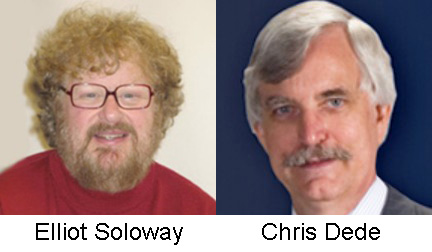
ISTE is no longer a teacher organization per se. It has changed. You can get updated on the latest technology, see this year’s trends, and meet and greet people. One highlight for me this year was to see that Elliot Soloway and Chris Dede‘s ideas of mobile technology have taken off. And then I thought of this article from MindShift. No one was talking about the lack of broadband or permissions to use technology in the schools or the way to negotiate that move. Digital equity seems to have died a quiet death. We did have an SIGDE workshop in the conference. Maybe it is our fault  we have no sponsors. I suppose that lets us know that we are not a real part of the mix. Or does it mean something else? Continue reading

Year-Round Schooling for the 21st Century: We Can’t Afford to Waste Summers

Frank B. WithrowBy Frank B. Withrow

At this time of year I always wonder at our slavish adherence to an agrarian schedule for schools. Million dollar plants are closed for the summer. Well, not completely. We often have the athletic departments active with team sports.

Staff, from teachers to principals, find summer jobs. I once had a principal who had a summer company to paint houses. He hired his male teachers, and they had a good business. Some of his teachers made more on their summer jobs than they did teaching.

We know that students lose much of what they have learned during this down time and that much of the first two months of the fall semester is spent relearning what they have lost.

If Walmart and others can serve their customers 24 hours a day year round, why do schools continue to tie themselves into a rigid and ill-conceived obsolete schedule?

What if we had a year-round, open schedule school system designed for modern families? For example, the schedule follows the family’s schedule. The students are in school from 8 to 5 each day or from 10 to 6 or even assigned as it fits their individual learning plan (ILP). The school is open from 7 in the morning to 7 in the evening. Students are assigned based upon their ILPs. Teaching staff schedules are also flexible in order to cover the entire day.

In this projected school system, there are traditional classes as well as virtual learning at home and at school through social media. All year long students engage in special learning experiences built around project based learning where learners, working in teams, experiment with such things as actually constructing a robot to serve disabled individuals.

Continue reading

The UVA Controversy: Change as a Moving Target

Jim ShimabukuroBy Jim Shimabukuro
Editor

It’s hard to disagree with John Eger’s[1] take on the significance of the UVA president’s resignation and reinstatement. The message is change — or else. But this is precisely the problem — a definition of change that everyone agrees with is nice, but is it useful?

In my mind, change, per se, is not the issue. In fact, every leader in higher ed has embraced change via technology. Teresa Sullivan is no exception. However, in her case, the pace of change at the University of Virginia[2] seems to have been the thorn.

Still, in Sullivan’s case, I’m not sure if speeding up the incremental pace would produce the kind of change that edX and Coursera represent. These MIT/Harvard and Stanford MOOCs (massive open online courses) have apparently set a new standard for change that is a radical departure from the incremental. The incremental model is appealing because it seems to satisfy the majority of professors[3]. Those who want to change while maintaining business as usual can have their cake and eat it, too. They can go blended, which is another way of saying that they can change without really having to change. They can continue to base their instruction in F2F (face-to-face) pedagogy and satisfy the demand for change by adding bits and pieces of the latest rage in technology. Post your syllabus and course schedule online, add a whiteboard to your F2F lectures, replace a percentage of your lectures with online activities, allow students to contact you via email — and, presto, you’ve changed.

But the question remains: Is this enough, and, perhaps more importantly, what exactly is “enough”?

Do we attain “enough” by placing a greater percentage of course work online? Adding more whiteboards? iPads? Clickers? Incorporating mobile devices into the instructional mix? Using more social media such as blogs, Facebook, Twitter? Expanding learning and teaching media to include teacher- and student-generated videos?

Herein lies the problem. No. All of these and more of it — even at a faster pace — doesn’t move us any closer to enough. Classrooms overflowing with the latest gadgets and online activities can come close, but they can never be enough. Change demands something more. Continue reading

How Anti-Evolution Helps to Define Science

picture of Harry KellerBy Harry Keller
Editor, Science Education

For nearly 150 years since Darwin first published The Origin of Species in 1859, the controversy has continued. Despite mountains of evidence collected from many branches of science, some still fight vigorously against teaching evolution in our school science classes.

I maintain that those fighting against this teaching are harming our society but may just be helping out science education. I refer here to what’s happening in the United States, which seems to be the country most affected by this controversy as well as being the one in which I live.

Answering why the anti-evolution forces are harming our society and how they might end up helping improve science education requires some digging. Society depends on technology to support our standard of living and on the creation of new technologies for export to fund our ability to buy technology. More and more of these technologies are biological in nature. Research into biology and medicine moves forward best when we understand the underlying principles of life. A framework upon which to set ideas and to imagine new ideas helps immensely in both research and development of new technologies and new products.

If you study well the advances in biology and medicine in recent decades, you will see that the concepts inherent in evolution have played an important role. If our students leave school without this important framework, then they are ill-prepared to participate in the advancement of science. If, even worse, they leave school opposing science and its precepts, then they may work to retard scientific advances. Evolution, as a concept and framework, has become the underpinning, tying together previously disparate aspects in all of our life sciences.

Right now, the world is on the verge of eradicating polio. One of three strains has already been destroyed, and only a few countries still harbor reservoirs of the remaining two and possibly only one. While this effort has been largely one of vaccinating everyone, development of new vaccines rests on medical research that depends on understanding how life works. Evolution is a crucial component. The speed with which we find cures for cancer, Alzheimer’s disease, and Parkinson’s disease are likely to depend on scientists who use evolutionary theory in their work.

Continue reading

Learning and Teaching in the 21st Century: The Potential for Social Media Such as Facebook

Frank B. WithrowBy Frank B. Withrow

In ancient times young people were trained in apprenticeships. A few were lucky enough to sit at the feet of great scholars. For the most part young people learned by imitating skilled seniors. Only a few scholars and scribes were literate. Great events were often recorded in paintings by master artist and carried forth by storytellers and ballad singers.

The invention of the printing press slowly changed society. Books and libraries became storehouses of history, science and mathematics. Eventually textbooks gave rise to schools, as we know them today. Historical events were recorded in print, and it became essential that people become literate. In the 1850s there was an argument as to whether textbooks for learners should include pictures and illustrations. Books allowed the master scholars, scientists and historians to store and distribute their wisdom and knowledge.

Until about five thousand years ago society used a strictly oral-aural system of communications. Once writing became available, mankind could store information and knowledge over time and space. Ideas that were printed could travel over land from one place to the next. Printed materials could be handed down one generation to the next. The users had to be literate in the language used. Literacy became the doorway to self-learning.

Mankind took a major step forward when we learned to transcribe speech and language into a stable code called writing. When the printing press was invented new ideas of schooling were possible. A mediator, that is, teachers, could transfer the writings of scholars to the masses. No longer did the learner need to be in the presence of the master scholar.

Today, technology allows us to go far beyond the printed word. Digitization of information is as significant a change as the printing press. We are at a major shift because we have the ability to bring live living color and enhanced graphics to any learning event. If our students are learning about John Glenn’s first space flight (20 Feb. 1962), they can see the actual footage of his orbits. Moreover they can see and hear him talk about the event and what he thinks it meant to the world. In fact, with social media we have the potential to create a Facebook page where he answers learners’ questions. Technology through social media allows us to practice team learning. Through social media, team members can be in the same classroom or even in different countries around the world.

Continue reading

Shaking It Up, Part 3 — A Conversation with John Sener, Author of ‘The Seven Futures of American Education’

Judith McDanielBy Judith McDaniel
Editor, Web-based Course Design

[Note: This is the last in a three-part series by Judith McDaniel. Read part 1 and part 2. – Editor]

If we define learning as content delivery, much that we now “know” about education follows from that premise. Freire calls it the “banking” method of education where the instructor deposits knowledge in the head of the willing “learner.” When that is what it means to learn, what could be wrong with standardized tests that measure content knowledge? If the transfer of knowledge is what it means to learn, then WHAT is transmitted takes on importance and HOW it is transmitted can be fairly standardized. This basically describes education today.

But if the cyberization of knowledge has produced “an unknowable body of knowledge,” how can anyone maintain that learning is about content, about knowing what has been known in the past? Not that we don’t need to know history and government and science and math, but that we need to know them differently?

I asked Sener, “If learning is NOT about content delivery/transfer/absorption, how should we define it?”

Continue reading

Shaking It Up, Part 2 — A Conversation with John Sener, Author of ‘The Seven Futures of American Education’

Judith McDanielBy Judith McDaniel
Editor, Web-based Course Design

[Note: This is the second in a three-part series by Judith McDaniel. Read part 1 and part 3. – Editor]

I asked Sener, “How can we improve education, using all of the knowledge and resources available to us?” In Seven Futures, he provides data indicating “that at least 70 percent of American jobs now require specialized skills and knowledge, and that students need education that will help prepare them for jobs which haven’t even been invented yet” (29). It seems obvious to me that our entire educational system needs a jump start and that teachers trained in the old methods of teaching the old knowledge don’t have any chance at all of meeting that challenge.

Imagine what teaching today’s students for tomorrow’s needs might entail — “Realigning Education with Redefined Knowledge.” Simply put, old knowledge isn’t enough. What we know is changing, changing quickly, and it’s not just the sciences. Yes, the number and definition of the planets has changed, but so has every branch of knowledge. I talked with a discouraged college student who recently graduated from a prestigious university in journalism. His last course in college had consisted of an advanced journalism class that exclusively included information on working in print media. The professor was a woman in mid career who seemed not to know that these students had a very small chance of working on a newspaper or magazine.  They were not even being prepared for the careers that have been invented in information production on the internet. Continue reading