A month before Operation Iraqi Freedom was launched, Chief of Staff Eric Shinseki, the U.S. Army’s top general at the time, testified before the Senate Armed Services Committee that “several hundred thousand soldiers” would be needed to secure Iraq after the invasion. The U.S. Defense Secretary replied that the general’s estimate was “far from the mark”; the Deputy Defense Secretary chimed in, claiming it was “way off the mark.” Three years later, the CENTCOM Commander admitted that the general’s estimate had been correct after all.
The point of this bit of history is that the U.S. government is wont to take grand and dramatic action to solve problems without paying close attention to the consequences. In the short run, the greater the theatrics, the greater the impact on the public. In the spirit of No Child Left Behind, we have The Digital Promise, the latest shock and awe solution to our country’s broken public schools. The question, however, is the long run, the aftermath. If necessary, can we sustain the additional costs over many years?
I once was a scoutmaster and had two boys that were eager to become Eagle Scouts. They both succeeded. One was very smart and things came easy to him. The other had to sometimes struggle to master content. The smart kid was a loner and liked to work alone and could care less about what the other Scouts were doing. The other wanted everyone to join him in his effort to become an Eagle. When he discovered something new that he liked, he wanted all his friends to join in and share the joy with him. I knew both boys from when they were just preschoolers. Both made Eagle, both did well in college and both had successful families and were successful in their fields of work.
The lone wolf passed away a few years ago. He was a good citizen and a good professional and had a good life. The other is retired now after a life working to benefit others. I recently got an email from him on Facebook saying he was volunteering to work in a social charity effort to help disabled people. He in effect said he could not think of not working at something that brought good to other people. He indicated that he expected to continue doing such work as long as he lived. Continue reading →
Ipads, Ipods, smart phones and the Internet give educators new tools to rethink learning and schools. Today there are many learning places that our children engage in daily from Sesame Street as preschoolers and other learning programs on television to formal classes in schools. As educators we must develop new ways to certify that a student has learned his or her lessons. For example, a student may watch all of Ken Burns’s Civil War or the many videos on World War II and have gained a comprehensive understanding of those history lessons. How does the education system certify these informal learning experiences? There are many blended learning opportunities available to learners.
A student may be active in the Scouts and become an Eagle Scout. Can what the student learns in scouting somehow be considered in accreditation of his or her learning experience? Learning in traditional schools takes up about 1/9th of the student’s time. Can we blend the total learning experience of students into a comprehensive whole? Could some teachers become monitors of nontraditional learning? For example, we have published standards in subject areas. If students believe they have mastered the skills and knowledge in a given area, can they be tested and credited in that area? For example, in English literature, if they have read all the assigned materials, could they set up an appointment with a monitor and be tested and interviewed with respect to his or her knowledge? Continue reading →
The bi-annual conference of the European Association for Research on Learning and Instruction (EARLI) took place from August 29 to September 3 at Exeter University – “probably one of the best Universities in the World.” Approximately 1600 researchers with backgrounds in pedagogy, psychology, social sciences and educational technology traveled to the South-West peninsular of the UK to discuss educational ideas for “the dawning age of the Internet” (conference program). Delegates came from more than 35 countries and from every continent: Chile, Canada, South Africa, Indonesia, Australia, New Zealand and Europe. The largest contingents came from the Netherlands and Germany, followed by the UK and Finland.
EARLI has a reputation for its high standard of academic contributions and is a must-go-event for many researchers in the learning sciences. Numerous PhD students and postdocs use the opportunity to present their work, discuss research designs, and debate their findings and implications with more senior researchers. This year’s acceptance rate of papers and symposia was about 68%. Overall, the program comprised approximately 600 presentations, 160 symposia, 65 roundtables and 150 posters. Continue reading →
When your digital generation daughter is six she may guide you on the interactions on Facebook or show you how to leave a message on Twitter. It is a part of their lives, and it is an uncharted information resource. It is vast and it is comprehensive, but in many ways it is not vetted. Even primary information is not vetted very well. Nevertheless it is here, and the question is how well can we use it?
We are in a transitional period where we are all learning. As with any new technology there are problems of adjusting to this new cornucopia of information. The iPad and other comparable technologies can give a first grader a library of all the textbooks needed for K-12 schooling. It can be upgraded as new information becomes available. Some people reject the new technology and prefer to use the old guidelines and standards of the print on paper world. It is worthwhile to remember that Socrates worried that writing would interfere with memory. With each new technological advance we must adjust our society to its uses. We must remember that the young are more likely to use the new than the more mature. Often the older people reject the new because it is more difficult for them to understand and use. On the other hand it is second nature to the young. Continue reading →
Three items in recent ed tech news caught my eye this morning, more for their implications than their news value.
The first is Sharon Roznik’s “Your Schools: No More Pencils, No More Books?” (The [Fond du Lac] Reporter, 9.15.11). In Fond du Lac, Wisconsin, schools are increasingly opening their doors to allow students to bring the latest personal communication devices such as “laptops, iPads and iPods” into classrooms. One of the school districts, New Holstein, is developing a BYOD or Bring Your Own Device program.
Roznik quotes Carmen Klassy, the Oakfield School District’s director of 21st century learning, who lists reasons for the changes:
to introduce a mode of learning that “is relevant to [students’] everyday lives”
to keep “up with today’s technology”
“to bring the world into the classroom”
to interact “with business professionals and people from all different cultures”
to provide teachers with “a whole new toolbox for” instruction
Stefanie Panke: Tell me a little bit about yourself. Where do you live? Are you in school or working? How old are you?
Billy Sichone: I am Billy Sichone from Zambia and work as program manager for one of World Vision‘s large scale development programs, located north of Zambia, Africa. I am married to Jane, and we have two daughters. My work is very demanding and involves a lot of travel as well as interactions with different kinds of people. I am 41 years old and have been a student of the University of the People for two years now. I am pursuing an online undergraduate degree in business administration. I have found it fascinating and a serious learning point to update my knowledge base as well as acquire new skills. The most interesting thing is that it is 100% online and free in addition to a diverse learning environment with colleagues from all over the world.
Billy Sichone, a student at University of the People (UoPeople), “the world’s first tuition-free online university, dedicated to the global advancement and democratization of higher education.”
Please describe how you first got involved with University of the People!
Sichone: I first got involved with UoPeople in very interesting circumstances sometime in September 2009. I must have subscribed to some online site and stated that my interest was online learning, and then one day I just received a mail from an unknown source suggesting that there was an opening to study with an online university called the “University of the People.” At first I thought it was spam mail but decided to follow the link nonetheless. What I discovered surprised me, and I immediately signed up, commencing my studies in November 2009. Continue reading →
Test results for reading and math from the Kyrene School District in Arizona seem to prove that pouring millions of dollars of technology into traditional classrooms may be a waste of money. According to Matt Richtel,* in the last six years the district, “which serves 18,000 kindergarten to eighth-grade students, mostly from the cities of Tempe, Phoenix and Chandler,” has invested $33 million in “technology-centric” classrooms. In a few months, the district will be asking voters to approve “$46.3 million more in taxes over seven years” to continue this program.
If people are surprised, they shouldn’t be. In the photo that accompanies Richtel’s article, we see students in a traditional classroom, lined up in rows and sitting before notebook computers. A large screen at the front of the room projects a page that is apparently on the teacher’s notebook. All appear to be on the same page. This was held up “as a model of [successful innovation] by the National School Boards Association, which in 2008 organized a visit by 100 educators from 17 states.”
However, “as statewide scores have risen,” says Richtel, “the scores in Kyrene have “stagnated.” He concludes, and I have to agree, “The push for technology is to the benefit of one group: technology companies.” Continue reading →
“What’s the point?” I hear that a lot when it comes to the use of Twitter in education. And, in some cases, I completely agree. But if the beginning of the semester snuck up on you like it did me and you’re looking for quick student engagement wins, Twitter might be able to help. Here are three ideas to get you started:
Number 1 – Current events
As Hurricane Irene barreled toward the East Coast, citizens battened their hatches and concerned relatives rushed to the Web for the latest information. My husband, two friends and I had planned a trip to the Jersey Shore to watch our good friend play in her first roller derby bout with the Jersey Shore Roller Girls. Their bouting venue? On the boardwalk. Obviously, not the ideal place to be with a hurricane charging toward the Jersey shore.
While CNN.com and Weather.com provided frequent updates, the information on Twitter was instant. People reporting wind speeds, flooding conditions and general storm progress updates filled my Twitter stream, and I had some interesting conversations with people who knew exactly what was going on. The trip was ultimately canceled but imagine harnessing this in your classroom. Libya, Somalia, the world economy — we’re living in a time of rapid change, and Twitter can help your students interact with that history.
In the beginning was the word. Early man developed the ability to share his sensory world through spoken communications. Speech and language allowed mankind to share private sensory experiences publicly. Speech was superimposed on the breathing system, leaving the body free to engage the world. Receptive language was received through the ears. This system was global in nature and did not require light. Essentially the speech and language system was superimposed on the global warning system of the human animal. In fact, the communication system can be detected even in noise. This system worked for mankind and enabled them to share skills and knowledge from one individual to another.
However, the spoken word is a fleeting signal or a capsule in time. Being limited in time it was not completely stable. Some five thousand years ago a major step forward came when mankind began to write. First there were pictographic symbols and then phonetic symbols and codes. The written word bound mankind in space and time with a stable format for communications. Skills, knowledge and experiences could be handed down in time and space. They could be transmitted over distance and from one generation to the next over time. The written word was a tremendous advance in human knowledge, as were the management of that knowledge and its storage in libraries. However, scribes and scholars served as gatekeepers since often they were the only literate members of society.
Crowdfunding and social payments are alternative revenue models for (online) content, projects and initiatives that rely on voluntary support instead of consumerism. Web 2.0 platforms such as kickstarter, slicethepie, kiva, or flattr combine fundraising with transparency, networking support and active participation. Julia Kaltenbeck studies software-engineering and economics at Graz University of Technology (Austria). She recently completed her master’s project* on crowdfunding and social payments in the context of open educational resources (OER).
Julia Kaltenbeck
“When Martin Ebner, one of the editors of L3T, an open content textbook on learning and teaching with technologies, offered me the possibility to write my master’s project about this very prestigious project, I immediately agreed,” explains Julia. In total, more than 100 authors and 80 reviewers contributed to the L3T project. Within one year, the first German language textbook on educational technology made it to the shelf – and its online pendant is available for free. Recently, the L3T project has successfully carried out a crowdfunding initiative on the German crowdfunding plattform Startnext. For ETC, Julia summarizes the results of her project. Continue reading →
With each new technology we have pluses and minuses. It saddens me that teenagers are using the social media for criminal and destructive purposes. The slash and flash targeting of all night stores by mostly teenage girls, converging en masse to steal from them, is disturbing. We should be wise enough to counter these events and to use the power of social media for the benefit of young people.
It still takes a village to raise a child. By that I mean a culture must honor and reward the concept of education. For most of our history we have been an optimistic society that believes the younger generation will be better off than the current generation.
So let us begin anew – remembering on both sides that civility is not a sign of weakness, and sincerity is always subject to proof. Let us never negotiate out of fear. But let us never fear to negotiate.
Let both sides explore what problems unite us instead of belaboring those problems which divide us.
The problem is that we can’t expect to see this dialogue and exploration coming from technocrats or people who are hired to manage instructional technology. Their survival depends on centralization and a tight rein on all technology. The last thing they want is for teachers to become empowered and independent learners capable of creating their own learning environments from the best options that are available on the living and breathing web. –Jim Shimabukuro
I really agree with all until the final paragraph. It sounds good and would work if theory matched reality. For too many instructors and K-12 teachers, they just don’t know “the best options that are available on the living and breathing web.” Furthermore many don’t even know how to find out. Once they do, they have the problem of evaluation, of technological literacy, which means being able accurately to evaluate technology for a specific purpose and assess costs and benefits.
School technologists can help a great deal and should not be removed from the equation. They understand the technology; instructors understand the pedagogy. Together, they could make intelligent decisions. Continue reading →
Stefanie Panke, in the discussion (8.16.11) on her article, “Open Learning at P2PU: An Interview with Jessica Ledbetter” (8.11.11), asks critical questions re performance in open online classes: Why do people drop out or hang in? How does this affect class culture or the facilitators?
I’m not sure what the answers are for the first question, but I’m certain that most who have taught or learned online have an opinion. My guess is that “easy access” is a root cause. It takes little effort to register for an online class, it’s free, and anonymity is an option. Thus when a door is purposely left wide open, many will enter, and this will include those who are merely curious, marginally interested, or lack the necessary time, temperament, skills, or knowledge to succeed.
The paradox is that “easy access” is also the root cause for popularity, i.e., for the same reasons that many will drop out, many will register. Thus we have a case of you can’t have your cake and eat it, too. Continue reading →
The road to technological change in education isn’t going to be paved by those who are committed to traditional face-to-face pedagogy. Yet, Ann Taylor, interim director of the Dutton e-Education Institute at Penn State, suggests that colleges “use traditional face-to-face faculty as … lead instructors, but hire part-time individuals to handle grading and daily course interactions” (Mary Bart, “Best Practices Help Dispel the Myths of Online Faculty Hiring Practices,” Faculty Focus, 15 Aug. 2011). This advice will more than likely lead to more of the same old ground-based practices. The instructional base is still the classroom, and from this perspective, change doesn’t stand a chance.
Taylor also suggests hiring a “course manager to oversee … online courses” (Bart). Unfortunately, for the vast majority of colleges, this is the model for online classes. This, too, is a perpetuation of practice that’s proven inimical to change. The problem is that the only person who can and should manage a class, online or F2F, is the instructor. Adding a layer of bureaucracy isn’t the answer. This is an extremely costly stopgap and simply postpones the need for teachers to manage their online courses. Continue reading →
[Note: This is the first in a series of articles in which Stefanie plans to explore open and informal learning. -Editor]
Introduction
The peer-to-peer learning community, P2PU, was founded in 2007. Since then, it has grown to approximately 1000 members. The credo “everyone has something to contribute and everyone has something to learn” guides the design of this informal university. Users can create their own courses or choose to subscribe to an existing course – either as active participants or as followers. Courses run for several weeks at a time and are open for enrollment during this period. Course organizers can set up a list of tasks, link to online material or work through a book.
Jessica Ledbetter
As an example, one class I am currently following reads Ivan Illich’s Deschooling Society. Participants are supposed to reciprocally review their takes on the learning tasks, giving mutual support and helping to improve each other’s work. Though no traditional accreditation is provided, P2PU is currently developing a badging system together with Mozilla Foundation to recognize informal learning, in particular, in the field of web development (Kamenetz, 2011, p.85). Continue reading →
South Central is a rural school district in South Dakota, and next year it will be offering science classes without science teachers (Josh Verges, “Four Rural S.D. Schools Let Students Run the Show,” Argus Leader 23 July 2011). “The teachers,” according to Verges, “are not expected to know the science curriculum; they just have to know students and how to connect them with resources and experts who can teach it.”
The emphasis will be on STEM (science, technology, engineering, math), and the approach will be project-based: students work in small groups on a real world problem, and much of the learning is done online. The groups work independently, and teachers intervene only when needed.
The motivation for this change is economics – small, remote schools can’t afford to hire qualified science teachers. However, it puts a new twist into an old saw: Necessity is the mother of innovation. With this one decision, South Central steps out of the 19th century and into the 21st. Continue reading →
George Siemens, in an interview with Audrey Watters, says, “In terms of evaluation of learners, assessment should be in-process, not at the conclusion of a course in the form of an exam or a test” (“How Data and Analytics Can Improve Education,” O’Reilly Radar, 25 July 2011). In the context of online learning, he’s underscoring the data mining tools built into learning management systems to do just that – provide on demand information on student log-ins, participation, completion of activities, etc. that can be used to formatively monitor progress. He also mentions the capacity to mine more complex data such as the quality of a student’s performance, but this area is still relatively unexplored.
Still, teachers are discovering that online classes provide mountains of qualitative digital data for each student. In essence, everything that’s done by everyone in an online class is automatically recorded and archived. For example, I teach completely online writing courses and have access to a mind-boggling amount of performance information. For each student, I can access all email exchanges that we’ve had, all discussion forum and chat posts, all confirmations of tasks completed, all evaluations written for classmates’ drafts, and all drafts written and comments received from peers and from me. Because this data is in digital form, it’s also searchable, fluid, and portable. Continue reading →
With budget cuts eliminating teachers and other human resources in schools, ebooks, hand held devices and social media are stepping in to fill the void. Rip Van Winkle, if he returned today, would find the average school a strange place. For the most part educational reform has traditionally repackaged the old ways in only slightly different new formats, but the system has remained the same. The digital world, however, has the potential for radical changes.
Modern schools can be traced back to the 1700s because by then we were storing and retrieving skills and knowledge in relatively cheap printed books. Learning by the young was no longer limited to apprenticeships with master craftsmen or sitting at the feet of primary scholars. Libraries of information were no longer limited to scribes and scholars. Universal literacy was the doorway to learning and knowledge. Teachers replaced scholars as the guiding force for young learners. The United States of America led the world in providing schools for all children including disabled children. However, to our shame we created a dual system of segregated schools for Afro American learners. We have always had an elite element of schools that are not open to everyone. However, in general, our schools have been the open doorway to class mobility. Continue reading →
By Claude Almansi
Editor, Accessibility Issues
ETCJ Associate Administrator
In 2006, Copiepresse, the rights managing society of Belgian publishers of French- and German-language daily newspapers, sued Google about the snippets shown in Google News and about the cached versions displayed in Google Search. On May 5, 2011, a decision of the Brussels appeal court slightly reworded but basically confirmed the 2007 judgment of the first instance court :
La cour … Condamne Google à retirer des sites Google.be et Google.com, plus particulièrement des liens «en cache» visibles sur “Google Web” et du service “Google News”, tous les articles, photographies et représentations graphiques des éditeurs belges de presse quotidienne francophone et germanophone, représentés par Copiepresse …, sous peine d’une astreinte de 25.000,00 € par jour de retard ….
The syntax is contorted and the part between commas starting with “plus particulièrement” is ambiguous. Moreover, I’m not a lawyer. So here is a very informal attempt at translation:
The court … orders Google to withdraw from the Google.be and Google.com sites, more particularly from the “cached” links visible on “Google Web” and from the “Google News” service, all articles, photographs and graphical representations of the Belgian publishers of French- and German press represented by Copiepresse …, or pay € 25’000.00 for each day in noncompliance …. Continue reading →
By Frank B. Withrow
[Note: In this article, Frank shares profiles of some very amazing people who view disabilities as inspiration rather than obstacles: Desdie and Frank, Nanette Fabray, Mabel Hubbard Bell, Henry and Emmanuel, and Dennis. -Editor]
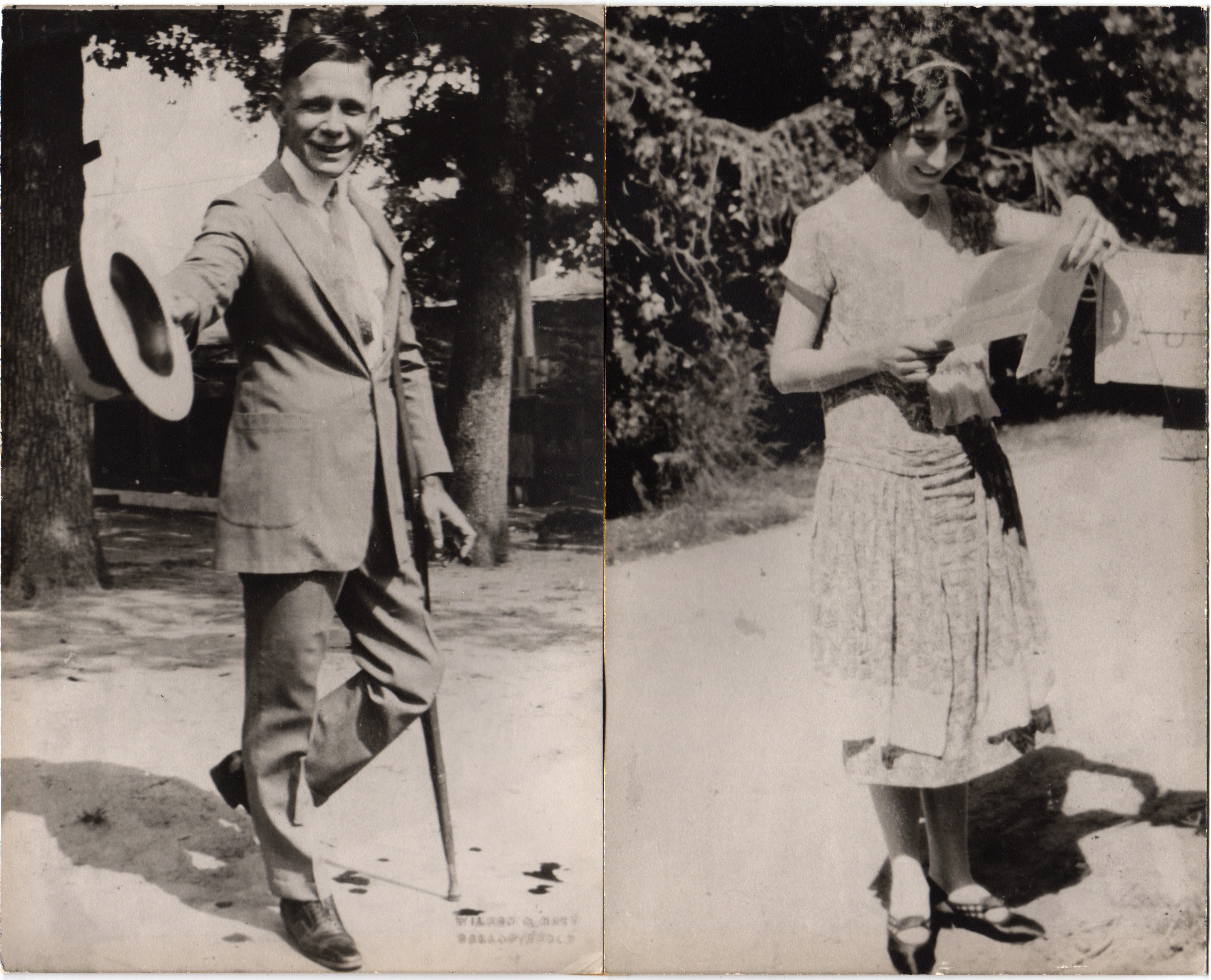
Desdie and Frank
They were both independent and working for an insurance company. Desdie was a PBX operator, and Frank was a rising claims manager. Both came from large farm families. Frank was the oldest of ten children born in what is now Withrow Springs State Park in Arkansas. Desdie was among the younger daughters of a father who had ten children. Her birth mother had died two children after Desdie was born in Oklahoma.
Frank Sr. and Desdie (click to zoom in)
His stepbrother, Fred, had dropped Frank as an infant on a farm implement. At the time the wound had been treated, but his knee healed in a frozen 90-degree bend position. Frank and Desdie had been seeing one another for some time when Desdie took Frank to meet her father, Jack Thomas. Jack seemed to like Frank, but later talked to Desdie. He questioned whether they were developing a serious relationship and warned her about marrying a disabled person. Desdie responded by saying he was one of the most interesting men she had ever met. She thanked her father for his advice and went on to marry Frank in 1923. Frank’s mother died in 1925, and Desdie and Frank brought the three youngest girls and two youngest boys to Dallas to live with them. His father was unhappy since he used the children to pick cotton, but Frank had promised his mother on her deathbed to care for the younger children. Continue reading →
This journal, Educational Technology and Change, is built in a WordPress web publishing environment. I hesitate to call it a “blog” because people tend to immediately close on it and can’t see that WordPress is no more a blog than the smartphone is a phone.
I’ve had my iPhone 4 for about two months, and it’s already changing my view of what it means to be connected. WordPress and iPhone, together, are redefining the publishing landscape for me. They’re not only placing publishing in the hands of the many, but they’re making it possible for them to do it from anywhere at anytime. It’s no longer a matter of waiting until I can get to a computer with web access. Instead, I have it with me at all times wherever I am, eliminating the waiting altogether.
I can now write an article using the built-in notes application and a Bluetooth wireless keyboard that I originally purchased for the iPad. In fact, I’m writing the first draft of this article on the iPhone. A couple months ago, I would’ve scoffed at the idea of composing on a screen the size of a credit card. Impossible, I would’ve sworn. But I’m doing it now, and I find it just as comfortable as my laptop or desktop. Continue reading →
[Note: I started writing about the project of Liceo Artistico De Fabris, then I asked for feedback from Frank B. Withrow, because he has written about his experience in enabling tactile learning in “Technology Can Help Deaf-Blind Infants” and from Roberta Ranzani, with whom I have collaborated in several subtitling and educational projects. Frank sent the text about tactile books and the American Printing House for the Blind. Roberta mentioned a tactile astronomy workshop for the blind that took place in Venice. A friend of hers, Tiziana Castorina, had attended, and Roberta asked her for a description. Thanks to Tizana and Frank for allowing me to post their texts here, and to Roberta for her suggestion and for the introduction to Tiziana – CA]
Claude Almansi: Tactile books — Liceo Artistico De Fabris
On June 29, 2011, Roberto Ellero sent me the URL of a video he made about a project by Prof. Adriana Sasso and her students at the Liceo Artistico “De Fabris” (Nove, Vicenza, Italy — liceo means secondary school): creating tactile books for blind and sight-impaired children.
From the video, it seemed that this project could be relevant to previous discussions here about project-based learning: for example, see “Project Based vs Problem Based Learning” by Jan Schwartz (June 26, 2011), in reply to Jim Shimabukuro’s “A Quick and Dirty Look at Project-Based Learning” (May 20, 2011). So I asked Roberto if it would be alright to subtitle it in English (well, in Italian and French too). He agreed, so here goes:
With a wide range of curriculum available on the Internet, home schooling has become a more viable option for some families. The schoolhouse offers more than just academic resources. It also offers a social environment where friendships are established and where students learn to work together in teams. Learning resources on the Internet offer high levels of content and highly qualified teachers. Such programs, especially if approved by the state, are viable opportunities for learners of all ages.
Consequently, some two million students (Dan Lips and Evan Feinberg, “Homeschooling: A Growing Option in American Education,” Heritage Foundation, 3 April 2008) in the USA are now engaged in home schooling. To partially make up for the social interactions of the regular public school, some areas have an extensive set of options for families with home scholars. These include field trips, debating contests, orchestras, community sports teams and even drama theaters.
The 23rd annual World Conference on Educational Multimedia, Hypermedia & Telecommunications (ED-MEDIA) took place from June 27 to July 1 in Lisbon, Portugal. The event brought together approximately 800 participants from 60 countries. At the backdrop of the beautiful Faculty of Letters Campus at Lisbon University, teachers, researchers, software vendors, instructional designers, administrators and multimedia authors discussed future directions at the crossroad of education and technology – which happened to blend perfectly with experiencing Portuguese hospitality!
ED-MEDIA attracts participants from various fields such as pedagogy, educational psychology, computational science and information science. Organized by the Association for the Advancement of Computing in Education (AACE), the annual conference takes place at various locations in the US, Canada, and, approximately every third year, Europe. The attendees of this year’s event experienced a packed conference program. In addition to various keynotes, invited lectures and an extensive graduate program track, approximately 600 presentations, posters, workshops and symposiums were competing for their attention. This report mirrors my own eclectic view based on four conference days that allowed participants to choose from up to twelve concurrent sessions. Continue reading →




 By Jim Shimabukuro











 Educational Technology and Change Journal
