Posted on December 3, 2010 by JimS
 By William H. Zaggle
There are some great models for a new kind of assessment, at least in science. While attending the Turning Technologies Higher Education User Conference on the Harvard Campus in October, I was treated to a lecture by Harvard Physicist Dr. Eric Mazur on the concepts of interactive teaching and “dynamic assessment,” a term that originated, I believe, in the work of the Russian psychologist Lev Vygotsky, specifically Mind in Society: Development of Higher Psychological Processes (1978).
I was inspired by Dr. Mazur’s creative ways of testing students’ mental models rather than rote knowledge and his use of “conceptual” questions and discussions that require students to exercise the “skeptical, critical, and scientific thinking skills” our species developed as early hominids. By presenting mental “problems” in small doses and testing students dynamically, gradually increasing the level and complexity of the problem to keep students within their “zone of proximal development,” as defined by Vygotsky, his students learn to develop their own mental models of the problem and form their own questions rather than just learn someone else’s answers to the questions.
Continue reading →
Filed under: Uncategorized | 4 Comments »
Posted on December 1, 2010 by JimS

The current discussion about the deployment of broadband fascinates me. It does because, in my work, I go from a place where every kind of connection is possible to a place where there is no cell phone service and no broadband and where the use of the Internet is limited.
I might also add that the media markets are very compromised in what they offer in various regions, but that is a whole different story. Or is it?
In many places I visit, the supporting education community has little information that allows it to trust the use of the Internet so, even if there is Internet access, it is blocked for safety reasons. My work is hard but fun, trying to convince those who think technology is a pain that there are some parts of it that they don’t want to be without.
Today, 1 December 2010, there is a forum being held on this very problem: “Technology, Social Innovation and Civic Participation: What’s the Next Step?” It’s sponsored by the New America Foundation, Washington, D.C., and runs from 3:30 – 4:45pm.
Today is a busy day for groups to share their visions. They are trying to get your attention for their viewpoints. What is your take? How do you see the implementation of technology? What is the right course of action to take for all? What will transform education? Did the Digital Learning Council get it right? I’d love to hear your thoughts. Please post them as comments.
Filed under: Uncategorized | 1 Comment »
Posted on December 1, 2010 by JimS

One of the reasons that online course discussions fail is the lack of an assessment system that not only accurately scores quality student participation but actually encourages high quality participation.
Some courses actually do not grade student discussions. I am not sure why, but I suspect it is because instructors similarly fail to grade face to face discussions and somehow see it as an inappropriate interference in the students’ free expression. It is possible that it can become exactly that, but that is only with poorly designed systems. If there is one thing that I have learned about the difference between online education and face to face instruction is that in online, if you aren’t grading it, they aren’t doing it. In face to face, your mere physical observation of their participation (or lack of it) is perceived to be a form of assessment that encourages participation. That physical observation is missing in online discussions.
The most common ways of grading discussions are the most destructive. If you really want to have a dull, meaningless discussion, make the number of posts the primary factor in assessment. In general, whenever you have a scoring criterion that places a primacy on quantity over quality, you will usually get quantity without quality. Ask for three posts per student, and you will get three posts per student, with the content of each being something like “post one,” “post two,” and “post three.” You will get many an “I agree” or “I disagree” post that adds nothing to the discussion. In almost all rubric creation, I do everything I can to avoid having actual numbers. Continue reading →
Filed under: Uncategorized | 6 Comments »
Posted on December 1, 2010 by JimS
 By Harry Keller
Editor, Science Education
In “Information Overload, Then and Now” (Chronicle of Higher Education, 28 November 2010), Ann Blair comments on the history and future of information overload. We all feel it from time to time. My undergraduate experience took this problem to new levels as I navigated from English literature to world history to engineering drawing to physics to chemistry and to calculus every week. It was like drinking from the proverbial firehose.
Prof. Blair (Harvard University, History) has put this topic into historical perspective. The article is interesting and undoubtedly is intended to interest people in reading the book. However, I was struck by the last sentence.
Many of our technologies will no doubt rapidly seem obsolete, but, we can hope, not human attention and judgment, which should continue to be the central components of thoughtful information management.
I received two messages from this sentence. She points out that human judgment will not soon be supplanted by computers. I concur. For me, she implies much more, that we must ensure that students learn good thinking skills. Technology can both help and hurt this process. Of course, these two faces of technology have been around at least since spears could help obtain food and hurt other people. Continue reading →
Filed under: Uncategorized | 2 Comments »
Posted on December 1, 2010 by JimS
 By Jim Shimabukuro
Editor
Class Differences: Online Education in the United States, 2010* (Babson Survey Research Group, November 2010) is the eighth report on online education by Babson Survey Research Group for the Sloan Foundation. The authors are I. Elaine Allen and Jeff Seaman from Babson Survey Research Group, Babson College. In this review, I present excerpts from the report followed by a brief comment.
The following questions and excerpts are direct quotes from the report:
How Many Students are Learning Online?
For the seventh consecutive year the number of students taking at least one online course continued to expand at a rate far in excess of the growth of overall higher education enrollments. The most recent estimate, for fall 2009, shows an increase of twenty-one percent over fall 2008 to a total of 5.6 million online students. The growth from 1.6 million students taking at least one online course in fall 2002 to the 5.6 million for fall 2009 translates into a compound annual growth rate of nineteen percent for this time period. For comparison, the overall higher education student body has grown at an annual rate of less than two percent during this same period – from 16.6 million in fall 2002 to 19.0 million for fall 2009. (8) Continue reading →
Filed under: Uncategorized | 3 Comments »
Posted on November 30, 2010 by JimS
By Jim Shimabukuro
Editor
Earlier today, Judith McDaniel, ETCJ editor of web-based course design, emailed me a link to Julie Zhuo’s op-ed in the NY Times, “Where Anonymity Breeds Contempt“* (29 November 2010). Zhuo’s article is about trolling, and she defines it “as the act of posting inflammatory, derogatory or provocative messages in public forums.”
Zhuo claims that studies prove “anonymity increases unethical behavior.” She also mentions a term for this behavior, “the online disinhibition effect.” (The embedded links are provided by Zhuo.) She suggests that site administrators “do their part by rethinking the systems they have in place for user commentary so as to discourage — or disallow — anonymity.”
Here in ETCJ, we don’t allow anonymous comments, and this safeguard has been quite effective. But, as Zhuo says, “Many commenters write things that are rude or inflammatory under their real names.” To prevent non-anonymous trolling, she suggests a number of measures, including a rating system for commenters, careful monitoring of posts, and a process for reporting trolls. Continue reading →
Filed under: Uncategorized | 8 Comments »
Posted on November 30, 2010 by JimS
 By Claude Almansi
Editor, Accessibility Issues
[Note: On Cyber Monday, Operation In Our Sites II, a coordinated effort of the U.S. Justice Department’s Criminal Division, the Department of Homeland Security, and nine U.S. Attorneys’ Offices, “obtained and executed seizure orders against 82 domain names of websites engaged in the sale and distribution of counterfeit goods and illegal copyrighted works.” It specifically “targeted online retailers of a diverse array of counterfeit goods, including sports equipment, shoes, handbags, athletic apparel, sunglasses, and illegal copies of DVDs, music and software” (USDOJ). In her letter below to the Justice Department, Claude Almansi, Educational Technology and Change Journal associate administrator and editor for accessibility issues, points out that “the seizure notices added to the sites seized in ‘Operation In Our Sites II’ are surprisingly inaccessible to people who must use a screen reader because they are blind or have other print disabilities.” -js]
from: Claude Almansi <claude.almansi@gmail.com>
to: askdoj@usdoj.gov
cc: Webmaster.ICE@dhs.gov,
webmaster@usdoj.gov,
James N Shimabukuro <jamess@hawaii.edu>
date: Mon, Nov 29, 2010 at 11:29 PM
subject: Accessibility issue with the seizure notices of “Operation In Our Sites II”
I am associate administrator and editor for accessibility issues at Educational Technology and Change Journal (1) and am thinking of writing a piece on “Operation In Our Sites II”, described by Attorney General Eric Holder and ICE’s Director John Morton in their Nov. 29, 2010 press conference (2).
In view of the US government’s commitment to digital accessibility as per Section 508 of ADA, evidenced for instance in the joint letter about the accessibility of e-book readers sent last to the presidents of US universities and colleges by the US Departments of Justice and of Education last Summer (3), the seizure notices added to the sites seized in “Operation In Our Sites II” (4) are surprisingly inaccessible to people who must use a screen reader because they are blind or have other print disabilities.
 Continue reading →
Filed under: Accessibility | Tagged: Accessibility, DoHS, DoJ, domain seizre, ice | 4 Comments »
Posted on November 29, 2010 by JimS
 By Bonnie Bracey Sutton
Editor, Policy Issues
Larry Cuban, in “How One Science Teacher Integrates Laptops into Lessons” (11.25.10), describes how a high school biology teacher, Carol Donnelly (pseudonym), has incorporated laptops and the web to create a hybrid mix that’s exciting and effective. I thought this example might stimulate discussion on how others are using a wide range of instructional technology, including social networking applications such as student blogs, to enrich hybrid practices.
The following excerpts on Donnelly’s strategies are from Cuban:
[Donnelly’s students] watch animations of photosynthesis that she had loaded on their machines earlier. A pop-up quiz appeared after the animations.
A lesson on the plasma (or cell) membrane . . . took three days. She included exercises that came from Kerpoof multimedia software that had students draw and label parts of the plasma membrane.
Donnelly also has her students blogging. With a laptop camera, students liven up their blog page with photos they take of themselves and others. She reads the blogs and comments but gives no grades on entries.
[Her students tap into] other teachers’ lessons, videos, and websites [permitting them] to dig deeper into content than their text.
[Donnelly:] “When I asked students to compare the features of a cell to anything they wanted—the high school, family, friends, sports team, etc.—they created stories, took photos off the web, did an Imovie and a Keynote presentation. I was surprised and pleased. I had not expected all of that to be done in one class period.”
Filed under: Uncategorized | 2 Comments »
Posted on November 28, 2010 by JimS
By Jim Shimabukuro
Editor
In her weeks 4-6 report on PLENK2010, Stefanie Panke mentions a decline in active participation. In her final report covering weeks 7-10, she closes with a summary on what she has learned. In that summary, she quotes from a thread begun by Chris Jobling, who asks: “Am I alone in feeling that this course has gone through a development that seems like a frontier town in the American gold rush? Intense excitement and rapid growth at the start. Ghost town and tumble weeds at the end” (“Not with a bang but with a whimper,” 16 Nov. 2010, 08:50; Webcite).
The ensuing discussion is fascinating, and I found three comments especially so for the insights they offer about the drop off in activity and the course as a whole. They were posted by Jobling, Bruce Jones, and Larry Phillips. Continue reading →
Filed under: Uncategorized | 2 Comments »
Posted on November 26, 2010 by JimS
 By Stefanie Panke
Editor, Social Software in Education
I ended my last report from PLENK 2010, the “Personal Learning Environments Networks and Knowledge” course, with the revelation that teaching several classes this semester and being a student in a massive open online course (MOOC) at the same time provided me with some challenges to “manage and balance” – an important competence for the informal learner. The closing line in that report, “my next PLENK review might take a little while,” proved prophetic. This summary of the last four weeks of PLENK is at the same time a resumé of my overall learning experience since last Friday’s web conference was the final curtain for the class.
Week 7: Help for the Information Hoarder!
Week seven dealt with tool choices within one’s personal learning environment. Should I try out this new mind mapping software or not? How many different environments can one person use? What level of diversity is helping or hindering my students’ knowledge creation process? Albeit the official motto was “Tools – What Exists, What Is Being Built?”, my attention in the reading material and web conference was centered on an article by Maria Andersen, “The World Is My School: Welcome to the Era of Personalized Learning.” Andersen is a math professor at Muskegon Community College (Michigan) and an education technology specialist. Her topic was information overflow, created within our personal learning networks, and how we need new tools that enforce not only information retrieval but information reflection. She says: Continue reading →
Filed under: Uncategorized | Leave a comment »
Posted on November 22, 2010 by JimS
“Where ignorance is bliss, ’tis folly to be wise.” —Thomas Gray
One night more than 50 years ago, my father took his children out to look up at a great wonder — a star moving slowly across the sky. To this seven-year-old, the words “Sputnik” and “satellite” were meaningless, and I had no idea how profoundly they would affect my life.
In a cold-war induced panic, the United States began a massive approach to elevate our knowledge in what we now call the STEM areas. America had been jolted into the belief that national prosperity — even survival — demanded a population knowledgeable in science, technology, engineering, and math. In a few years that program reached me, and I was directed into an “honors” science and math path that ended with my taking every science class in my high school, including AP chemistry, as well as going all the way through calculus before heading off to college. That story may be a surprise to those who knew me as an English teacher, but the change in focus was due more to politics (the Vietnam War) and to a really bad Calculus II teacher in college than to any shortcomings in the national focus on science and math. Continue reading →
Filed under: Uncategorized | 5 Comments »
Posted on November 19, 2010 by JimS
By Jim Shimabukuro
Editor
Part of the problem in the ongoing dialogue on the effectiveness of completely online instruction is that much of the talk is just that, talk. This absence of concrete examples may be at the bottom of some of the misunderstandings in discussions.
In fact, there are real-life successful models, and EBUS Academy in British Columbia is one. It’s a public elementary (K-7) and secondary (junior, 8-9; senior, 10-12) school that’s free to BC students and completely online. (They also have a program for adult students.) The beauty of this model is its simplicity. Unlike many systems that seem to have been thrown together piecemeal, this one appears to have been planned from the ground up.
Furthermore, the language on the website is geared to real people, not to other educators. In everyday language that’s mercifully free of educationese, the staff provides just the information one needs to understand what EBUS is all about and, if interested, how to participate. Continue reading →
Filed under: Uncategorized | 3 Comments »
Posted on November 16, 2010 by JimS

Sacramento State is a prime example of the state of online education in our nation’s colleges. Confused.
In “Online Education Now in Demand, Report Says” (State Hornet, Nov. 9-10, 2010), Laila Barakat reviews a recent legislative analyst’s report on California Community Colleges and state universities and interviews staff at Sac State. I haven’t read the report so the quotes (direct and indirect), below, that are related to it are Barakat’s impressions.
According to the report, “distance education” is the same as “online,” and “hybrid” is something totally different. Furthermore, the “demand for high-quality and accessible distance education” courses is “great.”
The advantage of online instruction is the access it provides students to courses they wouldn’t be able to take because of schedule conflicts. Additionally, they allow “campuses to increase instruction and enrollment without building additional classrooms and parking structures, and create ‘virtual’ academic departments that are taught by faculty from more than one campus.” Continue reading →
Filed under: Uncategorized | 6 Comments »
Posted on November 11, 2010 by JimS
By Harry Keller
Editor, Science Education
Jay Mathews wrote a challenging column, “Even Our Best Kids Lag in Math — Middle Schools to Blame,” in the Washington Post Online (11.10.10). In it, he discusses a study by Eric A. Hanushek and Paul E. Peterson, of Stanford’s Hoover Institution, and Ludger Woessmann, an economist from the University of Munich. The article suggests that our students learn very little science and math in middle school and that we should raise our middle school science and math standards. Mathews also suggests that middle school math and science teaching may have to be improved as well.
Middle school (grades 6-8, ages roughly 11-13) is an important transitional period in young people’s lives. Because of problems with discipline and just getting students to pay attention, efforts to create substantive learning in math and science have slackened according to Mathews.
His evidence comes from PISA, the Program for International Student Assessment. Whereas students from the best scoring countries attain an accomplished level of 20% or more on the assessment, only 6% of U.S. students reach this level. Even if you only consider white students and at least one college-educated parent, the rate remains low at 10.3%. Almost all educators agree that this rate bodes ill for our future. Continue reading →
Filed under: Uncategorized | 3 Comments »
Posted on November 10, 2010 by JimS
By Jim Shimabukuro
Editor
The U.S. Department of Education, Office of Educational Technology, released the National Education Technology Plan, Transforming American Education: Learning Powered by Technology, on November 9, 2010. The plan is presented as “A Model of Learning Powered by Technology,” which is divided into five “essential areas”: Learning: Engage and Empower, Assessment: Measure What Matters, Teaching: Prepare and Connect, Infrastructure: Access and Enable, Productivity: Redesign and Transform. Excerpts from each of these areas are presented below to provide a general overview of the model.
After a quick review of the executive summary, I was left with a number of questions: Does this plan, this model, provide the vision that the U.S. needs to strengthen its educational systems? Is it based on an accurate assessment and projection of the state of technology in the world and in education? Does it logically and clearly point the way to the best possible use of technology in education? Following the excerpts, I present some of my preliminary reactions to these questions. Continue reading →
Filed under: Uncategorized | 15 Comments »
Posted on November 7, 2010 by JimS
By Stefanie Panke
Editor, Social Software in Education
In 2004, Duke University gave out 1600 iPods to incoming freshmen to experiment with the educational value of podcasting. Students and teachers soon were facing a mobile content distribution problem. This gave birth to the idea of applying the distribution logic of the Apple iTunes music store to educational material: The same infrastructure that was already used to provide download opportunities for albums and tracks could easily cover lectures and sessions. This was the start of “Project Indigo,” a collaboration of Apple with Duke, Brown, Stanford, Michigan, and Wisconsin. As a result, in 2007, Apple officially launched iTunes U, a distribution system for educational content with the compelling slogan “Learn anything, anytime, anywhere.”
Three years later , Richard Teversham, Director of Education Mobility and Content at Apple Europe, London, announces, “Today is a momentous day for us all,” opening the iTunes U 2010 conference. The 170 attendees from 16 countries (mainly Europe, but also India and the US) gathered at the Hilton Parc Hotel in Munich to discuss educational use cases and institutional strategies for iTunes U. The conference started on the evening of the 13th with a welcome reception at the Pinakothek der Moderne, a museum that presents art, architecture and design and offers one of the world’s greatest collections of works from the 20th and 21st century. The location was well chosen to serve as a metaphor for Apple’s curational aspirations. iTunes U, indeed, has gained undeniable momentum: 800 institutions from 26 countries provide content on the educational repository, which so far comprises 350,000 assets and has recently passed the 300 million download mark. Continue reading →
Filed under: Uncategorized | Leave a comment »
Posted on November 5, 2010 by JimS
By Jim Shimabukuro
Editor
On 3 November 2010, on the ETCJ listserv, I shared an email message from Steve Eskow on the subject of “The Open Courseware Movement.” He included a link to D.D. Guttenplan’s article in the NY Times, “For Exposure, Universities Put Courses on the Web” (11.1.10). Steve’s question: “Jim, have we done much with this idea?” Responses from editors and writers followed quickly: Claude Almansi, a few hours later; Jessica Knott, Jan Schwartz, and Robert Plants, early the next morning.
Here’s the full text of Claude’s message (11.3.10 at 11:59 AM). I’m reproducing it here because it’s filled with useful and fascinating links and info:
Thanks, Jim and Steve
On the same theme, about the economics of Open Access publications,
see the US “Compact for Open-Access Publishing Equity – COPE”
<http://www.oacompact.org/> (<http://www.oacompact.org/signatories/>
for the universities that signed it).
Continue reading →
Filed under: Uncategorized | 4 Comments »
Posted on November 4, 2010 by JimS
 By Chad Trevitte and Steve Eskow
[Note: The original article, “Reschooling Society and the Promise of ee-Learning: An Interview with Steve Eskow,” appeared in Innovate, August-September 2007. In this updated version, Steve responds to additional questions submitted by Jim Shimabukuro, ETCJ editor. The new material appears in bold italics. The bio at the beginning of the original article has been omitted in this update. For a glimpse of Steve’s current bio, click on his photo. -js]
[Note by Chad Trevitte:] As guest editor of this special issue of Innovate, Eskow granted me an insightful interview in which we discussed ee-learning, its relevance to various theories of learning, and the promise it holds for revitalizing educational practice in the academy.
Chad Trevitte [CT]: Perhaps the best place for us to begin is to discuss your understanding of ee-learning as a distinctive mode of pedagogy. How would you define the term?
Steve Eskow [SE]: The term is a hybrid one that brings together two kinds of e-learning. What I’ll call “e-learning1” is electronic learning, in which the new communication technologies such as the computer, cell phone, or television provide the scene of instruction. The computer can house and move anywhere all the older media — the book, for example — as well as all the media and methods associated with traditional pedagogy: the lecture, the recitation, the discussion, or the tutorial. MIT is putting its laboratories online and making them available to students around the world; the British Open University is making its courses available. And simulations and the new game pedagogies begin to bring new teaching methods to the instructional scene.
Continue reading →
Filed under: Uncategorized | 2 Comments »
Posted on November 3, 2010 by JimS
By Steve Eskow
Editor, Hybrid vs. Virtual Issues
[Note: This article was first published as a reply (11.3.10) to John Adsit‘s comment on Steve’s “The Culture of Presentation.” -js]
John, your picture is all too accurate. Grim but accurate.
We’re ETC: the last word in the trilogy is “Change.”
Perhaps we need to spend more time and thought on “Change”: how to encourage it, which approaches discourage it, which approaches are almost certain to fail?
Is the change picture as bleak as you paint it? There are computers in the schools, there are online courses and online schools: are these evidence of movement in new directions?
One small hunch about the resistance you describe:
I note that many reformers, advocates of large changes, seem certain of the failures of the present system and the superiority of their proposed changes – certain before the evidence is in.
Might this style of critique and advocacy tend to generate the posture of defence of the present and rejection of the new?
Do we agents of change need to be more humble, more tentative, less certain that we have the keys to a better future?
Would we create more support for our work if it could be framed as research, as the search for new and better directions, rather than proposed as utopias already found?
Filed under: Uncategorized | 2 Comments »
Posted on November 3, 2010 by JimS
 By John Adsit
Editor, Curriculum & Instruction
The annual convention of the Dive Equipment and Marketing Association (DEMA) will be held in mid-November, and at that meeting a new kind of hybrid online education program will be announced. It contains aspects of distance education that have never been tried before. In the interest of full disclosure, I should make it clear that I have been a part of this project from the start.
 Continue reading →
Filed under: Uncategorized | 5 Comments »
Posted on November 2, 2010 by JimS
Back in the 1990s, when my principal job was instructional reform, I can say without a doubt that the biggest opposition I faced came from history teachers. I was trying to persuade teachers to focus instruction on getting students to use higher order thinking skills, to analyze data, to use information the same way a professional in that field would. When I made presentations on this topic, the strongest opposition usually came from history teachers, who insisted students could not do any of those things until they had memorized enough information to be able to do such analyses and projects. I vividly recall a teacher almost pounding a desk and repeating over and over, with increasing anger, how important it was for students to know the details of the Dred Scott case.
After that frustrating session, I went into several AP English classes, filled with brilliant students who had completed American History only a few months before, and I asked them who Dred Scott was. Not a single one knew. When I presented that information to the same history teachers the next day, they were absolutely unmoved. Learning history meant memorizing dates, events, and names, and that was all there was to it. The fact that students might forget it all a few weeks after the final exam was unimportant.
Continue reading →
Filed under: Uncategorized | 8 Comments »
Posted on November 2, 2010 by JimS
Here are some eye-catching quotes (bold added) from “MCNC Looks to ‘Enhance the Learning Experience’” (Local Tech Wire, 1 Nov. 2010):
MCNC [Microelectronics Center of North Carolina] will host its 2010 NCREN [North Carolina Research and Education Network] Community Day celebration on Nov. 18 and Nov. 19 at the N.C. School of Science and Mathematics (NCSSM) in Durham. Online registration is available until Nov. 12.
MCNC is the company and NCREN is the network, our flagship product.
MCNC is an independent, non-profit organization that employs advanced networking technologies and systems to continuously improve learning and collaboration throughout North Carolina’s K20 education community.
The North Carolina Research and Education Network (NCREN) is a highly reliable, cost-efficient network. NCREN is one of the nation’s first and one of the world’s leading statewide regional optical networks.
This year’s theme of Enhancing the Learning Experience will paint a vision for North Carolina’s future where opportunities are unlimited through technology and collaboration.
Continue reading →
Filed under: Uncategorized | 2 Comments »
Posted on October 22, 2010 by JimS
By Steve Eskow
Editor, Hybrid vs. Virtual Issues
In her 2004 essay “How Computers Change the Way We Think” (Chronicle of Higher Education, 30 Jan. 2004), Sherry Turkle says:
Indeed, the culture in which our children are raised is increasingly a culture of presentation, a corporate culture in which appearance is often more important than reality.
Turkle uses Power Point as illustration: a program that can take a jumble of notions and notes and simulate coherence.
As a case in point, I submit the following “Framework for 21st Century Learning” from the Partnership for 21st Century Skills site. The letters A, B, and C as well as red circles have been added to facilitate my comments. Continue reading →
Filed under: Uncategorized | 17 Comments »
Posted on October 22, 2010 by JimS
By Stefanie Panke
Editor, Social Software in Education
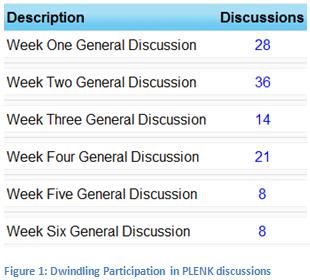
Lately, I’ve had a hard time keeping up with and documenting my attendance at PLENK2010, mainly because I missed several Web meetings and found it difficult to follow the discussion. Looking at the discussion forums, I sense that this is a common experience. Recurring reasons for passive participation or dropping out altogether are the lack of structure and the feeling that “it’s all been said.”
Dolors Capdet explained: “I think the vast majority of those registered do not know how to get involved in the course because they feel that they cannot bring anything new and, therefore, they assume the role of spectator” (MOOC discussion October 2010). Another participant complained: “When I responded to comments posted by fellow participants, the replies that I got back shut down dialogue rather than opened it up. I did not receive one response that made me want to reply to the same conversation again.” However, as a reply to this posting, Sheila received many hints, pointers and opportunities to debate.
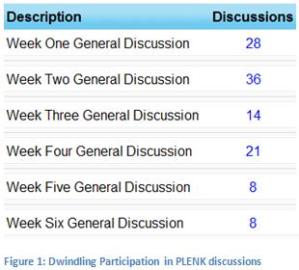
Despite the dwindling participation, the past three weeks were arguably the most interesting part of the course, exploring the theoretical background for personal learning environments, sharing experiences in evaluating the learning process in a PLE, and trying to define digital literacies for learning with PLEs. Continue reading →
Filed under: Uncategorized | 3 Comments »
Posted on October 18, 2010 by JimS
 By Tim Stutt
Why is it that so many of the games labeled as good for learning are also no fun to play? And how about all those games marketed as being educational when they’re really very thin on content and building thinking skills?
The short answer to both is that we’re asking a lot for game to be both fun and educational, not to mention available on many platforms and affordable to a wide audience.
In “Moving Learning Games Forward: Obstacles, Opportunities, & Openness” (The Education Arcade, MIT 2009), Eric Klopfer, Scott Osterweil, and Katie Salen outline many of the reasons why educational games and software fail. In their view, social and cultural attitudes towards games and the perceived lack of seriousness of gaming amongst the educational community are significant obstacles. Moreover, the time and costs of development are major deterrents to game publishers who are uncertain about the strength of the market for educational titles. Game developers often target the consumer entertainment market since there are fewer barriers to adoption and a wider and more lucrative market. Also, until there is a shift in attitudes and policies within educational institutions towards games, it is unlikely that we will see many excellent products on the market. Continue reading →
Filed under: Uncategorized | 19 Comments »






 Educational Technology and Change Journal


