
‘Peer Reviewing in Political Science’ – April 2015 Issue of PS

PS Header2
In The Profession section of its April 2015 (v48, 02) issue, PS: Political Science & Politics (PS)1 scrutinizes the peer review system, a core value in the research community. Some question whether or not peer review is sustainable given the increased and unequal burdens placed on reviewers. In “Peer Reviewing in Political Science: New Survey Results”, Paul Djupe of Denison University argues that the common perception that reviewers are overburdened with requests has never been tested through reliable data collection. He finds, contrary to the conventional wisdom, that most scholars appreciate peer review, and that most peer review requests by journals are accepted. The only common complaint is that peer review is not considered as part of the tenure and promotion process.

Also in The Profession, the right time for associate professors to go for promotion is considered by Kurt Weyland of the University of Texas in “The Logic of the Promotion Decision: In Dubio Pro Patientia”. Weyland argues that it is in the associate professor’s own interest to establish a convincing case before they bid for the rank of full professor and efforts to ‘force’ a promotion prematurely can leave a bad impression and damage the career. Accumulating a strong record in research and publication is the best way to assure a smooth path to tenure.

PS Toolbar2

In the Profession Symposium, see the articles on “Reinventing the Scholarly Conference: Reflections from the Field.”

In The Teacher , Matthew Woessner of Penn State shows how computer games like SimCity can be used to engage young people to think about politics, governance, and the challenges of managing cities in the real world.  Continue reading

Free Webinar: 2015 Survey of College & University Presidents 4/14/15 at 2pm ET

IHE01
Inside Higher Ed’s 2015 Survey of College and University Presidents was conducted in conjunction with researchers from Gallup. Highlights of the survey findings include:

  • A majority of presidents give the Obama administration’s ratings proposal a grade of D or F, and a third of presidents say they view the plan more negatively than they did before the administration released a detailed framework about the plan in December.
  • Presidents are skeptical that the proposed rating system would accurately reflect their institutions’ quality, and are least supportive of the possible use of graduate income level and federal graduation rates as ratings criteria. Campus CEOs offer more support for using as criteria the percentage of first-generation and Pell Grant eligible students enrolled, and degree completion rates.
  • Presidents of two-year colleges are likelier than their peers at four-year public and private institutions to support the president’s plan to encourage states to offer free community college tuition.
  • More than half of the presidents are confident about the sustainability of their institution’s financial model over the next 5 years, but only 39 percent feel that way over 10 years.
  • About one-third of college presidents say that sexual assault is prevalent at U.S. colleges. But only a small percentage believe it is an issue at their institution.
  • A large majority of presidents (81 percent) say that the state of race relations on their campus is excellent or good.
  • The majority of those surveyed say presidents should play a more active role in decisions about tenure and hiring faculty members.
  • Nearly half of presidents agree that university leaders should speak out on issues beyond education.

Join Inside Higher Ed editors Scott Jaschik and Doug Lederman for a lively discussion of these and other findings of the 2015 Survey of College and University Presidents in a free webinar on April 14 at 2 p.m. Eastern. Can’t attend the live event? You should still register – all registrants will receive the slide deck and recording shortly after the event.

IHE02

The Inside Higher Ed 2015 Survey of College and University Presidents was made possible in part by the generous financial support of Pearson, Jenzabar and Academic Partnerships. Your registration information will be shared with these companies.

Captioning for the deaf and hard of hearing is provided by CaptionAccess for all Inside Higher Ed webinars. Transcripts available upon request.

MOOC Sightings 007: The Battushig Factor in College Admissions

MOOC Sightings2

The difference between SAT scores of students from the lowest (<$20K) and highest (>$200K) income brackets is approximately 400 points. This point difference is mirrored in comparisons between the lowest (<high school) and highest (graduate degree) parental education levels.1

Battushig Myanganbayar

Battushig Myanganbayar

This correlation seems immutable. Parental education and income levels impact SAT scores and determine who gets into the most selective colleges. Then along came Battushig — Battushig Myanganbayar of Mongolia, that is, “The Boy Genius of Ulan Bator” — who, in June 2012, at 15, “became one of 340 students out of 150,000 to earn a perfect score in Circuits and Electronics, a sophomore-level class at M.I.T. and the first Massive Open Online Course, or MOOC.”2 His accomplishment didn’t go unnoticed, and he is now a research student at the MIT Media Lab.

Battushig is, of course, a rare exception, but his success adds to the already enormous potential of MOOCs and raises the possibility that they could become a factor in college admissions. In an editorial yesterday, Pitt News broaches this very idea: “Universities sometimes directly accept a student that excels in one of their MOOCs…. If not, the student may still choose to list the MOOC on his or her resumé under skills or relevant education. A completed MOOC is a valuable asset, comparable to a week-long leadership conference.”3

The message for parents and students is clear: MOOCs are poised to clear their current wildcard status and earn credibility as a key factor in college admissions.
__________
1 Zachary A. Goldfarb, “These Four Charts Show How the SAT Favors Rich, Educated Families,” Washington Post, 5 Mar. 2014. Also see Josh Zumbrun, “SAT Scores and Income Inequality: How Wealthier Kids Rank Higher,” WSJ, 7 Oct. 2014.

2 Laura Pappano, “The Boy Genius of Ulan Bator,” NY Times, 13 Sep. 2013. Also see her “How Colleges Are Finding Tomorrow’s Prodigies,” Christian Science Monitor, 23 Feb. 2014.

3Massive Open Online Courses Better Depict Student Potential,” op-ed, Pitt News, 23 Mar. 2015.

MOOC Sightings 006: Universities Are ‘Middle-men Selling a Product That Is Past Its Sell-by Date’

MOOC Sightings2

MOOC numbers from Seb Murray1 that are hard to ignore:

“About 50% [of] Coursera’s 12 million users are utilizing its courses to advance their careers, says Julia [Stiglitz, head of business development at Coursera]. ‘Helping people accelerate their career[s] by learning new skills is a major way that we hope to impact the lives of our learners.’”

“A recent survey of 400 US employers by Duke University and research group RTI International found that 57% said they could see their organization using Moocs for recruitment. And three-quarters said job applicants taking relevant Moocs would be perceived positively in hiring decisions.”

“In a poll of 1,000 UK employers last year by distance learning specialist the Open University[,] nearly half said additional education is the number-one reason they would offer salary increase or promotion – and gaining education with free online courses was the third most common thing the employers looked for.”

“Recent research by the Career Advisory Board found that 87% of 500 US hiring managers are likely to consider non-traditional ‘micro-credentials’, or specialized certificates awarded by reputable educational institutions, as proof of skill mastery.”

“Close to 95% of edX courses offer a verified certificate, [Nancy Moss, director of communications at edX] says, with many of its users looking for new jobs. ”

“While universities have faced the ignominy of budget cuts, tech groups have harvested massive war chests to expand. EdX last year had been funded with $90 million; Coursera has raised a total of $85 million; Udacity has raised $58 million.”

“Alison’s [Mike Feerick, CEO and founder of the Ireland-based Mooc provider,] offered a view that is widely shared in the education community: ‘…[Universities] are the necessary middle-men selling a product that is past its sell-by date.’”

__________
1Mooc Makers Disrupt Business Education With Careers Focus,” BusinessBecause, 22 Mar. 2015.

MOOC Sightings 005: Wharton School and Universiti Teknikal Malaysia

MOOC Sightings2

Rapid change is the norm, and for professional development in business, MOOCs are the answer. “Wharton School recently teamed up with Coursera . . . and tech start-ups Snapdeal and Shazam to launch $595 online courses with certificates.” This unbundled or certificate model underscores the MOOC’s disruptive force. “‘For adults who have limited resources – whether that’s time or money,'” says Rick Levin, Coursera chief executive, “‘the Specialization [industry project] model works well.'”1

As change approaches warp speed, the shelf life of knowledge decreases and the need for constantly accessible modules of new knowledge increases. The watchword here is accessible, and this is the MOOC’s domain.

This fact is becoming increasingly obvious in the world of business where you’re either on the leading edge or out of the picture, and the critical factor is time. You can’t pause or stop to learn. Learning has to be on the go, and this means anytime-anywhere.

Will this disruption creep into our college campuses? Will traditional students take to learning in MOOC modules to keep pace with the latest developments in their field? How will this impact courses in the more traditional semester mold?

Most expect professors to gradually blend modules into their curricula, but this is an institutional perspective. My guess is that students will self-modularize and independently flow toward MOOCs that give them the edge, regardless of what professors and colleges decide to do.

In fact, this is already happening, but this disruption doesn’t show up on the campus-richter scale because, from all appearances, the students are on campus and sitting in lecture halls.

On college campuses in other parts of the world, the disruptive power of MOOCs is being embraced. Shahrin Sahib, vice-chancellor of Universiti Teknikal Malaysia Melaka (UTeM), sees MOOCs as a window for “‘students to work collaboratively and closely with colleagues around the world and to have access not only to course instructors, but to textbook authors and experts from other institutions.'”2

For Sahib, the playing field is no longer just the university campus or Malaysia but the globe. He says, “‘If students are to fully assume positions of leadership and responsibility in specific organizations and in society as a whole, then they must be prepared to deal with the global environment.'” For college students, regardless of location, MOOCs are an interactive and accessible portal to that environment.
__________
1 Seb Murray, “Technology Expands Business Education As Students Opt for Digital Route,” BusinessBecause, 10 Mar. 2015.
2 Kelly Koh, “MOOC Can Help Create Global-ready Graduates,” New Straits Times, 10 Mar. 2015.

Free Webinar on Student Engagement 3/19/15 at 11am ET

5 Secrets to Spectacular Student Engagement

Thursday, March 19, 2015 at 11 AM EDT (US)
Not time-zone friendly? Register to receive the archive.

Dr. Colin Montpetit, Assistant Professor of Science Education at the University of Ottawa

Dr. Colin Montpetit, Assistant Professor of Science Education at the University of Ottawa

Register for this complimentary webinar to learn how Dr. Colin Montpetit, Assistant Professor of Science Education at the University of Ottawa, increased class participation to 99%. Hear how he transformed his classroom into an “active learning zone” with the use of a student engagement solution.

Get the full story behind Dr. Montpetit’s stunning findings – how student participation rates grew in his classes, grades improved and failure rates decreased. Register today!

Who Should Attend: All are welcome. Those in Academic Technology or Teaching and Learning Centers are highly encouraged to attend.

ScreenHunter_233 Mar. 10 08.07

TCC Online Conference 20th Anniversary – Final Call for Registration

TCC2015 header

Final Call for Registration
Register now to save your spot!

TCC, Technology, Colleges and Community, is a worldwide online conference attended by university and college personnel including faculty, academic support staff, counselors, student services personnel, students, and administrators.

Join our special 20th Edition of this annual event to share your expertise, experiences, and knowledge relevant to the use of information technology in learning, teaching, innovation, and academic services. 

Seats are still available to participate online or onsite (this year only).
 

This event is very helpful and novice friendly by providing a strong foundation about learning with technology. For more information, visit:

http://2015.tcconlineconference.org/

TCCHawaiiLTEC (University of Hawaii) • LearningTimes
To unsubscribe to this mailing list
Send a message from this email address to listserv@hawaii.edu. In the BODY of the message,
type: SIGNOFF TCCOHANA-L. For assistance, contact Bert Kimura <bert@hawaii.edu>.

To join our mailing list

MOOC Sightings 004: Outside the Box with Ontario’s Judy Morris

MOOC Sightings2
Updated 3/1/15
As in all things MOOC, look northward to Canada for the prevailing winds, and this time it’s to Ontario, and more specifically, to president and CEO of Lambton College Judy Morris. “Over the last few years,” she says, “Ontario colleges have seen enrollment in online learning grow ‘exponentially higher than on-ground learning.'”1

 Judy Morris, President and CEO of Lambton College, Ontario.

Judy Morris, President and CEO of Lambton College, Ontario.

Granted, she’s talking about online courses and not MOOCs, but the difference is superficial. In all but name, online courses are MOOCs that have been literally stuffed into the concrete and glass boxes that define traditional classrooms. In the box, they are subject to the same start and finish dates, registration requirements, enrollment caps, credit policies, fees, and even pedagogy that fail miserably at mimicking F2F (face-to-face) interactions.

Is it any wonder, then, that online courses fare so poorly in comparison to blended courses? As they’re currently positioned, completely online courses are simply poor copies lacking the features that make onground courses so effective for those who can afford to be on campus and attend classes in person for four to six years.

For the promise of online courses, we need look no further than MOOCs. There are some obvious differences: MOOCs attract huge enrollments and there’s usually no cap to class size, registration is free, anyone can register, they’re usually shorter than the standard quarter or semester, there’s no F2F requirement, feedback is provided by peers, they don’t count toward a degree, and they appeal primarily to nontraditional students.  Continue reading

MOOC Sightings 003: FutureLearn, Microdegrees, ‘Open Internet’

MOOC Sightings2
Updated 3/3/15
UK’s FutureLearn, a part of Open University, “now hosts over 220 [MOOCs] from 44 partners.” Noteworthy is their completion and participation figures: “Of those that begin a FutureLearn course, 23% go on to complete the majority of steps and all of the assignments, while 39% of them interact with other users through social media, comments and conversations.”1 Takes the wind out of the less-than-10% completion argument, doesn’t it?

Right now, the MOOC’s disruptive path is being carved out in nanodegrees and microdegrees by developers and employers. “By forming partnerships and designing programs in conjunction with employers, ventures with new business models are offering their students programs and degrees that will make them more attractive job candidates.”2

The implications are enormous for colleges that understand this trend. Stuart M. Butler, senior fellow at Brookings, dubs it the “‘general contractor’ model of college education,” and says, “It is only a matter of time before enterprising colleges or other entrepreneurs start assembling comprehensive degree programs consisting of microdegrees supplemented by other experiences, such as a semester abroad and time at a small liberal arts college.” Adding employer-designed microdegrees to one’s transcript and resume seems like a no-brainer for college graduates entering the job market.

An alert from Claude Almansi: Open Internet, a 12-week MOOC that begins on March 6, 2015, is designed to “train a new generation of thinkers and actors to advocate for positive open and free internet policies and agendas from a human rights and public interest approach.” The course is free and offered in the Spanish language. Each week will feature a different module, and “each module will take approximately 2-5 hours of study time, including reading and completing assignments.” It will be hosted on the Peer 2 Peer University platform.

MOOCs appear to be a natural medium for social justice programs such as Open Internet, and I believe it’s only a matter of time before we see an explosion of similar MOOCs worldwide and in many different languages. In the end, MOOCs may just be the great equalizer, serving as the training medium for the world’s human rights activists.

__________
1Growth in online courses shows need for universities to incorporate new technology in their teaching models, says expert,” Out-Law.com, Pinsent Masons, 24 Feb. 2015.

2 Stuart M. Butler, “How Google and Coursera may upend the traditional college degree,” TechTank, Brookings, 23 Feb. 2015.

MOOC Sightings 002: Oxford Professor Declares MOOCs the Loser

MOOC Sightings2

William Whyte, professor of social and architectural history at St John’s College Oxford, assures us that in the “battle” of MOOCs vs traditional campus-based universities, “The MOOC will prove to [be] the loser.”1 He parades the usual suspects for their demise: low completion rates and absence of credits and degrees.

He tosses Britain’s E-University and Open University in with MOOCs for what amounts to a clean sweep of online programs. Two birds with one stone, as it were. He cites E-University as a costly failure and Open University as “actually a rather traditional university.” Convenient, but what these institutions have in common with MOOCs is baffling.

He bolsters his prediction with survey results: “Only 6% of prospective undergraduates surveyed last year [want] to stay at home and study. The other 94% expected and hoped to move away to a different place for their degrees.”

Whyte declares traditional universities the winner because “people want and expect something rather more than a purely virtual, entirely electronic experience of university. They expect it to be a place.”

Strong reassurance, indeed, for those who see MOOCs as “a horrible sort of inevitability.” Traditional universities have not only withstood the MOOC challenge but actually emerged stronger.  Continue reading

MOOC Sightings 001: UNC and Cornell

MOOC Sightings2

Despite wholesale announcements by powerful academic leaders throughout the U.S. that MOOCs are dead, sightings continue to pour in from around the country and the rest of the world. For skeptics, the problem is physical evidence. People can offer them and take them, but no one seems to know what a MOOC looks like. Some point to Coursera and edX, but in the opinion of most MOOC experts, who are primarily from Canada and the UK, these are hoaxes.

So, in the interest of determining once and for all whether MOOCs are fo’ real, I’ll be opening Project White Book to publish promising sightings and photos of MOOCs. In this inaugural post, I’m sharing the photo, below, of what appears to be one person’s conception of a MOOC. I recently found it in the ETC spam queue. It was posted anonymously with the header “Da MOOC!” I’ll post photos as I receive them, so if you have one, email it to me (jamess@hawaii.edu) and I’ll publish the most interesting.

Is this a MOOC, a hoax, or just another weather-related phenomenon?

Is this a MOOC, a hoax, or just another weather-related phenomenon?

I’m also sharing promising sightings by Sarah Kaylan Butler, “50,000 Enroll in UNC Online Course” (Daily Tarheel, 2/19/15), and Blaine Friedlander, “Cornell Sinks Teeth into Four New MOOCs” (Cornell Chronicle, 2/19/15).

Butler reports that “almost 50,000 students have enrolled in a massive open online course on positive psychology taught by UNC professor Barbara Fredrickson.” Evidence that this Coursera-based course might be a real MOOC is very strong. It’s six weeks long, a departure from the usual quarter or semester time frame. It’s comfortably aimed at interest rather than college credit. According to Fredrickson, “Most people that are enrolled — 95 percent of them — say that they’re interested out of their own curiosity.” And the professor is on firm MOOC footing, looking for pedagogical guidance from the future rather than the past. She says, “I’ve written a couple of books for general audience and one of the things that’s clear about our changing audience is that people don’t necessarily want to read books, but they like ideas.”

Another promising sighting is from Cornell. Friedlander reports that “Cornell will offer four new [MOOCs] in 2016: shark biodiversity and conservation, the science and politics of genetically modified organisms (GMOs), an introduction to engineering simulations, and how deals get done – mergers and acquisitions principles.” They’re still in the planning stages, so I’ll keep an eye out for more details as they become available.

Are MOOCs fo’ real? In this series, I’ll be looking at the evidence through a lens that’s forged from constructivist and disruptive theory as well as a dash of whimsy. In this process, I look forward to hearing your thoughts. Please share them in the discussion below. If you’re logging in from an address that has been previously approved, your reply will be posted automatically. If not, your first reply will be published within 24-48 hours. Subsequent replies from your address will be published immediately.

Free Webinar: ‘Using Technology to Engage Students’ 2/23/15 3pm EST

From Macmillan Higher Education 2/17/15:

Join us on Monday, February 23rd at 3pm EST for a complimentary webinar on “Using Technology to Engage Students” with Solina Lindahl of Cal Poly San Luis Obispo!

The 21st century classroom is getting larger, more tech-laden and full of students weaned on digital devices. How should our teaching change (or NOT change) in light of this? This talk is aimed at showing how iPads, iClickers and more can engage the face-to-face large class. Included are a brief discussion of some of the more innovative (and easy) visual presentation apps, as well as a look at using iPads to do the most old-fashioned of practices: worked problems.

edtech week

To learn more about all of our EdTech Week sessions and our presenters, please visit our EdTech Week website. You can also join our event on Facebook for the latest updates and information! We hope to see you there!

Register for TCC 2015 – The Future Is Now

kimura80By Bert Kimura

Aloha,

Register for the TCC 2015 Worldwide Online Conference, The Future Is Now:

http://tcconlineconference.org/

Enjoy KEYNOTE sessions by:

  • Dr. Howard Rheingold, Author, Critic, Journalist & Educator
  • Alan Levine, Pedagogical Technologist, Architect of Open & Connected Learning
  • Dr. Stella Perez, Sr. VP Communications and Advancement, American Association of Community Colleges

This year, our 20th conference features an ONSITE option to participate in-person at the University of Hawai’i at Manoa campus. There is also an option to participate virtually ONLINE as in previous years.

For further information (including low-cost housing and an optional educational tour), see:

http://2015.tcconlineconference.org/register/

Site licenses for unlimited participation from a campus or system are available. Special rates apply to University of Hawai’i faculty and staff. For more info, contact Sharon Fowler <fowlers@hawaii.edu>.

We look forward to seeing you at TCC 2015.

Warm regards,
Bert Kimura
For the TCC Conference Team

Practical Reasoning – Challenges for Teaching and Assessment

By Stefanie Panke
Editor, Social Software in Education

In a faculty brown bag lunch, Molly Sutphen, Associate Director of the UNC Center for Faculty Excellence and author of the seminal book Educating Nurses: A Call for Radical Transformation, delivered a talk on Practical Reasoning at the School of Government. The talk was a nice follow-up to the Teaching Palooza that our faculty organized last summer. Since the School’s focus is on teaching adult learners, enhancing practical reasoning skills is an important objective of my instructional design work.

Molly Sutphen, Associate Director of the UNC Center for Faculty Excellence

Molly Sutphen, Associate Director and Teaching and Learning Coordinator, UNC Center for Faculty Excellence

Characteristics of Effective Practical Reasoning

  • To be able to draw on knowledge from different areas, courses, or types of knowledge and use it
  • To develop a sense of salience about a situation
  • To realize the stakes of a situation
  • To put boundaries around a problem or question
  • To be able to envision different outcomes
  • To be able to construct a narrative forward and backward

Assessment and Practical Reasoning

With the pressure of constantly demonstrating impact, assessing the short term learning outcomes of practical reasoning is problematic. “Practitioners may learn, but we don’t know it – what you teach, someone will perhaps not use for another five months – or ten years,” said Dr. Sutphen. She recommends taking “a long view” instead.

Instructional Strategy: Unfolding Cases

Dr. Sutphen introduced unfolding cases as an instructional strategy to teach practical reasoning skills. Unfolding cases are underdetermined (no obvious plan or resolution), scaffolded (controlled amount of information), and orchestrated (prompting specific, relevant questioning). In a plenary exercise, she presented a list of questions to help teachers construct unfolding cases.

  • What is this a case of?
  • Where do you want to start and end?
  • How underdetermined do you want the case to be?
  • Who are the actors? At which point will they be revealed?
  • What is the arc of the narrative?
  • What information will you provide or conceal?
  • Will you give boundaries or expect them to be discovered?

Further Reading

Benner, P., Sutphen, M., Leonard, V., & Day, L. (2009). Educating nurses: A call for radical transformation (Vol. 15). John Wiley & Sons.

Colby, A., Ehrlich, T., Sullivan, W. M., & Dolle, J. R. (2011). Rethinking undergraduate business education: Liberal learning for the profession (Vol. 20). John Wiley & Sons.

Schwartz, B., & Sharpe, K. (2010). Practical wisdom: The right way to do the right thing. Penguin.

Gherardi, S. (2012). “Docta ignorantia”: Professional Knowing at the Core and at the Margins of a Practice. Journal of Education and Work, 25(1), 15-38.

Seed Wins the Mars One University Competition to Germinate Life on Mars in 2018

Mars One Press Release: Amersfoort, 5 Jan. 2015:

Mars One is proud to present the winner of the Mars One University Competition: Seed. The Seed team is an important step closer to sending their payload to Mars. The winning payload will fly to the surface of Mars on Mars One’s 2018 unmanned lander mission. Seed was selected by popular vote from an initial 35 university proposals and this is the first time the public has decided which payload receives the extraordinary opportunity to land on Mars.

Photo courtesy of Bryan Versteeg and Mars One.

Photo courtesy of Bryan Versteeg and Mars One.

“We were generally very pleased with the high quality of the university proposals and the amount of effort associated with preparing them,” said Arno Wielders, co-founder and Chief Technical Officer of Mars One. “Seed itself is uniquely inspiring since this would be the first time a plant will be grown on Mars.”

The Winning Team – Seed aims to germinate the first seed on Mars in order to contribute to the development of life support systems and provide a deeper understanding of plant growth on Mars. The payload will consist of an external container, which provides protection from the harsh environment, and interior container, which will hold several seed cassettes. The seeds will stem from the plant Arabidopsis thaliana, which is commonly used in space plant studies. After landing, the seeds inside the cassette will be provided with conditions for germination and seedling growth. The growth will then be recorded using images transmitted back to Earth.

“We are really pleased to be the selected project among so many excellent ideas. We are thrilled to be the first to send life to Mars! This will be a great journey that we hope to share with you all!” said Teresa Araújo, Seed team member.

Seed consists of four bioengineering students from the University of Porto and two PhD students from MIT Portugal and the University of Madrid. The team is supported by Dr. Maria Helena Carvalho, plant researcher at IBMC and Dr. Jack van Loon, from the VU Medical Center, VU-University in Amsterdam, and support scientist at ESTEC-ESA. Seed benefits from scientific and technical support from several advisers, whose expertise range from biological systems to spacecraft development and validation. Read more about Seed here.

An in-depth technical analysis of the winning proposal will be conducted to ensure that the winner has a feasible plan and that their payload can be integrated on the 2018 Mars lander. Mars One and its advisers will contribute to the analysis by thoroughly and critically examining the Seed proposal.

If Seed runs into any issues regarding feasibility or can not stick to the schedule, Mars One will fall back on the runner ups of the university competition. The second and third placed projects are Cyano Knights and Lettuce on Mars.

More information

About Mars One

Mars One is a not-for-profit foundation that will establish permanent human life on Mars. Human settlement on Mars is possible today with existing technologies. Mars One’s mission plan integrates components that are well tested and readily available from industry leaders worldwide. The first footprint on Mars and lives of the crew thereon will captivate and inspire generations. It is this public interest that will help finance this human mission to Mars.

For more information visit www.mars-one.com

College and Other Lies

vb0-80By Veronica Brockschmidt
Student at Kapi’olani Community College
University of Hawai’i

Starting in elementary school, the importance of finding the perfect career for you is introduced with fun little surveys that point you in the direction of possible future jobs based on your interests and selected answers. Kids would get career options like Model, Painter, Teacher, Doctor, etc, and a statistic on salary ranges for each position. In high school, the importance of graduating and attending college is drilled in from day one. By the age of 16 you were expected to know, without a doubt, what you wanted to be when you “grow up.” By the time you actually graduated high school, you needed to know exactly what you wanted to major in and the career you wanted for the rest of your life. That’s some intense pressure, especially for still technically being a kid and not actually accepted into any colleges yet.

You were given more statistics about the financial lives of Americans with college degrees and how much better their lives were than those with only a high school diploma. The implication was that if you go on to finish college, you’d be a millionaire (Kristof), but if you stop now with only your high school diploma, you’ll be stuck at McDonald’s asking your old classmates if they “Want fries with that?” The fear tactic worked. Plus, who doesn’t want to make up to $1,000,000.00 more than someone with just a high school education?

So you do the whole college thing because it’s the new societal norm and you want to make your parents proud. You feel like you have your life together because you’re getting good grades and you have the career major that you truly love and could happily do for the rest of your life. Little do you know that you were severely overpromised on realistic job opportunities and, suddenly, being a college graduate seems like it has nothing to do with how successful you actually are (9gag).

Perhaps it was that, at the time of you declared a major, that industry was hiring a lot of people and that the promise of success even had something to do with your decision. But now that three to five years have passed, those positions have filled up due to the overwhelming flood of qualified applicants who all had the same idea as you. Either way, you, “the successful college graduate,” are somehow unemployed, still eating Top Ramen, and sharing a bedroom to be able to afford rent.  Continue reading

Weary Professors Abandon Technology?

picture of Harry KellerBy Harry Keller
Editor, Science Education

According to US News & World Report, “[P]rofessors say they don’t have enough help to use this technology effectively, haven’t seen results from it, and fear that the cost savings administrators keep insisting that technology will bring could mean their own careers are on the line.”

Just take a moment to break this sentence down and understand what’s being asserted here.

Professors don’t have enough help to use the technology. This comment implies that the technologies under consideration do not have an easily used interface. Good technology should not require any but the most rudimentary training that you can receive from, for example, watching a video.

Professors haven’t seen results from it. Some technologies in education do not generate results. They may be used inappropriately for the course. The results may not match what the technologies enhance. Many professors may be working with anecdotal data from others that could be quite unscientific. The fact that you haven’t seen results from some set of technologies does not mean that all technologies are useless in education.

Professors fear losing their jobs to technology. Some technologies in some institutions could be used that way. If the professor provides no added value, then what is that person doing teaching anyway? Almost no students can guide themselves effectively through the educational process. They don’t know enough to make the necessary choices. Educators will not become obsolete soon. Nevertheless, some institutions may reduce faculty in the mistaken idea that technology can replace them. Fear should not be a determining factor in what to do or not to do. Fearing the inevitable is foolish; fearing the impotent is abandoning yourself to fear.  Continue reading

Mars One: 10 Potential University Payloads to Mars in 2018

Photo courtesy of Bryan Versteeg and Mars One www.mars-one.com

Photo courtesy of Bryan Versteeg and Mars One.

Amersfoort,1st December 2014 – Mars One is proud to present the ten Mars One University Competition finalists eligible to fly to Mars. One of these ten payloads will receive the once in a lifetime opportunity to fly on Mars One’s first unmanned Lander mission to Mars in 2018. For the first time ever the public will be able to decide which payload receives the extraordinary opportunity to fly to Mars.

The ten remaining projects from an initial 35 submissions were submitted by diverse universities worldwide. In order to get this far, the payload proposals needed to meet all requirements as described by Mars One supplier Lockheed Martin. Mars One community members, social media followers, and the general public will have the opportunity to vote on and select the winning payload. Voting opportunities for the public will be opened in the first weeks of December, 2014. Voting submission will be accepted until December 31st, 2014.

The winning university payload will be announced on January 5th, 2015. The winning payload needs to be feasible and meet the requirements and restrictions as outlined in the Proposal Information Package (PIP) and on-going discussions with Lockheed Martin, who will build the 2018 lander. Additionally, if in any case the winning team can not perform or adjust to additional requirements the runner-up will be chosen instead.

Arno Wielders, Co-founder & CTO of Mars One said, “These ten final projects are unique and creative and we are very happy with the payload proposals these teams have presented. It would be highly interesting to see each and every one of these projects being launched to Mars. Now it is up to the public to decide which project they would like to have on Mars.”  Continue reading

The Issue of Part-Time Community College Students

Jim ShimabukuroBy Jim Shimabukuro
Editor

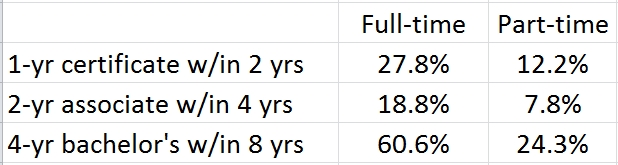
For college students in general, a 2011 survey found that 75% are part-time. Of these, “Even when given twice as long to complete certificates and degrees, no more than a quarter ever make it to graduation day.”1 Another study in 2012, focusing on community college students, found that 59% are part-time. Of these, 42% work more than 30 hours a week, 37% care for dependents 11 or more hours a week, and 40% take evening or weekend classes.2

In comparison to full-time students, part-timers fail at over twice the rate in completing certificate and degree programs. Here’s a breakdown from the 2011 survey:

part-time

Considering their numbers and their low completion rates, it’s a wonder that community colleges continue to do business as usual, with little or no change in practices that date back over half a century.

Thus, I was pleasantly surprised to find, in my college emailbox, an announcement that I’ve been returning to, off and on, for the past few days. It is a call for proposals to address the problem of part-timers. The proposed plan has to either (1) assist part-time students earn 12 credits in an academic year or (2) shorten their time-to-degree. The deadline is close and the form is complicated, so I won’t be submitting a proposal. But I do have some thoughts on this subject.

From a part-time student’s perspective, college is only one of a handful of other responsibilities with higher priorities. S/he has to be able to fit it into her life, and not the other way around. The problem is that colleges are set up for traditional students whose main priority is to complete a program. So, like a square peg, she’s trying to fit into a round hole.

The courses she needs are either filled or offered at a time that’s not convenient for her. Offerings at night or on weekends are slim pickings. Even when she can fit a class in, she finds it difficult to meet deadlines, complete learning activities, or obtain learning assistance. Competing for her time are work and family demands. Furthermore, the commute to campus is all too often time-consuming and, if she drives, the cost of gas and limited parking stalls are an ongoing concern.

The fact that our hypothetical part-timer is among the majority of students who are poorly served should be an incentive to change, from a perspective that’s campus-centered to one that’s student-centered. In other words, colleges ought to be asking, How can we accommodate part-timers with their unique needs?

The title of the 2011 report mentioned above goes to the heart of the problem — “Time Is the Enemy.” The traditional college schedule is the enemy of the part-time student. It’s in one dimension, while part-timers are in another. Put another way, part-timers make up a completely different population that isn’t being served by the colleges as they are now. Put in still another way, part-timers are an open invitation for disruption, for a disruptive approach that will accommodate the needs of a large population of students who are currently being ignored.  Continue reading

Study Shows College Education Often Worthless

picture of Harry KellerBy Harry Keller
Editor, Science Education

According to a New York Times article (“The Economic Price of Colleges’ Failures,” 2 Sep. 2014), our colleges and universities are doing a terrible job of educating our youth. The conclusions are academic dynamite.

The article, by Kevin Carey, depends on two books by sociologists Richard Arum and Josipa Roksa: Academically Adrift (Jan. 2011) and Aspiring Adults Adrift (Sep. 2014). According to Carey, Arum and Roksa lean heavily on a test of critical thinking and other skills known as the “Collegiate Learning Assessment” (CLA). For this reason, conclusions depend on the value of this particular test instrument, which some have called into question.

Even if the CLA is flawed, it cannot be totally inaccurate, and the findings should indicate a general direction. According to the article, students who graduated from college “improved less than half of one standard deviation” in the test.

All of that time and all of that money resulted in little benefit to the students. Interestingly, the students themselves did not see it that way. They thought they received a good education. The problem, as the second book pointed out, is that the job market does not agree with their self-assessment. According to Carey, “Because they didn’t acquire vital critical thinking skills, they’re less likely to get a job and more likely to lose the jobs they get than students who received a good education.”

Reading between the lines, some colleges still provide a good education, but a great number do not. Note the emphasis on critical thinking skills that stand in strong contrast to the memory skills that so many courses support. The CLA claims to test critical thinking, analytical reasoning, and communications.  Continue reading