By Mike Curcio
Student at Kapi’olani Community College
University of Hawai’i
Google Voice (Voice) is a telephony management service offered by Google. Like their other services, Voice is free-of-charge, with the exception of international calls. If you already have a personal Google account, and, with 425 million active Gmail users worldwide, chances are that you do, getting started with Voice can be very easy.
One of the initial steps in the setup process is selecting a phone number. Voice can assign users a phone number from most U.S. area codes (Alaska and Hawaiʻi users cannot currently obtain local phone numbers through Voice). Alternatively, users can choose their own phone number in many area codes. Let’s say you own a pet grooming company. You could check the availability of the number “DOG-WASH” or “364-9274.”
Voice is officially available to users in the U.S. only, but I have successfully used it in Japan with no problems, making and receiving free calls and text messages to and from the U.S. via Voice’s web interface. With the help of a WiFi connection and another free Android App, GrooveIP, I was also able to use my phone to send and receive calls and text messages, just as I would at home, without being charged for data or minutes. U.S.-based international students may want to set up Voice accounts for their families back home. Continue reading →
By Lynn Zimmerman
Associate Editor
Editor, Teacher Education
As part of their programming on April 8, 2013, which was Holocaust Remembrance Day, WBUR Here & Now broadcast a story that illustrated a unique approach using technology to preserve the stories of Holocaust survivors. World War II and the Holocaust ended in 1945. Therefore, those who survived those years are aging and dying. Over the past 20 years there have been numerous attempts to preserve the stories of those who survived, from films to audio recordings, documentaries to webcasts.
Simulated Holographic Video of Holocaust survivor Pinchas Gutter speaking to a class of students. Published on YouTube, 8 Feb. 2013.
The University of Southern California’s Shoah Foundation and Institute for Creative Technologies have come up with the most unusual to date — they are creating holographic images of survivors that not only tell the person’s story but can also interact with the audience, answering their questions. When asked how they were able to do this, Paul Debevec, Associate Director of USC’s Institute for Creative Technologies, answered that they spent about 12 hours with each participating survivor, asking them every conceivable question one might ask a Holocaust survivor to generate a database of answers using artificial intelligence technology. Stephen Smith, executive director of the Shoah Foundation, remarked that the Foundation has 52,000 testimonies and they have a lot of experience in what survivors want to talk about and what questions students ask.
The idea is that this technology is a way to give children of the future a chance to see, hear and interact with a Holocaust survivor long after the last one has gone. The interviewer was concerned that the idea was rather ghoulish. However, Smith, assured her that this was not the case. He explained that is like watching very good quality 3-D TV.
It is expected that the technology will be available for museums within the next year or two. Debevec predicts that this technology will be economically feasible for everyone in the future.
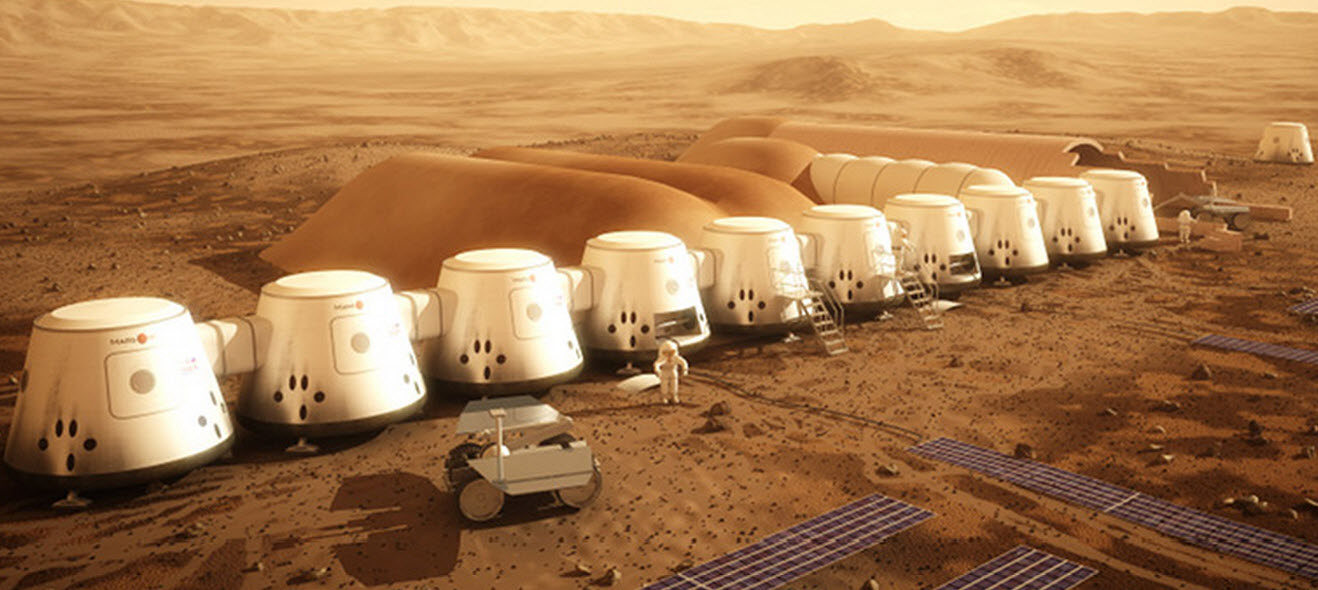
The Mars One project has received quite a bit of press lately. This project plans to establish a human colony on Mars in 2023 with four people. The project is the brainchild of Bas Lansdorp, a Dutch businessman. You must give him credit for creativeness. Much of the financing will come from a 24-hour television reality show that will follow every step of the project, including watching the new “Martians” as they adapt to the harsh Mars environment.
According to the Mars One website, this project will use existing technology. The habitat consists of modules that will arrive on Mars over a period of years and will be moved into place by a Mars rover. The first colonists will do the final assembly. Every two years, four more colonists will arrive until the total population consists of twenty immigrants. At that point, the colony intends to be self-sustaining, requiring no additional supplies from Earth. No kidding! At $10,000 per pound, Earth will not continue sending oxygen, water, food, Mars suits, and more to Mars regularly.
If you haven’t guessed yet, the trips by the colonists will be one-way only. There’s absolutely no provision for bringing them home. Even with an estimated $6 billion budget, the money just isn’t there. So, who will these colonists be? Interestingly, Lansdorp proposes to charge for the privilege of taking a one-way trip to hell. But, I’m getting ahead of myself.
Bas Lansdorp
The technology does exist to ferry materials, habitats, and a few people to Mars. The technology exists to produce enough solar power to eke out a sort of living there, in principle. The concept of establishing human habitation on another world must create a sense of excitement in anyone who has the time to pay attention. The educational opportunities would be enormous. The new colonists would be “going boldly where no one has gone before” – unless NASA gets there first with their round-trip Mars program.
Sugata Mitra, winner of the 2013 TED Prize, reminds us that, as educators, we may be so consumed by teaching that we ignore learning, that there’s a fundamental difference between teaching-centered and learning-centered. Mitra is his own best model for his vision of education, or SOLE, for self-organized learning environment. SOLE is a more formal school-based version of Mitra’s earlier hole-in-the-wall (HIW) street learning environment. Both, however, are grounded in his theory of minimally invasive education (MIE).
Mitra is, by training, a physicist, but by temperament, a self-organized learner. The heart of his gift is curiosity, and his scientific training provides the rest. He didn’t begin by studying teaching. Instead, he studied learning. He placed a web-connected computer in a kiosk in a Delhi slum, left it on, invited children to play with it, stepped away, and watched. The question, simply stated, was: Can students learn without teachers?
He was amazed to learn that, yes, they can. They learn individually and in small groups, and they teach one another what they have learned. Out of his observations, he drew implications, and the most important is that both teachers and computers are technologies, or media for learning. That is, children can learn from either or both. With this awareness, he realized that in cases where schools and teachers are scarce or unavailable, computers could suffice. The question that remained, however, was: What does this mean, if anything, for traditional models of learning that rely on schools and teachers? Continue reading →
[Note: The following was first posted in the ETCJ listserv on 25 March 2013. It was prompted by a discussion in the WCET listserv on “a new online theater course” earlier that morning. -Editor]
It can actually be surprisingly easy to create effective online courses in the “trouble” areas. More than a decade ago the school I directed had an online physical education class. People would pooh-pooh it as ridiculous, and then after I described the content, they would usually say, “Wow! Can I take it?”
A lot of the course was academic, teaching concepts related to fitness. Students started the class with a fitness test. They set goals for improving their fitness, and they set a personal path toward those goals. It was possible that no two students would be doing the same activities. They had periodic tests along the way to check their progress, and they then adjusted their goals and their plans appropriately. There was a final test to see how they had met their goals, and they had to write a reaction and a self-evaluation. What they ultimately learned was how to apply principles of physical fitness to their lives for the rest of their lives. Continue reading →
[The following is a response to colleagues’ comments, in ETCJ’s staff listserv, re the need for change in the way science is traditionally taught. The discussion was spurred by the 2 Feb. 2013 report, “For Each and Every Child: A Strategy for Education Equity and Excellence,” by the Department of Education’s Equity and Excellence Commission. -Editor]
You have to remember, I got thrown out of schools for doing all of the things that we talk about that are going to be the future. I worked with the White House. The principal called me in and said, “You can’t do this technology stuff in Arlington Schools if you want to stay.” That was not a choice to me. Teachers who did what they were told are still probably working. I was not what the schools wanted, an innovator using technology. You are preaching to the wrong person.
I can’t demonstrate my skills right now. I don’t have a place to do it. Tracy Learning Center in Tracy, CA, is where I worked to help establish advocacy. My benefactor died.
Nysmith School in Herndon, VA, and a few other schools and projects do what I love. NCLB took the steam out of STEM, the science out of the classroom, and the focus away from what was called SMET, now STEM. NCLB took me out of the classroom. I will always remember the discussion.
I was with people who are STEM evangelists in the Nysmith School, which I visited in the NIIAC times. We as a council visited the school back then. Both of the schools are not mainstream. Tracy School is a charter school, K-12, mostly minority kids, very minority. Because the school has a longer day, with another month in the school year, it has to be a charter school. We had a plan. Continue reading →
For some time we have been working around an obsolete model of education with the idea that, if we just somehow make the old model better, education will be better. I do not believe technology blindly applied is the answer, but look at three to five year olds and how they have learned to use iPads without a course in iPad usage.
Real reform will include the following:
Every child will have an Individual Learning Plan.
Every child will have a mentor teacher.
Schools and educational staff will be open at least ten hours each day and open year round.
High quality digital libraries will be accessible to learners at home and at schools.
Schools will offer laboratories and facilities where learners can work together in teams or individually.
Significant federal research and development funds will be available to create high quality digital learning materials.
Teachers will participate in continuous learning with respect to new curricula materials.
Learners will be scheduled for learning experiences as needed.
WE need to stop tinkering around the old school model that did us well yesterday but is inadequate for today’s digital world.
It is a sophomoric question, but I will ask it anyway. Is it better to be blind, deaf, or crippled? Of course, the answer is it is better not to have any of these disabilities.
Crippled means that you will have ambulatory limitations. However, if you have lost a leg there are prosthetic legs that can allow you to walk and even to run. Or wheelchairs can restore a degree of mobility. Blindness is also an ambulatory disability. You are to an extent limited in your mobility. You are not likely to own or drive a car, but even this is being made obsolete by modern technologies that are demonstrating self-driving cars. If you are blind you may not become an artist, but even that is marginal.
Oscar Pistorius.
In a sense deafness is the hidden disability. Unless a neighbor stops to talk with you, you appear as just another person in the neighborhood. You drive a car, you play catch baseball with friends, and you dance with your girl friend on the patio after eating the steak cooked on the outdoor barbecue set. For all practical purposes you do not appear any different than the average neighbor.
But you are! You did not learn the English language from your mother’s knee. Whether you use American Sign Language or speech read, your language is visual. It requires an ample light source. As a deaf person you cannot easily multitask, that is, carry on a conversation while washing your car because you must see and concentrate on the speaker. Visual-based communication has different parameters than auditory-based language. As a deaf communicator, there must be enough light and you must concentrate on the speaker.
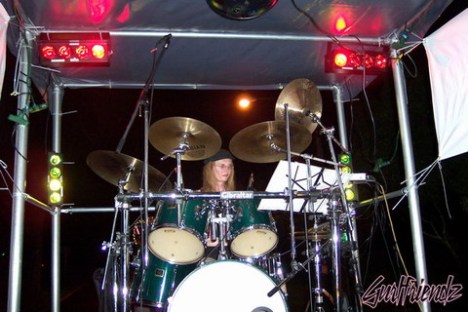
Stephanie Ellison, “a percussionist who happens to be deaf.”
As a hearing person I can multitask. I can talk and listen to you while I paint your portrait. As a hearing person I can carry on a conversation with you while I brush my shoes or I can listen to the radio in the dark. Since sounds surround me globally I can carry on a conversation in many different environments. If I am deaf I must have light and I must look at the sender I am communicating with whatever system I use ASL, finger spelling or speech reading. Even captioned TV requires my full attention whereas a hearing person can multitask and still get the meaning of what is on TV. I can iron my shirt and follow the latest news on TV. Continue reading →
This week, I had the chance to talk with Dr. Daniel McGee (CV), former middle and high school teacher in Francistown, Botswana, Peace Corps volunteer, and researcher/biostatistician for the Centers for Disease Control in Atlanta, Georgia. Dr. McGee’s work in creating a free, public access online learning system for primary and secondary students in Puerto Rico has gained traction in recent years, becoming the basis for online pre-calculus materials that will now be used in schools throughout Puerto Rico.
As his projects began generating larger and larger data sets, he became interested in exploring the insights they might provide on learning styles, learning types, and learning in general. This interview provides an overview of the motivations behind the study as well as a brief discussion of some of his key findings.
Daniel Lee McGee, Professor, Mathematics, University of Puerto Rico
JK:What did this study find, exactly? Why is this important?
DM: There were two important results of this study.
Result 1: In general, most efforts to define the categories for learning types have been a priori in nature. Researchers will start with a set of learning types and then will categorize students. This study takes an a posteriori approach to student learning types. We gather a great deal of data on a lot of students. The data comes from questionnaires and results on quizzes and exams from an online learning system. Rather than starting with predefined categories for students, we look for natural groups of students based on similar responses to questionnaires and similar results on quizzes and exams. These natural groupings lend insight into the natural learning styles of the students taking the course. The first result of the study was that students were not scattered randomly, they did form natural groupings. So the vast amount of information available with online learning systems does allow us, at least in Puerto Rico, to identify student learning types in an a posteriori manner.
The vast amount of information available with online learning systems does allow us, at least in Puerto Rico, to identify student learning types in an a posteriori manner.
Importance of result 1: Our results indicate that large groups of students seem to organize themselves into distinct clusters. The ability to identify these clusters and their associated strengths and weaknesses will allow professors with large groups of students using online systems to better address the particular needs of the distinct learning types that are in their class at a particular time. Continue reading →
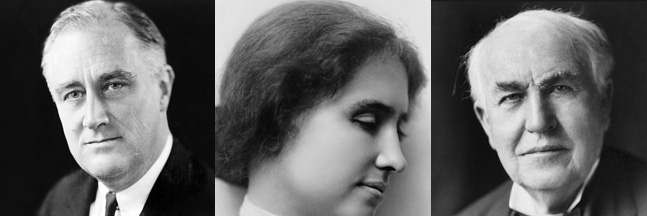
A mind in a crippled body can explore the heights of science and move all mankind forward into new scientific knowledge. Stephen Hawking opens up new scientific vistas. Helen Keller, out of darkness and silence, through words opens new avenues of interpersonal relationships. Blind musicians like Ray Charles and Stevie Wonder bring new melodies into our lives. In yesteryears a President who could not walk bonded us together and inspired us to weather our economic woes and then fight our way through World War II. A deaf man invented electric lights.
Stevie Wonder, Ray Charles, Stephen Hawking
Electric lights and wearable glasses moved mankind forward. Electric lights enable man to read 24 hours each day, and wearable glasses allow us to see well enough to read throughout our life times. Books and wearable glasses enable mankind to search the wisdom and knowledge of the past.
Franklin Roosevelt, Helen Keller, Thomas Edison
The mind can solve the most intricate problem or puzzle. To see, to hear, to feel, to smell and to taste enable the human to know his or her world. The mind organizes these sensory experiences into words and language. Speech and language are public expressions of our private sensory experiences. The voice in our minds organizes our world. If I am blind the world is auditory. If I am deaf my word is visual.
As every teacher knows, there is an overloading number of websites and tools available to educators, some free and others with registration costs. Most of these tools are geared toward specific content, and the trick can often be trying to sift through all of the different types to find the ones that suit your needs, skills, and even your personality. Triptico offers a wide variety of creative, interactive, and visually engaging apps. The best part is that you have access to numerous apps for free. Not to mention that the developer of this program is constantly creating new apps to use for free.
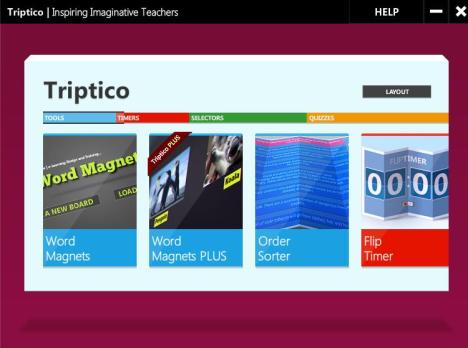
Figure 1 – Triptico App Launch Screen
About Triptico
Triptico.co.uk is a web tool that allows you to create and use various types of activities, tools, and quiz makers to help improve the classroom and engage students. Triptico is a free app available for download with an option to upgrade for a small fee. There are four different categories of programs: tools, timers, selectors, and quizzes. Each has interactive apps that you can use and adapt to your class. The different interactive modes allow you to bring creativity and uniqueness into the classroom, diversifying the ways in which students learn, review, and practice various skills. Triptico is simple to use yet sophisticated in content with apps color coded to denote type and categories.
“Alone we can do so little; together we can do so much.” -Helen Keller
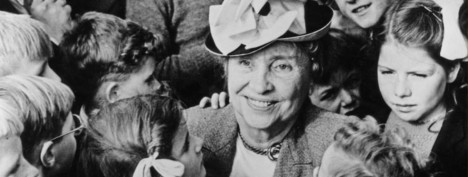
As a child I met Helen Keller. She was one of the most fascinating people I have ever met. I have met other deaf blind people who are amazing. Leonard could place his hand on your face and understand your speech. Leonard and his deaf blind wife lived independently and worked in an electrical product plant assembling electric insulators.
In 1963 we had learned how to ensure women who were pregnant and contacted rubella could bring their babies to full term. Thus we produced some 60,000 multiply disabled infants. Five thousand were deaf blind. Congress passed a law that created centers for deaf blind services. I was the Director of the Division of Education Services in the Bureau of Education for the Handicapped and administered the deaf blind services.
Helen Keller. Photo from Helen Keller International.
I have a deaf blind grand nephew that is now two years old. I have given considerable thought to the education of deaf blind children. They explore and know their world through the near senses of touch, smell, and taste. Of these three, touch is dominant because it is the sense that they will use to organize their world. My nephew has two cochlear implants and appears to enjoy music. As yet we do not know if in deaf blind children cochlear implants will lead to the development of speech and language.
(On 21 Feb. 2013, Bonnie Bracey Sutton, ETCJ associate editor, shared Valerie Strauss’s “U.S. Teachers’ Job Satisfaction Craters — Report” [Washington Post, 21 Feb. 2013] in our staff listserv. In response, I posted the following comment, which I’ve revised for this publication. -js)
Thanks, Bonnie, for sharing these stats. With teacher morale so low, the outlook for U.S. schools is bleak. For me, the elephant in the room is the impact of poverty. As a nation, we can’t continue to blame teachers for the consequences of poverty. We can’t expect them to resolve the causes of poverty. This is and always has been a social issue — not a pedagogical one.
What’s the answer?
For me, reading between the numbers, it means we ought to stop pushing highstakes testing and the common core. We need to allow teachers to do their job. They’re trained to determine where their students are and where they could be in terms of their classes, and for each student and each class, the profiles vary widely. This “diagnosis” is not only academic. In many if not most cases, it includes affective factors. Thus for variable portions of their classes, the teacher’s challenge may be motivation, attitude, rather than academics. For example, in writing instruction, the hurdle may be pull rather than push. How to attract students to writing may be the primary question — not how to push them toward earning higher scores on a standardized test that purports to measure writing competence.
To generate pull, teachers may decide to put their red pencils down and work with the language that students bring from their homes and neighborhoods. It may not be pretty in terms of common core standards, but it’s the reality. Preliminary goals may be to simply get students to enjoy writing and sharing their interests and concerns, in their most intimate and affective language. Giving them personally meaningful reasons for learning to write may be the fundamental pull that’s necessary to gradually incorporate the pushing of our beloved standards. We must find ways to recognize and reward teachers who are able to pull, to motivate, to change attitudes rather than simply move the needle in standardized tests. Continue reading →
The Total Learning Research Institute’s Space Explorers model of team learning emphasizes full participation of all of the members whatever their individual skills or knowledge may be. The five foundation principles of team learning are:
Treat others as you wish to be treated.
Walk the talk.
Respect and value other team members’ ideas and contributions.
Be part of the solution and not a part of the problem.
Hang together, not separately.
Team Learning can be applied to any educational level from preschool to graduate school and can be used to model principles that are used in many professions and businesses. It is famous for its use in NASA missions. Everyone on the team contributes to the overall objective. Teams often first define the objective or problem to be solved.
“Taking education to new heights…”
Team learning happens when a group of students work together to coordinate their efforts toward meeting a specific goal. The team uses the skills and talents of all its members to reach a specific goal. It not only meets the team goal, but it also meets the personal goals of its members. Continue reading →
The English language is the most used language in the world. Many of its 1,000,000 words are adapted from other languages. English has 44 sounds that are represented by the 26 letters of the Roman alphabet. The 26 letters are combined 196 ways to represent the 44 sounds of English. Therefore, English is only a semi-phonetic language in its written form. English adapts many words from other languages but often retains the spelling of the original language while anglicizing the pronunciation of the word. For example, “bouquet” from the French language is pronounced as “bokay” in English while retaining the French spelling. Spelling bees are thought to have originated in the USA, and the reason is probably because English spelling must often rely on memorization.
Vocal sounds and hearing are used as the warning system for humans and animals. A dog will bark to express its awareness of danger in its environment to alert other dogs. Many animals have vocalizations that are used to warn others of impending dangers. Vocalization superimposed on the eating and breathing systems is the expressive mechanisms used to warn and alert others. Hearing is the receptive sense that alerts individuals to danger. Continue reading →
While I am delighted that Congressman George Miller has introduced new technology legislation*, it has weaknesses as I read it. All of the items are worthwhile, but in my opinion they are not the central issues. We need leaders who have insight and a new vision of what the digital world is bringing us. Already five year olds are iPad literate. How will schools treat these new five year olds and how will we bridge the gap between the digital home and the non-digital home?
Congressman George Miller, senior Democrat of the House Education and Workforce Committee and chairman of the Democratic Policy Committee.
Just as fifty years ago broadcast television forced schools to acknowledge Sesame Street, Mister Rogers Neighborhood and other television influences, today we must adjust to iPad home users. To meet these challenges there must be:
An Assistant Secretary for Technology and Information sciences in U.S. DOE that provides national leadership.
A staff-training program for both teachers and administrators that rebuilds the staff to use the new digital resources.
A national digital library accessible via cloud technologies. The library should contain both commercial and government developed video, computer programs and ebook materials. Users must be able to access it 24/7 year round.
A research and development program that creates new materials modeled after comprehensive multiple media products such as The Voyage of the Mimi.
A digital assessment system for all materials used to reach the common core curriculum.
A public awareness program that provides the public with knowledge about the changes in schools and the importance of these new learning and teaching tools and how they are used both in the home and classroom. The little red school house with the all knowing teacher is obsolete.
A training program for administrators and school boards to understand a digital year round school model.
A wide range of very different experiences in schools, including laboratories, camp experiences (space camp, for example), team building projects, and community experiences. The digital world opens the world as a resource for learning.
Change will take place. It will be nice if our leadership has the wisdom to understand the digital world and how important it is to be a leader rather than a follower. We need radical rethinking, not tinkering with the obsolete current educational model.
These changes will take place regardless of whether or not we provide national leadership because the technology is here. The question is whether we will have wise enough leadership with a systematic vision that guides these Earth-shattering changes. If we are wise, we will guide the radical shifts from the old model to the new model of learning and teaching.
Every child deserves the best education we, the people, can give. It is up to us to make it happen.
__________
* Webcitation alternative.
The purpose of schools is to transfer the skills, knowledge and history of one generation to the next. In the past this was most often done through apprenticeships. About five thousand years ago writing of the spoken word was developed. This allowed mankind to transfer knowledge over both time and space. The printed records in books and libraries transferred information across generations and across geographic boundaries.
Learners had to develop moral, literacy, scientific and most importantly self-government qualities and skills if they were to serve as citizens in a modern scientific participatory democratic society.
For many years knowledge was transferred via apprenticeships. With the printing press and libraries modern schools could be developed where learners came together with teachers to learn in a classroom in a school. Knowledge and history were stored and retrieved via books and libraries. Teachers guided learners through the books. The apprenticeship model of learning gave way to classrooms and teachers. Learners were brought together in classrooms within schools to be guided by teachers through the stored knowledge of the society. In the 20th century learners could be gathered together and guided through the knowledge and experience retrieved from books and libraries.
In recent history, films, videos and computers have supplemented books as the storehouse of human experiences and knowledge. In the last few years the digital age has transformed the way we store and retrieve all information. As print on paper has been transferred to the digital format we now have vast libraries of full motion color videos, printed materials and even interactive simulations accessible to the learner. A student studying World War II can not only read about the speeches of Churchill and Roosevelt, but they can see and hear them. They can see videos of the battles and in addition they have access to fictional movies about the war. In addition, there are German and Japanese primary resources available. Continue reading →
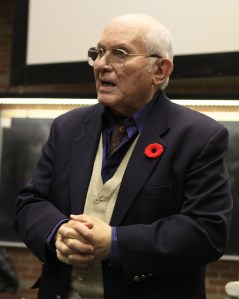
Dr. Yager is a Professor of Science Education at the University of Iowa and the Iowa Academy of Education. He has a long career in this area, and we should pay attention when he writes.
He has just written a short article for Science Education Review (11.3 [2012], pp. 54-55), “Does ‘Hands-On’ Indicate Real Reforms of Science Teaching?”* It begins with the following sentence. “Too often the reform of science for K-12 students is described as being ‘hands-on.’“ Everyone seems to be calling for reform these days. So, this is a valid discussion. Many of the reformers are “hands-on” advocates and even extremists who insist that no science education should be anything but “hands-on.” The short piece, just 1.5 pages, is well worth reading for anyone involved in science education.
Robert E Yager
Dr. Yager makes the point that involving muscles does not necessarily involve the mind. Indeed, as I also have seen, just the opposite is often the case. Science is about exploring. According to Dr. Yager, “One uniqueness of humans is their interest in exploring the natural world.” This uniqueness can drive the excitement and engagement of students with science. Losing it tends to do exactly the reverse.
Further on, he says, “Hands-on may be needed to develop tools to investigate student ideas.” Then, he counters with, “Often collecting evidence involves technology, not science!” He’s saying that you might use hands-on to collect evidence for your scientific investigation, or you might use technology. The hunt for dark matter is all technology. The Mars rovers are distant technology. Neither is truly hands-on. However, I take the view that science and science education are not the same thing. Just because scientists are trending away from hands-on, does that mean that students should too?
The teacher was stunned. His online Advanced Placement English students, students from many different participating schools, had just turned in their first writing assignment. Many of them showed the high quality expected from AP students, but some were terrible. The students showed little understanding of the topic, and their writing skills were abysmal. He contacted their schools to see what he could learn about those students.
He learned that the students who had done so poorly had never done well in English classes in their lives — some had never passed a single one. Some were second language students who struggled to read and write English at all. What on Earth were they doing in AP English? In all the cases, the guidance counselors had decided that the students had no chance of passing a regular English class so they decided the new online AP English class was just the ticket. It was an online class so it had to be easy.
In successful educational experiences, all parties involved approach the experience with realistic expectations. Students assume that with reasonable effort they will pass the class. Teachers expect students will work within the rules, the curriculum will be appropriate, their administrative duties will make reasonable demands on their time, and they will be compensated for their work at an acceptable level. Administrators expect students and faculty will complete all required tasks on time.
In the traditional school system, this works pretty well since, after thousands of years of classroom evolution, everyone knows what to expect. In P-12 online education, however, even veterans are still trying to figure out how it works.
The model used in many P-12 online programs throughout the world is very different from what has gone before. In many of the most common models, a school district either sets up a small online program using some of its own staff teaching online courses or outsources some or all of the courses to an outside vendor. In the case when an outside vendor is used, the vendor’s teachers will have students simultaneously in a number of schools and even a number of states. This model brings the advantage of pooling students in low enrollment classes and allowing them to take classes that would otherwise not be available to them. In this early stage of its development, though, it also brings on problems that spring from the unrealistic expectations of its participants. When reality and expectations do not agree, problems are sure to follow.
The most common problem is the one cited above — just about everyone seems to think online courses are easy. When students, guidance counselors, and parents enter a challenging online program with the expectation that they are getting a free ride, the consequence is educational disaster. But that is not the only example of unrealistic expectations in online education. The mismatch between expectation and reality often occurs at every level of participation. Continue reading →
[Note to the reader: I am CEO of an online science lab provider and, while this article does not address online learning, it does have opinions related to the use of science labs. While I have made every effort to avoid bias based on my current position and believe that my opinion would be the same were I, for example, still a university professor, readers should be aware of my personal connection in this regard. -HK]
The long-awaited Next Generation Science Standards (NGSS) second draft has been published for public review*. This is the final public review version. After diving into them, I found them lacking in some important respects.
I’ve taken the time to look at both versions (DCI and Topic arrangements). They’re both the same material arranged differently. I haven’t bothered with elementary school standards because I’m happy with doing any science at all in grades K-5.
I spent some time in the middle school area and was disappointed with the lack of academic rigor, the insufficient range of topics for three years of learning, and the paucity of quantitative investigations indicated. So, I went on to the high school topics hoping for something better.
As a chemist, the first thing I looked for was chemistry. There’s so no such topic. The NGSS document is arranged under three heading: PS, LS, and ESS. These stand for physical science, life science, and earth and space science. Earth and space science is certainly physical in nature but has its own separate section, while chemistry must lie hidden in physical science somewhere. The word chemistry does not appear.
Instead, most of what I’d term chemistry appears under two headings: Structure and Properties of Matter and Chemical Reactions. All right, a derivative word for chemistry does appear there but only in the topic-oriented version.
In order to see what’s afoot here, it’s necessary to list the topics under these headings. The good news and the bad news is that there are only ten topics (eleven if you count the bonus topic). It’s good because the list is short and easy to write here. The bad news is that this is all that there is for an entire year of high school chemistry. To give the NGSS their due, the introductory material does indicate that these are “core” ideas and that teachers are free to add on more material. You have to wonder how many teachers will bother to expand on the requirements that they’re given. Continue reading →
[Note: ETCJ editors and writers live full lives, and from time to time, we’ll be publishing some of their extracurricular pursuits. See John Adsit’s “The Great Technology Controversy Follows Me into the Caves,” the first in this series. -Editor]
A few weeks ago, Jim asked me why I never wrote about roller derby. My answer to him was that I’d honestly never thought about it. What’s to say? Every day, I wake up, roll over and groan. Sometimes instead of getting out of bed, I roll out of it and onto the floor, somehow miraculously proceeding to my feet from there. Something on my body always hurts. I am 35 years old, but my laugh lines are thankfully all in the right place. I weigh 180 pounds, but I’m happy with my body and what I can do with it.
Addie Mortem (Jess Knott), blocker for the Lansing Derby Vixens. Photo by Jena McShane of McShane Photography.
Last year, I ran a half marathon with very little training due to a bruised kidney. But I did it. (Wait, you bruised your what?) I spend two hours, three days a week smelling seriously terrible (excuse me?), and the rest of them studying hypermedia and online learning. I teach faculty development workshops and laugh so much I should have an abdominal six-pack (a what?). I am a smackademic (smackaHUH?).
I am Addie Mortem, a blocker for the Lansing Derby Vixens roller derby league of Lansing, Michigan. I am also Jessica Knott, instructional designer at Michigan State University and PhD student in MSU’s nationally-ranked PhD program in Higher, Adult and Lifelong Education. Hence, I am a “smackademic,” as coined in a Chronicle of Higher Educationarticle circa 2010 (http://chronicle.com/article/Smackademics-Join-the-Ranks/123670/). And I am not alone in my league as I am joined by criminal justice PhD student in criminal justice Ludacrush, PhD student in English Rue McSlamahan, PhD in music theory PhDemon, PhD in forestry House of Bruise, PhD student in educational administration Krizzy Azzbee, and Juris Doctor Little Hitaly. Continue reading →
U.S. Education Dept. Offers Tools for Evaluating Ed. Tech by Sean Cavanagh from Education Week (12.28.12)
The US Dept. of Education has released a draft (Expanding Evidence Approaches) of a proposed framework for administrators and teachers to use in evaluating educational technology. This research-based framework aims at helping educators make economically wise as well as educationally sound choices.
Language-teaching firms: Linguists online: Technology is starting to change language-learning from The Economist (1.5.13)
This article focuses on two language firms and how they are using technology to teach languages. Berlitz, one of the oldest language teaching companies, has sold off its publishing business. Bought out by a Japanese firm a few years ago, it has been a little slow getting into the language teaching technology market. Rosetta Stone, which recently went public, is moving away from the boxed sets of CDs to an online platform which is more expensive to operate but more flexible for learners.
How to Get Parent Support for Tech Use in Class by Jennifer Carey from MindShift (12.31.12) at KQED (original 12.14.12).
Sometimes parents do not understand the role that technology can play in learning. Carey suggests some practical tips on how to engage students and parents in technology-assisted education. Communication is key to this process.
Like gold, we horde what we’ve learned about education and expect to live off the interest for the rest of our professional lives. Tossing it out with the garbage is unthinkable. Crazy. Yet we also know that we can’t re-envision or change education as long as our slates are filled with the dusty remnants of prior learning.
Jim Finkelstein, in “Simple Minds Think Alike: The Art of Unlearning Complexity” (Huff Post, 4 Jan. 2013), says that “Unlearning how things have been done in the past, while seemingly unnatural is entirely possible….When it comes down to it, the stuff that gets us stuck in the first place is what we’re striving to unlearn…. All it takes to change and escape from a habitual rut is a single thought or idea that is swimming in the opposing direction of everything you’ve ever learned or been taught.”
The idea of unlearning, of wiping the slate clean, of “swimming in the opposing direction” to envision change is not new. It has a long tradition in Eastern philosophy, and educators such as Karen Windeknecht and Brian L. Delahaye, in “A Model of Individual and Organisational Unlearning” (Proceedings 18th annual Conference of the Australian and New Zealand Academy of Management, 2004), say that “The major reason for encouraging or engaging in unlearning is to allow the inclusion of new information or behaviours, and as a means to assisting learning, innovation and change” (3).
Emily J. Klein, in “Learning, Unlearning, and Relearning: Lessons from One School’s Approach to Creating and Sustaining Learning Communities” (Teacher Education Quarterly, winter 2008), defines “unlearning” as “letting go of deeply held assumptions about what it means to be a teacher, what classrooms look like, what the essence of teaching and learning is” (80). However, unfortunately, she leaves us with a bit of wiggle room to keep some of the old stuff on the slate by saying that “a certain amount of unlearning or changing of beliefs is necessary for any school reform” (95).
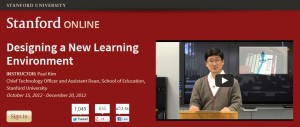
I have recently completed Stanford University’s Massive Open Online Course (MOOC), ‘Designing a New Learning Environment’. As an educational technologist, I try to keep abreast of developments in the ever‑changing world of technology. I had been reading a lot about the transformative potential of MOOCs and was keen to try one out for myself. I am always sceptical about claims of ‘reinventing education’, ‘the end of universities as we know them’ or ‘the biggest innovation to happen in education for 200 years’. I chose ‘Designing a New Learning Environment’, as it seemed like an interesting topic – one of which I already had considerable experience but where there is always something new to learn. Stanford’s reputation was also a factor.
Stanford Online: Designing a New Learning Environment
A ten-week course where I should spend 1-3 hours per week on course activities seemed a manageable commitment. For the first five weeks, I completed individual assignments. The second half of the course was devoted to an ambitious team assignment where teams took up the challenge of designing a new learning environment.
Teams – the Good, the Bad & the Ugly
I took my time before joining a team, as I did not have a project of my own. I wanted a team with a broad mix of participants where I could contribute. I was also expecting my progress in the course to lead me towards a team or topic. This did not happen. Finally, while browsing through the list of teams, I chose the Engagineers, a team of eight interested, as their name suggests, in engagement. They had started a thoughtful discussion in their team journal. Fortunately, this proved to be a very good choice, as once the team got going, we worked well together. None of the team knew each other beforehand, but we still managed to form an effective working relationship. We used familiar tools such as Skype and email as effective and reliable means of communication.
[Note: This article was prompted by an email exchange initiated by Lynn Zimmerman on 1.13.13. -Editor]
This sort of question seems to be on my desk daily in many different guises. I began writing software in 1960 and never really stopped.
There’s no simple answer. Also, the “philosopher’s stone” of software, a way to create software without programming, has been sought after for decades without result. There are some teaching languages for elementary school that are like that but are too limited to be of much use in the real world. Do not expect to be able to drag-and-drop an “app” soon even though Eclipse for Java, and other GUIs (graphic user interfaces) for other languages, do something like that for the UI part of an application. It takes more to make the software really do useful work for you.
For the novice who’d like to have an application, you can use HTML5 and Javascript as long as your program is relatively short, maybe under 100 lines. For comparison, Smart Science® explorations uses a 20,000-line client-side Java program with around 20,000 lines of Java on the server and a substantial SQL database. Once you exceed 1,000 lines, Javascript begins to break down, and you must use something more robust. (Actually, I’d stay away from Javascript programs longer than two pages, about 150 lines.) The advantage of this approach is that your program will run essentially anywhere, including those tablets. Continue reading →




 By Mike Curcio





















 Educational Technology and Change Journal
