Human Beings Could Be the Largest Untapped Resource in Online Learning

Jim ShimabukuroBy Jim Shimabukuro
Editor

Posted 7/28/15 at 10:17am; updated 11:46am

In the discussion on “MOOCs and Traditional Online Courses Are on a Collision Path,” Ray Rose (onlinelearningevangelist) and Harry Keller are having a fascinating exchange on the problem of captioning in MOOC videos. A cost-effective solution is autocaptioning, but the outlook at this time for developing an effective tool isn’t very good.

Their discussion fascinates in more ways than one. For example, it raises the issue of problem-solving in the online environment. What is the best approach?

For problems in technology, we naturally gravitate toward technological solutions, for example, a program that automatically translates speech to text and displays it as captions.

The cost for developing such a program, however, may be prohibitive, and the wide variation in human speech even within a single dialect makes the task extremely difficult.

But high tech problems don’t necessarily exclude low-tech solutions that are leveraged by technology. Put another way, the latest technology could generate innovative approaches that rely on old-fashioned human power, creating cost-effective solutions that blend the old with the new.

For example, Duke’s Sally Kornbluth,1 discussing the problem of formative evaluations in MOOCs, says, “If you’re wondering how you can possibly read 400,000 essays, you can have 400,000 students read one another’s essays.” Her point is that “there’s a lot of unexplored power that can be harnessed.” We just need to open our eyes to a much wider range of possibilities — and the possibilities could easily include human resources such as classmates empowered by networking technology.

The rap against peer feedback models, however, is that they’re unreliable, but ongoing research is proving that they can be and are being improved.

We have to keep in mind, though, that peer feedback is really just one of many other forms of evaluation provided by people other than teachers. For example, Sebastian Thrun,2 for his Udacity nanodegree on Android programming, takes the idea of peer evaluators and leverages it to include experts who aren’t part of the formal instructional staff. He has created a “network of 300 global code reviewers” who provide feedback to students.

The genius of this business model is that it’s self-sustaining while providing a profit for Udacity. Students pay $200 a month, reviewers’ pay is covered by this amount, students rate the quality of the feedback they receive, and reviewer income is determined by the evaluations they receive from students.

According to Thrun, “The best-earning global code reviewer makes more than 17,000 bucks a month. I compare this to the typical part-time teacher in the U.S. who teaches at a college — they make about $2,000 a month.”

This model could be applied to other problems (see Harry Keller’s comment) such as captioning. For example, MOOC developers could put out an international call for transcribers who are willing to provide captioning services. Since captions are aimed primarily at learners with disabilities, candidates could be volunteers or paid through philanthropic and public funds. A rating system could be attached to the videos, providing both student feedback on the quality of the captions and a means to control for quality.

The pool for captioners, when geographic location is factored out, is potentially huge. It could include high school and college students earning service credits, retirees, homebound adults, military personnel, and select prisoners.

We tend to think of technology as cold and impersonal, but it really doesn’t have to be. Technology could easily be a means to expand and deepen human interaction, providing a way for people to collaborate, one-on-one, with others.

__________
1George Anders, “The Believer: Duke’s Sally Kornbluth,” MIT Technology Review, 27 July 2015.
2Nanette Byrnes, “Uber for Education,” MIT Technology Review, 27 July 2015.

MOOCs and Traditional Online Courses Are on a Collision Path

Jim ShimabukuroBy Jim Shimabukuro
Editor

Updated 27 July 2015

In everyone’s bucket list, under the heading “Education,” is “Attend an elite college.” Until recently, however, this item has remained unchecked for the vast majority. According to Jonathan Wai, “Only about 2% to 5% of all US undergraduates went to … elite schools.”1

Thanks to MOOCs, the economic and scholastic barriers are going down. And thanks to Natalie Morin,2 students in the U.S. and the world over don’t have to look far for elite offerings. Among the 31 in her list are:

Harvard (“Science and Cooking; Tangible Things: Discovering History Through Artworks, Artifacts, Scientific Specimens; Poetry in America: The Civil War and Its Aftermath”); MIT (“Introduction to Computer Science and Programming; Circuits and Electronics; Molecular Biology; User Innovation: A Path to Entrepreneurship; Introductory Physics: Classical Mechanics”); Princeton (“Computer Architecture; Effective Altruism; Imagining Other Earths; Paradoxes of War; Reinventing the Piano; Bitcoin and Cryptocurrency Technology”);

Yale (“America’s Unwritten Constitution; Capital Punishment: Race, Poverty, & Disadvantage; Introduction to Classical Music; Moral Foundations of Politics”); Stanford (“Planning for a Sustainable Future with Wind, Water and the Sun; Behind and Beyond Big Data; Careers in Media Technology; Environmental Risk and Resilience; Online Certificate Program in Novel Writing; Adventures in Writing”); Columbia (“The Civil War and Reconstruction 1850-1861; The Civil War and Reconstruction 1861-1865; The Civil War and Reconstruction 1865-1890”); University of Pennsylvania (“An Introduction to Corporate Finance; The Global Business of Sports; Modern & Contemporary American Poetry; Introduction to Key Constitutional Concepts and Supreme Court Cases”);

University of Chicago (“Asset Pricing; Internet Giants; Global Warming; Understanding the Brain; Critical Issues in Urban Education”); Dartmouth (“Introduction to Italian Opera; Introduction to Environmental Science; The Engineering Structures Around Us”); Cornell (“The Ethics of Eating; American Capitalism: A History; The Computing Technology: Inside Your Smartphone; Introduction to Global Hospitality Management”);

Johns Hopkins (“Psychological First Aid; Confronting Gender Based Violence: Global Lessons with Case Studies from India; Major Depression in the Population: A Public Health Approach”); Northwestern (“Teaching the Violin and Viola: Creating a Healthy Foundation; Career 911: Your Future Job in Medicine and Healthcare; Understanding Media by Understanding Google”); Berkeley (“The Science of Happiness; Biology for Voters; Electronic Interfaces: Bridging the Physical and Digital Worlds”);

Wellesley (“Shakespeare: On the Page and in Performance; Introduction to Global Sociology; Was Alexander Great? The Life, Leadership and Legacies of History’s Greatest Warrior; Introduction to Human Evolution”); Georgetown (“The Divine Comedy: Dante’s Journey to Freedom; Globalization’s Winners and Losers: Challenges for Developed and Developing Countries; Terrorism and Counterterrorism”).

MOOCs are free and completely online, they’re open to everyone, and the registration process is simple. You’re free to plug in when and where you want for as long as you want, and if you decide to complete the course, you could earn a certificate. In some cases, a certificate requires a small fee.

Developers are beginning to design a second generation of MOOCs, or MOOC2, that can be taken for credit toward college degrees. For example, see “edX-ASU Global Freshman Academy: Will It Work?” As these evolve, the distinction between online courses locked into traditional structures and MOOCs will gradually disappear.

A key obstacle to the growth of MOOC2 has been pricing. MOOCs that cost as much as traditional onground courses are simply out of reach for nontraditional students who make up the bulk of participants. However, a recent trend toward drastically lowering the cost of traditional courses in completely online degree programs is underway at Texas Tech and other universities. A critical element in this business model is the removal of out-of-state tuition, the final barrier to the expansion of online programs.

MOOCs and traditional online courses are on a collision path, and the impact will change the face of higher education forever, obliterating the class and geographic barriers that have limited access to elite colleges. The promise of online, from the very beginning, has always been access, and here, in the middle of 2015, the promise is gaining traction.

Addendum 7/27/15: Read Ray Rose’s comment re learners with disabilities and the accessibility challenges they pose for MOOCs and online courses. Also see his Access and Equity for All Learners in Blended and Online Education, INACOL, Oct. 2014.

__________
1Frank Bruni Is Wrong About Ivy League Schools,” Quartz, 22 Mar. 2015.
231 Elite Colleges That Offer Free Online Learning,” Tucson.com, 23 July 2015.

Wearable Tech on Your Preschooler? Technology Education and Innovation for Children

By Stefanie Panke
Editor, Social Software in Education

Updated 7/29/15

Catherine Cook School just hosted the first annual IDEA:TE (Innovation, Design, Engineering and Art: Transforming Education) conference June 23-26. The School’s Director of Innovation, JD Pirtle, talks about best practices for encouraging teachers to integrate technology into everyday classroom practices.

Please explain the purpose and some of the highlights of the IDEA:TE conference.

JD Pirtle, Director of Innovation, Catherine Cook School

JD Pirtle, Director of Innovation, Catherine Cook School

The impetus behind the IDEA:TE Conference came after having dozens of conversations with educators at many other schools here in Chicago, and with educators nationwide. Many of these teachers, librarians, technology coordinators, and administrators had been tapped by their heads of school to create and staff “Maker” labs or innovation hubs. Not only did these educators lack the expertise necessary to run and maintain the many machines and opportunities that an innovation lab necessarily includes, they were struggling with creating engaging and effective curriculum utilizing emerging and traditional technology. In response to this, I initiated the IDEA:TE conference to provide hands-on workshops led by experts in a variety of disciplines, such as 3D printing, computer programming, and textile arts, who come from teaching backgrounds ranging from elementary schools to graduate school.

It was enthralling to see such a diverse group of educators learning together. Rather than sitting through days packed with lectures, attendees were actively involved. From making interactive, laser-cut Arduino powered tea-lights to hand-sewn laptop cases, these educators had intense, hands-on experiences that are replicable in their own classrooms.

Attendees at IDEA:TE create hand-sewn laptop cases in the textile arts workshop.

Attendees at IDEA:TE create hand-sewn laptop cases in the textile arts workshop.

Workshop presenter and Catherine Cook 1st grade teacher Kate Herron demos ScratchJr for an IDEA:TE attendee.

A 3D printed ring designed by an IDEA:TE attendee.

A 3D printed ring designed by an IDEA:TE attendee.

From recording and editing music and audio, to sewing wearable technologies, and even creating furniture using laser cutters and 3D printers, Catherine Cook School integrates a diverse set of technologies. Can you share some best practices from different classrooms?

In our innovative work with students and faculty, we engage almost exclusively in project-based learning. There is no “tech time” or pulling students out of the classroom for tech class. Each aspect of Catherine Cook’s IDEA (Innovation, Design, Engineering, and Art) program, which begins in preschool, is woven into the curriculum and is cross-disciplinary.  Continue reading

Marie Mérouze

[Published 22 July 2017]

Marie Mérouze is the founder and CEO of Marbotic, an IoT startup focusing on the creating of connected devices for children. Marbotic has two flagship products: Smart Letters and Smart Numbers.

Marie has her Masters in Engineering from Ecole Centrale Paris, an engineering graduate institution. She worked at an E-Learning company for children for ten years before founding her own company.

Marie on Twitter: https://twitter.com/MarieMerouze
Marie on LinkedIn: https://fr.linkedin.com/in/mariemerouze

ETC Publications

3 Reasons Apps Foster Effective Learning

 Children Need More Than Apps in the Classroom

MOOCs Experiencing an Identity Crisis

Jim ShimabukuroBy Jim Shimabukuro
Editor

The University of Hong Kong,1 following the popular flip trend, is taking tentative first steps toward incorporating MOOCs into their on-campus courses. (See my earlier article on blended MOOCs.) Like its counterparts in the U.S., HKU’s MOOCs are closed for their on-campus students but simultaneously open for outsiders. In other words, they remain tethered to traditional courses for F2F students and free for distant students.

Noteworthy is HKU’s discovery that MOOC forums, unlike online forums attached to onground classes, “are extremely lively.” One of the professors attributes this disparity to the comfort of anonymity and is looking into extending the anonymity option to on-campus students.

Another explanation may be that F2F meetings simply render online forums moot. Off-campus MOOC students, lacking this option, turn to the forums for their sole means of interaction.

Yet another explanation is that the open end of MOOCs is disruptive, attracting a completely different population of students. For example, HKU MOOCs — dubbed HKUx to reflect its association with edX — attracted 10,000 to 12,000 “students from 173 countries,” and “more than 10 per cent were over 50 years old, and the median age was 29.” This population, although varying widely in characteristics, shares a common problem that sets them apart: They’re unable, for whatever reason, to attend F2F classes. For want of a better term, they are nontraditional students.

The implication is that HKUx and similar MOOCs are both closed and open at the same time, serving two distinct populations with very different purposes.

In the coming months and years, it’ll be interesting to see if HKUx professors will realize that, from the perspective of on-campus students, their MOOCs are essentially blended courses. It is only from the perspective of distant students that they appear to be MOOCs.

The fact that two very different populations can coexist in MOOCs opens up a lot of possibilities. First and foremost is that the success of MOOC practices for nontraditionals could gradually loosen the tether to F2F classes for traditionals, transforming blended courses into true MOOCs or, at the least, completely online courses. The primary obstacle to this scenario is the fear that interactions inevitably suffer in online forums. The success of HKU’s MOOC forums, however, belies this fear.

Another possibility is that tradition will outweigh the potential advantages of MOOCs and keep them anchored to on-campus classrooms, sustaining the blended model for who knows how long.

In the end, traditional students will probably tip the scale away from blended to MOOC when they realize that online learning is just as if not better than F2F for a number of reasons, including the freedom of anytime-anywhere engagement. When — and not if — this happens, the longstanding policy of withholding college credit for MOOC courses will be on the line.

__________
1Victor Wang, “How MOOCs helped University of Hong Kong apply e-learning tools on campus,” South China Morning Post, 20 July 2015.

International Students and the Need for LMS Orientations

Lynn ZimmermannBy Lynn Zimmerman
Associate Editor
Editor, Teacher Education

You may be familiar with US News & World Report’s (USNWR) best college rankings, a resource that many people use for basic information about universities and colleges in the US. Like many media outlets, USNWR has established a presence on the Internet and features a number of blogs for matters related to education. Among these is one that focuses on education and the international student, the International Student Counsel. This blog is aimed at international students and their parents and provides advice about many aspects of education in the US, such as things to look for when researching universities, choosing a major, passing the TOEFL, and how to pay for college.

A July 7, 2015, post on the International Student Counsel blog, “4 Academic Surprises for New International College Students,” discussed some of the adjustments that international students have to make when attending universities in the US. The first item suggests that students must get familiar with the university’s online system to help manage homework and course material. International students and technology is a topic that I covered on June 10, 2015 (“Technology Advice for First Year International Students in US Colleges“), and again on July 9, 2015 (“Technology Advice for First Year International Students in US Colleges“).

I think the topic of international students in the US is worth revisiting for two reasons. First, the fact that there is a blog devoted to these issues in a major media outlet demonstrates that there is an audience for this type of information. According to a November 17, 2014, post, the Number of International College Students Continues to Climb in the US, and they and their parents have a need to know what kinds of issues may arise. Second, I think this blog is a resource that educators in the US should be aware of. If you haven’t had any international students yet, you probably will at some point.

Many articles about international students focus on what the student needs to do to adjust, but as important is for American educators to think about how they can help make the transition easier for their students. Does the international relations orientation include information about the university’s Learning Management System (LMS) — not just instructions on how to log on but demonstrations on how most professors and students use it? Does the professor assume all the students will know where to find class information or does he or she inform students of the class expectations regarding LMS use?

A few simple steps taken by educators at the beginning of the semester can alert international students to questions that they may need to ask and prevent issues from arising.

Blended MOOCs, Online Remedial Courses, Nevada’s ESA

Jim ShimabukuroBy Jim Shimabukuro
Editor

At Indian Institute of Technology Bombay, three courses will be blended with MOOCs,1 adding yet another variation to the alphabet MOOCs — bMOOC.2 The MOOCs are required, and MOOC performance affects course grades. They’re adding flip into the mix by devoting interactive F2F class time to topics covered online. This innovation is in response to the shortage of qualified faculty in higher ed.

* * *

Community colleges devote huge chunks of their budget to remedial learning, and a sizable amount of the cost is in constructing and maintaining onground facilities such as learning centers, labs, classrooms, and staff offices. An alternative that may be long overdue is to shift remedial learning online via online courses and MOOCs. In a study last month, Furqan Nazeeri, Jared Moore, and Nathan Benjamin3 suggest that “Offering remedial courses online rather than on campus has the potential to provide time and cost savings” (p. 6).

This is just one of the implications they discuss. Their approach is interesting. They lump MOOCs into the larger category of online courses. This is both accurate and insightful. However, it’s a source of confusion throughout the report when it’s not clear whether the reference is to MOOCs or for-credit online courses or both.

Their division of online courses into four models — For-Credit, Research, Pre-Matriculation and Post-Graduation — is typical of the confusion. This scheme seems appropriate for MOOCs but not for online versions of traditional courses. Even for MOOCs, the categories are more inclusive than exclusive, blurring the distinctions. For this study, perhaps MOOCs and online courses based on traditional course parameters should have been treated as separate models.

* * *

Lance Izumi4 advocates “Nevada’s recently enacted nearly universal education savings account (ESA) program.” This is how it works: “For parents earning above the low-income level, the state will deposit funds totaling 90 percent of the average statewide support per pupil, or roughly $5,100, into an individual education savings account for each child.” The amount rises to 100 percent and $5,700 for low-income parents. “Parents can withdraw funds from their ESAs to pay for a variety of educational services, such as private school tuition, distance-learning online programs, and tutoring.”

Sounds like a good idea, until it smacks into the brick wall of reality, in this case, the high cost of private schools.5 Still, with wise management, diligence, and luck, parents could find affordable alternative schools or even home-school their children with the money.

Considering the rest of the nation, Nevada’s $5,700 cost per pupil figure seems low. According to Allie Bidwell, “Nationwide, states spent an average of $10,667 per student in the 2011-12 school year – a 2.8 percent drop from the $10,975 they spent in 2010-11, according to a report from the National Center for Education Statistics.”6

__________
1Rozelle Laha, “IITs, IIMs use technology to fight faculty crisis,” Hindustan Times, 15 July 2015.
2Not to be confused with the Barcelona School Bmooc, a business training platform.
3A Framework for Online Learning Revenue Models at Universities: Research and Opportunities, ExtensionEngine, June 2015.
4Why Your State Should Copy Nevada’s School Choice Plan,” Heartland, 7 July 2015.
5Geoff Williams, “Can I Afford to Send My Child to Private School?U.S. News, 3 Feb. 2015.
6How States Are Spending Money in Education,” U.S. News, 29 Jan. 2015.

Chat Rooms, Emoji, ELLs, ABCmouse

lynnz_col2
Chat rooms can boost success in learning English as a foreign language research shows” from phys.org, 7 July 2015.

This article reviews a newly published book1 which focuses on a research project conducted in the UAE. Ten female students were tracked for one semester as they engaged in conversations with native speakers of English in a chat room setting. The researchers found that the students developed speaking, writing and vocabulary skills. They identified one cause as “the relatively risk-free context of real time but not face-to-face interaction” provided by the technology.

Who needs words when you have an emoji?” by Finnian Curran in The Irish Times, 2 July 2015.

Curran asks: With clear evidence that more and more people are using the minuscule symbols, what does it mean for the future of the English language and should we be worried?

He cites several research studies and scholars who have examined the use of emojis, research which supports how they accompany language and also cultural differences in their usage. He also confirms that he sees no cause for worry.

Effectively incorporating technology with English learners” by Erick Hermann in Multibriefs: Exclusive, 11 June 2015.

Hermann identifies issues that arise when schools and school districts make decisions about expenditures for technology for the upcoming school year and the impact technology has on English Language Learners (ELLs). He points out that while good practice should be behind all such choices and purchases, the specific needs of ELLs who require additional instructional supports, such as various visual aids and redundant information, must be addressed.

Mobile app helps Chinese kids learn English” from Phys.org, 23 June 2015.

Many parents in China want their children to start learning English as early as possible. The ABCmouse English Language Learning app, designed for 3-8 year olds, was developed with very young language learners in mind.

__________
1Rahma Al-Mahrooqi & Salah Troudi, eds., Using Technology in Foreign Language Teaching, Cambridge Scholars Publishing, 10 Jan. 2014.

Social Media in TESOL: An Interview with John Wasko

Lynn ZimmermannBy Lynn Zimmerman
Associate Editor
Editor, Teacher Education

[Note: This interview was prompted by an email, sent by John to Lynn, re her article “Technology Advice for First Year International Students in US Colleges. -Editor]

John Wasko, a former Peace Corps volunteer in Samoa, is president of American Pacific University in Pago Pago, American Samoa. Part of the university’s mission is to help foreign students develop academic English language skills and cultural competence so they can successfully complete study at colleges and universities in the US. Mr. Wasko commented that “too many foreign students come to the US unprepared to face an American classroom.” A commitment to using “21st century digital learning tools and resources” helps students accomplish their language and cultural competencies.

John Wasko

John Wasko

LZ: What are some of the social media online resources you use that have been effective?

JW: The most popular chat rooms in Asia and Southeast Asia are Wechat, QQ and IMO. I use them all to teach the kids English. First, they have automatic translators built in. Secondly you can share audio files for pronunciation. Third they have live video chat. You can talk and see the student in real time. Fourth they work great on mobile. There are even more chat sites specific to different countries. Zalo, for example is specific to Vietnam.

LZ: How do you use these resources in your teaching?

JW: I am now improving my teaching strategies by developing text modules and practical scenarios. Each builds on others to develop more complex sentence structures, vocabulary, contextual speech, jargon and slang. Using Google images in concert with text and audio messaging helps a lot and can be done on the fly.

LZ: Is there anything else you’d like to say?

JW: Here is the great thing. You don’t need any special set up or call center or anything like that. Just a smartphone. I use an iPhone 4. Works great. If we can develop mobile techniques to help these students, every university will knock on their door.

LZ: Thanks.

Why Teaching Is No Longer Relevant in Online Courses and MOOCs

Jim ShimabukuroBy Jim Shimabukuro
Editor

Harry Keller raises some hot issues in his comment on “Attrition in MOOCs: Is It a Problem or an Advantage?” The good news is that most are attributable to course design, which exposes a critical difference between traditional and blended courses, on the one hand, and online courses and MOOCs, on the other. In contrast to a series of teacher-led onground classes, an online course is more like a pattern of codes in a complex software program.

As such, it shares a trait common to all programs, and that’s bugs. In other words, it’s a perpetual work in progress. It’s never completely free of bugs. In fact, you don’t know what the bugs are until users expose them or bring them up. To make matters even worse, some of the bugs are intermittent, lying dormant for weeks or months and suddenly popping up when least expected.

This is where debugging in the form of creativity and problem solving enters the picture. In short, setting up an online course is just the beginning of a long-term commitment to debugging and improving the “code” until the course does what it’s supposed to. It’s not a matter of a semester or two but years, and the process is open-ended, never ending.

This means that abandoning a MOOC or online course because it fails in the first go around is like expecting a software program to work perfectly the first time it’s used. It’s never going to happen.

A great online course is great because it’s always evolving even after many years. It never stops growing and changing. By the same token, a poorly designed course can only get better IF the debugging is effective. Thus, teachers, students, and administrators really need to be patient and give the process a chance to evolve.  Continue reading

Trigger Warnings, English Grammar and Style, Ed Tech and K-12 Teachers

Jim ShimabukuroBy Jim Shimabukuro
Editor

warns us that “Students no longer receive their education directly from a person standing in the front of a lectern and the learning experience may now take place virtually or across augmented realities…. Faculty should take proactive steps to address potentially triggering material that they set students to watch or read online, prior to a meltdown occurring.”1 She provides insights into how to integrate trigger warnings into assignments and lectures, e.g., via eblasts and in-line messages.

* * *

If you’re a teacher concerned about your students’ writing or a student searching for a way to upgrade your basic writing skills, here’s a MOOC that might address your needs. English Grammar and Style is an “eight-week course… starting on July 26 [on] how to apply grammar and syntax to ‘produce coherent, economical, and compelling writing.'”2 It’s being offered by the University of Queensland via edX. Last year, it attracted 50,000 students. Thus far, it has attracted 10,000. MOOCs are free, and students can take them in conjunction with their regular classes. They can log in at a time and from a place that’s convenient for them.


* * *

, reporting from ISTE 2015, shared results from a study “released… by the Education Technology Industry Network of the Software & Information Industry Association.” Molnar says, “In general, the study found that the most critical unmet needs for K-12 educators are: Continuous access to adequate bandwidth[;] Access to the level of technology resources common to other professionals[;] Training in technology that is available to other professionals.”3 The dirty little secret in K-12 schooling is that precious little of our education technology dollars trickle down to teachers, who are asked to do more with less every year as the gap between technology and the profession widens. The question everyone ought to be asking is, Where are the tech dollars going?

__________
1As Learning Moves Online, Trigger Warnings Must Too,” The Conversation, 3 July 2015.
2Tim Dodd, “MOOC Watch: Users Flock to Online Grammar Course from the University of Queensland,” AFR, 3 July 2015.
3Educators Report on Uses, Wish List for Student Data in K-12,” Education Week, 1 July 2015.

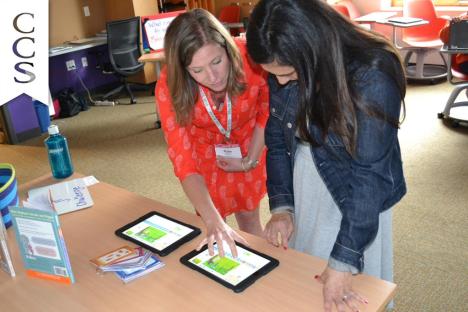
Technology in Early Education: An Interview with Katie Paciga

Lynn ZimmermannBy Lynn Zimmerman
Associate Editor
Editor, Teacher Education

Katie Paciga, PhD, is an Assistant Professor of Education at Columbia College Chicago. She teaches courses in Language Development, Children’s Media and Technology, and Early Reading and Writing Methods. Her area of specialization is emergent/early digital literacy development. I interviewed Katie about her views on technology and literacy education for young learners.

LZ: What do you think is the most exciting connection between technology and literacy? Why?

KP: So, the way I see it, there is incredible cultural relevance to the whole connection between technology and literacy. That’s really the most important point. Scientists will continue to debate over the value-added (or not added) because we have evolved. While that debate happens, though, most people are using technology as a tool for communication — to consume information, to create new texts, and to communicate messages. The ways we carry out these actions have changed in the past decade in very significant ways. I suppose you could argue that technology has been impacting the ways we communicate from the time of the evolution of the first writing tool to the telephone, radio, printing press, television, and now the computer and Internet. Humans have always communicated, but today there are new vocabulary terms to describe how we communicate and the tools that we use to do so are different as well.

Dr. Katie Paciga

Dr. Katie Paciga

There are always new technological developments, so our strategies for consuming information, creating new messages, and connecting with other people to communicate our messages need to adapt and evolve fairly quickly. To be literate in a technologically advanced society we need to be able to ask good questions, execute searches, evaluate resources, comprehend material we choose to read, and then synthesize information across MANY resources. I guess, in some ways, we have always had to do this to advance knowledge, but the volume of resources and the reliability of the information children (and adults) encounter daily as they seek answers to their questions is much more diverse than it was just two or three decades ago.

Composition can often require a new language (i.e., computer code) if we are to contribute to creating new texts — contributing our own messages to the world. In addition, we need to be persuasive to get our messages heard in society where search engine optimized content gets communicated more readily than material that is not as clickable, shareable, etc. Visual content has become more prominent in texts, too.

The ways we connect to share our messages with one another have also changed with Facetime, Skype, Facebook, Twitter, Instagram, Snapchat, Vine, and the other forms of web-chat and social media. In this way our students’ messages (and sometimes images) are out there for a much wider audience than those in the immediate community.  Continue reading

Attrition in MOOCs: Is It a Problem or an Advantage?

Jim ShimabukuroBy Jim Shimabukuro
Editor

It’s hard to fault research into MOOCs since there are so many more questions than answers. Thus, I was drawn to the news that MIT researchers have developed “a dropout-prediction model trained on data from one offering of a course [that] can help predict which students will stop out of the next offering.”1 Still, I find myself questioning the purpose, which is to reduce the high attrition rates associated with MOOCs. The assumption is that 90% or more stopout is a problem that needs solving.

I’m not convinced that it is. It may be for traditional onground college courses where dropouts impact revenue, but it may not be for massive open online courses where most students are more like window shoppers than serious customers. MOOCs are an open invitation for anyone and everyone on the planet to come in, look around, and sample for free with no pressure to buy. Students can participate from anywhere at anytime during the day, so commuting or traveling to a specific location at a certain time is not an issue. Thus, the investment of time and money is almost nil.

MOOCs are risk free and convenient, and this is their nature and their attraction. The option to engage as one pleases or stopout at any time are strengths rather than weaknesses or problems to be solved. In short, traditional courses and MOOCs are fundamentally different, and attrition may be a problem for one but an advantage for the other.

In the context of massive enrollment, ten percent retention isn’t necessarily a bad thing when it means 100 out of 1,000 or 500 out of 5,000. Thus, MOOCs could be considered successful despite — and maybe even because of — their attrition numbers.

The question of why students step out is worthwhile and should provide useful results, but the purpose should be to improve instructional design to retain students intent on completing the course and not just to reduce attrition. These ends appear to be similar, but they’re not. The issue isn’t retention for retention’s sake but course design that’s optimized for serious students.

What matters is the attrition of students who are serious about completing a MOOC. In this population, what is the retention rate? What are the causes of stopouts? How can these problems be addressed?

We have a lot to learn about MOOCs, and one of the basic problems is figuring out what the right questions are. All too often, our questions reflect our preconceptions of what MOOCs are instead of what they really are. If we see them in the same light as traditional onground courses, then we’ll apply the same standards. If we see them in a different light, then we’ll begin the search for standards that are appropriate.

__________
1Larry Hardesty, “Helping Students Stick with MOOCs,” MIT News, 1 July 2015.

Lessons from Large-scale Digital Curators

Lynn ZimmermannBy Lynn Zimmerman
Associate Editor
Editor, Teacher Education

One advantage of the digital age is that it is easy to save anything. As individuals we save emails, documents, pictures, videos, many more files than we really need on our computers, on remote devices, most recently in the Cloud. We may be more or less organized with our “filing” system so that our digital records are at our fingertips, or not.

For teachers and students alike this ability to store and easily share files can be time-saving and create different ways of interacting with materials and with each other. As we use and save these files, we often assume that they are safe and will be around forever. The same goes for materials we access daily from a variety of websites.

However, imagine that you are responsible not only for your own digital records but for those of an organization, such as a library, museum or a municipal archive. How do you conserve and administer large-scale archives and repositories? How do you provide easy access of these materials to others? Luckily, there are trained professionals who handle the input and output of these large sources of digital information. Their knowledge about archiving and preservation can provide models which can be used in everyday life.

Recently, UNC Chapel Hill, one of the leaders in digital preservation, held the DigCCurr Institute to provide a space for digital curation professionals from around the world to share their ideas and learn about the issues and how to handle some of the challenges of large-scale digital preservation. You can learn more about it at: DigCCurr Institute 2015 Draws Digital Curation Professionals from Across the Country and the World