ITForum Discussion on Accessibility

Claude AlmansiBy Claude Almansi

Editor, Accessibility Issues

The URL for the video below is http://www.youtube.com/watch?v=kTvHIDKLFqc.The possibility to automatically caption YouTube videos in English was announced by Google on Nov. 11, 2009: a huge step forward for deaf people that benefits all users. And this is typical of most accessibility measures.

About the discussion

Photo of Roberto ElleroFrom November 29 to December 2, 2009, Roberto Ellero and I animated a discussion about Web accessibility on the Instructional Technology Forum mailing-list.

This mailing list is private (if you wish to join, apply at it.coe.uga.edu/itforum/Subscribing.html), but our initial notes for the discussions are in a public wiki, accessibility4all.wikispaces.com, where the e-mail discussion has been copied to the accessibility4all.wikispaces.com/Discussion page.

The participants in the accessibility discussion were instructional design professionals, teachers and students. Therefore they were already well aware of the need for accessibility in teaching and of the existence of requirements for its enacting.

For instance they all knew that non-text objects – pictures, videos, audio files – conveying info but not accessible to all can be used, but that an alternative must be provided for people with disabilities preventing access to such objects. Nevertheless. as accessibility4all.wikispaces.com/Discussion shows, some interesting questions and issues emerged in the discussion:

General themes

Among the general, conceptual themes of the discussion:

Universal design and redundancy

Universal design, i.e., planning something that everybody can use (whether in real life or on the Web), may not be fully reachable, but it is a goal that must be kept in mind from the start of the designing process.

Redundancy – i.e., offering the same info/knowledge in different forms – is a means towards that goal. Alternative formats can be linked to in order to avoid cluttering a given web page.

Accessibility tools

The phrase “accessibility tools” is used to describe different things:

  • Assistive technology for people with disabilities: e.g., screen readers – like JAWS – for blind people.
  • Emulators of assistive technology used by designers to check how a page will be perceived by people who have to use an assistive technology: e.g., screen reader emulators – like the Fangs addon for Firefox.
  • Automated accessibility checkers used by designers, but only indicatively – just as automated spell checkers are only indicative.

Specific issues

Among the more specific and concrete issues discussed:

Language

In the context of online learning materials, if web sites must be accessible to all, including people with language disabilities/problems, won’t that entail a stylistic flattening? Or, as Robert Becker put it, in connection with the Universal Design theme:

. . . So, to make a point, I could say that assigning Chaucer’s Middle English or Shakespeare’s Elizabethan text is to erect a barrier to learners. That may be, but to do otherwise is to erect an even greater barrier to Learning.

I recall a personal experience teaching English to inner city adult students trying to earn associate degrees. I dumped the prescribed reading list full of “accessible” texts and replaced it with real literature. The memory of watching most of my students successfully engage with Jane Austin will never fade.

In Learning generally there is no greater barrier than the absence of challenge and aspiration.

Tables

Tables can be a barrier for blind people, because reading with your ears with a screen-reader means reading linearly. This issue  was first raised – in connection with the Universal Design theme, again – by Beverley Ferrell,  moderator  of the ITForum list:

If blind people read in a completely different manner ( and we may not be aware of this) and screen readers read like this:

http://wac.osu.edu/webaim/ tables2.htm then layout tables and data tables have to be designed differently.

Jim Thatcher has a fairly basic tutorial that explains it http://jimthatcher.com/ webcourse9.htm

I have not had time to read and comprehend all of this vs design for data etc such as Tufte recommends, so is it really the best way to display the data for those who are not sight disabled or must we always design two versions? and what about adding mobile issues to this? There are those who disagree with Tufte’s ideas also. Tables might not be useful, so data in graphs etc would be a real challenge for the new person designing accessible information.

Invitation

I have only highlighted some of the points raised in that discussion about accessibility on the Instructional Technology Forum mailing-list. You can find several other themes  in accessibility4all.wikispaces.com/Discussion. The mailing-list discussion is now closed, but it  can  continue either in the comments to this post or on the wiki [1], which is a more democratic platform than a blog ;-). As the video at the beginning shows, the means to enact Web accessibility are progressing fast, for the benefit of all, not only of people with disabilities.

[1] You can join the wiki at: accessibility4all.wikispaces.com/space/join.

Prix Möbius Suisse Rewards Inaccessible Flash Site

Claude AlmansiBy Claude Almansi
Editor, Accessibility Issues

Last Saturday, Oct. 3, 2009, the awards ceremony of  Premio Möbius took place in Lugano (CH). There were two categories: Premio Möbius Multimedia, for cultural CDs and DVDs in Italian, and Grand Prix Möbius Suisse, for Swiss websites about cultural heritage.

Prix Möbius international de la Communauté Européenne, Scienza Tecnica e Medicina, Cultura, Arti e Lettere, Educazione e Formazione permanente, Premio Möbius Multimedia Lugano

Prix Möbius candidates

In the Prix Möbius category, the candidates were:

Accessibility and ease of navigation

As for accessibility and ease of navigation,  the Zurich Kunsthaus and Centre Dürrenmatt sites are the best: they read well in linear version (as spoken by screen readers) and have hierarchical headers, which allow people using a screen reader to quickly navigate from section to section (unfortunately, the Centre Dürrenmatt, being a national museum, has to use the drab template of all Swiss federal and cantonal sites).

Next best is the site of Museum Franz Gertsch; “next” because in order to enter the otherwise accessible and easily navigable rest of the site, you have to click on the word “mehr” (more) in the home page – not a very intuitive process.

Then, on a par, there are  the websites of Fotomuseum Winterthur and Site Archéologique de la Cathédrale Saint-Pierre, which don’t use hierarchical headers, hence are not easily navigable with a screen reader.

The worst by far is the site of the m.a.x. museo:

screenshot of the site as seen with Firefox on a laptop with 1280x800 screen

Screenshot of the site as seen with Firefox on a laptop with a 1280x800 screen.

The site is entirely in Flash. What a screen reader would voice is “Page has three frames and no linksm.a.x.museo colon plus forty-one left paren zero right paren ninety-one six hundred eighty-two fifty-six fifty-six dash Internet ExplorerFrameFrame end.FrameFrame end.FrameFrame end.”

Actually, in spite of the “no links,” there are two links: to the Italian and the English version, but as they are within the Flash movie, the screen-reader cannot identify them. And these two don’t even show on a laptop with 1280×800 screen, using Firefox (see screenshot above).

And the winner of Prix Möbius Suisse . . .

. . . is the site of the m.a.x. museo, www.maxmuseo.ch. Leaving aside its violation of accessibility norms, the motivation for awarding it the Prix Moebius is rather odd: “It achieves an immediate, natural and linguistically coherent synthesis of the museum’s identity and of Max Huber’s world” (my translation). Now all the site says about the museum’s identity and Max Huber’s world is:

. . . the m.a.x. museo was established on the 12th of November 2006 by the wife of leading Swiss graphic designer, the late Max Huber, Aoi Huber-Kono, with the aim of disseminating design culture and leaving his work to posterity.
It is the aspiration of this museum that it will serve as a bridge towards young designers and artists of future generations through various exhibitions, while conveying the message of Max Huber who dedicated his life to design.
We plan to organize exhibitions primarily on graphic design in order to present “design” in general to the world.

Very synthetic indeed – not even a single link to other information about Max Huber in the links section.

Granted, the flash movie is pretty. But is this enough to decree that a site is “the best site for cultural heritage,” as the description of Prix Moebius Suisse maintains?

Two paradoxes

The first paradox is that the jury of Prix Moebius Suisse is chaired by Professor Paolo Paolini, who is in charge of a Master’s course in Design of Interactive Applications for Cultural Heritage. Does he really think the purely-flash site of the m.a.x museo is an example his students should follow?

The second paradox is that Professor Paolo Paolini is co-author, with his colleagues of the Lugano Università della Svizzera Italiana, Elisa Rubegni, Alberto Terragni and Stefano Vaghi, of “Accessibility for Blind Users: An Innovative Framework” (Springer Verlag, 2008), whose abstract says:

. . . The main thesis of this paper, which focuses on blind users, is that technical recommendations (as those of the W3C) are not sufficient to guarantee actual accessibility, that we define as the possibility for the users of “reading” the website and “navigating through it” in an effective manner. A consequence of our approach is the emphasis on design, as a way to achieve actual accessibility, and on usability (by blind users,) as the main evaluation criterion. . . .

Actually, Making Content Understandable and Navigable was already one of the two main themes of the first WC3’s Web Content Accessibility Guidelines (WCAG 1.0). And WCAG 2.0 has a whole section entitled Provide ways to help users navigate, find content, and determine where they are.

If more websites – including the site of the Moebius Awards, www.moebiuslugano.ch, which presently conveys textual info in the .jpg image reproduced at the top of this post without an alternative description and violates accessibility commonsense in too many further ways to list here – at least applied these existing guidelines, people with disabilities would have an easier time reading and navigating them.

So Professor Paolini and his colleagues want to go further than these WCAG, apparently. That’s great. But then, why did he, as chairman of the Prix Möbius jury, allow the award to go to a site that is fully inaccessible to blind people?

Political poisoned gift?

Could there be a political agenda behind the selection of the m.a.x museo site? A kind of “cultural exception” protectionist policy à la French? An unwritten rule to favor local sites [1], no matter how unusable and inaccessible?

If so, this is a very short-sighted and harmful policy, particularly for such flash-only sites:

  • The content of  sites made entirely in flash does not get indexed by search engines, which cannot parse text inserted in a movie anymore than in a .jpg picture. When I tried to find info about a very beautiful exposition of Bruno Munari‘s work the Museum had in 2008 by googling “max museo Chiasso” (without quotes), the first hit was indeed to section www.maxmuseo.ch/en/museo.html of the museum’s site, but that page says nothing about the Munari.
    And if you try the Google cache link for this hit, a message says: “This is Google’s cache of http://www.maxmuseo.ch/en/museo.html. It is a snapshot of the page as it appeared on 16 Jul 2009 22:32:17 GMT. (…) These terms only appear in links pointing to this page: max museo munari.”
  • Sites made entirely in flash do not open at all in cell phones, and that again is paradoxical, considering that the Möbius Awards ceremony on Oct. 3, 2009, started with a round table about digital natives, where speakers underline the present evolution towards cell phones rather than computers for internet use.

Hence awarding the Prix Möbius to such a site lulls the site owner into thinking they have a good thing, whereas they only have a pretty gimmick that cuts them off from search engine results and from cell phone users. Above all, the award is an insult to blind people – and in the case of m.a.x museo Chiasso, to low-sighted people as well, as the navigation links in the flash movie are in very pale grey on white.

__________

[1] Re this possible political bias for Ticinese websites: in 2008, the Prix Moebius for cultural heritage went to kunstpanorama.ch, the sanely textual site of the Luzern Kunsthalle, though they also gave a special mention for cacticino.net,  yet another Ticinese flash website (of the Centro d’Arte Contemporanea Ticino). This is proven by web.archive.org/web/20080511213956/http://www.moebiuslugano.ch/annun.html, i.e., the version of the awards announcement saved on May 11, 2009, by the Internet Archive and by the entries about this 2008 Möbius award in Kultpavillon.ch, the blog of Kunstpanorama.ch. However, the page for the 2008 awards of the Premio Moebius website strangely lists cacticino.net for the Cultural Heritage award and kunstpanorama.ch for the special mention.

Google Book Search Settlement Unfair to Non-US Authors

Claude AlmansiBy Claude Almansi
Editor, Accessibility Issues

Of Books and Vegetables

I first thought of calling this post “Of Books and Vegetables” because, when I half woke up the morning after I sent a letter of objection to the Google Book Search Settlement, I remembered Ms B. and the building site for a middle school in Cortona. The building activity had stopped just after the ground had been cleared, due to blocked funds. So for two years,  Ms B., who lived on the other side of the street, used it  to grow very tasty tomatoes and zucchini No one objected to this private exploitation of  the site: it would have been silly to waste its potential, and Ms B. generously shared her vegetables with friends and neighbours. When the funding issue was solved, the building started again and her vegetable patch was bulldozed.

I chose a more conservative title because the analogy with Google scanning out-of-print works in libraries is imperfect: if a big canning industry, instead of Ms B., had started to grow vegetables on the building site,  the borough of Cortona would probably have tried to levy a rental for this use. But the principle remains: it is silly, even immoral, to waste potential revenue – especially if its exploitation will serve the public.

Challenging or objecting?

So I did not object to the Google Book Search Settlement for the same proprietary reasons as the eminent cultural personalities who signed the Heidelberg Appeal (English textGerman text with signatures):

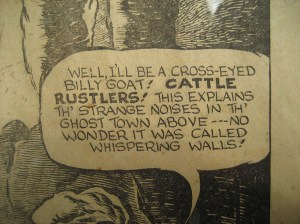
Comic where someone says: Well, I'll be cross-eyed, Billy Goat! Cattle rustlers! This explains th' strange noises in th' ghost town above --- No wonder it was called Whispering Walls

Actually, I did not mean to object: at first I only challenged the Settlement Registry’s classifying as  “not commercially available” the Google scan of  Theatre of Sleep, an anthology my late husband Guido Almansi and I had edited and published with Pan Books in 1986 – and for which, after his death in 2001, I was the remaining mentioned copyright holder.

The physical book has indeed been out of print for years, but it contains many excerpts from in-copyright and commercially available works, which we had obtained permission to use in – and only in – the Pan Book version. Even if the Settlement foresees the possibility for right holders on such excerpts to claim them and forbid Google to display them, some right holders might not know about the Settlement, or not remember exclusive permissions granted decades ago; besides, the search engine of the Settlement registry often does not find the authors of such excerpts. Under our initial transactions for Theatre of Sleep, I am answerable to these right holders – no pact between parties who had nothing to do with these transactions can change this.

Another reason not to allow Google to display even the rest of the anthology under the Settlement’s conditions was the absolutely unacceptable digital restriction of what – paying – users would be able to print or copypaste from Google books. Such digital restriction measures just don’t work: in Copying from a Google Book, I show how easy it is to do so even with theoretically thus restricted works. And if users pay for an e-book, they should be able to do what they want with it for personal use. So I made an unprotected e-version of what was legally offerable in Theatre of Sleep, and uploaded it  in archive.org/details/TheatreOfSleep, an in-progress version because I will re-add in-copyright texts when I get permission again.

Foreign authors and the Settlement

I could have left things at that, without objecting to the Settlement. But Peter Brantley of the Internet Archive pointed out in an e-mail that many people who are hit by the Settlement and utterly dislike it do not object because it is too complex and they have no legal training. This is my situation too, so I included the excessive complexity of the Settlement in my objections.

Theatre of Sleep An anthology of literary dreams - Guido Almansi Claude BéguinThen there was another reason for objecting. Guido and I also did an adaptation of Theatre of Sleep for the Italian readership – Teatro del Sonno – which was published by Garzanti in 1988, is out of print, and has been scanned by Google. For that one we had ceded the copyright to Garzanti, mainly because we did not want to send the permission requests all over again and Garzanti could do that more easily.

But Garzanti has not yet claimed Teatro del Sonno under the Settlement. Its editorial director explained to me that Italian publishers have chosen to wait for the result of the Final Fairness Hearing about it, in case it results in its invalidation: due to the imprecision of the Registry’s search engine, checking what Google has and has not scanned is very time-consuming. Though they are very displeased with the Settlement, Italian publishers are not objecting either, apparently. Above all, they are not systematically informing their authors about the Settlement.

Considering what little info non-US media gave about the Settlement, we are left with the impression that it was a US-only affair. However, this lack of information puts non-US authors at risk. As Mary Minow explained in Google Book Settlement, orphan works, and foreign works (LibraryLaw Blog, April 21, 2009):

The largest group of non-active rights holders are likely to be foreign authors. In spite of Google’s efforts to publicize the settlement abroad, I suspect that most foreign rights owners of out-of-print books will fail to register with the Registry.  There are a couple of reasons for this.  For one, they may not know that their book is still protected by copyright in the US.  In addition, they may assume that international network of reproduction rights organizations would manage their royalties, and not understand the need to register separately. . . .

If there is an injustice being done in the settlement, it is with foreign authors.

Also, if foreign right-holders do not object to the Settlement, how is the US Court to know that they disapprove of it?

Letter of objections

Hence my letter of objections, below. Not because I think they are representative of non-US objections, but because I believe it is important that non-US right-holders object to the Settlement if they disapprove of it, even if their reasons are very different. The deadline for doing so is Sept. 4, 2009, and for the modalities, see 24. How can I object to the Settlement? in the Settlement’s FAQs.

Direct download links: PDFODT

Links

I have gathered / am gathering some bookmarks about the Settlement in diigo.com/user/calmansi/googlesettlement. Several of those, in particular about its repercussions outside US, come from the very useful Google Settlement Information, Documents, News &  Links page in Michael W. Perry’s Inkling Books.

Credits

By order of appearance:

Accessibility and Common Sense

Claude AlmansiBy Claude Almansi
Editor, Accessibility Issues

Technology and technology guidelines are very important in implementing accessibility. Yet accessibility is not a technology issue — it is a common sense issue, both because it is logical and because making things as accessible as possible for as many people as possible becomes an obvious necessity once you “sense in common” with the other person, put yourself in his or her place.

Accessibility in 3D life

(I am not sure if what follows makes sense to readers in America, as accessibility in real life seems to be part of the American culture.)

People without motor disability usually don’t notice steps at the entrance of public buildings or toilet doors too narrow for a wheelchair. If you are in one, or often accompanying a person in one, you do. Builders’ decisions at times can lead to strange absurdities, though they know about accessibility rules and architectural technology. For instance, in 2000, a grand accessible toilet was added to the Museo d’Arte in Lugano (CH), while at the same time accessing the museum in a wheelchair was made well-nigh impossible by adding of a visitor-counting turnstile at the main entrance: people in wheelchairs had to be carted by on a spiral staircase up to a back door.

True, building decisions were made by the town administration, which, though it had a public works departments where people should know the rules and the technology to implement them, was not known for its common sense — in either meaning of the term. However, in 2001, after a protest by a disabled people’s association was taken up in the local media and caused questions in the local parliament, the administration finally provided a lift to the level of the back entrance for people in wheelchairs.

Computer accessibility: non-text objects

Guidelines for computerized and web content accessibility says that equivalent alternatives to auditory and visual content must be provided for deaf and blind people (see the first WCAG 01 guideline, for instance). For instance, if a video is used, this means captioning audio for deaf people and giving an audio description of nonverbal actions for blind people. Or at least, if this is not feasible, offer an alternative text transcript that can be read by both blind (through text-to-speech) and deaf people.

Alt attribute

Static images that convey information should be provided with an alternative content description: when a short description is enough, this can be done in the alternative content description attribute (alt=”description”) in the link that shows the image. This should be fairly simple: nowadays, authoring tools — be they desktop or online, like the one for this blog — prompt you to add such a description when you insert an image through the “rich text” editor (see Authoring Tool Accessibility Guidelines (ATAG) Overview and links therein), which will add the alt attribute.

Nevertheless, while the above-mentioned Museo d’Arte of Lugano gave in to public pressure about wheelchair accessibility, its website remains blithely callous in ignoring basic accessibility precepts, in spite of directives to make all public administration sites accessible. It still has a “no right click” script that disables the contextual menu, thus hampering people with motor disabilities, despite the long-averred uselessness of such scripts to prevent users from saving images (either by saving the whole webpage or by looking up the URL of a given image in the source code). And it uses text images without any alt attribute instead of normal text for its navigation. Therefore, if you view the homepage in “replace images by alt attributes” mode in order to get the same content a blind person using a screen reader would, the result is:

As all texts are presented as gifs of text images WITOUT alt attributes in this page, you only see the word HOMEPAGE

Empty alt attribute

If the image is purely decorative, you still provide an alt attribute, but you leave it empty (alt=””): this way the text-to-speech just ignores it. Nevertheless, there are websites that use the empty alt attribute (no description) for images that convey information (and vice versa add a useless description for decorative images, which means that the screen reader will read a lot of bunk).

Limits of automated accessibility checkers

Automated accessibility checkers are very useful to spot accessibility problems. But as they only check the source of the page, they won’t fail a page for inappropriate uses of the empty alt attribute — they will just suggest you check that the image really doesn’t convey information. Maybe at times the empty alt attribute is deliberately used to pass the automated check, for instance if laws or regulations state that a given type of computerized content (educational in particular) must apply accessibility guidelines and if this is only checked with an automated program.

Embedding an inaccessible page into a frame is another way to bypass automated accessibility checks. www.mantecausd.net (mentioned in Microsoft Case Studies: Manteca Unified School District) does pass Priority 1 level of accessibility with the CynthiaSays checker, in spite of evident lack of alt attributes (and misuses of the empty alt attribute in some cases). But it does so thanks to the use of frames. What the checker reads is the source page, which only says: “Welcome to the Manteca Unified School District. Our site uses frames, but your browser doesn’t support them.” The realcontent is in http://manteca.schoolspan.com, which is embedded in a frame of www.mantecausd.net. CynthiaSays does fail http://manteca.schoolspan.com for the lack of alternative description, but a hasty check on just www.mantecausd.net might misleadingly give the impression that the page conforms to the Priority 1 level of accessibility.

Be it through the inappropriate use of the empty alt attribute or of frames, though, the result is that blind people don’t get the information conveyed by images. This is why it is so essential to apply common sense, to put oneself in the other person’s place

Accessibility in education

Fortunately, most educational web sites are designed for real accessibility to the greatest possible number of students, not just to pass automated accessibility tests. And while this can be time-consuming, it also offers great advantages to all students:


Designing for accessibility leads to greater educational usability

In the 3D world, removing — or better, avoiding from the beginning — architectural barriers to facilitate access for people in wheelchairs also improves usability for other people: mothers with a child in a pram, aged persons for whom the staircase access is too tiring, etc.

This is also true with designing computerized content with accessibility to the greatest possible number of users in mind. If you structure a text correctly, using hierarchical heading styles for subtitles (instead of just playing around with bold and font size) to make navigation easier with a screen reader for blind people, you can also automatically extract an interactive table of content. This is handy for everyone. And adding explanatory graphics to help people who have other, non-visual, text reading impairments (dyslexia for instance) will also help people who are more visually inclined.

The point is that accessibility leads to redundancy in order to cover as many cases as possible of disabilities. And hence it also covers different learning styles.

Teachers’ and students’ content

While main educational web sites tend nowadays to apply accessibility guidelines, course materials uploaded to a course management system or platform can at times remain an issue. It is therefore necessary to educate teachers about what accessibility does and does not entail and about simple tools to implement it (captioning etc.).

Web 2.0 and accessibility in education

Some education authorities are very wary of public Web 2.0 tools being used in schools, but usually because they fear they’d have to answer for students being exposed to inappropriate contacts and content. However, even when there is no such veto from the powers above, Web 2.0 tools can also present accessibility issues, especially for authoring. Jennison Asuncion has created the LinkedIn Web 2.0 Accessibility Forum where questions about these issues are discussed (you have to join, but anyone can).

Universal accessibility?

Some education authorities require that links to the Nth level be checked for appropriate content in course materials. This is not feasible, not even in the limited “non-pornographic” sense of “appropriate” they usually have in mind. Let alone for accessibility. Each person is different, and so it has been claimed that there is no such thing as universal accessibility because persons with a disability will each have different requirements. However, they will also each have their own way to address barriers.

Faced with a reading requirement presented as an image PDF, for instance, blind students are more likely than non-blind ones to think of putting it through an optical character recognition software to get a text version their text-to-speech can read — and to have such software on their computer. Yet why not start by giving the reading requirement as text to start with? It would be far more usable for everybody. One problem is that accessibility is often perceived as something very complicated and technological, “for geeks.” This is discouraging. So are some myths like “accessibility and usability are not compatible,” whose propagators at times allege to prove it by saying that “a black text on a black background,” like the one below1

This is an example of “black on
black” text that might pass automated accessibility tests.
But who – except kids wanting to write “secret messages”
– would do that?

would pass accessibility checks. Automated checks, maybe. But as explained above, automated checks are useful tools, but just tools.

So even if universal electronic accessibility is not concretely reachable, accessibility to the greatest number of people, according to their various capacities and impairments, must be the goal. To this end, there are some basic “common sense” design principles that are useful to all, and there are free, easy-to-use tools to implement them. And for fine-tuning, there are experts ready to answer questions. It is necessary to make people — and teachers in particular — who produce electronic content aware of this.

Pet bitch

One of the accessibility design principles is the already mentioned use of heading styles for titles and subtitles in a text, rather than messing about with character size and shape and bold and what-not directly on the text. See Using Headings Correctly in WebAIM’s Creating a Semantic Structure page.

Indeed, heading styles are semantic because they identify for others — not only for the screen-readers used by the blind — what you consider as main and subsidiary content, and they allow you to draw an interactive table of content2. Yet, somehow, it is at times difficult to convey the usefulness of headings, even to teachers and to people otherwise endowed with strong logical capacities. So why don’t blog platforms — this one included — almost never offer the possibility to choose heading styles in their visual editor while wiki platforms do?

Sure, authors can switch to the html version and add the necessary tags, as I have done here. But I can still remember the not-so-distant time when I had sworn I would never learn a single html tag, because I thought it was “geek stuff”. . .

______________________

1To view the text, just highlight the black box by mousing over it

Live Radio Captioning for the Deaf

claude80By Claude Almansi
Staff Writer

Thanks to:

  • Sylvia Monnat, director of captioning at Télévision Suisse Romande (French-speaking Swiss television www.tsr.ch) for the explanations she gave me by phone on live captioning through re-speaking.
  • Neal Stein, of Harris Corporation (www.harris.com), for the authorization to publish on YouTube the video excerpt shown below, and for his explanations on the US live radio captioning project.

Why Caption Radio?

Making radio accessible for deaf and hard of hearing persons is not commonly perceived as a priority. For instance, the new version of the Swiss law and ordinance on Radio and Television that came into force in 2007 does add several dispositions about accessibility for people with sight and hearing disabilities but does not mention captioning radio. See art. 7 [1] of the law and art. 7 [2] and 8 [3] of the ordinance (in French). According to most non-deaf people’s “common sense,” deaf persons don’t use radio – just as many non-blind people still believe that blind people can’t use computers.

Yet deaf persons are interested in accessing radio content through captioning, as Cheryl Heppner, Executive Director of NVRC [4], explains in this video:

The video is from the January 8, 2008, I-CART introductory press conference at CES 2008. The full video can be downloaded from www.i-cart.net. Transcript of the above excerpt:

I’m one of 31 million people in the United States who are deaf or hard of hearing. A number that continues to grow. NPR Labs and its partners are on the verge of making many of my dreams come true. Beyond having that really crucial emergency information, captioned radio could also open up a world I’ve never had, because I lost my hearing before my seventh birthday.

When I am stuck in Washington’s legendary Beltway gridlock, I could check the traffic report and find out why, what my best route would be. I could check the sports scores and follow the games for all my favorite teams. I could know why my husband is always laughing so uproariously when he listens to “Car Talk.” And I could annoy him by singing along badly to the lyrics of his favorite songs.

I can’t wait. Thank you.

NPR’s Live Captioned Broadcast of Presidential Election

The work by NPR Labs and its partners, mentioned by Cheryl Heppner in this January 2008 conference, led to the broadcasting of live captioned debates on NPR during the US election campaign a few months later. The assessment by deaf and hard of hearing people of this experiment was extremely positive. According to the press release “Deaf and Hard of Hearing Vote Yes on New Radio Technology During NPR’s Live Captioned Broadcast of Presidential Election” (Nov. 13, 2008) [5]:

  • 95% were happy with the level of captioning accuracy, a crucial aspect for readability and comprehension
  • 77% said they would be interested in purchasing a captioned radio display unit when it becomes available
  • 86% indicated they would be interested in purchasing a “dual-view” screen display for a car (which would enable a deaf passenger to see the captioned radio text while the driver listens to the radio).

How Are Radio Captions Transmitted?

A digital radio signal can be divided to transmit audio and text, and the text can be read on the radio display. In fact, text messages are already being sent micro4_serviceon car radio displays through Radio Data System (RDS). For instance, this is how the Swiss traffic information service Inforoutes updated drivers in real time – or almost – about the state of traffic jams due to work in the Glion tunnel in 2004. (See “Service,” in French, on page 4, in the May 2004 newsletter of Les Radios Francophones Publiques [6].)

The radio devices used in the experience conducted by NPR Labs and its partners that Cheryl Heppner mentions have a bigger display. For the exact technical explanation of how the captions work, see the presentations section of www.i-cart.net.

Stenocaptioning vs. Respeaking

The NPR experiment mentioned above used “stenocaptioned,” i.e., they were written with a stenotype [7] whose output gets translated into captions in normal English by computer software. Live stenocaptioning – whether for news broadcasts or for in-presence events in specially equipped venues – seems to be the preferred solution in countries such as the US and Italy that have a tradition of stenotyping court proceedings or parliamentary debates.

In most other European countries, according to Ms. Sylvia Monnat, director of captioning at Télévision Suisse Romande (French-speaking Swiss TV – www.tsr.ch), broadcasters tend to prefer “respeaking,” which works with speech-to-text technology: the software gets trained to recognize the voice of respeakers, and then converts what they repeat into captions.

Ms. Monnat further explained that, on the one hand, the advantages of respeaking involves training. In fact, countries without a stenotyping tradition do not offer courses for it, whereas existing interpretation schools can arrange respeaking courses since it is a normal exercise in the training of conference interpreters. Moreover, respeaking is easier to learn than stenotyping.

On the other hand, it takes time to, first, train the speech-to-text software to recognize the respeakers’ voices and, second, to add words not present in its basic thesaurus for each respeaker’s voice. Moreover, enough respeakers have to be trained so that one whose voice is recognized by the software will be available when needed. Whereas once a new word has been added to the thesaurus of the stenocaptioning software, it can be used by any stenocaptioner.

Outlook

The fast evolution of technology makes it difficult to foresee the issues of live captioning, even in the near future. Radio and television are merging into “multimedia broadcasting.” And, in turn, the line between broadcasting and the internet is gradually fading (see the HDTV offer by internet providers). Speech-to-text technology will probably continue to improve. Mutimedia devices are also evolving rapidly.

However, the response of the deaf and hard of hearing people who participated in the NPR Live captioning experiment seems to allow one safe surmise: live radio captioning is here to stay, whatever the means it will use tomorrow.

Resources

Further information on live captioning can be found in the online version of the “Proceedings of the First International Seminar on Real-time Intralingual Subtitling” held in Forlì, Italy, on Nov. 17, 2006 [8].

This and other online resources mentioned here have been tagged “captioning” in Diigo and can therefore be found, together with resources added by other Diigo users, in www.diigo.com/tag/captioning.