Who Dat? It’s E-Learn 2014! Come, Learn, Share, Connect

By Stefanie Panke
Editor, Social Software in Education

The 19th annual international conference AACE E-Learn took place from October 27-30 in the sunny, warm and welcoming climate of the city of New Orleans. The conference attracted 670 participants from 60 different countries who enjoyed four days of workshops, keynotes, presentations, symposia, SIG meetings, posters, and, last but not least, informal discussions and networking opportunities during the session breaks.
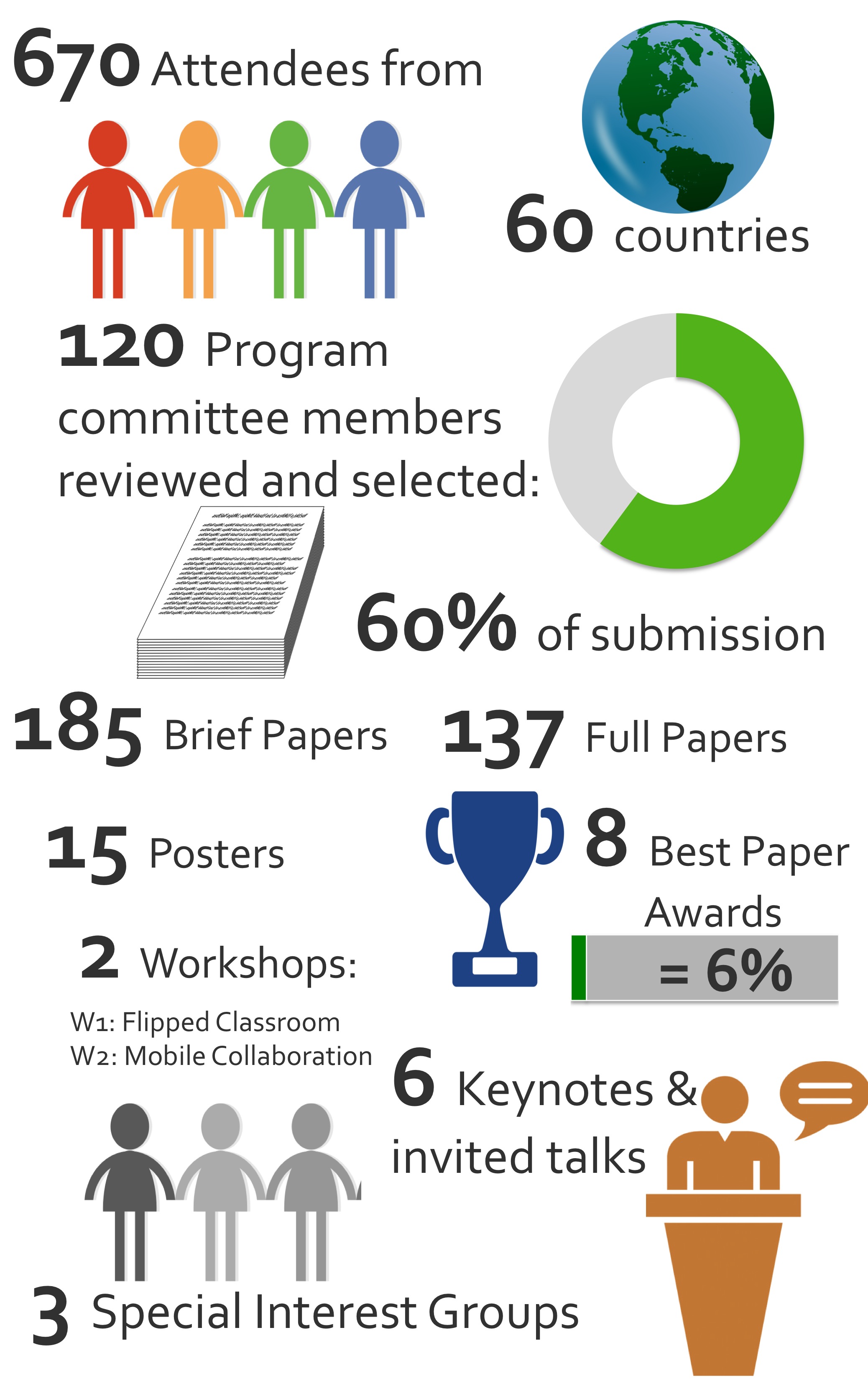
Conference infographic by Stefanie Panke.

Conference infographic by Stefanie Panke.

AACE E-Learn Conference

What sets AACE conferences apart from other events in the educational technology community is the rigorous peer review process in the selection of presentations. Instead of simply submitting an abstract, AACE requires a full manuscript of 6-10 pages. While writing skills do not always and certainly not necessarily translate into great presentations, the quality off contributions is generally high. This also makes the conference proceedings (available in the AACE digital library EditLib) a really great resource for an up-to-date overview of the current state-of-the-art in educational technology. While access to the proceedings is generally restricted to conference participants and subscribers, several papers that were honored with an outstanding paper award are openly accessible:

The best paper awards mirror the diverse spectrum of the conference. E-Learn is a place where educational technology researchers, developers, and practitioners from higher education, K-12, nonprofit and industry sectors meet – brought together by a joint focus on leveraging technology for achieving instructional goals.

My Conference Experience

This conference report is my personal eclectic account of E-Learn 2014. My schedule was packed this year: Not only did I, in a hyperactive mood, choose to deliver three talks, but I also had a symposium and a special interest group meeting to moderate and an executive committee meeting to attend. Luckily, the overall conference atmosphere, the great discussions during the special interest group meeting, and the thoughtful feedback, ideas, encouragement and contributions by numerous conference participants made all of this fun.  Continue reading

Technology Is a Partial Answer to Improving Teacher Quality

picture of Harry KellerBy Harry Keller
Editor, Science Education

On October 29, the New York Times published an op-ed by Frank Bruni1 that is based on a new book by Joel Klein (past chancellor of New York City Public Schools) and that has plenty of advice for educators. According to Bruni, Klein tells us that the primary issue in education is teacher quality.

Bruni’s analysis of Klein’s writing is good enough that everyone should read it and read between the lines too. Bruni also had the opportunity to interview Klein and asked some penetrating questions. Here are some bullet points that I have excerpted from the article:

• Stiffen the admission requirements for schools of education.
• Fix education school curricula, including ensuring teachers master their subjects.
• Create a rational incentive system for compensating teachers, a huge problem today.

You can read the article for the details. What does all of this have to do with technology? A great deal, actually, and in two important areas. The first area is teacher training. We can do much in this area, both with simulating teacher classroom experiences and with mastering subject matter. We currently train pilots with simulators before putting them in airplanes. The same thing could be done for teachers to help them more rapidly reach competency with student interaction, discipline, and engagement.

I am only intimately familiar with science education and can say that we have some great tools to advance science teacher understanding of their subjects. Too many science teachers enter classrooms unprepared to teach science for the simple reason that they do not understand the nature of science. It’s sort of like teaching chess without knowing how the pieces move. We can fix that.  Continue reading

Reading, Vocabulary, Glogster, Funding, ESL Teachers, VoiceThread

lynnz_col2

Cutting to the Common Core: The Positive Side of the Digital Divide by J. Zorfass and T. Gray in Language Magazine: The authors make the case for using digital texts to support the reading process for all learners.

Computer games give boost to English. The University of Gothenburg in Science Daily Success in the world of computer games and a good English vocabulary go hand in hand. A recent study has shown that players who are good at computer games increase their English vocabulary. The study also showed a difference between the genders. Boys spend about twice as much time a week playing computer games as girls. However, girls spend about twice as much time a week on Facebook and other language-related activities.

Tools for achieving oral fluency by Marsha Appling-Nunez in Language Magazine: The author makes suggestions for helping English language learners with their speaking and presentation skills. Glogster is a graphical blog that students can use when doing oral books reports, or other presentations. She also recommends PechaKucha Prezi, which is a method of presenting information using pictures only which requires the speaker to focus on good pronunciation, filler reduction, and vocabulary.

For Public Schools, the Long and Bumpy Road to Going Digital by Kathy Baron in Mindshift: Equipment, software licensing, training. Funding – or lack of it – is the number one issue facing school districts as they convert to the digital learning world.

Preparing Teacher Candidates to Work with English Language Learners in an Online Course Environment by Stephanie Dewing in TEIS News: The author reports on a study she did on the efficacy of an online course for ESL teachers. She found minimal evidence of transformative learning experiences. She proposes several changes in course design to try to produce a context more conducive for transformational learning.

Using Web 2.0 Tools, Such as Voicethread™, to Enhance ELL Instructor and Student Learning by Kelly Torres In TEIS News: Torres advocates using tools such as VoiceThread™, a multimedia tool that can provide a slide show with pictures, documents, and videos to engage students in online course materials by allowing them to see and hear their peers.

Geography? T3G…ESRI in Education

VicSutton80By Vic Sutton

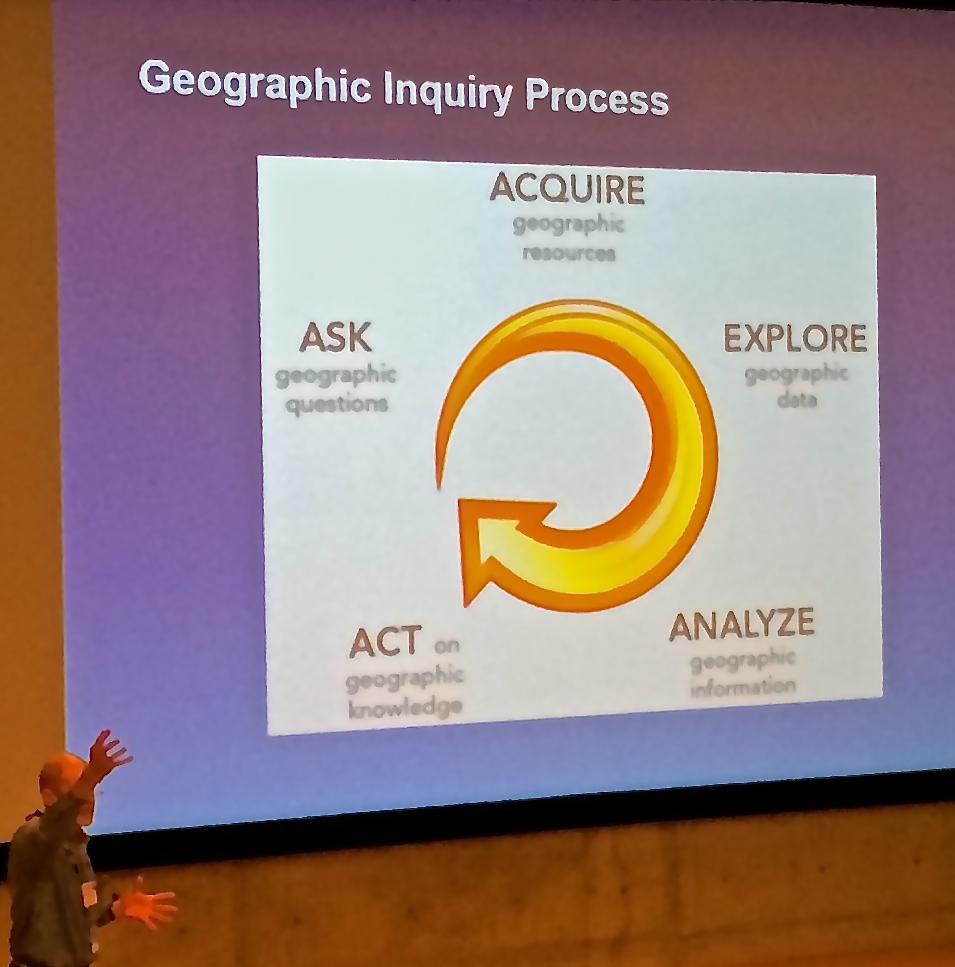
While at a recent workshop at the Redlands, CA, headquarters of the Environmental Science Research Institute (ESRI), I heard the most concise definition of geography yet: “What where? Why there? Why care?”

vic063014 1

My wife, Bonnie Bracey Sutton, had been accepted for a week-long workshop in ESRI’s T3G Institute. I traveled with her, thinking I was heading for a holiday in Southern California – maybe visit the beach and chill out in wine country.

No such luck. As soon as he saw me, Charlie Fitzpatrick said, “I’ll get you a badge.”

Charlie Fitzpatrick is the K-12 education manager at ESRI. Before joining ESRI in 1992, Charlie taught social studies in grades 7-12 for 15 years.

vic063014 2

“T3G” is ESRI’s acronym for “teachers teaching teachers GIS.” So the goal of the workshop was to give a group of some 90 educators the knowledge and hands-on skills to be able to teach other colleagues how to use geographic information system information in their work.  Continue reading

What Does Cyberlearning Mean to You? Cyberlearning Summit 2014

By Bonnie Bracey Sutton
Associate Editor

(Note: See Vic Sutton’s report on this conference. -Editor)

Teachers working in classrooms need ideas and frameworks and support for initiatives beyond the ideas that have been classified as regular education. Sometimes funding is a problem. Powerful partners get you permission to do wonderful things in the classroom.

My first involvement with a network of powerful people, learning ideas and new technologies was with Cilt. You can tell that it was some time ago. We called STEM, SMET. Here is a look at what we started with:

bonnie 062514 01

We investigated, learned, shared and promoted ideas. Concord has wonderful free resources to share, and here is a summary:

The Center for Innovative Learning Technologies (CILT) was founded in October 1997 with a grant from the National Science Foundation (NSF) to stimulate the development and study of important, technology-enabled solutions to critical problems in K-14 science, mathematics, engineering, and technology (SMET) learning. Four “theme teams” focused the efforts in areas of highest promise. CILT events, often workshops organized by theme, provided a collaborative forum in which people in the learning science community met to assess the progress of the field, define research agendas, and initiate new collaborations. Many of these collaborations form seed grants funded by CILT. In addition to these successful CILT programs, CILT has generated many resources for the learning science community, including tools, publications, and NetCourses.

In this day and time, people sometimes do not think that meeting people and sharing in conferences is necessary. But the leaders of Cyberinfrastructure have better ideas. They do a conference and put the ideas online. You have a choice. There are pieces of brilliant ideas, presentations and demonstrations, and even poster sessions for you online.  Continue reading

Cyberlearning Summit 2014: A Quick Recap

VicSutton80By Vic Sutton

[Note: See Bonnie Bracey Sutton’s report. -Editor]

There is reportedly a wealth of research being conducted unto cyberlearning, but there are no clear views about how to translate research results into action in the community context, in particular for schools or informal education.

This emerged from the recent Cyberlearning Summit held in Madison, Wisconsin, on 9-10 June 2014, which brought together some 200 participants — mostly academics, plus some educators, industry representatives and grant makers — to highlight “advances in the design of technology-mediated learning environments, how people learn with technology, and how to use cyberlearning technologies to effectively shed light on learning.”

Bonnie's photos

There was no discussion about quite what cyberlearning is, but it appears to be a fancy name for on-line learning.

The meeting was organized by the Center for Innovative Research in Cyberlearning (CIRCL), funded by the National Science Foundation (NSF), and featured a number of eminently qualified speakers.

Yasmin Kafai, from the University of Pennsylvania, reminded participants of the remark by the late Steve Jobs that “everybody in this country should learn to program a computer, because it teaches you how to think.”  Continue reading

Social Media Tips for Virtual Conference Attendance

By Melissa A. Venable

[Note: Jessica Knott, ETCJ’s Twitter/Facebook editor, has coordinated the publication of this article. -Editor]

Last month The Sloan Consortium’s 7th Emerging Technologies for Online Learning took place in Dallas, Texas. According to the latest Sloan-C View newsletter, there were “more than 700 onsite and 1,000 virtual attendees representing 47 states including DC and 23 countries.”

Saint Leo University provided virtual access to a limited number of instructors, including adjuncts like myself. In my formal request to attend, I made a commitment to “be active on multiple social media platforms and use the symposium hashtag – #et4online – to further engage in live sessions and network with other attendees.” I was fortunate to be selected to attend, and it was this social media commitment that made all the difference in my experience.

Recorded sessions are helpful but don’t provide the energy and interaction of real-time attendance. And there is a lot to be gained from following the social media backchannel of a conference, but formal registration allows for a different level of access to the sessions and other attendees. This article includes a few of my lessons learned as a virtual conference participant.

Prepare to Participate

Are your social media accounts up-to-date? This may be the best place to start. Take a look at the platforms that are being encouraged by the conference organizers and review your profiles before the event starts. If it has been a while since you logged in to an account, it could take some time to review and refresh the information you are providing about yourself. Keep in mind that these profiles serve as your business card in an online networking sense.

Follow the conference itself and the sponsoring organization. In addition to the conference hashtag, this Sloan Consortium event was also active with social media accounts focused specifically on this conference, including Twitter and Facebook. These accounts provided a constant stream of reminders, letting participants know about upcoming sessions, highlighting participants and presenters, and announcing schedule changes.

Set Realistic Expectations

The Sloan symposium offered fewer streamed sessions than onsite sessions, but there were multiple presentation options for each time slot. The streamed sessions took place in Dallas with a live audience and allowed virtual attendees to watch both the presenter and his or her slide presentation simultaneously. Members of the online group were able to interact with each other via text chat and ask questions of the presenter through an online session chairperson who relayed them in real-time. We also connected and exchanged thoughts and resources through our social media accounts.

Take a look at your schedule for the week and identify, in advance, the sessions you would like to attend. Add these sessions to your calendar. I was tripped up when logging into my first session (an hour early), before I realized I needed to calculate time zone differences. The website mentioned this, of course, but sometimes you have to learn on your own, and I instantly connected with other virtual attendees on Twitter who made the same mistake.  Continue reading

SoTL Commons 2014 in Savannah: ‘Teaching Without Learning Is Just Talking’

By Stefanie Panke
Editor, Social Software in Education

The 7th SoTL commons conference at Savannah, Georgia, was held from March 26-28, 2014. The annual event is organized by Georgia Southern University. SoTL commons is a small conference; the 2014 edition attracted around 180 participants. The majority of the participants came from small colleges and universities in the southern United States, though the event also had national reach with people from Wisconsin, Louisiana, and the Midwest, as well as a few international attendees from Colombia, South Africa, Sweden, Portugal and Nigeria.

My personal conference highlight was the keynote by Peter Felten, Director of the Center for the Advancement of Teaching and Learning at Elon University. Peter used an amusing and powerful analogy to clarify the question that seems to be a crucial, non-negotiable ingredient of every SoTL gathering: What do we mean by Scholarship of Teaching and Learning?

Peter Felten: ‘Which mutt is the cutest?’ Can you give criteria for cuteness? How about criteria for excellence in SoTL?

Peter Felten: “Which mutt is the cutest?” Can you give criteria for cuteness? How about criteria for excellence in SoTL?

He  characterized SoTL as a mutt discipline — in contrast to the “best in show approach” of disciplinary research. Just as a show dog will be only appreciated by few experts in the breeding trade, disciplinary research often resides in the ivory tower. SoTL has the advantage of being widely accessible to a broader audience. However, it has to define its boundaries to be (accepted as) a scholarly discipline.
To this end, Peter presented five principles, which offer a heuristic framework to characterize any SoTL project:

  1. The inquiry is focused on student learning.
  2. The research is grounded in context — both scholarly discourse and local, organizational environment.
  3. The approach is methodologically sound.
  4. The project is conducted in partnership with students.
  5. The results are appropriately public.

These principles allow for common ground among SoTL inquiries, can help clarify and demystify SoTL to others and ultimately enhance the influence of SoTL. (For more details, see “Principles of Good Practice in SoTL.”)

The talk spurred a debate among the audience, in particular the absence of “teaching” as a perspective in the first principle. What if you are working with faculty to improve their teaching? Peter argued that ultimately every SoTL project aims at improving student learning and referred to Angelo and Cross (1993), who stated that “learning can — and often does occur without teaching but teaching cannot occur without learning; teaching without learning is just talking” (p.3 — see full text at ERIC).

Nancy Chick

Nancy Chick

Peter’s thoughts were taken up by Nancy Chick’s keynote address on the following day. She focused on the question “What is methodologically sound research in SoTL?” As editor of Teaching & Learning Inquiry, the new ISSOTL journal launched in spring 2013, Nancy was in a perfect position to highlight methodological aspects. What sets SoTL apart from disciplinary research is the variety of data sources scholars use to trace learning. Although SoTL projects comprise a wide range of theoretical, methodological, and empirical perspectives, it is crucial to find a good fit between research question and data sources.  Continue reading

Can America’s Wasted Talent Be Harnessed Through the Power of Internet Based Learning?

Jim_Riggs80By Jim Riggs
Professor, Advanced Studies in Education
College of Education
CSU Stanislaus
President Emeritus, Columbia College (1997-2007)

For nearly 150 years, the American dream of a better life of economic success and advancement has been found largely through the narrow path of higher education. However, access to traditional higher education has always been limited to the top one-third of the adult population and by all indications will continue to be rationed at this level or less into the foreseeable future. Peter Smith, in his 2010 book, Harnessing America’s Wasted Talent: A New Ecology of Learning, points out that while traditional higher education will continue to serve this segment of the population, educational leaders must find alternative ways that will effectively meet the postsecondary education needs of a much larger segment of the adult population.

Smith is not alone in this thinking. There have been numerous reports in recent years that have also called for greater access, flexibility, credit portability and increasing degree completion for a much larger percentage of the adult population. In addition, many of these reports place a special emphasis on closing the growing achievement gap, which is increasingly leaving Latinos and African-Americans behind other groups when it comes to earning college degrees. Why is this important? There is a strong and growing consensus among policy makers, educators, economists and scholars that, if this country is to remain an economic superpower, a much larger and more diverse segment of the adult population must be better educated.

America’s current workforce is aging and retiring, and 85% of all new jobs now require some college education. A real crisis is rapidly developing  — America is finding itself with an escalating gap between the increasingly sophisticated workforce skill demands of the new economy and what the average American worker has to offer. In a 2011 report, The Undereducated American, Georgetown University professors Anthony Carnevale and Stephen Rose provide a strong argument that America will need a dramatic increase in the number of individuals with college degrees within the next decade. This increase in college graduates, according to Carnevale and Rose, is not only needed to help sustain the nation’s economic growth but will also help reverse the 30 year trend of growth in income inequity.

However, with the downturn in the economy over the past six years, we are once again reminded that a college degree alone is not a complete guarantee against economic challenges or underemployment. Economic growth and viability cannot solely depend on education. Nonetheless, according to the Bureau of Labor Statistics, the greatest predictor of personal income and employability for Americans still is, and will continue to be, their level of educational attainment.  Continue reading

Twitter for Professional Use – Part 4: Participating in a Live Event

By Melissa A. Venable

[Note: ETCJ’s Twitter editor, Jessica Knott, has been working with Melissa to develop this series. See Part 1: Getting Started, Part 2: Channeling the Streams, and Part 3: Curating the Chaos. -Editor]

This final installment in this series offers guidance on using your Twitter account to join live conversations and monitor ongoing professional events. After setting up and learning to manage your account, a good next step is to join active groups and discussions that use hashtags to set their conversations apart from the rest.

What Is a Hashtag?

Adding the “#” symbol to series of letters and numbers creates what is known as a hashtag. These are searchable in the Twitter system and can function as filters to create a list of tweets that include the hashtag. By inserting a hashtag into a tweet, you add your message to the conversation, joining all the others who have chosen to add that same hashtag as well.

Anyone can create a hashtag and start a conversation. Like tags and keywords, they help you sort through the seemingly endless flow of information to identify related topics of interest. Use Twitter search to find recent tweets related to #edtech, #highered, or #election2012 as examples. Notice that searching by keyword (highered) or hashtag (#highered) allows you to see all of the messages with the hashtag, including those from accounts you don’t follow.

Join a Live Conversation

Twitter chats are real-time text chat conversations in which participants tweet their questions and responses. Chats go beyond just using the hashtag to participating at scheduled times. Anyone can join in by simply adding the chat’s specific hashtag to tweets during the session. There are several established chats focusing on education topics, such as #lrnchat and #edchatContinue reading