Teaching About Global Warming

picture of Harry KellerBy Harry Keller
Editor, Science Education

With all of the misinformation regarding global warming or climate change, it’s hard to deliver convincing information to students. The subject has many aspects. One that receives lots of negative press is the so-called “greenhouse effect.”

The term in a misnomer because the effect of carbon dioxide, methane, and other warming gases is very different than the effect that keeps a greenhouse warm. In the latter case, it’s merely the isolation from the cold air outside of the greenhouse that creates the effect. Glass is a sufficiently good insulator to stop conductive loss of heat and certainly eliminates convective losses. However, it does not block infrared (IR) radiation and keep it from escaping.

To demonstrate this fact, you only have to paint the inside of a small foam cooler black, put a piece of glass over the top, and illuminate it with a heat lamp. A thermometer punched through the side and shielded from the heat lamp with a small piece of cardboard completes this simple experiment. I have done this experiment, and the temperature will not rise.
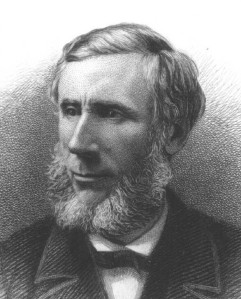
John Tyndall, author of "The Bakerian Lecture: On the Absorption and Radiation of Heat by Gases and Vapours, and on the Physical Connexion of Radiation, Absorption, and Conduction," Philosophical Transactions of the Royal Society of London, Vol. 151 (1861).

John Tyndall, author of “The Bakerian Lecture: On the Absorption and Radiation of Heat by Gases and Vapours, and on the Physical Connexion of Radiation, Absorption, and Conduction,” Philosophical Transactions of the Royal Society of London, Vol. 151 (1861).

The atmospheric greenhouse effect is more subtle. John Tyndall discovered the effect and published his findings in 1861, the year the United States Civil War began. His paper makes very interesting reading because it describes how he had to make his own apparatus and the nature of his measurements. Its general availability is only through our technology today.  Continue reading

PISA Days Are Here Again (Part 2): Time for a New Song?

John SenerBy John Sener

[Note: This is the second in a three-part series, “PISA Days Are Here Again.” See part 1 and 3.]

The latest round of national self-flagellation generated by the recent announcement of the latest round of PISA international test scores (and neatly packaged by the US Department of Education as “PISA Day1) has subsided for the most part. Unfortunately, the accompanying memes and their destructive power continue to reverberate through the American psyche, humming a depressingly familiar tune. Let’s listen more closely to what the song sounds like:

PISA Days are here again
Time to moan and gnash our teeth again?
Do our kids just stink at math again?
PISA days are here again…

Upon closer examination, the notion that we can determine much of anything useful about the state of American education or its economic impact through PISA or any other standardized test scores quickly falls apart like a wet answer sheet. As one critique has noted,2 standardized tests are less objective than is commonly believed: they don’t measure actual student achievement; their results are routinely distorted or misapplied for assessment purposes; they encourage students to become “superficial thinkers.” Instead, consider this list of traits from educational critic Gerald Bracey that we presumably want our learners to have: creativity, critical thinking, resilience, motivation, persistence, curiosity, endurance, reliability, enthusiasm, empathy, self-awareness, self-discipline, civic-mindedness, courage, compassion, resourcefulness, sense of beauty, sense of wonder.3 What do they have in common? Standardized tests measure NONE of them.

PISAday2013

Still, as a recent New York Times editorial4 bemoaned, don’t PISA results demonstrate that US kids stink — er, “lag behind” in math, and that “even [US] gifted students can’t keep up” with the rest of the world in math and science? There are several answers to this question, including: “No,” “So what?” and “That’s actually a good thing.” One reason is that PISA results purport to represent the achievement of all American 15-year-old students (on a low-stakes, largely meaningless snapshot of an event, but that’s another line of critique). In reality, analyses of math test results that take socioeconomic factors into account have found that US students are doing just fine5 or even scoring near the top.6 Not that the results really matter; as another report noted, the US (or any large country for that matter) doesn’t need all of its students doing math and science at a high level, but rather only a “sufficient number of highly educated workers.7 So in fact, any STEM workforce shortage could be met (at least in theory) by adopting one of the NYT editorial’s proposed solutions: more focus on boosting achievement of gifted students in math and science (which could, among other things, drag down the US’s overall PISA scores). Indeed, this may be a good thing, for as University of Oregon researcher Yong Zhao has found, countries with high PISA math scores actually score lower on measures of “perceived entrepreneurial capabilities.”8 As Zhao argues in his book World Class Learners: Educating Creative and Entrepreneurial Students,9 teaching students to think like entrepreneurs (resourceful, flexible, creative, and global) is different from preparing students to be homogenous, compliant, and standardized workers for mass employment (and guess what’s excellent preparation for that outcome?). Nevertheless, the chorus bemoaning US PISA test results remains loud:

Altogether shout it now
There is no one
Who can doubt it now
Chinese, Poles & Finns will rout us now
PISA days are here again

Actually, there are all sorts of reasons to doubt PISA results. As the Brookings Institution’s Tom Loveless has pointed out,10 the PISA results for China are heavily skewed since the Chinese government only allowed the release of results for Shanghai, an area which is highly unrepresentative of the country as a whole. Yet that hasn’t stopped the major media outlets from shouting out the results, for example “China: The World’s Most Clever Country?”11 (BBC), “US Teens Lag in Global Education Rankings as Asian Countries Rise to the Top12 (USNews/NBC News), and “U.S. Students Get Stuck in Middle of the Pack on OECD Test13 (Bloomberg).

Continue reading

Jorge: The Education of a 12-year-old in an Immigrant Family

Jeremy Scott Burg80By Jeremy Scott Burg
Student at Kapi’olani Community College
University of Hawai’i

I’m packing my backpack with pajamas and a change of clothes. It’s a rare sunny Saturday in Scappoose, Oregon. I’m going to a sleepover at my best friend’s house. His name is Jorge. I say “bye” to Mom and hop on my bicycle. There are several miles to Jorge’s house, but I’m used to riding far on my dirt bike. I ride on two-lane country roads until I get to the paved logging road that will take me most of the way to his house. Cars aren’t allowed to use the logging road, and the log trucks are rarely on it, so it’s a nice safe ride for me. After that ends, I’m back on country roads for a short while when I finally arrive at the long gravel road Jorge lives on. Jorge is my Mexican friend I met while we were both attending sixth grade at Peterson Elementary School. During this sleepover, I catch a glimpse of what it is like being the first-born son in an immigrant family.

Scappoose, Oregon

Scappoose, Oregon

I ride up to Jorge’s driveway. Further down the gravel road is the big dairy farm where Jorge’s dad works. I turn into the driveway when Jorge and his younger brother, Crispin, are coming out of the house. Jorge is a little taller than me with a lean body. His thick jet black hair is cut short on the sides and left longer on top. He says I’m just in time because his mom has asked him to go to the minimart to get some supplies. The cool part is we get to take the car. Jorge is twelve years old and has learned to drive by going back and forth to the dairy farm with his dad, about a mile round-trip. He’s also previously driven to the minimart with his mom and alone. The distance is about seven miles. There isn’t much traffic or police out in the country. Jorge tells Crispin he can’t go with us. We get into his mom’s new Ford Taurus and drive away. When we are far enough away, Jorge pulls a tape of N.W.A. out of his back pocket and puts it in the tape player. We have just morphed into the two coolest twelve year olds, blasting gangsta rap with the windows rolled down. I haven’t even tried driving yet, and here’s Jorge running an errand for his mom with the family car. I feel free.  Continue reading

MOOCs Are So Much More Than Courses or Statistics

By Jessica Knott
Associate Editor
Editor, Twitter/Facebook

[Note: This article was first posted in ETCJ’s staff listserv this morning, in response to a discussion on Tamar Lewin’s “After Setbacks, Online Courses Are Rethought” (NY Times, 12/10/13). Lewin’s article was shared in a post by Harry Keller on 12/11/13. -Editor]

I have such a different view of MOOCs. Maybe it’s because I work on them from time to time.1 This e-mail won’t be nearly long enough to get my thoughts out because I’m super short on time. (I know, we all are, so that’s such a lame excuse.) But the analytics on MOOCs and the things that point to problems, such as 4% completion, 80% having degrees — in a way, I kind of see those as opportunities.

We talk about MOOCs as though they’re all one beast. I know it’s unintentional — but we do. Each MOOC is so different. Believe me, I’ve taken 23 of them. I have completed three. Some were so terribly constructed that I could get all of the correct answers to the content and still fail the quizzes. Some were so amazing that I couldn’t stop exploring and lost track of deadlines. Others? Well, others were just there. I’m sure they served their purpose, but they left no impression.

I see MOOCs like museums. You sign up, you go in and see what’s there. What do you want to get out of it? Some people are striving for that certificate. Others, like me, just want to pick up some new skills, or maybe learn some statistical tricks, or learn about scientific theories they’d never have a chance to interact with otherwise — if they had to pay.

More importantly, what *is* success in a MOOC? Is success completion? Or is success learning? Because, according to this conversation, the MOOCs have failed me. But I can tell you, while that’s true for a few of them, they’ve *far* from failed me. The conversation is shifting a little, from completion to potential. MOOCs are this really amazing thing. They can be a whole course experience, or they can be used as course content. They can stand alone, or be integrated.

I just think there is so much to the conversation and potential that can be lost if we look at MOOCs simply as courses or as statistics. Let me be clear. That’s not what I’m saying you’re doing here. I do feel that, sometimes, that’s what researchers tend to do. There is a real shift happening out there, though. It’s very exciting, that is, unless I’m a conference reviewer and reviewing your submission on MOOCs that looks like every other submission on MOOCs. Then you might not find it as exciting.

Ohio State is doing some things really right. Jesse Stommel has some great ideas. And, the standards, which I’m sure you’ve seen: Jim Groom, Alec Couros, Tanya Joosten, George Veletsianos, Amy Collier, etc. I have some blog posts, thought pieces, articles and resources if you’re interested. Let me know (jlknott@gmail.com). If I start sending them, there’s a good chance I’ll never stop.
__________
1 See MOOC MOOC! The interview (9/11/13) and MOOCulus for Calculus Fun: An Interview with Tom Evans (7/11/13).

Space Heats Up

picture of Harry KellerBy Harry Keller
Editor, Science Education

All eyes are not on Mars these days even though the recent news will buoy those interested in the red planet. Some significant events have taken place in space flight in the last two months.

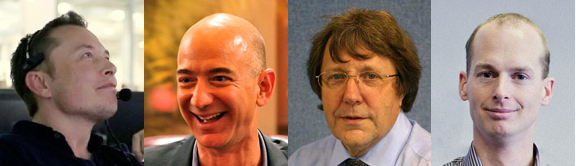
Perhaps, one of the biggest is the entry into the commercial space race of Amazon’s Jeff Bezos. His Blue Origin rocket engine has been successfully tested for the first time (NBC article). The November 20 test was a full simulation of blast off and entry into Earth orbit using his hydrogen-fueled rocket engine with 110,000 pounds of thrust. Elon Musk’s SpaceX has a competitor.

Elon Musk, Jeff Bezos, Alan Bond, Bas Lansdorp.

Elon Musk, Jeff Bezos, Alan Bond, Bas Lansdorp.

Speaking of SpaceX, they have launched a big commercial satellite into a geostationary orbit, 22,000 miles (36,000 km) into space. The satellite is nearly 7,000 pounds (2,138 kg) and launched on December 3 at a cost that is tens of millions of dollars less than previous similar launches. The Falcon 9 rocket performed flawlessly and is the precursor for the soon-to-come Falcon Heavy rocket that will lift 116,850 pounds (53,000 kg) into Earth orbit and is likely to be the rocket used for the first manned Mars ventures.

NASA has announced the test date for its Orion manned space capsule, September 2014. Ultimately, this capsule is slated to carry humans back to the Moon. This is a larger capsule and with much more computer capability than previous manned capsules.

Another NASA announcement opens up a competition for the commercial International Space Station spaceships. These ships are due to begin transporting crews and supplies in 2017.

These sorts of competitions will lead to faster development of technologies that can make manned missions to Mars feasible. Mars One remains a long shot because of its desire to have people live out a “normal” life there. Despite Bas Lansdorp’s remark that returning people to Mars is more difficult that having them live there, the hurdles to long stays on Mars exceed those to landing and returning. Neither has been done, but the former has more unknowns; the latter mostly requires scaling some technologies and providing fuel for the return journey. While a few ideas for on-Mars fuel production have been made none have been tested outside of a laboratory.

For example, the Alan Bond concept of turning CO2 from the Mars air into CO and O2 has not been attempted with Mars air, which has 1/100th of the pressure of Earth air and some contaminants, such as omnipresent dust, that could cause problems in the real (Mars) world. The Mars Direct idea combining on-board hydrogen with atmospheric CO2 to make methane (CH4) and oxygen has the same issues. Finally, breaking water into hydrogen and oxygen means extracting water from the Mars regolith (dirt). We don’t know exactly where to find water on Mars or how to deal with the many corrosive contaminants in the ground. Until someone tests these ideas on Mars or in a very well simulated Martian environment, we won’t be sure that any will work.

See the Mars One article and spirited discussion for more on the problems of living on Mars for more than a year or so. Even a year will be tough, but should be manageable.

Mars One Delayed for Two Years

picture of Harry KellerBy Harry Keller
Editor, Science Education

At a news conference today, the Mars One team announced contracts with two vendors for studies and a two-year delay in their schedule. The first launch now is scheduled for 2018 with the launch of the first manned mission in 2025. This puts Mars One closer to the schedules of other announced Mars landings in 2030 or later. This sort of very ambitious project almost always suffers delays, and this may not be the last. Given that much of the technology, although existing in some form, has not been created in the form necessary for the trip to Mars.

Bas Lansdorp on 19 April 2013. Image from video added to YouTube by Raitis Misa on 23 April 2013.

Bas Lansdorp on 19 April 2013. Image from video added to YouTube by Raitis Misa on 23 April 2013.

No one has ever landed as large a mass as planned for Mars One on Mars. Even lifting the materials into space may extend into areas not ever reached previously. Planned rockets may be capable, but without detailed plans, it’s hard to evaluate the likelihood of success.

The funding will come from sponsorships, partnerships, and crowdfunding through Indiegogo. The crowdfunding site is already up and has raised over $8,000 of its $400,000 goal in the first hour since the news conference. The crowdfunding will finance the initial studies by Lockheed-Martin and SSTL, who will produce the 2018 lander and communication satellite respectively.  Continue reading

The ‘New Rich’: A New Conservatism in U.S. Education?

Jim ShimabukuroBy Jim Shimabukuro
Editor

Here’s a statistic and thought from Hope Yen that ought to interest anyone who’s made the connection between poverty and educational achievement: “Fully 20 percent of U.S. adults become rich for parts of their lives, wielding outsize influence on America’s economy and politics. This little-known group may pose the biggest barrier to reducing the nation’s income inequality” (“Rising Riches: 1 in 5 in U.S. Reaches Affluence,” AP/USA Today, 12/6/13).

This massive wall of nouveau riche are, according to Yen, “much more fiscally conservative than other Americans, polling suggests, and less likely to support public programs, such as food stamps or early public education, to help the disadvantaged.”

For the 20%, success may breed contempt — contempt for those who can’t work their way out of poverty. An intriguing question involves the relationship between this hardscrabble group and the nation’s growing affinity for standardized tests. Are the new rich more inclined to support national and international testing? And, more importantly, why?

One of the new rich interviewed by Yen says that much of her income goes toward putting her children through college. She is probably representative of a 20% mindset that views testing and high test scores as the entry pass to degrees and economic success. The tests are a means to an end, and the end is separation, separation from the have-nots.

In this scenario, education begins to mirror the gated communities that attract the new rich, and high scores are passes into our nation’s gated schools and colleges. You want entry? Fine. Score well on standardized tests.

But the real victims are the children and youth who are born into poverty. Theoretically, they can study their way out of their circumstances, but the deck is stacked against them from day one. Ironically, the few who do make it out often become the new gatekeepers of privilege, chanting the mantra, “If I can do it, so can you.”

If the new rich are the force behind the testing movement and if the reason is to maintain and even exaggerate the income divide, then the question is what can be done to reverse this trend or somehow close the gap.

I don’t think there are any easy answers. In fact, as a nation, we may find the premise behind this question embarrassing, exposing an instinct that is more self-serving than charitable.

Can Technology Expand the Reach of Great Teachers?

Frank B. WithrowBy Frank B. Withrow

We have always had examples of schools and teachers that, regardless of their support, were able to inspire and bring out the best in students. My anatomy teacher, Dr. Davis, was a teacher who intuitively inspired students to think and to excel. He was a Presidential Scientist and world renowned authority, but he spent as much time working with an undergraduate student as he did in his post graduate classes.

We have always had these inspiring teachers. The question is, Can technology expand their reach? The question is whether we, as a nation, wish to honor teachers and schools and foster a true love of learning. I am less concerned about a grade for our schools and learners than I am about developing a society that honors learning whether it is through technology or inspired teachers.

If we desire good schools we will have them. Technology can expand the number of children now denied schools worldwide. For the first time, technology has allowed us to dream of schools for every child in the world. Some countries will do well with this dream; others will stumble.

Right now it is difficult to pick the winners and losers.

Mars: One-Way or Round-Trip?

picture of Harry KellerBy Harry Keller
Editor, Science Education

[Note: This is part of Harry’s series on Mars, which began with “Mars One: Exciting Adventure or Hoax?” (4/8/13). As of 12/8/13, the discussion is still very active and has grown to 585 responses. Many of the comments are of article length, and the breadth and depth of information and participation make the discussion just as if not more valuable than the original article. The article has been tweeted 38 times and mentioned in 284 Facebook posts, and these figures are growing by the day -Editor.]

Mars is in the news again.1 And again. It seems that everyone is going crazy over Mars. The problems of getting to Mars are many and difficult, but that’s not stopping plenty of people from making plans and issuing press releases.

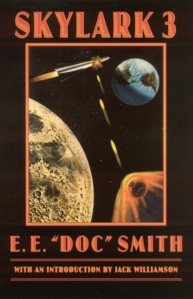
Skylark series

When I think back to my youth, I recall reading my first science fiction novel in a small local library after school in 1953. It was E. E. (Doc) Smith’s story of space travel, one of the Skylark series. At that time, no one had even put a tiny object into orbit.

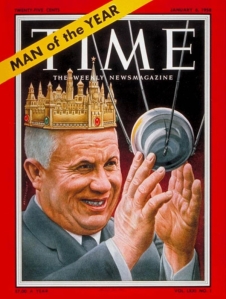
A mere four years later, Sputnik I was launched, and the world entered the space age for real. Rockets to space were no longer science fiction. The next year, 1958, the United States put Explorer 1 in orbit. It weighed about 31 pounds. Dwight Eisenhower was president then. We were in the middle of the Cold War, and Nikita Kruschev was in charge of the Soviet Union. Both his picture and that of Sputnik I were on the cover of Time magazine the previous year. Indeed, if memory serves, he was the “Man of the Year.”Kruschev and Sputnik cover

No one knew how much payload could be put into space. No one knew the effects of prolonged weightlessness on people. The Van Allen radiation belts were discovered and verified by Explorer 1 and Explorer 3 in 1958, raising the issue of radiation in space.

Despite the lack of experience in putting satellites in orbit and the great uncertainties in putting a human in space, the United States not only put men into space but even put them on the Moon just eleven years later. ELEVEN YEARS! Starting from a tiny satellite in orbit, a lunar landing module weighing over 1,000 times as much and holding two people landed on the Moon in that short time.

Those who say that we can’t put people on Mars in 10-15 years don’t remember the magic decade of the 1960s. You have to watch out when you use that word, “can’t.” The Mars Direct program was proposed in the 1970s and was to have people on Mars by 2000. That didn’t happen, and technology has advanced enormously since then. It’s more possible today, and it’s still a very tall undertaking.  Continue reading

PISA Days Are Here Again…

John SenerBy John Sener

[Note: This is the first in a three-part series, “PISA Days Are Here Again.” See part 2 and 3.]

I’ve already written about comparative achievement tests.1 Now that “PISA Days” are here again, thus begins another round of national self-flagellation about the supposedly sorry state of American education based on dubious interpretations of international test scores of questionable credibility and limited value.2 I’m in the midst of a lot of work-related catching up, but I suspect I’ll be pulling together my thoughts about this latest round of PISA-induced moaning and gnashing of teeth over the next week or so.

I don’t think that the NBCNEWS article3 is strong at all — it’s as formulaic as all the others that are sprouting up as predictably as flowers after a desert rain. It quotes sources (e.g., Eric Hanushek) with well-known biases on which they base their living and professional careers. It has the predictable counterargument buried in the middle and ultimately dismissed without much substance, and it concludes that Things Are Bad and Slowly Getting Worse. I’ve already read several of these articles, and I will be surprised to find one for which I don’t already know how the plot ends.

BTW, here’s an angle on such articles that just popped up for me: last night, for unrelated reasons I was re-reading parts of Daniel Goleman’s book Emotional Intelligence (1995), in particular the chapter about “The Hallmark of the Emotional Mind.” Goleman apparently posits that we have an emotional mind as distinct from our analytical one. I haven’t done the mapping yet, but I have a strong suspicion that the current spate of PISA doom articles are based almost entirely on emotional arguments. No one writing these articles is doing any actual analysis of the facts, and if they did, the arguments would fall apart like a house of cards.

Part of me wants to bemoan the fact that so many professionals, including some educators, want to embrace the PISA results so uncritically. But I think the more interesting angle is the fact that we seem to respond, collectively and individually, to emotional arguments. Winning the analytical argument is not enough; one has to win the emotional argument somehow. I’m still figuring out how that happens…

Or, here is one antidote to this madness: Diane Ravitch’s article, which includes an analysis of Keith Baker’s work (which unfortunately costs $$ to access) through which he concludes that “standings in the league tables of international tests are worthless.” I’m in the process of collecting other more rational responses to this latest release of PISA results, from which I hope will emerge a reasoned, analytical summary of what the PISA results mean (or don’t mean). But I remain more intrigued by the question lurking in the background: why do people respond so emotionally and not rationally when it comes to international test score results? More on that in a later post…

__________
1 John Sener, “Standardized Tests and Foul Shooting: Look Out, Michael Jordan!“, ETCJ, 3/12/11.
2 John Sener, The Seven Futures of American Education: Improving Learning and Teaching in a Screen-Captured World, 2012, p. 78.
3 Daniel Arkin, “US Teens Lag in Global Education Rankings As Asian Countries Rise to the Top,” NBCNEWS/AP, 12/3/13.

A Caltech Grad in a Caltech MOOC, Part 5

picture of Harry KellerBy Harry Keller
Editor, Science Education

[Note: Harry, who holds a BS in chemistry from the California Institute of Techology and a PhD in analytical chemistry from Columbia University, is sharing his first MOOC experience in this series. See part 1, 2, 3 and 4. -Editor]

The End of My First MOOC Journey

As an audit student, my motivation to finish is not great. I have to ask if drop-out rates mean not taking the final exam because I never intended to punish myself that way when I began. I already have a very good doctorate in science and have no incentive to acquire more initials after my name today.

The last two lectures of the course were both quite technical and, once you penetrate the jargon, quite illuminating. They brought me to the state of the art in machine learning: SVM and RBF.

I was introduced to machine learning decades ago and was interested enough to obtain a book on it, the only book available at the time. This book was heavy on theory and not very useful to a practitioner. Machine learning in those days consisted of just one approach, known today as PLA or Perceptron Learning Algorithm. It was adequate for simpler learning situations and was adjusted to work in others but was not really sufficient.

The machine learning universe expanded with the advent of neural networks, a learning concept that sprang from biological work at the time. Neural networks are still used but not very often.

Today, support vector machines (SVM) and radial basis functions (RBF) represent where machine learning lies. The former requires an advanced mathematics known as quadratic regression (QR). The latter only requires matrix manipulation and iterative processing, both readily available with software.  Continue reading

Proposal for a Holistic Emphasis in K-12

Bob Hoffmann80aBy Bob Hoffmann*

[Note: This article was written in response to Harry Keller’s “Acronym in Cheek: STEM, STEAM…” (11/11/13). -Editor]

Thanks for your insightful article.

This exact question was presented as New Business Item (NBI) #43 to the delegates of the National Education Association (NEA) Representative Assembly (RA) in terms of “ways to integrate the arts into STEM.” The Vocational, Career, and Technical Educators’ Caucus (of which I am a past-chair) looked into the claims by supporters of the “Put the Arts into STEM” (STEAM) initiative and found that the motion would give an NEA endorsement to massive changes in our courses. We organized an effective response, which defeated the motion among the 9000+ delegates.

The STEAM Initiative advocates claimed that “art is used everywhere in STEM,” from the Fibonacci series in math and nature to the “Harmony of the Spheres” of the solar system orbits, from design in architecture to the “form factor of the iPad in your hands.” We should certainly recognize that this is true in specific historical cases, yet our challenge now is to encourage similar innovations from our students, keeping in mind that such grand new ideas are the exception, not the rule.

The maker of the proposal, Mr. Tom McLaughlin, identified the source of many of their arguments for STEAM as a book by Robert S. and Michele M. Root-Bernstein titled Sparks of Genius: The Thirteen Thinking Tools of the World’s Most Creative People. While the authors clearly support the integration of creative thinking skills with the arts, the inverse does not seem to hold — that students must learn the arts to become creative thinkers.  Continue reading

The Symbiosis of College and Massive Open Online Courses (MOOCs)

kenji mori80ABy Kenji Mori
Student at Kapi’olani Community College
University of Hawai’i

Information Technology has great potential for education. As one college student says, “It allows for a plethora of knowledge to be shared, as well as content that is created by other users to reach a wider audience than would ordinary [SIC] be possible” (Taylor). In recent years, Massive Open Online Courses (MOOCs) have taken advantage of this in order to offer free courses over the Internet. Unlike most online college classes, these courses allow tens or even hundreds of thousands of students around the globe to widen their knowledge. MOOCs have much to offer students. The integration of MOOCs in college courses will lead to a better learning experience.

Recently, when I was introduced to the concept of MOOCs, I created an account on Udacity and edX – two of the leading providers of MOOC content. My eyes lit up as I found courses not only on introductory level subjects but also on more advanced topics such as artificial intelligence and cryptography. These courses are offered by top universities such as Harvard and MIT and conducted by world-renowned professors.

MOOCs generally follow the format of a series of video lectures interspersed with quizzes. They do not derive most of their appeal from the use of innovation. After all, they are not far different from the lectures we see in today’s classrooms. Rather, they are revolutionary in that they make education available in a way thus unprecedented. Free, quality education is being made available to all. According to one national poll, about half of the families in the United States cannot afford college (Allebrand). For them, MOOCs are a godsend. For graduates, MOOCs give the opportunity to become life-long learners. Even for college students, there is much to gain.  Continue reading

Breakthrough: Online Bachelor’s Degree for $19,200

Jim ShimabukuroBy Jim Shimabukuro
Editor

Mount Washington College, accredited by the New England Association of Colleges and Schools, is offering Bachelor’s Degrees in Accounting, Business Administration, Business Administration: Management, Business Administration: Marketing, Information Technology. It’s also offering Associate’s Degrees in Accounting, Business Administration, and Information Technology. The following are excerpts from the press release, 11/18/13:

With a tuition structure starting as low as $4,800 per academic year ($2,400 per term), students can complete an IT bachelor’s degree for less than $20,000, making it among the most affordable regionally accredited programs in the United States. Mount Washington College also offers business degree programs within the same highly affordable tuition structure.

 Mount Washington College, 3 Sundial Ave, Manchester, NH ‎

Mount Washington College, 3 Sundial Ave, Manchester, NH ‎

Consistent with Mount Washington College’s instructional philosophy, the IT degree program allows students to pace themselves, managing the intensity of work and completion of their degree based on their individual timetable. The curriculum is designed to meet the needs of adult learners who are often balancing a full-time job and raising a family with other scheduling demands and life commitments. Student Mentors are there to help right from the start, serving as a resource to students from the time of admission through graduation.  Continue reading

The Finnish Education System May Not Be the Answer to Our Woes

Jim ShimabukuroBy Jim Shimabukuro
Editor

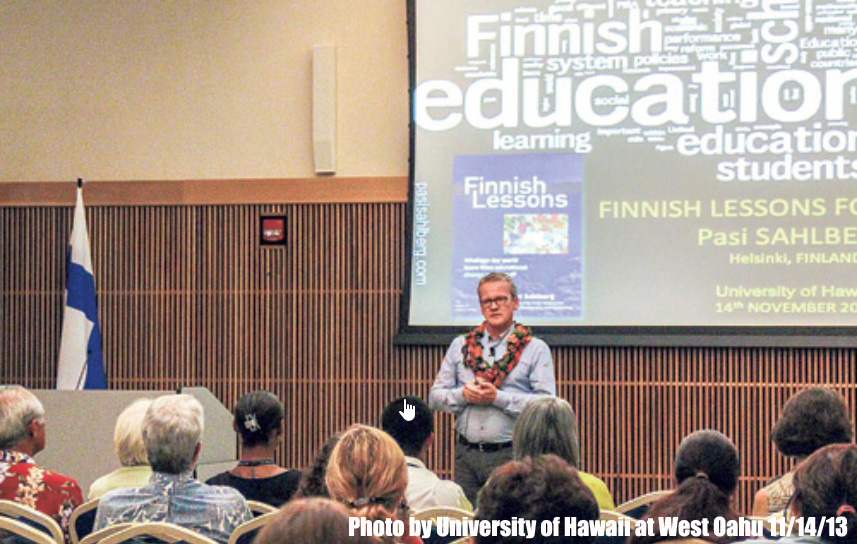
Pasi Sahlberg1 talked about the Finnish comprehensive public education system at the University of Hawaii at West Oahu on 14 November 2013 (Essoyan2). The system ranks among the highest in the world in PISA (Programme for International Student Assessment) and other international tests. It is free for students from preschool through higher education and is considered a model for the rest of the world.

Pasi Sahlberg at the University of Hawaii at West Oahu on 11/14/13.

Pasi Sahlberg at the University of Hawaii at West Oahu on 11/14/13.

Features of the system have been widely covered for years3, so I won’t go into them. What’s worth highlighting in Sahlberg’s talk at West Oahu, however, is his caveat that “‘what works in Finland doesn’t necessarily work someplace else.'” In other words, we can’t and shouldn’t simply port Finnish practices over to the U.S. and hope for the same results.

Sahlberg presented “slides showing that the more unequal the distribution of wealth in a country, the lower the test scores tend to be.” The United States, he said, “has high inequality and relatively low academic performance, while the reverse is true for Finland.” According to Sahlberg, the U.S. is “‘one of the most unequal countries in the developed world. There is a big gap between those who have and don’t have.'” He characterized Finland as a lot more egalitarian. “‘Somehow,'” he said, “‘the equity and excellence go hand in hand'” (Essoyan).  Continue reading

A Caltech Grad in a Caltech MOOC, Part 4 (updated 12/8/13)

picture of Harry KellerBy Harry Keller
Editor, Science Education

[Note: Harry, who holds a BS in chemistry from the California Institute of Techology and a PhD in analytical chemistry from Columbia University, is sharing his first MOOC experience in this series. See part 1, 2, 3 and 5. -Editor]

November 12, 2013

Week six was not an easy week. Some emergencies took away time I had expected to spend on the course. The material was interesting but difficult. The pace was rapid.

This week, we learned about the crucial issue of overfitting in machine learning and about its cure, regularization. These are not topics for the faint at heart because they go deep into the world of machine learning and involve a great deal of mathematics.

The homework was both hard and easy. Once again, I was tested on my programming ability more than on my understanding of the topics in a few of the questions. I’m not sure how one might create a course on machine learning that did not include writing software because machine learning, by definition, uses computer algorithms.

I find the homework deadlines both useful and frustrating. Were it not for the deadlines, I’d have plenty of higher-priority things to do and probably never get it done. However, I constantly have to deal with being unable to plumb the depths of the material or even complete the homework satisfactorily in the time available. This course certainly does not allow one to proceed at one’s own pace, although it does allow you to set your own schedule within the course calendar.

The mathematics continues to use the full panoply of mathematics symbols and expressions. Do not go near this course without a very good background in advanced mathematics: calculus, set theory, matrix algebra, and more.

I feel that I’m being asked to learn much more than I have to learn. This is supposed to be an introduction to machine learning. I’m rather intimidated by the prospect of an advanced course. Yet, the pearls of learning are there to be gathered, scattered among all of the mathematics, abstruse concepts, and software writing. This is not a mere aggregation of tools. This course provides a sound mathematical footing for every tool provided — if you can hack the math.

I had absolutely no time to even peek at the discussions this week but didn’t really have to because the material was clear enough, and the homework was also clear while being mostly tough. One or two questions were fairly easy to answer, but the rest took some work.

Looking at the answer key, I discovered that I shouldn’t have changed my answer to one of the questions, but I do not understand why. I still think I had the right answer the second time.

The final grade on the MOOC is not in yet, but I’m guaranteed a homework grade of at least a B and a course grade of a C at this point. The next lecture, on validation, looks like it will be one of the most valuable yet. I just wish I knew that I am learning everything well. With this sort of MOOC, that’s a real challenge.

[Update 12/8/13 – Harry submitted the following report on 11/18/13, but I didn’t see it in my mailbox until this morning. My apologies to Harry and to you, the readers. -Editor]

November 18, 2013

The lectures this week were very informative. The homework was another matter entirely. Possibly, I’ve topped out here, but there was a significant issue that should be addressed. Continue reading

Can America’s Wasted Talent Be Harnessed Through the Power of Internet Based Learning?

Jim_Riggs80By Jim Riggs
Professor, Advanced Studies in Education
College of Education
CSU Stanislaus
President Emeritus, Columbia College (1997-2007)

For nearly 150 years, the American dream of a better life of economic success and advancement has been found largely through the narrow path of higher education. However, access to traditional higher education has always been limited to the top one-third of the adult population and by all indications will continue to be rationed at this level or less into the foreseeable future. Peter Smith, in his 2010 book, Harnessing America’s Wasted Talent: A New Ecology of Learning, points out that while traditional higher education will continue to serve this segment of the population, educational leaders must find alternative ways that will effectively meet the postsecondary education needs of a much larger segment of the adult population.

Smith is not alone in this thinking. There have been numerous reports in recent years that have also called for greater access, flexibility, credit portability and increasing degree completion for a much larger percentage of the adult population. In addition, many of these reports place a special emphasis on closing the growing achievement gap, which is increasingly leaving Latinos and African-Americans behind other groups when it comes to earning college degrees. Why is this important? There is a strong and growing consensus among policy makers, educators, economists and scholars that, if this country is to remain an economic superpower, a much larger and more diverse segment of the adult population must be better educated.

America’s current workforce is aging and retiring, and 85% of all new jobs now require some college education. A real crisis is rapidly developing  — America is finding itself with an escalating gap between the increasingly sophisticated workforce skill demands of the new economy and what the average American worker has to offer. In a 2011 report, The Undereducated American, Georgetown University professors Anthony Carnevale and Stephen Rose provide a strong argument that America will need a dramatic increase in the number of individuals with college degrees within the next decade. This increase in college graduates, according to Carnevale and Rose, is not only needed to help sustain the nation’s economic growth but will also help reverse the 30 year trend of growth in income inequity.

However, with the downturn in the economy over the past six years, we are once again reminded that a college degree alone is not a complete guarantee against economic challenges or underemployment. Economic growth and viability cannot solely depend on education. Nonetheless, according to the Bureau of Labor Statistics, the greatest predictor of personal income and employability for Americans still is, and will continue to be, their level of educational attainment.  Continue reading

Acronym in Cheek: STEM, STEAM…

picture of Harry KellerBy Harry Keller
Editor, Science Education

[Note: See Bob Hoffmann’s response in “Proposal for a Holistic Emphasis in K-12” (11/24/13). -Editor]

STEM (Science, Technology, Engineering, and Mathematics) has taken over from simple, unadorned “science” as the term describing our science classes. Because most of these classes use technology and mathematics already, the major change is the addition of engineering. Many science classes already had some sort of engineering-oriented activities they call projects. The NGSS (Next Generation Science Standards) has increased the emphasis on engineering.

STEM, as a moniker, has had such success that it has resulted in some copycat acronyms. Preeminent among these is STEAM, which adds art to the list. I have absolutely nothing against inserting art into science classes and even support the idea. However, the creeping growth of an acronym does bother me as does the omission of equally important areas of learning for students in science classes.

I also happen to think that that putting technology into the acronym is superfluous. I’d much prefer, for example, thinking as the T in STEM if you have that letter at all.

I have read many spirited discussions about STEAM replacing STEM, and they all seem to originate from teachers of traditional art classes where drawing, painting, and sculpting is taught. What about performance arts? What about music? I have not seen anyone agitating to add those to science classes. Why not?

There’s also the crucial role of history and social science in general to learning. There certainly is much history in science, both the history of science and the historical context. Our children can learn much from this analysis, possibly more than memorizing the names of U.S. Presidents or of the Kings of England along with dates. Why do we not see agitation for SHTEM or HEMST? Not a clever enough acronym? That’s hardly a sufficient excuse.  Continue reading

The Surface Pro 2 Will Be the Death of Notebooks

Jim ShimabukuroBy Jim Shimabukuro
Editor

Updated 11/19/13, 9/6/14

(Related articles: “Thoughts on the Surface Pro 2 After 8 Months” and “Why the Surface Pro 2 Will Be a Game Changer in the Tablet World Series.”)

About three weeks ago, when all I had to go on was reviews, I predicted that the Microsoft Surface Pro 2 (SP2) would be a game changer. I had just put in my order then and was told that shipment would be in mid- or late-December. Thus, I was surprised and happy to learn, in late-October, that it had been shipped for next-day delivery. It arrived on schedule, and in the time it took to remove it from the packaging, plug it in, and turn it on, I knew that the notebook was dead.

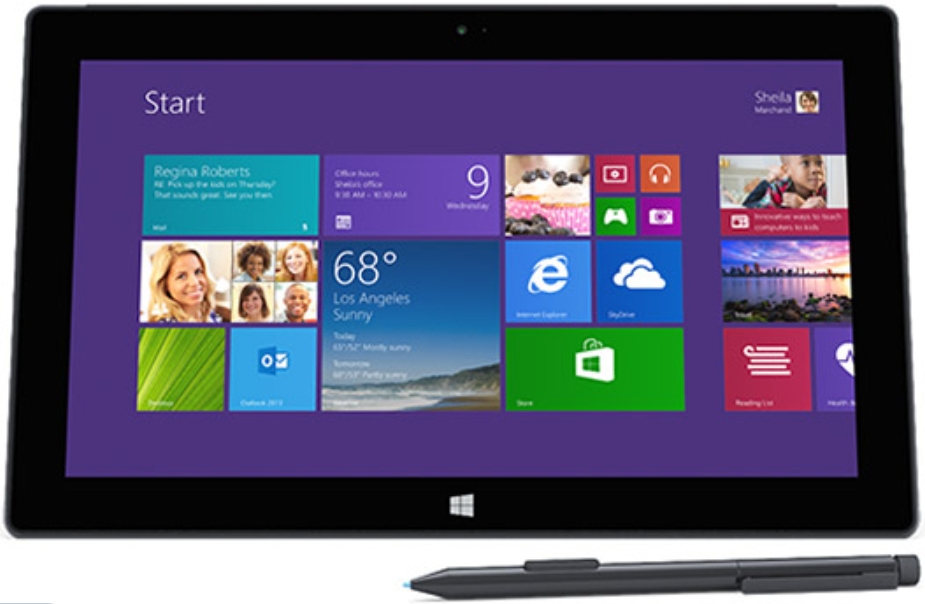
Surface Pro 2 with type cover and digital pen.

Surface Pro 2 with detachable type cover and digital pen.

I’ve had it for about a week and haven’t had time to do more than a few things, but what I’ve seen is impressive. The look and feel reminds me of the original iPad and iPhone4 — which I’m still using. Rock solid and sleek, beautifully engineered. In contrast, the clamshell notebook with its hinged keyboard suddenly seems odd, anachronistic, looking more like yesterday’s typewriter than tomorrow’s computer.

Don’t get me wrong. The SP2, like the original iPad, is far from perfect, and better and less expensive models from Microsoft and competitors will soon be flooding the market. However, it’s more than done its job as a groundbreaker. In short, it’s the first viable full-blown Windows PC in a tablet chassis.

Form factor alone, however, wouldn’t be worth much if the tablet couldn’t perform. The big question for me was — and still is, to some extent — will it perform?

In size, it’s slightly larger than the original iPad and only a half pound heavier. But the difference in terms of sheer power is huge. The SP2 runs the 64-bit version of Windows 8.1, MS Office 2013, and everything else you can run on a notebook or desktop. It has a high-resolution 1080p display and an HDMI port. Plug in a 26″ 1920 x 1080 monitor and you have all the size you’ll need. It has a standard USB 3.0 port and a micro-SD card slot. Plug in an external two-terabyte drive, a CD/DVD player-recorder, a thumb drive, or an SD card for more onground storage.  Continue reading

An Interview with Tom Preskett: The Evolving Role of a Learning Technologist

Jim ShimabukuroBy Jim Shimabukuro
Editor

Updated 11/6/13, 5:40am HST.

Introduction: Tom Preskett was a staff writer with ETCJ from 2008-2011, and we make it a point to touch bases with him from time to time. For example, in 2012, he wrote A Londoner’s View of the 2012 Olympics: Live Feed of All Sports at Any Time!. He brings a reflective insider’s view of what it means to be a learning technologist in the most exciting period in the history of the field. The following interview, conducted via email over the last few days, is prompted by his recent move from the London Centre for Leadership in Learning, Institute of Education, to Nord Anglia Education, Oxford.

JS: Tell us about Nord Anglia Education.

TP: Nord Anglia Education is a premium schools organisation. We own 27 schools located in South East Asia, China, Europe, North America and the Middle East. Most of our schools follow a curriculum based on the National Curriculum of England, adapted country by country to meet local culture and conditions.

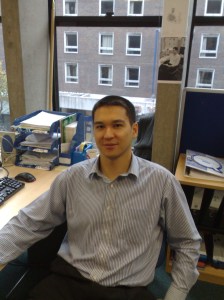
Tom Preskett

Tom Preskett, Learning Technologist, Nord Anglia Education.

To support these schools are two online environments. One aimed at the students, the Global Classroom, and one aimed at the teachers, Nord Anglia University. Both are moodle environments although they don’t act like traditional virtual learning environments. Our online environments tie together as each school has a moodle, and authentication carries across the Global Classroom and Nord Anglia University. The ethos is one of High Performance Learning as created by our educational director, Professor Deborah Eyre. You can read all about this in her paper “Room at the Top.”

Continue reading

A Caltech Grad in a Caltech MOOC, Part 3

picture of Harry KellerBy Harry Keller
Editor, Science Education

[Note: Harry, who holds a BS in chemistry from the California Institute of Techology and a PhD in analytical chemistry from Columbia University, is sharing his first MOOC experience in this series. See part 1, 2, 4 and 5. -Editor]

November 2, 2013

The discussions should play a larger role, but I have found them to be unsatisfying. Either they’re about esoterica or trivia. Perhaps, I’m too pragmatic for this course. It’s not just about the course; it’s also about the students. It’s clear that not all students and courses go together.

I think that I’ve already gained the most important insights into machine learning from this course, how to know whether a given situation lends itself to this valuable tool. Completing the course will expand the machine learning options and my depth of understanding of how to use them.

Last week, I didn’t have the time to visit the discussion groups. This week, I don’t feel the necessity but may do so just to see what’s going on.

November 4, 2013

As I work on the fifth homework assignment, I’m not sure whether I’ve become smarter or the homework has become easier. Last week was very hurried, and I stumbled badly. This week went along nicely. There’s still plenty of mathematics, more than you might imagine, but the concepts seem more manageable.

When I began, I only knew a bit about this field from my days as a university professor when a colleague published papers about machine learning used to identify compounds in gas chromatograph tracings and spectroscopy. It was a promising area then.

Continue reading

New AACE Special Interest Group on ‘Assessing, Designing and Developing E-Learning (ADD)’

By Stefanie Panke
Editor, Social Software in Education

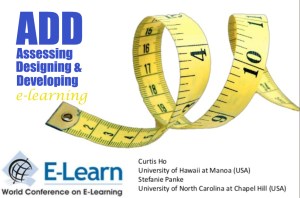
The Association for the Advancement of Computing in Education (AACE) has launched a Special Interest Group, “Assessing, Designing and  Developing E-Learning” (ADD). You do not have to be an AACE member or an attendee of previous AACE conferences to  join — though some activities will be tied to the E-Learn 2014 conference to be held in New Orleans from October 27-30, 2014.

The SIG had its inaugural meeting during the AACE E-Learn 2013 conference. If you missed it, review our presentation for collaboration ideas.

ADD3

Based on the discussion during the SIG meeting on Oct. 23, we have initiated first community activities:

  • To facilitate SIG projects, discussions, meetings and publications we want to learn more about your background and interests. Please take 10 minutes (or less) and fill out the survey.
  • We created a LinkedIn group for our SIG members to communicate with each other. Here’s the link to the LinkedIn group – join us there.
  • Are you a member of the AACE network Academic Experts? Learn more about the SIG.

Our next step is to see what information the survey brings in and share this with our SIG. We are excited about the many possibilities for collaboration and look forward to meeting again at E-Learn 2014 in New Orleans. In the meantime, stay connected through ADD SIG events and activities.

Please feel free to share this information with interested peers.

Curtis Ho and Stefanie Panke
Chairs, ADD (Assessing, Designing & Developing E-Learning)

A Caltech Grad in a Caltech MOOC, Part 2

picture of Harry KellerBy Harry Keller
Editor, Science Education

[Note: Harry, who holds a BS in chemistry from the California Institute of Techology and a PhD in analytical chemistry from Columbia University, is sharing his first MOOC experience in this series. See part 1, 3, 4 and 5. -Editor]

October 19, 2013

The third week of this MOOC unveiled to me a problem with MOOCs. Not every student is a “student.” I am not really a student. I have conflicting priorities that few students have. Sure, some have jobs and family responsibilities. Generally speaking, they can leave their jobs behind when they leave their jobs.

As an entrepreneur, I am “on call” 24/7. I have to “steal” a few hours a week for this MOOC. I have a goal that may help my business — or may not. The MOOC has to be a low priority. I have no way of knowing when I can watch the lectures or do the homework beforehand.

If you cannot set aside a definite and adequate number of hours every week, you may not be able to achieve all you wish with your MOOC.

This has been a very busy week. I already have two full days committed next week. By full, I mean from arising to falling asleep, not a mere 8 or 9 or 10 hours. There will be not a minute for MOOCs.

Last week, I managed 8/10 on my homework due to not paying attention when I encoded my answers as (a) through (e). This week I paid attention to that but did not have time to analyze my answers as fully as I would have liked. Instead of the recommended ten hours spent on homework, I spent about one. My 7/10 on the homework reflected this less deep thinking.

One problem I missed had me determine the largest number of points that can be shattered by a planar triangle learning model. I really thought that I understood this problem but clearly did not. I don’t really have the time to figure out why.

The last problem in the set required finding the growth function for a planar annulus training model. I was able to find the answer quite nicely and got it right.

The good part about this homework is that I did not have to write any software. The two previous homework sets required considerable amounts of programming. You could make a mistake in understanding or in coding. Having two modes of error made the exercises more stressful than usual.  Continue reading

Qualities for a Strong Online vs. F2F Teacher: Are They Different?

Joseph Chianakas80By Joe Chianakas

[Note: This article first appeared in ETCJ as a comment on “Online Learning 2012: Six Issues That Refuse to Die” (12/29/11) on 10/22/13. -Editor]

Improving education and instruction, whether it’s online or F2F, is all about the quality of the teacher. It goes without saying that a bad instructor will create a bad environment, in either setting. A great instructor will have a positive impact on students, no matter the environment. So the questions I would add are: What are the characteristics of a strong educator? Are there different characteristics for the online instructor compared to the F2F instructor?

What are the characteristics of a strong educator? Are there different characteristics for the online instructor compared to the F2F instructor?

A good online instructor must be well-organized, must create a solid structure within the CMS, and must be active and involved with the students. A good F2F instructor? Well, it’s similar, right? So what are the differences?

I think it helps to have a strong personality in the F2F environment, and for me, it’s that social interaction that I enjoy the most about teaching. I build rapport with my students, and I think that makes them enjoy class more and, thus, learn more. It sure makes me enjoy my career more.

Can we do that online? Many try, but it’s not quite the same. Then I wonder: So am I selfish? Do I just want to enjoy my work more? Maybe.

I do know without a doubt that teaching online has enhanced my F2F classes. It has improved my organization, my rubrics, my instructions, and much more in the F2F classroom. It’s easy to sit down and talk to someone about a topic or assignment. It’s significantly more challenging to clearly articulate strong discussion topics and assignments when teaching online.

I really enjoy thinking about these questions. I want to be the best educator I can be, no matter where I’m teaching. And I think it’s important for people to know that we can all learn from one another — that there is value in reflecting what we lose or gain in either medium of teaching. I want to keep asking questions like these and those in the article, and I want to get better at what I do without insulting anyone’s teaching or teaching preferences. Let’s simply strive to improve.

Why the Surface Pro 2 Will Be a Game Changer in the Tablet World Series

Jim ShimabukuroBy Jim Shimabukuro
Editor

Last updated 9/6/14

(Related articles: “Thoughts on the Surface Pro 2 After 8 Months” and “The Surface Pro 2 Will Be the Death of Notebooks.”)

I’m one of the 15 million who bought the first generation iPad in 2010-11, and I’m still using it today as a flexible extension of my desktop. I can take it anywhere within my WiFi zone and have instant connection to the web. Press, sweep, and tap, and I have my email. Tap and tap, my favorite websites. Tap and press, I’m done. No desk, no mouse, no keyboard, no waiting around.

Microsoft Surface Pro 2

Microsoft Surface Pro 2

But it’s not a desktop PC, and it still can’t do some of the basics. It can handle email, both reading and writing, but it can’t multitask very easily. This means that any task that requires grabbing info from one app and using it in another is iffy and requires so many steps that it’s almost not worth doing unless you’re desperate.

My iPad also can’t do standard PC apps such as MS Word and Excel and the gazillion little utilities that I can’t live without, and its ability to handle the vast range of webpage styles is poor, which makes web browsing and research a more miss than hit exercise. There are countless workarounds for mainstream desktop programs and app alternatives for mobile devices that are supposed to render standard websites readable, but these are clunky and offer poor alternatives to the real deals.

My iPad can’t handle images and videos very well, and it balks at most online video formats outside of YouTube. Thus, it’s a great tool for what it can do, but it leaves me on a short tether to my desktop.

I’ve been closely following the 2nd-to-4th generation iPad releases, but I haven’t seen the breakthroughs that I need. I also have an android tablet to keep an eye on what’s happening in that sector, but the issues are similar.  Continue reading