Digital literacy an elementary skill by Ellen Ciurczak in The Clarion-Ledger (11/30/14)
The teachers at Petal Upper Elementary School believe that you can’t start too early teaching students how to acquire a variety of skills using computers, from Internet safety to keyboarding skills.
A valuable lesson on bullying in observer-reporter.com (11/30/14)
Bullying and cyber-bullying are serious problems that many young people have to deal with. Elissa McCracken, Miss Ohio 2012, chose cyberbullying as the issue she would focus on during her term because she was a victim of bullying herself.
You may have noticed recent news about Stephen Hawking predicting the demise of the human race due to the rise of artificial intelligence (AI)1. Others of genius rank, such as Elon Musk and Ray Kurzweil2, have also made this prediction. With “The Theory of Everything” (biopic about Prof. Hawking) in theaters right now, this prediction is resonating across the English-speaking world.
Before digging your shelters or heading for the hills, you should ask, “What is artificial intelligence?” A bit of history may help put this entire subject into perspective. The term was coined in 1955 by John McCarthy, who called it “the science and engineering of making intelligent machines.”3 “When?” you ask. “That’s nearly 60 years ago! Before I was born!” (I actually was born well before then, but statistically you probably weren’t.)
Funny how AI has not taken over the world in the 60 years it’s had so far. Why the sudden worry? Computers are becoming more powerful and less expensive. Computer memory is dirt cheap, speaking historically. This trend of more computer power and more memory shows no signs of abating soon. Could it eventually reach the tipping point where machines are sentient and self-reproducing? Would they then remove the “scourge” of humans from the Earth’s surface? Might the end be less dramatic in that they would render people superfluous? Imagine a world in which all work, including creative work, is done by machines. Who needs Beethoven when you have the Ultra-Composer Mark IV?
This entire discussion circles around to defining machine intelligence and estimating exactly how smart machines might become. Right off the bat, understand that intelligence, as we commonly understand it, has not been seen in machines yet. No one truly knows if it ever will be. To comprehend why, you must have a feeling for the nature of computers and computing. Continue reading →
The film that inspired the empowering real-life movement supported by celebrities such as Miley Cyrus, Lena Dunham, Russell Simmons, Rihanna, Cara Delevingne and many more!
#FREETHENIPPLE
Starring Lina Esco (LOL), Lola Kirke (Gone Girl),
Monique Coleman (High School Musical) and Zach Grenier (“The Good Wife”)
Directed by Lina Esco
SUNDANCE SELECTS WILL RELEASE FREE THE NIPPLE ON
DECEMBER 12, 2014, THEATRICALLY AND ON VOD.
WHAT IS FREE THE NIPPLE: Today, in the USA it is ILLEGAL for a woman to be topless in 37 of the United States of America in some states that includes breastfeeding. In less tolerant places like Louisiana, a woman exposing her nipples can carry a sentence of up to three years in jail and a $2,500 fine. In New York City, in 1992 it became LEGAL for women to be topless in public, but the NYPD continued to arrest women, so we took to the streets with cameras and our cast to fight these Puritanical injustices first hand. By the end the production, Free The Nipple morphed into a “real life” revolution that transcended the bounds of mere entertainment. Famous graffiti artists, mobs of dedicated women, and celebrities from Miley Cyrus to Liv Tyler and Lena Dunham jumped on board and ignited a national media blitz that has transformed into a powerful movement to Free The Nipple in America. Other celebrity supporters include Cara Delevingne, Shepard Fairey, Kendall Jenner, Adrian Grenier, Rihanna, Elizabeth Jagger, Scout Willis, Rumer Willis, Soko, Suki Waterhouse, Kellan Lutz, Dree Hemingway, Russell Simmons.
ABOUT THE FILM: A group of fearless women fight for their right to go topless in public, as they smash societal taboos one bare breast at a time. Based on a true story, this spirited satire follows New York City activists Liv and With, who take their crusade for gender equality from the streets of the urban jungle to the courts. More than just a movie,Free the Nipple has launched an empowering real-life movement, inspiring women across the globe to take back their bodies.
Director: Lina Esco
Writer: Hunter Richards
Producers: Lina Esco, Hunter Richards, Lisa Azuelos, Julien Madon
Co-Producer: Gigi Graff
For more information please visit http://www.freethenipple.com
Amersfoort,1st December 2014 – Mars One is proud to present the ten Mars One University Competition finalists eligible to fly to Mars. One of these ten payloads will receive the once in a lifetime opportunity to fly on Mars One’s first unmanned Lander mission to Mars in 2018. For the first time ever the public will be able to decide which payload receives the extraordinary opportunity to fly to Mars.
The ten remaining projects from an initial 35 submissions were submitted by diverse universities worldwide. In order to get this far, the payload proposals needed to meet all requirements as described by Mars One supplier Lockheed Martin. Mars One community members, social media followers, and the general public will have the opportunity to vote on and select the winning payload. Voting opportunities for the public will be opened in the first weeks of December, 2014. Voting submission will be accepted until December 31st, 2014.
The winning university payload will be announced on January 5th, 2015. The winning payload needs to be feasible and meet the requirements and restrictions as outlined in the Proposal Information Package (PIP) and on-going discussions with Lockheed Martin, who will build the 2018 lander. Additionally, if in any case the winning team can not perform or adjust to additional requirements the runner-up will be chosen instead.
Arno Wielders, Co-founder & CTO of Mars One said, “These ten final projects are unique and creative and we are very happy with the payload proposals these teams have presented. It would be highly interesting to see each and every one of these projects being launched to Mars. Now it is up to the public to decide which project they would like to have on Mars.” Continue reading →
Playing High-Action Video Games May Speed Up Learning, Studies Say by Sarah D. Sparks in Education Week 11/13/14
Sparks reports on a study in the December issue of Human Movement Science that contradicts earlier research which connects extensive video game play to attention-deficit disorders and other impulsiveness disorders. The authors contend that “game playing can improve students’ attention control” and create better learners.
Smartphone addicts: A project-based learning activity by Alexandra Lowe in TESOL blog 11/5/14
Lowe describes how she used the idea of a Smartphone survey to move English language use outside the classroom. In groups students developed and conducted surveys about Smartphone use.
Learning languages is a workout for brains, both young, old by Victoria M. Infivero from Science Daily 11/12/14
Using MRI scans, researchers at Penn State have demonstrated that even the adult brain grows and changes when learning a new language. They are also using “virtual 3-D-like environments with situation-based learning to help the brain make some of those new connections more effectively.”
Report Urges Caution on Approaches Equating Technology in Schools with Personalized Learning by William J. Mathis and Noel Enyedy, from NEPC 11/24/14
This policy brief addresses the increased use of technology in schools and questions its effectiveness. The authors point to a number of factors, including the fact that teaching practices and learning outcomes often have not changed.
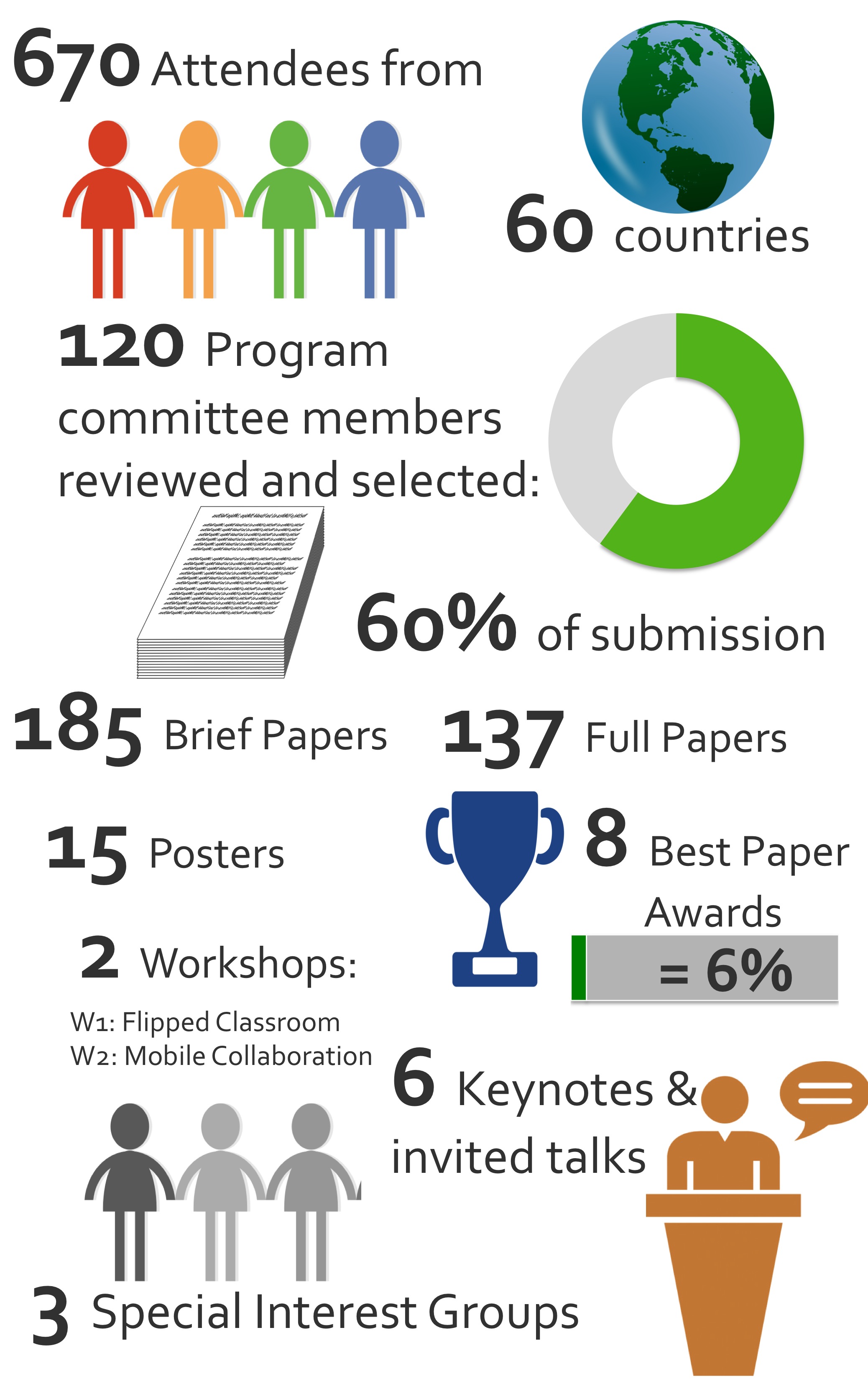
The 19th annual international conference AACE E-Learn took place from October 27-30 in the sunny, warm and welcoming climate of the city of New Orleans. The conference attracted 670 participants from 60 different countries who enjoyed four days of workshops, keynotes, presentations, symposia, SIG meetings, posters, and, last but not least, informal discussions and networking opportunities during the session breaks.
Conference infographic by Stefanie Panke.
AACE E-Learn Conference
What sets AACE conferences apart from other events in the educational technology community is the rigorous peer review process in the selection of presentations. Instead of simply submitting an abstract, AACE requires a full manuscript of 6-10 pages. While writing skills do not always and certainly not necessarily translate into great presentations, the quality off contributions is generally high. This also makes the conference proceedings (available in the AACE digital library EditLib) a really great resource for an up-to-date overview of the current state-of-the-art in educational technology. While access to the proceedings is generally restricted to conference participants and subscribers, several papers that were honored with an outstanding paper award are openly accessible:
The best paper awards mirror the diverse spectrum of the conference. E-Learn is a place where educational technology researchers, developers, and practitioners from higher education, K-12, nonprofit and industry sectors meet – brought together by a joint focus on leveraging technology for achieving instructional goals.
My Conference Experience
This conference report is my personal eclectic account of E-Learn 2014. My schedule was packed this year: Not only did I, in a hyperactive mood, choose to deliver three talks, but I also had a symposium and a special interest group meeting to moderate and an executive committee meeting to attend. Luckily, the overall conference atmosphere, the great discussions during the special interest group meeting, and the thoughtful feedback, ideas, encouragement and contributions by numerous conference participants made all of this fun. Continue reading →
CALL FOR PROPOSALS
Please consider submitting a proposal for a paper or general session relating to all aspects of educational technology, including but not limited to e-learning, open education, ICT, online communities, social media, augmented reality, educational gaming, faculty & student support, Web 2.0 tools, international education and mobile learning. We also encourage retrospective presentations, personal experiences, and forecasting the future.
VENUE
For our 20th anniversary celebration, there are two options: (1) ONLINE only or (2) ONSITE. Onsite sessions will run from March 18-19 at the University of Hawaii at Manoa Campus Center, and participants will also have access to all online sessions from March 17-19. All onsite sessions will be streamed to online participants.
For onsite participants: We’re offering an optional educational tour of Kamehameha Schools and a stopover at Kapiolani Community College for lunch and a talk at CELTT (Center for Excellence in Learning, Teaching and Technology). We’ve also arranged for a block of low cost housing options at the East-West Center (Lincoln Hall) and at Ala Moana Hotel.
TCC Hawaii, LearningTimes, & the Learning Design and Technology Department, College of Education, UH-Manoa collaborate to produce this event. Numerous volunteer faculty and staff worldwide provide additional support.
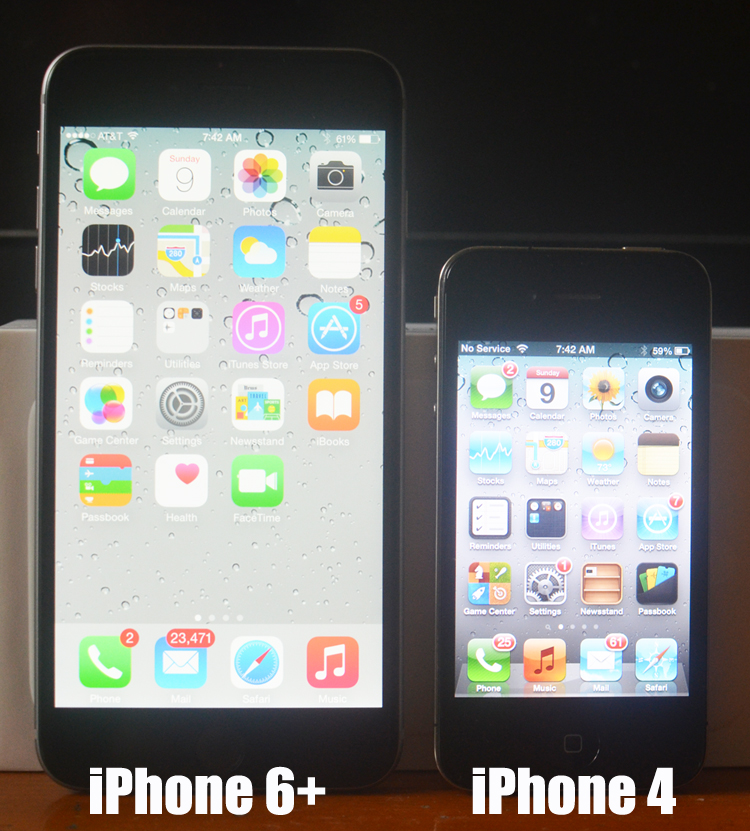
The iPhone 6 Plus arrived via USPS priority mail yesterday, so I’ve had it for a little over a day. My first impression is that it has a completely different look and feel from the iPhone 4, which I reviewed in July 2011. The 4 has a solid industrial feel that’s enhanced by sharply beveled edges. I like the way it looks and feels in my hand. The 6+, in comparison, feels fragile, perhaps because of its thinness and rounded edges. This sense of fragility, however, is gradually fading the more I handle it. My guess is that it will take a few days for a new muscle memory to replace the old.
iPhone 6 Plus: 6.22 x 3.06 x 0.28 inches, 6.07 ounces. iPhone 4: 4.5 x 2.31 x 0.37 inches, 4.8 ounces.
The most critical factor for me is hand fit. It has to feel comfortable. It took a few hours to adjust to the size difference, especially the length, 6.22″ vs 4.5″. The width difference, 3.06″ vs 2.31″, is noticeable, but it’s surprisingly comfortable in my hand. My immediate thought was that the next version of the plus could easily be an inch wider (4″ instead of 3″) and still fit the average-sized hand.
iPhone 6+ and iPhone 4 width: 3.06″ vs 2.31″.
The next critical factor for me is pocketability. It has to fit comfortably in my pants pocket. The 4 fits in any and every pocket. The 6+ fits best in the front pockets. It’s slightly heavier than the 4, 6.07 vs 4.8 ounces, but it actually feels lighter in my pocket. This sensation is probably caused by its dimensions. It’s less dense. Taller, wider, and thinner, the weight is spread out whereas the 4 is concentrated in a smaller area.
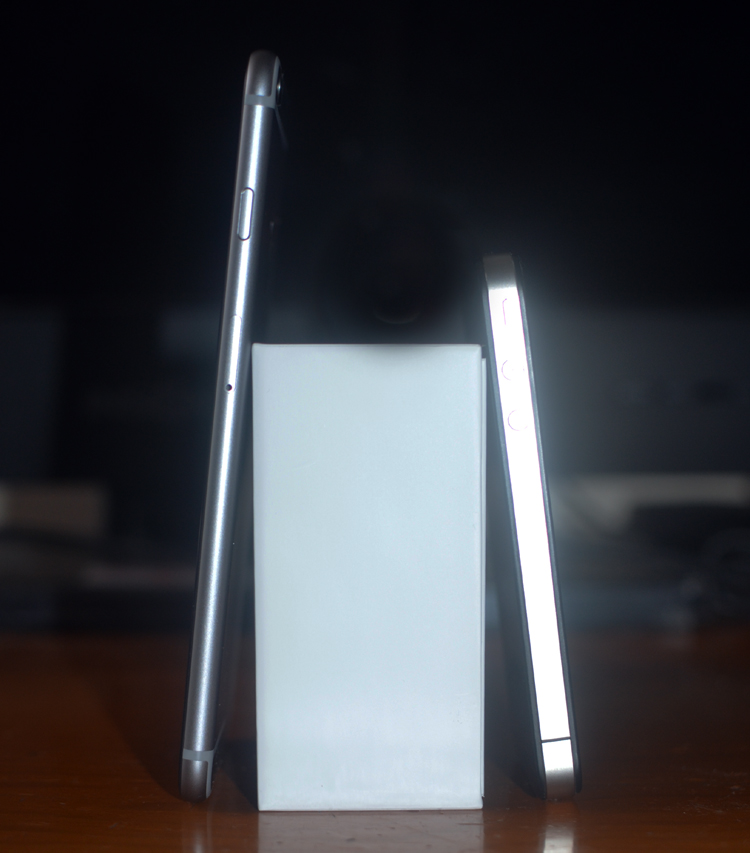
iPhone 6+ and iPhone 4 thickness: 0.28″ vs 0.37″.
I take my iPhone with me on walks and use it as a music player with in-ear headphones. The 6+ felt comfortable in my right front pocket. I slipped it in upside down because the 1/8″ headphone jack is on the bottom edge. The +/- volume buttons are in the same place as the 4’s, and I’m able to adjust volume from outside the pocket while walking. Continue reading →
Impacts of MOOCs on Higher Education by Allison Dulin Salisbury, from Inside Higher Ed
Although she comments that they are much criticized, the author focuses on positive outcomes of MOOCs such as the increased awareness by institutions of higher education that the digital age is here to stay. Read the comments, too, because a reader takes her to task for ignoring some data and this sparked a lively discussion.
When Students Get Creative With Tech Tools, Teachers Focus on Skills by Jennifer Carey from MindShift
All students need to learn how to use reading, writing, speaking and listening skills. The skill(s) the teacher wants the students to work with should be central to any lesson, including one infused with technology. Carey reminds readers that focusing on the skills rather than the tools results in effective learning. Digital tools should be used like any other teaching strategy; identify the skills you want your students to learn then decide how they will do it.
Latest games are finally unlocking the key to making learning more fun by Emmanuel Felton from Hechinger Report
Kids learn from games without realizing they are learning. Some educational game developers assert that gaming can go beyond using games to students’ actually designing and building games, using higher order thinking skills as they work collaboratively.
What Are the Most Powerful Uses of Tech for Learning? By Katrina Schwartz from MindShift
In order for technology to be an effective learning tool, the learner first needs access. Then they need the knowledge to go beyond just being a consumer of information to being an active participant in the digital world. Teachers can be and are at the center of this type of deeper and more meaningful learning.
Only a few true nerds, such as myself, will be at all challenged with Big Hero 6. Let me explain.
Big Hero 6 is about four students at San Fransokyo Institute of Technology (SFIT), the younger brother of a fifth, and a robot. These are the “6” in Big Hero 6. The catch here is that these “super heroes” don’t have mystical powers. Their performance boosts come from technologies that they create.
The lead character is Hiro Hamada (Ryan Potter) who is a wild genius youth who enjoys bot fights instead of the serious business of school. His older brother, Tadashi, tries to dissuade him from wasting all of his talent on underground bot fighting and finally breaks through. He gets Hiro hooked on being a student at SFIT. There’s a catch. SFIT is a robotics-oriented school, and you must show your ability to get in. Hiro must demonstrate his capability to the faculty of the school by showing actual robotics.
How he does so and what happens next set the course for the film. There’s just enough scariness and just sufficient levity associated with it to please school-age children. I’ll be taking my grandsons (aged five and seven) to see this movie two days after it opens and will share their reactions with you then.
The robot member of the six is the most unlikely hero you’ll ever meet. Baymax is voiced perfectly by Scott Adsit. He is a healthcare robot, a nurse, who looks like, as the script puts it, a marshmallow. He is white and squishy — inflated actually. He has a large pot belly and walks like a penguin. This robot is the legacy of Tadashi, his ultimate creation.
Besides Hiro and Baymax, the six include Go Go Tomago (Jamie Chung) who is a speed freak, Wasabi (Damon Wayons Jr.) who has terminal OCD and looks like he spends too much time in the gym, Honey Lemon (Genesis Rodriguez) who seems out of place in a robotics school because her expertise is in chemistry, and Fred (T. J. Miller) who just likes to hang out with the smart kids at SFIT. Continue reading →
Interstellar is a great story with excellent acting, especially from Matthew McConaughey and Mackenzie Foy. For me, the three hours felt more like a normal two. Like the characters in the movie, I was asking where the time went.
In the not-to-distant future, maybe 20-30 years, the Earth is in real trouble. All efforts are now focused on food. Climate change has destroyed much of our ability to grow crops. National budgets have even eliminated defense spending.
Cooper, a former NASA test pilot, is now a farmer struggling against ever-increasing problems of drought and blight. He stumbles across strange gravity messages that direct him to the remnants of NASA run by Professor Brand (Michael Caine).
The film revolves around the relationship between Cooper and Murph (Foy and, later, Jessica Chasten, and, even later, Ellen Burstyn). This is the emotional center of the movie and the important love story. Oh, there’s another standard love story as well but one that definitely is not strongly promoted in the story.
Needless to say, there are adventures and sacrifices made, and the intrepid astronauts save the world through a combination of love, luck, and lots of fancy mental gymnastics.
If you’ve seen a trailer, you’ve seen a mountain-size ocean wave approaching people standing in calf-high water. These waves are continual on this odd planet and also are completely unexplained and irrational. What force could have moved so much water — over and over again? This is just the beginning of making this movie exciting while ignoring reality. Continue reading →
The new movie, The Theory of Everything, is about the life of Stephen Hawking from his graduation from Oxford to his becoming famous and then separating from his devoted wife of over a quarter century. Please, everyone, go to this movie. Why? Because it’s a good story, well acted and directed, and because you will be supporting the concept of telling the stories of scientists in movies. We must have more of this.
Stephen has a special resonance with me for strictly non-scientific reasons. We were born in the same year. We both entered prestigious colleges at the same age, 17, and went on to prestigious graduate schools for our doctorates. We were both married in the same year, he to Jane and I to Jayne. Of course, there are innumerable differences to balance these few coincidences. I majored in chemistry, he in physics. I have enjoyed rather good health overall. He is outrageously famous, while I labor in obscurity. And so it goes.
Before getting to the science, I’ll praise Eddie Redmayne for his uncanny portrayal of Stephen Hawking. From the early stumbling to the later crablike fingers and the difficulty in forming words, he nails Hawking in a manner that I never would have believed. Especially moving are the scenes in which he has the twinkle and slight smile showing Hawking’s personal joy at special moments and his puckish sense of humor.
This is a wonderful love story in which personal connection overcomes insurmountable odds. Jane (Wilde) Hawking’s (played by Felicity Jones) indomitable spirit lifts Stephen Hawking to the threshold of his greatness. We see this spirit and unwillingness to give up displayed several times in the movie. The very fact that Jane has three children, the last when Stephen is unable to move from his wheelchair speaks volumes about her. Ms. Jones brings a real sense of what the actual Mrs. Hawking must have felt to many of the scenes in the movie. Continue reading →
Recent news of a drop in iPad sales1 by Apple triggered some thoughts. Reporting that educational sales of iPads are still on the rise prompted more thinking. Then, I found that some of our customers had a very interesting response to our queries about this area.
We deliver our software as HTML5, making updates unnecessary and allowing for the software to run on any platform: iPad, iPhone, Android device, Chromebook, MacBook, MS Surface, Linux desktop, etc. We can readily convert the software to an iOS app and to an Android app. The question we asked is, “Should we?” The answer, at least from schools, was as resounding “No!”
Making predictions is a very risky business, if you care about your credibility. I am going out on a very long limb by making two predictions for the future. Any number of new developments can make these predictions wildly inaccurate or could cement their certainty.
The first prediction is that iPads will continue the decline in sales and eventually level off. There will be some bumps in this path, of course, but the overall process is one of stagnation at best. The article gives some reasons. For example, people are not upgrading their old iPads as quickly as Apple had anticipated. An iPad is not an iPhone and does not engender the mass hysteria with respect to new versions that you see with such a constantly visible status symbol as your cell phone.
Those tablets also don’t have as many preferred uses as many had predicted. Most who can afford an iPad also have a “real” computer that they use for power applications such as word processing. The tablet is mostly used for videos, music, email, texting (when not using the cell phone for that), and so on. In brief, tablets are not supplanting computers in large numbers. Given a computer and a cell phone, with screen size growing apace, the tablet is the “middle child” and is unnecessary to everyday functioning. It’s too large to carry in your pocket and too small for many serious uses.
The above is not to suggest that tablets will vanish, only that they will settle into a niche market until someone radically changes the interface. The touchscreen is magic for young children and some applications. My grandchildren took to them like kids to candy, even at ages 3 and 5. Still, a touchscreen interface can only take you so far. Adding three-finger gestures really doesn’t make it that exciting. The problems lie in two primary areas: screen size and computing power (CPU and memory). The apps for them have been designed to use what’s available. Continue reading →
On October 29, the New York Times published an op-ed by Frank Bruni1 that is based on a new book by Joel Klein (past chancellor of New York City Public Schools) and that has plenty of advice for educators. According to Bruni, Klein tells us that the primary issue in education is teacher quality.
Bruni’s analysis of Klein’s writing is good enough that everyone should read it and read between the lines too. Bruni also had the opportunity to interview Klein and asked some penetrating questions. Here are some bullet points that I have excerpted from the article:
• Stiffen the admission requirements for schools of education.
• Fix education school curricula, including ensuring teachers master their subjects.
• Create a rational incentive system for compensating teachers, a huge problem today.
You can read the article for the details. What does all of this have to do with technology? A great deal, actually, and in two important areas. The first area is teacher training. We can do much in this area, both with simulating teacher classroom experiences and with mastering subject matter. We currently train pilots with simulators before putting them in airplanes. The same thing could be done for teachers to help them more rapidly reach competency with student interaction, discipline, and engagement.
I am only intimately familiar with science education and can say that we have some great tools to advance science teacher understanding of their subjects. Too many science teachers enter classrooms unprepared to teach science for the simple reason that they do not understand the nature of science. It’s sort of like teaching chess without knowing how the pieces move. We can fix that. Continue reading →
Struggling with a cumbersome paper map is difficult and inconvenient, and then it begins to rain. Google Maps is a user-friendly alternative, a technological tool that can be accessed via a computer or a mobile device, compatible with both Android and iOS operating systems. This app offers users a variety of functions, increasing versatility and convenience. It is an innovative and handy tool that assists users in more than just arriving at their desired destination with great ease.
With Google Maps, users can type or say a street address, a point of interest, or a named location into the search bar. Kapi’olani Community College classmate, Kelsey Hardee, says, “Now that I have a moped, I love the voice option so I can be directed hands free!” Google Maps locates the destiantion on a map. From here, users have the option to seek driving, transit, walking, or biking directions. With multiple routes, users can select the one that is most convenient and meets their needs. After selecting their desired route, the application offers directions to the desired destination or an option to hear turn-by-turn navigation instructions, similar to those of a standalone GPS system. Additional features include satellite imagery, allowing users to access a street-view of the area, a particularly useful function that helps to increase visual familiarity of an area.
A recently added feature allows Google Maps users to explore nearby businesses, including eateries, hotels, malls, and other points of interest. This feature is complete with consumer ratings and reviews, business information such as hours and contact information, and driving, walking, biking, or transit directions to visit the point of interest. According to David Pogue of the NY Times, “Google’s points-of-interest database also excels.” While other apps offer a similar feature, many of them actually access Google Maps to provide location and directions. Google Maps is more effective and convenient since it reduces the number of steps in the process. Continue reading →
By Lynn Zimmerman
Associate Editor
Editor, Teacher Education
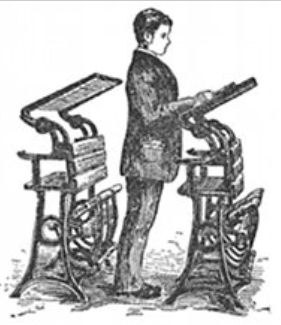
A few years ago I went to the Rutherford B. Hayes House in Fremont, OH. (In case you are wondering why, I had a friend who worked there at the time.) One of the things that struck me was his standing desk. When I first saw it, I assumed it was a podium for lecturing, but my friend informed me that, no, it was the desk where he often worked. Other than Thomas Wolfe (of Look Homeward Angel fame), who apparently wrote standing at his refrigerator, I had never heard of anyone standing and writing or doing other paperwork. I decided it must just be easier for tall people somehow and did not give it another thought.
Then, a couple of years ago I started having back and neck problems. I spend many hours, like many modern people, sitting in front of a computer for hours on end. After several doctor visits, I started changing the way I worked. The doctor gave me a website that would show me how to properly (ergonomically1) adjust my workspace. She also recommended a timer for my computer that covers your screen for a few minutes every so often. I did not do that, but I did start taking more frequent breaks. I mentally break my work into segments depending on what I am doing. When I reach the bottom of a page, I take a break. When I have completed five PowerPoint slides, I take a break. After I have graded so many pages, I take a break. Sometimes, I’ll just stand up and sit down, but I try to get up and at least walk into another room.
The doctor also showed me some folding shelves that you can mount on the wall at the appropriate height for standing and working on your computer. I didn’t buy one, but I did set up my iPad on a chest high bookshelf. Then, rather than checking my email while I was sitting and working on my laptop, I started checking my email on the iPad so that I would have to stand up and walk over to it and stand as I read and responded to emails.
I still have problems with my neck and hips, but there is a definite improvement. When I am in a situation, such as a hotel room, where I cannot set up my equipment as ergonomically, I can definitely feel a difference. Then I have to be conscious of taking those stand up breaks.
I learned that many famous people, including Ernest Hemingway, Thomas Jefferson, and Charles Dickens, used standing desks. Korbey focuses on a study done by Mark Benden, Associate Professor of Environmental and Occupational Health at Texas A&M Health Science Center. He and his team believe that too much sitting contributes to a variety of problems that children have in school, as well as to obesity. They found that elementary students who stand up more to work burned more calories and were more engaged in learning when they could stand and move around. As an educator, this makes sense to me. Children need to move and twitch and fidget. And, maybe, adults do, too.
By Scott Miyahira
Student at Kapi’olani Community College
University of Hawai’i
We’ve all been there. You’re shopping in the grocery store, sitting in your car, or watching television at home, and a catchy tune floats into your ear. You listen intently and maybe even bob your head to the beat. You’re really getting into this song you’re hearing for the first time, but before you know it, it’s over, and you have no idea what you just heard. Like a sappy romance film cliché, you’ve fallen in love and don’t know if you’ll ever meet again. You ask your friends, but no one seems to know either. You didn’t even get a name…
All melodrama aside, those days are over thanks to SoundHound. For any music lover on the go, it is the best mobile music identification software available.
SoundHound is a free mobile application, universally compatible with iOS, Android, Blackberry, and Windows devices. When you want to know the title, artist, or lyrics of a song, all it takes is a tap on the screen of the SoundHound app and it will identify it for you in as little as three to ten seconds. I am an avid music listener and collector with nearly four thousand tracks on my iPhone alone, and I am constantly looking to add to my collection. However, keeping up with ever-changing music trends and artists can be extremely difficult. SoundHound allows me to quickly identify new songs I hear and like or songs I recognize but can’t identify, thus enabling me to look them up and potentially add them to my ever-expanding library. I must shamefully admit that, for these reasons, SoundHound has become one of the most frequently used apps on my phone, beating out productivity and informational apps. Continue reading →
By John Palmer
Student at Kapi’olani Community College
University of Hawai’i
Living in today’s high-tech world, it’s almost a silly question. Have you ever forgotten the password to your FaceBook login, eBay log-in, WordPress page or your “other” email account? Of course you have. Everyone has, myself included! But what if there was an app, and all you needed to do was remember one password, and it, in turn, would be the key to getting into every other app, website or even bank account you use? Keeper is an app for saving passwords that is a time-saver and highly useful.
Rarely do I download an app or software that I cannot live without, but Keeper is such an application. Why? Keeper remembers everything so I don’t have to. I have used it for many years to remember (and protect) passwords to my bank account, log-ins to websites, even to pay my electric and phone bills. You can completely eliminate the risk of your cookie data being robbed when using it on your PC or MAC since it stores data like a database, as opposed to a web page, which leaves your information open to bots that comb and steal cookie data, making you, that’s right, say it with me people — vulnerable. In fact, the cross-platform compatibility is so great that it works on iPhone, iPod Touch, iPad, even your Kindle or Nook.
The browser version works on Safari, Internet Explorer, Chrome, and Firefox. It also uses world-class encryption technology so you never have to worry about all of your private information being hacked. I’m going to go out on a limb here and predict that if you aren’t already using this great app, next to your social media, email, and phone (and notwithstanding Flappy Bird, but that’s another story), you will without a doubt find yourself using this app often. Continue reading →
The new Hollywood movie, FURY, focuses on tanks, their role, and tank crews in World War II. This 2-hour 14-minute film opens in theaters on Friday, 17 Oct. 2014. It stars Brad Pitt, a sure audience draw, playing the somewhat complex leader of the five-man crew of the FURY, a Sherman tank. If you go to this movie, watch Logan Lerman as Normal Ellison. He almost steals the show.
The movie starts in April 1945, near the end of the European part of World War II. VE (Victory in Europe) day is celebrated here as May 8, 1945. It’s spring, and everything is mud, mud, mud. American troops are in Germany by this time, and the famous Battle of the Bulge ended a few months earlier. German troops are now defending their homeland ferociously.
FURY, a Sherman tank.
The main character of this movie truly is FURY, at least for me, and really did steal the show when I watched. The tank used in the filming was real, supplied by the Tank Museum in Bovington, England, a late-war Sherman with a 76mm gun. That’s the big gun on the turret. The inside shots were done in a specially created set that could open up in several directions for the different shots. The entire set was mounted on a gimbal that could move it for the inside shots where the tank was in motion. If you think that the inside of that tank looks really crowded, you should know that it was made 10% larger than the real thing.
Before discussing tanks in more detail, I should warn potential movie goers that this is a very violent movie with lots of grisly scenes, very grisly, and plenty of profane language in nearly every scene. Interestingly, there is no explicit sex.
For those who don’t mind the above, this is truly a riveting and tense movie. There’s little let up in the tension that begins with the first scene. I found it difficult to turn away from the screen even when the most horrific scenes took place. The characters are interesting but, except for Pitt (playing Wardaddy) and Lerman, they’re not plumbed deeply. Even Wardaddy, who says, “It’s my home” about the tank, never has this aspect explained, except implicitly. We are left to wonder if this attachment came about over time or from a single incident. We also are given no clue as to how he became fluent in German.
One more “character” in the movie is the entire FURY tank crew of five. The examination of the development of this team and its personality helps to make up for not looking more deeply into the individual characters because it’s the team and the tank that count in the end.
My favorite quote, again from Wardaddy, “Ideals are peaceful. History is violent,” sums up the movie. Get ready for a Hollywood ride.
Back to the tanks — we’re still using those old machines today. The first were used in World War I a century ago and were rather primitive. They were little more than mobile armored weapons and personnel protectors to move troops across the no-man’s land between trenches while withstanding the machine gun fire and easily trampling the extensive barbed wire fences for the following ground troops. The WWII tanks were much more powerful and versatile and formed the mainstay of many land operations. In the movie, we see quite a few German officers at the front on horseback. This contrast of horse and tank may be intended to suggest that tanks will soon go the way of the horse.
David ‘Sting’ Rae, center, with the crew on set.
To have a better idea of what the past and present role of the tank is in warfare and what the future may bring, I interviewed David “Sting” Rae, a technical consultant for the movie. Mr. Rae sees a continuing role for tanks in the military. According to Mr. Rae, “The US Marines reinvented the role of the tank in Fallujah during the Iraq conflict where it proved almost decisive in breaking the will of the insurgents and allowing the infantry to take and hold ground.” Continue reading →
At a time when relations between the United States and Russia are cooling – if not cold – an innovative programme of the Eurasia Foundation continues to promote exchanges of professionals from both countries.
The ‘U.S.-Russia Social Expertise Exchange’ (SEE for short) was set up to promote co-operation between civil society leaders from the two countries.
Twelve working groups bring together experts in programme areas that include, for example, child protection, collaborative journalism, gender equity, and ‘rule of law and the community’.
Bonnie Bracey Sutton
My wife, Bonnie Bracey Sutton, is a member of the SEE working group on ‘Education and Youth’, and I had the chance to accompany her to its last meeting, held on 10-11 October in Washington, DC.
The working group hopes to hold a research seminar in March 2015, to appoint two senior and two junior fellows from each country who will take part in exchanges through February and March 2015, and to organize a ‘Cyberfair’ to showcase its projects, perhaps in November next year.
Bonnie had a fellowship from the Eurasia Foundation, which took her to Saint Petersburg and Samara last February, and I paid my own way to travel with her.
Our greatest surprise was to discover that Russia, despite its leadership in areas like space technology, is a poor country. People take home USD 250-300 a month. Of course, prices are lower than in the U.S, so that is not so terrible in terms of purchasing power.
But we never before visited a country where just about everyone with whom we had a serious conversation wanted to know our home address (if you want to get a visa to visit the U.S. you have to supply a U.S. address).
The U.S. Government has said that despite poor political relationships, social and cultural exchanges between the two countries will continue to be funded. We hope so, and we will see what modest support we can provide to contribute to them.
I stayed up past 1:30 this morning to get this shot of the blood red moon over Honolulu. The light from the moon, once eclipsed, was very poor. Most of my earlier shots were turning out completely black with no images. I started at 1/200 sec. and worked all the way down the click stops to 1/3 sec. before I was finally able to get a halfway decent image. I had the aperture open all the way to f5.6 the whole time as I walked the shutter speed down.
Blood red moon over Honolulu on 10/8/14 at 1:28am. Nikon D5100, f5.6, 1/3 sec., ISO 250, 300mm.
I was using a 300mm zoom, too, so the slow shutter was a problem. I tried to steady the camera by lying back in a beach chair on the south balcony and shooting almost straight up, in the narrow bit of sky between the overhang from the apartment above and the railing. The lens has built-in IS (image stabilization), but most of the photos still ended up with visible blurring around the edges. Anyway, I didn’t futz with the colors in Photoshop. This is the actual red of the moon. However, I did brighten the image a bit to bring out more detail.
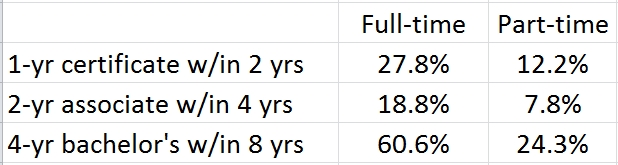
For college students in general, a 2011 survey found that 75% are part-time. Of these, “Even when given twice as long to complete certificates and degrees, no more than a quarter ever make it to graduation day.”1 Another study in 2012, focusing on community college students, found that 59% are part-time. Of these, 42% work more than 30 hours a week, 37% care for dependents 11 or more hours a week, and 40% take evening or weekend classes.2
In comparison to full-time students, part-timers fail at over twice the rate in completing certificate and degree programs. Here’s a breakdown from the 2011 survey:
Considering their numbers and their low completion rates, it’s a wonder that community colleges continue to do business as usual, with little or no change in practices that date back over half a century.
Thus, I was pleasantly surprised to find, in my college emailbox, an announcement that I’ve been returning to, off and on, for the past few days. It is a call for proposals to address the problem of part-timers. The proposed plan has to either (1) assist part-time students earn 12 credits in an academic year or (2) shorten their time-to-degree. The deadline is close and the form is complicated, so I won’t be submitting a proposal. But I do have some thoughts on this subject.
From a part-time student’s perspective, college is only one of a handful of other responsibilities with higher priorities. S/he has to be able to fit it into her life, and not the other way around. The problem is that colleges are set up for traditional students whose main priority is to complete a program. So, like a square peg, she’s trying to fit into a round hole.
The courses she needs are either filled or offered at a time that’s not convenient for her. Offerings at night or on weekends are slim pickings. Even when she can fit a class in, she finds it difficult to meet deadlines, complete learning activities, or obtain learning assistance. Competing for her time are work and family demands. Furthermore, the commute to campus is all too often time-consuming and, if she drives, the cost of gas and limited parking stalls are an ongoing concern.
The fact that our hypothetical part-timer is among the majority of students who are poorly served should be an incentive to change, from a perspective that’s campus-centered to one that’s student-centered. In other words, colleges ought to be asking, How can we accommodate part-timers with their unique needs?
The title of the 2011 report mentioned above goes to the heart of the problem — “Time Is the Enemy.” The traditional college schedule is the enemy of the part-time student. It’s in one dimension, while part-timers are in another. Put another way, part-timers make up a completely different population that isn’t being served by the colleges as they are now. Put in still another way, part-timers are an open invitation for disruption, for a disruptive approach that will accommodate the needs of a large population of students who are currently being ignored. Continue reading →
Big Hero 6 marks several firsts for Walt Disney Animation Studios (WDAS). It’s their first action animation with six action sequences. Previous animated movies had two or three. It’s the first WDAS movie to use the new Hyperion system that makes light much more real than ever before. The computer has 55,000 cores and resides in four separate locations.
It’s the first WDAS movie to have six major characters, actually twelve if you count their super alter-egos. It’s the first time WDAS has teamed with the XPRIZE Foundation to create a prize for students. If they win, they will be at the premier in Los Angeles on November 7 and walk the red carpet.
However, these are not the breakthroughs that excite me. This is the first time that the producer, Roy Conli, and the directors, Don Hall and Chris Williams, decided at the outset that this movie would be grounded in reality, that the science would be right. If the story group came to them during the four years that elapsed since the idea first was considered with a story idea that broke the rules of nature, they said no.
However, they did not hesitate in pushing the limits of technology. In some scenes, the g forces would have caused blackouts for real people. If you’re willing to overlook these small violations of the laws of nature and enjoy the ways in which the boundaries of technology are tested, you’re in for a treat. My day at WDAS provided me with only a few short sequences, the longest being 16 minutes, but it showed enough to convince me that this movie is breaking new ground.
Teachers, ask your students what they think about soft (and inflatable) robots? Can anyone create microbots in the real world? How can you do that? What about mental control over robots? Could you have plasma gloves or magnesium fire spitting costumes? Can robotics someday make anyone into a super hero? Explore the science.
Of course, there’s a story here and lots of heart. It’s Disney, after all. And, if you love action adventure as well as animated feature movies, this may be your lucky day.
I really like that science overrides fantasy in this movie. I only wish I had been there to point out places where the boundaries were pushed a bit far and make sure that they did so for good reasons.
The technology behind this movie is another story in itself. Never have so many extras appeared in scenes in an animated movie. It has over 500 different types of extra characters who can appear in the thousands when necessary with each doing its own thing. The city of San Fransokyo was modeled on San Francisco using the assessor records for the city so that you can find the plot where any real house sits, although that house may not look exactly like the real one but will look like homes in the neighborhood. Altogether, about 83,000 individual buildings were created in their external entirety for this movie. The underwater sequence that I saw was amazingly realistic. And so it goes. It took a large team, including 90 animators, two years to make this movie.
For me, a former chemistry professor, seeing one character be a chemist (Honey Lemon) with a sort-of Periodic Table emblazoned on her purse was cool. But, the Table is active, and she presses the element buttons to make incredible compounds really quickly that help to conquer the bad guy or save the good guys. While this purse is not very likely, the stuff it makes is very well animated and looks very real.
Once I’ve seen the movie, I hope to return to these pages with a deeper review of the science and technology that we all can discuss.
On Monday, September 22, the XPRIZE Foundation announced the Global Literacy XPRIZE in New York City. This newest XPRIZE may, in some ways, be more ambitious than the previously announced $30 million Google Lunar XPRIZE. It seeks to bring literacy to more than 300 million children who cannot read, write, or do arithmetic.
The XPRIZE Foundation, in the last part of its proposed rules, says, “At XPRIZE, we don’t believe that we have all the answers, but we believe passionately in inspiring and incentivizing people to find solutions to our Grand Challenges… But we want to hear from you… You can email us your feedback at global.learning@xprize.org…” This article summarizes my comments and should stimulate readers to provide theirs. If you have comments for the XPRIZE Foundation, please leave a reply here, in the discussion at the end of this article, for all of our readers to see. Likewise, should you have remarks about my comments, I would love to hear from you. The following comments are my own opinions informed by my own experiences. A good argument may well persuade me to change them. In any event, I look forward to an excellent discussion.
Quickly summarizing the competition: Teams will compete to develop software solutions to learning literacy that can be applied worldwide using Android tablets with nearby servers. Literacy includes reading, writing, and numeracy. The language to be learned will be English. The software will be open source. The software and content, ready for trial in the real world, must be completed within 18 months of selection of the finalists. The overall time frame from announcement to final award is 4-1/2 years. Read the official guidelines for all details.
I’ll begin by praising the XPRIZE Foundation for this bold effort to eliminate illiteracy across the entire globe. Education may well be our most serious problem today because a well educated world (really educated and not just schooled) will address all of our other problems such as clean water, climate change, terrorism, poor nutrition, preventable disease, ocean health, renewable resources, and so on. The Foundation is approaching problems that others ignore or give up on but that must be solved. Their competitions to date have energized entrepreneurs and those with entrepreneurial spirit to attack serious, nearly intractable problems. The technologies being developed are likely to have an impact far removed from the competition in which they are created.
I think that the “Proposed Guidelines, V.1” for this Global Literacy XPRIZE competition, have a number of controversial parts and am highlighting the ones that I believe should be altered. While the comments below are intended to be constructive, they are also definite, blunt, and tough. I feel that they should be if they are to get any attention. The controversial parts I see are: open source, teaching English, writing, and the Android platform. I wrap up with two comments: a contrarian view and literacy as fire.
1. OPEN SOURCE
The rules require that the five finalists, each of whom receives $1 million dollars and a chance at the $10 million grand prize, place their software source code in open source. This requirement is unusual in XPRIZE competitions. I think that it creates problems. Here is what the guidelines say:
An essential component of the Competition design is a commitment not only to open source software solutions, but also to an open source development process. In order to maximize the potential for the growth of this solution beyond XPRIZE, the Finalist Entries will be released under permissive licenses allowing both commercial and non-commercial use.
Software must be released on the Apache License, 2.0. Content and assets must be licensed under the Creative Commons CC BY (4.0) license. In essence, all work must be made available to anyone anywhere for free. Anyone can use the sources to build a copy and load it onto tablets without paying any fee at all. Continue reading →
While this is an unabashed promotion of the upcoming Disney animated feature Big Hero 6, it also is a real XPRIZE for young people. The prize is not millions of dollars but is still really cool.
Six winning students will travel to Los Angeles, walk the red carpet at the film’s premier, go behind the scenes to meet the creative minds at Walt Disney Animation Studios and Walt Disney Imagineering, and join a special “Visioneering” session at XPRIZE headquarters.
Students will enter in either the Junior Division (8-12 years of age) or the Senior Division (13-17 years). They will present their solutions to the world’s biggest challenges. The precise statement is “What one problem would you tackle to change the world? How would you do it? Tell us in a video!” XPRIZE judges will review the submissions and choose twenty finalists. Then, the public and a panel of expert judges will vote to determine the six winners.
Registration opens on Friday, September 19. Have your students put on their thinking caps. You do not have to go to the movie (unless you win). Entry is free. Just create a one-to-three minute video showing how you will use any combination of STEAM (science, technology, engineering, arts, and math) to solve one of the world’s problems. Be creative in defining the problem, in finding a potential solution to the problem, and in presenting your proposed solution.
Clearly, Disney does not require introduction. The XPRIZE Foundation is a matchmaker of sorts. It identifies highly leveraged situations that innovation can solve and that can change the world for the better. It finds sponsors for the challenges it creates around these problems that are not being addressed otherwise for a variety of reasons. Anyone, anywhere can enter. But beware! These are never easy challenges.
I hope that this challenge introduces thousands of young people to the joys of discovery (science) and creation (engineering) while using technology and arts to show that they have great ideas.
I also hope to follow up with an in-depth discussion with the Walt Disney Animation Studios Chief Technology Officer, Andy Hendrickson in the next few weeks.

























 Educational Technology and Change Journal
