The Paleo Diet Belongs in Caves: What You Really Need to Know About Diets

picture of Harry KellerBy Harry Keller
Editor, Science Education

Diets provide a great opportunity to exercise critical thinking. Pick any diet and pick it apart. Do this as a mental exercise or, if you teach, with your classes. Chances are that many of your students’ parents have dieted or are dieting. In this article, I am picking on the currently trendy Paleo diet.

The Paleo diet persists. I have a strange theory about diets. The first part is that people don’t like to diet. They like to eat whatever they choose. I suspect that this is especially true of libertarians. The second part is that many people see their food as a health problem and would like to change their eating patterns.

Many years ago, the Grapefruit Diet was very popular. This was great for people who loved grapefruit but not so much for those who found them too sour or too messy. Then, there was the problem that grapefruits are like the proverbial Chinese dinner that left you hungry shortly after finishing it. “Have another piece of grapefruit” just doesn’t work for most people.

Skeleton and restoration model of Neanderthal (La Ferrassie 1). Exhibit in the National Museum of Nature and Science, Tokyo, Japan.

Skeleton and restoration model of Neanderthal (La Ferrassie 1). Exhibit in the National Museum of Nature and Science, Tokyo, Japan.

Anyway, my theory is that diets are successful not if they work but rather when they cater to people’s desires. If you could get away with an ice cream diet, you’d have the world doing it because “everyone likes ice cream.” I haven’t yet seen a broccoli diet even though it would probably work better than grapefruit.  Continue reading

Using GIS and GPS Technology as Teaching Tools?

Lynn ZimmermannBy Lynn Zimmerman
Associate Editor
Editor, Teacher Education

Recently, I was at an education conference in Croatia, and one of the presentations was about using geographic information systems (GIS) and global positioning systems (GPS) technology as teaching tools. The presenters proposed that this technology can be integrated in a variety of ways to create interdisciplinary lessons and projects that are technology-based. Students can learn with the GIS and GPS rather than just learn about it so that they can become producers of knowledge about the physical world around them and not just consumers of information.

One of the connections the presenters made was to the sport of orienteering to promote the development of map-reading skills and navigation. Even though orienteering is usually done low-tech with a compass and a map, higher levels of technology can create a different experience for participants.

“Field-Map birdie” by Claudiusmm – Own work. Licensed under Public Domain via Wikimedia Commons.

Of particular interest for me as a teacher of English as Foreign Language are the ways this type of technology can be used to create authentic (real-life) reading, writing, speaking and listening activities for students. The presenters made a specific point that students’ real life knowledge about nature gained with this technology can easily be represented through the medium of digital story telling, which itself integrates reading, writing, and speaking and uses critical thinking skills as students plan and develop their project.

If anyone has had experience with these types of projects, I’d like to hear about them. Post a comment to this article or email me at zimmerma@purduecal.edu

__________
A preliminary list of resources:
Alec Bodzin, GIS and GPS Links, Lehigh University, 2/12/15.
GIS in Education Resource Sheet,” Utah Rural Schools Association, n.d.
Jennifer Johnston, “Engineering Professor Shares Mapping Technology with Teachers,” MyVU, Vanderbilt University, 8/20/14.
Bianca Bowman, “Teacher Knowledge and Geospatial Technologies,” Conversations on Knowledge for Teaching 2015 Education Technologies: Now and in the Future, n.d.

Deus What?

picture of Harry KellerBy Harry Keller
Editor, Science Education

Yet another “robot” movie has appeared, and another Terminator movie is scheduled for release. It’s the robots who should be saying, “I’ll be back.”

Having already written on robots and artificial intelligence, writing about the latest opus, Ex Machina, may seem anticlimactic. This movie certainly has some excellent optics. Just four characters make up the speaking parts. One more is important to the plot, and only ten are listed in the credits. This is a small movie when measured by personalities on screen. The special effects that make Ava look mechanical are almost astounding and, along with the scenery and sets, make this a large movie.

The premise that a lone genius can create an artificial intelligence that passes muster as capable of human thought is an enoromus stretch. That he also can fit it all into a human framework that can walk bipedally and can perform other human-like actions is beyond imagining. You really must suspend disbelief to watch this movie and seek its philosophical underpinnings.

In the end, it’s the same old story that we’ve seen since Mary Shelly wrote Frankenstein. Man should not play god, and creating new life is extremely dangerous. The movie plays on the morality of choosing to be god and on people’s fears of the unknown, especially when created by a “mad scientist.”  Continue reading

Textbooks, Emoticons, Assessment, Technology

lynnz_col2

Universities seek alternatives to expensive textbooks by Leslie Corbly in Deseret News National 4/25/15
With the increasing cost of textbooks, schools are adopting policies to allow open source textbooks that can be offered free online to students. Research shows that interactive digital texts not only cut costs but improve student engagement.

Some bilinguals use emoticons more when chatting in non-native language in Science Daily 2/17/15
The use of the emoticon (which many people love to hate) by language learners was studied by a research team and compared to the use of nonverbal communication and found a correlation ;-)

New Tablet-Based Interactive ELL Test in Language Magazine 2/20/15
This new tablet-based assessment, which can provide data about ELLs, raises the question about how much information we want a private company to have about our students and whether and how it should be disseminated. These issues are not addressed in the article.

Teachers Mixed on Common Core, Support Blended Learning by Dian Schaffhauser in The Journal 2/9/15
A poll conducted by the Association of American Educators showed that more than 90% of teachers in the US report that they use technology in the classroom and that 67% of them are in favor of blended learning and that students should be required to take at least one online course before graduation. I assume they are talking about high school.

Technology changing teacher’s role in Science Daily 2/16/15
In what should come as no surprise to anyone, a recent Finnish-Swiss-Belgian study showed that “the use of technology changes the role of the teacher from a traditional knowledge provider rather into a facilitator guiding the students’ learning processes and engaging in joint problem-solving with the students. In addition, technology offers a range of new types of learning possibilities.”

The End of Dark Energy

picture of Harry KellerBy Harry Keller
Editor, Science Education

Dr. Peter A. Milne and his associates have found an unexpected and, to the cosmological community, startling result from their surveys of supernovae. This result illustrates both the consistent and varying nature of science at the same time.

Dr. Peter Milne

Dr. Peter Milne

We know from a great many astronomical observations that the universe has been expanding for a little short of 14 billion years and continues to expand. Because of gravity, everyone expected that this expansion was slowing over time with theories and measurements suggesting that this expansion would eventually coast to a very dilute universe drifting apart at ever slower speeds.

In the 1990s, some astronomers separately discovered that the universe is expanding ever more rapidly instead of the expected opposite slowing of expansion using measurements of he brightness of very distant supernovae. They received the Nobel Prize in physics for this work in 2011.

Stars can explode. One common explosion is called a nova. A much more cataclysmic and extremely brighter explosion is a supernova. Supernovae shine with a brightness that can exceed that of all of the hundred billion or so stars in its galaxy. For this reason, we can see them in distant galaxies that are barely visible in our best telescopes. A supernova is a rare event occurring about three times a century in a galaxy the size of our Milky Way. With hundreds of billions of galaxies, however, it’s not too hard to find hundreds each year using modern astronomical equipment.

A special sort of supernova created when the two stars in a binary star system go through a specific series of interactions is known as a type 1a supernova. Because of the steps required to reach supernova status, the brightness of these type 1a supernovae has been considered to be a constant that can be used to estimate distances to very distant galaxies. Brightness declines with distance in a very precise manner.

There remains the possibility that acceleration of very distant bodies in our universe away from each other is a basic property of our space-time structure not detectable at smaller distances of only millions or even tens of millions of light-years, that “dark energy” is just an attempt to recast a phenomenon into understandable terms, just as the caloric theory of heat was long ago. -HK

The measurements of these supernovae were the reason to believe that the expansion of the universe was accelerating. We are seeing these very distant supernovae with light that started its journey over ten billion years ago when the universe was very young. Dr. Milne has discovered that type 1a supernovae are not all the same but fall into two categories of different brightness. Furthermore, the supernovae from the early universe are, on average, less bright than those in the more recent universe.

The lower brightness of the distant supernovae may well be due to less inherent brightness instead of greater distance. This finding destroys a fair piece of that Nobel Prize discovery. Dr. Milne still attests that the universe’s expansion is accelerating, just not so fast, but the vast number of recalculations being done to account for this new discovery will take some time.  Continue reading

Digital Privacy, ELL, Smartphones and GPA, Language and Smell

lynnz_col2
Bill Would Limit Use of Student Data by Natasha Singer in the New York Times, 22 Mar. 2015
Singer looks at some of the issues raised by the Student Digital Privacy and Parental Rights Act, a bill to place limits on how “companies that operate school services — like online homework portals, digital grade books for teachers or student email programs —” can use or disclose “students’ personal information to tailor advertisements to them” and “bar them from collecting or using student data to create marketing profiles.”

Digital curriculum targets ELL learning gap from eSchool News, 19 Mar. 2015
Middlebury Interactive Languages has developed English Language Learner programs which “are modeled after Middlebury Interactive’s world language courses and, like those programs, integrate research-based learning techniques, cultural awareness and project-based activities into blended learning classrooms.”

Increased Smartphone Use Equals Lower GPA Among College Students by Brian Heaton from from Government Technology, 17 Mar. 2015
This study from Kent State University about the effects of smartphone use on grades is sure to cause a stir. Even controlling for certain “known predictors, the group still found the relationship between cellphone use and GPA was ‘statistically significant and negative.’”

Does speaking English limit our sense of SMELL? The ability to identify and describe odours depends on the language you speak by Richard Gray for Mail Online, 30 Mar. 2015
While this article is not technology and educated related, it does look at the science of language from a different perspective as researchers describe the relationship between the language we speak and our sense of smell and our perception of colors.

Robots in Movies

picture of Harry KellerBy Harry Keller
Editor, Science Education

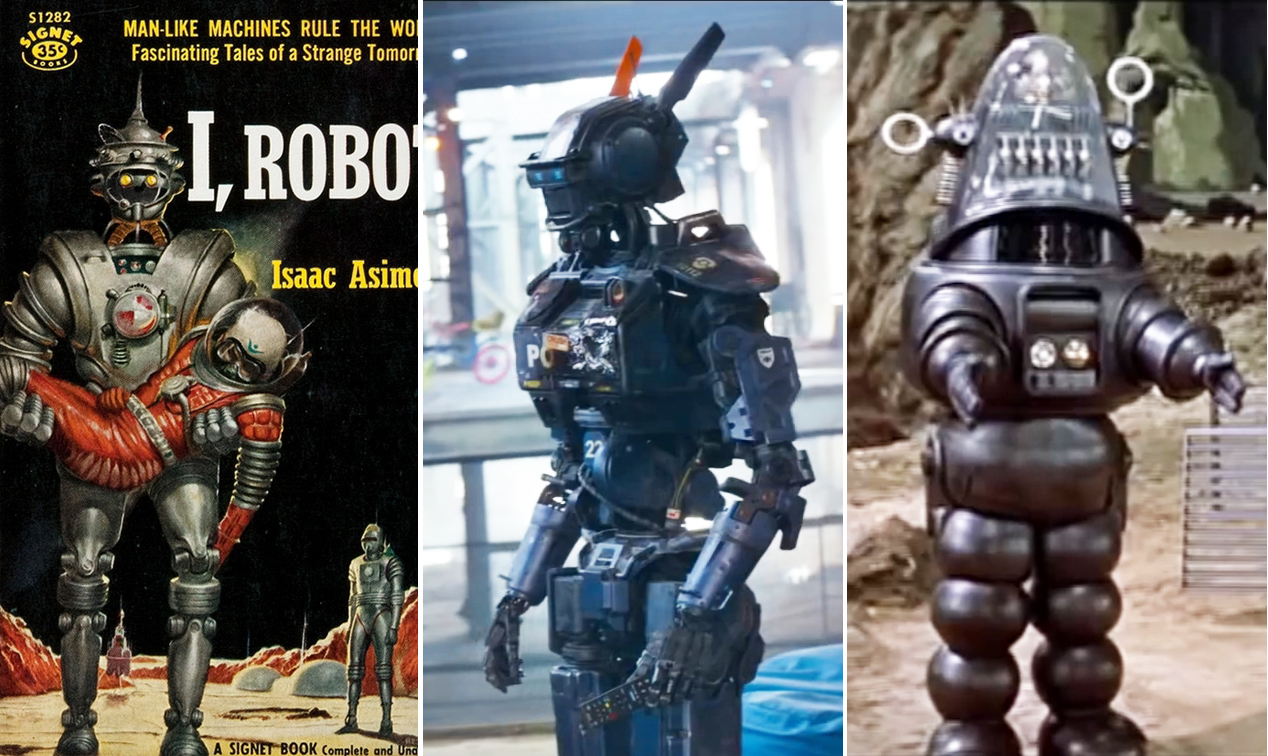
Artificial intelligence has appeared in a great many movies over the years, often as robots. The latest is Chappie, a movie that has been panned by a majority of critics but apparently enjoyed by quite a few movie goers.

Robots (or AI) have been good and bad. The first that I recall was Robby in the first science fiction (SF) movie to adhere to scientific ideas (of the time), Forbidden Planet. This 1956 movie starred Leslie Nielsen when he was still doing romantic leading roles. The character of Robby created quite a stir at the time. He was definitely a benevolent robot who was unable to harm humans. An immense computer system, the hidden evil element of the movie, served as a foil.

robots 03
Most people remember HAL, the AI embedded in the spaceship of 2001, a Space Odyssey. This movie debuted twelve years later and showed how AI could be a force of evil. Few who saw it will forget the creepy voice of HAL (notably one letter apiece short of IBM alphabetically).

I probably will not see Chappie for several reasons based on the reviews and my viewing of the trailers. The concept of artificial intelligence rising to the level of human consciousness bothers me, not for religious but for scientific reasons. However, many students probably will see it if only because of its themes involving street gangs and defiance of authority.  Continue reading

Videos on Demand: Education Week ‘Leaders to Learn From’ 2015

On 18 March 2015, Education Week recognized 16 exceptional district-level leaders at an exclusive event in Washington, D.C., featuring presentations and discussions on leadership and education policy. Featured speakers included Assistant Secretary, U.S. Department of Education Deborah S. Delisle and Adviser to the Premier and Minister of Education in Ontario, Canada Michael Fullan. Watch the videos from the event.

Recognition Presentation: Meet the Leaders To Learn From (Part I)


Recognition Presentation: Meet the Leaders To Learn From (Part II)

Continue reading

‘Peer Reviewing in Political Science’ – April 2015 Issue of PS

PS Header2
In The Profession section of its April 2015 (v48, 02) issue, PS: Political Science & Politics (PS)1 scrutinizes the peer review system, a core value in the research community. Some question whether or not peer review is sustainable given the increased and unequal burdens placed on reviewers. In “Peer Reviewing in Political Science: New Survey Results”, Paul Djupe of Denison University argues that the common perception that reviewers are overburdened with requests has never been tested through reliable data collection. He finds, contrary to the conventional wisdom, that most scholars appreciate peer review, and that most peer review requests by journals are accepted. The only common complaint is that peer review is not considered as part of the tenure and promotion process.

Also in The Profession, the right time for associate professors to go for promotion is considered by Kurt Weyland of the University of Texas in “The Logic of the Promotion Decision: In Dubio Pro Patientia”. Weyland argues that it is in the associate professor’s own interest to establish a convincing case before they bid for the rank of full professor and efforts to ‘force’ a promotion prematurely can leave a bad impression and damage the career. Accumulating a strong record in research and publication is the best way to assure a smooth path to tenure.

PS Toolbar2

In the Profession Symposium, see the articles on “Reinventing the Scholarly Conference: Reflections from the Field.”

In The Teacher , Matthew Woessner of Penn State shows how computer games like SimCity can be used to engage young people to think about politics, governance, and the challenges of managing cities in the real world.  Continue reading

Dark Matter Clues

picture of Harry KellerBy Harry Keller
Editor, Science Education

You may have seen the headlines already. “What is dark matter made of? Galaxy cluster collisions offer clues,” shouts the Christian Science Monitor.1

Here you have a great moment to engage students in something exciting and to use critical thinking. Dark matter is a hypothesis to explain why stars in galaxies circle around their centers faster than the observable matter says that they should, as well as other more sophisticated reasons. It’s called “dark” because it does not emit light and because you cannot see it. You might also have called it “invisible” matter, but much matter seems invisible. Besides, “dark” implies spooky, and this stuff is definitely spooky because ordinary matter moves right through it as though it isn’t there, except for gravitational effects.

The new finding just reported tell us that dark matter behaves just the same way with itself. One patch of dark matter moves right through another as though it’s not there at all (again, except for gravitational effects). This result pushes back against the most popular idea about the identity of dark matter, that it’s WIMPs — weakly interacting massive particles — because particles don’t just pass right through each other.

Dark matter is invisible. Based on the effect of gravitational lensing, a ring of dark matter has been detected in this image of a galaxy cluster (CL0024+17) and has been represented in blue. NASA, ESA, M.J. Jee and H. Ford (Johns Hopkins University)

Dark matter is invisible. Based on the effect of gravitational lensing, a ring of dark matter has been detected in this image of a galaxy cluster (CL0024+17) and has been represented in blue. Image from NASA, ESA, M.J. Jee and H. Ford (Johns Hopkins University).

Two explanations come to mind. Some physicists doing the work still are seeking particles, but these other explanations could help get around that barrier. There are some truly exotic explanations going around as well, such as the existence of a “mirror universe.” It’s best to stick with the simplest ones, though. Occam’s Razor tells us so.

One explanation is that gravity just doesn’t work exactly as we expect it to, especially when dealing with very large masses spanning very large volumes of space. This is not a very popular explanation. The other is that dark matter is really energy. Because of the equivalence of energy and matter demonstrated by Einstein and captured in his famous equation, E=mc2, energy is affected by and causes gravity.  Continue reading

2015 Contest to Promote STEM Innovation in Public Middle Schools: Apply May 4-June 12

ScreenHunter_234 Mar. 26 08.35

Northrop Grumman Foundation today announced it is launching an online contest to encourage today’s students to become tomorrow’s innovators by creating classrooms and science labs that inspire. The Fab School Labs contest is open to public middle schools and will make five grants of up to $100,000 available to five winning schools to fund a school lab makeover.

Northrop Grumman Foundation Launches Middle School Contest to Promote STEM Innovation

Beginning May 4 and continuing through June 12, 2015, teachers, principals and school administrators can enter their eligible school by visiting www.FabSchoolLabs.com, where they can learn about the contest and submit their application, along with photos and video to help tell their story. Semi-finalist schools will be chosen and their videos will receive online votes of support to assist with the final selection process. The winning schools will team up with Fab School Labs contest partner Flinn Scientific Inc. to design a state-of-the-art lab complete with all of the tools, resources and furnishings needed.

Fab School Labs contest gives schools funding to create a first-class STEM learning environment

The contest is designed to drive students’ interest in science, technology, engineering and mathematics (STEM) by giving public middle school teachers and school administrators the chance to create the STEM lab of their dreams and give students access to the latest learning tools and technologies that will stimulate as well as teach.  Continue reading

Free Webinar: 2015 Survey of College & University Presidents 4/14/15 at 2pm ET

IHE01
Inside Higher Ed’s 2015 Survey of College and University Presidents was conducted in conjunction with researchers from Gallup. Highlights of the survey findings include:

  • A majority of presidents give the Obama administration’s ratings proposal a grade of D or F, and a third of presidents say they view the plan more negatively than they did before the administration released a detailed framework about the plan in December.
  • Presidents are skeptical that the proposed rating system would accurately reflect their institutions’ quality, and are least supportive of the possible use of graduate income level and federal graduation rates as ratings criteria. Campus CEOs offer more support for using as criteria the percentage of first-generation and Pell Grant eligible students enrolled, and degree completion rates.
  • Presidents of two-year colleges are likelier than their peers at four-year public and private institutions to support the president’s plan to encourage states to offer free community college tuition.
  • More than half of the presidents are confident about the sustainability of their institution’s financial model over the next 5 years, but only 39 percent feel that way over 10 years.
  • About one-third of college presidents say that sexual assault is prevalent at U.S. colleges. But only a small percentage believe it is an issue at their institution.
  • A large majority of presidents (81 percent) say that the state of race relations on their campus is excellent or good.
  • The majority of those surveyed say presidents should play a more active role in decisions about tenure and hiring faculty members.
  • Nearly half of presidents agree that university leaders should speak out on issues beyond education.

Join Inside Higher Ed editors Scott Jaschik and Doug Lederman for a lively discussion of these and other findings of the 2015 Survey of College and University Presidents in a free webinar on April 14 at 2 p.m. Eastern. Can’t attend the live event? You should still register – all registrants will receive the slide deck and recording shortly after the event.

IHE02

The Inside Higher Ed 2015 Survey of College and University Presidents was made possible in part by the generous financial support of Pearson, Jenzabar and Academic Partnerships. Your registration information will be shared with these companies.

Captioning for the deaf and hard of hearing is provided by CaptionAccess for all Inside Higher Ed webinars. Transcripts available upon request.

MOOC Sightings 007: The Battushig Factor in College Admissions

MOOC Sightings2

The difference between SAT scores of students from the lowest (<$20K) and highest (>$200K) income brackets is approximately 400 points. This point difference is mirrored in comparisons between the lowest (<high school) and highest (graduate degree) parental education levels.1

Battushig Myanganbayar

Battushig Myanganbayar

This correlation seems immutable. Parental education and income levels impact SAT scores and determine who gets into the most selective colleges. Then along came Battushig — Battushig Myanganbayar of Mongolia, that is, “The Boy Genius of Ulan Bator” — who, in June 2012, at 15, “became one of 340 students out of 150,000 to earn a perfect score in Circuits and Electronics, a sophomore-level class at M.I.T. and the first Massive Open Online Course, or MOOC.”2 His accomplishment didn’t go unnoticed, and he is now a research student at the MIT Media Lab.

Battushig is, of course, a rare exception, but his success adds to the already enormous potential of MOOCs and raises the possibility that they could become a factor in college admissions. In an editorial yesterday, Pitt News broaches this very idea: “Universities sometimes directly accept a student that excels in one of their MOOCs…. If not, the student may still choose to list the MOOC on his or her resumé under skills or relevant education. A completed MOOC is a valuable asset, comparable to a week-long leadership conference.”3

The message for parents and students is clear: MOOCs are poised to clear their current wildcard status and earn credibility as a key factor in college admissions.
__________
1 Zachary A. Goldfarb, “These Four Charts Show How the SAT Favors Rich, Educated Families,” Washington Post, 5 Mar. 2014. Also see Josh Zumbrun, “SAT Scores and Income Inequality: How Wealthier Kids Rank Higher,” WSJ, 7 Oct. 2014.

2 Laura Pappano, “The Boy Genius of Ulan Bator,” NY Times, 13 Sep. 2013. Also see her “How Colleges Are Finding Tomorrow’s Prodigies,” Christian Science Monitor, 23 Feb. 2014.

3Massive Open Online Courses Better Depict Student Potential,” op-ed, Pitt News, 23 Mar. 2015.

MOOC Sightings 006: Universities Are ‘Middle-men Selling a Product That Is Past Its Sell-by Date’

MOOC Sightings2

MOOC numbers from Seb Murray1 that are hard to ignore:

“About 50% [of] Coursera’s 12 million users are utilizing its courses to advance their careers, says Julia [Stiglitz, head of business development at Coursera]. ‘Helping people accelerate their career[s] by learning new skills is a major way that we hope to impact the lives of our learners.’”

“A recent survey of 400 US employers by Duke University and research group RTI International found that 57% said they could see their organization using Moocs for recruitment. And three-quarters said job applicants taking relevant Moocs would be perceived positively in hiring decisions.”

“In a poll of 1,000 UK employers last year by distance learning specialist the Open University[,] nearly half said additional education is the number-one reason they would offer salary increase or promotion – and gaining education with free online courses was the third most common thing the employers looked for.”

“Recent research by the Career Advisory Board found that 87% of 500 US hiring managers are likely to consider non-traditional ‘micro-credentials’, or specialized certificates awarded by reputable educational institutions, as proof of skill mastery.”

“Close to 95% of edX courses offer a verified certificate, [Nancy Moss, director of communications at edX] says, with many of its users looking for new jobs. ”

“While universities have faced the ignominy of budget cuts, tech groups have harvested massive war chests to expand. EdX last year had been funded with $90 million; Coursera has raised a total of $85 million; Udacity has raised $58 million.”

“Alison’s [Mike Feerick, CEO and founder of the Ireland-based Mooc provider,] offered a view that is widely shared in the education community: ‘…[Universities] are the necessary middle-men selling a product that is past its sell-by date.’”

__________
1Mooc Makers Disrupt Business Education With Careers Focus,” BusinessBecause, 22 Mar. 2015.

A Network for Under-served Populations

By Bonnie Bracey Sutton
Associate Editor

The article below is from a dear friend, Joyce Malyn-Smith. Please send her names and interests. We are trying to get funding for programs and grants for more minorities.

A Network for Under-served Populations

By J. Malyn-Smith

Joyce Malyn-Smith

Joyce Malyn-Smith

I want to expand my own professional network in order to share information and opportunities I come across in my work to build the next generation of technology enabled citizens and workers. As someone who has spent many years working with under-served populations I am particularly concerned that persons of color, Hispanics and Native Americans may not be aware of many of these opportunities, or may learn of them too late to participate. For example, I am working with NSF’s Cyberlearning and ITEST resource centers, both hosting workshops in June aimed at helping people, who have not received Cyberlearning or ITEST funding, to develop strong NSF proposals.

The first goal for the expansion of my own professional network is to do what I can to ensure that these workshops are accessible to persons of color, Hispanics and Native Americans. To that end, I am asking you to help me expand my network so that I can forward relevant information, answer questions they might have about the events, and make sure a diverse group of potential participants are aware of when applications open so that these types of events are more accessible to them.  Continue reading

Mars One CEO Answers Questions About Mission Feasibility

Amersfoort, 19th March 2015 – Mars One recently published a video in which Bas Lansdorp, CEO and Co-founder of Mars One, replies to recent criticism concerning the feasibility of Mars One’s human mission to Mars.


Question: What do you think of the recent news articles that doubt the feasibility of Mars One?

BL: At Mars One we really value good criticism because it helps us to improve our mission. We get a lot of criticism from our advisors, and that is also exactly what we want from them. The recent bad press about Mars One was largely caused by an article on medium.com, which contains a lot of things that are not true. For example, the suggestion was made that our candidates were selected on the basis of how much money they donate to Mars One. That is simply not true, and it is very easy to find that on our website. There are a lot of current Round Three candidates that did not make any donations to Mars One, and there are also lots of people that did not make it to the third round that contributed a lot to Mars One. The two things are not related at all, and to say that they are is simply a lie. The article also states that there were only 2,700 applications for Mars One, which is not true. We offered the reporter, the first journalist ever, access to our list of 200,000 applications, but she was not interested in that. It seems that she is more interested in writing a sensational article about Mars One than in the truth.

We will have to delay the first unmanned mission to 2020. Delaying our first unmanned mission by two years also means that all the other missions will move by the same period of time, with our first human landing now planned for 2027. -B.L.

Question: Concerns have been voiced about the thoroughness of the astronaut selection process. What is your response to that?

BL: We started our astronaut selection with over 200,000 applications that were submitted online. The application included a video and a lot of psychological questions for our candidates. We used that to narrow down the candidates to about 1000 that had to do a medical check, which was very similar to the check for NASA astronauts. All the remaining candidates then underwent an interview. The interview and all other parts of the selection process were led by Norbert Kraft, our Chief Medical Officer. He has worked on astronaut selection for 5 years at the Japanese Space Agency, and at NASA he researched crew composition for long duration space missions.  Continue reading

Mars One Fizzles?

picture of Harry KellerBy Harry Keller
Editor, Science Education

One of the craziest schemes to garner worldwide publicity and lots of contributions is having some new problems. Mars One has lost one of its final hundred to misgivings about the process by which he was chosen. Will more come out with similar stories? Is this the beginning of the end for Mars One?

The Mars One stray is Joseph Roche, an assistant professor at Trinity College Dublin with a PhD in, wait for it, physics and astrophysics. With this education and background, he’s not just a scientist well equipped with Carl Sagan’s famous “baloney detection kit,” he’s also a specialist in getting around the universe.

Mars One is a reach too far. Until I see plenty of funding and until I see that water mission and then see the first supply mission land successfully, I will remain cautiously skeptical. -H.K.

I have written plenty about Mars One and its challenges. In the end, I stated that its biggest challenge is not radiation or water or air or food but money. It’s not just the money to send that first expedition to Mars but also the money to keep sending more until the colony is self-sufficient. The first expedition requires several preparatory flights to deliver lots of habitat modules, freeze-dried food, solar panels, machinery, rovers, and more. Each of those unmanned preparatory flights will cost very large sums of money, likely a billion or more dollars apiece.  Continue reading

Digital Equity and Social Justice

VicSutton80By Vic Sutton

The challenges of digital equity and social justice were recurrent themes in two recent meetings looking at ways to leverage technology to improve education.

“Digital equity” is shorthand for the bundle of problems that prevent many from accessing online resources, in particular the Internet.

Some would-be users live in areas that do not have broadband access. Other users, even in areas where there is high-speed broadband, cannot afford it. Yet more people have simply not gotten around to getting online.

As Dr. Louis Gomez of UCLA put it, we are facing “epic inequality.” The U.S. education system, Dr. Gomez maintained, “is marked by racial and class inequality.” He added that poor educational performance “has persisted for decades for large swaths of the U.S. population.”

Dr. Gomez was speaking at this year’s Cyberlearning 2015 conference, organised by the Center for Innovative Research in Cyberlearning (CIRCL) and held in Arlington, VA, on 27-28 January.  Continue reading

Life on Frozen Moons

picture of Harry KellerBy Harry Keller
Editor, Science Education

Now that three of the moons of our solar system’s gas giant planets have been said to have subsurface oceans, it’s time to take stock and consider the meaning of these analyses.

Ganymede and Europa of Jupiter along with Enceladus of Saturn are likely to have oceans far below their frozen surfaces. Should we send unmanned missions to explore these unusual moons, and what should we be searching for? Many have exclaimed that we have extremophiles (organisms that survive in extreme environments) here on Earth, so we cannot discount the likelihood of life beneath miles of ice where the Sun never shines.

This image or video was catalogued by Jet Propulsion Laboratory of the United States National Aeronautics and Space Administration (NASA)

Enceladus’ north polar region. This image was catalogued by NASA’s Jet Propulsion Laboratory.

If we search near the geysers of Enceladus, might we find the frozen remnants of miniature fish coughed up from deep down inside this odd moon? Answering this question requires more than a moment’s thought. What is life? How does it begin and advance? Are the ingredients for life available in those cold, deep seas?

Here’s my definition. Life uses available energy and materials to reproduce itself and has the potential for errors in reproduction that will allow for evolution. From what we know, those vast, cold underground oceans have the necessary ingredients. Without an energy source, they would be frozen and not liquid. Heat coming from the inside of a moon must provide chemicals that can both be used as chemical energy sources and as materials for constructing living organisms.  Continue reading

MOOC Sightings 005: Wharton School and Universiti Teknikal Malaysia

MOOC Sightings2

Rapid change is the norm, and for professional development in business, MOOCs are the answer. “Wharton School recently teamed up with Coursera . . . and tech start-ups Snapdeal and Shazam to launch $595 online courses with certificates.” This unbundled or certificate model underscores the MOOC’s disruptive force. “‘For adults who have limited resources – whether that’s time or money,'” says Rick Levin, Coursera chief executive, “‘the Specialization [industry project] model works well.'”1

As change approaches warp speed, the shelf life of knowledge decreases and the need for constantly accessible modules of new knowledge increases. The watchword here is accessible, and this is the MOOC’s domain.

This fact is becoming increasingly obvious in the world of business where you’re either on the leading edge or out of the picture, and the critical factor is time. You can’t pause or stop to learn. Learning has to be on the go, and this means anytime-anywhere.

Will this disruption creep into our college campuses? Will traditional students take to learning in MOOC modules to keep pace with the latest developments in their field? How will this impact courses in the more traditional semester mold?

Most expect professors to gradually blend modules into their curricula, but this is an institutional perspective. My guess is that students will self-modularize and independently flow toward MOOCs that give them the edge, regardless of what professors and colleges decide to do.

In fact, this is already happening, but this disruption doesn’t show up on the campus-richter scale because, from all appearances, the students are on campus and sitting in lecture halls.

On college campuses in other parts of the world, the disruptive power of MOOCs is being embraced. Shahrin Sahib, vice-chancellor of Universiti Teknikal Malaysia Melaka (UTeM), sees MOOCs as a window for “‘students to work collaboratively and closely with colleagues around the world and to have access not only to course instructors, but to textbook authors and experts from other institutions.'”2

For Sahib, the playing field is no longer just the university campus or Malaysia but the globe. He says, “‘If students are to fully assume positions of leadership and responsibility in specific organizations and in society as a whole, then they must be prepared to deal with the global environment.'” For college students, regardless of location, MOOCs are an interactive and accessible portal to that environment.
__________
1 Seb Murray, “Technology Expands Business Education As Students Opt for Digital Route,” BusinessBecause, 10 Mar. 2015.
2 Kelly Koh, “MOOC Can Help Create Global-ready Graduates,” New Straits Times, 10 Mar. 2015.

Does SETI Make Sense? Part IV: Communicating

Harry SETI header

We are likely to be the only civilization in our galactic cluster if the chances of forming such a civilization are but one in ten trillion. These are not encouraging numbers. For the sake of argument put the odds up to having 100 civilizations in our galaxy. That’s lots more than I would expect and means that the estimates are way off, by a factor of 10,000. Such an improvement in estimates certainly is friendly to SETI. But, can we contact one of these other civilizations?

Although I think that SETI is a colossal waste of resources, I cannot fault those who pursue this dream.

The galaxy is a very large place, about 100,000 light-years across. Any civilizations will be in an annulus around the center because being close to a galactic center is inimical to life. We won’t be able to communicate to the other side of our galaxy due to the extreme noise originating at our galactic center. Our potential range for communication is probably about 20,000 light-years, but this range again is limited by the number of noisy objects between us and our target.  Continue reading

Free Webinar on Student Engagement 3/19/15 at 11am ET

5 Secrets to Spectacular Student Engagement

Thursday, March 19, 2015 at 11 AM EDT (US)
Not time-zone friendly? Register to receive the archive.

Dr. Colin Montpetit, Assistant Professor of Science Education at the University of Ottawa

Dr. Colin Montpetit, Assistant Professor of Science Education at the University of Ottawa

Register for this complimentary webinar to learn how Dr. Colin Montpetit, Assistant Professor of Science Education at the University of Ottawa, increased class participation to 99%. Hear how he transformed his classroom into an “active learning zone” with the use of a student engagement solution.

Get the full story behind Dr. Montpetit’s stunning findings – how student participation rates grew in his classes, grades improved and failure rates decreased. Register today!

Who Should Attend: All are welcome. Those in Academic Technology or Teaching and Learning Centers are highly encouraged to attend.

ScreenHunter_233 Mar. 10 08.07

Ed Week Free Livestream 3/18/15 at 8am ET: Delisle & Fullan

edweek2 Meet This Year’s Most Innovative Education Leaders
Brought to you LIVE on Wednesday, March 18, 2015,
from 8:00 AM to 12:30 PM (ET), from Washington, D.C.

Deborah S. Delisle, Assistant Secretary for Elementary and Secondary Education, and Michael Fullan, Adviser to the Premier and Minister of Education in Ontario, Canada.

Deborah S. Delisle, Assistant Secretary for Elementary and Secondary Education, and Michael Fullan, Adviser to the Premier and Minister of Education in Ontario, Canada.

Learn the secrets. Repeat the results. Register today for FREE live access to this exclusive event, featuring keynoters Deborah S. Delisle, Assistant Secretary, U.S. Department of Education and Michael Fullan, Adviser to the Premier and Minister of Education in Ontario, Canada.

edweek1

Join us live from Washington, D.C., as the Leaders for 2015 reveal the keys to their successes through engaging presentations, discussions, and Q&A.

As a virtual attendee you’ll view the action live from your computer and takeaway all of the insights on what it takes to make huge impacts in school systems from San Francisco to rural Georgia.

Register now for free access to the Leaders To Learn From 2015 live event

Does SETI Make Sense? Part III: Evolution

Harry SETI header

Every planet that develops life based on chemistry similar to ours will begin with single cells. The entire water ecosystem will consist of these cells in some variety. That variety necessarily came about due to errors in copying the cells from one generation to the next. They would have a rather mundane life of drifting about randomly until encountering some useful molecule and absorbing that molecule. When enough of these molecules had been absorbed, possibly taking years, the single cell will divide into two.

In this slow, inexorable process, the seas will become full of these cells. Some will drift to inhospitable places where they’ll be killed and spill their contents back into the sea for other cells to absorb. Direct conflict is unlikely because the apparatus for killing and absorbing other cells is too complex to develop readily.

Altogether, there’s something like a chance in a billion that a given star will have a planet that can develop and sustain life. The chances are probably much worse.

Early on, after about a billion years, some developed the ability to use sunlight to make molecules from CO2 and water, from chlorophyll, probably an early form that has evolved into its many varieties today. Some scientists suggest that the earliest versions of chlorophyll did not produce oxygen as a byproduct. By about 2.3 billion years ago, some definitely had and started putting oxygen into the water. For life at that time, oxygen was a serious poison, worse than cyanide is to us. It was a matter of adapt or die — or hide somewhere where oxygen did not exist.

This was probably the first great extinction on Earth, and it was caused by oxygen pollution. Evolution favored those who had a way to neutralize this nasty chemical. Slowly but surely, the removal of so many anaerobic species left ecological niches open, and aerobic cells began to fill them. They used a new way to create energy though oxidation, a much more efficient way than their predecessors. Unfortunately (or fortunately from our viewpoint), the oxygen had some other side effects.

Continue reading

Preparing Your Child for a Robotic Future

Don’t Let a Robot Take Your Child’s Future Career: Roboticist’s Book Offers Educational Advice for Parents

Illah NourbakhshIllah Nourbakhsh says robots and artificial intelligence will increasingly displace people from many conventional jobs. The professor of robotics at Carnegie Mellon University has even written a book about it, called “Robot Futures.”
It’s enough to make parents despair over their children’s career prospects, he acknowledged, and that’s why he’s publishing a pair of follow-up books, “Parenting for Robot Futures.” Part 1: Education and Technology is now available on Amazon.com.

The key, he said, is to raise children who are “technologically fluent.”

“If we want our children to flourish in a technology-rich future, we need them to understand technology deeply— so deeply that our kids influence the future of technology rather than simply being techno-consumers, along for the ride,” he writes.

“There are no shortcuts to developing tech fluency, and there is no way to outsource the parent’s role to school, after-school or video games,” Nourbakhsh writes.

In the 64-page first volume, Nourbakhsh provides an overview to help parents understand the strengths and shortcomings of technology education in schools, including the movement to STEM (science, technology, engineering and mathematics) education, digital learning and massive open online courses, or MOOCs.

Continue reading