Proposal for a Holistic Emphasis in K-12

Bob Hoffmann80aBy Bob Hoffmann*

[Note: This article was written in response to Harry Keller’s “Acronym in Cheek: STEM, STEAM…” (11/11/13). -Editor]

Thanks for your insightful article.

This exact question was presented as New Business Item (NBI) #43 to the delegates of the National Education Association (NEA) Representative Assembly (RA) in terms of “ways to integrate the arts into STEM.” The Vocational, Career, and Technical Educators’ Caucus (of which I am a past-chair) looked into the claims by supporters of the “Put the Arts into STEM” (STEAM) initiative and found that the motion would give an NEA endorsement to massive changes in our courses. We organized an effective response, which defeated the motion among the 9000+ delegates.

The STEAM Initiative advocates claimed that “art is used everywhere in STEM,” from the Fibonacci series in math and nature to the “Harmony of the Spheres” of the solar system orbits, from design in architecture to the “form factor of the iPad in your hands.” We should certainly recognize that this is true in specific historical cases, yet our challenge now is to encourage similar innovations from our students, keeping in mind that such grand new ideas are the exception, not the rule.

The maker of the proposal, Mr. Tom McLaughlin, identified the source of many of their arguments for STEAM as a book by Robert S. and Michele M. Root-Bernstein titled Sparks of Genius: The Thirteen Thinking Tools of the World’s Most Creative People. While the authors clearly support the integration of creative thinking skills with the arts, the inverse does not seem to hold — that students must learn the arts to become creative thinkers.  Continue reading

The Symbiosis of College and Massive Open Online Courses (MOOCs)

kenji mori80ABy Kenji Mori
Student at Kapi’olani Community College
University of Hawai’i

Information Technology has great potential for education. As one college student says, “It allows for a plethora of knowledge to be shared, as well as content that is created by other users to reach a wider audience than would ordinary [SIC] be possible” (Taylor). In recent years, Massive Open Online Courses (MOOCs) have taken advantage of this in order to offer free courses over the Internet. Unlike most online college classes, these courses allow tens or even hundreds of thousands of students around the globe to widen their knowledge. MOOCs have much to offer students. The integration of MOOCs in college courses will lead to a better learning experience.

Recently, when I was introduced to the concept of MOOCs, I created an account on Udacity and edX – two of the leading providers of MOOC content. My eyes lit up as I found courses not only on introductory level subjects but also on more advanced topics such as artificial intelligence and cryptography. These courses are offered by top universities such as Harvard and MIT and conducted by world-renowned professors.

MOOCs generally follow the format of a series of video lectures interspersed with quizzes. They do not derive most of their appeal from the use of innovation. After all, they are not far different from the lectures we see in today’s classrooms. Rather, they are revolutionary in that they make education available in a way thus unprecedented. Free, quality education is being made available to all. According to one national poll, about half of the families in the United States cannot afford college (Allebrand). For them, MOOCs are a godsend. For graduates, MOOCs give the opportunity to become life-long learners. Even for college students, there is much to gain.  Continue reading

Breakthrough: Online Bachelor’s Degree for $19,200

Jim ShimabukuroBy Jim Shimabukuro
Editor

Mount Washington College, accredited by the New England Association of Colleges and Schools, is offering Bachelor’s Degrees in Accounting, Business Administration, Business Administration: Management, Business Administration: Marketing, Information Technology. It’s also offering Associate’s Degrees in Accounting, Business Administration, and Information Technology. The following are excerpts from the press release, 11/18/13:

With a tuition structure starting as low as $4,800 per academic year ($2,400 per term), students can complete an IT bachelor’s degree for less than $20,000, making it among the most affordable regionally accredited programs in the United States. Mount Washington College also offers business degree programs within the same highly affordable tuition structure.

 Mount Washington College, 3 Sundial Ave, Manchester, NH ‎

Mount Washington College, 3 Sundial Ave, Manchester, NH ‎

Consistent with Mount Washington College’s instructional philosophy, the IT degree program allows students to pace themselves, managing the intensity of work and completion of their degree based on their individual timetable. The curriculum is designed to meet the needs of adult learners who are often balancing a full-time job and raising a family with other scheduling demands and life commitments. Student Mentors are there to help right from the start, serving as a resource to students from the time of admission through graduation.  Continue reading

The Finnish Education System May Not Be the Answer to Our Woes

Jim ShimabukuroBy Jim Shimabukuro
Editor

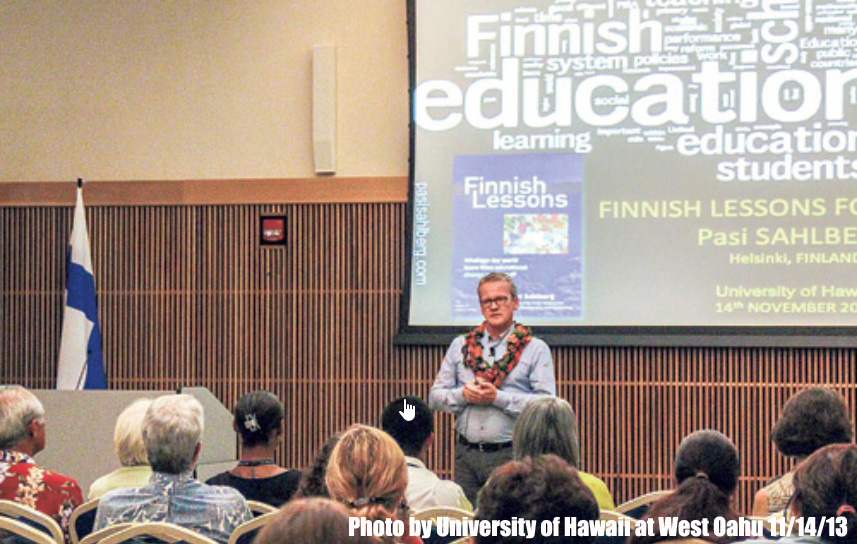
Pasi Sahlberg1 talked about the Finnish comprehensive public education system at the University of Hawaii at West Oahu on 14 November 2013 (Essoyan2). The system ranks among the highest in the world in PISA (Programme for International Student Assessment) and other international tests. It is free for students from preschool through higher education and is considered a model for the rest of the world.

Pasi Sahlberg at the University of Hawaii at West Oahu on 11/14/13.

Pasi Sahlberg at the University of Hawaii at West Oahu on 11/14/13.

Features of the system have been widely covered for years3, so I won’t go into them. What’s worth highlighting in Sahlberg’s talk at West Oahu, however, is his caveat that “‘what works in Finland doesn’t necessarily work someplace else.'” In other words, we can’t and shouldn’t simply port Finnish practices over to the U.S. and hope for the same results.

Sahlberg presented “slides showing that the more unequal the distribution of wealth in a country, the lower the test scores tend to be.” The United States, he said, “has high inequality and relatively low academic performance, while the reverse is true for Finland.” According to Sahlberg, the U.S. is “‘one of the most unequal countries in the developed world. There is a big gap between those who have and don’t have.'” He characterized Finland as a lot more egalitarian. “‘Somehow,'” he said, “‘the equity and excellence go hand in hand'” (Essoyan).  Continue reading

A Caltech Grad in a Caltech MOOC, Part 4 (updated 12/8/13)

picture of Harry KellerBy Harry Keller
Editor, Science Education

[Note: Harry, who holds a BS in chemistry from the California Institute of Techology and a PhD in analytical chemistry from Columbia University, is sharing his first MOOC experience in this series. See part 1, 2, 3 and 5. -Editor]

November 12, 2013

Week six was not an easy week. Some emergencies took away time I had expected to spend on the course. The material was interesting but difficult. The pace was rapid.

This week, we learned about the crucial issue of overfitting in machine learning and about its cure, regularization. These are not topics for the faint at heart because they go deep into the world of machine learning and involve a great deal of mathematics.

The homework was both hard and easy. Once again, I was tested on my programming ability more than on my understanding of the topics in a few of the questions. I’m not sure how one might create a course on machine learning that did not include writing software because machine learning, by definition, uses computer algorithms.

I find the homework deadlines both useful and frustrating. Were it not for the deadlines, I’d have plenty of higher-priority things to do and probably never get it done. However, I constantly have to deal with being unable to plumb the depths of the material or even complete the homework satisfactorily in the time available. This course certainly does not allow one to proceed at one’s own pace, although it does allow you to set your own schedule within the course calendar.

The mathematics continues to use the full panoply of mathematics symbols and expressions. Do not go near this course without a very good background in advanced mathematics: calculus, set theory, matrix algebra, and more.

I feel that I’m being asked to learn much more than I have to learn. This is supposed to be an introduction to machine learning. I’m rather intimidated by the prospect of an advanced course. Yet, the pearls of learning are there to be gathered, scattered among all of the mathematics, abstruse concepts, and software writing. This is not a mere aggregation of tools. This course provides a sound mathematical footing for every tool provided — if you can hack the math.

I had absolutely no time to even peek at the discussions this week but didn’t really have to because the material was clear enough, and the homework was also clear while being mostly tough. One or two questions were fairly easy to answer, but the rest took some work.

Looking at the answer key, I discovered that I shouldn’t have changed my answer to one of the questions, but I do not understand why. I still think I had the right answer the second time.

The final grade on the MOOC is not in yet, but I’m guaranteed a homework grade of at least a B and a course grade of a C at this point. The next lecture, on validation, looks like it will be one of the most valuable yet. I just wish I knew that I am learning everything well. With this sort of MOOC, that’s a real challenge.

[Update 12/8/13 – Harry submitted the following report on 11/18/13, but I didn’t see it in my mailbox until this morning. My apologies to Harry and to you, the readers. -Editor]

November 18, 2013

The lectures this week were very informative. The homework was another matter entirely. Possibly, I’ve topped out here, but there was a significant issue that should be addressed. Continue reading

Can America’s Wasted Talent Be Harnessed Through the Power of Internet Based Learning?

Jim_Riggs80By Jim Riggs
Professor, Advanced Studies in Education
College of Education
CSU Stanislaus
President Emeritus, Columbia College (1997-2007)

For nearly 150 years, the American dream of a better life of economic success and advancement has been found largely through the narrow path of higher education. However, access to traditional higher education has always been limited to the top one-third of the adult population and by all indications will continue to be rationed at this level or less into the foreseeable future. Peter Smith, in his 2010 book, Harnessing America’s Wasted Talent: A New Ecology of Learning, points out that while traditional higher education will continue to serve this segment of the population, educational leaders must find alternative ways that will effectively meet the postsecondary education needs of a much larger segment of the adult population.

Smith is not alone in this thinking. There have been numerous reports in recent years that have also called for greater access, flexibility, credit portability and increasing degree completion for a much larger percentage of the adult population. In addition, many of these reports place a special emphasis on closing the growing achievement gap, which is increasingly leaving Latinos and African-Americans behind other groups when it comes to earning college degrees. Why is this important? There is a strong and growing consensus among policy makers, educators, economists and scholars that, if this country is to remain an economic superpower, a much larger and more diverse segment of the adult population must be better educated.

America’s current workforce is aging and retiring, and 85% of all new jobs now require some college education. A real crisis is rapidly developing  — America is finding itself with an escalating gap between the increasingly sophisticated workforce skill demands of the new economy and what the average American worker has to offer. In a 2011 report, The Undereducated American, Georgetown University professors Anthony Carnevale and Stephen Rose provide a strong argument that America will need a dramatic increase in the number of individuals with college degrees within the next decade. This increase in college graduates, according to Carnevale and Rose, is not only needed to help sustain the nation’s economic growth but will also help reverse the 30 year trend of growth in income inequity.

However, with the downturn in the economy over the past six years, we are once again reminded that a college degree alone is not a complete guarantee against economic challenges or underemployment. Economic growth and viability cannot solely depend on education. Nonetheless, according to the Bureau of Labor Statistics, the greatest predictor of personal income and employability for Americans still is, and will continue to be, their level of educational attainment.  Continue reading

Acronym in Cheek: STEM, STEAM…

picture of Harry KellerBy Harry Keller
Editor, Science Education

[Note: See Bob Hoffmann’s response in “Proposal for a Holistic Emphasis in K-12” (11/24/13). -Editor]

STEM (Science, Technology, Engineering, and Mathematics) has taken over from simple, unadorned “science” as the term describing our science classes. Because most of these classes use technology and mathematics already, the major change is the addition of engineering. Many science classes already had some sort of engineering-oriented activities they call projects. The NGSS (Next Generation Science Standards) has increased the emphasis on engineering.

STEM, as a moniker, has had such success that it has resulted in some copycat acronyms. Preeminent among these is STEAM, which adds art to the list. I have absolutely nothing against inserting art into science classes and even support the idea. However, the creeping growth of an acronym does bother me as does the omission of equally important areas of learning for students in science classes.

I also happen to think that that putting technology into the acronym is superfluous. I’d much prefer, for example, thinking as the T in STEM if you have that letter at all.

I have read many spirited discussions about STEAM replacing STEM, and they all seem to originate from teachers of traditional art classes where drawing, painting, and sculpting is taught. What about performance arts? What about music? I have not seen anyone agitating to add those to science classes. Why not?

There’s also the crucial role of history and social science in general to learning. There certainly is much history in science, both the history of science and the historical context. Our children can learn much from this analysis, possibly more than memorizing the names of U.S. Presidents or of the Kings of England along with dates. Why do we not see agitation for SHTEM or HEMST? Not a clever enough acronym? That’s hardly a sufficient excuse.  Continue reading

The Surface Pro 2 Will Be the Death of Notebooks

Jim ShimabukuroBy Jim Shimabukuro
Editor

Updated 11/19/13, 9/6/14

(Related articles: “Thoughts on the Surface Pro 2 After 8 Months” and “Why the Surface Pro 2 Will Be a Game Changer in the Tablet World Series.”)

About three weeks ago, when all I had to go on was reviews, I predicted that the Microsoft Surface Pro 2 (SP2) would be a game changer. I had just put in my order then and was told that shipment would be in mid- or late-December. Thus, I was surprised and happy to learn, in late-October, that it had been shipped for next-day delivery. It arrived on schedule, and in the time it took to remove it from the packaging, plug it in, and turn it on, I knew that the notebook was dead.

Surface Pro 2 with type cover and digital pen.

Surface Pro 2 with detachable type cover and digital pen.

I’ve had it for about a week and haven’t had time to do more than a few things, but what I’ve seen is impressive. The look and feel reminds me of the original iPad and iPhone4 — which I’m still using. Rock solid and sleek, beautifully engineered. In contrast, the clamshell notebook with its hinged keyboard suddenly seems odd, anachronistic, looking more like yesterday’s typewriter than tomorrow’s computer.

Don’t get me wrong. The SP2, like the original iPad, is far from perfect, and better and less expensive models from Microsoft and competitors will soon be flooding the market. However, it’s more than done its job as a groundbreaker. In short, it’s the first viable full-blown Windows PC in a tablet chassis.

Form factor alone, however, wouldn’t be worth much if the tablet couldn’t perform. The big question for me was — and still is, to some extent — will it perform?

In size, it’s slightly larger than the original iPad and only a half pound heavier. But the difference in terms of sheer power is huge. The SP2 runs the 64-bit version of Windows 8.1, MS Office 2013, and everything else you can run on a notebook or desktop. It has a high-resolution 1080p display and an HDMI port. Plug in a 26″ 1920 x 1080 monitor and you have all the size you’ll need. It has a standard USB 3.0 port and a micro-SD card slot. Plug in an external two-terabyte drive, a CD/DVD player-recorder, a thumb drive, or an SD card for more onground storage.  Continue reading

An Interview with Tom Preskett: The Evolving Role of a Learning Technologist

Jim ShimabukuroBy Jim Shimabukuro
Editor

Updated 11/6/13, 5:40am HST.

Introduction: Tom Preskett was a staff writer with ETCJ from 2008-2011, and we make it a point to touch bases with him from time to time. For example, in 2012, he wrote A Londoner’s View of the 2012 Olympics: Live Feed of All Sports at Any Time!. He brings a reflective insider’s view of what it means to be a learning technologist in the most exciting period in the history of the field. The following interview, conducted via email over the last few days, is prompted by his recent move from the London Centre for Leadership in Learning, Institute of Education, to Nord Anglia Education, Oxford.

JS: Tell us about Nord Anglia Education.

TP: Nord Anglia Education is a premium schools organisation. We own 27 schools located in South East Asia, China, Europe, North America and the Middle East. Most of our schools follow a curriculum based on the National Curriculum of England, adapted country by country to meet local culture and conditions.

Tom Preskett

Tom Preskett, Learning Technologist, Nord Anglia Education.

To support these schools are two online environments. One aimed at the students, the Global Classroom, and one aimed at the teachers, Nord Anglia University. Both are moodle environments although they don’t act like traditional virtual learning environments. Our online environments tie together as each school has a moodle, and authentication carries across the Global Classroom and Nord Anglia University. The ethos is one of High Performance Learning as created by our educational director, Professor Deborah Eyre. You can read all about this in her paper “Room at the Top.”

Continue reading

A Caltech Grad in a Caltech MOOC, Part 3

picture of Harry KellerBy Harry Keller
Editor, Science Education

[Note: Harry, who holds a BS in chemistry from the California Institute of Techology and a PhD in analytical chemistry from Columbia University, is sharing his first MOOC experience in this series. See part 1, 2, 4 and 5. -Editor]

November 2, 2013

The discussions should play a larger role, but I have found them to be unsatisfying. Either they’re about esoterica or trivia. Perhaps, I’m too pragmatic for this course. It’s not just about the course; it’s also about the students. It’s clear that not all students and courses go together.

I think that I’ve already gained the most important insights into machine learning from this course, how to know whether a given situation lends itself to this valuable tool. Completing the course will expand the machine learning options and my depth of understanding of how to use them.

Last week, I didn’t have the time to visit the discussion groups. This week, I don’t feel the necessity but may do so just to see what’s going on.

November 4, 2013

As I work on the fifth homework assignment, I’m not sure whether I’ve become smarter or the homework has become easier. Last week was very hurried, and I stumbled badly. This week went along nicely. There’s still plenty of mathematics, more than you might imagine, but the concepts seem more manageable.

When I began, I only knew a bit about this field from my days as a university professor when a colleague published papers about machine learning used to identify compounds in gas chromatograph tracings and spectroscopy. It was a promising area then.

Continue reading

New AACE Special Interest Group on ‘Assessing, Designing and Developing E-Learning (ADD)’

By Stefanie Panke
Editor, Social Software in Education

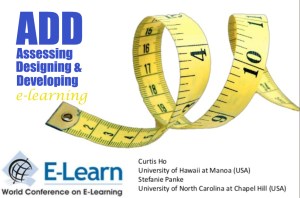
The Association for the Advancement of Computing in Education (AACE) has launched a Special Interest Group, “Assessing, Designing and  Developing E-Learning” (ADD). You do not have to be an AACE member or an attendee of previous AACE conferences to  join — though some activities will be tied to the E-Learn 2014 conference to be held in New Orleans from October 27-30, 2014.

The SIG had its inaugural meeting during the AACE E-Learn 2013 conference. If you missed it, review our presentation for collaboration ideas.

ADD3

Based on the discussion during the SIG meeting on Oct. 23, we have initiated first community activities:

  • To facilitate SIG projects, discussions, meetings and publications we want to learn more about your background and interests. Please take 10 minutes (or less) and fill out the survey.
  • We created a LinkedIn group for our SIG members to communicate with each other. Here’s the link to the LinkedIn group – join us there.
  • Are you a member of the AACE network Academic Experts? Learn more about the SIG.

Our next step is to see what information the survey brings in and share this with our SIG. We are excited about the many possibilities for collaboration and look forward to meeting again at E-Learn 2014 in New Orleans. In the meantime, stay connected through ADD SIG events and activities.

Please feel free to share this information with interested peers.

Curtis Ho and Stefanie Panke
Chairs, ADD (Assessing, Designing & Developing E-Learning)

A Caltech Grad in a Caltech MOOC, Part 2

picture of Harry KellerBy Harry Keller
Editor, Science Education

[Note: Harry, who holds a BS in chemistry from the California Institute of Techology and a PhD in analytical chemistry from Columbia University, is sharing his first MOOC experience in this series. See part 1, 3, 4 and 5. -Editor]

October 19, 2013

The third week of this MOOC unveiled to me a problem with MOOCs. Not every student is a “student.” I am not really a student. I have conflicting priorities that few students have. Sure, some have jobs and family responsibilities. Generally speaking, they can leave their jobs behind when they leave their jobs.

As an entrepreneur, I am “on call” 24/7. I have to “steal” a few hours a week for this MOOC. I have a goal that may help my business — or may not. The MOOC has to be a low priority. I have no way of knowing when I can watch the lectures or do the homework beforehand.

If you cannot set aside a definite and adequate number of hours every week, you may not be able to achieve all you wish with your MOOC.

This has been a very busy week. I already have two full days committed next week. By full, I mean from arising to falling asleep, not a mere 8 or 9 or 10 hours. There will be not a minute for MOOCs.

Last week, I managed 8/10 on my homework due to not paying attention when I encoded my answers as (a) through (e). This week I paid attention to that but did not have time to analyze my answers as fully as I would have liked. Instead of the recommended ten hours spent on homework, I spent about one. My 7/10 on the homework reflected this less deep thinking.

One problem I missed had me determine the largest number of points that can be shattered by a planar triangle learning model. I really thought that I understood this problem but clearly did not. I don’t really have the time to figure out why.

The last problem in the set required finding the growth function for a planar annulus training model. I was able to find the answer quite nicely and got it right.

The good part about this homework is that I did not have to write any software. The two previous homework sets required considerable amounts of programming. You could make a mistake in understanding or in coding. Having two modes of error made the exercises more stressful than usual.  Continue reading

Qualities for a Strong Online vs. F2F Teacher: Are They Different?

Joseph Chianakas80By Joe Chianakas

[Note: This article first appeared in ETCJ as a comment on “Online Learning 2012: Six Issues That Refuse to Die” (12/29/11) on 10/22/13. -Editor]

Improving education and instruction, whether it’s online or F2F, is all about the quality of the teacher. It goes without saying that a bad instructor will create a bad environment, in either setting. A great instructor will have a positive impact on students, no matter the environment. So the questions I would add are: What are the characteristics of a strong educator? Are there different characteristics for the online instructor compared to the F2F instructor?

What are the characteristics of a strong educator? Are there different characteristics for the online instructor compared to the F2F instructor?

A good online instructor must be well-organized, must create a solid structure within the CMS, and must be active and involved with the students. A good F2F instructor? Well, it’s similar, right? So what are the differences?

I think it helps to have a strong personality in the F2F environment, and for me, it’s that social interaction that I enjoy the most about teaching. I build rapport with my students, and I think that makes them enjoy class more and, thus, learn more. It sure makes me enjoy my career more.

Can we do that online? Many try, but it’s not quite the same. Then I wonder: So am I selfish? Do I just want to enjoy my work more? Maybe.

I do know without a doubt that teaching online has enhanced my F2F classes. It has improved my organization, my rubrics, my instructions, and much more in the F2F classroom. It’s easy to sit down and talk to someone about a topic or assignment. It’s significantly more challenging to clearly articulate strong discussion topics and assignments when teaching online.

I really enjoy thinking about these questions. I want to be the best educator I can be, no matter where I’m teaching. And I think it’s important for people to know that we can all learn from one another — that there is value in reflecting what we lose or gain in either medium of teaching. I want to keep asking questions like these and those in the article, and I want to get better at what I do without insulting anyone’s teaching or teaching preferences. Let’s simply strive to improve.

Why the Surface Pro 2 Will Be a Game Changer in the Tablet World Series

Jim ShimabukuroBy Jim Shimabukuro
Editor

Last updated 9/6/14

(Related articles: “Thoughts on the Surface Pro 2 After 8 Months” and “The Surface Pro 2 Will Be the Death of Notebooks.”)

I’m one of the 15 million who bought the first generation iPad in 2010-11, and I’m still using it today as a flexible extension of my desktop. I can take it anywhere within my WiFi zone and have instant connection to the web. Press, sweep, and tap, and I have my email. Tap and tap, my favorite websites. Tap and press, I’m done. No desk, no mouse, no keyboard, no waiting around.

Microsoft Surface Pro 2

Microsoft Surface Pro 2

But it’s not a desktop PC, and it still can’t do some of the basics. It can handle email, both reading and writing, but it can’t multitask very easily. This means that any task that requires grabbing info from one app and using it in another is iffy and requires so many steps that it’s almost not worth doing unless you’re desperate.

My iPad also can’t do standard PC apps such as MS Word and Excel and the gazillion little utilities that I can’t live without, and its ability to handle the vast range of webpage styles is poor, which makes web browsing and research a more miss than hit exercise. There are countless workarounds for mainstream desktop programs and app alternatives for mobile devices that are supposed to render standard websites readable, but these are clunky and offer poor alternatives to the real deals.

My iPad can’t handle images and videos very well, and it balks at most online video formats outside of YouTube. Thus, it’s a great tool for what it can do, but it leaves me on a short tether to my desktop.

I’ve been closely following the 2nd-to-4th generation iPad releases, but I haven’t seen the breakthroughs that I need. I also have an android tablet to keep an eye on what’s happening in that sector, but the issues are similar.  Continue reading

ISSOTL 2013: ‘Doing SoTL Means You Never Have to Say You’re Sorry!’

By Stefanie Panke
Editor, Social Software in Education

The 10th annual conference of the International Society for the Scholarship of Teaching and Learning was held in Raleigh, North Carolina, on October 2–5, 2013, hosted by Elon University’s Center for Engaged Learning (CEL). ISSOTL 2013 attracted approximately 600 participants. Most of the attendees came from universities across the US. Visitors from Canada, Europe, Australia, and other countries added an international flair to the event.

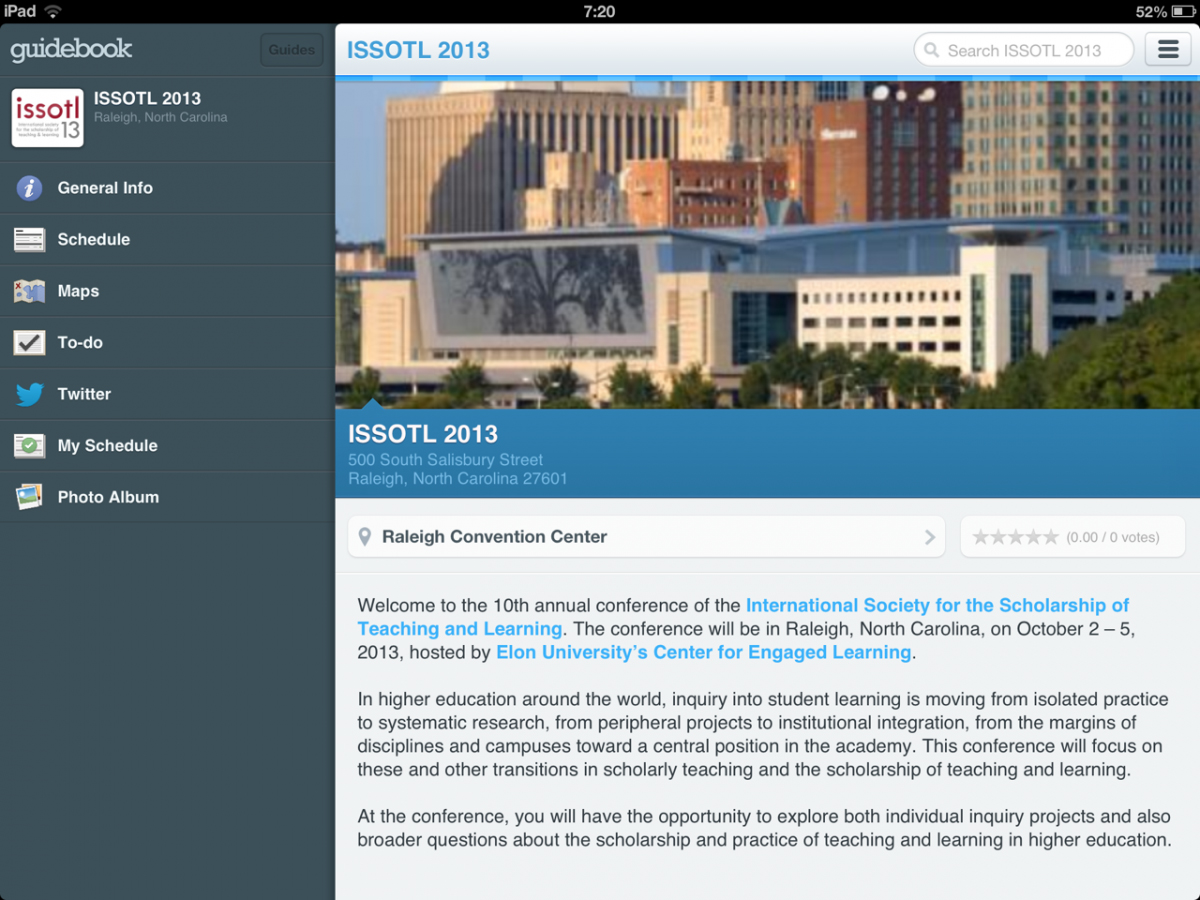
The conference organizers Peter Felten, Jessie Moore and Heidi Ihrig did a remarkable job in bringing together the traditions and values of the SoTL community with innovative ideas and emerging technologies. The conference was preceded by a free online series that featured videos, chats and discussion forums. During the event, participants were able to follow their personalized schedules on their mobile devices using the guidebook conference app.  At the same time, plenary presentations did not rely on Twitter-walls for interaction, but used buzz groups and other small group discussion formats to foster in-depth dialogue and deep processing.

 Schedule, planner and collective photo album: ISSOTL Guidebook App. Click image to enlarge.

Schedule, planner and collective photo album: ISSOTL Guidebook App. Click image to enlarge.

Wednesday, October 2: ‘The 8-track-tape Player of Opening Plenaries’

issotl 02For me, who like most participants did not book an additional pre-conference workshop or symposium, the conference started at 6:30 pm on Wednesday with the initial plenary session. The purpose of the plenary was to bridge from the online pre-conference to the live event, as the moderator Randy Bass (Georgetown University) jokingly explained: “This is not a task that anybody had to do a few years ago, and this is probably not a task that anyone will have to do a few years from now. We are the 8-track-tape player of opening plenaries.”  Continue reading

Students: Win a Trip to L.A. – Enter the IWitness Challenge – Deadline 12/2/13

i witness
Students across the country have already started working on their IWitness Challenge project sponsored by the USC Shoah Foundation – The Institute for Visual History and Education, but there’s still time for youngsters in your community to enter this free online program geared to all secondary-school students.

The deadline to enter the Challenge is Dec. 2, 2013. The winning student, along with their teacher and a family member will be brought to Los Angeles to showcase their work as part of the 20th anniversary activities for the Shoah Foundation, which was founded by director Steven Spielberg in 1994 after making “Schindler’s List.”

The IWitness Challenge (iwitness.usc.edu) connects students with the past in a very personal way that spurs them to take action to improve the future.

With access to many of the Shoah Foundation’s 52,000 testimonies of survivors, liberators and rescuers, students experience history in a way that hits home. Instead of reading facts from textbooks, students feel the emotions and build relationships with those who lived through seemingly impossible situations.

But students do more than watch the testimony. The IWitness Challenge compels them to think, to make smart choices and to create their own project and video from what they’ve learned. By encouraging teachers and students to create their own lesson plans, IWitness allows them to expand on practically any subject they wish to pursue. From civics, government and history to poetry, art and ethics, educators can tailor lessons appropriate for their classrooms.  Continue reading

VLC Media Player: Many Hidden Features

Chaz Baruela80By Chaz Baruela
Student, University of Hawai’i at Hilo

The first time I bought a laptop I used the default media player program, which is Windows Media Player. Unfortunately, there are some file types that do not work unless you download extra codecs for them. I didn’t want to download extra codecs, so I asked my friends what media player they use. That is when VLC media player was introduced to me. I have been using this program for the past five years, and in my opinion it is one of the best media players around.

VLC Media Player

VLC Media Player

First, the program is 100 percent free plus the download and install is quick and easy. When you install VLC, you don’t need to download extra codecs. Almost all video and music files such as mp4, mkv, avi, mp3, and ogg are playable as soon as VLC is installed. One classmate, Kai, commented on my post and said that he uses VLC media player to play flash video and matroska video files (Gilding). Another, Leleiohoku, said that she only found one movie that they couldn’t play (Stafford). My point is that VLC plays almost everything.

When you start up the media player, one of the first things you will notice is the interface. Reviews about how simple and attractive it looks are mixed. However, I think it is simple and has the basic functions covered such as a loop and a playlist. What you might not know is that there are some other “hidden” buttons that allow you to record, take a snapshot from a video, and a frame by frame button. I don’t see much use for frame by frame because all it does is stop the video and play it forward one frame at a time.  Continue reading

A Caltech Grad in a Caltech MOOC

picture of Harry KellerBy Harry Keller
Editor, Science Education

[Note: Harry, who holds a BS in chemistry from the California Institute of Techology and a PhD in analytical chemistry from Columbia University, has been sharing his first MOOC experience as comments to Jim’s “Technology in Higher Ed: We Ain’t Seen Nothin’ Yet” (10/3/13), but they’ve quickly grown into a series that we’ll be publishing on a loose schedule. See part 2, 3, 4 and 5. -Editor]

October 3, 2013

Future MOOCs may or may not be termed “MOOCs.” Things are reaching the point where small operations may change the world. Just look at the impact that Salman Khan had on education.

The Kepler project in Rwanda is an example of being a bit more creative by taking MOOCs and combining them with in-person teachers to deliver high-quality education. After all, they’re free!

How this resource comes to be used will affect how it evolves.

Another factor will be adaptive learning options and more interactivity.

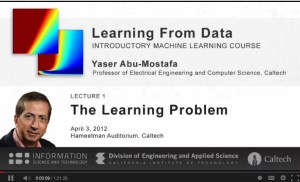
Opening screen for "Lecture 1: The Learning Problem Free," from Caltech Professor Yaser Abu-Mostaf's free introductory Machine Learning online course (MOOC).

Opening screen for “Lecture 1: The Learning Problem,” from Caltech Professor Yaser Abu-Mostaf’s free introductory Machine Learning online course (MOOC).

I’m currently taking my first MOOC, given by my alma mater, just to learn something new (machine learning — haha) and learn about MOOCs first-hand. So far, it’s nothing very exciting, but I haven’t bothered with any of the discussion group stuff because I just don’t have time for it. I may not have time to complete the course, but at least I’ll have learned SOMETHING and experienced it.

October 6, 2013

Follow up on my MOOC — I handed in the first homework assignment. I tried to do the last problem (requiring writing software) the hard way (by quantitative analysis) and decided that it would just take too long and settled for an alternative approach (Monte Carlo method), which only took a few minutes to program and run.

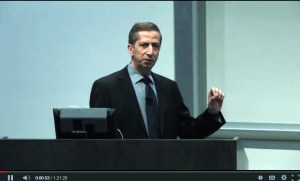
Professor Yaser Abu-Mostafa

Professor Yaser Abu-Mostafa

My first homework grade = 10/10. I took a look at the discussion group after I finished my homework to see what sort of questions and answers were being posted. I guess I’m rather biased from having been a Caltech student and having done essentially all homework solo. I think figuring out how to do it is as important (maybe more so) than doing it.  Continue reading

Language Is the Key to Community

Frank B. WithrowBy Frank B. Withrow

Human infants come into this world seeing, hearing, smelling, tasting and feeling the sensory world around them. The human culture developed the spoken word so that they could share private sensory experiences publicly. That enabled them to develop communities that built civilizations. About five thousand years ago mankind discovered that they could transform the spoken word into the written word. That enables mankind to transfer experience and knowledge over time and space.

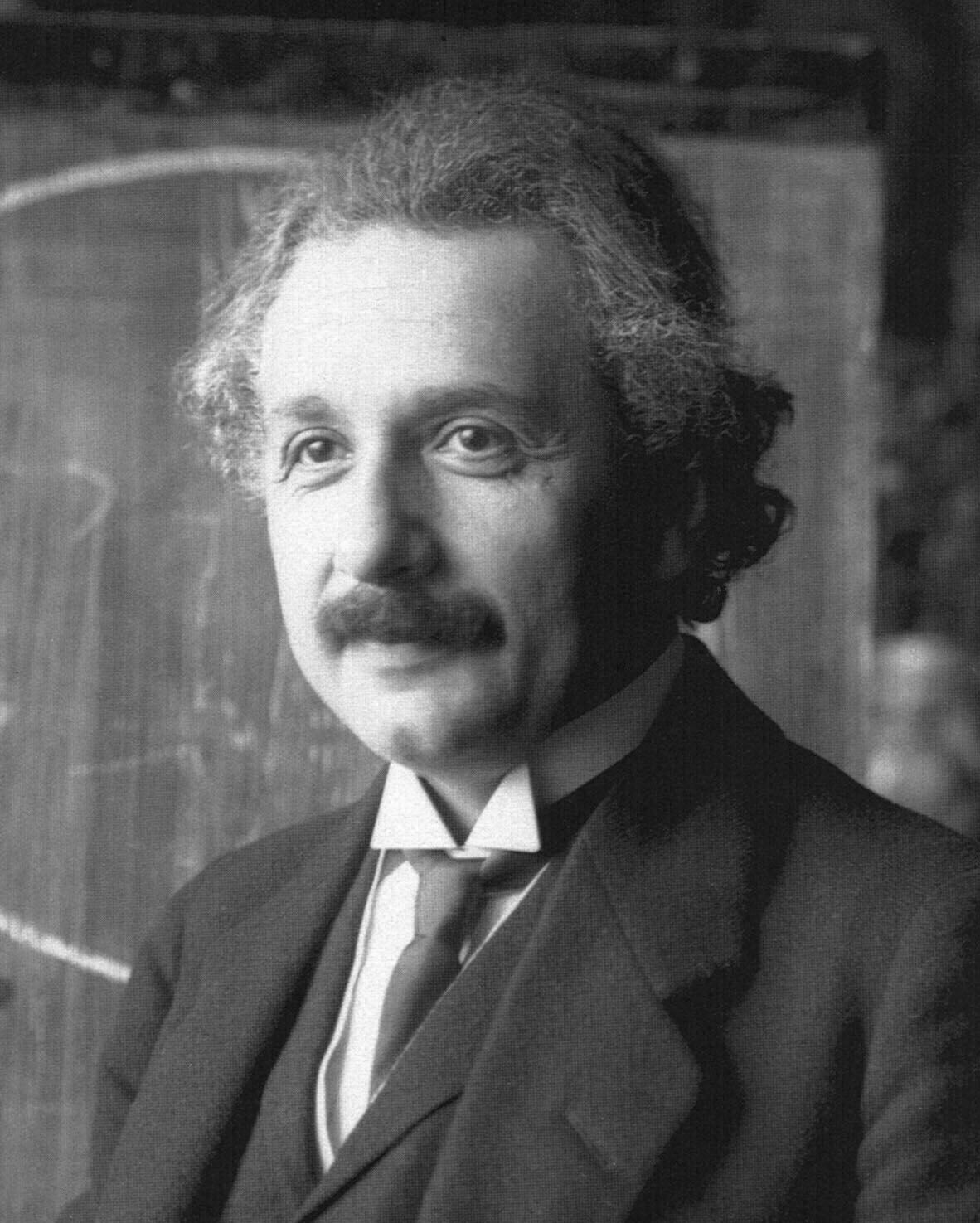
Albert Einstein

“Albert Einstein . . . felt the development of speech and language was one of mankind’s greatest accomplishments.”

I have been enjoying the thoughts and ideas about a peaceful world by a German Jew. They were written some eighty years ago as he worked at the League of Nations trying to avert World War II. He did not write in English so his original thoughts were in German and subsequently translated into English. He was very thoughtful in his deliberations. Among other things he felt technology would make us so efficient that there would not be enough work to employ everyone. He also felt the development of speech and language was one of mankind’s greatest accomplishments. I have been reading Albert Einstein’s papers of the 1930s.

We know our world through our sensory perceptions. They are the beginnings that are followed by words. There is an inherent desire by humans to communicate one with another. If our sensory perception are disabled we find a way around them to meet our needs to share. If we are deaf we use American Sign Language or lip-read. If we are deaf blind we learn touch signs. Even mentally slow children learn speech and language.  Continue reading

Technology in Higher Ed: We Ain’t Seen Nothin’ Yet

Jim ShimabukuroBy Jim Shimabukuro
Editor

Technology is increasingly dividing the academy, but this is a natural pattern in change. Most HE institutions fail to grasp that disruption is an outside force that creates a whole new population of students. This oversight or denial leaves colleges and universities fighting to defend its traditional practices — but they’re battling a strawman.

The real “enemy,” if you will, is a whole new way (MOOCs) to reach the world’s nontraditional student population. MOOCs aren’t aimed at traditional college students, but many traditional students are exploring the benefits of MOOCs and some institutions are exploring MOOC-like courses for their students.

The leadership in MOOC development and deployment is increasingly shifting to other parts of the world where HE has been a pipe dream for the masses. In the US, it is also shifting, on little cat feet, to small groups or departments in lesser-known colleges and universities with staff who understand and are exploring the potential of MOOCs. These garage and bootstrap operations are where change is being forged, and it will be interesting to see, in the coming months (not years), where this will take us.

We’re only seeing the tip of the iceberg in terms of technology-driven changes to come in HE. On our campuses, we need to take our eyes off the little islands that we call home and look beyond our shores to the vast ocean of possibilities. If we think we’ve witnessed change, we have another think coming. We ain’t seen nothin’ yet!

__________
MOOCs Outside of Mainstream U.S. Higher Ed (updated 10/20/13):

China MOOC: xuetangX, accessed 10/20/13.

Tim Johnson, “Online education inspires eager students in Latin America,” CSM, 10/4/13.

MOOCs take off in Rwanda: Accreditation, sustainability and quality issues,” Institute of Learning Innovation, 10/1/13.

Carolyn Fox, “Higher, open education for India,” Open Source, 8/29/13. \

Hiep Pham, “Research chemist launches Vietnam’s first MOOCs site,” University World News, 9/21/13.

MOOCs.co, 2013: “Higher Education MOOCs“; “K – 12 MOOCs“; “MOOCsNews© on Credits, Certificates, Degrees, Career Services, Job Placement and other related subjects.”

Technological Advances for the Disabled Benefit Everyone

Frank B. WithrowBy Frank B. Withrow

Captioned Films for the Deaf became a Federal law in 1958. Television was a more difficult problem. Open captions on television were opposed by a percentage of the hearing population. Therefore, we had to develop a system that, on the same broadcast, could have captions and a broadcast that was free of the captions. We experimented with the broadcast technology and discovered that we could in fact encode the caption in the broadcast signal and with the proper decoding system have a clear non-captioned broadcast and with the decoder have a captioned program. The FCC approved the system and it works today.

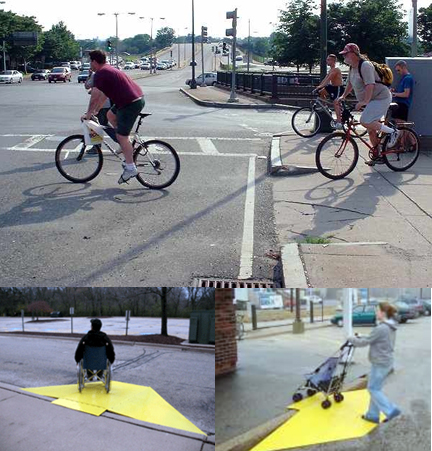
Curb cuts benefit everyone.

Curb cuts benefit everyone.

Ironically the side effects of captions have made caption television an interesting product. Bars have used it in crowded environments. Doctors and dentists have used it and captions are widely used in hospital rooms. Like so many devices the captioned TV has been used beyond its original purpose. We see many applications of systems devised for the disabled being used by the wider community. The IQ test was originally developed to identify mentally limited children. The typewriter was developed for cerebral palsied individuals. In fact, Alexander Graham Bell was a teacher of deaf children when he developed the telephone. While he was not specifically developing the telephone to aid deaf people, his concern for deaf education provided the background for the telephone.

Many advances in our society have come from work among the disabled that was designed to enable them to more effectively compete in the world.

Today’s advancements with high technology lead us to believe that cochlear implants and optical implants will lessen the limitation of hearing and sight loses.

We know that the human brain can overcome many obstacles. Digital technologies will open many doors in the future. For example, we have the technology today to translate a severe speech problem into understandable speech. If the speaker has consistent speech even if it is not understandable we can use digital technologies to make it understandable.

Wheelchair curb cuts benefit parents with babies in strollers. I had a DC bicycle delivery boy tell me they were for them.

The larger community also uses things that benefit the disabled. Education for the disabled makes them taxpayers rather than tax users. Good programs for the disabled are wise investments for society.

Retirement of Your Elementary School Students: Keeping in Touch with Facebook

Frank B. WithrowBy Frank B. Withrow

As a teacher there always is one learner you cannot reach. You wonder why since your lesson plans seem in order, the other kids are learning but Suzy is stagnating. I had a girl who should have done well, but she had a hearing loss and was also mildly cerebral palsied. She was not a bad learner but also not really a good learner. I was never satisfied with her progress but also could not point out exactly where she fell short.

Central Institute for the Deaf, St. Louis MO

Central Institute for the Deaf, St. Louis MO

Forty years afterwards, she wrote me and asked why she failed. She never married, never worked and really never fully participated in the world. I could not answer her question, but it did not surprise me that she never became integrated into society. Almost intuitively I knew she would not make it.

I recently heard from a classmate of hers who had retired from being a school janitor. He was beloved by the teachers and students in his school. Being a janitor does not sound like a wonderful success story, but it does not surprise me that he did his work well and was socially liked by all who came in contact with him. As a kid he was hyperactive and into everything. In fact, he was so into everything people thought of him as a pest. Yet he has contributed to society and been a taxpayer rather than a tax consumer. He is a success story.

I taught multiply disabled students fifty-five years ago. It is interesting to find some of those students on Facebook. Some are very successful with good jobs and families of their own. My former students live all over the nation — even the world. It is nice to be able to find and follow them on Facebook. They are in their seventies so I must be getting a bit older myself.

I was a Scoutmaster as well as a teacher. My first Eagle Scout was a great kid. He was not the smartest, but he was the most compassionate and born leader I ever had. He worked hard to achieve but also wanted everyone else to experience what he was doing. He is close to 80 now and still a leader. He has worked in charities and still wants to help others. He has had a long and happy marriage. He says he has no intention of retiring and still believes he can help others.

Some of my students have children who have gone on to accomplish outstanding things. Central Institute for the Deaf in St. Louis where I taught will be 100 years old in 2014. I look forward to its reunion. In the meantime Facebook brings back memories.

My large family is spread from New Hampshire to Texas and the West Coast. I have been impressed that Facebook helps us follow one another. It would be an interesting study to examine how Facebook engages families and reconnects teachers with students.

SPOCs Are MOOC Game Changers

Jim ShimabukuroBy Jim Shimabukuro
Editor

They’re billed as SPOCs, or small private online courses, and they’re being led by Harvard and UC-Berkeley. According to Rob Lue1, Harvard’s edX director, “We’re already in a post-Mooc era,”2 and SPOCs are the next generation. Considering the specs on SPOCs, however, SOOC3 — for selective open online course — may be a better fit for what appears to be a strong candidate for nextgen status. The problem with the moniker is that SPOCs aren’t always private.

Rob Lue, director of HarvardX.

Rob Lue, Harvard’s edX director.

For example, on the one hand, one of the two new HarvardX SPOCs this fall is GSD1.1x: The Architectural Imaginary. It is closed and private, and available “only to incoming Design School students.” However, it “may be opened up to the broader public at a later date.” On the other hand, HarvardX’s first SPOC, HLS1x: Copyright, in spring 2013, was open and selective: “Law School professor William W. Fisher, III, and his teaching staff chose from 4,100 applicants worldwide to form the 500-student online class.”4

SPOCs are MOOCs with fixed enrollments.5 However, beyond this general characteristic, there are two distinct types: private and selective. The former are, for all practical purposes, indistinguishable from traditional online courses. The real innovation is in the latter — selective. Anyone can apply, but acceptance is selective to limit enrollment. Thus, SOOC is probably a better fit for the Harvard-Berkeley nextgen MOOC.

SOOC numbers are smaller, but they’re still potentially massive in comparison to traditional onground courses. Coughlan describes them as “still free and delivered through the internet, but access is restricted to much smaller numbers, tens or hundreds, rather than tens of thousands.”

The selection factor in SOOCs is a game changer. Selectivity addresses three critical problems that have plagued MOOCs from day one: low levels of active participation, low retention rates, and variable student backgrounds. By limiting enrollment to selected students, SOOCs have the potential to become serious and effective online learning platforms that retain the MOOC’s magic of massive, open, and online.

As the ratio between staff and student numbers diverge, interaction remains an issue and reliance shifts to peer-to-peer support for feedback and guidance. However, when those with insufficient background knowledge, skills, and motivation are factored out, peer support systems may have a strong potential for success. Thus, selectivity may be the second generation answer to the MOOC’s current woes.

SOOCs open up a whole new dimension of possibilities for MOOCs. For example, a variation on selecting students up front may be to allow students to self-select in via performance in the first few weeks of a course. In other words, all students are accepted in the beginning, but only those who participate actively and at a given level — determined by staff or peers using rubrics — will be retained. This would amount to a two-stage enrollment process that’s initially open but becomes progressively selective in the first phase of the course.

Regardless of what they’re called — SPOCs, SOOCs, or something else — incorporating selectivity into the MOOC design is brilliant.
__________
1 “Robert Lue . . . Director Life Sciences Education and Professor of the Practice in the Molecular and Cellular Biology (MCB) department, directs Harvard’s edX – dubbed HarvardX” (Cathryn Delude, “edX, Transforming the Future of Education,” MCB, 11/29/12).

2 Sean Coughlan, “Harvard Plans to Boldly Go with ‘Spocs’,” BBC News, 9/24/13.

3 The acronym SOOC has been used by others, e.g., Heather M. Ross in “Instead of a MOOC, How About a SOOC?” (Educatus, 10/29/12) and Michael K. Clifford in “SOOC Challenges MOOC Muddle” (DreamDegree, 7/2/13). For Ross, it stood for small open online course; for Clifford, strategic open online courses.

4 Madeline R. Conway, “HarvardX’s New Fall Offerings to Include Two SPOCs,” Harvard Crimson, 6/21/13.

5 Dev A. Patel, “Law School Debuts First Online Course,” Harvard Crimson, 1/31/13.

Martian Rhapsody: Chapter 1 – Landing (REVISED)

martian_rhap017

[Note 7/6/14: See Chapter 2 – Rocks. -Editor]

Harry Keller

Harry Keller

To the reader: I’ve decided to redo chapter one to incorporate story ideas that wouldn’t have been possible with the original chapter. Please bear with me, and I apologize for the false start. I hope you’ll enjoy this adventure as much as I’m enjoying sharing it with you. Best, Harry.

mars-As the Google Mars shuttle continues its weeks-long deceleration toward its unbelievable destination, the crew of four busily checks the instruments on the attached Citigroup crew module where they have lived and worked for four months. They are so involved in monitoring not only their own module but also the Royal Dutch Shell supply module that they momentarily forget that they’re about to become the first humans ever to set foot on another planet. The shuttle holds the two attached modules like a parent carrying twins in both arms. It may look awkward to those used to air-based flight but creates no impediment to travel in the vacuum of space.

“Final pre-separation check,” snaps Aleka as the about-to-be Martians go through procedures necessary to ensure a clean separation from the shuttle. She glances out of the small thick window and sees the edge of the red planet against the black of space with its countless bright point lights of stars strewn haphazardly across its seemingly infinite reaches as though a child had thrown diamonds and diamond dust on a vast expanse of black velvet.

A few weeks earlier, the entire crew of four was excited to see the small red dot of Mars expand and grow into a shiny red penny in the black, deep expanse of space  – nearly 14 billion light-years deep, far beyond human imagination. Now, it fills most of one side of their view. Earth has receded to a pale blue dot, left forever to the billions living there. A new world awaits. Humans will triumph over Mars someday. Aleka has promised herself that this will be that day.

“Check,” says co-pilot Chun. Her engineer’s mind racing with the excitement and the checks she’s performing to ensure a safe entry and landing.

Four years of training guarantee that the anxious crew all know their roles in this landing precisely. The captain, Aleka (Allie), is the only flight-trained pilot on the mission, but all of them have spent countless hours in the landing simulator and can take over if necessary. Redundancy has been the watchword of the Mars mission from the very beginning. For the landing at Amazon base, however, there could be only one crew module. Everything depends on its successful entry into the absurdly thin Mars air, about 1% of the density of that on Earth, followed by the powered descent to the surface.  Continue reading

MOOC MOOC! The interview

By Jessica Knott
Associate Editor
Editor, Twitter/Facebook

nowthats160Rarely does a MOOC strike fear into the heart of its participants. Interestingly, in this case I mean the MOOC itself, not the content. MOOC MOOC, a MOOC about MOOCs (MOOC! Sorry, I just wanted to say it once more, as I didn’t feel I had worked enough instances of the word MOOC into the sentence) offered challenges and learning, exploring the MOOC phenomenon in an interesting, creative way.

MOOC MOOC has been offered three times by Jesse Stommel, Founder and director of Hybrid Pedagogy, and Sean Michael Morris, managing editor and coordinator of Educational Outreach for Hybrid Pedagogy. Jesse is also an assistant professor at University of Wisconsin-Madison and an advocate for lifelong learning and the public digital humanities. Sean calls himself a digital agnostic and a contemplative pedagogue. He is also a creative writer and a former community college English department chair. MOOC MOOC has been offered three times: in August 2012, January 2013, and June 2013.

Please cross your fingers as I conduct this interview, and hope the MOOC MOOC does not eat me alive. Here we go…

MOOCSleeps

1. What is a MOOC MOOC?

JESSE: A MOOC MOOC is a mostly amiable beast. He looks a lot like a cave troll but with altogether more charm and less menace. He’s misunderstood, only mean from a certain angle, but also clever. He eats MOOCs, disruptive innovation, and venture capitalists for breakfast. He has been known to cuddle a Twitter pal on occasion, which usually involves copious amounts of slobber.

Jesse Stommel

Jesse Stommel

MOOC MOOC: [eyes his dad suspiciously]

JESSE: MOOC MOOC is also a massive open online course about massive open online courses, a mini-micro-meta-MOOC that refuses to take the MOOC at face value, choosing instead to approach it as a sandbox for exploring nodal learning, participant pedagogy, and the course as container.  Continue reading