
A Conversation with Curtis Ho: AACE E-Learn SIG on Designing, Developing and Assessing E-Learning

By Stefanie Panke
Editor, Social Software in Education

Dr. Curtis P. Ho is professor and former chair of the Educational Technology department at the University of Hawai’i at Manoa. His research interests comprise collaborative learning through distance education, instructional design strategies for teaching online, instructional technology standards in teacher education and the integration of technology into the curriculum. Dr. Ho serves on the executive committee for the AACE E-Learn conference (forthcoming in October 2013), where we co-chair a new Special Interest Group on Designing, Developing and Assessing E-Learning. Since we have never met in person (yet), I asked Curtis to comment on six statements related to assessment.

Curtis P. Ho

Curtis P. Ho

Statement 1: Authentic assessment is the “silver bullet” for deep, transfer-oriented learning – if only we knew how to do it right.

Curtis: Yes, I like the term “transfer-oriented learning” to define how we need to shape assessment. This is the gold standard for learning outcomes. After all, this is Robert Gagne’s 9th event of his Nine Events of Instruction. The challenge will be to create and implement authentic learning in an online course. How authentic can learning be if we are confining it to a 15-week semester at a distance?

Stefanie: I find David Jonassen’s work on problem solving (i.e., Jonassen 2011) a great starting point to think about the instructional design of assessment.

I am particularly interested in the design of assessment that fosters mastery orientation and offers gratification to performance-oriented learners. How can we make students want to improve and push themselves, and give them opportunities to shine and prove what they can do?

Statement 2: Assessment in online learning needs to move beyond multiple-choice quizzes in PowerPoint modules.

Curtis: I would generally agree. The ideal is to have authentic assessment at all times. However, multiple-choice quizzes may be useful in reinforcing short-term learning, and I see using this for self-check or practice. It may be used to scaffold lower level learning.

Continue reading

MOOC Looks: Zombies and Sober Reality

Articles Cited:

Carmel DeAmicis,  “The Walking Dead Online Class: Are Zombies the MOOC Future?“, PandoDaily, 4 Sep. 2013.

Keith Devlin, “MOOC Mania Meets the Sober Reality of Education,” Huff Post: The Blog, 19 Aug. 2013.

USC Shoah Foundation: Video Challenge for Grades 6-12

Lynn ZimmermannBy Lynn Zimmerman
Associate Editor
Editor, Teacher Education

In 1994, Steven Spielberg established the Survivors of the Shoah Visual History Foundation, a nonprofit organization whose original mission was to videotape “the testimonies of 50,000 survivors and other witnesses of the Holocaust from around the world for educational purposes before it was too late.” In the years since then the foundation’s mission has changed from just archiving to establishing educational uses for the materials that are archived. The education department has developed “educational programs and products for classroom use by students of all ages.”

iwitness02

This year (2013) is the 20th anniversary of Spielberg’s movie, Schindler’s List, which provided the impetus for the establishment of this foundation. To commemorate this anniversary, an online learning initiative has been set up to engage high school students in a competition that uses IWitness, a website set up for secondary educators and their students. Students participating in IWitness Video Challenge will have access to the 1,300 testimonies available on IWitness and will create their own video-essay.

This project seems to offer opportunities for students and teachers to engage in an assignment that would not be as accessible without modern technology. They can view, copy, and create using multimedia tools to develop a video essay that connects the students with the past and the present. To find out more about IWitness Challenge, I contacted Josh Grossberg of the USC Shoah Foundation – The Institute for Visual History and Education.

LZ: Who do you think will participate?

JG: We certainly hope that all students participate; it is our core belief that one person can make the world a better place and we want to reach as many of them as possible. Although IWitness is still in beta, it has already been accessed by more than 10,000 high-school students and 3,200 educators in 39 countries and all 50 U.S. states.

Continue reading

‘Teaching Digital Natives’: Difference Between ‘Relevant’ and ‘Real’

Lynn ZimmermannBy Lynn Zimmerman
Associate Editor
Editor, Teacher Education

Review of Marc Prensky’s Teaching Digital Natives: Partnering for Real Learning, Corwin Press, 2010. ISBN: 978-1-4129-7541-4.

I picked this book up because, as I have mentioned before, I worry that as a teacher educator I am educating today’s teachers for yesterday’s students. Although Prensky has some interesting insights into today’s and tomorrow’s learners, the concept he is presenting is not new and he admits this. What the book does offer, however, is specific ways in which today’s learner is different and some specific ways in which teachers can address these differences.

TDN

Throughout the book, Prensky encourages the teacher to see their students differently, as partners in learning. This concept is very similar to what is known as student-centered learning, problem-based learning, constructivism and many other progressive models that were developed in the 20th century. Prensky asserts that today’s students are not less able than previous generations but that their tolerance and needs have changed, and what and how they learn is different from students in the past. In the introduction, he makes his view very clear: “They want ways of learning that are meaningful to them, ways that make them see — immediately — that the time they are spending in their formal education is valuable, and ways that make good use of the technology they know is their birthright” (p. 3).

For Prensky, this immediacy is one of the keys to understanding today’s students. Technology allows them to participate in real ways in life across the globe, whether in something as serious as the events during the “Arab Spring” of 20111 or as trivial as voting on “American Idol.” He goes on to assert that teachers do not necessarily have to become experts in technology but that they need to re-imagine their pedagogy so that the student themselves take responsibility for their own learning using the technology they are so familiar with and so fond of.

By “real” he means immediately applicable to their lives. This is where technology can come in and make a difference.

As a teacher educator, I know that the notions he presents are not new. However, one of the points Prensky stresses is the difference between “relevant” and “real” — and that caught my eye. I have always been concerned with ensuring my students’ learning is relevant for them and the students they will be teaching. Prensky says that relevance is not enough. By “real” he means immediately applicable to their lives. This is where technology can come in and make a difference. Rather than only reading about historical events and watching videos about them, they can take virtual tours of many places, participating in or even creating simulations.

If a space launch is coming up, they can compute everything from budgets to payloads. They can use Skype to talk to real scientists about real-world problems. They can participate in urban planning projects for the future to help them think about and plan for the future they are going into. While these ideas are not really new to any progressive/constructivist educator, the reminder that students may have ways and means to accomplish tasks that the teacher may not have imagined is worth keeping in mind.

__________
1 Jean-Marie Guehenno, “The Arab Spring Is 2011, Not 1989,” NY Times, 21 Apr. 2011.

10th Annual Teaching and Learning Conference at Elon University: Cutting Edge Without Being Trendy

Stefanie Panke, Rob Moore, and Jamar Jones

Stefanie Panke, Rob Moore, and Jamar Jones

By Stefanie Panke, Rob Moore, and Jamar Jones

The 10th Annual Teaching and Learning Conference held on August 15 at Elon University (NC) is a regional event that attracts teachers, instructional designers, curriculum specialists, researchers, and students interested in the Scholarship of Teaching and Learning (SoTL). The UNC School of Government instructional support team spent a day of professional development there that proved to be a cornucopia of fresh ideas, concepts and insights.

Morning Plenary Session

R. Michael Paige

R. Michael Paige

The opening keynote featured an inspiringly passionate talk by Michael Paige, Professor Emeritus of International and Intercultural Education at the University of Minnesota. Paige’s keynote raised awareness of the multifaceted and multilayered nature of the concept of intercultural sensitivity. In a nutshell: Every classroom is an intercultural experiment. Learners’ cultural backgrounds, values, and life experiences differ. What does it mean to become intercultural? Diversity and intercultural encounters go beyond different nationalities and include sexual orientations, localities, ethnicities, as well as learning and communication styles. “Who is the role model for us?” asked Paige. “In most societies, this is still really a challenge.” Getting students to transcend ethnocentrism and explore intercultural relations is a demanding pedagogical task. Intercultural sensitivity is not innate but needs to be learned and taught.  It is normal for students to be in denial of cultural patterns and to feel more comfortable in monocultural environments. Paige introduced the Intercultural Development Continuum (IDC) as a useful model to help students navigate intercultural experiences.

fig01

Concurrent Sessions

After the morning plenary, we split up to attend different sessions: Each of us had a few personal highlights.

Stefanie’s Favorites: Authentic Learning , Motivation, and Big Data

Deandra Little and Paul Anderson

Deandra Little and Paul Anderson

Deandra Little and Paul Anderson from Elon University delivered the next talk I attended. The speakers connected their introduction to the keynote and revealed they both recently moved to North Carolina. They asked the audience, “Well, who else is new?” which led to interesting intercultural discoveries. It turned out that Anderson, academic literacy specialist, had worked as a consultant with the University of Bielefeld (Germany) where I completed my PhD.

Anderson and Little defined authentic assignment as asking students to produce intellectual work (at an appropriate level) that mirrors a typical task that practitioners or scholars in the respective discipline perform. Thus, students are placed in a realistic situation where they use the knowledge and skills they are learning in the course to help someone else outside the classroom – not the instructor.  “Think about it from the student’s perspective – you need to write something for someone who already knows more about the subject than you do,” Anderson said, describing the problem of traditional writing assignments. Little explained in more detail their narrative approach towards authentic assignments. The instructors immerse the students in a story in which they use the subject knowledge to help another person or group. This approach comprises seven components: (1) The learning goal of the assignment, (2) the role the student will play, (3) the person (audience) who asks for the student’s assistance, (4) the problem or question, (5) the reason why the audience seeks the student’s help, (6) what the audience will do with the student’s work, and (7) the type of communication (genre) the student will produce to solve the problem.  Continue reading

‘Inspiration Mars’ Inspires

picture of Harry KellerBy Harry Keller
Editor, Science Education

Mars seems to be everywhere these days. Who will go? How will we go? When will we go?

These questions have yet to be answered. Dennis Tito, a millionaire with Mars instead of stars in his eyes is focusing on a project he terms “Inspiration Mars.” This is not a landing but just a flyby. It’s not a four-person flight but rather a two-person flight by a man and a woman, both past child-bearing age for the reasons of radiation during the 501-day trip.

There’s one very conspicuous hitch in this program, readily admitted by all involved: the date. In order to be efficient, space missions to Mars must take place roughly once every two years, when Earth and Mars are aligned in their orbits. In 2018, there will be a special alignment that occurs infrequently and provides what the Inspiration Mars people call a “exceptionally quick, free-return orbit” that’s available just twice in every fifteen years. The next such launch window is in 2031, according to the Inspiration Mars site. This project has a very tight schedule.

 Inspiration Mars

By orbiting Mars at about 100 miles above the surface, the mission will avoid encountering the thin Martian atmosphere and will also use the so-called slingshot effect that takes some momentum from the planet itself to accelerate the spacecraft back to Earth and shorten the return trip considerably. It also reduces the amount of fuel that the craft must carry considerably.  Continue reading

Hyperloop: Is It Better, Faster, and Cheaper?

picture of Harry KellerBy Harry Keller
Editor, Science Education

Now that Elon Musk has revealed details of his Hyperloop concept for traveling between cities faster than double the speed of an airplane, it’s time to put his ideas to the test. Will they work? Should we build it?

Such a complex system has no trivial answer. We can consider two important factors, however. Will it work? Does it satisfy the demands of a new technology?

Hyperloop, by Elon Musk, Chairman, Product Architect and CEO, 12 Aug. 2013.

Hyperloop, by Elon Musk, Chairman, Product Architect and CEO, 12 Aug. 2013.

For the second question, the answer comes from considering how technology is supposed to work. When you inject technology into an existing space such as travel (or education for that matter), it should work better, result in faster results, and cost less than what it’s replacing or supplementing. Dan Goldin of NASA put it into really simple terms long ago:  Better, Faster, Cheaper.

Hyperloop pod.

Hyperloop pod.

How does Elon Musk’s plan stack up? From his own blog, here are his goals for intermediate distance transportation of from a few hundred miles up to around 900 miles when compared to existing system.

  • Safer
  • Faster
  • Lower cost
  • More convenient
  • Immune to weather
  • Sustainably self-powering
  • Resistant to Earthquakes (he’s in California)
  • Not disruptive to those along the route

The second two items match nicely. Musk claims that a ticket on the Hyperloop from Los Angeles to San Francisco should cost about $20 one-way. The speed of 700 to 800 mph certainly counts as faster. Is it better too? That depends much on what you consider to be better. The travel pods will hold about 28 people if his design is chosen. They will not be spacious. His drawings suggest a rather cramped environment that could bother claustrophobic passengers, except that this system will be above ground and could have a view. However, the drawings don’t show windows.

Elon Musk in Mission Control at SpaceX. He is a South African-American inventor and entrepreneur, best known for founding SpaceX and for co-founding Tesla Motors and PayPal.

Elon Musk in Mission Control at SpaceX. He is a South African-American inventor and entrepreneur, best known for founding SpaceX and for co-founding Tesla Motors and PayPal.

A 350-mile trip might take around a half-hour, long enough to become upset with being in a small closed space with others. The potentially longest trip of 900 miles would require over an hour. All current modes of transportation, planes, trains, automobiles, and boats, have windows that passengers tend to like very much despite the view. Looking out of a window at 30,000 feet or traveling at 70 mph can be disconcerting. However, the power of the desire to see overcomes this problem for most.

Continue reading

My Vision for the 21st Century School

Frank B. WithrowBy Frank B. Withrow

A school facility is too expensive to operate only part of the year; therefore the 21st century school is designed to operate year round. The school day or time the school is open is at least twelve hours per day. Staff work on different shifts in order to efficiently use resources. Students attend at times scheduled in conjunction with their parents. Students can also access some instruction from their homes.

Obviously individual students do not attend all the hours the school is available. Students, in fact, attend at different times and different lengths of time in order to have the maximum learning take place.

schoolhouse_day_night7Students, with the help of the school, schedule family vacations when all the members of the family have common vacation windows. Such vacations can happen at any time of the year. In fact, if a family is vacationing at a historical site such as the Grand Canyon, Washington, DC, Europe or Asia, the school can work with the student and family to document the vacation and share such results in the school library of vacation experiences. If the family is attending the Olympics, the student might even report back to the school events from their viewpoint. For example, my ten-year-old granddaughter attended my wife’s burial in Arlington Cemetery. She produced a slide show on the history of Arlington Cemetery and discussed who could be buried there. Her grandmother had been a Navy Corpsman in World War II. The service included a 21-gun salute and a formal Navy internment. She shared this with her class in Pennsylvania when she returned home. Obviously, family vacations can be extended learning experiences.

Dr. Margaret S. Withrow, author of Auditorily Augmented Interactive Three-dimensional Television as an Aid to Language Learning Among Deaf and Hearing Impaired Children: Final Report (1980), is buried at Arlington National Cemetery.

Dr. Margaret S. Withrow, author of Auditorily Augmented Interactive Three-dimensional Television as an Aid to Language Learning Among Deaf and Hearing Impaired Children: Final Report (1980) and a Navy Corpsman in World War II, is buried at Arlington Cemetery.

The 21st century school contains a range of learning environments that includes classrooms, small team rooms, laboratories, technology centers and digital libraries as well as gyms and sports fields. In addition, schools have camping facilities that can be used year round. Schools have shops where students can create various projects they have designed. School auditoriums are used for community meetings so that the school becomes a center of community activities.  Continue reading

Broadband for Schools: Do We Need Gbps Bandwidth?

picture of Harry KellerBy Harry Keller
Editor, Science Education

A great many people are agitating for broadband in schools.1 They insist that our young people will not be prepared for the future without it. If you look at these people carefully, you’ll mostly find technophiles and members of companies making online learning products.

[Disclaimer: I am the president of a company that makes an online learning product.]

They are taking the easy way out. Schools have greater needs than broadband Internet access. Eventually they’ll all have it as the broadband wave sweeps our nation. (I’m writing in the U.S.)  However, has anyone really assessed the necessity for really high bandwidth, 1 Gbps and above? If so, I haven’t seen it.

ScreenHunter_06 Aug. 03 11.44

Consider what’s really important for schools to have. Number one is good teachers. Broadband has nothing to do with that. Number two is good leader/administrators. Again, no broadband here. Somewhere well down the list is new technology. But, what technology?

To know what the requirements will be, we must have a good crystal ball. We don’t have that so think about what’s available today rather than attempt to predict the future. You can find plenty of interesting online learning options. What are their bandwidth requirements? Leave out non-learning options such as students downloading the latest horror flick or porn movie. Consider only the requirements for learning software.

How many students at one time will be using the Internet for learning? Maybe half. What fraction of the time on the Internet actually involves downloading media? Media are the major bandwidth users. Now, average out the bandwidth for everyone. You’ll probably get a smaller number than you thought you would.  Continue reading

Free Textbooks for College?

picture of Harry KellerBy Harry Keller
Editor, Science Education

Another school year is about to start, and students are scrambling to keep their debt load low and their college experience as positive and marketable as possible. With plenty of textbooks costing $200, $300, and more, the extra $1,000 or so for books is a formidable burden to many.

isbn text3

Good news comes in many flavors, and textbooks for less is one example. A very quick search turned up four sources for textbooks that are either free or very inexpensive.

Each has its advantages and disadvantages. The future of each is uncertain, but now is the time to take advantage of great opportunities. Ideally, you should have a free online version of the textbook assigned by your professor. I am a former professor and know that professors often do not spend lots of time making textbook decisions and frequently don’t bother to check the cost to the students. Sometimes, your book was written by your professor and so adds to his or her bank account every time one is sold.

My field is chemistry. So, I naturally checked out the chemistry titles from the above providers. College Open Textbooks has 45 chemistry titles, all for free. The problem you’ll encounter is that none may match your instructor’s choice. Go see your instructor a year before the course if you’d like to influence the choices.  Continue reading

Sloan-C’s Blended Learning 2013 — Best Yet!

By Jessica Knott
Associate Editor
Editor, Twitter/Facebook

A couple of weeks ago I had the opportunity to attend the Sloan Consortium’s Blended Learning Conference (July 8-9) in beautiful Milwaukee, Wisconsin. I had attended earlier iterations of this event with mixed satisfaction. But when it comes to their face-to-face events, the planning committees and conference chairs seemingly step up their game every year. This conference, chaired by Tanya Joosten (@tjoosten), was one of the best I have ever attended, in person or virtually.

Tanya Joosten

Tanya Joosten, conference chair.

While there, I had the opportunity to give a workshop entitled Visualizing Your Blended Course Design. Those who know me might be giggling a bit as it is common knowledge that my art skills are somewhat mediocre. One might say that my stick figures belong in the wood chipper. But the point of this workshop is to show people that the art isn’t the important part of the process. It doesn’t matter if you produce the most beautiful picture that ever was. What I want is for you to think a little differently about the design of the experience you provide your students.

Too often, we see the word “design” and zero right in on the elements of graphic design. Indeed, in my past, I’ve had people tell me that I’m not an instructional designer because I’m just not that good at the visual aspects. I vigorously disagree. A well-orchestrated teaching activity, executed in an environment spanning face-to-face environments and the virtual world where everything tangible is only tangible because we make it so, requires careful design and planning. We are all designers, even if our artistic skills more closely resemble third grade art class projects than they do the Mona Lisa. I’m proud of every third grade-level piece I produce because of the thought that goes into it.

Conan Heiselt

Conan Heiselt

Drawing lets us think differently. It gets us away from what we know and allows us to use different parts of our brain. It makes us see our content in new ways. It lets us explore frameworks without the pressure of choosing “the right one.” A former colleague, Conan Heiselt, taught me that when you’re looking at a big, white, blank piece of paper, the first thing you should do is mess it up. This removes even more of the pressure to be perfect. I have incorporated this idea and found that he is absolutely right. Participants laugh and look at me like I’m crazy, but it’s often the point in the workshop where they begin to let go and have fun. This was no different at the blended conference. Workshop participant Brandi Leming (@BMPLearning) documented some of her thinking on Twitter. For me, the coolest part of the whole thing is looking around and seeing inside the brains of 20 – 60 different workshop participants; everyone visualizing differently, different pictures, motion, thoughts and structure.

Of course, for some, this workshop just simply doesn’t connect. Maybe the drawing is too stressful, or I am just unable to make the connections for them. Heck, I’ve been flat out told that drawing your ideas was “stupid and a waste of my time.” That’s okay too. I think this workshop went well, and several people told me so. I’m always curious about what the others thought. Wouldn’t it be awesome to know what the people you’re teaching are thinking as you’re teaching them? The best thing about working in the field of education is that right to explore, question, challenge, and finally settle on what’s best for you and your students. This is one of the things that the Sloan blended conference did really well this year. Continue reading

Esri 2013 – The Best Conference I’ve Attended This Year

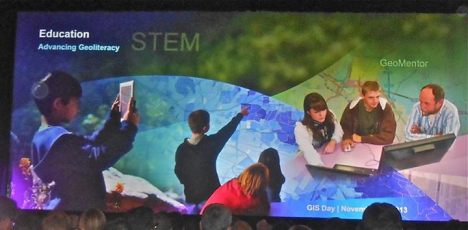
The absolute best conference that I have attended this year is the Esri Educators Conference, San Diego, July 6–9, 2013. Note that the educators also participated in the main conference, Esri International User Conference, also in San Diego, July 8–12, 2013. The big conference is also online.

This photo captures the essence of the educator's conference.

This photo captures the essence of the Esri Education GIS (geographic information system) Conference.

In the days before the main conference, the educators’ conference is one of many mini-sessions. These groups quietly gather in separate meeting places. They are long enough to be meaningful.

esri 01

The educator’s conference is different from any other conference I have attended. It is small and intimate. The icing on the cake for this conference was that six educators were picked from their videos to tell their GIS stories. They shared them and freely interacted with the audience. The stories were moving, diverse and informative.

There was plenty of time after the sessions ended for meetings and networking. This conference allows one to meet professors, to network with other teachers, national and international, and to gain practice in GIS skills with hands-on sessions and guidance. We had an un-conference section. There were also educator blogs and skill workshop sessions.  Continue reading

Textbooks Are Zombies

picture of Harry KellerBy Harry Keller
Editor, Science Education

Despite plenty of nay-sayers, the textbook is dead. It just doesn’t know it yet and continues on walking about as though alive. Textbooks have evolved considerably over the last fifty years and even somewhat in the previous fifty years. I even have one, A Text-Book of Physics, on my bookshelf beside me that was printed in 1891. It has some line drawings and no color. Its size is about 5”x8”. Today, textbooks have lots of colorful images, plenty of side bars, and lots of engaging questions sprinkled about on their heavy-weight glossy paper stock. They also have tons of advice to teachers on how to use them effectively. They’ve gone about as far as they can go with paper as the medium.

books_zomb

The word “textbook” originated in the 1720s, almost 300 years ago. It’s had a good run and is ready to retire. Those who argue that you cannot learn well without a textbook ignore the centuries prior to 1720 when lots of people, not everyone of course, learned and learned well with no textbooks anywhere.

Some will say that books were around even if they weren’t textbooks. The movable-type printing press was invented around 1439, only 180 years before the word “textbook” was coined. Before that all writing was done by hand or by engraving an entire plate for each page making books very expensive. Yet, people were learning long before 1439 or 1720. Even stone-age tribes passed on learning from generation to generation. Some argue that having a repository of knowledge is one reason that our species evolved longer life spans than chimpanzees and Neanderthals.

Johannes Gutenberg invented the printing press and independently developed a movable type system ca. 1450.

Johannes Gutenberg invented the printing press and independently developed a movable type system ca. 1439.

You can learn without textbooks. That’s certain. And you can learn well. But why should we bother to change something that’s worked for 300 years? Many deliver the verdict in a single word: technology. That’s way too simplistic.

Continue reading

Muvaffak Gozaydin: Online Education in the Next Ten Years

By Muvaffak Gozaydin

[Note: This article was originally posted as comments on Jim Shimabukuro’s “MIT LINC 2013: ‘Consistent but Stupid.’” -Editor]

Muvaffak Gozaydin, Istanbul, Turkey, Tuvalu; President, ONLINE Education Co Non-profit

Muvaffak Gozaydin, Istanbul, Turkey, Tuvalu; President, ONLINE Education Co Non-profit

Here are my forecastings for U.S. higher ed (HE) in the next 10 years:

1. Only 100 or so research universities will survive.

2. They will develop very good online courses for their digital divisions.

3. Digital divisions will provide credits and degrees as MITx, HarvardX, StanfordX, etc.

4. Fees will be $ 1-10 per course so everybody can go to any school they want.

5. More than 60% of the people, 25-65 years old, will have degrees as Obama asks.

6. Graduates will find jobs easily since they graduated from good schools.

7. States will sell the land and buildings of the state schools and will generate funds to retrain the 2 million jobless teachers.

8. There will be no subsidy for higher ed (HE), therefore citizens will pay less State taxes.

9. There will be no subsidy from the Federal Government, therefore there won’t be $1 trillion loans and Federal tax will be less, too.

10. Money will flow into the U.S. from foreign students.

11. The Pentagon will be happy since there will be sufficient students for STEM.

12. Eighty percent of the students in digital divisions will be foreigners.

13. Most nations will be thankful to the U.S. for solving their HE problem.

14. Yes, even good MOOCs will be disrupting the education world but, to me, in a good way. Sure, politicians should advance with very careful steps like edX is doing. I say Coursera is moving too fast.

15. Somewhow GNP will increase, too.

Please comment where I am wrong and right.

Thanks a billion to all.

Wholesale Adoption of iPads by Schools a Mistake

picture of Harry KellerBy Harry Keller
Editor, Science Education

[Note: The following article first appeared as a comment on Morgan Sims‘s “Mobile Technology Finding a Place in the Classroom.” -Editor]

I do not desire to rain on anyone’s parade. Every technology has potential usefulness. Tablets with gesture-based interfaces have captured the imagination of very many people, some of them educators. My grandchildren both have iPads and do so much with them that it staggers the imagination. They’re just four and six years of age. Yet, the iPad is not an educational panacea, and neither is any other technology.

iPad mini and iPad with Retina display, retrieved from the Apple Store 7.11.13.

iPad mini and iPad with Retina display, retrieved from the Apple Store 7.11.13.

Consumer technology must come under special scrutiny. How well does it adapt to education? How easy is it for education to adopt?  Continue reading

MOOCulus for Calculus Fun: An Interview with Tom Evans

By Jessica Knott
Associate Editor
Editor, Twitter/Facebook

nowthats160With all the news and debate surrounding MOOCs, I have been looking for examples of people breaking the mold. In this, the first installment of Now That’s What I Call MOOC (bear with me, we probably won’t get to installment 73 like the CDs), we visit with Tom Evans of Ohio State University, discussing MOOCulus, platforms, student response, and more.

What is MOOCulus?

MOOCulus is an online platform, developed at Ohio State, to provide students a place to go to practice Calculus problems. The key to learning Calculus is to do problems, tons of problems. Over and over and over and over…

cat-jump

Our MOOC platform provider, Coursera, didn’t offer an engaging method for students to simply practice problems so we built MOOCulus to provide that opportunity for Calculus fun!

How was it developed and on what platform? Tell me a little bit about the tool itself and how students have responded to it.

Jim Fowler, Ohio State University

Jim Fowler, Ohio State University

MOOCulus was developed by Jim Fowler, a Math lecturer in our Math department at Ohio State. He and his team used Ruby on Rails to build the platform, which we host locally on campus. He initially used the Khan Academy as underlying framework to build the practice problems in MOOCulus and is working on branching out from that to build truly randomized practice problems that progress in difficulty as students master content. As they answer questions correctly, the progress bar moves to the right and turns green; as they miss questions, the progress bar begins to move to the left and turns red.

Continue reading

Mobile Technology Finding a Place in the Classroom

Morgan Sims80By Morgan Sims

Many of us remember the days when monochrome-screened Macintosh Classic computers were used in classrooms. We played the old school games like “Oregon Trail” and “Where in the World Is Carmen San Diego.” Times have changed and schools are responding. No longer are kids reprimanded for having gadgets in view. In fact, teachers and students are reaping the benefits of mobile technology. Here are some of the ways we are seeing a new face of technology in the learning environment.

Teachers’ Trusty Toolbox of Goods

Student using iPad in school. Image via Flickr by Flickingerbrad.

Student using iPad in school. Image via Flickr by Flickingerbrad.

There are several platforms, apps, and websites that are designed with mobile technology in mind. Taking care of the teacher, these resources help build lesson plans, virtually tutor students, provide file organization, and much more. The following tools are easy and helpful with educational planning in today’s world.

  • Notability is an app specifically for note taking. Teachers are constant thinkers and planners. They’re always jotting ideas down on napkins and sticky notes when that light bulb goes off. Notability lets users take notes and annotate PDF files with Dropbox and Google Drive Sync. It’s a multi-functional app that keeps teachers organized and ready to seize the day.

Continue reading

MIT LINC 2013: ‘Consistent but Stupid’

Jim ShimabukuroBy Jim Shimabukuro
Editor

[Updated 6 July 2013]

I attended the June 17 LINC 20131 morning and afternoon sessions via webcasts: the afternoon session live and the morning session on demand on July 32. I was especially interested in the morning session, “Four Perspectives on MOOCs,” featuring keynote addresses by Sanjay Sarma, director of MITx and the MIT Office of Digital Learning; Sir John Daniel, former president of The Open University (UK) and of the Commonwealth of Learning; Anant Agarwal, president of edX; and Tony Bates, research associate with Contact North, Ontario’s Distance Education and Training Network.

I expected some courteous differences of opinion but hoped for some heat. For most of the 3-hour 50-minute (3:49:44) session, I got what I expected, gracious statements of differences but no direct confrontations. Then, as the end of the open panel discussion drew near, at the 3:22:54 mark in the video, Dan Hastings, MIT Dean for Undergraduate Education and panel chair, said, “I’m going to insert a question from the Twitter feed, which is, will MOOC certification soon become meaningful educational currency?”

This was the spark, and what followed was a brief clash that lit up the issue of academic legitimacy for MOOCs that all were very careful to dance around throughout the discussion. The question, in this case, was: If a student, who has not been admitted to MIT, successfully completes the MOOC version of an MIT course at a distance, shouldn’t s/he receive academic credit that could count toward an MIT degree?

The 3:42 video below captures the exchanges among the panelists.

Agarwal was the first to respond, followed by an exchange between Daniel and Sarma, pictured in the video. Daniel said, “I think there’s still a fundamental question of intellectual honesty. I like the idea of the two funnels [hard in, easy out vs. easy in, hard out] but there’s nevertheless a disconnect in that one funnel [F2F MIT course] leads you to a degree and the other [MOOC equivalent of the course] leads you to a certificate.” He then asked about the 15-year-old high school student in Mongolia who aced Agarwal’s MOOC and will be entering MIT in the fall: Will he receive credit for the course or will he have to take it all over again?

Sarma replied that the Mongolian student would not receive MIT credit for the MOOC course, and Daniel replied, “At least you’re consistent, even if it’s stupid.”  Continue reading

ISTE 2013: Successful — but Too Big?

ISTE 2013 (San Antonio, June 23-26, 2013) defeated me. It was hot, too hot; it was big, too big — except that I am sure it generated a lot of money. The attendance was huge, national and international and local. The venue was so large that it made for sore feet.

There were busses to take you to the center, but the weather was so hot that you would rather walk to the site than wait 20 minutes for the next bus. Some meetings were so distant from each other that it was time impossible to get to the sessions.

Many people had just a few participants in their sessions. I felt like I do when in the airline lanes. These lanes would be: Vendors, Corporate Sponsors, Officers of ISTE, SIGS, Youth, SETDA. State Affiliates, Distinguished Apple Educators, and so on. Separation by funding, importance. And lost in the mix were new teachers who come to learn, make associations, and to benefit from ISTE membership.

A strand of kids were involved. There are people who think all kids are digital immigrants. I don’t fight them. I tolerate them because they have the microphone and most of the funding. Perhaps ISTE is growing a new audience. The kids were everywhere, too. They did poster sessions and workshops, too.

A number of SIGs were involved. (See photos below.) We are at this time volunteers. We had a SIG open house. That’s a good thing because the meetings all overlap. Significant interest groups work throughout the year and do professional development for ISTE. It was a good thing to see the people you talk to, if only briefly, in the course of the meetings. We networked at an Open House.

There were SETDA meetings, state affinity meetings. There were SIG-sponsored workshops and keynotes and bloggers’ cafes. There were international gatherings… Does it sound like all too much? It was!

There were tourist distractions, but they were crowded too. Very crowded. I walked less steps in Rome. People in San Antonio walk all over the place, not just left or right. I fully expected someone to fall into the San Antonio River.

I think this is the very first time I gave up on the exhibit hall. It was too big, too many exhibitors, and crowded. I tried.

I have a black belt in exhibit halls, but this time I lost.

A disappointment. The first keynote was “entertainment” on gamification

I did not go to Richard Culleta’s keynote. I saw him at SETDA (San Antonio, June 21-24, 2013) and got his message about data. Boring. He did reference that the groups he profiled were funded from Race to the Top.

Twenty thousand people were at ISTE. I guess it was a marketing success.

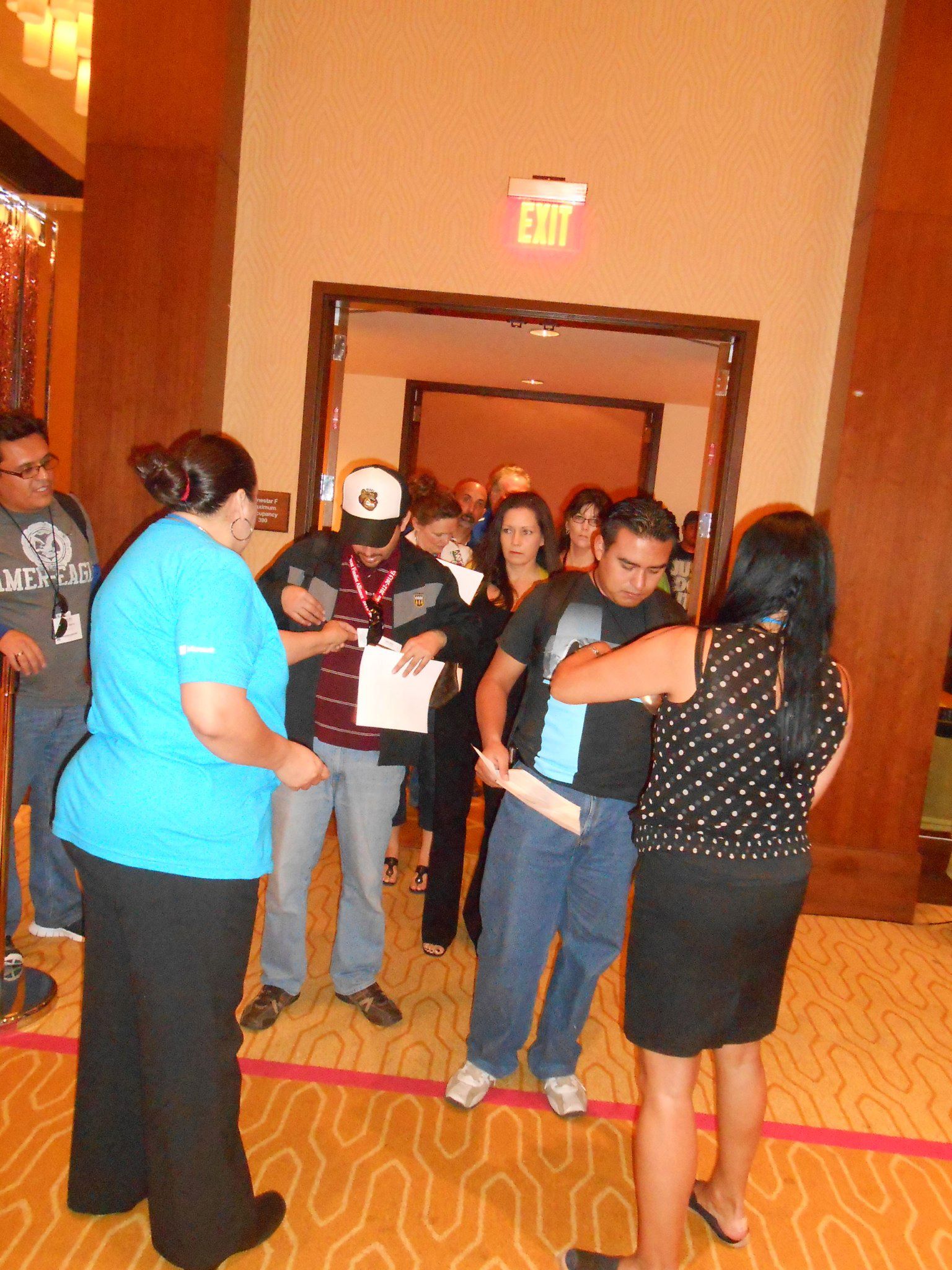
People in line for Surface tablets. Microsoft gave away 10,000 Surface tablets. I wrote about that event here. There were tears of joy here in the room where they were giving them away.

People in line for Surface tablets. Microsoft gave away 10,000 tablets. I wrote about that event here. There were tears of joy here in the room where they were giving them away.

Continue reading

A Beginner’s Guide to Twitter Chat Participation

By Melissa A. Venable

[Note: ETCJ’s Twitter/Facebook editor, Jessica Knott, has been working with Melissa to develop this article. Also see Melissa’s four-part series on  Twitter for Professional Use. -Editor]

A Twitter chat is a live, real-time discussion that takes place via Twitter messages, also known as tweets. Connected by use of a specific hashtag, those contributing to the discussion can add their comments in 140-character increments. While it may seem an odd way to participate in a conversation, you may be surprised at the benefits the platform provides, and at the growth of this format among educators at all levels.

As moderator of the Inside Online Learning chat (#IOLchat) since June 2011, I’ve experienced many of these benefits. It’s been a great opportunity to connect with a larger community of students, educators, and instructional designers, and to facilitate new connections among participants. It’s also an effective way to (virtually) meet leaders in the field of online education who have served as guest hosts.

If you’ve thought about joining a Twitter chat or are completely new to the concept, the intent of this guide is to provide you with the basic information necessary to successfully participate in your first live chat.

What to Expect

As in any group discussion, Twitter chats feature a general exchange of ideas, opinions, recommendations, and resources. Most are open to the public, and anyone interested in the topic is encouraged to attend. There are four common components of these live conversations you should look for:

  • Moderator: An individual or group that organizes the event and facilitates the conversation. Several chats, including @chat2lrn and @lrnchat, have their own Twitter accounts and homepages to help coordinate efforts.
  • Central topic: Most chats are organized around a central theme of interest, as well as a more detailed topic for each “meeting.” For example, one of the more popular events for educators is #edchat. This group always discusses issues related to education, but also picks a focus each week. A recent May session sought input on the question: “How important is it to teach critical thinking and how do we do it?”
  • Hashtag: The # symbol used with a series of letters and numbers is known as a “hashtag” and adding the chat-specific hashtag to each of your tweets allows you to participate. The hashtag is searchable and creates a way to filter the tweets that are part of the chat. Hashtags are also increasingly part of other social platforms, including Tumblr, Instagram, Google+, and Flickr.
  • Time and date: Many Twitter chats are recurring events scheduled monthly, weekly, or another pre-determined interval. Find a chat that meets both your interest and availability on compiled lists like these: Weekly Education Chats, Twitter Chat Schedule, Twitter Directory for Higher Education.

As you review existing Twitter chats, you may notice that some provide discussion questions in advance, while others include them during the live event. But some chats will be more open-ended, taking direction cues from gathered participants. As a participant, you should assume that your contributions will be collected in some sort of transcript, ranging from a blog post summary to a compilation via a hashtag aggregation tool like StorifyContinue reading

A Quality Check on the NCTQ ‘Teacher Prep Review’

John SenerBy John Sener

Lyndsey Layton’s article1 on the NCTQ Teacher Prep Review2 actually has a new message: How to use rankings to bash teacher training programs. And the larger message is: As a society, Americans still really don’t know how to value education.

Is there lots of room for improvement? Sure. But tellingly, the article mentions the stat about how few U.S. teachers graduated in the top third of their class (more rankings), compared to countries whose students lead the world on international exams (yet more rankings!). Yet not a word on the possible causes for this — you know, little things like teacher pay, prestige, professionalization, or other features that reflect a culture that knows how to value education.

Click to view the report.

View the report.

All you really need to know about the study is this sentence: “The organization did not visit the schools or interview students and faculty.” Of course, it doesn’t help that the WaPo article uncritically accepts the criteria used by the study, referring to “admissions standards and inspected syllabuses, textbooks and course requirements.” Imagine how long a restaurant critic would last if s/he bestowed rankings on eateries without actually visiting (“But I looked carefully at the menus! And I inspected their cookbooks and the reservation policies!”).

The actual “specialized scoring methodology” used by the study is very detailed but apparently very oriented toward meeting the Common Core standards:

Actually, the more I delve into the study, the more dismayed I’m becoming. The full Standards and Indicators section is almost more of a political document than a teacher quality document. The “Selection Criteria” (Standard 1) is essentially a single criterion: “academic caliber” as indicated by a 3.0 GPA or proxy measure. Think about that a minute — recall fondly your favorite teacher(s), the one(s) who Changed Your Life or made some small difference. Now, quick quiz: what was that teacher’s GPA in college? You have no idea, of course — nor should you, because reducing teacher qualifications to a 3.0 GPA is a reductionist recipe for destructive devolution.  Continue reading

Is the LEAD Commission Right About Education Technology?

picture of Harry KellerBy Harry Keller
Editor, Science Education

The Leading Education by Advancing Digital (LEAD) Commission was created in March 2012 and is co-chaired by Lee Bollinger (President of Columbia University), Jim Coulter (Co-Founder of TPG Capital), Margaret Spellings (Former Secretary of Education) and Jim Steyer (CEO of Common Sense Media). – from “Paving a Path Forward.”

The LEAD Commission1 has published a five-point plan for a national technology initiative. The points are:

  1. Solve the infrastructure challenge by upgrading the wiring of our schools.
  2. Build a national effort to deploy devices
  3. Accelerate the adoption of digital curriculum
  4. Embrace and encourage model schools
  5. Invest in human capital

Little Red School House Plugged

These are great-sounding goals, especially given the state of today’s technology and the poor learning opportunities in too many of our schools. Due to a recession and extensive government budget cuts, our country’s entire infrastructure continues to deteriorate. There’s much to do here, but are these the right goals, and are they properly articulated? Let’s take them one at a time2.

THE INFRASTRUCTURE CHALLENGE

Having visited a great many schools across the country, I can sympathize with the wiring issues. In many classrooms, a complete class of 30 or so students cannot operate with the wireless access available and have reasonable response times. Frequently, this problem results because of a “computer cart” with an inexpensive router that cannot handle the traffic. Sometimes, it’s the building’s central routing hardware. Occasionally, it’s the school’s connection to the Internet.

I’ve seen cases and heard of more where the problem is that a school’s administrative load on the bandwidth swamps the educational access. Most schools have provided a priority to administrative access and left teachers and students in a second-class position with respect to Internet bandwidth. This seems to be a reversal of priorities in this writer’s opinion.  Continue reading

Technology Bang for Buck

picture of Harry KellerBy Harry Keller
Editor, Science Education

A recent article1 from the Center for American Progress analyzes data from NAEP, the National Assessment of Educational Progress. The summary bullet points seem reasonable enough.

  • Students often use technology for basic skills.
  • States are not looking at what sort of outcomes they are getting for the technology spending.
  • Students from disadvantaged neighborhoods are less likely to have access to more rigorous STEM-learning opportunities.edtech03

The explanations may veer widely from rational thought. After explaining that the first point means that technology is used more for drill than for real learning, the report goes on to address science classes and STEM education.

Our analysis showed that 73 percent of students, for example, reported regularly watching a movie or video in science class. By contrast, far fewer students used computers in their science classes — just 66 percent of students reported regularly using a computer in science class.

What’s wrong with movies? Some are excellent explanations and visualizations of natural phenomena, far better than a lecture by the typical science teacher. On the other hand, is using a computer in science class synonymous with better learning? I’d say not. It’s entirely dependent on the software being used. These statistics say nothing about the quality of education.  Continue reading

The Winds of Change Blow Young: K-12 Reform

Jim ShimabukuroBy Jim Shimabukuro
Editor

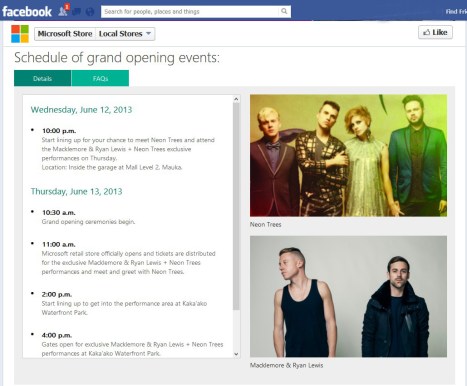
Got up this morning and ipadded the local news. A Microsoft store is opening at 11AM today in the Ala Moana Center (Honolulu). This news is interesting, but not half as much as the buzz generators.

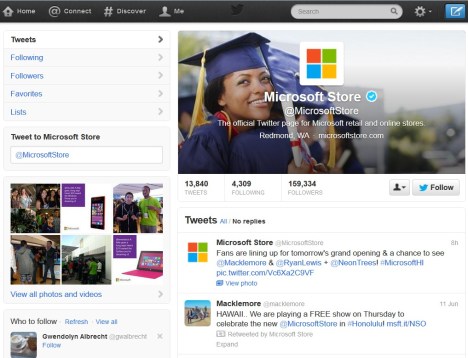
A crowd of mostly the young gathered the night before to be among the first to enter and win concert tickets. How did they hear about it? According to Jenn Branstetter, a Microsoft social media team member, via the corporation’s Facebook and Twitter pages.

Microsoft Store Facebook page.

Microsoft Store Facebook page.

Microsoft Store Twitter page.

Microsoft Store Twitter page.

And the concert tickets? They’re for Macklemore & Ryan Lewis. Their song, “Thrift Shop,” is at the top of the Billboard Hot 100 chart. How did it get there? YouTube, where it has had 340 million views and counting. Neon Trees will also perform.

So, what does this have to do with change in education? A lot, that is, if we’re really paying attention. First is that we may need to shift our eyes and ears to our children, our students. Facebook, Twitter, YouTube — the media associated with this Microsoft event — are all social media. And all are easily accessible via their smartphones.

Continue reading

MOOCs, Ted Underwood, CALL Overview, netTrekker, Special Needs, Language Learning

lynnz_col2

Report: Four in 10 colleges to offer MOOCs by 2016 by Denny Carter in eCampus News

Despite disadvantages, such as cost, credit issues, and some “high profile rejections” of them, MOOCs are still on the rise.

Ted Underwood

Ted Underwood

Computer Research Project Shows Shift in English Language in R&D

Ted Underwood, at the University of Illinois, has used digital mining software, data from Google books, and dictionary.com to track how the English language has shifted over the centuries.

CALL Overview: Technology Tools From the Convention by Justin Shewell and Roger Drury in TESOL Connections

The authors give an overview of technology related presentations at the recent convention. Topics range from using various kinds of mobile technology to webinars.

Focusing Web Searches for K-12 Students by Bridget McCrea in THE Journal

So much information, so little time, and not always appropriate for schoolchildren. This article looks at a search engine, netTrekker Search, a subscription service designed for schools.

How Technology Is Helping Special-Needs Students Excel by Heather Hayes in EdTech: Focus on K-12

Innovations in technology can help students with special needs develop more independence and improve their ability to integrate better into the mainstream classroom with their peers.

EdTech photo by Deanne Fitzmaurice

EdTech photo by Deanne Fitzmaurice

Are Language Teachers Leading the Way with Education Technology? By Joe Dale in The Guardian

Dale looks at how foreign language teachers embrace technology for giving their students authentic experiences with language learning, everything from social networking to video conferencing.