Farnsworth’s Fusion: What’s It All About?

picture of Harry KellerBy Harry Keller
Editor, Science Education

Last February, Conrad Farnsworth achieved nuclear fusion in his father’s shed in Wyoming*. This would be a big deal were it not for fourteen other high school students who had done this previously. You can find a YouTube video of his accomplishment and will note that the poverty-stricken need not apply. The equipment I see there would cost a few thousand dollars new and over a thousand even if you scrounged quite a bit. You even have to have a cylinder of deuterium, the stable heavier isotope of hydrogen. It has an atomic mass of two instead of hydrogen’s one due to an added neutron in its nucleus.

“First Neutrons,” uploaded to YouTube by Conrad Farnsworth on 2 Dec. 2011.

He achieved fusion by confining the deuterium in an extremely hot plasma, hundreds of millions of degrees hot. That’s hot!

Plasma is the fourth state of matter after solid, liquid, and gas. A plasma is like a glowing hot gas. Its molecules have disintegrated into atoms, and those have lost electrons to become ionized. Ionized gases can conduct electricity just like your fluorescent lights (today’s energy-saving CFLs for example) do. The ionized gas in those lights causes the fluorescent material lining the inside of the glass to glow.

Gases like to expand when they’re heated up. This expansion cools them down. To achieve enormous temperatures and fusion, you must confine the gas to prevent expansion. The problem you’ll face is that no known substance can survive those high temperatures. You cannot make a bottle to hold your super-hot plasma out of any material in the universe.  Continue reading

What Are MOOCs Anyway and Should You Consider Moocing?

Jim ShimabukuroBy Jim Shimabukuro
Editor

[Updated 10/27/13: see footnote 1.]

If we can get past the magic of “massive” and “free,” we begin to see Coursera/edX-type MOOCs for what they really are — online courses, no different from the ones your college or university is offering right now. Open up registration to anyone anywhere, don’t charge a fee, and you’re MOOCing.

The MOOCs that we’re now associating with Stanford, Harvard, and MIT are actually based on video lectures, and this alone should give us a hint as to why they’re being embraced by so many higher ed institutions. In a very real sense, it’s like having your cake and eating it, too. You can serve a theoretically infinite number of students with a single course featuring lectures by a single instructor. And the best part is, you don’t need to provide prohibitively costly infrastructure for the course. Digitize the lectures in video, store them somewhere, post links, and you’re good to go — as far as content goes.

Besides content, the basic foundation of any course is learning strategy, or a process (“instruction”) that’s designed to help students achieve course objectives. For MOOCs, traditional classroom approaches become less effective as the teacher-to-student ratio (1:X) climbs in disproportion. Simply put, when X reaches a certain point, methodology must change.

The change of least resistance is peer facilitation. Nothing new, really. Teachers, especially in writing, have been using peer feeedback strategies for decades. Results are mixed, as can be expected, depending on any number of variations in instructional quality. Still, when done right, students can learn to provide effective feedback on their classmates’ performance. The key is in the rubrics.

In courses with enrollments so massive that a teacher is unable to monitor student mastery (understanding and application) of rubrics, relatively “simple” technical innovations are needed to ensure quality peer feedback. I say “simple” because we already have the technology to automatically gather, integrate, and report data from and across a wide range of different online activities. For example, students can be quizzed on their understanding of rubrics, and the result could be used in different contexts, e.g., to rate their comments on the quality of their classmates’ work1. With this rating, authors would be able to determine how much weight to assign reviews received from classmates. A low rating would mean the critic doesn’t have a clue about the requirements for a particular assignment.  Continue reading

Temple’s TECH: A Learning Center That’s a Form of Social Media

John SenerBy John Sener

Recently, my colleague and Assistant Vice Provost Dominique Kliger invited me to Temple University to give a talk about my book. After the presentation, Dominique offered to take me on a tour of Temple’s TECH center. I readily accepted, but to be honest, I was prepared to be underwhelmed in a “been there, seen that” sort of way — what could be so novel and compelling about a tech lab center?

Dominique Kliger, Ph.D. Assistant Vice Provost, Distance Learning and Summer Programs, Director, Temple University

Dominique Kliger, Ph.D., Assistant Vice Provost, Distance Learning and Summer Programs, Temple University

I couldn’t have been more wrong. The tech center was amazing — and not for the reasons you might think.

Temple’s TECH Center has a large, open room area filled with pods of computer workstations, so my first impression was how it resembled Virginia Tech’s Math Emporium, which I had visited three years ago — but we were just getting started. Dominique pointed out a box mounted on a pillar, which had a series of several neon light tubes whose contours collectively suggested the shape of an ear. As she explained to me, this “earbox’s” neon lights indicated the ambient noise in the room; if excessive room noise persisted, an announcement was made requesting students to quiet down.

This slideshow requires JavaScript.

This was a neat enough device in its own right, but an even more striking feature of the TECH Center was its variety of study spaces, each clearly designed for its purpose and equipped with appropriate technology. There were areas with normal-size computer screens for independent study, and there were areas for videoconference meetings with screens large enough to accommodate a group of 10 participants. There were open areas for individual study and for small group work and for simply chilling a bit. There were breakout rooms for study groups or group projects, all equipped with a group workstation. There were rooms for graphic design and rooms filled with music keyboards and broadcasting equipment.

Continue reading

‘Hacking the Academy’ – Intimate Conversations with Voices at the Edge

By Jessica Knott
Associate Editor
Editor, Twitter

Much like the tone of ETC Journal, the collection of articles compiled in Hacking the Academy does not comprise the most rigorously edited academic prose. The writing is often conversational, rarely dense, and I found this to be one of its greatest strengths. I felt as though these academics were sharing private ruminations, not writing manifestos. From the moment on page seven I read Tad Suiter’s definition of a hacker as being “a person who looks at systemic knowledge structures and learns about them from making or doing,” I was hooked. So much of what we do in online education (indeed, education in general) is “hacked,” whether we acknowledge it or not. I believe the greatest value this collection provides is fodder for debate: in a time where “the academy” is equally immovable and in flux, are we doing enough to challenge ourselves and each other as we work within its virtual, tangible walls?

Hacking A2In a chapter on Unconferences, Watrall, Calder, and Boggs discuss the hidden costs and challenges of organizing a “for the people, by the people” type of conference. As a matter of full disclosure, I have attended Great Lakes THATCamp twice. It feels, by far, more like a true academic conference than an unconference. If you are considering attending or planning an Unconference, I encourage you to heed Watrall’s advice regarding planning. In this particular instance I can tell you that what he writes truly translates to an experience that surpasses expectation.

In this vein, separate from the overall conference planning, I encourage readers to pay close heed to Calder’s urging toward self-preparedness: “The best thing about an unconference is that professionals are able to come together and discuss real issues face to face… your input could be the difference between moving someone else’s project forward – perhaps in ways they never expected” (135). This, the perspective of the prepared other, planning to present or not, is a refreshing one. Follow Watrall on Twitter at @captain_primate, and Boggs at @clioweb.  Continue reading

Cloudy with a Rain of Data

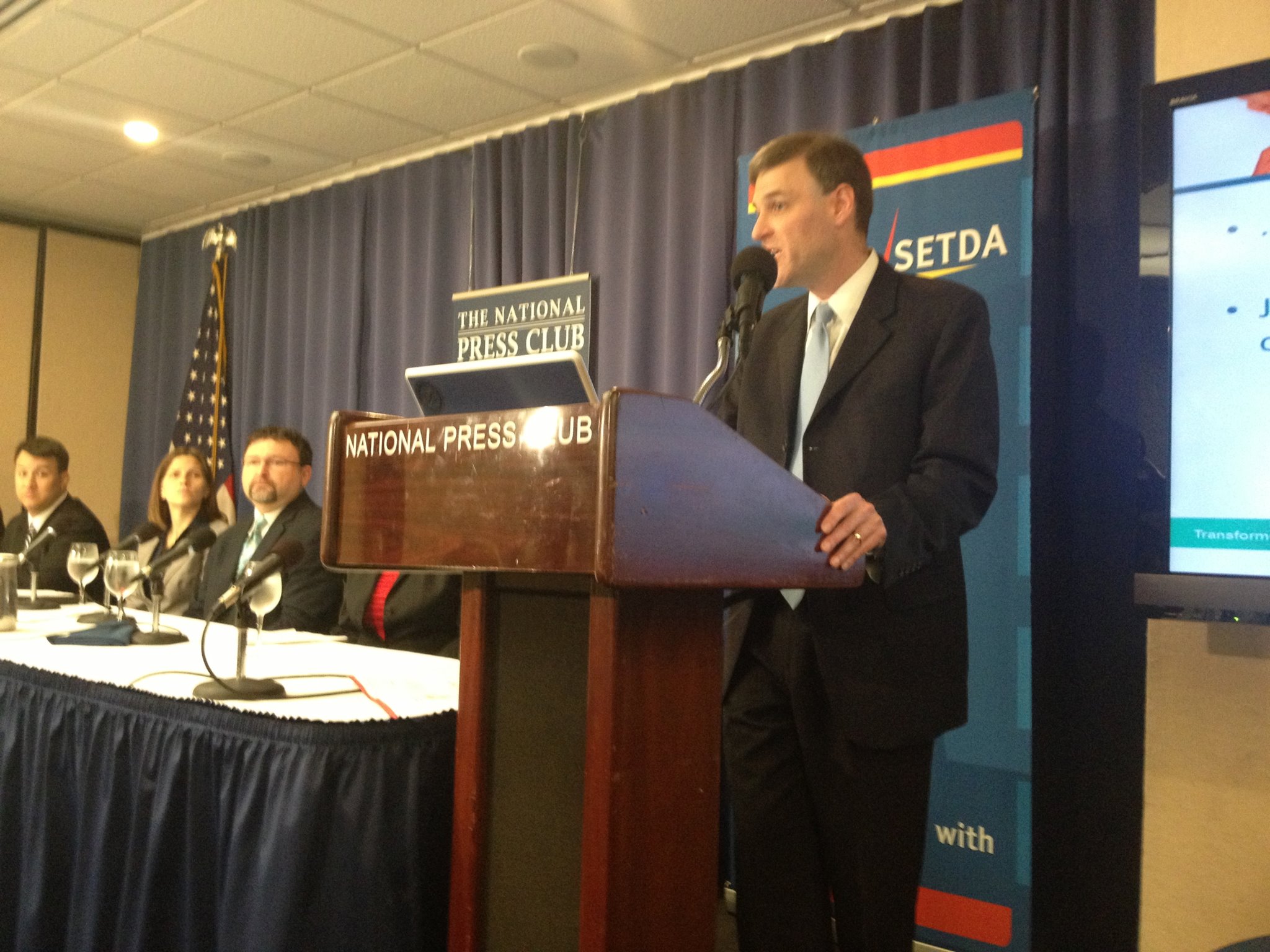
I attended the press conference for the release of SETDA’s (State Educational Technology Directors Association) report Transforming Data to Information in Service of Learning. It was hosted by SETDA’s executive director, Douglas A. Levin, at the National Press Club in Washington, DC, May 21, 2013.

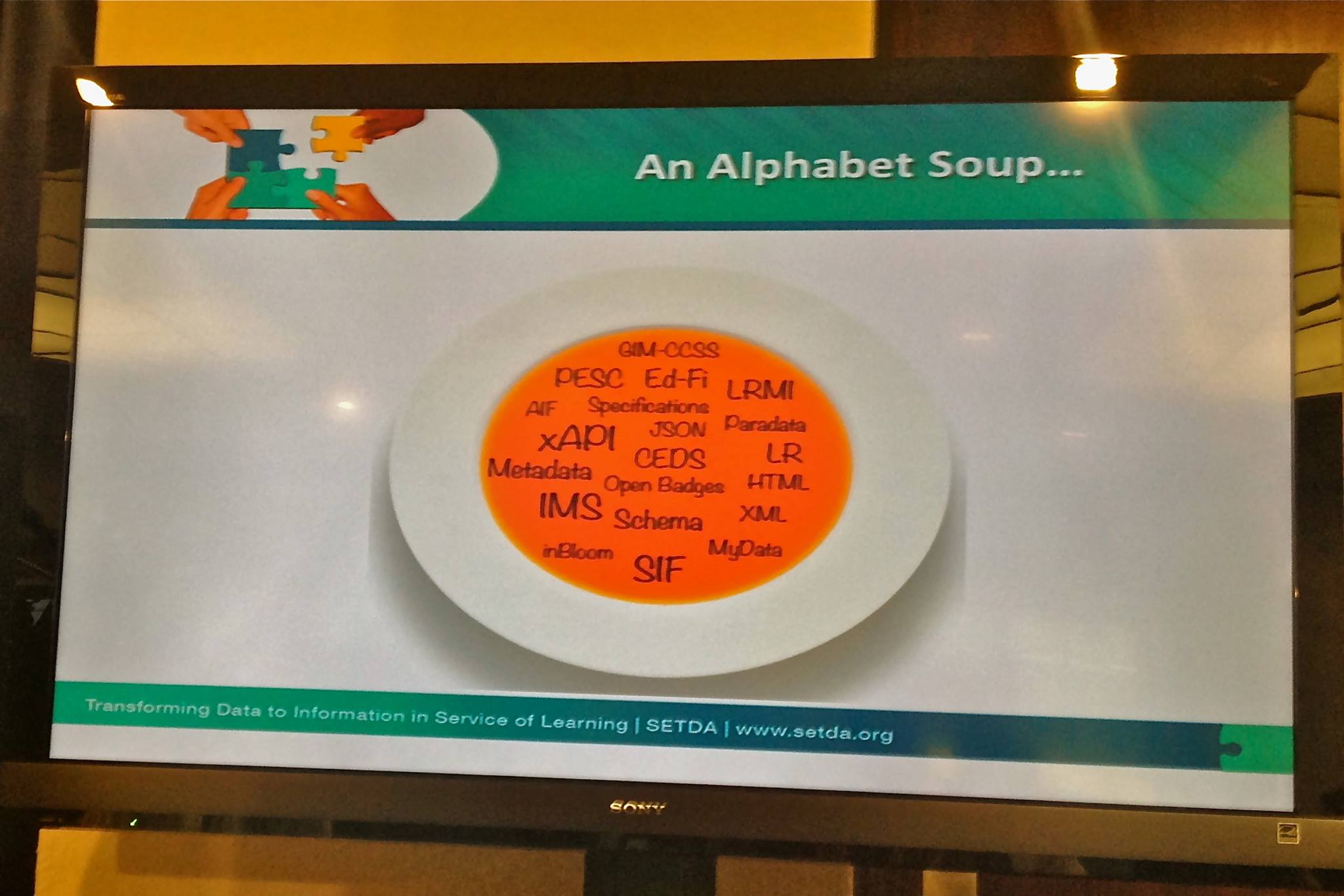
The presenters had RTT (Race to the Top) funding* and spoke in an alphabet of words that few regular people, including school board members who make big decisions, understand. SETDA had the task of trying to make it understandable and explain fluent ways to help schools and communities understand the task, cost and rationale. There was an attempt to make us understand the terminology and to explain the importance of the topic.

[*Update 5.23.13, 2:10pm: See the correction from Douglas A. Levin.]

As I sat there I knew I was privileged to be a part of the audience. My concern is that we have a digital divide, and one part of it is big data information. The report spells out data standards and interoperability initiatives. I know these topics and descriptions from my work on the NIIAC, but the school boards, parent committees and people dealing with the transformational change in education, as well as regular citizens, have a lot to learn. This is actually a Race to the Top project, and SETDA is trying to facilitate learning and understanding across the states.

Douglas A. Levin, SETDA (State Educational Technology Directors Association) executive director.

Douglas A. Levin, SETDA (State Educational Technology Directors Association) executive director.

The presenters ... spoke in an alphabet of words ...

The presenters … spoke in an alphabet of words …

Click image for PDF report.

Click image for PDF report.

__________
Posted on 5.23.13 at 10:23am.
Updated on 5.23.13 at 10:30am.
Updated on 5.23.13 at 2:10pm.

Martian Rhapsody: Chapter 1 – Landing

PLEASE SEE THE REVISED VERSION OF THIS CHAPTER.

martian_rhap017

Harry Keller

Harry Keller

Preface

After receiving many comments from my article, “Mars One: Exciting Adventure or Hoax?“,  and exploring many issues of any such undertaking as well as the specifics of Mars One, I have decided that the conversation has become increasingly technical and therefore less interesting to our readers. In order to make our conversation more interesting and to bring more people into the conversation, I am presenting a series of episodes in a fictional future in which the first permanent settlers will arrive on Mars. While Mars One and our discussion have generated many of the ideas, this series does not claim to have a relation to any specific Mars settlement program. It just explores the issues involved in such a venture.

For the purposes of making the exposition and discussion more real, I will name the first four humans to arrive on Mars: Aleka (Hawaiian female: aka Allie) is the flight-trained captain, Balasubramian (Indian male: Balu for short and Bob among the crew) has the crucial survival role of botanist, Chun (Chinese female: aka Chunnie) functions as the engineer, and Dawit (Ethiopian male: everyone just calls him Dave) is the mission communicator. For the purposes of having a broad gene pool, the early settlers have genetic roots that include a worldwide geographical scope of origins.

I’d like to encourage you all to participate. Each chapter will end with a problem that must be solved. I am interested in seeing ideas different from the ones I imagine and may rewrite future chapters if better answers are submitted. If you are a science teacher at any level, please consider discussing these issues in your classes. We’re nearing the end of the school year now, and this sort of discussion may work nicely with the end-of-year mentality that you encounter. A fun, open discussion can make science come alive for students. Use NASA images to liven things up. -Harry E. Keller

Chap01_Landing2

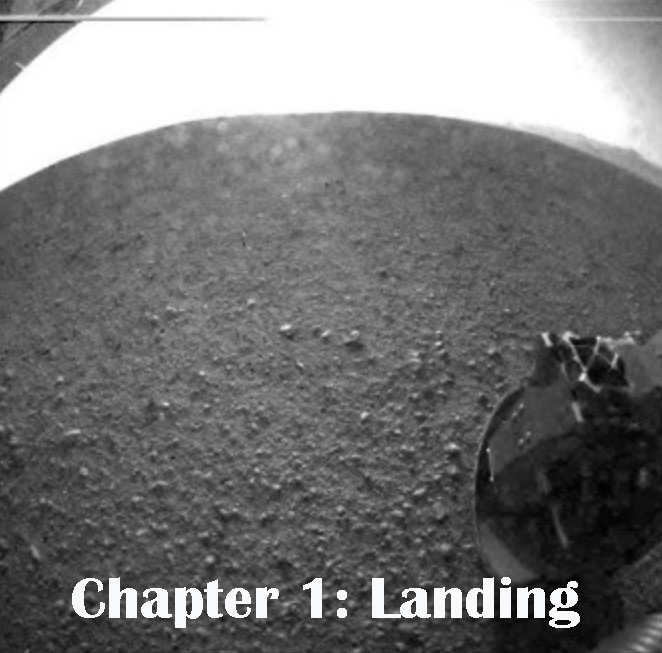
mars-As the Google Mars shuttle continues its weeks-long deceleration toward its incredible destination, the crew of four busily checks the instruments on the attached Citigroup crew module where they have lived and worked for four months. They are so involved in monitoring not only their own module but also the Royal Dutch Shell supply module that they momentarily forget they’re about to become the first humans ever to set foot on another planet. The shuttle holds the two attached modules like a parent carrying twins in both arms. The configuration of shuttle and two landing modules may look awkward but creates no impediment to travel in the vacuum of space.

Four years of training guarantee that the anxious crew all know their roles in this landing precisely. The captain, Aleka (Allie), is the only flight-trained pilot on the mission, but all of them have spent countless hours in the landing simulator and can take over if necessary. Redundancy has been the watchword of the Mars mission from the very beginning.

For the landing at Amazon base, however, there could be only one crew module. Everything depends on its successful entry into the absurdly thin Mars air, about 1% of the density of that on Earth and containing 95% carbon dioxide, followed by the powered descent to the surface. Ordinary chemical rockets slow the landers as they approach the surface where the gravity is 38% of that of Earth. While the low gravity means that less fuel is required for descent, it still is strong enough to kill everyone if the landing module crashes. Every element from the heat shield and parachute to the landing engines must function perfectly for a safe landing.  Continue reading

Stone Soup with Curt Bonk: Armchair Indiana Jones in Action

By Stefanie Panke
Editor, Social Software in Education

On May 15, 2013, I had the opportunity to attend the Stone Soup Conference, a professional development event at Meredith College in Raleigh. The day featured three talks by Dr. Curt Bonk, Professor of Instructional Systems Technology at Indiana University. The day was centered on major themes of Curt’s work: open learning, networking, creative instructional techniques and motivational strategies: “Quality, plagiarism, copyright and assessment are the four topics everyone wants to know about before considering online learning. I am not going to talk about any of these. I am going to talk about pedagogy,” he clarified in the beginning.

Fig.1: Curt Bonk at the Meredith Stone Soup Conference, May 15, 2013.

Fig.1: Curt Bonk at the Meredith Stone Soup Conference, May 15, 2013.

Curt explored the development of educational technologies over the past decades – which he depicted as a journey toward openness. Central to his credo, “Today, anyone can learn anything from anyone at any time,” is the vast amount of high-quality material available on the web. Ten years ago, the use of open learning, sharing and educational technologies was met with great resistance. Today, educators have access to sites like Merlot, Connexions, World Digital Library and Smithsonian education resources. This allows teachers to explore new roles as curators of learning: “It is our job to mine and mind high quality material – and ignore the rest.” Obviously, this does not mean that teachers merely point students toward online resources. On the contrary, Curt introduced an 80/20 rule of thumb: “Approximately 20% of students are self-directed learners; the others need our guidance.”

Throughout the day, Curt connected current technology trends with the history of education. As one of his role models, he named Charles Wedemeyer, founder of the Open University UK and author of the book “Learning at the Back Door” (1981) that predicts the impact of e-learning on education. Another example of trends prevalent today that were predicted in the 1980s is the video “Apple Knowledge Navigator” (1987).

Continue reading

‘Teaching History in the Digital Age’ – Call for a New Breed of Teachers

Lynn ZimmermannBy Lynn Zimmerman
Associate Editor
Editor, Teacher Education

As a teacher educator, I am concerned that I am training my students how to teach yesterday’s students rather than tomorrow’s. Therefore, I was interested in seeing what T. Mills Kelly had to say, in Teaching History in the Digital Age (2013), about best practice for today’s and tomorrow’s students. As it happens, I also recently read The Shallows: What the Internet Is Doing to Our Brains, by Nicholas Carr, which is going to be my university’s One Book next year. Carr focuses on how the Internet has shaped how we think and view the world. Carr points out that, according to recent brain research, how we access and store information alters the physical properties of the brain. He contends that the practice of getting small amounts of information from a variety of sources may help us be more efficient information gatherers but at the cost of the ability to concentrate and reflect on what we are gathering.

history_digital

Carr’s argument seems to parallel and support Kelly’s ideas in several ways. Traditionally, history teaching has relied on imparting knowledge and analysis, usually in the form of lectures, which research has shown is not the most effective approach. Perhaps partly because of this method of teaching, history is often seen by students as the acquisition of facts and not as a process of gathering and analyzing data. Also, Kelly says that the notion of perspective is often ignored, e.g., what is included, what is left out, why it is included or left out.

Kelly contends that the digital age offers historians the opportunity to help their students become historians, analysts, not just fact collectors. Not only do more students go to online sources rather than print, but today’s students are used to creating on the Internet — not just consuming. Kelly asserts that educators need to take advantage of this tendency in order to create learning opportunities that promote active engagement and not just passive acquisition through lectures and reading. He does caution that instructors must teach students that their role is not to remix or remake history. They should not give in to their desire to change primary sources so that they are “better,” a tendency that Web 2.0 savvy students may have. However, this type of engagement with history gives the instructor and students opportunities to examine the ethics of a variety of issues that can come up in projects, from plagiarism to the manipulation of information to support one’s point.  Continue reading

‘Hacking the Academy’ – A Test of Time

Jim ShimabukuroBy Jim Shimabukuro
Editor

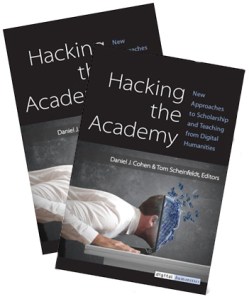
The first thing you should know about Hacking the Academy: New Approaches to Scholarship and Teaching from Digital Humanities (Daniel J. Cohen and Tom Scheinfeldt, editors, University of Michigan Press, 2013) is that it was compiled in May 2010 — three years ago. I’m not sure what the full implications of this time gap are, but for starters, the iPad was released in April 2010, a month earlier, so it’s not mentioned in the book. The first MOOC was offered by the University of Manitoba in 2008, but they didn’t become wildly popular until 2012 so they, too, are left out.

Once past the hurdle of the three-year gap, I found the offerings interesting both as a retrospective and as a time-tested compass for change. Change is so rapid in ed tech that the concept of “past” is becoming more a blur than a time line. Thus, I found myself intrigued by this slice of time that preserves some of the more progressive thinking three years ago, including insights that are still relevant today.

Hacking the Academy

I received the UM Press announcement for Hacking early yesterday morning and requested a digital review copy later that morning. After downloading it, I did a quick search for “iPad” and “MOOC” and, as expected, came up empty.

An “online and open-access version” of the book was released on 8 Sep. 2011 (Jason B. Jones, “Hacking the Academy: the Book,” Chronicle, 9.9.11), but I was unaware of it until today. Andrew Tully, in his University of Nebraska – Lincoln blog (4.18.12), provides a useful overview of the project so I won’t go into it.

I like the twist that the project has given to the word “hacking.” In “Why ‘Hacking’?”, Tad Suiter says, “Hackers are autodidacts,” and he defines hacking as “The clever gaming of complex systems to produce an unprecedented result.” But here’s the part that makes it very special even, and perhaps moreso, today: “The academy, ultimately, can only be invigorated and improved by an infusion of the hacker ethos that goes beyond the computer  science departments and infects all the disciplines.” Suiter’s point is that the hacker is us, the teachers in the disciplines, in the classrooms. Adam Turner, in “Hacker Spaces as Scholarly Spaces,” amplifies Suiter’s point. He says, “Hacking is about doing: creating, thinking, questioning, observing, learning, and teaching. The core of academic work is, at its heart, hacking.” The implications of teacher as hacker are as fresh today as they were in 2010.  Continue reading

Mars – A New Beginning

picture of Harry KellerBy Harry Keller
Editor, Science Education

[UPDATE 5/18/13: See Martian Rhapsody: Chapter 1 – Landing. -Editor]

The discussion on “Mars One: Exciting Adventure or Hoax?” (4.8.13) has been wonderful, and I thank all of those who have participated. I’d like to take this entire issue to another level. Please stay tuned, watching ETC-J for a new beginning of the discussion about Mars.

"A crater near the Martian North Pole with a large lake of water ice. The lake is about 10 km across." - Robert O'Connell, University of Virginia.

“A crater near the Martian North Pole with a large lake of water ice. The lake is about 10 km across.” – Robert O’Connell, University of Virginia. NASA photo.

ETC-J is working on a serialized fictional account of the first Mars settlement so that those who are not so technically oriented can participate. We’ll have plenty of science and will address those issues we’ve talked about in the article and the discussion and many more in the context of the possible actuality of a Mars settlement. We’ll also have personalities and their reactions to crises. We’re making the assumption that it will happen within 20 years, maybe ten or so. We will use only technologies that we have or that could become available within this time frame. Exceptions will be made to this rule only if there absolutely is no other way, and we’ll still make every effort to make it scientifically sound. As a scientist, I wouldn’t have it any other way.

You’ll read about some real surprises in the episodes. We’ll be as creative as possible and will encourage all of you to write in with your ideas about how to solve the problems facing the settlers in the most recent episode. Some of your ideas will find their way into future episodes and will be acknowledged in the discussion.

If you know a science teacher, be sure to clue her/him into what’s going on. We’ll have special challenges for science classes to discuss. We invite science teachers to respond on behalf of their classes and to sign with their school name. I’m hoping that my own business, Smart Science Education Inc., will be able to fund some prizes, but I cannot make promises about that yet.

While prompted by the discussion of Mars One, any resemblance to the actual Mars One program is unintended. We will use the best ideas from anywhere, including Mars One, in our narrative, but this is NOT Mars One.

Watch for the first episode soon and be ready with your commentary on any science errors in each episode, solutions to the problems facing the settlers, and the science class challenges. I’m looking forward to a stimulating discussion. I hope you’ll join us on this adventure.

When Attending a Virtual Conference, It’s the Little Things

By Jessica Knott
Associate Editor
Editor, Twitter

Like Jim and Stefanie, I attended TCC and SLOAN-C. Both conferences left me with big ideas and a lot to take with me into my professional practice (not to mention posts for ETC Journal, which will be rolling out in the coming weeks). But before I dive in, let me take a brief detour to direct your attention to my colleague Stefanie Panke’s write-up of her TCC experiences and state that I agree wholeheartedly with her assertion about badging. As of this year, I am sold on it. Additionally, I encourage you to read Jim’s words on session selection and his call for the flipped conference as a solution to virtual conference overload. Their reviews were amazingly well done, inspiring me to take a trip back to the drawing board for some deeper pondering on themes and my experiences.

Stefanie Panke

Stefanie Panke

Last year, I found the badging experience to be somewhat superficial, but I believe now that I was approaching the whole thing somewhat incorrectly. Watching TCC 2013 unfold and seeing the interactions between attendees, I have a better understanding of the values badging provides. I saw people make personal connections based on the badges they had earned, and I saw their virtual experiences become personal ones. This is not a feeling I had at SLOAN Emerging Technologies, despite a more active Twitter back channel.

Now, as the true focus of this post, I’d like to discuss the pros and cons of the two conference experiences. I am a virtual conference veteran, but found that the close proximity of these two events provides an interesting comparative look at how little touches make attendees feel at home and connected.

Laura Pasquini

Laura Pasquini

The biggest pro of both conferences was by far the people. While I felt lost most of the time in the Emerging Tech experience, with a large, hard to wield PDF of offerings and e-mails from vendors asking me to come visit their booths and thanking me for rich conversations that were never had, the Twitter back channel provided an excellent mechanism for grounding myself and allowing my brain to focus on what I was learning. Laura Pasquini (@laurapasquini) wrote an excellent blog post of her experiences at the conference. Though she attended in person, her perspectives are pertinent for those present and virtual.

Continue reading

My Spring of Discontent: A Proposal for Flipped Conferences

Jim ShimabukuroBy Jim Shimabukuro
Editor

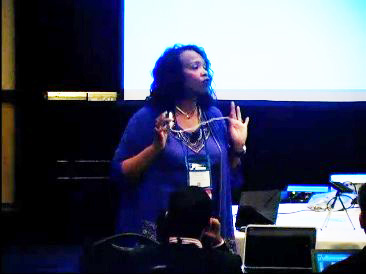
ET4 Online — Sloan-C’s 6th Annual International Symposium for Emerging Technologies for Online Learning, April 9-11, 2013 — was everything you could ask for in a conference. The number of presentations was mind-boggling. I was able to take in just a few. One was by Robbie K. Melton, associate vice chancellor of eLearning and a full tenured professor at Tennessee State University. She talks about “Impact and Transformation of Mobilization in Education: Emerging Smart Phones & Tablets Innovations” (10 Apr. 2013), but I have no doubt that she could probably talk about anything and get her audience to buy in. She strides the floor, mingling with her audience.

Robbie K. Melton

Robbie K. Melton

Her voice is vibrant, her presence is compelling. She has you hanging on every word. You know that she probably has outstanding teacher awards covering all four walls of her office. In a debate, you’re sure her opponents would probably end up cheering for her. One of the innovations she mentions allows professors to override the mobile devices that students bring to classrooms. With this gadget, professors can maintain control in their classrooms even in this BYOD era. However, you know she doesn’t need it in her classrooms. She’s that good.

Kim Coon

Kim Coon

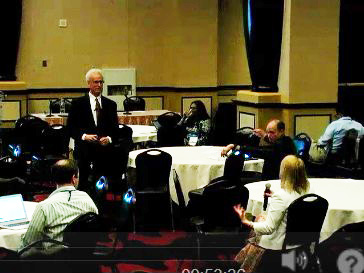
Another standout speaker was Kim Coon, executive vice-president for strategic partnerships at Comcourse, Inc. While Melton was hot, Coon was, well, cool. His talk was on “Making the Next Big Thing Happen, When Nobody Believes You Can: Moving from Idea, to Consensus, to Implementation” (9 Apr. 2013). He, too, mingles with the audience, carrying an extra mike for audience members to use. He’s a master at engagement. He gets the audience involved. He remembers the names and comments of those who have picked up the mike, and he integrates them into his talk, almost seamlessly, like a magician.  Continue reading

Time Out at TCC 2013: How Social Media Saved the Day

By Stefanie Panke
Editor, Social Software in Education

Last week 1000 attendees enjoyed three days packed with information and discussion at the 18th Annual TCC Worldwide Online Conference, held from April 16-18, 2013. The acronym TCC stands for Technology, Colleges and Community. Organized by the University of Hawaii, TCC is the oldest running worldwide online conference designed for university and college practitioners. Addressees include faculty, academic support staff, counselors, student services personnel, students, and administrators.

As usual, my review is by no means an authoritative summary but comprises an eclectic collection of talks and topics I found particularly interesting as well as general observations of the conference’s atmosphere and features.

Day 1 (April 16):  Technical Hiccups, Engaging Presenters

TCC 2013 started with the GAU* for an online event: The conference site was down. Surprisingly, the impact was not as devastating as one would think. The social media team quickly rose to the occasion and posted the link to an alternative entry page on Facebook and Twitter. Social Media saved the day!

panke01

The first session I attended dealt with the question of how to approach the challenge of training faculty in using instructional technologies. Sher Downing, Executive Director for Online Academic Services (OAS) in the School of Business at Arizona State University, presented her strategies in the well-received talk “Ways to Train Faculty.” To facilitate online learning, the OAS team developed a comprehensive faculty training package that comprises innovative formats such as “hit the road” one-on-one training in faculty offices, online and interactive training and certification, faculty blogs, faculty roundtables and informal chats “on the dean’s patio.” Especially the latter seem to be an ideal space for discussing ideas, visions and problems among faculty and instructional designers.

Continue reading

Professional Cohorts: A Little Help From Your Friends

By Jessica Knott
Associate Editor
Editor, Twitter

Cohort I

I recently had the opportunity to attend the Educause Midwest Regional Conference in Chicago, Illinois. While there, I attended a session by Brian Paige, IT Director of Calvin College, Bo Wandschneider, CIO (Chief Information Officer) of Queen’s University, and Melissa Woo, Vice Provost for Information Services and CIO at the University of Oregon entitled “Creating Peer Mentoring Networks for Leadership Development.” Calling themselves a “cohort,” these three, and others they have picked up since their initial meeting, have become a support group of sorts for each other as they navigate careers in leadership positions in the higher education field.

Bo Wandschneider, Melissa Woo, Pete Hoffswell, and Dan Ewart.

Bo Wandschneider, Melissa Woo, Pete Hoffswell, and Dan Ewart.

I asked them some questions about their experience, and, in true cohort fashion, they collaborated together in a Google document to answer. The following responses are the collaborative effort of Paige, Wandschneider, and Woo, as well as Pete Hoffswell of Davenport University and Dan Ewart of the University of Idaho.

What drew you to the people you ultimately grouped with?

What drew us to each other were our commonalities. We’re all in a more-or-less similar stage in our career progressions. As such, we face similar challenges and had a lot in common that we wanted to discuss. Currently four of the five of us are CIOs (and the rest of us are encouraging the fifth!). Interestingly only one of us was a CIO at the time of joining the group. Three of us became CIOs during the time we’ve been in the group. An additional motivating factor for one of the group’s members is that he’d seen presentations given by some of the members of the group and was excited about the chance to explore their ideas further. However, what’s probably most important and the one thing that really drew the people in the group to each other was the willingness to share and trust.  Continue reading

Give Your Phone a Voice!

M_Curcio_80By Mike Curcio
Student at Kapi’olani Community College
University of Hawai’i

Google Voice (Voice) is a telephony management service offered by Google. Like their other services, Voice is free-of-charge, with the exception of international calls. If you already have a personal Google account, and, with 425 million active Gmail users worldwide, chances are that you do, getting started with Voice can be very easy.

voice

One of the initial steps in the setup process is selecting a phone number. Voice can assign users a phone number from most U.S. area codes (Alaska and Hawaiʻi users cannot currently obtain local phone numbers through Voice). Alternatively, users can choose their own phone number in many area codes. Let’s say you own a pet grooming company. You could check the availability of the number “DOG-WASH” or “364-9274.”

Voice is officially available to users in the U.S. only, but I have successfully used it in Japan with no problems, making and receiving free calls and text messages to and from the U.S. via Voice’s web interface. With the help of a WiFi connection and another free Android App, GrooveIP, I was also able to use my phone to send and receive calls and text messages, just as I would at home, without being charged for data or minutes. U.S.-based international students may want to set up Voice accounts for their families back home.   Continue reading

Interactive Holographic Images Preserve Stories of Holocaust Survivors

Lynn ZimmermannBy Lynn Zimmerman
Associate Editor
Editor, Teacher Education

As part of their programming on April 8, 2013, which was Holocaust Remembrance Day, WBUR Here & Now broadcast a story that illustrated a unique approach using technology to preserve the stories of Holocaust survivors. World War II and the Holocaust ended in 1945. Therefore, those who survived those years are aging and dying. Over the past 20 years there have been numerous attempts to preserve the stories of those who survived, from films to audio recordings, documentaries to webcasts.

Simulated Holographic Video of Holocaust survivor Pinchas Gutter speaking to a class of students. Published on YouTube, 8 Feb. 2013.

The University of Southern California’s Shoah Foundation and Institute for Creative Technologies have come up with the most unusual to date — they are creating holographic images of survivors that not only tell the person’s story but can also interact with the audience, answering their questions. When asked how they were able to do this, Paul Debevec, Associate Director of USC’s Institute for Creative Technologies, answered that they spent about 12 hours with each participating survivor, asking them every conceivable question one might ask a Holocaust survivor to generate a database of answers using artificial intelligence technology. Stephen Smith, executive director of the Shoah Foundation, remarked that the Foundation has 52,000 testimonies and they have a lot of experience in what survivors want to talk about and what questions students ask.

The idea is that this technology is a way to give children of the future a chance to see, hear and interact with a Holocaust survivor long after the last one has gone. The interviewer was concerned that the idea was rather ghoulish. However, Smith, assured her that this was not the case. He explained that is like watching very good quality 3-D TV.

It is expected that the technology will be available for museums within the next year or two. Debevec predicts that this technology will be economically feasible for everyone in the future.

Pinchas Gutter - see his simulacrum at http://hereandnow.wbur.org/2013/04/08/holocaust-survivor-holograms

Pinchas Gutter – see his simulacrum.

You can see Pinchas Gutter’s simulacrum at http://hereandnow.wbur.org/2013/04/08/holocaust-survivor-holograms

Mars One: Exciting Adventure or Hoax?

picture of Harry KellerBy Harry Keller
Editor, Science Education

Updated 3/22/15
[Update 5/8/13: Please see “Mars – A New Beginning,” Harry’s follow-up plans for this article and discussion. Update 5/18/13: See Martian Rhapsody: Chapter 1 – Landing. -Editor]

The Mars One project has received quite a bit of press lately. This project plans to establish a human colony on Mars in 2023 with four people. The project is the brainchild of Bas Lansdorp, a Dutch businessman. You must give him credit for creativeness. Much of the financing will come from a 24-hour television reality show that will follow every step of the project, including watching the new “Martians” as they adapt to the harsh Mars environment.

According to the Mars One website, this project will use existing technology. The habitat consists of modules that will arrive on Mars over a period of years and will be moved into place by a Mars rover. The first colonists will do the final assembly. Every two years, four more colonists will arrive until the total population consists of twenty immigrants. At that point, the colony intends to be self-sustaining, requiring no additional supplies from Earth. No kidding!  At $10,000 per pound, Earth will not continue sending oxygen, water, food, Mars suits, and more to Mars regularly.

MarsOne2025

If you haven’t guessed yet, the trips by the colonists will be one-way only. There’s absolutely no provision for bringing them home. Even with an estimated $6 billion budget, the money just isn’t there. So, who will these colonists be? Interestingly, Lansdorp proposes to charge for the privilege of taking a one-way trip to hell. But, I’m getting ahead of myself.

Bas Lansdorp

Bas Lansdorp

The technology does exist to ferry materials, habitats, and a few people to Mars. The technology exists to produce enough solar power to eke out a sort of living there, in principle. The concept of establishing human habitation on another world must create a sense of excitement in anyone who has the time to pay attention. The educational opportunities would be enormous. The new colonists would be “going boldly where no one has gone before” – unless NASA gets there first with their round-trip Mars program.

Continue reading

Sugata Mitra, MOOCs, and Minimally Invasive Education

Jim ShimabukuroBy Jim Shimabukuro
Editor

Sugata Mitra, winner of the 2013 TED Prize, reminds us that, as educators, we may be so consumed by teaching that we ignore learning, that there’s a fundamental difference between teaching-centered and learning-centered. Mitra is his own best model for his vision of education, or SOLE, for self-organized learning environment. SOLE is a more formal school-based version of Mitra’s earlier hole-in-the-wall (HIW) street learning environment. Both, however, are grounded in his theory of minimally invasive education (MIE).

Mitra is, by training, a physicist, but by temperament, a self-organized learner. The heart of his gift is curiosity, and his scientific training provides the rest. He didn’t begin by studying teaching. Instead, he studied learning. He placed a web-connected computer in a kiosk in a Delhi slum, left it on, invited children to play with it, stepped away, and watched. The question, simply stated, was: Can students learn without teachers?

Hole in the wall

He was amazed to learn that, yes, they can. They learn individually and in small groups, and they teach one another what they have learned. Out of his observations, he drew implications, and the most important is that both teachers and computers are technologies, or media for learning. That is, children can learn from either or both. With this awareness, he realized that in cases where schools and teachers are scarce or unavailable, computers could suffice. The question that remained, however, was: What does this mean, if anything, for traditional models of learning that rely on schools and teachers?  Continue reading

An Online Physical Education Class

[Note: The following was first posted in the ETCJ listserv on 25 March 2013. It was prompted by a discussion in the WCET listserv on “a new online theater course” earlier that morning. -Editor]

It can actually be surprisingly easy to create effective online courses in the “trouble” areas. More than a decade ago the school I directed had an online physical education class. People would pooh-pooh it as ridiculous, and then after I described the content, they would usually say, “Wow! Can I take it?”

A lot of the course was academic, teaching concepts related to fitness. Students started the class with a fitness test. They set goals for improving their fitness, and they set a personal path toward those goals. It was possible that no two students would be doing the same activities. They had periodic tests along the way to check their progress, and they then adjusted their goals and their plans appropriately. There was a final test to see how they had met their goals, and they had to write a reaction and a self-evaluation. What they ultimately learned was how to apply principles of physical fitness to their lives for the rest of their lives.  Continue reading

Don’t Blame Teachers for the Poor State of STEM

[The following is a response to colleagues’ comments, in ETCJ’s staff listserv, re the need for change in the way science is traditionally taught. The discussion was spurred by the 2 Feb. 2013 report, “For Each and Every Child: A Strategy for Education Equity and Excellence,” by the Department of Education’s Equity and Excellence Commission. -Editor]

You have to remember, I got thrown out of schools for doing all of the things that we talk about that are going to be the future. I worked with the White House. The principal called me in and said, “You can’t do this technology stuff in Arlington Schools if you want to stay.” That was not a choice to me. Teachers who did what they were told are still probably working. I was not what the schools wanted, an innovator using technology. You are preaching to the wrong person.

I can’t demonstrate my skills right now. I don’t have a place to do it. Tracy Learning Center in Tracy, CA, is where I worked to help establish advocacy. My benefactor died.

Nysmith School in Herndon, VA, and a few other schools and projects do what I love. NCLB took the steam out of STEM, the science out of the classroom, and the focus away from what was called SMET, now STEM. NCLB took me out of the classroom. I will always remember the discussion.

I was with people who are STEM evangelists in the Nysmith School, which I visited in the NIIAC times. We as a council visited the school back then. Both of the schools are not mainstream. Tracy School is a charter school, K-12, mostly minority kids, very minority. Because the school has a longer day, with another month in the school year, it has to be a charter school. We had a plan.  Continue reading

‘For Each and Every Child’ – A Strategy for Yesterday’s Child

Frank B. WithrowBy Frank B. Withrow

[Note: The following is a response to the 2 Feb. 2013 report, “For Each and Every Child: A Strategy for Education Equity and Excellence,” by the Department of Education’s Equity and Excellence Commission. -Editor]

For some time we have been working around an obsolete model of education with the idea that, if we just somehow make the old model better, education will be better. I do not believe technology blindly applied is the answer, but look at three to five year olds and how they have learned to use iPads without a course in iPad usage.

For Each and Every

Real reform will include the following:

  1. Every child will have an Individual Learning Plan.
  2. Every child will have a mentor teacher.
  3. Schools and educational staff will be open at least ten hours each day and open year round.
  4. High quality digital libraries will be accessible to learners at home and at schools.
  5. Schools will offer laboratories and facilities where learners can work together in teams or individually.
  6. Significant federal research and development funds will be available to create high quality digital learning materials.
  7. Teachers will participate in continuous learning with respect to new curricula materials.
  8. Learners will be scheduled for learning experiences as needed.

WE need to stop tinkering around the old school model that did us well yesterday but is inadequate for today’s digital world.

Continue reading

Impact of Facebook on Deaf Language Users?

Frank B. WithrowBy Frank B. Withrow

It is a sophomoric question, but I will ask it anyway. Is it better to be blind, deaf, or crippled? Of course, the answer is it is better not to have any of these disabilities.

Crippled means that you will have ambulatory limitations. However, if you have lost a leg there are prosthetic legs that can allow you to walk and even to run. Or wheelchairs can restore a degree of mobility. Blindness is also an ambulatory disability. You are to an extent limited in your mobility. You are not likely to own or drive a car, but even this is being made obsolete by modern technologies that are demonstrating self-driving cars. If you are blind you may not become an artist, but even that is marginal.

Oscar Pistorius.

Oscar Pistorius.

In a sense deafness is the hidden disability. Unless a neighbor stops to talk with you, you appear as just another person in the neighborhood. You drive a car, you play catch baseball with friends, and you dance with your girl friend on the patio after eating the steak cooked on the outdoor barbecue set. For all practical purposes you do not appear any different than the average neighbor.

But you are! You did not learn the English language from your mother’s knee. Whether you use American Sign Language or speech read, your language is visual. It requires an ample light source. As a deaf person you cannot easily multitask, that is, carry on a conversation while washing your car because you must see and concentrate on the speaker. Visual-based communication has different parameters than auditory-based language. As a deaf communicator, there must be enough light and you must concentrate on the speaker.

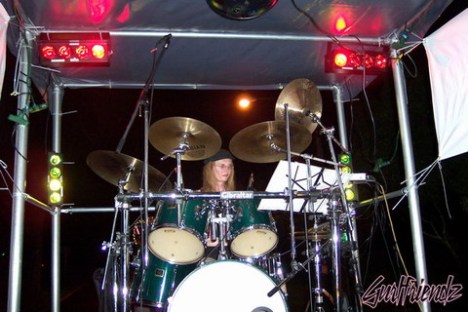
Stephanie Ellison, "a percussionist who happens to be deaf."

Stephanie Ellison, “a percussionist who happens to be deaf.”

As a hearing person I can multitask. I can talk and listen to you while I paint your portrait. As a hearing person I can carry on a conversation with you while I brush my shoes or I can listen to the radio in the dark. Since sounds surround me globally I can carry on a conversation in many different environments. If I am deaf I must have light and I must look at the sender I am communicating with whatever system I use ASL, finger spelling or speech reading. Even captioned TV requires my full attention whereas a hearing person can multitask and still get the meaning of what is on TV. I can iron my shirt and follow the latest news on TV.  Continue reading

Study Suggests the Need for an Intergrated Learning Styles Approach to Calculus

By Jessica Knott
Associate Editor
Editor, Twitter

This week, I had the chance to talk with Dr. Daniel McGee (CV), former middle and high school teacher in Francistown, Botswana, Peace Corps volunteer, and researcher/biostatistician for the Centers for Disease Control in Atlanta, Georgia. Dr. McGee’s work in creating a free, public access online learning system for primary and secondary students in Puerto Rico has gained traction in recent years, becoming the basis for online pre-calculus materials that will now be used in schools throughout Puerto Rico.

As his projects began generating larger and larger data sets, he became interested in exploring the insights they might provide on learning styles, learning types, and learning in general. This interview provides an overview of the motivations behind the study as well as a brief discussion of some of his key findings.

Daniel Lee McGee, Professor, Mathematics, University of Puerto Rico

Daniel Lee McGee, Professor, Mathematics, University of Puerto Rico

JK: What did this study find, exactly? Why is this important?

DM: There were two important results of this study.

Result 1: In general, most efforts to define the categories for learning types have been a priori in nature. Researchers will start with a set of learning types and then will categorize students. This study takes an a posteriori approach to student learning types. We gather a great deal of data on a lot of students. The data comes from questionnaires and results on quizzes and exams from an online learning system. Rather than starting with predefined categories for students, we look for natural groups of students based on similar responses to questionnaires and similar results on quizzes and exams. These natural groupings lend insight into the natural learning styles of the students taking the course. The first result of the study was that students were not scattered randomly, they did form natural groupings. So the vast amount of information available with online learning systems does allow us, at least in Puerto Rico, to identify student learning types in an a posteriori manner.

The vast amount of information available with online learning systems does allow us, at least in Puerto Rico, to identify student learning types in an a posteriori manner.

Importance of result 1: Our results indicate that large groups of students seem to organize themselves into distinct clusters. The ability to identify these clusters and their associated strengths and weaknesses will allow professors with large groups of students using online systems to better address the particular needs of the distinct learning types that are in their class at a particular time.  Continue reading

What Can a Mind Do?

Frank B. WithrowBy Frank B. Withrow

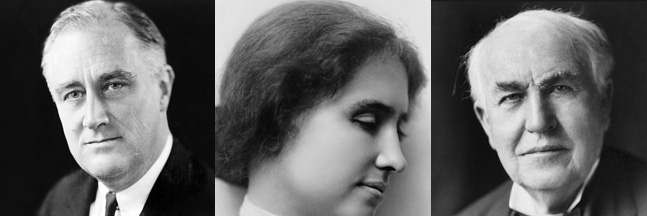
A mind in a crippled body can explore the heights of science and move all mankind forward into new scientific knowledge. Stephen Hawking opens up new scientific vistas. Helen Keller, out of darkness and silence, through words opens new avenues of interpersonal relationships. Blind musicians like Ray Charles and Stevie Wonder bring new melodies into our lives. In yesteryears a President who could not walk bonded us together and inspired us to weather our economic woes and then fight our way through World War II. A deaf man invented electric lights.

Stevie Wonder, Ray Charles, Stephen Hawking

Stevie Wonder, Ray Charles, Stephen Hawking

Electric lights and wearable glasses moved mankind forward. Electric lights enable man to read 24 hours each day, and wearable glasses allow us to see well enough to read throughout our life times. Books and wearable glasses enable mankind to search the wisdom and knowledge of the past.

Franklin Roosevelt, Helen Keller, Thomas Edison

Franklin Roosevelt, Helen Keller, Thomas Edison

The mind can solve the most intricate problem or puzzle. To see, to hear, to feel, to smell and to taste enable the human to know his or her world. The mind organizes these sensory experiences into words and language. Speech and language are public expressions of our private sensory experiences. The voice in our minds organizes our world. If I am blind the world is auditory. If I am deaf my word is visual.

Continue reading

Triptico: A Powerful and Free Instructional App

Harrison and Gilmartin160By Kathlyen Harrison and Michael Gilmartin

As every teacher knows, there is an overloading number of websites and tools available to educators, some free and others with registration costs. Most of these tools are geared toward specific content, and the trick can often be trying to sift through all of the different types to find the ones that suit your needs, skills, and even your personality. Triptico offers a wide variety of creative, interactive, and visually engaging apps. The best part is that you have access to numerous apps for free. Not to mention that the developer of this program is constantly creating new apps to use for free.

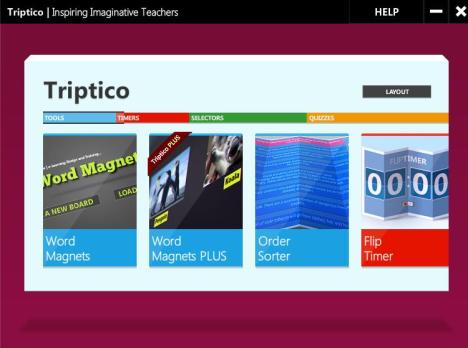
Figure 1 - Triptico App Launch Screen

Figure 1 – Triptico App Launch Screen

About Triptico

Triptico.co.uk is a web tool that allows you to create and use various types of activities, tools, and quiz makers to help improve the classroom and engage students. Triptico is a free app available for download with an option to upgrade for a small fee. There are four different categories of programs: tools, timers, selectors, and quizzes. Each has interactive apps that you can use and adapt to your class. The different interactive modes allow you to bring creativity and uniqueness into the classroom, diversifying the ways in which students learn, review, and practice various skills. Triptico is simple to use yet sophisticated in content with apps color coded to denote type and categories.

Continue reading