“Alone we can do so little; together we can do so much.” -Helen Keller
As a child I met Helen Keller. She was one of the most fascinating people I have ever met. I have met other deaf blind people who are amazing. Leonard could place his hand on your face and understand your speech. Leonard and his deaf blind wife lived independently and worked in an electrical product plant assembling electric insulators.
In 1963 we had learned how to ensure women who were pregnant and contacted rubella could bring their babies to full term. Thus we produced some 60,000 multiply disabled infants. Five thousand were deaf blind. Congress passed a law that created centers for deaf blind services. I was the Director of the Division of Education Services in the Bureau of Education for the Handicapped and administered the deaf blind services.
Helen Keller. Photo from Helen Keller International.
I have a deaf blind grand nephew that is now two years old. I have given considerable thought to the education of deaf blind children. They explore and know their world through the near senses of touch, smell, and taste. Of these three, touch is dominant because it is the sense that they will use to organize their world. My nephew has two cochlear implants and appears to enjoy music. As yet we do not know if in deaf blind children cochlear implants will lead to the development of speech and language.
(On 21 Feb. 2013, Bonnie Bracey Sutton, ETCJ associate editor, shared Valerie Strauss’s “U.S. Teachers’ Job Satisfaction Craters — Report” [Washington Post, 21 Feb. 2013] in our staff listserv. In response, I posted the following comment, which I’ve revised for this publication. -js)
Thanks, Bonnie, for sharing these stats. With teacher morale so low, the outlook for U.S. schools is bleak. For me, the elephant in the room is the impact of poverty. As a nation, we can’t continue to blame teachers for the consequences of poverty. We can’t expect them to resolve the causes of poverty. This is and always has been a social issue — not a pedagogical one.
What’s the answer?
For me, reading between the numbers, it means we ought to stop pushing highstakes testing and the common core. We need to allow teachers to do their job. They’re trained to determine where their students are and where they could be in terms of their classes, and for each student and each class, the profiles vary widely. This “diagnosis” is not only academic. In many if not most cases, it includes affective factors. Thus for variable portions of their classes, the teacher’s challenge may be motivation, attitude, rather than academics. For example, in writing instruction, the hurdle may be pull rather than push. How to attract students to writing may be the primary question — not how to push them toward earning higher scores on a standardized test that purports to measure writing competence.
To generate pull, teachers may decide to put their red pencils down and work with the language that students bring from their homes and neighborhoods. It may not be pretty in terms of common core standards, but it’s the reality. Preliminary goals may be to simply get students to enjoy writing and sharing their interests and concerns, in their most intimate and affective language. Giving them personally meaningful reasons for learning to write may be the fundamental pull that’s necessary to gradually incorporate the pushing of our beloved standards. We must find ways to recognize and reward teachers who are able to pull, to motivate, to change attitudes rather than simply move the needle in standardized tests. Continue reading →
The Total Learning Research Institute’s Space Explorers model of team learning emphasizes full participation of all of the members whatever their individual skills or knowledge may be. The five foundation principles of team learning are:
Treat others as you wish to be treated.
Walk the talk.
Respect and value other team members’ ideas and contributions.
Be part of the solution and not a part of the problem.
Hang together, not separately.
Team Learning can be applied to any educational level from preschool to graduate school and can be used to model principles that are used in many professions and businesses. It is famous for its use in NASA missions. Everyone on the team contributes to the overall objective. Teams often first define the objective or problem to be solved.
“Taking education to new heights…”
Team learning happens when a group of students work together to coordinate their efforts toward meeting a specific goal. The team uses the skills and talents of all its members to reach a specific goal. It not only meets the team goal, but it also meets the personal goals of its members. Continue reading →
The English language is the most used language in the world. Many of its 1,000,000 words are adapted from other languages. English has 44 sounds that are represented by the 26 letters of the Roman alphabet. The 26 letters are combined 196 ways to represent the 44 sounds of English. Therefore, English is only a semi-phonetic language in its written form. English adapts many words from other languages but often retains the spelling of the original language while anglicizing the pronunciation of the word. For example, “bouquet” from the French language is pronounced as “bokay” in English while retaining the French spelling. Spelling bees are thought to have originated in the USA, and the reason is probably because English spelling must often rely on memorization.
Vocal sounds and hearing are used as the warning system for humans and animals. A dog will bark to express its awareness of danger in its environment to alert other dogs. Many animals have vocalizations that are used to warn others of impending dangers. Vocalization superimposed on the eating and breathing systems is the expressive mechanisms used to warn and alert others. Hearing is the receptive sense that alerts individuals to danger. Continue reading →
While I am delighted that Congressman George Miller has introduced new technology legislation*, it has weaknesses as I read it. All of the items are worthwhile, but in my opinion they are not the central issues. We need leaders who have insight and a new vision of what the digital world is bringing us. Already five year olds are iPad literate. How will schools treat these new five year olds and how will we bridge the gap between the digital home and the non-digital home?
Congressman George Miller, senior Democrat of the House Education and Workforce Committee and chairman of the Democratic Policy Committee.
Just as fifty years ago broadcast television forced schools to acknowledge Sesame Street, Mister Rogers Neighborhood and other television influences, today we must adjust to iPad home users. To meet these challenges there must be:
An Assistant Secretary for Technology and Information sciences in U.S. DOE that provides national leadership.
A staff-training program for both teachers and administrators that rebuilds the staff to use the new digital resources.
A national digital library accessible via cloud technologies. The library should contain both commercial and government developed video, computer programs and ebook materials. Users must be able to access it 24/7 year round.
A research and development program that creates new materials modeled after comprehensive multiple media products such as The Voyage of the Mimi.
A digital assessment system for all materials used to reach the common core curriculum.
A public awareness program that provides the public with knowledge about the changes in schools and the importance of these new learning and teaching tools and how they are used both in the home and classroom. The little red school house with the all knowing teacher is obsolete.
A training program for administrators and school boards to understand a digital year round school model.
A wide range of very different experiences in schools, including laboratories, camp experiences (space camp, for example), team building projects, and community experiences. The digital world opens the world as a resource for learning.
Change will take place. It will be nice if our leadership has the wisdom to understand the digital world and how important it is to be a leader rather than a follower. We need radical rethinking, not tinkering with the obsolete current educational model.
These changes will take place regardless of whether or not we provide national leadership because the technology is here. The question is whether we will have wise enough leadership with a systematic vision that guides these Earth-shattering changes. If we are wise, we will guide the radical shifts from the old model to the new model of learning and teaching.
Every child deserves the best education we, the people, can give. It is up to us to make it happen.
__________
* Webcitation alternative.
The purpose of schools is to transfer the skills, knowledge and history of one generation to the next. In the past this was most often done through apprenticeships. About five thousand years ago writing of the spoken word was developed. This allowed mankind to transfer knowledge over both time and space. The printed records in books and libraries transferred information across generations and across geographic boundaries.
Learners had to develop moral, literacy, scientific and most importantly self-government qualities and skills if they were to serve as citizens in a modern scientific participatory democratic society.
For many years knowledge was transferred via apprenticeships. With the printing press and libraries modern schools could be developed where learners came together with teachers to learn in a classroom in a school. Knowledge and history were stored and retrieved via books and libraries. Teachers guided learners through the books. The apprenticeship model of learning gave way to classrooms and teachers. Learners were brought together in classrooms within schools to be guided by teachers through the stored knowledge of the society. In the 20th century learners could be gathered together and guided through the knowledge and experience retrieved from books and libraries.
In recent history, films, videos and computers have supplemented books as the storehouse of human experiences and knowledge. In the last few years the digital age has transformed the way we store and retrieve all information. As print on paper has been transferred to the digital format we now have vast libraries of full motion color videos, printed materials and even interactive simulations accessible to the learner. A student studying World War II can not only read about the speeches of Churchill and Roosevelt, but they can see and hear them. They can see videos of the battles and in addition they have access to fictional movies about the war. In addition, there are German and Japanese primary resources available. Continue reading →
Dr. Yager is a Professor of Science Education at the University of Iowa and the Iowa Academy of Education. He has a long career in this area, and we should pay attention when he writes.
He has just written a short article for Science Education Review (11.3 [2012], pp. 54-55), “Does ‘Hands-On’ Indicate Real Reforms of Science Teaching?”* It begins with the following sentence. “Too often the reform of science for K-12 students is described as being ‘hands-on.’“ Everyone seems to be calling for reform these days. So, this is a valid discussion. Many of the reformers are “hands-on” advocates and even extremists who insist that no science education should be anything but “hands-on.” The short piece, just 1.5 pages, is well worth reading for anyone involved in science education.
Robert E Yager
Dr. Yager makes the point that involving muscles does not necessarily involve the mind. Indeed, as I also have seen, just the opposite is often the case. Science is about exploring. According to Dr. Yager, “One uniqueness of humans is their interest in exploring the natural world.” This uniqueness can drive the excitement and engagement of students with science. Losing it tends to do exactly the reverse.
Further on, he says, “Hands-on may be needed to develop tools to investigate student ideas.” Then, he counters with, “Often collecting evidence involves technology, not science!” He’s saying that you might use hands-on to collect evidence for your scientific investigation, or you might use technology. The hunt for dark matter is all technology. The Mars rovers are distant technology. Neither is truly hands-on. However, I take the view that science and science education are not the same thing. Just because scientists are trending away from hands-on, does that mean that students should too?
The teacher was stunned. His online Advanced Placement English students, students from many different participating schools, had just turned in their first writing assignment. Many of them showed the high quality expected from AP students, but some were terrible. The students showed little understanding of the topic, and their writing skills were abysmal. He contacted their schools to see what he could learn about those students.
He learned that the students who had done so poorly had never done well in English classes in their lives — some had never passed a single one. Some were second language students who struggled to read and write English at all. What on Earth were they doing in AP English? In all the cases, the guidance counselors had decided that the students had no chance of passing a regular English class so they decided the new online AP English class was just the ticket. It was an online class so it had to be easy.
In successful educational experiences, all parties involved approach the experience with realistic expectations. Students assume that with reasonable effort they will pass the class. Teachers expect students will work within the rules, the curriculum will be appropriate, their administrative duties will make reasonable demands on their time, and they will be compensated for their work at an acceptable level. Administrators expect students and faculty will complete all required tasks on time.
In the traditional school system, this works pretty well since, after thousands of years of classroom evolution, everyone knows what to expect. In P-12 online education, however, even veterans are still trying to figure out how it works.
The model used in many P-12 online programs throughout the world is very different from what has gone before. In many of the most common models, a school district either sets up a small online program using some of its own staff teaching online courses or outsources some or all of the courses to an outside vendor. In the case when an outside vendor is used, the vendor’s teachers will have students simultaneously in a number of schools and even a number of states. This model brings the advantage of pooling students in low enrollment classes and allowing them to take classes that would otherwise not be available to them. In this early stage of its development, though, it also brings on problems that spring from the unrealistic expectations of its participants. When reality and expectations do not agree, problems are sure to follow.
The most common problem is the one cited above — just about everyone seems to think online courses are easy. When students, guidance counselors, and parents enter a challenging online program with the expectation that they are getting a free ride, the consequence is educational disaster. But that is not the only example of unrealistic expectations in online education. The mismatch between expectation and reality often occurs at every level of participation. Continue reading →
[Note to the reader: I am CEO of an online science lab provider and, while this article does not address online learning, it does have opinions related to the use of science labs. While I have made every effort to avoid bias based on my current position and believe that my opinion would be the same were I, for example, still a university professor, readers should be aware of my personal connection in this regard. -HK]
The long-awaited Next Generation Science Standards (NGSS) second draft has been published for public review*. This is the final public review version. After diving into them, I found them lacking in some important respects.
I’ve taken the time to look at both versions (DCI and Topic arrangements). They’re both the same material arranged differently. I haven’t bothered with elementary school standards because I’m happy with doing any science at all in grades K-5.
I spent some time in the middle school area and was disappointed with the lack of academic rigor, the insufficient range of topics for three years of learning, and the paucity of quantitative investigations indicated. So, I went on to the high school topics hoping for something better.
As a chemist, the first thing I looked for was chemistry. There’s so no such topic. The NGSS document is arranged under three heading: PS, LS, and ESS. These stand for physical science, life science, and earth and space science. Earth and space science is certainly physical in nature but has its own separate section, while chemistry must lie hidden in physical science somewhere. The word chemistry does not appear.
Instead, most of what I’d term chemistry appears under two headings: Structure and Properties of Matter and Chemical Reactions. All right, a derivative word for chemistry does appear there but only in the topic-oriented version.
In order to see what’s afoot here, it’s necessary to list the topics under these headings. The good news and the bad news is that there are only ten topics (eleven if you count the bonus topic). It’s good because the list is short and easy to write here. The bad news is that this is all that there is for an entire year of high school chemistry. To give the NGSS their due, the introductory material does indicate that these are “core” ideas and that teachers are free to add on more material. You have to wonder how many teachers will bother to expand on the requirements that they’re given. Continue reading →
[Note: ETCJ editors and writers live full lives, and from time to time, we’ll be publishing some of their extracurricular pursuits. See John Adsit’s “The Great Technology Controversy Follows Me into the Caves,” the first in this series. -Editor]
A few weeks ago, Jim asked me why I never wrote about roller derby. My answer to him was that I’d honestly never thought about it. What’s to say? Every day, I wake up, roll over and groan. Sometimes instead of getting out of bed, I roll out of it and onto the floor, somehow miraculously proceeding to my feet from there. Something on my body always hurts. I am 35 years old, but my laugh lines are thankfully all in the right place. I weigh 180 pounds, but I’m happy with my body and what I can do with it.
Addie Mortem (Jess Knott), blocker for the Lansing Derby Vixens. Photo by Jena McShane of McShane Photography.
Last year, I ran a half marathon with very little training due to a bruised kidney. But I did it. (Wait, you bruised your what?) I spend two hours, three days a week smelling seriously terrible (excuse me?), and the rest of them studying hypermedia and online learning. I teach faculty development workshops and laugh so much I should have an abdominal six-pack (a what?). I am a smackademic (smackaHUH?).
I am Addie Mortem, a blocker for the Lansing Derby Vixens roller derby league of Lansing, Michigan. I am also Jessica Knott, instructional designer at Michigan State University and PhD student in MSU’s nationally-ranked PhD program in Higher, Adult and Lifelong Education. Hence, I am a “smackademic,” as coined in a Chronicle of Higher Educationarticle circa 2010 (http://chronicle.com/article/Smackademics-Join-the-Ranks/123670/). And I am not alone in my league as I am joined by criminal justice PhD student in criminal justice Ludacrush, PhD student in English Rue McSlamahan, PhD in music theory PhDemon, PhD in forestry House of Bruise, PhD student in educational administration Krizzy Azzbee, and Juris Doctor Little Hitaly. Continue reading →
U.S. Education Dept. Offers Tools for Evaluating Ed. Tech by Sean Cavanagh from Education Week (12.28.12)
The US Dept. of Education has released a draft (Expanding Evidence Approaches) of a proposed framework for administrators and teachers to use in evaluating educational technology. This research-based framework aims at helping educators make economically wise as well as educationally sound choices.
Language-teaching firms: Linguists online: Technology is starting to change language-learning from The Economist (1.5.13)
This article focuses on two language firms and how they are using technology to teach languages. Berlitz, one of the oldest language teaching companies, has sold off its publishing business. Bought out by a Japanese firm a few years ago, it has been a little slow getting into the language teaching technology market. Rosetta Stone, which recently went public, is moving away from the boxed sets of CDs to an online platform which is more expensive to operate but more flexible for learners.
How to Get Parent Support for Tech Use in Class by Jennifer Carey from MindShift (12.31.12) at KQED (original 12.14.12).
Sometimes parents do not understand the role that technology can play in learning. Carey suggests some practical tips on how to engage students and parents in technology-assisted education. Communication is key to this process.
Like gold, we horde what we’ve learned about education and expect to live off the interest for the rest of our professional lives. Tossing it out with the garbage is unthinkable. Crazy. Yet we also know that we can’t re-envision or change education as long as our slates are filled with the dusty remnants of prior learning.
Jim Finkelstein, in “Simple Minds Think Alike: The Art of Unlearning Complexity” (Huff Post, 4 Jan. 2013), says that “Unlearning how things have been done in the past, while seemingly unnatural is entirely possible….When it comes down to it, the stuff that gets us stuck in the first place is what we’re striving to unlearn…. All it takes to change and escape from a habitual rut is a single thought or idea that is swimming in the opposing direction of everything you’ve ever learned or been taught.”
The idea of unlearning, of wiping the slate clean, of “swimming in the opposing direction” to envision change is not new. It has a long tradition in Eastern philosophy, and educators such as Karen Windeknecht and Brian L. Delahaye, in “A Model of Individual and Organisational Unlearning” (Proceedings 18th annual Conference of the Australian and New Zealand Academy of Management, 2004), say that “The major reason for encouraging or engaging in unlearning is to allow the inclusion of new information or behaviours, and as a means to assisting learning, innovation and change” (3).
Emily J. Klein, in “Learning, Unlearning, and Relearning: Lessons from One School’s Approach to Creating and Sustaining Learning Communities” (Teacher Education Quarterly, winter 2008), defines “unlearning” as “letting go of deeply held assumptions about what it means to be a teacher, what classrooms look like, what the essence of teaching and learning is” (80). However, unfortunately, she leaves us with a bit of wiggle room to keep some of the old stuff on the slate by saying that “a certain amount of unlearning or changing of beliefs is necessary for any school reform” (95).
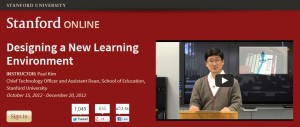
I have recently completed Stanford University’s Massive Open Online Course (MOOC), ‘Designing a New Learning Environment’. As an educational technologist, I try to keep abreast of developments in the ever‑changing world of technology. I had been reading a lot about the transformative potential of MOOCs and was keen to try one out for myself. I am always sceptical about claims of ‘reinventing education’, ‘the end of universities as we know them’ or ‘the biggest innovation to happen in education for 200 years’. I chose ‘Designing a New Learning Environment’, as it seemed like an interesting topic – one of which I already had considerable experience but where there is always something new to learn. Stanford’s reputation was also a factor.
Stanford Online: Designing a New Learning Environment
A ten-week course where I should spend 1-3 hours per week on course activities seemed a manageable commitment. For the first five weeks, I completed individual assignments. The second half of the course was devoted to an ambitious team assignment where teams took up the challenge of designing a new learning environment.
Teams – the Good, the Bad & the Ugly
I took my time before joining a team, as I did not have a project of my own. I wanted a team with a broad mix of participants where I could contribute. I was also expecting my progress in the course to lead me towards a team or topic. This did not happen. Finally, while browsing through the list of teams, I chose the Engagineers, a team of eight interested, as their name suggests, in engagement. They had started a thoughtful discussion in their team journal. Fortunately, this proved to be a very good choice, as once the team got going, we worked well together. None of the team knew each other beforehand, but we still managed to form an effective working relationship. We used familiar tools such as Skype and email as effective and reliable means of communication.
[Note: This article was prompted by an email exchange initiated by Lynn Zimmerman on 1.13.13. -Editor]
This sort of question seems to be on my desk daily in many different guises. I began writing software in 1960 and never really stopped.
There’s no simple answer. Also, the “philosopher’s stone” of software, a way to create software without programming, has been sought after for decades without result. There are some teaching languages for elementary school that are like that but are too limited to be of much use in the real world. Do not expect to be able to drag-and-drop an “app” soon even though Eclipse for Java, and other GUIs (graphic user interfaces) for other languages, do something like that for the UI part of an application. It takes more to make the software really do useful work for you.
For the novice who’d like to have an application, you can use HTML5 and Javascript as long as your program is relatively short, maybe under 100 lines. For comparison, Smart Science® explorations uses a 20,000-line client-side Java program with around 20,000 lines of Java on the server and a substantial SQL database. Once you exceed 1,000 lines, Javascript begins to break down, and you must use something more robust. (Actually, I’d stay away from Javascript programs longer than two pages, about 150 lines.) The advantage of this approach is that your program will run essentially anywhere, including those tablets. Continue reading →
By Lynn Zimmerman
Associate Editor
Editor, Teacher Education
The Shallows: What the Internet Is Doing to Our Brains by Nicholas Carr is one of the books we are considering for the One Book program at Purdue University Calumet. Our criteria for the selected book are loose. It has to have fairly broad appeal. It should spark discussion. It should lend itself to a variety of programming activities so that reading the book becomes a campus-wide event, not just a classroom activity. When the selection committee meets to decide, Carr’s book will be one of my top recommendations.
Nicholas Carr
Because The Shallows is about a timely topic, one that students and faculty alike are interested in, it will have broad appeal. The book is also relevant for a wide range of disciplines, psychology, philosophy, history, communication studies, and computer science to name a few. From Socrates to current learning theory, Carr looks at how the medium of transmitting information is as important as the message (McLuhan, 1964) and how the medium shapes and influences our cognitive processes and our worldview. Carr contends that the brain actually changes and adapts to these different media so that we not only cognitively process things differently but our brain physically makes space for and handles informational transmission differently. Continue reading →
I. Elaine Allen and Jeff Seaman, co-directors of The Babson Survey Research Group, Babson College, MA, announced this morning the release of their 2013 report, Changing Course: Ten Years of Tracking Online Education in the United States.
The authors describe their tenth annual survey as an independent and “collaborative effort between the Babson Survey Research Group and the College Board” that is generously supported by Pearson and the Sloan Consortium.
In their announcement, they include some highlights:
Over 6.7 million students were taking at least one online course during the fall 2011 term, an increase of 570,000 students over the previous year.
Thirty-two percent of higher education students now take at least one course online.
Seventy-seven percent of academic leaders rate the learning outcomes in online education as the same or superior to those in face-to-face.
Only 30.2 percent of chief academic officers believe that their faculty accept the value and legitimacy of online education — a rate that is lower than recorded in 2004.
After their 2011 report, I published a review, “Sloan-C’s Definition of ‘Online Course’ May Be Out of Sync with Reality” (22 Jan. 2012), in which I questioned the survey’s definition of “online course,” which, in my opinion, is impractical and ultimately self-defeating. The 2013 survey retains the same definition. The explanation also remains the same: “To ensure consistency the same definitions have been used for al[sic] ten years of these national reports.” Since the authors claim that their report is independent and that Sloan-C’s role is supportive, criticisms, if any, should be directed at Allen and Seaman. In their closing, they make this clear: “We welcome comments. Please let us know how we can improve the reports at bsrg@babson.edu.”
I don’t have any answers and I have not had time to read your draft. I have been consumed with family responsibilities and some of my emails have gotten lost while running two households. Sorry about that.
I was always punished for teaching thinking, until I was picked by President Clinton to be on the NIIAC. OK, and with the Lucas Foundation, which was also a boost. But my heart is sad. I see the same things going on in schools now, and worse practices. Not sure about Common Core and how it will be enacted.
The tests you hear about are the tip of the iceberg. There are internal, school-level, grade-level, county and practice tests.
I was a gifted and talented teacher. It was because I was determined to make school better, interesting and a compelling place to go. So I learned not to gate kids. I thought I knew math but found that I was very poorly prepared, that most people taught with their hand in the back of the book (for the answers), and that most schools allowed only one way to do math — the approach used in the book. A student, who was brilliant, took me to task when he understood number systems and then invented his own. It is really not that hard, but you have to get it. I took lots of courses that required thinking, creating, inventing — and understanding math. I understood cuisenaire rods and visual math. My 4th graders tested at the top in standardized math tests. All of them. Continue reading →
Learn English online: How the internet is changing language by Jane O’Brien BBC News Magazine, 12.13.12
O’Brien reports that English will continue to dominate Internet use but because many of the users are non-native speakers, the way English is used is quickly evolving. She cites examples of Spanglish (Spanish + Englihs), Hinglish (Hindi+English) , and Konglish (Korean + English) that are developing forms and vocabularies much in the way pidgins, such as Creole, developed over time.
Federal Effort Aims to Transform Learning Technologies by Sean Cavanagh in Education Week, 1.3.13
The National Science Foundation’s fairly new program, Cyberlearning: Transforming Education, is designed to support research on advanced learning technologies. The purpose is to link scientific theories of learning with technology to “spawn myriad new technologies and ideas, rather than any single product.” Promoting mobile access and integrating a student’s learning experiences through dashboards are just two of the ideas that are being explored.
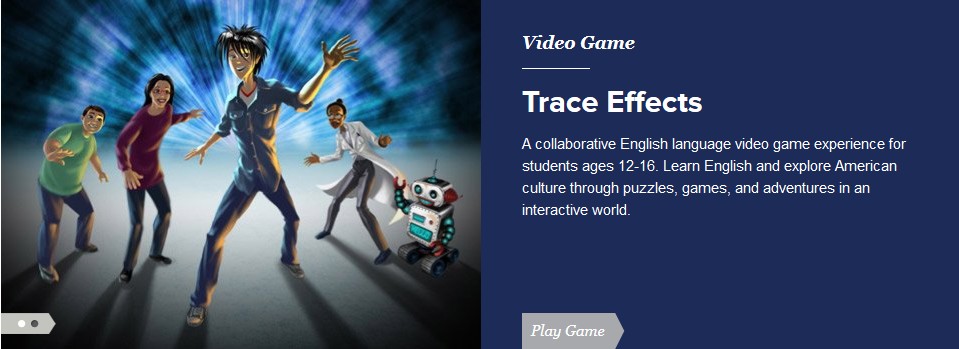
I watched the first episode of Trace Effects. It is set up in chapters and looks like a graphic novel. The voices are clear and talk slowly, and there is captioning so learners can read along. Once you finish a chapter there are tasks to perform, which require moving Trace (the main character) and having him interact with other characters.
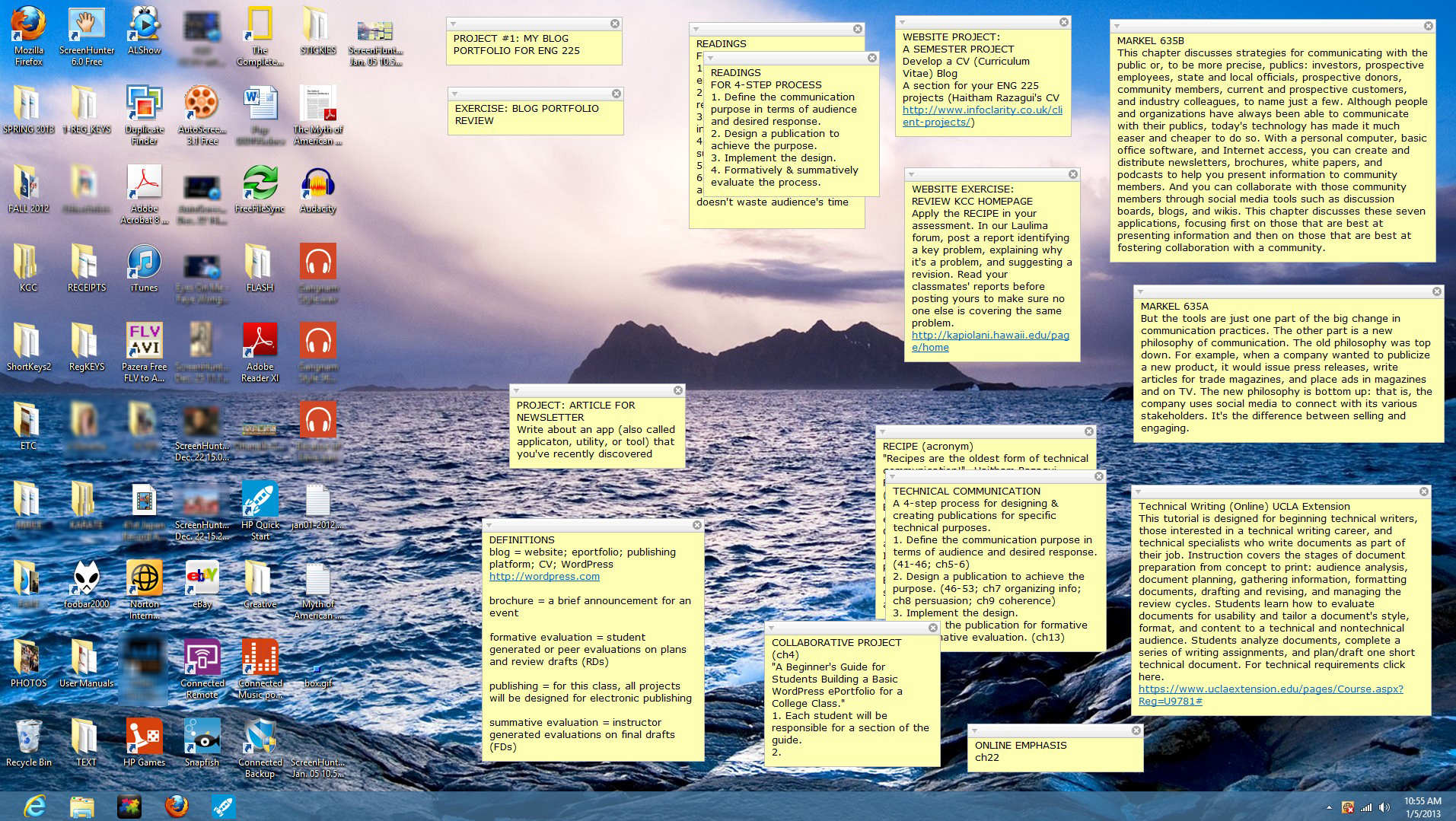
I’m visual when it comes to verbal. With topics that are complex and new, I automatically doodle before actually sitting down at my computer to write sentences and paragraphs. With paper and pencil, I map out the relationships between and among ideas or units of thought. I usually begin with a word that rises to the surface of my mind. I write it down on whatever’s handy. Backs of envelopes or scraps of paper are the usual. I add another word that I associate with the first and position it in a way that reveals their logical relationship.
I add small rectangles around the words and connect them with lines and arrows to suggest causal links, or I use circles that overlap or contain smaller circles to show various set relationships. I continue to construct the picture by dropping in idea words and sketching in their logical connection to the parts and the whole. Some words surface but don’t seem to fit anywhere at the moment so I plop them on the side. Later, I work them into the evolving picture or erase them if they don’t seem to fit in anywhere. As you can imagine, with paper and pencil this means a lot of erasing and redrawing.
My 32-inch desktop screen with Stickies.
In grad school, I found a huge blackboard at a thrift shop a couple blocks away from my apartment. I lugged it back to my small room and screwed it into one of the walls. It filled nearly the entire wall. I was in doodle heaven. This became my thinking pad. I could quickly sketch idea maps with chalk and revise with an eraser as I went along. I could step back at any time to see the whole picture, and step in to futz with the parts. When it was complete, I sat down with my typewriter (no personal computers back then) and wrote the paper. Continue reading →
Over the Christmas Season I have had the opportunity to spend some time with my great grand children. It makes me wonder if schools and teachers are ready for today’s digital kids. Alina, my almost five great granddaughter, is fluent in both English and Spanish. I might also say she manages my dog better than either Anne or I do. She commands and George follows. Therefore she must also speak dog.
However, what is more impressive is her command of her iPad. She told me my iPad was old fashion since it did not have a camera. So much for being the first to have a technology. She demonstrated for me her favorite programs on her iPad that can take pictures. She knew what she wanted to show me and how well she could use her favorite games and stories.
She likes my Eloise stories on my website because they are in both English and Spanish. She also likes an art program and she draws very good pictures with it.
Her three year old sister is comfortable with the iPad if not the Master user. She did not look down on my iPad but found some of my artwork of cartoon characters that she found delightful.
Both little girls were completely at home with the technology and by the time they reach preschool will be Masters of the iPad. Alina wants Anne and dog George to visit her at her home. I am assuming she would welcome the old man also. She was able to locate, using the GPS, the directions from our house to hers. So we have no reason not to visit them.
They got a set of engineering building blocks for Christmas, and they build several structures with Uncle Bill on the living room floor. There were illustrated plans, which Alina followed.
My kids and grandkids like to play Scrabble and have bitter challenges that they look up in the old faithful unabridged dictionary. Scrabble yes, dictionary no. It gathered dust on the side table. Challenges were immediately looked up in their iPhone dictionaries.
We have a German made vacuum cleaner that needed a new bag. The kids immediately found three stores in the area on their iPhones. The GPS system on their iPhone directed them to the store for replacements.
The little girls also played matching games on their iPad.
I must ask the question: Are preschool teachers and schools ready for iPad five year old experts? The digital world belongs to them. It is their second nature.
Online Education Programs Tackle Student Cheating by Ryan Lytle from US News & World Report
Lytle reports on various issues involved in online courses such as cheating on tests and plagiarism. Representatives from several universities point out that these are not just issues in the online classroom and offer their suggestions for reducing the problems. Sometimes the solution means making a choice between academic integrity and access. A university student commented that she thinks the most effective way to avoid cheating and plagiarism is for faculty to “to take a hard stand against students who violate class policies.”
Students learn better with star trek-style touchscreen desks from PopSci
A three-year study from the UK shows that students using interactive technology developed better math skills than their peers who were taught using traditional methods. The results suggest that using touchscreen desks improves students’ critical thinking abilities.
How tablets are invading the classroom by Simon Hill from Digital Trends
Hill gives an overview of the various tablets and the trends in integrating them into the classroom. Digital textbooks and tests are just two of the trends he focuses on, as well as the growing number of users who have their own tablets. At the end of the article he asks readers to respond to the question of whether they are the answer for integrating technology into education and which seems to be the best fit. Continue reading →
In 2013, after the hype has settled and the glitter has dulled, we’ll have a clearer understanding of MOOCs and what they mean for higher ed. As 2012 comes to a close, we’re beginning to see glimpses of a growing awareness that Coursera, edX and similar platforms are basically crude constructs that attempt to push traditional practices into the virtual learning environment. As aggregates of new and old technology, they are, at best, makeshift hybrids that don’t quite fit into the new world of online education.
Carole Cadwalladr, Observer (UK) feature writer, took a Coursera course and included her experience in “Do Online Courses Spell the End for the Traditional University?” (Observer, 11.10.12). Her initial impression is, “They’re just videos of lectures, really.” Later, she shares her amazement at the level of interaction and instructor participation in live forums. However, her initial comment, that they are basically videos of lectures, resonates.
Max Crema, a student at Edinburgh University, reaches the same conclusion. In his interview with Cadwalladr, he tells her that “he’s already used online lectures from MIT to supplement his course.” And “the problem with lectures,” he reminds us, “is that they are about 300 years out of date. They date back to the time when universities only had one book. That’s why you still have academic positions called readers.” Crema’s stark observation of the relationship between videos, books, and lectures underscores the fact that all three are more similar than different and share common ground as modes of presentation. Continue reading →
Through 12/21, Google is providing an exclusive opportunity through DonorsChoose.org for public school teachers to request the Samsung Series 5 Chromebook for the heavily discounted price of $99 each, including hardware, management and support. The Chromebook is a new type of web-based computer designed to make learning with technology easier, and will be available in Lakeshore’s eSchoolMall catalog.
Chromebooks for Education are fast, intuitive, and easy-to-manage computers that connect students and teachers with the power of the web. Chromebooks provide fast access to the web’s vast education and collaboration resources, while offering easy centralized management at a low cost. Click here to read more.
UPDATE: As of December 10th, 11pm eastern time, we’ve received a tremendous response to this offer. With a limited quantity of discounted Chromebooks available, we cannot accept additional submissions at this time. If you’d like to be notified if additional Chromebooks become available, read on for instructions. Click here* to read more.
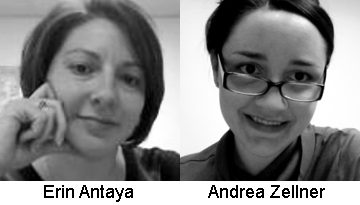
Fields ensconced within the walls of academia grow more technical by the day. As Andrea Zellner of Michigan State University points out in a recent GradHacker post (“Learning to Code,” 14 Nov. 2012), programming skills have become increasingly important in disciplines outside of computer science, especially for those teaching online. If you’re like me, the idea of learning to program is daunting. I’ve taken programming class after programming class, to mixed results. Zellner’s article had me thinking about the struggle to gain technology skills and how faculty members and teachers, already strapped for time, must feel in their pursuit. I asked for insight, and my Twitter network delivered yet again.
Erin Antaya (@gypsymama75), with a 10-year background in education and counseling and experience working for her family’s business and Biggby Coffee, turned me onto a group called Girl Develop It (@girldevelopit). Girl? Develop It? How had I never heard of this before? With more research, I discovered they are everywhere, and Erin, along with the founders of the Detroit Chapter of Girl Develop It (@GDIdet), Michelle Srbinovich and Erika Carlson, were kind enough to speak to me about what it all means.
Erin took to meetup.com and found the class offered at WDET in Detroit. “It was awesome,” she says. “The class [was] a safe and comfortable environment to ask questions and network.” According to Srbinovich, the story behind the Detroit chapter is amazing. In March 2012, she wanted to learn to code before the year’s end and set about finding the means to learn. In the process, she found Girl Develop It, and, she says, “The prospect of having an in-person introduction to web development and a female support system was exciting, and I knew it would give me extra motivation to continue learning.” Knowing others would feel the same she started her own group. The Detroit chapter was born. Continue reading →
It’s that time of the year when we begin to wonder who or what will be the Time 2012 person of the year. Keep in mind that the criterion is “the person who most influenced the news this year for better or worse.”

































 Educational Technology and Change Journal
