
The Sad State of Teaching Thinking in Our Nation’s Schools

[Note: This article is a response to Harry Keller’s “Need More Software Engineers? Teach Thinking Skills Better” (ETCJ 11.29.12). -Editor]

I usually do not disagree with Harry. But I can tell him that he has no idea of the weaknesses of math and science in the grades where students begin to think about careers, hobbies and joining clubs. Education is a voyage of discovery. Some people never invest out of boredom or inadequate opportunity. They may be seduced by the media, but for things other than education and learning.

We also live in a world that supports entertainment and sports over academic performances for the most part. We glorify sports at all levels and also the entertainment industry most of which is very shallow. The news hardly reflects anything of importance of a thinking nature.

Education is like fashion. It depends on the whim of the politicians in Washington and the local school leaders. And there is no punishment for mistakes like those of the No Child Left Behind era when those of us who were teaching thinking-based learning were pushed into using test-based evaluation and modifying anything innovative, creative or science-based.

I went to Catholic schools where we were tested in the beginning of the year and the end of the year so the legacy of who was teaching well or not teaching well stopped at the source, the teachers from grades 1-to-8 who did the work and did the teaching.We did not have PE or science. I hate it that I missed the opportunity to grow into loving science until after my formal training. Thank god for museums and museum educators and courses for teachers. I had the Smithsonian as a learning playground.

We have in the US this testing that purports to measure a whole year and it starts in midyear, February in many instances, when in fact there are chapters and levels of knowledge still to be taught. I have been told that the statistics make up for the fact that we have not taught subject x, but I do not believe it.  Continue reading

Need More Software Engineers? Teach Thinking Skills Better

picture of Harry KellerBy Harry Keller
Editor, Science Education

We’ve seen much hue and cry about our schools being unable to meet the demand for “computer scientists.” What industry really misses is software engineers. The term “computer scientist” is misleading because the skill set of those who write computer programs is one of engineering. Science expands the boundaries of knowledge about the natural universe. That’s why just about every computer scientist worthy of the name is in academia.

Software engineers design computer software, and software coders are the technicians of computer software who implement those designs. Software architects work at a level above the engineers and consider much broader aspects of software creation. It turns out that really good software engineers can do architecture, design, and coding.

Should our high schools be preparing our young people for these careers specifically? Are our math classes geared to producing mathematicians? Are our English classes designed to produce novelists, playwrights, and journalists? Do our history classes create the next generation of historians? These rhetorical questions all have the same answer: no.

What is the most important skill that a software engineer can possess? It’s a strong analytical mind capable of advanced abstraction. No amount of practice with toy programming languages or simple subsets of industrial-strength programming languages will provide students with those thinking skills. However, good math, science, and even history classes just may do the trick if the talent is already there. Other courses can buttress this learning if they stop being memory courses.  Continue reading

The Real Issue in Ed Tech May Be Maintenance

In the earliest days of technology use in schools, particularly computing, it was understood that the school would provide and maintain the equipment. Today that is changing, and some schools are expecting students to come equipped with their own computing ability, maintaining equipment for only students with a proven financial need. Obtaining the equipment is less of a challenge than many might think; the real issue may turn out to be maintenance. With students having to provide their own tech support, reliability of service may become an important issue.

This problem was brought home to me with all too much clarity over the past few months. As I write a highly shortened version of what happened, imagine that I am a student trying to deal with assignments under my school’s technology requirements. I take a lot of trips in which total luggage weight and space is a real concern, and I decided my best option would be a tablet. I researched the reviews and settled on a top rated model, an ASUS Transformer, a tablet with the ability to be used like a laptop with a keyboard. Since I did not see it as a critical part of my life, I foolishly spurned the store’s additional full replacement warranty and stayed with the basic ASUS warranty.

When the tablet would not turn on one day, I used the ASUS email tech support. A couple of days later I got a reply telling me to go into the settings and make a number of changes. I replied that the solution they offered required me to turn on the tablet first, which I could not do. After a couple of days I got a new set of instructions for doing something completely different in the settings. I again tried to make them see that changing the settings was not possible unless the computer was turned on. Eventually I talked to a human being on the phone, and after a bit of an exchange he was able to see that point. Continue reading

Blame Poorly Designed Technology Instead of Teacher Training

picture of Harry KellerBy Harry Keller
Editor, Science Education

[Note: This article was originally posted as a comment, on 11.25.12, in response to Lynn Zimmerman’s Formative Assessment and Blended Learning, Texting, Bullying, MOOCs. -Editor]

Zimmerman: “They found that teachers and pupils lack sufficient training in how to use technology as educational tools.”

What about technology being easier to use? All of the blame does not go to training.

When you realize that professional development (PD) classes for teachers provide them with required credits for retaining certification and give them time off from teaching while having no requirement for success in these classes, you can see that teachers will sit in them and bring nothing from them back to the classroom. That’s your training.

Teachers are people, too, just like students are. Without motivation and good pedagogy, PD is just a day of vacation. For these reasons, we cannot pin our hopes on training. Technology should be easy enough to use that teachers who are motivated can learn to use a given new technology in under an hour. However, applying it by inserting it into curricula may take longer, even much longer.

Moreover, educational technology should already be an “educational tool.” Technology that must be stretched, bent, and twisted to fit into classrooms does not properly belong there. And, just because a teacher becomes enamored of some technology does not mean that the students will benefit. IWBs (interactive whiteboards) are a case in point here.

The best educational technologies will fulfill two crucial goals: (1) easy insertion into a curriculum and (2) positive transformation of teaching/learning in classes, i.e., better learning outcomes. These are in addition to the obvious ones such as ease of use and low cost. BTW, the improvement in learning should be due to the technology, not the shiny new thing syndrome.

Formative Assessment and Blended Learning, Texting, Bullying, MOOCs

Schools changing texting policies from eSchool News
Texting is one of the best ways to communicate with young people, but due to misconduct issues, many schools do not allow teachers and staff to communicate with students via texting. A school in Ohio sees the benefits of texting as a means of communication so is addressing the issue by sending home permission slips.

Addressing Bullying: Schoolwide Solutions by Nicole Yetter  from Education Week
This article reports on the 2011 “State of K-12 Cyberethics, Cybersafety, and Cybersecurity Curriculum in the United States” report published by the National Cyber Security Alliance and sponsored by Microsoft. This study found that schools needs to take a more active role in educating “students to be safe in today’s digitally connected age.”

Technology is not used effectively in schools is a report from The Information Daily.com
The National Endowment for Science, Technology, and the Arts (NESTA) in the UK has found that, despite schools spending millions of pounds on technology, it is not being used effectively. They found that teachers and pupils lack sufficient training in how to use technology as educational tools.

New frontier for scaling up online classes: credit by Justin Pope, AP Education Writer
MOOCs have opened up university courses to anyone who wants to take them. However, students do not receive university credit upon completion of these free courses. The sheer volume of students, grading, and concerns about cheating  are some of the issues that Pope explores.

Formative Assessment Is Foundational to Blended Learning by Michael Horn and Heather Staker from THE Journal
After explaining what formative assessment is – ongoing assessment – Horn and Staker look at the importance of formative assessment in the blended environment.  They assert that “formative assessment software appears to work best in blended learning environments if it helps students direct their own learning.”

Help Sandy Victims – Emergency Education Directory

Nov. 19, 2012
Hi Jim,

As the New York-New Jersey metropolitan area continues to struggle in the wake of Hurricane Sandy, it’s important to remember the far-reaching implications of putting life on hold in the middle of November. In New York City alone, over 75,000 students missed school last week, as 48 schools were left devastated by the storm and dozens were left without heat or power. Although not as urgent as providing housing, food, or fuel, those students’ educations must also be restored.

Photo from Huff Post 11.1.12

That’s why Noodle Education Inc., a New York-based education search provider, is setting up the Emergency Education Directory. Noodle will help connect students in the affected areas with volunteer educators willing to donate their time to teaching, tutoring, and guidance, as well as facilities with heat, power and resources to house displaced students and teachers for these sessions.

Supporting Noodle Education is the Education Industry Association (EIA), which represents and will help recruit more K-12 education companies to be listed on the Emergency Education Directory.

Already, Sandy has caused an estimated $50 billion in damages in the Northeast. A concerted effort by education providers will aid the recovery effort by helping students in the region stay on track with their schooling.

The more educators and students made aware of the Emergency Education Directory, the more effective the program will be. We think this issue would be of great interest to your readers and hope you will aid us in getting the word out.

Please let me know if you have any questions, or if I can connect you with Richard Katzman (rkatzman@noodle.org), Noodle’s point of contact on this matter. [Nov. 14 press release.]

Best,
Sylvie I. Calman
Account Executive
The Cutler Group
sylvie@cutlergrp.com

Are Games Such As ‘Angry Birds’ Appropriate for Kids?

Lynn ZimmermannBy Lynn Zimmerman
Associate Editor
Editor, Teacher Education

I am what Marc Prensky would call a “digital immigrant.” I did not grow up with computer technology but have learned to use it as it appears on my horizon. Some of this use has come from necessity, such as when the company I worked for bought Apple IIes to use for some data tracking. As more and more computer technology appeared on the scene, I embraced some of it while ignoring or rejecting others. I never played video/computer games, for instance, and wouldn’t know one end of a joystick from the other. On the other hand, I cannot imagine life without the Internet and Google.

However, I have started playing some computer games, such as solitaire and some other free card games on my computer and on the Internet. I am a user of Words for Friends through my FaceBook account. However, I have never really played what I consider to be video/computer games until this summer when I bought an Android tablet so I could have a small, light-weight device for checking my email when traveling and for downloading e-books. Around the same time, I heard a story on Dick Gordon’s The Story in which he interviewed the designers of Temple Run. It piqued my interest, I think in large part because one of the designers was a woman (gender differences in technology use and development is a story for another day).  Continue reading

Flipped, Blended, Distracted

Schools provide teachers with the training tools for flipping the classroom by Wylie Wong from EdTech Magazine
In order for innovative ideas such as flipped classrooms to work, teachers and administrators have to understand how to use the technology as well as technology integration.

Is the technology ‘ready’ for blended learning? By Michael Horn from Forbes
Horn asserts that blended learning and technology have not caught up with one another. Different needs and different models contribute to the challenges.

To Make Blended Learning Work, Teachers Try Different Tactics By Katrina Schwartz
from MindShift
In another article about blended learning, Schwartz talks about how blended learning is often an attempt to use traditional teaching methods with new technology. Some teachers easily integrate technology into their lessons and their classrooms, while others have less success. Some teachers are overwhelmed by the new technologies while others thrive on the challenges it presents for taking leaning in different directions.

Teachers: Technology changing how students learn  by Matt Ritchel from The New York Times
Two independent studies with teacher participants, one by the Pew Research Center and the other by Common Sense Media, seem to show that while teachers think the Internet and other technology has had a positive impact on student research skills they are concerned that technology contributes to students’ short attention span and their ability to focus.

Teachers concerned about students’ online research skills  from eSchool News
In a slight contradiction of the New York Times report, this article, also reporting on the Pew Research Center project, says that while teachers think that student access to research tools is improved, they are not necessarily good consumers of what they find. There is so much information available that they can become easily distracted and lose focus.

Chubb’s ‘The Best Teachers in the World’ Disses MSOs

[Note: This article first appeared as a comment to Withrow’s ETCJ article on 11.8.12. -Editor]

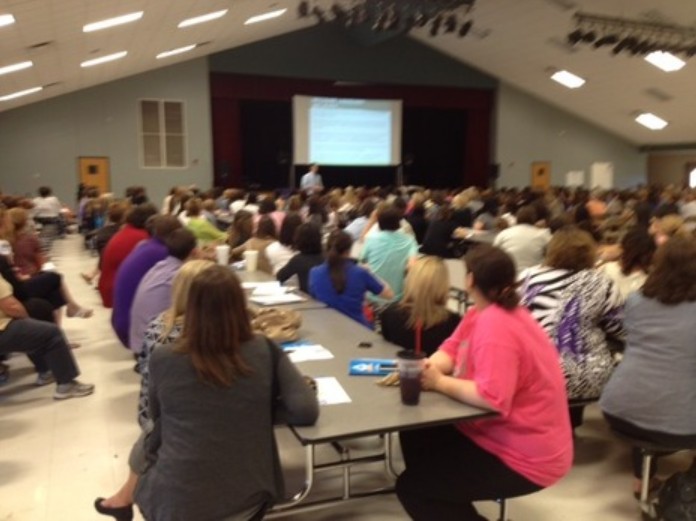
I was not going to respond to Frank B. Withrow‘s “Education in the 21st Century: The World Is Our Classroom.” Then I went to this meeting, and, since the recent election, I have been thinking. I know Frank. I know that he is speaking to all of the educators, but in Washington, lots of people sit on stages and affirm that there are certain practices that will change the world. I believe in Frank’s ideas and leadership. The nation turns a blind eye to the plight of children in rural, distant, unconnected and urban schools while seeking a digitized curriculum.

I don’t find it amusing that lots of the “experts,” if they have children, quickly explain that their kids go to Arlington, Montgomery, or Fairfax Schools. Never mind that lots of DC schools are in terrible need of modernity, and a few STEM schools don’t change the equation. The learning landscape is not even in DC and other places.

They just took librarians or media specialists out of DC elementary schools. I left teaching in DC years ago because of the lack of resources (Anthony Bowen is now a police station thanks to Rhee, but it is clean and no longer reeks of urine when the heat is on).

We lived through Rhee. Few have noted the ravages of her plan. Then I read Michael Keany’s “A Plan to Get the Best Teachers in the World” (11.10.12). Keany says:

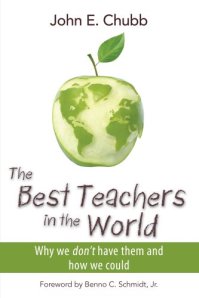
In his new book, The Best Teachers in the World: Why We Don’t Have Them and How We Could [Hoover Institution, Nov. 2012], Education Sector’s John Chubb explores strategies for how the United States can cultivate and retain the best teachers in the world, all with an eye toward raising student achievement. Jeff Selingo, an Education Sector senior fellow, sat down with Chubb to discuss the book at a recent Education Sector author talk.

Continue reading

Twitter for Professional Use – Part 4: Participating in a Live Event

By Melissa A. Venable

[Note: ETCJ’s Twitter editor, Jessica Knott, has been working with Melissa to develop this series. See Part 1: Getting Started, Part 2: Channeling the Streams, and Part 3: Curating the Chaos. -Editor]

This final installment in this series offers guidance on using your Twitter account to join live conversations and monitor ongoing professional events. After setting up and learning to manage your account, a good next step is to join active groups and discussions that use hashtags to set their conversations apart from the rest.

What Is a Hashtag?

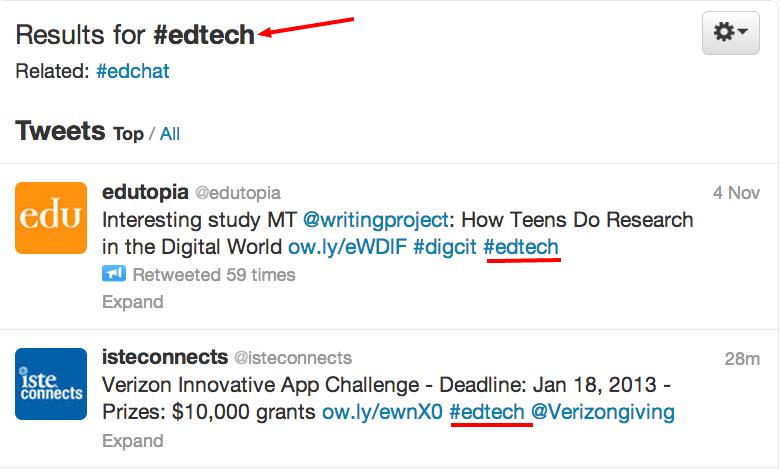
Adding the “#” symbol to series of letters and numbers creates what is known as a hashtag. These are searchable in the Twitter system and can function as filters to create a list of tweets that include the hashtag. By inserting a hashtag into a tweet, you add your message to the conversation, joining all the others who have chosen to add that same hashtag as well.

Anyone can create a hashtag and start a conversation. Like tags and keywords, they help you sort through the seemingly endless flow of information to identify related topics of interest. Use Twitter search to find recent tweets related to #edtech, #highered, or #election2012 as examples. Notice that searching by keyword (highered) or hashtag (#highered) allows you to see all of the messages with the hashtag, including those from accounts you don’t follow.

Join a Live Conversation

Twitter chats are real-time text chat conversations in which participants tweet their questions and responses. Chats go beyond just using the hashtag to participating at scheduled times. Anyone can join in by simply adding the chat’s specific hashtag to tweets during the session. There are several established chats focusing on education topics, such as #lrnchat and #edchatContinue reading

An Interview with Tim Holt, Author of ‘180 Questions’

By Bonnie Bracey Sutton
Associate Editor

[Note: Article updated on 11.10.12 — graphics added. -Editor]

Give a little of your background so we know who you are. Describe your work and how you assist teachers.

I’ve been in education for about 27 years now. I started as a classroom teacher and was a middle school science teacher for over a decade. I then moved on to administrative positions in my school district: I have worked in gifted and talented education, I’ve been an evaluator in education research, and most recently and for the last eight years I’ve been the Director of Instructional Technology for the El Paso Independent School District. My job is to try to try get teachers to use technology in the classroom with their students. I have a really great team of people that go out and train teachers on how to integrate technology into their lessons. Along the way I’ve been the President of the Science Teachers Association of Texas as well as President of the Technology Education Coordinators SIG, which is a statewide group in Texas of Instructional Technology Directors. Most people that know me from outside of Texas know me from my blog, which is now residing on Tumblr and is called HOLTTHINK.

What made you write 180 Questions: Daily Reflections for Educators and Their Professional Learning Communities?

For the longest time I thought just having a blog would be a good enough place to share my ideas and share what I was doing, but after a while I started thinking that a book would be a good place to put ideas that had to do with a very specific topic. The blog I have is kind of self-reflective and bounces all over the place from instructional technology to politics to different kinds of education topics, whereas the book is centered specifically on thinking about Professional Learning Communities or PLCs. What I wanted to do in this book was to give educators the opportunity to start doing a lot of reflection, which is something I think is sorely missing from a lot of professional development these days. What I see happening in professional development is people going in, getting trained on something, which they may or may not use, and then there is no follow-up, there is never anything that happens afterwards so you never know whether that training was useful or not useful.

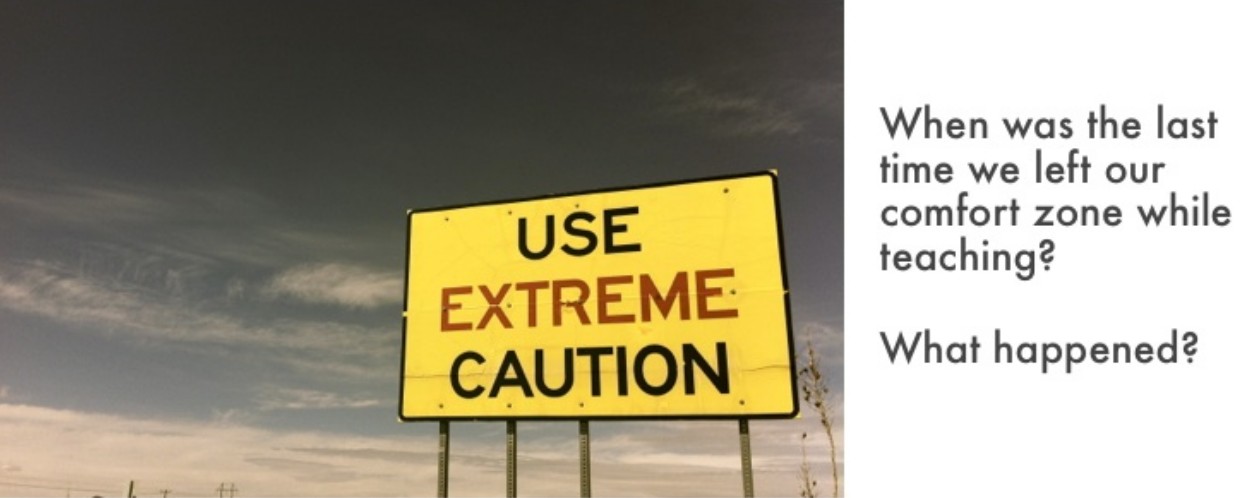
The purpose of the book was to look at how we look at ourselves as educators. When I was growing up, every evening my parents had this booklet called The Upper Room, which was a daily devotional that had a little message with a meaning, and a prayer. Every night at dinner my father would read the daily passage, which they picked up at church each Sunday. I don’t even know if they still make it anymore, but I liked that idea of having something that made you think or made you jump out of your comfort zone on a daily basis. So that was kind of the genesis for the idea of doing 180 Questions. The “180” comes from the length of a typical school year here in the United States.

Continue reading

Placement Tests and the Unravelling of College Developmental Programs

Jim ShimabukuroBy Jim Shimabukuro
Editor

With so many developmental programs in statewide community college systems (SWCCSs) reliant on high-stakes placement exams such as COMPASS and ACCUPLACER, the recent reports out of Columbia University’s Community College Research Center (CCRC) must have come as a shock. For decades, these tests have been impacting students’ academic careers, and now a set of studies has surfaced to question the validity of their use in predicting performance.

At issue is much more than the efficacy of placement tests. Because the scores are the thread that runs through, binds, and defines the entire developmental structure, there’s really no telling what will happen as Judith Scott-Clayton and her colleagues tug, bit by bit, at the loose end that they’ve discovered. Scott-Clayton, an assistant professor of economics and education and senior research associate with CCRC, which is part of Teachers College, is the prominent figure in this effort to take a long hard look at a system that seems to be broken because of a fundamental flaw — placement testing.

In one of the studies, “Development, Discouragement, or Diversion? New Evidence on the Effects of College Remediation” (National Bureau of Economic Research, Aug. 2012), Scott-Clayton and Olga Rodriguez (also Teachers College) cite a finding that “remediation does not develop students’ skills sufficiently to increase their rates of college success” (2). Furthermore, they say that many students “diverted” into developmental courses could have done well had they gone directly into the college-level courses:

First, we find that potentially one-quarter of students diverted from college-level courses in math, and up to 70 percent of those diverted in reading, would have earned a B or better in the relevant college course. Further, our analysis of impacts by prior predicted dropout risk suggests that diversionary effects are largest for the lowest-risk students, and we fail to find positive effects for any risk subgroup. (3)

In fact, these students who weren’t at risk in the first place may be at greater risk of dropping out as a result of this needless diversion.  Continue reading

Oakland Unified School District Uses GIS to Further Academic Achievement

By Jim Baumann
Esri Writer

Oakland, California, lies directly across the bay from San Francisco. During the California Gold Rush in the mid-eighteenth century, it served as the main staging point for miners and cargo traveling between the Bay Area and the Sierra foothills. Today, the city continues to serve as a major cargo terminus, and its seaport is the fourth busiest container port in the United States.

Due to the economic opportunities provided by the Gold Rush, the city was a destination for immigrants looking for greater prosperity. As a result of this and successive migrations, Oakland is now known for its ethnic diversity, with significant populations of African-American, Hispanic, Asian, and Caucasian residents. While valuable from a cultural perspective, this poses certain challenges for local government, particularly the Oakland Unified School District (OUSD), which must accommodate the diverse needs of its students, who speak more than 70 languages at home.

OUSD includes 61 elementary schools, 16 middle schools, 20 high schools, three K–8 schools, and one 6–12 school, as well as special education, independent studies, and early childhood education centers. It is the seventieth largest school district in the United States, and there are about 38,000 students in its K–12 programs. Chronic absenteeism is a major concern for the district, with nearly 40 percent of students in the East Oakland areas dropping out of high school before graduation. OUSD works with the Urban Strategies Council (USC), a nonprofit organization located in Oakland, to collect and analyze data related to school attendance and other social issues in the city.

Implementing a Community Data Portal with ArcGIS for Server

USC has used Esri‘s ArcGIS software for more than 20 years, applying it to a wide range of urban policy and reform initiatives affecting Alameda County, where Oakland is located, including health care services, affordable housing, violence prevention, education analysis, urban planning, disaster mitigation, and school absenteeism. It recently launched InfoAlamedaCounty Map Room, a free data portal that provides access to public datasets to the community for research, application development, civic engagement, and analysis.

Continue reading

Not Satisfied, but Hopeful, About Online Science

By Dan Branan, Ph.D.
NANSLO Lab Director
Colorado Community College System

John Adsit wrote a recent article (“No Satisfaction in Finding on Online vs. Traditional Science Classes,” 22 Oct. 2012) commenting on a study by the Colorado Department of Higher Education’s study showing, among other things, no significant difference in long-term college grades and GPA when comparing community college students who had taken their introductory science courses online with those who had taken them in the traditional community college classroom (Epper, 18 Oct. 2012). I had initially posted a response to John’s article, and was asked by the editor of ETCJ to expand it into an article, which I greatly appreciate. In short, it seems to me that John has largely missed the mark with regard to the Colorado study and its implications.

For many years, as an online educator in the community college system in Colorado, I have listened to traditional colleagues claim as a fact that students taking online science courses are not as well-prepared and, in fact, are at a disadvantage, compared to traditional students. The traditional model was held up as the standard, without proof, even though, as John points out in his post, there have been studies indicating that the traditional educational model does not work as well as it should in the first two years of college.

John’s initial response to the Colorado study is to merely sneer at the demonstrated equivalence of online vs. traditional science classes at the community college level by stating that “students in general learned very little in the first two years of college,” relying on the excellent analysis in Academically Adrift. While I cannot dispute the findings in that report, I do have an important question about its true meaning: Do we have proof that college education has ever been different? While it may indeed be a cause for alarm, could it be that the first two years of college are a time when students undergo a wide range of mental and personal transformations in readiness for the culminating two or three years before they earn their degree? Isn’t it true that the first two years of college are often filled with fairly bland courses in preparation for study in one’s chosen field of interest?

After all, the U.S. still possesses an undergraduate educational system that many students from around the world envy. According to a report last year from the Institute of International Education, the number of international students enrolled at U.S. colleges is 32 percent higher than it was a decade ago, and this is largely due to undergraduate enrollment of Chinese students.  Continue reading

The Real Story on Online Science Labs

picture of Harry KellerBy Harry Keller
Editor, Science Education

John Adsit has written very well (“No Satisfaction in Finding on Online vs. Traditional Science Classes,” 10.22.12) about some of the issues raised by the Colorado Department of Higher Education study (Epper) and has expressed some excellent insights into this field. In some ways, I wouldn’t go quite as far, and, in others, I’ll dig more deeply.

While it’s mostly true that a university cannot meet these standards in large classes, it does not have to be so. It’s because most professors are dedicated to research and not to teaching that such situations abound. I was such a professor with 350 students in a freshman chemistry course with labs. I met with my 22 teaching assistants weekly and visited lab sessions constantly during the course. It left me little research time but helped to build a good quality course. (Today, I’d make a much better one, but I was new to teaching then.)

In community colleges, there’s no excuse for not meeting the goals of America’s Lab Report (ALR). It’s not a publish-or-perish environment, and the class size is smaller.

John has listed the ALR goals in his remarks, and I’ll comment on them specifically. I see no excuse for not meeting the second set of four goals that addresses integration of science labs with the overall course. These are overarching goals for any lab course and would be easy to meet for anyone who cares to make the effort.

The first set of goals focuses more closely on the labs themselves. These are nice goals, but are not all equal when it comes to designing great lab experiences. I’ll take them out of order to put them into the proper context.

3. Understanding the complexity and ambiguity of empirical work.

This is so important that ALR singles it out as the one goal that can be achieved in no other way than through a science lab. In this context, it’s important to note the part of the report that John left out, the definition of a science lab:

Laboratory experiences provide opportunities for students to interact directly with the material world (or with data drawn from the material world), using the tools, data collection techniques, models, and theories of science.

Note well that the data must always come from the “material world.” That statement completely rules out simulations that use equations and algorithms to create the data.

Continue reading

The Latest Technologies Bump into Obsolete Laws

One of the marvelous things about the Internet is that it allows people to take courses anywhere anytime. While the Internet may give us that capability, the reality is that there are other issues that come into play. No, I am not talking about lack of Internet access or lack of infrastructure or resistance from instructors. I am referring to state laws and requirements about what can be taught in their state and how it can be taught.

A recent story on Planet Money at NPR brought this issue to light. In Warning to Minnesota Residents: Don’t Take Stanford Profs’ Free, Online Courses, Jacob Goldstein wrote about Coursera’s caveat to Minnesota residents that they cannot take the company’s free online classes except under very specific conditions, one of which is to complete most of the course outside of Minnesota.  A state department official said that part of the rationale for this 20-year-old law was to serve a consumer protection function for students.  In a response the day after this story appeared, the director of Minnesota’s Office of Higher Education said that the law obviously needs to be updated so that Minnesotans can take advantage of such free opportunities for lifelong learning.

One reason this piece caught my eye was that we have recently run into some related situations. Our graduate programs are going more and more online, and in order to increase enrollment, we want to go outside the state boundaries. However, it turns out that we have agreements with certain states and not with others. Recently we have had to turn away potential students from states with whom we don’t have agreements. I was surprised to learn that some states even require hefty (up to $1,000) fees to register your online course/program in their state.

It seems that possibilities offered by ever-changing technology are often hampered by challenges that are two steps behind where the technology is. Maybe the pace will never be equal, and maybe that’s not a bad thing altogether. It keeps everyone on their toes.

Joe Chianakas

[Note: This bio was first published on 10/22/13. -Editor]

Joseph Chianakas160Joe Chianakas
Professor of Communication
Illinois Central College
Joseph.Chianakas@ICC.edu

He previously taught high school English and communication for over a decade. Besides teaching, he loves fitness, martial arts, travel, and pop culture.

ETC Publications

Qualities for a Strong Online vs. F2F Teacher: Are They Different?

Education in the 21st Century: The World Is Our Classroom

Frank B. WithrowBy Frank B. Withrow

Several factors are acting on traditional education programs. Stringent budgets are limiting school options. Content is increasingly available in digital formats such as accessible video, computer lessons and even educational games. Core academic standards are available in content areas. Most important is that better digital management and assessment systems are becoming available. Home schooling has provided a model that can be expanded into a blended education environment.

When Don Bitzer developed the PLATO system, he dreamed that the learner could be assessed and then assigned appropriate learning materials to move his or her learning forward. Assessment materials would be available to measure the learner’s progress towards a desired level of achievement. This process could be repeated until the learner reached even a 100 percent proficiency. Today this dream is possible with core state standards and digital technologies that allow learning in the home, classroom or even workplace. Handheld media allows learning of content 24/7 year round.

In such a system the role of the teacher becomes more a tutor, a counselor, a mentor and a coach that guides the learner through the desired resources and provides the assessment needed to determine accomplishments by the learners.

Each learner will have an educational plan that they are working towards. Assessment systems will include tests, projects and products that are a part of the learner’s portfolio.

We are a mobile society, therefore each learner will have an education card that holds his or her records, accomplishments and portfolio of work. Much learning will take place in classrooms, but a large amount of content will be learned at home through libraries of lessons available anytime-anywhere in video formats, computer lessons and educational games. Team learning will be emphasized both in classrooms and through social media.

The school and community will become integrated. Education will become learner centric. School facilities will be laboratories where teams of learners work together to reach high levels of scientific achievements.

Children and families will be encouraged to contribute digital resources of their learning experiences on such things as family vacations or other significant family events.

Education in the 21st Century will be learner centric and more digital in nature with students bringing their own digital devices to the learning environment. The world is at our fingertips. We must be wise enough to use it.

No Satisfaction in Finding on Online vs. Traditional Science Classes

A recent study by the Colorado Department of Higher Education (Epper)* finds no significant difference in the performance of community college students who took science classes online and in traditional classrooms. This is consistent with many studies that show online learning to be as effective as classroom learning, but the importance of this study in the area of science is, sadly, less significant than it appears.

The study had two parts. One compared the grades of students within the system. This has little value as an indicator since grading was left to the instructors and thus provide no standard basis for comparison. The other part of the study is more valuable, showing no significant difference in the performance of the students after they transferred to four year colleges and universities. The students who completed their first two years of science education online did just well as those who completed it in regular classrooms. The significance in terms of science is the challenge to the common perception that students need to spend time in a true laboratory to get a proper science education. This online program used specially designed kits to replace the formal lab experience, and other programs used other online approaches.

Unfortunately, the 2010 study Academically Adrift shows there is little reason for celebration. That study found that students in general learned very little in the first two years of college. The conclusion of this study, then, implies that the online science program didn’t do any better (or worse) than a traditional program that we know isn’t working. One would hope that the online program is an improvement, and, in fact, it should be able to achieve improvement without breathing hard.

In 2005, the National Research Council published America’s Lab Report, a devastating look at science education in America. It was particularly concerned with the very poor way in which laboratory work was incorporated into the instructional process. Although that report focused on high school courses, the nature of the identified problems is almost certainly just as likely to be found in college classrooms, if not more so. This study not only shows why lab courses are ineffective, it also points the way to how they can be improved, whether in the physical classroom or in the online environment.

This was a meta-analysis that looked at a huge number of studies in science education.  Some of the studies actually indicated that students would perform better if labs were eliminated entirely. The reason is simply a matter of instructional alignment. Achievement in science is usually measured by the ability of students to memorize and repeat facts related to science. They are rarely assessed on their ability to think and perform as scientists, by investigating, forming hypotheses, and following the scientific method to solve a problem or reach a valid conclusion. Thus, instructional time spent on anything other than learning and memorizing facts is time wasted.  Continue reading

Size May Be the iPad Mini’s Downfall

Jim ShimabukuroBy Jim Shimabukuro
Editor

[Update 11.24.12: I just had my first hands-on trial with the iPad Mini a few minutes ago. I was wrong! It is narrow enough to grasp in one hand with thumb hooked over one edge and fingertips over the other. Also, despite its much smaller size, the screen is surprisingly readable and viewable. My apologies to Apple and congrats on a beautiful design! -Jim]

The release date is just a couple of days away, and the rumors seem to be converging on an iPad mini that will be 8.4x 5.7 inches in size, smaller than the iPad’s 9.5×7.3. But not by much. To get a feel for the mini’s size, I created a rough model out of a flyer that I received in the U.S. Mail. It was thick enough to hold the shape that I cut, roughly the height and width of the mini.

At 5.7 wide, I couldn’t wrap my fingers around it, as I do the iPhone, which is only 2.3 wide. I systematically reduced the width until I could comfortably get my fingers around it – the thumb at one end, the fingertips at the other. The grippable width that I arrived at was 4.0. At this width, the 8.4 height became awkward. I sliced away at it until the whole seemed right. The finished height was 6.0. It’s roughly the size of a postcard and slightly smaller than a paperback.

I then drew a rectangle on one side to get an idea of the screen size. Using the iPhone as a model, I decided to leave a bezel at the top and bottom, with the bottom slightly larger than the top. I left a slim margin for the sides. The diagonal screen size turned out to be 6.0, roughly midway between the iPhone’s 4.0 and the mini’s 7.9.

My aim wasn’t to build a large iPhone. I think the iPhone has maxed out in terms of size. Any larger than its 4.9×2.3 and it would be too big. My target was a new iPad that met two criteria:

  1. It is grippable by the human hand when held in portrait or landscape.
  2. It has a screen that’s at least twice that of the iPhone.

Continue reading

Passport – Blurring the Lines Between LMSs, Game Environments, and e-Portfolios

By Jessica Knott
Associate Editor
Editor, Twitter

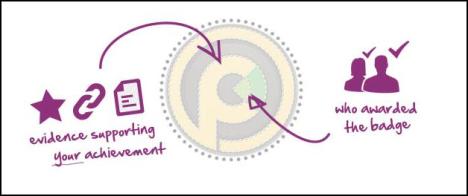
Today, we hear a lot on education blogs and in conference presentations about gamification and badging, especially in regard to how they challenge the current LMS structure and effectiveness. Purdue University has developed Passport, an app that blurs the line between LMSs, game environments, and e-portfolios.

Passport offers learning activities to students as a series of challenges rather than your typical pedagogical narrative.

“Digital badges create a new common currency for learning that enables us to identify smaller units of learning,” says Kyle Bowen, director of informatics for Information Technology. “Passport connects badges with an LMS-like interaction. In a ‘choose your own adventure’ style, students can self-select how to complete each challenge. Once complete, students are awarded digital badges that they can share as part of an online and mobile portfolio.”

Development on Passport began in May of 2012, and it was released in August of the same year. According to Bowen, developers are partnering with faculty members using the product to “assess the impact related to their use in an effort to find effective practices to teaching with digital badges.”

Purdue’s Studio projects have served as a mechanism for their initial immersion in the mobile market, and they are currently experimenting with the Passport Profile iPad app as a portfolio that can be used to demonstrate student work in interviews, meetings, and job fairs. Bowen notes that Passport is primarily a Web platform, and the Passport Profile portfolio app is currently the only component that is unique to mobile devices. The same functionality is also available online.

Passport is currently in a limited beta, and interested parties are invited to throw their hat into the ring. Bowen also invites those with passing interest to log in and try Passport for themselves. Two challenges have been provided to get you started in understanding how Passport works.

AT&T’s Online Mentoring Academy: A Model for Public-Private Partnering

By Jessica Knott
Associate Editor
Editor, Twitter

AT&T recently announced a $350 million initiative designed to increase high school graduation rates and place at-risk students more firmly on the career track. The Aspire Mentoring Academy plans to fund three different types of mentoring, in many cases provided by AT&T’s employees, and encompassing job mentoring, skills mentoring and e-mentoring.*

Job mentors are AT&T employees, sharing their experiences via project-based activities. According to Kat Bockli, PR representative for AT&T, employees sign up through the Aspire Mentoring Academy internal website. They are then provided with preparatory materials and training. Most of the training is online, but AT&T also plans partnerships with non-profits such as Junior Achievement, We Teach Science and The LEAD Program. “As our organizations work together to increase U.S. high school graduation rates, giving students real-world learning experiences is key to showing them the importance of staying in school,” said Jack E. Kosakowski, president and chief executive officer of Junior Achievement USA(r). “By working with AT&T employees at Aspire Mentoring Academy, students understand how what they learn in school applies to their lives after graduation.”

When it comes to project assessment, the program is interested in “data-driven outcomes that improve high school graduation rates,” according to Janiece Evans-Page, AVP for Community Engagement at AT&T. “Other on-track to graduate indicators, or ‘smaller metrics,’ include on-time promotion to the next grade and improved attendance rates. These shorter term metrics are key to achieving the high school graduation goal and will be included in how we measure our success.”

To be effective, the initiative requires significant support from AT&T employees. “I was mentored by a young professional when in high school. It made a big difference in the path my life took,” said Clara Garza, Aspire Academy mentor and Lead Chief of Staff for Executive Operations at AT&T, Dallas. “One of the best things about AMA is there are several mentoring opportunities the employee can choose from. You can participate in short-term mentoring events in the workplace or in classroom settings or choose a long-term mentoring option with a series of classroom settings or student mentoring. AMA is also fully customized – you can do it on your own time, when there is a particular need and they give you the tools to be successful.”

More information on Aspire Mentoring Academy can be found at http://www.att.com/gen/corporate-citizenship?pid=11547.
__________
* Update submitted by Kat Bockli, AT&T, on 10.24.12: “AT&T has launched AT&T Aspire, a $350 million initiative designed to increase high school graduation rates and place at-risk students more firmly on the career track. The Aspire Mentoring Academy is the key community engagement program of Aspire that plans to fund three different types of mentoring provided by AT&T’s employees, and encompassing job mentoring, skills mentoring and e-mentoring.”

Edited 10.24.12 at 07:00.

What Will Drive the Future of Educational Technology?

The FETC conference in Florida, one of the largest conferences in the world, is fast approaching, and that spurred some memories of when I went last year. I thought then about how different the exhibits and presentations were from what such a conference would have featured a decade before, and I wondered what it will look like a decade in the future. I thought then that much of what I was seeing was already becoming obsolete (or should be), and it makes me wonder what direction educational technology will (or should) take in the future.

The huge exhibit hall was filled with flashy demonstrations of the latest miracle products, few of which drew my interest. The vast majority of the big ticket items were all designed to improve the quality of a lecture. There were new and improved ways to put information on a screen as the lecturer explained it, and there was especially better ways for the audience to indicate their understanding electronically. I am all for the use of such response mechanisms for lectures, but since I don’t do a lot of that it would not do me a whole lot of good.

I went to two presentations with almost identical titles and almost identical announced purposes — to show cool web sites that could be made a part of instruction. Despite those similarities, there was a stark difference in the content, a difference that  illustrates the fundamental problem with anticipating  the future of educational technology and change. If we all agree that the purpose of technology is to enhance good instructional technique, then the difference lies not so much in technology but upon the vision of the instructional technique it is supposed to enhance. Continue reading

Wireless EdTech 2012, Augmented Reality Device, Infographics on Ed Tech, Broadband Deployment

“The Future of Education Is Wireless” — according to the Wireless EdTech Conference 2012, which was held in Washington, D.C., October 10-12. Why? “Mobile is innovative, affordable and provides 24/7 access to a seemingly endless amount of resources. That’s why there are more mobile subscriptions than toothbrushes. From low-income urbanites, to the suburban upper-class, to the poorest of poor in rural areas of the world, mobile connectivity has the power to transform learning in a 21st century environment” (conference site).

Then they go about showing, sharing and introducing policy, educational performance and international examples. There are powerful examples, and you really get up close and personal to the people who present and share their ideas.

I attended the conference. It’s the one conference that makes me want to attend all of the sessions. I usually go for the education section and the policy sessions. The conference is star-studded with people who know education and who are in touch with the pulse of the nation — educators, pupils, school board leaders, and policy makers. It’s a great conference to do powerful networking with, to name a few, the new president of ISTE, influential people from the Smithsonian and the wireless industry, and tried and true leaders like Dr. Chris Dede.

If international is your interest, here are a couple of videos for you:

Continue reading

CFHE 2012 Impressions: My Bumpy Start to a MOOC on Future Trends in Higher Ed – ‘505 Unread Discussion Messages’

By Stefanie Panke
Editor, Social Software in Education

The Massive Open Online Course Edfuture 2012 (CFHE 2012, Current/Future State of Higher Education: An Open Online Course) started on October 8 and will be running for six consecutive weeks. Since I am currently working on an article about future trends in educational technology, I was very excited to learn about the course and plan to participate as intensively and regularly as my schedule allows.

Getting Started

Unsurprisingly, the last week has been busy at work, and after a brief review of the reading material on Monday, I “skipped class” for the remainder of the weekly MOOC format. Checking back in on Friday only to get ambushed by “505 Unread Discussion Messages” that had secretly been piling up in the course forums, left me disheartened for a second. As usual, it pays to take a deep breath and a closer look at the MOOC’s course activities.

The majority of messages were personal introductions (441); about 65 dealt with the reading material of week one. The discussion threads covered various topics from sustainability and diversity of open education to the costs of higher education and international trends. I did not engage in any particular topic. Instead, I drifted through the threads in a serendipitous fashion and enjoyed listening in to different conversations. Here are my favorite quotes of the week:

I’m not participating in this MOOC to compare apples and oranges (bricks and bytes); I’m here to imagine ways we can be present to each other across time and distance. (Joe Moses, Oct. 9)

I personally have taken courses in Udacity and [they] are among the best courses I ever had. (William Colmenares, Oct. 9)

Continue reading