New Instructional Design Association in Higher Ed: An Interview with Camille Funk

By Stefanie Panke
Editor, Social Software in Education

The newly founded Higher Education eDesign Association (HEeD) targets higher education instructional designers, multimedia teams and administrators. The group’s vision is to foster networking and collaboration, offer professional development opportunities, support research, and create publication opportunities. On April 7-8, 2016, the first annual HEeD conference will be hosted by George Washington University in Washington.

I spoke to Camille Funk, founder and president of HEeD, about the niche that the organization is trying to fill, the idea behind it and its current initiatives.

Camille Funk, founder and president of Higher Education eDesign Association (HEeD)

Camille Funk, founder and president of Higher Education eDesign Association (HEeD)

Camille, you are director of eDesign Shop at George Washington University. Please describe your current work environment as an instructional designer.

We are a newly organized course production shop. The team consists of four instructional designers, a video producer, videographer, animator, and a team of five student employees. Currently, our shop has two production cycles (six months each) and produces an average of 30 courses a year.

What was your personal journey to the instructional design profession?

I came into the field, as many do, by happenstance. I received a bachelor’s degree in Elementary Education and master’s in International Educational Development. My intent was to pursue educational administration with a global reach. I chose to teach elementary school for a few years in preparation for an administrative role. I then took a position with Brigham Young University, Independent Study, as an administrator. In this role, I was introduced to instructional design. BYU Independent Study had a team of about ten instructional designers and a large multimedia shop to facilitate high-level course design.  Continue reading

Language Learning: Games, Social Media, and Apps

lynnz_col2

Memorize a list of vocabulary words or do a crossword puzzle? Which is more engaging? In “Try this game in your next vocabulary lesson” (Multi Briefs: Exclusive, 14 Oct. 2015), Debra Abrams refers to some recent research that shows the importance of using games and puzzles in the classroom. She goes on to explain a strategy she uses with her English language learners where they identify words they want to learn and create their own crossword puzzles.

In “Getting Started With Game-Based Language Learning” (Edutopia, 16 Oct. 2015), David Dodgson points out that, while GBL (game-based learning) has been receiving quite a bit of attention, little has been written about how it can be used with English language learners. He recommends four resources for GBL with a focus on language learning.

In “New app connects Valley high school students to English learners” (KPHO, 11 Oct. 2015), Erika Flore describes an app that is being used by students at Desert Vista High School to connect with students in other parts of the world to help them learn or improve their English. The Desert High students are volunteers who use a website, mobile app, and/or social media to connect mostly with students in China.

In “New ISU software helps students learn english” (Iowa State Daily, 12 Oct. 2015), Jake Dalbey describes CyWrite, a program “developed by students and professors” that gives specific feedback on writing errors. He explains that this program works better than others like it because the developers started with English linguistics and developed the program around it, unlike most other programs that start with the software and plug linguistic features into it.

Poverty, Reading, and Technology

Lynn ZimmermannBy Lynn Zimmerman
Associate Editor
Editor, Teacher Education

In his article “Technology Holds Promise for Students With Poor Vocabulary Skills” (Education Week, 23 July 2015), Steven L. Miller argues that technology offers one solution for creating individualized learning experiences for students to develop better literacy skills.

Miller’s premise is that children, especially from impoverished backgrounds, also come to school with impoverished language skills. He asserts that “children with lower vocabulary skills are often poor readers, so they continue to fall further and further behind in academic language and cognitive skills.”

While Miller’s article offers an effective solution to the problem of building vocabulary and consequently literacy skills, we have to be careful about generalizations regarding students from low-income or poverty situations. He bases his argument on research demonstrating that they hear more negative communication while students from professional families hear more positive and encouraging communications.

However, there is a broader range of research on the impact of poverty on learning, showing that while communication may be one aspect of literacy development, there are other factors such as poor nutrition and inadequate healthcare.

Regardless of the causes, education and educational technology can, as Miller states, help students with poor vocabulary skills. For example, he says:

Using speech-recognition software … students receive one-on-one guidance and real-time feedback from an unbiased listener as they read aloud. Using this approach, students can improve their reading grade level by up to 50 percent more than the students who only receive classroom instruction in the same time period.

Miller’s article is based on Betty Hart and Todd R. Risley’s 1995 study Meaningful Differences in the Everyday Experience of Young American Children. For a summary, see Hart and Risley’s “The Early Catastrophe: The 30 Million Word Gap by Age 3”  (American Educator, spring 2003).

TCCfx: Free Online Mini-Conference for Students & Faculty 28 Oct 2015

Aloha,

This fall, TCC Hawaii, in collaboration with graduate students from Learning Design & Technology (LTEC) at the University of Hawaii College of Education, will sponsor a FREE mini-conference, TCCfx, for graduate students and interested faculty. Undergraduate students are invited to participate as well.

Please share this information with your colleagues or interested students.

Bert Kimura

University of Hawaii-Manoa College of Education

University of Hawaii-Manoa College of Education

TCCfx 2015: Come Together, Engage & Learn

October 28, 2015
5:00 pm9:00 pm Hawaii Time
Online (Join.me)

Complementary Registration
https://tccfx2015.eventbrite.com

View other timezones 

TCCfx 2015 is a complimentary mini-online conference that serves as a platform for the growing learning design and technology (LTEC) community. This online conference aims to connect, collaborate, create, and improve teaching and learning in the 21st century by empowering current and prospective LTEC (or educational technology) students and others to prepare for success in their graduate programs and their future professions. Interested educators are invited to attend as well.

This event is sponsored by the University of Hawai’i at Manoa, Learning Design & Technology Department, College of Education; and AECT-HI (Hawaii Chapter) in collaboration with TCCHawaii.org .

For more information, contact conference chair Kimberly Suwa <suwak@hawaii.edu>.

MIT’s MOOC-based Micro-Master’s Degree: Waiting for the Other Shoe to Drop

Jim ShimabukuroBy Jim Shimabukuro
Editor

MIT’s decision to grant credit for MOOC courses in their supply-chain management master’s program1 is the long awaited breakthrough to the next step in online education. With this move, they’re distancing themselves from the pack, creating a huge vacuum that’s sure to suck the others in.

This decision of a top-tier university to recognize MOOCs as a viable alternative for delivering college credit courses was inevitable. It was going to happen, sooner or later. Given the fact that colleges in the U.S. and around the world have been offering completely online credit courses for years, the only question is, what took so long?

Hats off to the MIT administration and faculty for extending the promise of traditional online courses to MOOCs. MOOCs will cover the first half of the course work required for the master’s, and those who do well and are accepted into the program will then be required to register for the remaining half in on-campus classes. Despite this blended approach, this is a gutsy move in more ways than one. It spotlights the first “O” in MOOC, which is the most critical feature in massive open online courses. It also opens the door to the inevitable next step, a proliferation of full undergraduate and graduate degree programs delivered completely online via MOOCs at a fraction of the cost of MIT’s proposed blended model.2

Once that credibility door is opened by an institution such as MIT, which is among the handful of defacto higher ed leaders in online education, it’s pretty much a foregone conclusion that the entire wall between online and onground will crumble.

We’re probably going to see leapfrogging in the coming weeks and months, with the rest of the field scrambling to one up MIT. The intriguing question is, what forms will credit MOOCs take?

Considering the formless elasticity of MOOCs, options are wide open, limited only by imagination. The most imaginative and creative institutions will, as a first step, take a long hard look at the wealth of possibilities for innovation inherent in the MOOC structure and design courses that will shake up our ages-old model for college courses.

In this last quarter of 2015, we, the world, can begin to look forward to some massive surprises in online college degree options in spring 2016.
__________
1Jeffrey R. Young, “MIT Master’s Program to Use MOOCs as ‘Admissions Test’” (Chronicle of Higher Education, 7 Oct. 2015).
2This paragraph was expanded on 10/8/15 at 19:13 to clarify the blended nature of the pilot program.

MOOCs: A Toolbox for Course Designers?

Jim ShimabukuroBy Jim Shimabukuro
Editor

In a video interview, Jonathan Moules1 asks Simon Nelson, CEO of FutureLearn, some tough questions about the current state of MOOCs. Noules’ Moules’ questions caught my attention:

  • “How much of an issue is it that most of the people signed up for FutureLearn and other online education platforms already have a degree?”
  • “What’s more important, is it broadening access to millions of people across the planet to education or is it about making money?”
  • “How do you make money from online education?”
  • “A criticism of online education has been that a lot of people signing up for these courses don’t complete them. Do you see that as a challenge?”Simon Nelson CEO FutureLearn2

And I found Nelson’s responses succinct, clear, practical, and informed.

As much as these questions and responses are enlightening, however, I can’t help but feel that they continue to pigeonhole MOOCs as fascinating but peripheral, impractical and ineffective counterparts to standard college courses. As long as this perception persists, MOOCs will remain outside the circle of serious discussion in higher ed, and this alienation will prolong the wait for the next step in course design.

In my mind, MOOCs are much more than a far-out platform for free courses with almost limitless seating capacity. If we can  get past the idea that they are a specific course type, built in stone, we can begin to explore the endless possibilities that they represent as a tabula rasa for envisioning the shape of courses to come in the 21st century. In other words, MOOCs have expanded our conception of what a course can be, offering us a whole view that takes into account the latest technological breakthroughs. Continue reading

TCC Worldwide Online Conference 2016 Apr 19-21 – Call for Proposals

Aloha everyone,

It’s that time of year again. Hope you are enjoying the start of fall (or spring).

Below is the first announcement of our call for proposals for TCC 2016.

The full description is available online at: http://tcchawaii.org/call-for-proposals-2016

Please share with colleagues, students and interested friends.

Warm regards,
Bert, Curtis & Sharon

DSCF0663R-TCC

21st Annual

TCC WORLDWIDE ONLINE CONFERENCE

April 19-21, 2016
E-Learning: The More We Get Together

Submission deadline: December 15, 2015
Submission form: http://bit.ly/tcc2016-proposal

Homepage: tcchawaii.org

CALL FOR PROPOSALS
Please consider submitting a proposal for a paper or general session relating to all aspects of online learning, networking & collaboration, including but not limited to e-learning, open education, ICT, virtual communities, social media, augmented reality, educational gaming, faculty & student support, Web 2.0 tools, international education, mobile learning and professional development.

FULL DETAILS
http://tcchawaii.org/call-for-proposals-2016

SUBMISSIONS
http://bit.ly/tcc2016-proposal

VENUE
Participation in this conference is entirely online. All sessions will be delivered online in real-time. Sessions will also be recorded for later viewing.

MORE INFO
Bert Kimura <bert@hawaii.edu> or Curtis Ho <curtis@hawaii.edu>

TCC Hawaii, LearningTimes, and the Learning Design and Technology Department, College of Education, UH-Manoa, collaborate to produce this event. Numerous volunteer faculty and staff worldwide provide additional support.

To join our mailing list, see: http://tcchawaii.org/tccohana-l/

What’s With Our Educators and Police?

Harry Keller 80By Harry Keller
Former ETCJ Science Editor and Frequent Contributor

All right, they aren’t the only ones who might have made this error, but they are in the spotlight since they freaked out over a homemade electronic clock. Yes, that’s the one Ahmed Mohamed brought to school. Somehow one or more teachers and some police thought it looked like a bomb.

Now, what’s the most essential part of any bomb? Is it a clock? Nope. How about a circuit board? Not that either. What about a bunch of colored wires? Those are traditional fodder in TV shows. Not a chance. You can make a bomb with just a fuse, a blasting cap, and some dynamite, plastic explosive, or some mixture of oil and fertilizer.

The essential ingredient here is, you guessed it, explosives.

Without something explosive, no bomb. A circuit board hardly qualifies no matter how much electronics are on it. It only takes a moment to look and see the lack of explosives inside of the satchel that Ahmed carried his clock in, I assume to protect it.

What’s really going on here? I see two important issues. The first is the racial profiling that is obvious despite protests from school and law enforcement. The extreme reaction, including handcuffs, would not have happened to a blond kid. His satchel may have been inspected. He may have been questioned. But, it all would have been handled with much more restraint.

Then, there’s the damper that these incidents place on student creativity. Sure, we don’t like students experimenting with anything truly dangerous, especially in schools. This is a case where there was absolutely no danger — no chemicals, no high voltages, nothing explosive, nothing even sharp. The clock was completely benign.

Within reasonable guidelines, students should be encouraged to explore and be creative. Having two grandchildren in elementary school right now, I am very concerned about the future of education. The Next Generation Science Standards (NGSS, sort of a science Common Core) tell us to add more inquiry to our curricula. This reaction is exactly opposite to that spirit.

Our teachers and school administrators are acting as though they fear their own shadows. In this atmosphere, how can creative talent develop, let alone thrive? Must enlightened parents have ongoing battles with schools merely to ensure that their children have the opportunity to realize their potentials?

Now, imagine if Ahmed were taking an online course in engineering instead of the one in his physical high school. He might video his clock functioning and show its various parts through Instagram or YouTube. He could share his step-by-step construction experience, including mistakes, though Twitter and Facebook. The class could gather on Skype to share in real time. There would be no ignorant administrator or teacher to call the cops and no clueless police to terrorize this young student.

I have always believed that physical schools play an important role in helping our children to develop. Now, I’m not so certain.

Making Literacy More Personal for Kids

Lynn ZimmermannBy Lynn Zimmerman
Associate Editor
Editor, Teacher Education

Research has shown that a key to developing language skills, for the native speaker and for the English language learner, is reading. A home filled with books is a home filled with readers. That was certainly the case in my experience. My first “literacy” memories are the favorite stories that my father, very patiently, told me over and over and over. One of my earliest “reading” memories is going to the library with him and selecting my own book to read, Horton Hears a Who. Of course, I couldn’t read it myself, but it was “my” book. As I became a reader, I started acquiring books, some of them through a children’s book club. I remember how excited I was when “my” book arrived in the mail.

Susan Frey, in “Study Says Reading Aloud to Children, More Than Talking, Builds Literacy” (EdSource, 8 July 2015), focuses on a research project by Dominic Massaro at the University of California. Massaro says that “[r]eading aloud is the best way to help children develop word mastery and grammatical understanding” because the written word tends to follow these conventions more closely than speech. He goes on to say that we tend to be lazy when we speak using simplified forms and vocabulary.

Then, in “Making Reading Your Own” (Language Magazine, Sep. 2015), Todd Brekhus makes the point about the importance of “making literacy more personal to kids.” For the 21st century reader, he encourages the development of a digital library. He points out that one advantage of a digital library is the technological tools that are not available with hard-copy books, including opportunities for collaboration. He supports the use of interactive digital texts with English Language Learners, which can build literacy skills and reader confidence.

How do you use books and digital texts with your students, or even your children?

How GIS Improves the Process of Citizen Science

By Jim Baumann
Esri Writer

Researchers, Artists, and Technologies Engage with Local Groups Using Computer Mapping

Citizen science is an increasingly popular activity among a broad cross section of the population. Because the number and variety of opportunities for participation continue to grow, it is appealing to those in a widening range of age and physical ability. Participants have joined diverse scientific monitoring projects, including migratory bird studies and personal weather station observations, as well as provided their unused computer time for interstellar space exploration. Citizen science has even stimulated growth in the ecotourism industry.

Patrick Rickles at al 2“Regardless of their background or level of skill, citizen science provides people with a powerful platform that allows them to get involved in science and their environment,” says Patrick Rickles, research associate for the Extreme Citizen Science (ExCiteS) research group at University College London (UCL). “However, as valuable as this is, these programs often see the citizen as a passive participant that simply collects information and then hands it over to the researcher. At that point, their involvement in the project is considered complete.”

Recognizing the potential for change provided by greater engagement with citizen scientists, Muki Haklay, UCL professor of geographical information science (GISC), and Jerome Lewis, a UCL lecturer of anthropology, formed ExCiteS. This is an interdisciplinary group composed of researchers, artists, and information and communication technology specialists that work with local groups to better engage them in the process of citizen science through participatory action.  Continue reading

Who Are Your Tech-Sperts?

Lynn ZimmermannBy Lynn Zimmerman
Associate Editor
Editor, Teacher Education

With school starting back in many places, teachers are thinking about what they are going to do in the coming year and who their students will be. It is also a good time to think about how you and your students are going to use technology effectively in the classroom.

One question to consider is how you will identify the the “tech-sperts” in your classes. In many classes the real tech-sperts are the students. I don’t know if Kriscia Cabral (Digital Organization Tips and Tricks) coined this phrase, but it certainly fits, and these tech-sperts are a resource that teachers shouldn’t ignore. In Jim’s article, Zen and the Art of IT, he looks at some of the IT knowledge and skills that teachers need. However, Cabral thinks teachers should give over some of the responsibility to students.

First, recognizing that everyone has something to offer removes the burden from the teacher of having to know everything about technology, a field which can change from one day to the next. In her classes Cabral’s students help one another with devices, apps, websites, or whatever other types of technology they need assistance with. Utilizing students’ expertise has several advantages for the teacher and the students, and she asserts that the greater benefits are for the students.

Because different students are knowledgeable about different aspects of technology, everyone has a chance to be the tech-spert about something. This ability to help and support one another builds confidence in individual students as well as a collaborative environment among all students in the class.

What experiences have you had with using your students’ knowledge and expertise about technology as a classroom resource?

A Proposal for Change in Our Current Model for Higher Ed

Lynn ZimmermannBy Lynn Zimmerman
Associate Editor
Editor, Teacher Education

A couple days ago, I heard a report on BBC News at WUNC about the connection between higher education and the job market in the UK. A recent report showed that almost 60% of college graduates were not able to find jobs in their field or even at their level of education. Some analysts are saying a university education is worthless and a waste of money, so they are advocating a return to apprenticeships.

However, the speaker said that he thinks that university education needs to be better aligned with what’s going on in the workforce. He also asserted that the workforce needs to be more open-minded about the skills they are looking for. He used the example that if you are going to be a biochemist, you need to learn certain knowledge and skills. However, for other bio-tech jobs, many of the skills one learns in any STEM program can give the employee the necessary basic skill set, which they can then refine on the job.

When I worked at a high school here in the US, I was part of a workforce readiness initiative for high school students. A representative from the local phone company told us to send them applicants who can read and write and be on time and they can do the rest with their in-house training. At the time, I thought that was a little simplistic, and I still do, but there is some truth in what he says.

This story also made me think about technology and education as well as MOOCs, other educational delivery systems, and the cost of education. First, I want to make it clear that I think there is more to university education than “skills training.” I think the university is a place to expand our awareness, have the opportunity to explore issues, and learn to think, really think. However, I also believe that higher education needs to take a step back and re-think how it is educating.

One area that should be addressed is the current model of students taking two years of basic courses, English, math, science, etc., before they can start their major courses. If high schools are doing their job, students should have this basic knowledge before entering the university. If they don’t then, perhaps, these deficits can be addressed with online competency-based courses that students take along with their major courses.

There are several advantages to this idea. First, students learn the skills they need, but save time and money. Second, these courses can help teach mastery skills as they are developing or refining competencies, such as writing skills and critical thinking. Then in major courses, students can integrate these skills into their acquisition of abstract theory and concrete knowledge needed to develop what they need to find jobs and be successful in their chosen careers.

What are your thoughts about this issue? Have you experienced this type of model (blend of online competency-based basic courses and major courses) or another model that helps better prepare students for the 21st century workforce while assuring them a quality education?

Zen and the Art of Instructional Technology

Jim ShimabukuroBy Jim Shimabukuro
Editor

Updated 8/14/15

In her latest article, Lynn Zimmerman comments on Dian Schaffhauser’s “5 Essential Multimedia Skills Every Educator Must Master.” The skill that grabbed my attention is “Troubleshooting Your Own Tech.”

Troubleshooting is the most critical tech skill for 21st century teachers. Integrating tech into instruction invites “Trouble,” with a capital “T” no less. But it’s “good” trouble, the kind that extends our students’ reach into the world of web-based information and communications.

Technology is the proverbial can of worms, problems that mount as usage increases and deepens. Again, these are “good” problems, problems that come with the new territory that technology has opened up.

There’s no escaping the need to troubleshoot, or problem-solve. Teachers have to embrace the messiness that technology represents. They have to be willing to get their hands dirty, to pop the hood of hardware and software to see what the problem is, to futz with the parts to fix it, often with students looking over their shoulder and getting their hands dirty, too.

I’m not talking about repairing hardware or debugging software, although these are possibilities down the road. I’m talking about basic user-oriented skills such as setting up LMS and social media (SM) accounts, designing and developing course websites and resources, navigating the virtual learning environment, posting and commenting, participating in and moderating online forums, customizing settings, maintaining links, developing and maintaining static and interactive course webpages, integrating apps and SM such as Twitter and blogs into the teaching and learning process; intermediate skills such as coding in basic HTML to provide additional functions in apps, developing graphics and videos to facilitate learning, troubleshooting hardware and software usage and compatibility issues; and advanced skills such as continuously adapting hard and soft as well as traditional and new technology in innovative ways to enhance instruction and learning.

It’s important to stress that troubleshooting isn’t an exception, a one-time thing. It’s the norm in the world of instructional tech. It is an integral part of the process, which is continuous, dynamic, organic. When — not if — teachers run into problems, they should be able to fix them on their own. This ability to troubleshoot independently is critical because it gives them the skills they need to help their students, who will raise not only similar but a wider range of problems at a frequency that increases exponentially with class size. Referring most or all of these problems to IT specialists is simply out of the question. Instruction would never get off the starting line block.

It’s also important to note that technology is a “we” thing in the online or blended classroom, which means troubleshooting is a communal process. Everyone is at once a learner and a teacher, and the roles shift from moment to moment, from tech to tech. Thus, the ability to work collaboratively with colleagues, support staff, students, and others is essential.

A teacher who can’t or won’t troubleshoot will never be able to use tech in instruction. Total reliance on IT specialists to solve every tech problem is simply unsustainable.

But the good news is that once a teacher experiences the high that comes with getting under the hood and attacking a problem, s/he is on the road to becoming a DYOT (Do Your Own Tech) junkie. For a DYOTer, a problem is an invitation to learn, and with every mastery comes increased confidence and daring in trying out other technology.

__________
Related article: Why Teaching Is No Longer Relevant in Online Courses and MOOCs

How and Why We Use Technology in the Classroom

Lynn ZimmermannBy Lynn Zimmerman
Associate Editor
Editor, Teacher Education

With school getting ready to start back in many places, it seems like a good time to review how and why you use technology in the classroom. Educators in the 21st century work with technology in one form or another every day. Most are comfortable with some but not all types of technology.

Dian Schaffhauser, in THE Journal, reported on a national survey given to “teachers, administrators and tech leaders to tell us how technology energizes their classrooms.” Her article, “5 Essential Multimedia Skills Every Educator Must Master,” addresses the top five skills that were identified by educators. Besides “Troubleshooting Your Own Tech” and “Embracing Curiosity,” using videos and podcasts for the flipped classroom was one of the “instructional tools [that] could increase student interest and participation in class.”

Another skill that she focused on was knowing how to use the equipment in your classroom. She quotes Cameron Mount, an English instructor at Brookdale Community College (NJ): “Just about everything available in the room to use should be used. Variation in modes of instruction is not just a good idea; it’s practically compulsory in the day of the [individualized education program] and multimodal learning.”

The final skill addressed was how to use presentation software effectively. Although tools such as PowerPoint have been around a long time, many presenters still do not use them effectively. You have probably been victim to “death by PowerPoint” on various occasions. However, just transferring bad slides over to Prezi isn’t going to help.

Presentations need to be planned carefully, just as one would any other teaching tool and strategy. I confess, I was dismayed that effective presentations is still such an issue that this one made the top five. However, having sat through a presentation recently in which the presenter mumbled his way through the copious text on his slides, I shouldn’t have been surprised.

What about you? How do you use technology effectively? Where do you need to make some improvements?

Latinos in Science and Technology (LISTA)

VicSutton80By Vic Sutton

Among the organizations working to ensure better access for minority students to science, technology and math studies across the United States is the association Latinos in Science and Technology (LISTA).

LISTA’s latest initiative was a day-long meeting, an “Emerging Tech Leadership Summit,” held in North Bergen, New Jersey, on 22 July. It brought together Latinos and Latinas engaged in technology and business leaders from around the New York tri-state area and their associates.

Click image to enlarge.

Click image to enlarge.

Professor Jorge Schement, from New Jersey-based Rutgers University, set the scene.

He pointed out that the U.S. population is diversifying rapidly. Of the Latinos in the country, 66% have their origins in Mexico.  Continue reading

My Changing Expectations About Social Media: Facebook

Lynn ZimmermannBy Lynn Zimmerman
Associate Editor
Editor, Teacher Education

When I arrived in Albania to teach future English teachers at a university, I wanted to use online resources to stay connected with my students like I do in the US. After trying several different free learning management platforms, I decided to set us up on FaceBook. Most of my students already have FaceBook accounts, and they were used to using it. Although things did not work exactly as I had planned, it did form a basis for online communication among the students and with me.

My intention was that “our” FaceBook page would be a place for English-only communication about issues related to English and English teaching. I linked to the American English website and the British Council so we’d get their feeds. I asked the students to do the same when they find relevant links.

What actually has happened is that the site has functioned primarily as a social networking page for the students with daily posts of selfies and a lot of comments in Albanian. At first, I was upset by this because it did not meet my expectations. However, as time has gone by, I have accepted the social aspect of this and how it has created a sense of community among the students in a different way. I do use it to post class-related information and to link to “professional” resources, and they do occasionally post in English. However, the next time I do something like this with a group of students, I want to try to create more of a learning environment.

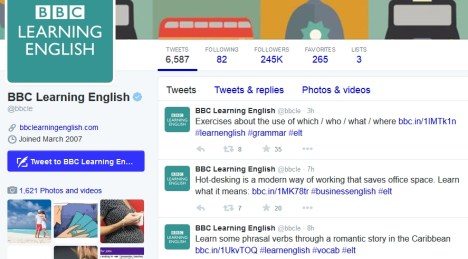
BBC LE
Eryk Bagshaw’s article “Social media is teaching the world English1 about using social media to offer “snack-size” English language lessons gave me some ideas about how to do this. This Australian initiative has found that users respond positively when offered small bits of English – a few idioms, a few uses of modal verbs, difficult spellings, etc. Bagshaw says, “It is all about giving people context to hang that learned language on.” He also wrote about how the BBC uses Twitter to connect English learning and current events and mentioned that creating a community is a part of the service and part of the appeal of using social media in this way. “You can get instant feedback from other users a world away, they collaborate, correct, rework. That is how you learn and that is really exciting.”

As a teacher, I recognize the importance of building community among learners. Therefore, I intend to take what I learned from my experience in Albania and what I learned from Bagshaw’s article and think about how I can change my expectations about social media use for a group of students so that it functions as a more effective learning tool, as well as for community-building .

I would like to hear others experiences with using social media in learning environments. What has worked? What hasn’t?

__________
1Sydney Morning Herald, 26 June 2015.

Human Beings Could Be the Largest Untapped Resource in Online Learning

Jim ShimabukuroBy Jim Shimabukuro
Editor

Posted 7/28/15 at 10:17am; updated 11:46am

In the discussion on “MOOCs and Traditional Online Courses Are on a Collision Path,” Ray Rose (onlinelearningevangelist) and Harry Keller are having a fascinating exchange on the problem of captioning in MOOC videos. A cost-effective solution is autocaptioning, but the outlook at this time for developing an effective tool isn’t very good.

Their discussion fascinates in more ways than one. For example, it raises the issue of problem-solving in the online environment. What is the best approach?

For problems in technology, we naturally gravitate toward technological solutions, for example, a program that automatically translates speech to text and displays it as captions.

The cost for developing such a program, however, may be prohibitive, and the wide variation in human speech even within a single dialect makes the task extremely difficult.

But high tech problems don’t necessarily exclude low-tech solutions that are leveraged by technology. Put another way, the latest technology could generate innovative approaches that rely on old-fashioned human power, creating cost-effective solutions that blend the old with the new.

For example, Duke’s Sally Kornbluth,1 discussing the problem of formative evaluations in MOOCs, says, “If you’re wondering how you can possibly read 400,000 essays, you can have 400,000 students read one another’s essays.” Her point is that “there’s a lot of unexplored power that can be harnessed.” We just need to open our eyes to a much wider range of possibilities — and the possibilities could easily include human resources such as classmates empowered by networking technology.

The rap against peer feedback models, however, is that they’re unreliable, but ongoing research is proving that they can be and are being improved.

We have to keep in mind, though, that peer feedback is really just one of many other forms of evaluation provided by people other than teachers. For example, Sebastian Thrun,2 for his Udacity nanodegree on Android programming, takes the idea of peer evaluators and leverages it to include experts who aren’t part of the formal instructional staff. He has created a “network of 300 global code reviewers” who provide feedback to students.

The genius of this business model is that it’s self-sustaining while providing a profit for Udacity. Students pay $200 a month, reviewers’ pay is covered by this amount, students rate the quality of the feedback they receive, and reviewer income is determined by the evaluations they receive from students.

According to Thrun, “The best-earning global code reviewer makes more than 17,000 bucks a month. I compare this to the typical part-time teacher in the U.S. who teaches at a college — they make about $2,000 a month.”

This model could be applied to other problems (see Harry Keller’s comment) such as captioning. For example, MOOC developers could put out an international call for transcribers who are willing to provide captioning services. Since captions are aimed primarily at learners with disabilities, candidates could be volunteers or paid through philanthropic and public funds. A rating system could be attached to the videos, providing both student feedback on the quality of the captions and a means to control for quality.

The pool for captioners, when geographic location is factored out, is potentially huge. It could include high school and college students earning service credits, retirees, homebound adults, military personnel, and select prisoners.

We tend to think of technology as cold and impersonal, but it really doesn’t have to be. Technology could easily be a means to expand and deepen human interaction, providing a way for people to collaborate, one-on-one, with others.

__________
1George Anders, “The Believer: Duke’s Sally Kornbluth,” MIT Technology Review, 27 July 2015.
2Nanette Byrnes, “Uber for Education,” MIT Technology Review, 27 July 2015.

MOOCs and Traditional Online Courses Are on a Collision Path

Jim ShimabukuroBy Jim Shimabukuro
Editor

Updated 27 July 2015

In everyone’s bucket list, under the heading “Education,” is “Attend an elite college.” Until recently, however, this item has remained unchecked for the vast majority. According to Jonathan Wai, “Only about 2% to 5% of all US undergraduates went to … elite schools.”1

Thanks to MOOCs, the economic and scholastic barriers are going down. And thanks to Natalie Morin,2 students in the U.S. and the world over don’t have to look far for elite offerings. Among the 31 in her list are:

Harvard (“Science and Cooking; Tangible Things: Discovering History Through Artworks, Artifacts, Scientific Specimens; Poetry in America: The Civil War and Its Aftermath”); MIT (“Introduction to Computer Science and Programming; Circuits and Electronics; Molecular Biology; User Innovation: A Path to Entrepreneurship; Introductory Physics: Classical Mechanics”); Princeton (“Computer Architecture; Effective Altruism; Imagining Other Earths; Paradoxes of War; Reinventing the Piano; Bitcoin and Cryptocurrency Technology”);

Yale (“America’s Unwritten Constitution; Capital Punishment: Race, Poverty, & Disadvantage; Introduction to Classical Music; Moral Foundations of Politics”); Stanford (“Planning for a Sustainable Future with Wind, Water and the Sun; Behind and Beyond Big Data; Careers in Media Technology; Environmental Risk and Resilience; Online Certificate Program in Novel Writing; Adventures in Writing”); Columbia (“The Civil War and Reconstruction 1850-1861; The Civil War and Reconstruction 1861-1865; The Civil War and Reconstruction 1865-1890”); University of Pennsylvania (“An Introduction to Corporate Finance; The Global Business of Sports; Modern & Contemporary American Poetry; Introduction to Key Constitutional Concepts and Supreme Court Cases”);

University of Chicago (“Asset Pricing; Internet Giants; Global Warming; Understanding the Brain; Critical Issues in Urban Education”); Dartmouth (“Introduction to Italian Opera; Introduction to Environmental Science; The Engineering Structures Around Us”); Cornell (“The Ethics of Eating; American Capitalism: A History; The Computing Technology: Inside Your Smartphone; Introduction to Global Hospitality Management”);

Johns Hopkins (“Psychological First Aid; Confronting Gender Based Violence: Global Lessons with Case Studies from India; Major Depression in the Population: A Public Health Approach”); Northwestern (“Teaching the Violin and Viola: Creating a Healthy Foundation; Career 911: Your Future Job in Medicine and Healthcare; Understanding Media by Understanding Google”); Berkeley (“The Science of Happiness; Biology for Voters; Electronic Interfaces: Bridging the Physical and Digital Worlds”);

Wellesley (“Shakespeare: On the Page and in Performance; Introduction to Global Sociology; Was Alexander Great? The Life, Leadership and Legacies of History’s Greatest Warrior; Introduction to Human Evolution”); Georgetown (“The Divine Comedy: Dante’s Journey to Freedom; Globalization’s Winners and Losers: Challenges for Developed and Developing Countries; Terrorism and Counterterrorism”).

MOOCs are free and completely online, they’re open to everyone, and the registration process is simple. You’re free to plug in when and where you want for as long as you want, and if you decide to complete the course, you could earn a certificate. In some cases, a certificate requires a small fee.

Developers are beginning to design a second generation of MOOCs, or MOOC2, that can be taken for credit toward college degrees. For example, see “edX-ASU Global Freshman Academy: Will It Work?” As these evolve, the distinction between online courses locked into traditional structures and MOOCs will gradually disappear.

A key obstacle to the growth of MOOC2 has been pricing. MOOCs that cost as much as traditional onground courses are simply out of reach for nontraditional students who make up the bulk of participants. However, a recent trend toward drastically lowering the cost of traditional courses in completely online degree programs is underway at Texas Tech and other universities. A critical element in this business model is the removal of out-of-state tuition, the final barrier to the expansion of online programs.

MOOCs and traditional online courses are on a collision path, and the impact will change the face of higher education forever, obliterating the class and geographic barriers that have limited access to elite colleges. The promise of online, from the very beginning, has always been access, and here, in the middle of 2015, the promise is gaining traction.

Addendum 7/27/15: Read Ray Rose’s comment re learners with disabilities and the accessibility challenges they pose for MOOCs and online courses. Also see his Access and Equity for All Learners in Blended and Online Education, INACOL, Oct. 2014.

__________
1Frank Bruni Is Wrong About Ivy League Schools,” Quartz, 22 Mar. 2015.
231 Elite Colleges That Offer Free Online Learning,” Tucson.com, 23 July 2015.

Wearable Tech on Your Preschooler? Technology Education and Innovation for Children

By Stefanie Panke
Editor, Social Software in Education

Updated 7/29/15

Catherine Cook School just hosted the first annual IDEA:TE (Innovation, Design, Engineering and Art: Transforming Education) conference June 23-26. The School’s Director of Innovation, JD Pirtle, talks about best practices for encouraging teachers to integrate technology into everyday classroom practices.

Please explain the purpose and some of the highlights of the IDEA:TE conference.

JD Pirtle, Director of Innovation, Catherine Cook School

JD Pirtle, Director of Innovation, Catherine Cook School

The impetus behind the IDEA:TE Conference came after having dozens of conversations with educators at many other schools here in Chicago, and with educators nationwide. Many of these teachers, librarians, technology coordinators, and administrators had been tapped by their heads of school to create and staff “Maker” labs or innovation hubs. Not only did these educators lack the expertise necessary to run and maintain the many machines and opportunities that an innovation lab necessarily includes, they were struggling with creating engaging and effective curriculum utilizing emerging and traditional technology. In response to this, I initiated the IDEA:TE conference to provide hands-on workshops led by experts in a variety of disciplines, such as 3D printing, computer programming, and textile arts, who come from teaching backgrounds ranging from elementary schools to graduate school.

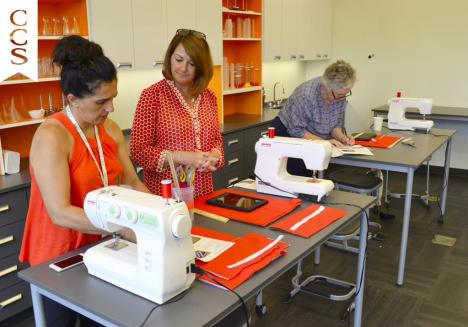
It was enthralling to see such a diverse group of educators learning together. Rather than sitting through days packed with lectures, attendees were actively involved. From making interactive, laser-cut Arduino powered tea-lights to hand-sewn laptop cases, these educators had intense, hands-on experiences that are replicable in their own classrooms.

Attendees at IDEA:TE create hand-sewn laptop cases in the textile arts workshop.

Attendees at IDEA:TE create hand-sewn laptop cases in the textile arts workshop.

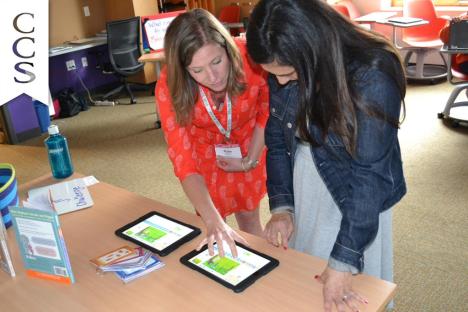
Workshop presenter and Catherine Cook 1st grade teacher Kate Herron demos ScratchJr for an IDEA:TE attendee.

A 3D printed ring designed by an IDEA:TE attendee.

A 3D printed ring designed by an IDEA:TE attendee.

From recording and editing music and audio, to sewing wearable technologies, and even creating furniture using laser cutters and 3D printers, Catherine Cook School integrates a diverse set of technologies. Can you share some best practices from different classrooms?

In our innovative work with students and faculty, we engage almost exclusively in project-based learning. There is no “tech time” or pulling students out of the classroom for tech class. Each aspect of Catherine Cook’s IDEA (Innovation, Design, Engineering, and Art) program, which begins in preschool, is woven into the curriculum and is cross-disciplinary.  Continue reading

Marie Mérouze

[Published 22 July 2017]

Marie Mérouze is the founder and CEO of Marbotic, an IoT startup focusing on the creating of connected devices for children. Marbotic has two flagship products: Smart Letters and Smart Numbers.

Marie has her Masters in Engineering from Ecole Centrale Paris, an engineering graduate institution. She worked at an E-Learning company for children for ten years before founding her own company.

Marie on Twitter: https://twitter.com/MarieMerouze
Marie on LinkedIn: https://fr.linkedin.com/in/mariemerouze

ETC Publications

3 Reasons Apps Foster Effective Learning

 Children Need More Than Apps in the Classroom

MOOCs Experiencing an Identity Crisis

Jim ShimabukuroBy Jim Shimabukuro
Editor

The University of Hong Kong,1 following the popular flip trend, is taking tentative first steps toward incorporating MOOCs into their on-campus courses. (See my earlier article on blended MOOCs.) Like its counterparts in the U.S., HKU’s MOOCs are closed for their on-campus students but simultaneously open for outsiders. In other words, they remain tethered to traditional courses for F2F students and free for distant students.

Noteworthy is HKU’s discovery that MOOC forums, unlike online forums attached to onground classes, “are extremely lively.” One of the professors attributes this disparity to the comfort of anonymity and is looking into extending the anonymity option to on-campus students.

Another explanation may be that F2F meetings simply render online forums moot. Off-campus MOOC students, lacking this option, turn to the forums for their sole means of interaction.

Yet another explanation is that the open end of MOOCs is disruptive, attracting a completely different population of students. For example, HKU MOOCs — dubbed HKUx to reflect its association with edX — attracted 10,000 to 12,000 “students from 173 countries,” and “more than 10 per cent were over 50 years old, and the median age was 29.” This population, although varying widely in characteristics, shares a common problem that sets them apart: They’re unable, for whatever reason, to attend F2F classes. For want of a better term, they are nontraditional students.

The implication is that HKUx and similar MOOCs are both closed and open at the same time, serving two distinct populations with very different purposes.

In the coming months and years, it’ll be interesting to see if HKUx professors will realize that, from the perspective of on-campus students, their MOOCs are essentially blended courses. It is only from the perspective of distant students that they appear to be MOOCs.

The fact that two very different populations can coexist in MOOCs opens up a lot of possibilities. First and foremost is that the success of MOOC practices for nontraditionals could gradually loosen the tether to F2F classes for traditionals, transforming blended courses into true MOOCs or, at the least, completely online courses. The primary obstacle to this scenario is the fear that interactions inevitably suffer in online forums. The success of HKU’s MOOC forums, however, belies this fear.

Another possibility is that tradition will outweigh the potential advantages of MOOCs and keep them anchored to on-campus classrooms, sustaining the blended model for who knows how long.

In the end, traditional students will probably tip the scale away from blended to MOOC when they realize that online learning is just as if not better than F2F for a number of reasons, including the freedom of anytime-anywhere engagement. When — and not if — this happens, the longstanding policy of withholding college credit for MOOC courses will be on the line.

__________
1Victor Wang, “How MOOCs helped University of Hong Kong apply e-learning tools on campus,” South China Morning Post, 20 July 2015.

International Students and the Need for LMS Orientations

Lynn ZimmermannBy Lynn Zimmerman
Associate Editor
Editor, Teacher Education

You may be familiar with US News & World Report’s (USNWR) best college rankings, a resource that many people use for basic information about universities and colleges in the US. Like many media outlets, USNWR has established a presence on the Internet and features a number of blogs for matters related to education. Among these is one that focuses on education and the international student, the International Student Counsel. This blog is aimed at international students and their parents and provides advice about many aspects of education in the US, such as things to look for when researching universities, choosing a major, passing the TOEFL, and how to pay for college.

A July 7, 2015, post on the International Student Counsel blog, “4 Academic Surprises for New International College Students,” discussed some of the adjustments that international students have to make when attending universities in the US. The first item suggests that students must get familiar with the university’s online system to help manage homework and course material. International students and technology is a topic that I covered on June 10, 2015 (“Technology Advice for First Year International Students in US Colleges“), and again on July 9, 2015 (“Technology Advice for First Year International Students in US Colleges“).

I think the topic of international students in the US is worth revisiting for two reasons. First, the fact that there is a blog devoted to these issues in a major media outlet demonstrates that there is an audience for this type of information. According to a November 17, 2014, post, the Number of International College Students Continues to Climb in the US, and they and their parents have a need to know what kinds of issues may arise. Second, I think this blog is a resource that educators in the US should be aware of. If you haven’t had any international students yet, you probably will at some point.

Many articles about international students focus on what the student needs to do to adjust, but as important is for American educators to think about how they can help make the transition easier for their students. Does the international relations orientation include information about the university’s Learning Management System (LMS) — not just instructions on how to log on but demonstrations on how most professors and students use it? Does the professor assume all the students will know where to find class information or does he or she inform students of the class expectations regarding LMS use?

A few simple steps taken by educators at the beginning of the semester can alert international students to questions that they may need to ask and prevent issues from arising.

Blended MOOCs, Online Remedial Courses, Nevada’s ESA

Jim ShimabukuroBy Jim Shimabukuro
Editor

At Indian Institute of Technology Bombay, three courses will be blended with MOOCs,1 adding yet another variation to the alphabet MOOCs — bMOOC.2 The MOOCs are required, and MOOC performance affects course grades. They’re adding flip into the mix by devoting interactive F2F class time to topics covered online. This innovation is in response to the shortage of qualified faculty in higher ed.

* * *

Community colleges devote huge chunks of their budget to remedial learning, and a sizable amount of the cost is in constructing and maintaining onground facilities such as learning centers, labs, classrooms, and staff offices. An alternative that may be long overdue is to shift remedial learning online via online courses and MOOCs. In a study last month, Furqan Nazeeri, Jared Moore, and Nathan Benjamin3 suggest that “Offering remedial courses online rather than on campus has the potential to provide time and cost savings” (p. 6).

This is just one of the implications they discuss. Their approach is interesting. They lump MOOCs into the larger category of online courses. This is both accurate and insightful. However, it’s a source of confusion throughout the report when it’s not clear whether the reference is to MOOCs or for-credit online courses or both.

Their division of online courses into four models — For-Credit, Research, Pre-Matriculation and Post-Graduation — is typical of the confusion. This scheme seems appropriate for MOOCs but not for online versions of traditional courses. Even for MOOCs, the categories are more inclusive than exclusive, blurring the distinctions. For this study, perhaps MOOCs and online courses based on traditional course parameters should have been treated as separate models.

* * *

Lance Izumi4 advocates “Nevada’s recently enacted nearly universal education savings account (ESA) program.” This is how it works: “For parents earning above the low-income level, the state will deposit funds totaling 90 percent of the average statewide support per pupil, or roughly $5,100, into an individual education savings account for each child.” The amount rises to 100 percent and $5,700 for low-income parents. “Parents can withdraw funds from their ESAs to pay for a variety of educational services, such as private school tuition, distance-learning online programs, and tutoring.”

Sounds like a good idea, until it smacks into the brick wall of reality, in this case, the high cost of private schools.5 Still, with wise management, diligence, and luck, parents could find affordable alternative schools or even home-school their children with the money.

Considering the rest of the nation, Nevada’s $5,700 cost per pupil figure seems low. According to Allie Bidwell, “Nationwide, states spent an average of $10,667 per student in the 2011-12 school year – a 2.8 percent drop from the $10,975 they spent in 2010-11, according to a report from the National Center for Education Statistics.”6

__________
1Rozelle Laha, “IITs, IIMs use technology to fight faculty crisis,” Hindustan Times, 15 July 2015.
2Not to be confused with the Barcelona School Bmooc, a business training platform.
3A Framework for Online Learning Revenue Models at Universities: Research and Opportunities, ExtensionEngine, June 2015.
4Why Your State Should Copy Nevada’s School Choice Plan,” Heartland, 7 July 2015.
5Geoff Williams, “Can I Afford to Send My Child to Private School?U.S. News, 3 Feb. 2015.
6How States Are Spending Money in Education,” U.S. News, 29 Jan. 2015.

Chat Rooms, Emoji, ELLs, ABCmouse

lynnz_col2
Chat rooms can boost success in learning English as a foreign language research shows” from phys.org, 7 July 2015.

This article reviews a newly published book1 which focuses on a research project conducted in the UAE. Ten female students were tracked for one semester as they engaged in conversations with native speakers of English in a chat room setting. The researchers found that the students developed speaking, writing and vocabulary skills. They identified one cause as “the relatively risk-free context of real time but not face-to-face interaction” provided by the technology.

Who needs words when you have an emoji?” by Finnian Curran in The Irish Times, 2 July 2015.

Curran asks: With clear evidence that more and more people are using the minuscule symbols, what does it mean for the future of the English language and should we be worried?

He cites several research studies and scholars who have examined the use of emojis, research which supports how they accompany language and also cultural differences in their usage. He also confirms that he sees no cause for worry.

Effectively incorporating technology with English learners” by Erick Hermann in Multibriefs: Exclusive, 11 June 2015.

Hermann identifies issues that arise when schools and school districts make decisions about expenditures for technology for the upcoming school year and the impact technology has on English Language Learners (ELLs). He points out that while good practice should be behind all such choices and purchases, the specific needs of ELLs who require additional instructional supports, such as various visual aids and redundant information, must be addressed.

Mobile app helps Chinese kids learn English” from Phys.org, 23 June 2015.

Many parents in China want their children to start learning English as early as possible. The ABCmouse English Language Learning app, designed for 3-8 year olds, was developed with very young language learners in mind.

__________
1Rahma Al-Mahrooqi & Salah Troudi, eds., Using Technology in Foreign Language Teaching, Cambridge Scholars Publishing, 10 Jan. 2014.

Social Media in TESOL: An Interview with John Wasko

Lynn ZimmermannBy Lynn Zimmerman
Associate Editor
Editor, Teacher Education

[Note: This interview was prompted by an email, sent by John to Lynn, re her article “Technology Advice for First Year International Students in US Colleges. -Editor]

John Wasko, a former Peace Corps volunteer in Samoa, is president of American Pacific University in Pago Pago, American Samoa. Part of the university’s mission is to help foreign students develop academic English language skills and cultural competence so they can successfully complete study at colleges and universities in the US. Mr. Wasko commented that “too many foreign students come to the US unprepared to face an American classroom.” A commitment to using “21st century digital learning tools and resources” helps students accomplish their language and cultural competencies.

John Wasko

John Wasko

LZ: What are some of the social media online resources you use that have been effective?

JW: The most popular chat rooms in Asia and Southeast Asia are Wechat, QQ and IMO. I use them all to teach the kids English. First, they have automatic translators built in. Secondly you can share audio files for pronunciation. Third they have live video chat. You can talk and see the student in real time. Fourth they work great on mobile. There are even more chat sites specific to different countries. Zalo, for example is specific to Vietnam.

LZ: How do you use these resources in your teaching?

JW: I am now improving my teaching strategies by developing text modules and practical scenarios. Each builds on others to develop more complex sentence structures, vocabulary, contextual speech, jargon and slang. Using Google images in concert with text and audio messaging helps a lot and can be done on the fly.

LZ: Is there anything else you’d like to say?

JW: Here is the great thing. You don’t need any special set up or call center or anything like that. Just a smartphone. I use an iPhone 4. Works great. If we can develop mobile techniques to help these students, every university will knock on their door.

LZ: Thanks.