Martian Rhapsody: Chapter 2 – Rocks

[Note: See chapter 1, Landing. Also see Harry’s Mars One: Exciting Adventure or Hoax?, especially the long-running, extended discussion at the end of the article. See his other Mars related articles in his list of publications. Chapter 2 is being published as submitted, without editing by ETCJ. -Editor]

Martian Rhapsody
by Harry E. Keller, PhD

CHAPTER 2
Rocks

The four hopeful settlers stare open-eyed at the vista that confronts them. Mars stares back, red-faced and malevolent. They discern nothing friendly or helpful in that stare. Some might see indifference, but they’d be wrong. If ever mankind faced evil, it is here in this impossibly alien and lifeless environment.

Even the dark, sharp-edged rocks strewn across the landscape with apparent reckless abandon seem infused with baleful intent, waiting patiently for countless eons for these soft Earthlings, waiting to cut them and trip them. The surface between the rocks is red, not the red of a poppy or even an Earth sunset, but an intense red that fills the land with emanations of harm. Despite the extreme thinness of the atmosphere, the strangely close horizon does not immediately and sharply turn to the black of space as on the Moon. The red dust of Mars hangs in the sparse air and softens the horizon just enough to give the appearance of red sand reaching up, an almost living thing.

As if sensing the planet’s personality, Chun speaks up, “We have to get that module back so we’re at full strength.”

“You bet!” responds Dawit excitedly, pumping his fist. He is undaunted by the landscape or the problem of the errant module.

“Sure,” says Aleka, “but first we have to put our habitat together.”

“Sorry,” says Chun as she moves into position.

“We all feel the same. All right, we’ve practiced this plenty of times,” says Aleka.

“Seems like thousands,” responds Dawit with a gesture none of the others can see because he’s inside.

“We don’t have all that long before our suits have to be recharged,” warns Balu.

“Right. Let’s rotate and connect,” says Aleka.

“Good thing that missing module connects at the end,” comments Chun.

“The rovers have done a nice job of clearing the site and putting the modules in place,” says Balu.

“I cannot wait to get a plan for the missing module,” comments Dawit over their intercom. Everything is an exciting adventure for Dawit.

Continue reading

What Does Cyberlearning Mean to You? Cyberlearning Summit 2014

By Bonnie Bracey Sutton
Associate Editor

(Note: See Vic Sutton’s report on this conference. -Editor)

Teachers working in classrooms need ideas and frameworks and support for initiatives beyond the ideas that have been classified as regular education. Sometimes funding is a problem. Powerful partners get you permission to do wonderful things in the classroom.

My first involvement with a network of powerful people, learning ideas and new technologies was with Cilt. You can tell that it was some time ago. We called STEM, SMET. Here is a look at what we started with:

bonnie 062514 01

We investigated, learned, shared and promoted ideas. Concord has wonderful free resources to share, and here is a summary:

The Center for Innovative Learning Technologies (CILT) was founded in October 1997 with a grant from the National Science Foundation (NSF) to stimulate the development and study of important, technology-enabled solutions to critical problems in K-14 science, mathematics, engineering, and technology (SMET) learning. Four “theme teams” focused the efforts in areas of highest promise. CILT events, often workshops organized by theme, provided a collaborative forum in which people in the learning science community met to assess the progress of the field, define research agendas, and initiate new collaborations. Many of these collaborations form seed grants funded by CILT. In addition to these successful CILT programs, CILT has generated many resources for the learning science community, including tools, publications, and NetCourses.

In this day and time, people sometimes do not think that meeting people and sharing in conferences is necessary. But the leaders of Cyberinfrastructure have better ideas. They do a conference and put the ideas online. You have a choice. There are pieces of brilliant ideas, presentations and demonstrations, and even poster sessions for you online.  Continue reading

Cyberlearning Summit 2014: A Quick Recap

VicSutton80By Vic Sutton

[Note: See Bonnie Bracey Sutton’s report. -Editor]

There is reportedly a wealth of research being conducted unto cyberlearning, but there are no clear views about how to translate research results into action in the community context, in particular for schools or informal education.

This emerged from the recent Cyberlearning Summit held in Madison, Wisconsin, on 9-10 June 2014, which brought together some 200 participants — mostly academics, plus some educators, industry representatives and grant makers — to highlight “advances in the design of technology-mediated learning environments, how people learn with technology, and how to use cyberlearning technologies to effectively shed light on learning.”

Bonnie's photos

There was no discussion about quite what cyberlearning is, but it appears to be a fancy name for on-line learning.

The meeting was organized by the Center for Innovative Research in Cyberlearning (CIRCL), funded by the National Science Foundation (NSF), and featured a number of eminently qualified speakers.

Yasmin Kafai, from the University of Pennsylvania, reminded participants of the remark by the late Steve Jobs that “everybody in this country should learn to program a computer, because it teaches you how to think.”  Continue reading

Social Media Tips for Virtual Conference Attendance

By Melissa A. Venable

[Note: Jessica Knott, ETCJ’s Twitter/Facebook editor, has coordinated the publication of this article. -Editor]

Last month The Sloan Consortium’s 7th Emerging Technologies for Online Learning took place in Dallas, Texas. According to the latest Sloan-C View newsletter, there were “more than 700 onsite and 1,000 virtual attendees representing 47 states including DC and 23 countries.”

Saint Leo University provided virtual access to a limited number of instructors, including adjuncts like myself. In my formal request to attend, I made a commitment to “be active on multiple social media platforms and use the symposium hashtag – #et4online – to further engage in live sessions and network with other attendees.” I was fortunate to be selected to attend, and it was this social media commitment that made all the difference in my experience.

Recorded sessions are helpful but don’t provide the energy and interaction of real-time attendance. And there is a lot to be gained from following the social media backchannel of a conference, but formal registration allows for a different level of access to the sessions and other attendees. This article includes a few of my lessons learned as a virtual conference participant.

Prepare to Participate

Are your social media accounts up-to-date? This may be the best place to start. Take a look at the platforms that are being encouraged by the conference organizers and review your profiles before the event starts. If it has been a while since you logged in to an account, it could take some time to review and refresh the information you are providing about yourself. Keep in mind that these profiles serve as your business card in an online networking sense.

Follow the conference itself and the sponsoring organization. In addition to the conference hashtag, this Sloan Consortium event was also active with social media accounts focused specifically on this conference, including Twitter and Facebook. These accounts provided a constant stream of reminders, letting participants know about upcoming sessions, highlighting participants and presenters, and announcing schedule changes.

Set Realistic Expectations

The Sloan symposium offered fewer streamed sessions than onsite sessions, but there were multiple presentation options for each time slot. The streamed sessions took place in Dallas with a live audience and allowed virtual attendees to watch both the presenter and his or her slide presentation simultaneously. Members of the online group were able to interact with each other via text chat and ask questions of the presenter through an online session chairperson who relayed them in real-time. We also connected and exchanged thoughts and resources through our social media accounts.

Take a look at your schedule for the week and identify, in advance, the sessions you would like to attend. Add these sessions to your calendar. I was tripped up when logging into my first session (an hour early), before I realized I needed to calculate time zone differences. The website mentioned this, of course, but sometimes you have to learn on your own, and I instantly connected with other virtual attendees on Twitter who made the same mistake.  Continue reading

Mars: One-Way or Round-Trip?

picture of Harry KellerBy Harry Keller
Editor, Science Education

[Note: This is part of Harry’s series on Mars, which began with “Mars One: Exciting Adventure or Hoax?” (4/8/13). As of 12/8/13, the discussion is still very active and has grown to 585 responses. Many of the comments are of article length, and the breadth and depth of information and participation make the discussion just as if not more valuable than the original article. The article has been tweeted 38 times and mentioned in 284 Facebook posts, and these figures are growing by the day -Editor.]

Mars is in the news again.1 And again. It seems that everyone is going crazy over Mars. The problems of getting to Mars are many and difficult, but that’s not stopping plenty of people from making plans and issuing press releases.

Skylark series

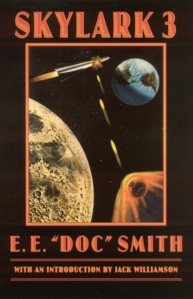
When I think back to my youth, I recall reading my first science fiction novel in a small local library after school in 1953. It was E. E. (Doc) Smith’s story of space travel, one of the Skylark series. At that time, no one had even put a tiny object into orbit.

A mere four years later, Sputnik I was launched, and the world entered the space age for real. Rockets to space were no longer science fiction. The next year, 1958, the United States put Explorer 1 in orbit. It weighed about 31 pounds. Dwight Eisenhower was president then. We were in the middle of the Cold War, and Nikita Kruschev was in charge of the Soviet Union. Both his picture and that of Sputnik I were on the cover of Time magazine the previous year. Indeed, if memory serves, he was the “Man of the Year.”Kruschev and Sputnik cover

No one knew how much payload could be put into space. No one knew the effects of prolonged weightlessness on people. The Van Allen radiation belts were discovered and verified by Explorer 1 and Explorer 3 in 1958, raising the issue of radiation in space.

Despite the lack of experience in putting satellites in orbit and the great uncertainties in putting a human in space, the United States not only put men into space but even put them on the Moon just eleven years later. ELEVEN YEARS! Starting from a tiny satellite in orbit, a lunar landing module weighing over 1,000 times as much and holding two people landed on the Moon in that short time.

Those who say that we can’t put people on Mars in 10-15 years don’t remember the magic decade of the 1960s. You have to watch out when you use that word, “can’t.” The Mars Direct program was proposed in the 1970s and was to have people on Mars by 2000. That didn’t happen, and technology has advanced enormously since then. It’s more possible today, and it’s still a very tall undertaking.  Continue reading

Proposal for a Holistic Emphasis in K-12

Bob Hoffmann80aBy Bob Hoffmann*

[Note: This article was written in response to Harry Keller’s “Acronym in Cheek: STEM, STEAM…” (11/11/13). -Editor]

Thanks for your insightful article.

This exact question was presented as New Business Item (NBI) #43 to the delegates of the National Education Association (NEA) Representative Assembly (RA) in terms of “ways to integrate the arts into STEM.” The Vocational, Career, and Technical Educators’ Caucus (of which I am a past-chair) looked into the claims by supporters of the “Put the Arts into STEM” (STEAM) initiative and found that the motion would give an NEA endorsement to massive changes in our courses. We organized an effective response, which defeated the motion among the 9000+ delegates.

The STEAM Initiative advocates claimed that “art is used everywhere in STEM,” from the Fibonacci series in math and nature to the “Harmony of the Spheres” of the solar system orbits, from design in architecture to the “form factor of the iPad in your hands.” We should certainly recognize that this is true in specific historical cases, yet our challenge now is to encourage similar innovations from our students, keeping in mind that such grand new ideas are the exception, not the rule.

The maker of the proposal, Mr. Tom McLaughlin, identified the source of many of their arguments for STEAM as a book by Robert S. and Michele M. Root-Bernstein titled Sparks of Genius: The Thirteen Thinking Tools of the World’s Most Creative People. While the authors clearly support the integration of creative thinking skills with the arts, the inverse does not seem to hold — that students must learn the arts to become creative thinkers.  Continue reading

The Symbiosis of College and Massive Open Online Courses (MOOCs)

kenji mori80ABy Kenji Mori
Student at Kapi’olani Community College
University of Hawai’i

Information Technology has great potential for education. As one college student says, “It allows for a plethora of knowledge to be shared, as well as content that is created by other users to reach a wider audience than would ordinary [SIC] be possible” (Taylor). In recent years, Massive Open Online Courses (MOOCs) have taken advantage of this in order to offer free courses over the Internet. Unlike most online college classes, these courses allow tens or even hundreds of thousands of students around the globe to widen their knowledge. MOOCs have much to offer students. The integration of MOOCs in college courses will lead to a better learning experience.

Recently, when I was introduced to the concept of MOOCs, I created an account on Udacity and edX – two of the leading providers of MOOC content. My eyes lit up as I found courses not only on introductory level subjects but also on more advanced topics such as artificial intelligence and cryptography. These courses are offered by top universities such as Harvard and MIT and conducted by world-renowned professors.

MOOCs generally follow the format of a series of video lectures interspersed with quizzes. They do not derive most of their appeal from the use of innovation. After all, they are not far different from the lectures we see in today’s classrooms. Rather, they are revolutionary in that they make education available in a way thus unprecedented. Free, quality education is being made available to all. According to one national poll, about half of the families in the United States cannot afford college (Allebrand). For them, MOOCs are a godsend. For graduates, MOOCs give the opportunity to become life-long learners. Even for college students, there is much to gain.  Continue reading

The Finnish Education System May Not Be the Answer to Our Woes

Jim ShimabukuroBy Jim Shimabukuro
Editor

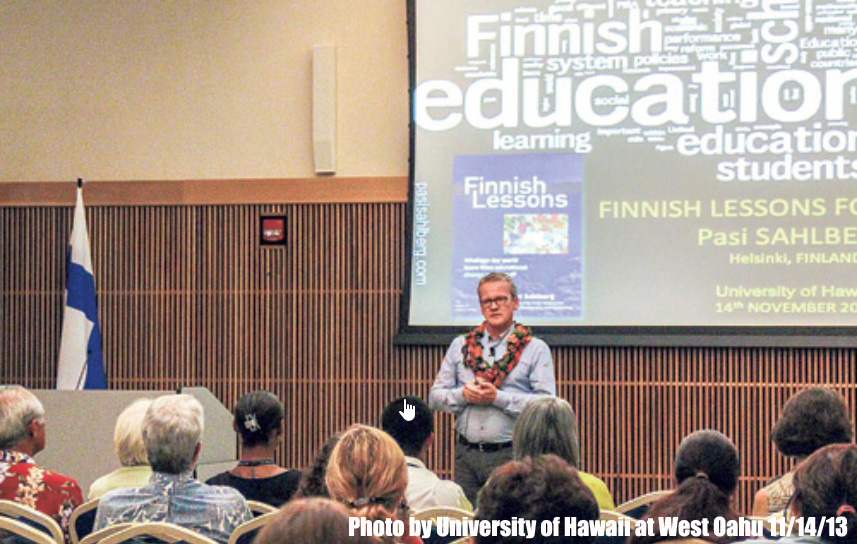
Pasi Sahlberg1 talked about the Finnish comprehensive public education system at the University of Hawaii at West Oahu on 14 November 2013 (Essoyan2). The system ranks among the highest in the world in PISA (Programme for International Student Assessment) and other international tests. It is free for students from preschool through higher education and is considered a model for the rest of the world.

Pasi Sahlberg at the University of Hawaii at West Oahu on 11/14/13.

Pasi Sahlberg at the University of Hawaii at West Oahu on 11/14/13.

Features of the system have been widely covered for years3, so I won’t go into them. What’s worth highlighting in Sahlberg’s talk at West Oahu, however, is his caveat that “‘what works in Finland doesn’t necessarily work someplace else.'” In other words, we can’t and shouldn’t simply port Finnish practices over to the U.S. and hope for the same results.

Sahlberg presented “slides showing that the more unequal the distribution of wealth in a country, the lower the test scores tend to be.” The United States, he said, “has high inequality and relatively low academic performance, while the reverse is true for Finland.” According to Sahlberg, the U.S. is “‘one of the most unequal countries in the developed world. There is a big gap between those who have and don’t have.'” He characterized Finland as a lot more egalitarian. “‘Somehow,'” he said, “‘the equity and excellence go hand in hand'” (Essoyan).  Continue reading

Can America’s Wasted Talent Be Harnessed Through the Power of Internet Based Learning?

Jim_Riggs80By Jim Riggs
Professor, Advanced Studies in Education
College of Education
CSU Stanislaus
President Emeritus, Columbia College (1997-2007)

For nearly 150 years, the American dream of a better life of economic success and advancement has been found largely through the narrow path of higher education. However, access to traditional higher education has always been limited to the top one-third of the adult population and by all indications will continue to be rationed at this level or less into the foreseeable future. Peter Smith, in his 2010 book, Harnessing America’s Wasted Talent: A New Ecology of Learning, points out that while traditional higher education will continue to serve this segment of the population, educational leaders must find alternative ways that will effectively meet the postsecondary education needs of a much larger segment of the adult population.

Smith is not alone in this thinking. There have been numerous reports in recent years that have also called for greater access, flexibility, credit portability and increasing degree completion for a much larger percentage of the adult population. In addition, many of these reports place a special emphasis on closing the growing achievement gap, which is increasingly leaving Latinos and African-Americans behind other groups when it comes to earning college degrees. Why is this important? There is a strong and growing consensus among policy makers, educators, economists and scholars that, if this country is to remain an economic superpower, a much larger and more diverse segment of the adult population must be better educated.

America’s current workforce is aging and retiring, and 85% of all new jobs now require some college education. A real crisis is rapidly developing  — America is finding itself with an escalating gap between the increasingly sophisticated workforce skill demands of the new economy and what the average American worker has to offer. In a 2011 report, The Undereducated American, Georgetown University professors Anthony Carnevale and Stephen Rose provide a strong argument that America will need a dramatic increase in the number of individuals with college degrees within the next decade. This increase in college graduates, according to Carnevale and Rose, is not only needed to help sustain the nation’s economic growth but will also help reverse the 30 year trend of growth in income inequity.

However, with the downturn in the economy over the past six years, we are once again reminded that a college degree alone is not a complete guarantee against economic challenges or underemployment. Economic growth and viability cannot solely depend on education. Nonetheless, according to the Bureau of Labor Statistics, the greatest predictor of personal income and employability for Americans still is, and will continue to be, their level of educational attainment.  Continue reading

‘Hacking the Academy’ – Intimate Conversations with Voices at the Edge

By Jessica Knott
Associate Editor
Editor, Twitter

Much like the tone of ETC Journal, the collection of articles compiled in Hacking the Academy does not comprise the most rigorously edited academic prose. The writing is often conversational, rarely dense, and I found this to be one of its greatest strengths. I felt as though these academics were sharing private ruminations, not writing manifestos. From the moment on page seven I read Tad Suiter’s definition of a hacker as being “a person who looks at systemic knowledge structures and learns about them from making or doing,” I was hooked. So much of what we do in online education (indeed, education in general) is “hacked,” whether we acknowledge it or not. I believe the greatest value this collection provides is fodder for debate: in a time where “the academy” is equally immovable and in flux, are we doing enough to challenge ourselves and each other as we work within its virtual, tangible walls?

Hacking A2In a chapter on Unconferences, Watrall, Calder, and Boggs discuss the hidden costs and challenges of organizing a “for the people, by the people” type of conference. As a matter of full disclosure, I have attended Great Lakes THATCamp twice. It feels, by far, more like a true academic conference than an unconference. If you are considering attending or planning an Unconference, I encourage you to heed Watrall’s advice regarding planning. In this particular instance I can tell you that what he writes truly translates to an experience that surpasses expectation.

In this vein, separate from the overall conference planning, I encourage readers to pay close heed to Calder’s urging toward self-preparedness: “The best thing about an unconference is that professionals are able to come together and discuss real issues face to face… your input could be the difference between moving someone else’s project forward – perhaps in ways they never expected” (135). This, the perspective of the prepared other, planning to present or not, is a refreshing one. Follow Watrall on Twitter at @captain_primate, and Boggs at @clioweb.  Continue reading

‘Hacking the Academy’ – A Test of Time

Jim ShimabukuroBy Jim Shimabukuro
Editor

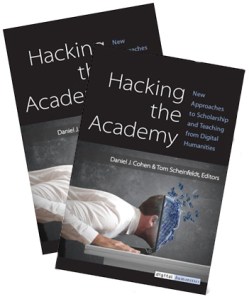
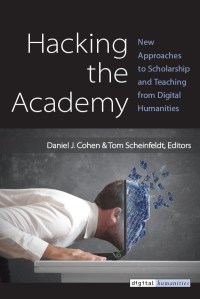
The first thing you should know about Hacking the Academy: New Approaches to Scholarship and Teaching from Digital Humanities (Daniel J. Cohen and Tom Scheinfeldt, editors, University of Michigan Press, 2013) is that it was compiled in May 2010 — three years ago. I’m not sure what the full implications of this time gap are, but for starters, the iPad was released in April 2010, a month earlier, so it’s not mentioned in the book. The first MOOC was offered by the University of Manitoba in 2008, but they didn’t become wildly popular until 2012 so they, too, are left out.

Once past the hurdle of the three-year gap, I found the offerings interesting both as a retrospective and as a time-tested compass for change. Change is so rapid in ed tech that the concept of “past” is becoming more a blur than a time line. Thus, I found myself intrigued by this slice of time that preserves some of the more progressive thinking three years ago, including insights that are still relevant today.

Hacking the Academy

I received the UM Press announcement for Hacking early yesterday morning and requested a digital review copy later that morning. After downloading it, I did a quick search for “iPad” and “MOOC” and, as expected, came up empty.

An “online and open-access version” of the book was released on 8 Sep. 2011 (Jason B. Jones, “Hacking the Academy: the Book,” Chronicle, 9.9.11), but I was unaware of it until today. Andrew Tully, in his University of Nebraska – Lincoln blog (4.18.12), provides a useful overview of the project so I won’t go into it.

I like the twist that the project has given to the word “hacking.” In “Why ‘Hacking’?”, Tad Suiter says, “Hackers are autodidacts,” and he defines hacking as “The clever gaming of complex systems to produce an unprecedented result.” But here’s the part that makes it very special even, and perhaps moreso, today: “The academy, ultimately, can only be invigorated and improved by an infusion of the hacker ethos that goes beyond the computer  science departments and infects all the disciplines.” Suiter’s point is that the hacker is us, the teachers in the disciplines, in the classrooms. Adam Turner, in “Hacker Spaces as Scholarly Spaces,” amplifies Suiter’s point. He says, “Hacking is about doing: creating, thinking, questioning, observing, learning, and teaching. The core of academic work is, at its heart, hacking.” The implications of teacher as hacker are as fresh today as they were in 2010.  Continue reading

Congressman Miller’s Tech Legislation Misses the Mark

Frank B. WithrowBy Frank B. Withrow

While I am delighted that Congressman George Miller has introduced new technology legislation*, it has weaknesses as I read it. All of the items are worthwhile, but in my opinion they are not the central issues. We need leaders who have insight and a new vision of what the digital world is bringing us. Already five year olds are iPad literate. How will schools treat these new five year olds and how will we bridge the gap between the digital home and the non-digital home?

Congressman George Miller, senior Democrat of the House Education and Workforce Committee and chairman of the Democratic Policy Committee.

Congressman George Miller, senior Democrat of the House Education and Workforce Committee and chairman of the Democratic Policy Committee.

Just as fifty years ago broadcast television forced schools to acknowledge Sesame Street, Mister Rogers Neighborhood and other television influences, today we must adjust to iPad home users. To meet these challenges there must be:

  1. An Assistant Secretary for Technology and Information sciences in U.S. DOE that provides national leadership.
  2. A staff-training program for both teachers and administrators that rebuilds the staff to use the new digital resources.
  3. A national digital library accessible via cloud technologies. The library should contain both commercial and government developed video, computer programs and ebook materials. Users must be able to access it 24/7 year round.
  4. A research and development program that creates new materials modeled after comprehensive multiple media products such as The Voyage of the Mimi.
  5. A digital assessment system for all materials used to reach the common core curriculum.
  6. A public awareness program that provides the public with knowledge about the changes in schools and the importance of these new learning and teaching tools and how they are used both in the home and classroom. The little red school house with the all knowing teacher is obsolete.
  7. A training program for administrators and school boards to understand a digital year round school model.
  8. A wide range of very different experiences in schools, including laboratories, camp experiences (space camp, for example), team building projects, and community experiences. The digital world opens the world as a resource for learning.

Change will take place. It will be nice if our leadership has the wisdom to understand the digital world and how important it is to be a leader rather than a follower. We need radical rethinking, not tinkering with the obsolete current educational model.

These changes will take place regardless of whether or not we provide national leadership because the technology is here. The question is whether we will have wise enough leadership with a systematic vision that guides these Earth-shattering changes. If we are wise, we will guide the radical shifts from the old model to the new model of learning and teaching.

Every child deserves the best education we, the people, can give. It is up to us to make it happen.
__________
* Webcitation alternative.

‘The Shallows’ – The Web Is Changing Our Brains

Lynn ZimmermannBy Lynn Zimmerman
Associate Editor
Editor, Teacher Education

The Shallows: What the Internet Is Doing to Our Brains by Nicholas Carr is one of the books we are considering for the One Book program at Purdue University Calumet. Our criteria for the selected book are loose. It has to have fairly broad appeal. It should spark discussion. It should lend itself to a variety of programming activities so that reading the book becomes a campus-wide event, not just a classroom activity. When the selection committee meets to decide, Carr’s book will be one of my top recommendations.

Nicholas Carr

Nicholas Carr

Because The Shallows is about a timely topic, one that students and faculty alike are interested in, it will have broad appeal. The book is also relevant for a wide range of disciplines, psychology, philosophy, history, communication studies, and computer science to name a few. From Socrates to current learning theory, Carr looks at how the medium of transmitting information is as important as the message (McLuhan, 1964) and how the medium shapes and influences our cognitive processes and our worldview. Carr contends that the brain actually changes and adapts to these different media so that we not only cognitively process things differently but our brain physically makes space for and handles informational transmission differently.  Continue reading

Babson 2013 Online Education Survey Report Released

Jim ShimabukuroBy Jim Shimabukuro
Editor

I. Elaine Allen and Jeff Seaman, co-directors of The Babson Survey Research Group, Babson College, MA, announced this morning the release of their 2013 report, Changing Course: Ten Years of Tracking Online Education in the United States.

The authors describe their tenth annual survey as an independent and “collaborative effort between the Babson Survey Research Group and the College Board” that is generously supported by Pearson and the Sloan Consortium.

In their announcement, they include some highlights:

  • Over 6.7 million students were taking at least one online course during the fall 2011 term, an increase of 570,000 students over the previous year.
  • Thirty-two percent of higher education students now take at least one course online.
  • Seventy-seven percent of academic leaders rate the learning outcomes in online education as the same or superior to those in face-to-face.
  • Only 30.2 percent of chief academic officers believe that their faculty accept the value and legitimacy of online education — a rate that is lower than recorded in 2004.

After their 2011 report, I published a review, “Sloan-C’s Definition of ‘Online Course’ May Be Out of Sync with Reality” (22 Jan. 2012), in which I questioned the survey’s definition of “online course,” which, in my opinion, is impractical and ultimately self-defeating. The 2013 survey retains the same definition. The explanation also remains the same: “To ensure consistency the same definitions have been used for al[sic] ten years of these national reports.” Since the authors claim that their report is independent and that Sloan-C’s role is supportive, criticisms, if any, should be directed at Allen and Seaman. In their closing, they make this clear: “We welcome comments.  Please let us know how we can improve the reports at bsrg@babson.edu.”

Internet English, NSF’s Cyberlearning, Trace Effects 3D, STEM and Minorities

lynnz_col2

Learn English online: How the internet is changing language by Jane O’Brien BBC News Magazine, 12.13.12
O’Brien reports that English will continue to dominate Internet use but because many of the users are non-native speakers, the way English is used is quickly evolving. She cites examples of Spanglish (Spanish + Englihs), Hinglish (Hindi+English) , and Konglish (Korean + English) that are developing forms and vocabularies much in the way pidgins, such as Creole, developed over time.

Federal Effort Aims to Transform Learning Technologies by Sean Cavanagh in Education Week, 1.3.13
The National Science Foundation’s fairly new program, Cyberlearning: Transforming Education, is designed to support research on advanced learning technologies. The purpose is to link scientific theories of learning with technology to “spawn myriad new technologies and ideas, rather than any single product.” Promoting mobile access and integrating a student’s learning experiences through dashboards are just two of the ideas that are being explored.

A Video Game to Improve Your English from Times of Malta.com, 12.30.12
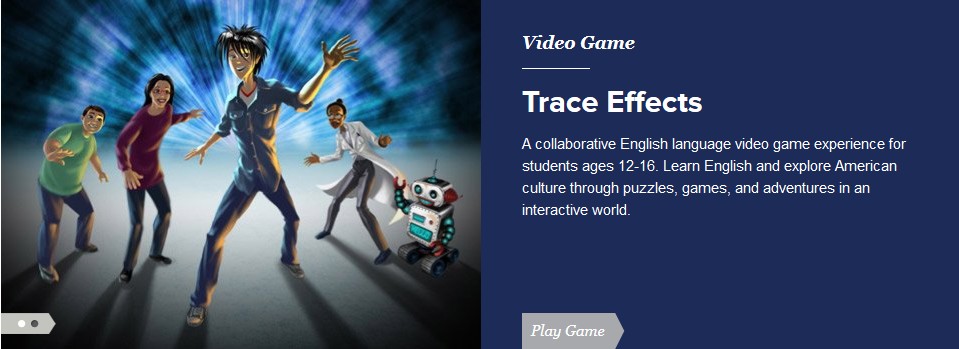
Trace Effects 3D is the latest offering from US Department of State’s Bureau of Educational and Cultural Affairs to help students learn English and about American culture. The Educational and Cultural Affairs website offers a wide range of materials and resources for students and teachers including webinar series, distance education programs and other interactive features.

Trace Effects

I watched the first episode of Trace Effects. It is set up in chapters and looks like a graphic novel. The voices are clear and talk slowly, and there is captioning so learners can read along. Once you finish a chapter there are tasks to perform, which require moving Trace (the main character) and having him interact with other characters.

Continue reading

Verbling, Touchscreens, Tablets, Smartphones etc.

lynnz_col2

Online Education Programs Tackle Student Cheating by Ryan Lytle from US News & World Report
Lytle reports on various issues involved in online courses such as cheating on tests and plagiarism. Representatives from several universities point out that these are not just issues in the online classroom and offer their suggestions for reducing the problems. Sometimes the solution means making a choice between academic integrity and access. A university student commented that she thinks the most effective way to avoid cheating and plagiarism is for faculty to “to take a hard stand against students who violate class policies.”

Students learn better with star trek-style touchscreen desks from PopSci
A three-year study from the UK shows that students using interactive technology developed better math skills than their peers who were taught using traditional methods. The results suggest that using touchscreen desks improves students’ critical thinking abilities.

Language Learning Service Verbling Launches Google Hangouts-Powered Classes, Adds Support For 9 New Languages by Rip Empson from Tech Crunch
Empson overviews the launch of Verbling, an online language learning website that pairs learners and native speakers for video chats.

How tablets are invading the classroom by Simon Hill from Digital Trends
Hill gives an overview of the various tablets and the trends in integrating them into the classroom. Digital textbooks and tests are just two of the trends he focuses on, as well as the growing number of users who have their own tablets. At the end of the article he asks readers to respond to the question of whether they are the answer for integrating technology into education and which seems to be the best fit.   Continue reading

Formative Assessment and Blended Learning, Texting, Bullying, MOOCs

Schools changing texting policies from eSchool News
Texting is one of the best ways to communicate with young people, but due to misconduct issues, many schools do not allow teachers and staff to communicate with students via texting. A school in Ohio sees the benefits of texting as a means of communication so is addressing the issue by sending home permission slips.

Addressing Bullying: Schoolwide Solutions by Nicole Yetter  from Education Week
This article reports on the 2011 “State of K-12 Cyberethics, Cybersafety, and Cybersecurity Curriculum in the United States” report published by the National Cyber Security Alliance and sponsored by Microsoft. This study found that schools needs to take a more active role in educating “students to be safe in today’s digitally connected age.”

Technology is not used effectively in schools is a report from The Information Daily.com
The National Endowment for Science, Technology, and the Arts (NESTA) in the UK has found that, despite schools spending millions of pounds on technology, it is not being used effectively. They found that teachers and pupils lack sufficient training in how to use technology as educational tools.

New frontier for scaling up online classes: credit by Justin Pope, AP Education Writer
MOOCs have opened up university courses to anyone who wants to take them. However, students do not receive university credit upon completion of these free courses. The sheer volume of students, grading, and concerns about cheating  are some of the issues that Pope explores.

Formative Assessment Is Foundational to Blended Learning by Michael Horn and Heather Staker from THE Journal
After explaining what formative assessment is – ongoing assessment – Horn and Staker look at the importance of formative assessment in the blended environment.  They assert that “formative assessment software appears to work best in blended learning environments if it helps students direct their own learning.”

Help Sandy Victims – Emergency Education Directory

Nov. 19, 2012
Hi Jim,

As the New York-New Jersey metropolitan area continues to struggle in the wake of Hurricane Sandy, it’s important to remember the far-reaching implications of putting life on hold in the middle of November. In New York City alone, over 75,000 students missed school last week, as 48 schools were left devastated by the storm and dozens were left without heat or power. Although not as urgent as providing housing, food, or fuel, those students’ educations must also be restored.

Photo from Huff Post 11.1.12

That’s why Noodle Education Inc., a New York-based education search provider, is setting up the Emergency Education Directory. Noodle will help connect students in the affected areas with volunteer educators willing to donate their time to teaching, tutoring, and guidance, as well as facilities with heat, power and resources to house displaced students and teachers for these sessions.

Supporting Noodle Education is the Education Industry Association (EIA), which represents and will help recruit more K-12 education companies to be listed on the Emergency Education Directory.

Already, Sandy has caused an estimated $50 billion in damages in the Northeast. A concerted effort by education providers will aid the recovery effort by helping students in the region stay on track with their schooling.

The more educators and students made aware of the Emergency Education Directory, the more effective the program will be. We think this issue would be of great interest to your readers and hope you will aid us in getting the word out.

Please let me know if you have any questions, or if I can connect you with Richard Katzman (rkatzman@noodle.org), Noodle’s point of contact on this matter. [Nov. 14 press release.]

Best,
Sylvie I. Calman
Account Executive
The Cutler Group
sylvie@cutlergrp.com

Flipped, Blended, Distracted

Schools provide teachers with the training tools for flipping the classroom by Wylie Wong from EdTech Magazine
In order for innovative ideas such as flipped classrooms to work, teachers and administrators have to understand how to use the technology as well as technology integration.

Is the technology ‘ready’ for blended learning? By Michael Horn from Forbes
Horn asserts that blended learning and technology have not caught up with one another. Different needs and different models contribute to the challenges.

To Make Blended Learning Work, Teachers Try Different Tactics By Katrina Schwartz
from MindShift
In another article about blended learning, Schwartz talks about how blended learning is often an attempt to use traditional teaching methods with new technology. Some teachers easily integrate technology into their lessons and their classrooms, while others have less success. Some teachers are overwhelmed by the new technologies while others thrive on the challenges it presents for taking leaning in different directions.

Teachers: Technology changing how students learn  by Matt Ritchel from The New York Times
Two independent studies with teacher participants, one by the Pew Research Center and the other by Common Sense Media, seem to show that while teachers think the Internet and other technology has had a positive impact on student research skills they are concerned that technology contributes to students’ short attention span and their ability to focus.

Teachers concerned about students’ online research skills  from eSchool News
In a slight contradiction of the New York Times report, this article, also reporting on the Pew Research Center project, says that while teachers think that student access to research tools is improved, they are not necessarily good consumers of what they find. There is so much information available that they can become easily distracted and lose focus.

Oakland Unified School District Uses GIS to Further Academic Achievement

By Jim Baumann
Esri Writer

Oakland, California, lies directly across the bay from San Francisco. During the California Gold Rush in the mid-eighteenth century, it served as the main staging point for miners and cargo traveling between the Bay Area and the Sierra foothills. Today, the city continues to serve as a major cargo terminus, and its seaport is the fourth busiest container port in the United States.

Due to the economic opportunities provided by the Gold Rush, the city was a destination for immigrants looking for greater prosperity. As a result of this and successive migrations, Oakland is now known for its ethnic diversity, with significant populations of African-American, Hispanic, Asian, and Caucasian residents. While valuable from a cultural perspective, this poses certain challenges for local government, particularly the Oakland Unified School District (OUSD), which must accommodate the diverse needs of its students, who speak more than 70 languages at home.

OUSD includes 61 elementary schools, 16 middle schools, 20 high schools, three K–8 schools, and one 6–12 school, as well as special education, independent studies, and early childhood education centers. It is the seventieth largest school district in the United States, and there are about 38,000 students in its K–12 programs. Chronic absenteeism is a major concern for the district, with nearly 40 percent of students in the East Oakland areas dropping out of high school before graduation. OUSD works with the Urban Strategies Council (USC), a nonprofit organization located in Oakland, to collect and analyze data related to school attendance and other social issues in the city.

Implementing a Community Data Portal with ArcGIS for Server

USC has used Esri‘s ArcGIS software for more than 20 years, applying it to a wide range of urban policy and reform initiatives affecting Alameda County, where Oakland is located, including health care services, affordable housing, violence prevention, education analysis, urban planning, disaster mitigation, and school absenteeism. It recently launched InfoAlamedaCounty Map Room, a free data portal that provides access to public datasets to the community for research, application development, civic engagement, and analysis.

Continue reading

The Latest Technologies Bump into Obsolete Laws

One of the marvelous things about the Internet is that it allows people to take courses anywhere anytime. While the Internet may give us that capability, the reality is that there are other issues that come into play. No, I am not talking about lack of Internet access or lack of infrastructure or resistance from instructors. I am referring to state laws and requirements about what can be taught in their state and how it can be taught.

A recent story on Planet Money at NPR brought this issue to light. In Warning to Minnesota Residents: Don’t Take Stanford Profs’ Free, Online Courses, Jacob Goldstein wrote about Coursera’s caveat to Minnesota residents that they cannot take the company’s free online classes except under very specific conditions, one of which is to complete most of the course outside of Minnesota.  A state department official said that part of the rationale for this 20-year-old law was to serve a consumer protection function for students.  In a response the day after this story appeared, the director of Minnesota’s Office of Higher Education said that the law obviously needs to be updated so that Minnesotans can take advantage of such free opportunities for lifelong learning.

One reason this piece caught my eye was that we have recently run into some related situations. Our graduate programs are going more and more online, and in order to increase enrollment, we want to go outside the state boundaries. However, it turns out that we have agreements with certain states and not with others. Recently we have had to turn away potential students from states with whom we don’t have agreements. I was surprised to learn that some states even require hefty (up to $1,000) fees to register your online course/program in their state.

It seems that possibilities offered by ever-changing technology are often hampered by challenges that are two steps behind where the technology is. Maybe the pace will never be equal, and maybe that’s not a bad thing altogether. It keeps everyone on their toes.

Education in the 21st Century: The World Is Our Classroom

Frank B. WithrowBy Frank B. Withrow

Several factors are acting on traditional education programs. Stringent budgets are limiting school options. Content is increasingly available in digital formats such as accessible video, computer lessons and even educational games. Core academic standards are available in content areas. Most important is that better digital management and assessment systems are becoming available. Home schooling has provided a model that can be expanded into a blended education environment.

When Don Bitzer developed the PLATO system, he dreamed that the learner could be assessed and then assigned appropriate learning materials to move his or her learning forward. Assessment materials would be available to measure the learner’s progress towards a desired level of achievement. This process could be repeated until the learner reached even a 100 percent proficiency. Today this dream is possible with core state standards and digital technologies that allow learning in the home, classroom or even workplace. Handheld media allows learning of content 24/7 year round.

In such a system the role of the teacher becomes more a tutor, a counselor, a mentor and a coach that guides the learner through the desired resources and provides the assessment needed to determine accomplishments by the learners.

Each learner will have an educational plan that they are working towards. Assessment systems will include tests, projects and products that are a part of the learner’s portfolio.

We are a mobile society, therefore each learner will have an education card that holds his or her records, accomplishments and portfolio of work. Much learning will take place in classrooms, but a large amount of content will be learned at home through libraries of lessons available anytime-anywhere in video formats, computer lessons and educational games. Team learning will be emphasized both in classrooms and through social media.

The school and community will become integrated. Education will become learner centric. School facilities will be laboratories where teams of learners work together to reach high levels of scientific achievements.

Children and families will be encouraged to contribute digital resources of their learning experiences on such things as family vacations or other significant family events.

Education in the 21st Century will be learner centric and more digital in nature with students bringing their own digital devices to the learning environment. The world is at our fingertips. We must be wise enough to use it.

AT&T’s Online Mentoring Academy: A Model for Public-Private Partnering

By Jessica Knott
Associate Editor
Editor, Twitter

AT&T recently announced a $350 million initiative designed to increase high school graduation rates and place at-risk students more firmly on the career track. The Aspire Mentoring Academy plans to fund three different types of mentoring, in many cases provided by AT&T’s employees, and encompassing job mentoring, skills mentoring and e-mentoring.*

Job mentors are AT&T employees, sharing their experiences via project-based activities. According to Kat Bockli, PR representative for AT&T, employees sign up through the Aspire Mentoring Academy internal website. They are then provided with preparatory materials and training. Most of the training is online, but AT&T also plans partnerships with non-profits such as Junior Achievement, We Teach Science and The LEAD Program. “As our organizations work together to increase U.S. high school graduation rates, giving students real-world learning experiences is key to showing them the importance of staying in school,” said Jack E. Kosakowski, president and chief executive officer of Junior Achievement USA(r). “By working with AT&T employees at Aspire Mentoring Academy, students understand how what they learn in school applies to their lives after graduation.”

When it comes to project assessment, the program is interested in “data-driven outcomes that improve high school graduation rates,” according to Janiece Evans-Page, AVP for Community Engagement at AT&T. “Other on-track to graduate indicators, or ‘smaller metrics,’ include on-time promotion to the next grade and improved attendance rates. These shorter term metrics are key to achieving the high school graduation goal and will be included in how we measure our success.”

To be effective, the initiative requires significant support from AT&T employees. “I was mentored by a young professional when in high school. It made a big difference in the path my life took,” said Clara Garza, Aspire Academy mentor and Lead Chief of Staff for Executive Operations at AT&T, Dallas. “One of the best things about AMA is there are several mentoring opportunities the employee can choose from. You can participate in short-term mentoring events in the workplace or in classroom settings or choose a long-term mentoring option with a series of classroom settings or student mentoring. AMA is also fully customized – you can do it on your own time, when there is a particular need and they give you the tools to be successful.”

More information on Aspire Mentoring Academy can be found at http://www.att.com/gen/corporate-citizenship?pid=11547.
__________
* Update submitted by Kat Bockli, AT&T, on 10.24.12: “AT&T has launched AT&T Aspire, a $350 million initiative designed to increase high school graduation rates and place at-risk students more firmly on the career track. The Aspire Mentoring Academy is the key community engagement program of Aspire that plans to fund three different types of mentoring provided by AT&T’s employees, and encompassing job mentoring, skills mentoring and e-mentoring.”

Edited 10.24.12 at 07:00.

CFHE 2012 Impressions: My Bumpy Start to a MOOC on Future Trends in Higher Ed – ‘505 Unread Discussion Messages’

By Stefanie Panke
Editor, Social Software in Education

The Massive Open Online Course Edfuture 2012 (CFHE 2012, Current/Future State of Higher Education: An Open Online Course) started on October 8 and will be running for six consecutive weeks. Since I am currently working on an article about future trends in educational technology, I was very excited to learn about the course and plan to participate as intensively and regularly as my schedule allows.

Getting Started

Unsurprisingly, the last week has been busy at work, and after a brief review of the reading material on Monday, I “skipped class” for the remainder of the weekly MOOC format. Checking back in on Friday only to get ambushed by “505 Unread Discussion Messages” that had secretly been piling up in the course forums, left me disheartened for a second. As usual, it pays to take a deep breath and a closer look at the MOOC’s course activities.

The majority of messages were personal introductions (441); about 65 dealt with the reading material of week one. The discussion threads covered various topics from sustainability and diversity of open education to the costs of higher education and international trends. I did not engage in any particular topic. Instead, I drifted through the threads in a serendipitous fashion and enjoyed listening in to different conversations. Here are my favorite quotes of the week:

I’m not participating in this MOOC to compare apples and oranges (bricks and bytes); I’m here to imagine ways we can be present to each other across time and distance. (Joe Moses, Oct. 9)

I personally have taken courses in Udacity and [they] are among the best courses I ever had. (William Colmenares, Oct. 9)

Continue reading