A Proposal for Change in Our Current Model for Higher Ed

Lynn ZimmermannBy Lynn Zimmerman
Associate Editor
Editor, Teacher Education

A couple days ago, I heard a report on BBC News at WUNC about the connection between higher education and the job market in the UK. A recent report showed that almost 60% of college graduates were not able to find jobs in their field or even at their level of education. Some analysts are saying a university education is worthless and a waste of money, so they are advocating a return to apprenticeships.

However, the speaker said that he thinks that university education needs to be better aligned with what’s going on in the workforce. He also asserted that the workforce needs to be more open-minded about the skills they are looking for. He used the example that if you are going to be a biochemist, you need to learn certain knowledge and skills. However, for other bio-tech jobs, many of the skills one learns in any STEM program can give the employee the necessary basic skill set, which they can then refine on the job.

When I worked at a high school here in the US, I was part of a workforce readiness initiative for high school students. A representative from the local phone company told us to send them applicants who can read and write and be on time and they can do the rest with their in-house training. At the time, I thought that was a little simplistic, and I still do, but there is some truth in what he says.

This story also made me think about technology and education as well as MOOCs, other educational delivery systems, and the cost of education. First, I want to make it clear that I think there is more to university education than “skills training.” I think the university is a place to expand our awareness, have the opportunity to explore issues, and learn to think, really think. However, I also believe that higher education needs to take a step back and re-think how it is educating.

One area that should be addressed is the current model of students taking two years of basic courses, English, math, science, etc., before they can start their major courses. If high schools are doing their job, students should have this basic knowledge before entering the university. If they don’t then, perhaps, these deficits can be addressed with online competency-based courses that students take along with their major courses.

There are several advantages to this idea. First, students learn the skills they need, but save time and money. Second, these courses can help teach mastery skills as they are developing or refining competencies, such as writing skills and critical thinking. Then in major courses, students can integrate these skills into their acquisition of abstract theory and concrete knowledge needed to develop what they need to find jobs and be successful in their chosen careers.

What are your thoughts about this issue? Have you experienced this type of model (blend of online competency-based basic courses and major courses) or another model that helps better prepare students for the 21st century workforce while assuring them a quality education?

How and Why We Use Technology in the Classroom

Lynn ZimmermannBy Lynn Zimmerman
Associate Editor
Editor, Teacher Education

With school getting ready to start back in many places, it seems like a good time to review how and why you use technology in the classroom. Educators in the 21st century work with technology in one form or another every day. Most are comfortable with some but not all types of technology.

Dian Schaffhauser, in THE Journal, reported on a national survey given to “teachers, administrators and tech leaders to tell us how technology energizes their classrooms.” Her article, “5 Essential Multimedia Skills Every Educator Must Master,” addresses the top five skills that were identified by educators. Besides “Troubleshooting Your Own Tech” and “Embracing Curiosity,” using videos and podcasts for the flipped classroom was one of the “instructional tools [that] could increase student interest and participation in class.”

Another skill that she focused on was knowing how to use the equipment in your classroom. She quotes Cameron Mount, an English instructor at Brookdale Community College (NJ): “Just about everything available in the room to use should be used. Variation in modes of instruction is not just a good idea; it’s practically compulsory in the day of the [individualized education program] and multimodal learning.”

The final skill addressed was how to use presentation software effectively. Although tools such as PowerPoint have been around a long time, many presenters still do not use them effectively. You have probably been victim to “death by PowerPoint” on various occasions. However, just transferring bad slides over to Prezi isn’t going to help.

Presentations need to be planned carefully, just as one would any other teaching tool and strategy. I confess, I was dismayed that effective presentations is still such an issue that this one made the top five. However, having sat through a presentation recently in which the presenter mumbled his way through the copious text on his slides, I shouldn’t have been surprised.

What about you? How do you use technology effectively? Where do you need to make some improvements?

Marie Mérouze

[Published 22 July 2017]

Marie Mérouze is the founder and CEO of Marbotic, an IoT startup focusing on the creating of connected devices for children. Marbotic has two flagship products: Smart Letters and Smart Numbers.

Marie has her Masters in Engineering from Ecole Centrale Paris, an engineering graduate institution. She worked at an E-Learning company for children for ten years before founding her own company.

Marie on Twitter: https://twitter.com/MarieMerouze
Marie on LinkedIn: https://fr.linkedin.com/in/mariemerouze

ETC Publications

3 Reasons Apps Foster Effective Learning

 Children Need More Than Apps in the Classroom

Language Is a Barrier to Digital Equality

Lynn ZimmermannBy Lynn Zimmerman
Associate Editor
Editor, Teacher Education

What language do you “speak” when you use the Internet? Why does it matter? In her article in The Guardian (online, of course), Holly Young explores “The Digital Language Divide: How Does the Language You Speak Shape Your Experience?1

Young points out that when the Internet first began, 80% of the content was in English. That figure has now dropped to 30%, and out of the 6,000 or so languages in existence, 10 of them make up 82% of all Internet content. These figures prompted her to ask some questions: Does the language you speak online matter? How is your Internet experience different if your first language is not one of those 10? How does language shape your access to information and your ability to communicate globally?

Young asserts that it definitely does make a difference. Just as language in day-to-day life can shape your connections with others and your common interests, the Internet does the same. People often communicate with those who speak the same language, sharing ideas and information that is common for their language group. Research has even shown that bilingual users behave differently on different platforms in their two different languages.

The author makes many other points about the inequality of information, who is represented, and how some groups are represented by others. She also looks at ways to bridge the divide and explores which languages will survive online.

Why should this issue be of interest to us as educators? Young tells us that “[i]n 2011 the UN declared access to the internet as a basic human right.” However, not everyone has equal access, whether due to inadequate infrastructure or the lack of linguistic diversity on the web. We should think about what we and our students are missing if our access is limited by language.

__________
1 N.d. WebCite alternative.

Gwen Sinclair

(Published 12 June 2018)
Gwen Sinclair
Librarian
Government Documents & Maps Department
University of Hawai‘i at Mānoa Library

She holds master’s degrees in Library Science and Geography from UHM and is an adjunct faculty member in the UHM Library and Information Science Program. Her publications reflect her interest in government documents and federal property in Hawai‘i.

ETCJ Publications
These Boots Are Made for Running
Not in Our Lifetime: Are Libraries Dead?

Whither the College Library?

Jim ShimabukuroBy Jim Shimabukuro
Editor

Updated 6/14/15
When was the last time you stepped into a college library? If you’re like most, that time is somewhere in the distant past, and this is true even if your work takes you or keeps you on campus. Just as the textbook was the portal to knowledge for a course, the library was once the portal to primary sources of information for all courses. That is, before the advent of smartphones, tablets, notebooks, and the internet.

The first thing you notice when you enter is the absence of rows and rows of bookshelves. Instead, the space is filled with study carrels and tables.

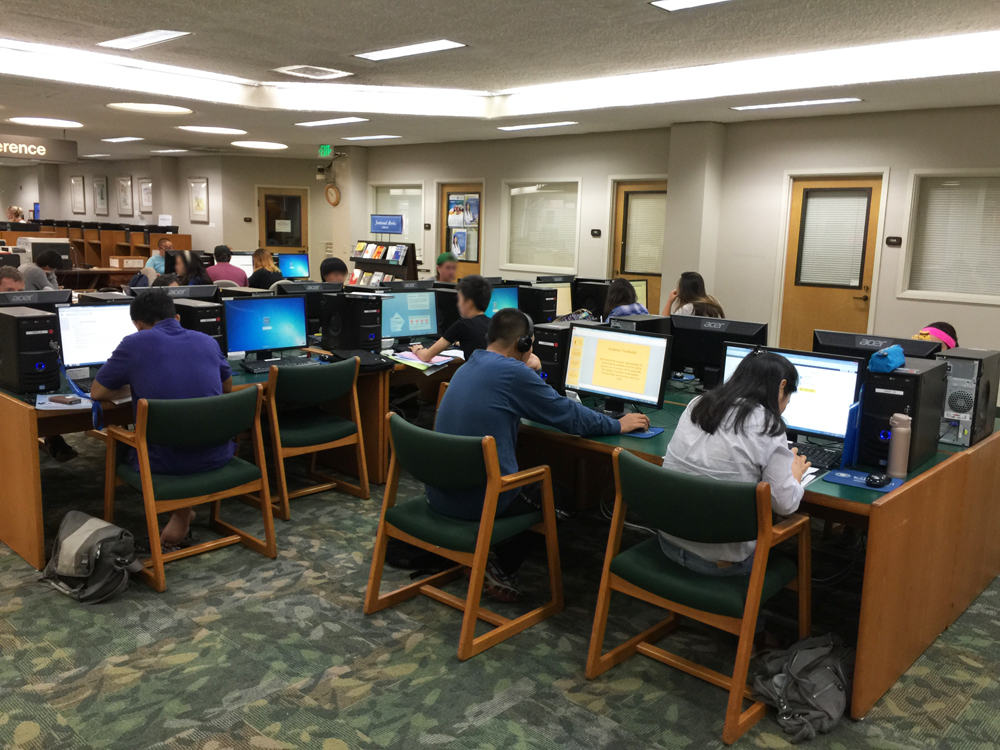
The first thing you notice when you enter is the absence of rows and rows of bookshelves. Instead, the space is filled with computer workstations (above), study tables and carrels (see photos below).

Today, all the limitations that we attribute to a hardcopy textbook are reflected in the library. In a world of mobile anytime-anywhere communications and access to information, the library is looking more like a phone booth, a movie theater, a Blockbuster, or, more tellingly, a Borders. Just as the tiny businesses that sprouted along highways faded away when freeways bypassed them, the library is fast becoming a victim of the cyberway, the electronic equivalent of an extreme autobahn.

The library is a study center.

The library is a study center.

In essence, the smartphone that students carry in their pockets and bags has become the interactive portal to not just library information but to nearly all information. This fact alone probably says more about the future of libraries and, by extension, college campuses than all the articles and books ever written about the impact of technology on higher education.  Continue reading

Using GIS and GPS Technology as Teaching Tools?

Lynn ZimmermannBy Lynn Zimmerman
Associate Editor
Editor, Teacher Education

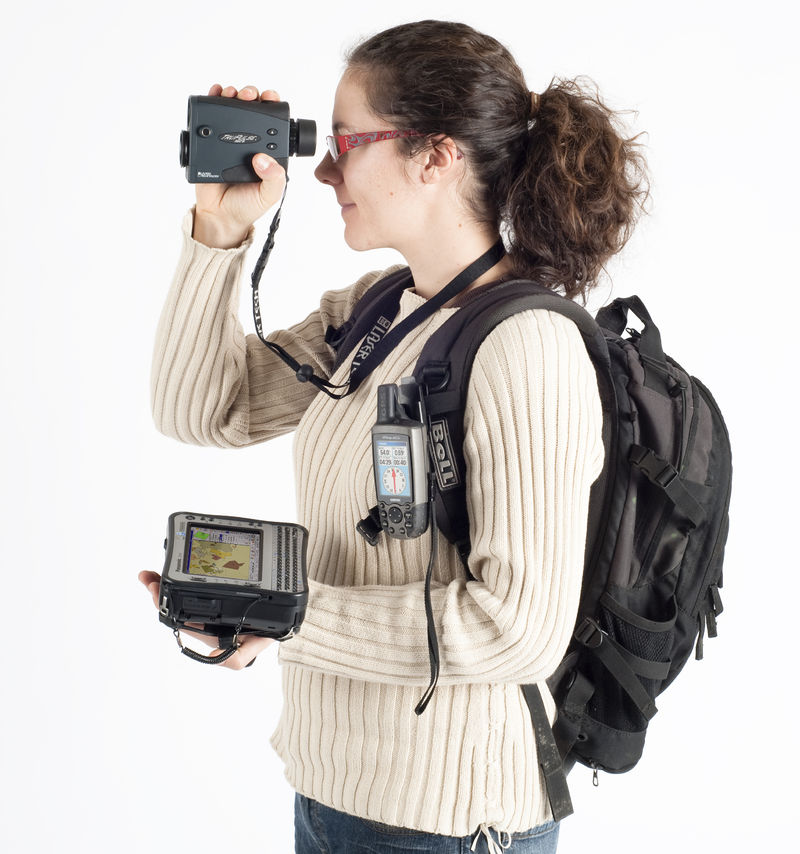
Recently, I was at an education conference in Croatia, and one of the presentations was about using geographic information systems (GIS) and global positioning systems (GPS) technology as teaching tools. The presenters proposed that this technology can be integrated in a variety of ways to create interdisciplinary lessons and projects that are technology-based. Students can learn with the GIS and GPS rather than just learn about it so that they can become producers of knowledge about the physical world around them and not just consumers of information.

One of the connections the presenters made was to the sport of orienteering to promote the development of map-reading skills and navigation. Even though orienteering is usually done low-tech with a compass and a map, higher levels of technology can create a different experience for participants.

“Field-Map birdie” by Claudiusmm – Own work. Licensed under Public Domain via Wikimedia Commons.

Of particular interest for me as a teacher of English as Foreign Language are the ways this type of technology can be used to create authentic (real-life) reading, writing, speaking and listening activities for students. The presenters made a specific point that students’ real life knowledge about nature gained with this technology can easily be represented through the medium of digital story telling, which itself integrates reading, writing, and speaking and uses critical thinking skills as students plan and develop their project.

If anyone has had experience with these types of projects, I’d like to hear about them. Post a comment to this article or email me at zimmerma@purduecal.edu

__________
A preliminary list of resources:
Alec Bodzin, GIS and GPS Links, Lehigh University, 2/12/15.
GIS in Education Resource Sheet,” Utah Rural Schools Association, n.d.
Jennifer Johnston, “Engineering Professor Shares Mapping Technology with Teachers,” MyVU, Vanderbilt University, 8/20/14.
Bianca Bowman, “Teacher Knowledge and Geospatial Technologies,” Conversations on Knowledge for Teaching 2015 Education Technologies: Now and in the Future, n.d.

Deus What?

picture of Harry KellerBy Harry Keller
Editor, Science Education

Yet another “robot” movie has appeared, and another Terminator movie is scheduled for release. It’s the robots who should be saying, “I’ll be back.”

Having already written on robots and artificial intelligence, writing about the latest opus, Ex Machina, may seem anticlimactic. This movie certainly has some excellent optics. Just four characters make up the speaking parts. One more is important to the plot, and only ten are listed in the credits. This is a small movie when measured by personalities on screen. The special effects that make Ava look mechanical are almost astounding and, along with the scenery and sets, make this a large movie.

The premise that a lone genius can create an artificial intelligence that passes muster as capable of human thought is an enoromus stretch. That he also can fit it all into a human framework that can walk bipedally and can perform other human-like actions is beyond imagining. You really must suspend disbelief to watch this movie and seek its philosophical underpinnings.

In the end, it’s the same old story that we’ve seen since Mary Shelly wrote Frankenstein. Man should not play god, and creating new life is extremely dangerous. The movie plays on the morality of choosing to be god and on people’s fears of the unknown, especially when created by a “mad scientist.”  Continue reading

Life Unplugged

Scott Miyahira 2 80By Scott Miyahira
Student at Kapi’olani Community College
University of Hawai’i

“You’re bringing those?”

My sister questioned me with some genuine curiosity and just a hint of nag, as I stuffed my iPad and my portable Nintendo gaming system into my carry-on luggage. Despite the fact that she was the younger sibling by four years, she had a way of occasionally borrowing the maternal tone of our mother.

“Yea, why?” I replied with just a tinge of annoyance.

“When are you going to use it?”

“I don’t know. We might have some down time. You’re not bringing yours?”

“No…,” she answered, this time adopting that same annoyance.

I guess I could see her point; we were only going to be in Hilo for two days. But this was my vacation. I came back home to Maui for a temporary get away from my life on Oahu, a life of two full-time jobs and only just enough free time to eat and sleep, sometimes not even that. I spent so much of my normal day-to-day always doing something that, for my vacation, all I wanted to do was nothing — nothing except lie around, watch Netflix, and play video games, which was usually most of what I did on my vacations at home. So if my Maui vacation was to be interrupted by a short family trip to the Big Island, I was bringing my entertainment with me. Much to my surprise, this “short family trip” would reveal to me my own dependence on technology and give me a new-found appreciation for a life unplugged.

A simple cottage smaller than I was expecting, painted in a classic white with stone walls around the base, long glass windows across the front, and an unassuming but prominent tower poking out from the back.

A simple cottage smaller than I was expecting, painted in a classic white with stone walls around the base, long glass windows across the front, and an unassuming but prominent tower poking out from the back.

My mom had been bugging me about this trip for a while. “Aunty Terry hasn’t seen you since you were little. You just absolutely have to see their place, and they’re getting old so you won’t have many more opportunities to do so,” she would say.  Continue reading

Stuck in Macadamia Nut Hell

Cami Lyn Nagata 80By Cami Lyn Nagata
Student at Kapi’olani Community College
University of Hawai’i

I wondered why I was the only one that wanted to go to the farm with grandpa. All of my older cousins came up with reasons why they couldn’t go with us. Even Mom didn’t want to come. I should have caught the hint when I had the chance, but I was only eight, too young to realize that going to the macadamia nut farm was not going to be carefree fun. I didn’t know it then, but I was about to learn that hard work pays off.

The road was bumpy. I bounced in the seat, the belt digging into my neck each time. The smell of the sweat stained seats stung my nose as the wind whipped around the cabin of the truck. The engine moaned as we slowly climbed the twisting dirt road. Grandpa drove, eyes focused on the road, a mischievous smirk planted on his face. I could see the trees. We were getting close.

We pulled off the road and stopped at the metal gate. Grandpa put the truck in park, then quickly climbed out and unlocked the gate. With a strong push, the gate swung open to let us through. He got back in, and we drove up the path, passing a number of trees.  Continue reading

Serve the Nation as a Presidential Innovation Fellow

PIF logo

Calling All Innovators: Apply to Serve the Nation as a Presidential Innovation Fellow
by Ryan Panchadsaram, Garren Givens on February 12, 2015 at 11:00 AM EST

Today, we are very excited to announce that we are on the lookout for more innovators and technologists to serve the nation as Presidential Innovation Fellows.

The Fellowship brings talented, diverse individuals from outside government to team up with top federal innovators to tackle some of our country’s most pressing challenges. Acting as a small team alongside federal agency “co-founders,” Fellows will work quickly and iteratively to turn promising ideas into game-changing solutions.

As always, the Fellows will focus on national priorities, leveraging the best principles and practices of the innovation economy to help create positive impact in the span of months, not years. This is an opportunity to truly transform how government works for the people it serves.

Projects will focus on topics such as:

  • Education: Fellows will work with myriad agencies to help make education more accessible to more Americans.
  • Jobs and the economy: Fellows will work on fueling the economy and stimulating job growth through innovation and improved opportunities for entrepreneurs and businesses of all sizes.
  • Climate change: Fellows will help our country and its communities prepare for the impacts of climate change.
  • Health and patient care: Fellows will leverage innovation to save lives, provide better access to benefits and programs promoting quality of life.

Fellows selected for this highly competitive program will serve for 12 months as entrepreneurs-in-residence to our federal agencies. Over the course of the Fellowship, individuals work as part of a small team of three to four. These teams of designers, developers, and product managers will participate in two to three “deep dives,” with the goal of “accelerating” initiatives chosen by the Program for their potential impact.

The first step is to apply online. Candidates can apply anytime, throughout the year, and applications will be evaluated on a rolling basis.

We look forward to kicking off another exciting year of projects.

Ryan Panchadsaram is the U.S. Deputy Chief Technology Officer. Garren Givens is Director of the Presidential Innovation Fellows and Deputy Executive Director of 18F.

The Imitation Game: A Cautionary Tale

picture of Harry KellerBy Harry Keller
Editor, Science Education

With The Imitation Game having academy award nominations, it’s a good movie to consider for science learning. Benedict Cumberbatch and Keira Knightly star in this story of Alan Turing. Turing is famous in computer science for the Turing Machine and the Turing Test. The latter was named by him as “the imitation game.”

A Turing Machine is a concept created by Turing that says that anything computable can be computed by a ridiculously simple machine consisting of a tape of indefinite length that contains only ones and zeroes and a reader that decides what to do upon reading the tape — to move forward or backward and how much. This decision depends on the state of the machine and the number read on the tape. Turing’s machine can, in theory, perform any computation being done today by any computer. You can say that Turing invented the modern computer — in theory anyway.

Alan Mathison Turing at the time of his election to a Fellowship of the Royal Society. Photograph was taken at the Elliott & Fry studio on 29 March 1951.

Alan Mathison Turing at the time of his election to a Fellowship of the Royal Society. Photograph was taken at the Elliott & Fry studio on 29 March 1951.

As Alan Turing sat and thought about computers, he asked himself what is the potential of computing machines in the indefinite future. He decided that it’s possible for a machine, in theory, to mimic human behavior. He then asked how can you tell if the machine truly is behaving as a human. In those days, all communication with machines was by writing or, worse, by looking at lights or blips on a CRT. His test involved writing to a machine and receiving written replies. If, no matter how much you wrote and read, you could not tell whether the replies were coming from a human or a machine, then the machine passed the test, “the imitation game,” and should be considered for all intents and purposes as human.  Continue reading

‘Free the Nipple’ – on 12 Dec. 2014

Sundance SelectsPresents

FREE THE NIPPLE

The film that inspired the empowering real-life movement supported by celebrities such as Miley Cyrus, Lena Dunham,
Russell Simmons, Rihanna, Cara Delevingne and many more!

#FREETHENIPPLE

Starring Lina Esco (LOL), Lola Kirke (Gone Girl),
Monique Coleman (High School Musical) and Zach Grenier (“The Good Wife”)

Free the NippleDirected by Lina Esco

SUNDANCE SELECTS WILL RELEASE FREE THE NIPPLE ON
DECEMBER 12, 2014, THEATRICALLY AND ON VOD.

WHAT IS FREE THE NIPPLE: Today, in the USA it is ILLEGAL for a woman to be topless in 37 of the United States of America in some states that includes breastfeeding. In less tolerant places like Louisiana, a woman exposing her nipples can carry a sentence of up to three years in jail and a $2,500 fine. In New York City, in 1992 it became LEGAL for women to be topless in public, but the NYPD continued to arrest women, so we took to the streets with cameras and our cast to fight these Puritanical injustices first hand. By the end the production, Free The Nipple morphed into a “real life” revolution that transcended the bounds of mere entertainment. Famous graffiti artists, mobs of dedicated women, and celebrities from Miley Cyrus to Liv Tyler and Lena Dunham jumped on board and ignited a national media blitz that has transformed into a powerful movement to Free The Nipple in America. Other celebrity supporters include Cara Delevingne, Shepard Fairey, Kendall Jenner, Adrian Grenier, Rihanna, Elizabeth Jagger, Scout Willis, Rumer Willis, Soko, Suki Waterhouse, Kellan Lutz, Dree Hemingway, Russell Simmons.

ABOUT THE FILM: A group of fearless women fight for their right to go topless in public, as they smash societal taboos one bare breast at a time. Based on a true story, this spirited satire follows New York City activists Liv and With, who take their crusade for gender equality from the streets of the urban jungle to the courts. More than just a movie,Free the Nipple has launched an empowering real-life movement, inspiring women across the globe to take back their bodies.

Director: Lina Esco
Writer: Hunter Richards
Producers: Lina Esco, Hunter Richards, Lisa Azuelos, Julien Madon
Co-Producer: Gigi Graff
For more information please visit http://www.freethenipple.com

All Rise! – Ergonomics and Back Pain

Lynn ZimmermannBy Lynn Zimmerman
Associate Editor
Editor, Teacher Education

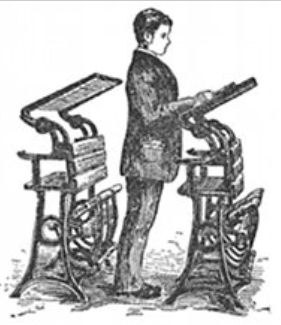
A few years ago I went to the Rutherford B. Hayes House in Fremont, OH. (In case you are wondering why, I had a friend who worked there at the time.) One of the things that struck me was his standing desk. When I first saw it, I assumed it was a podium for lecturing, but my friend informed me that, no, it was the desk where he often worked. Other than Thomas Wolfe (of Look Homeward Angel fame), who apparently wrote standing at his refrigerator, I had never heard of anyone standing and writing or doing other paperwork. I decided it must just be easier for tall people somehow and did not give it another thought.

Illustration from Brett and Kate McKay's "Become a Stand-Up Guy: The History, Benefits, and Use of Standing Desks," Art of Manliness, 5 July 2011.

Illustration from Brett and Kate McKay’s “Become a Stand-Up Guy: The History, Benefits, and Use of Standing Desks,” Art of Manliness, 5 July 2011.

Then, a couple of years ago I started having back and neck problems. I spend many hours, like many modern people, sitting in front of a computer for hours on end. After several doctor visits, I started changing the way I worked. The doctor gave me a website that would show me how to properly (ergonomically1) adjust my workspace. She also recommended a timer for my computer that covers your screen for a few minutes every so often. I did not do that, but I did start taking more frequent breaks. I mentally break my work into segments depending on what I am doing. When I reach the bottom of a page, I take a break. When I have completed five PowerPoint slides, I take a break. After I have graded so many pages, I take a break. Sometimes, I’ll just stand up and sit down, but I try to get up and at least walk into another room.

The doctor also showed me some folding shelves that you can mount on the wall at the appropriate height for standing and working on your computer. I didn’t buy one, but I did set up my iPad on a chest high bookshelf. Then, rather than checking my email while I was sitting and working on my laptop, I started checking my email on the iPad so that I would have to stand up and walk over to it and stand as I read and responded to emails.

I still have problems with my neck and hips, but there is a definite improvement. When I am in a situation, such as a hotel room, where I cannot set up my equipment as ergonomically, I can definitely feel a difference. Then I have to be conscious of taking those stand up breaks.

The reason this topic came up is that I ran across an article, “How Standing Desks Can Help Students Focus in the Classroom,” by Holly Korbey at MindShift.

I learned that many famous people, including Ernest Hemingway, Thomas Jefferson, and Charles Dickens, used standing desks. Korbey focuses on a study done by Mark Benden, Associate Professor of Environmental and Occupational Health at Texas A&M Health Science Center. He and his team believe that too much sitting contributes to a variety of problems that children have in school, as well as to obesity. They found that elementary students who stand up more to work burned more calories and were more engaged in learning when they could stand and move around. As an educator, this makes sense to me. Children need to move and twitch and fidget. And, maybe, adults do, too.

__________
1 For more on ergonomics, see “Ergonomic Workstation Guidelines,” North Carolina State University.

What’s This Song Called? – SoundHound App Review

Scott Miyahira 80By Scott Miyahira
Student at Kapi’olani Community College
University of Hawai’i

We’ve all been there. You’re shopping in the grocery store, sitting in your car, or watching television at home, and a catchy tune floats into your ear. You listen intently and maybe even bob your head to the beat. You’re really getting into this song you’re hearing for the first time, but before you know it, it’s over, and you have no idea what you just heard. Like a sappy romance film cliché, you’ve fallen in love and don’t know if you’ll ever meet again. You ask your friends, but no one seems to know either. You didn’t even get a name…

All melodrama aside, those days are over thanks to SoundHound. For any music lover on the go, it is the best mobile music identification software available.

SoundHoundSoundHound is a free mobile application, universally compatible with iOS, Android, Blackberry, and Windows devices. When you want to know the title, artist, or lyrics of a song, all it takes is a tap on the screen of the SoundHound app and it will identify it for you in as little as three to ten seconds. I am an avid music listener and collector with nearly four thousand tracks on my iPhone alone, and I am constantly looking to add to my collection. However, keeping up with ever-changing music trends and artists can be extremely difficult. SoundHound allows me to quickly identify new songs I hear and like or songs I recognize but can’t identify, thus enabling me to look them up and potentially add them to my ever-expanding library. I must shamefully admit that, for these reasons, SoundHound has become one of the most frequently used apps on my phone, beating out productivity and informational apps.  Continue reading

Rarely Do I Download an App and Keep It, but When I Do — It’s a Keeper!

John Palmer F2014 80By John Palmer
Student at Kapi’olani Community College
University of Hawai’i

Living in today’s high-tech world, it’s almost a silly question. Have you ever forgotten the password to your FaceBook login, eBay log-in, WordPress page or your “other” email account? Of course you have. Everyone has, myself included! But what if there was an app, and all you needed to do was remember one password, and it, in turn, would be the key to getting into every other app, website or even bank account you use? Keeper is an app for saving passwords that is a time-saver and highly useful.

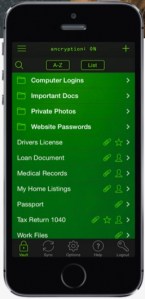
KeeperRarely do I download an app or software that I cannot live without, but Keeper is such an application. Why? Keeper remembers everything so I don’t have to. I have used it for many years to remember (and protect) passwords to my bank account, log-ins to websites, even to pay my electric and phone bills. You can completely eliminate the risk of your cookie data being robbed when using it on your PC or MAC since it stores data like a database, as opposed to a web page, which leaves your information open to bots that comb and steal cookie data, making you, that’s right, say it with me people — vulnerable. In fact, the cross-platform compatibility is so great that it works on iPhone, iPod Touch, iPad, even your Kindle or Nook.

The browser version works on Safari, Internet Explorer, Chrome, and Firefox. It also uses world-class encryption technology so you never have to worry about all of your private information being hacked. I’m going to go out on a limb here and predict that if you aren’t already using this great app, next to your social media, email, and phone (and notwithstanding Flappy Bird, but that’s another story), you will without a doubt find yourself using this app often.  Continue reading

U.S.-Russian Collaboration

VicSutton80By Vic Sutton

At a time when relations between the United States and Russia are cooling – if not cold – an innovative programme of the Eurasia Foundation continues to promote exchanges of professionals from both countries.

The ‘U.S.-Russia Social Expertise Exchange’ (SEE for short) was set up to promote co-operation between civil society leaders from the two countries.

Twelve working groups bring together experts in programme areas that include, for example, child protection, collaborative journalism, gender equity, and ‘rule of law and the community’.

Bonnie Bracey Sutton

Bonnie Bracey Sutton

My wife, Bonnie Bracey Sutton, is a member of the SEE working group on ‘Education and Youth’, and I had the chance to accompany her to its last meeting, held on 10-11 October in Washington, DC.

The working group hopes to hold a research seminar in March 2015, to appoint two senior and two junior fellows from each country who will take part in exchanges through February and March 2015, and to organize a ‘Cyberfair’ to showcase its projects, perhaps in November next year.

Bonnie had a fellowship from the Eurasia Foundation, which took her to Saint Petersburg and Samara last February, and I paid my own way to travel with her.

Our greatest surprise was to discover that Russia, despite its leadership in areas like space technology, is a poor country. People take home USD 250-300 a month. Of course, prices are lower than in the U.S, so that is not so terrible in terms of purchasing power.

But we never before visited a country where just about everyone with whom we had a serious conversation wanted to know our home address (if you want to get a visa to visit the U.S. you have to supply a U.S. address).

The U.S. Government has said that despite poor political relationships, social and cultural exchanges between the two countries will continue to be funded. We hope so, and we will see what modest support we can provide to contribute to them.

Blood Red Moon Over Honolulu – 8 Oct. 2014 at 1:28am

Jim ShimabukuroBy Jim Shimabukuro
Editor

I stayed up past 1:30 this morning to get this shot of the blood red moon over Honolulu. The light from the moon, once eclipsed, was very poor. Most of my earlier shots were turning out completely black with no images. I started at 1/200 sec. and worked all the way down the click stops to 1/3 sec. before I was finally able to get a halfway decent image. I had the aperture open all the way to f5.6 the whole time as I walked the shutter speed down.

Blood red moon taken in Honolulu on 10/8/14 at 1:28am. Nikon D5100, f5.6, 1/3 sec., ISO 250, 300mm.

Blood red moon over Honolulu on 10/8/14 at 1:28am. Nikon D5100, f5.6, 1/3 sec., ISO 250, 300mm.

I was using a 300mm zoom, too, so the slow shutter was a problem. I tried to steady the camera by lying back in a beach chair on the south balcony and shooting almost straight up, in the narrow bit of sky between the overhang from the apartment above and the railing. The lens has built-in IS (image stabilization), but most of the photos still ended up with visible blurring around the edges. Anyway, I didn’t futz with the colors in Photoshop. This is the actual red of the moon. However, I did brighten the image a bit to bring out more detail.

Disney and XPRIZE Unite to Encourage Students to Think Science

picture of Harry KellerBy Harry Keller
Editor, Science Education

While this is an unabashed promotion of the upcoming Disney animated feature Big Hero 6, it also is a real XPRIZE for young people. The prize is not millions of dollars but is still really cool.

Six winning students will travel to Los Angeles, walk the red carpet at the film’s premier, go behind the scenes to meet the creative minds at Walt Disney Animation Studios and Walt Disney Imagineering, and join a special “Visioneering” session at XPRIZE headquarters.

big hero 6

Students will enter in either the Junior Division (8-12 years of age) or the Senior Division (13-17 years). They will present their solutions to the world’s biggest challenges. The precise statement is “What one problem would you tackle to change the world? How would you do it? Tell us in a video!” XPRIZE judges will review the submissions and choose twenty finalists. Then, the public and a panel of expert judges will vote to determine the six winners.

Registration opens on Friday, September 19. Have your students put on their thinking caps. You do not have to go to the movie (unless you win). Entry is free. Just create a one-to-three minute video showing how you will use any combination of STEAM (science, technology, engineering, arts, and math) to solve one of the world’s problems. Be creative in defining the problem, in finding a potential solution to the problem, and in presenting your proposed solution.

Clearly, Disney does not require introduction. The XPRIZE Foundation is a matchmaker of sorts. It identifies highly leveraged situations that innovation can solve and that can change the world for the better. It finds sponsors for the challenges it creates around these problems that are not being addressed otherwise for a variety of reasons. Anyone, anywhere can enter. But beware! These are never easy challenges.

See my previous article for more on the XPRIZE Foundation.

I hope that this challenge introduces thousands of young people to the joys of discovery (science) and creation (engineering) while using technology and arts to show that they have great ideas.

I also hope to follow up with an in-depth discussion with the Walt Disney Animation Studios Chief Technology Officer, Andy Hendrickson in the next few weeks.

Widget Archive

TCC 2018

 Call for Participation: Registration
 Prelude March 21: Institutional Initiatives in Digital Credentials (FREE)
 Main Conference (Apr 17-19) Registration

HOT@ PLENK 2010

Stefanie Panke: PLENK2010: Weeks 7-10 – The End
Stefanie Panke: PLENK 2010: Weeks 4-6 – Learning Theories, Evaluation and Literacies
Stefanie Panke: PLENK2010: Week 3 – ‘Web XXO’ Emerging Technologies
Stefanie Panke: PLENK2010: Week 2 – Personal Learning & Institutional Learning or ‘A Great Course in Diagram Making’!
Stefanie Panke: PLENK 2010: Week 1 – Just Like ‘Watching Football’
Lynn Zimmerman: PLENK2010 – How Can PLEs Benefit My Students?
Lynn Zimmerman’s account of her first day at PLENK 2010
George Siemens’ (PLENK 2010 facilitator) comment to Stefanie re “curating resources”

Live!
Solar Impulse: Around the World in a Solar Airplane

MOOC MOOC! The interview (9/11/13)

MOOCulus for Calculus Fun: An Interview with Tom Evans (7/11/13)

***

megaphone with writing: Call For Chapters

***

an apple core with text: core issues with John Sener
Do We Really Need a Core Curriculum? (2.22.11)

The Value of Curriculum Cores (3.3.11)

Standardized Tests and Foul Shooting: Look Out, Michael Jordan! (3.12.11)

***

OpenCourseWare
Open Educational Resources – An Invitation to Reflect Your Practice by Stefanie Panke

HippoCampus, Monterey Institute for Technology and Education (sources Ray Schroeder and Sara Bernard)

MIT OpenCourseWare

OpenLearn, The Open University

Open Learning Initiative, Carnegie Mellon

Tufts OpenCourseWare

Stanford on iTunes U

Webcast.berkeley

Utah State OpenCourseWare

On-Demand Online Learning Programs, Kutztown University Small Business Development Center

University of Southern Queensland’s OpenCourseWare

University of California Irvine OpenCourseWare

***

ETC Mailing List
To receive periodic email announcements about the latest articles and discussions on ETC, send your name and email address to jamess@hawaii.edu

***

Links
100 Excellent Open Access Journals for Educators, 11 Nov. 2009

***

Encounters

‘Digital_Nation’ – Two Reviews

Assuming that Teachers Aren’t the Primary Obstacle to Change . . .

Sloan-C’s Virtual Attendance Option: Real or an Afterthought?

Sidewiki – Handy Tool or Destructive Weapon?

‘College for $99 a Month’

USDE 2009 Report on Effectiveness of Online Learning

Blended Learning Is Largely an Illusion

Email your ideas for an encounter to Jim at jamess@hawaii.edu

***

Breaking News

The latest ed tech news selected by ETCJ writers and editors.

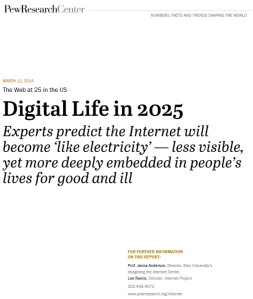
A Glimpse at ‘Digital Life in 2025’

Jim ShimabukuroBy Jim Shimabukuro
Editor

The conclusion of Pew’s Digital Life in 2025 (3/11/14) report1 is a simple one. In the next eleven years, the internet will become ubiquitous. A few tiny voices disagree, claiming governments will shut it down or balkanize it, turning it into a virtual reflection of the planet’s jigsaw geography. But the overwhelming prediction is the internet will be more of everything2 that we currently associate with it. The 61-page document is devoted to explaining the how and the implications, split between mostly optimism and some pessimism.

Click image to view the full report in PDF.

Click image to view the full 61-page report.

The ubiquity of the internet is already a reality so projecting more of the same is not surprising. Echoing words and phrases abound throughout the report: pervasive, connected, global connectivity, ubernet, and “world-spanning information fabric known as the Internet of Things.” The phrase “like electricity” is incorporated into the subtitle, and it serves as the starting point for the rest of the discussion: “Information sharing over the Internet will be so effortlessly interwoven into daily life that it will become invisible, flowing like electricity [through our lives].”

This simile lends itself to a vision of humans as altered or transformed3, as wired to participate in an “augmented reality,”4 a reality that is no longer defined by time and geographical boundaries. Perhaps the most profound implication is the irrelevance of national borders in the ubernet. This is how David Hughes puts it:

All 7-plus billion humans on this planet will sooner or later be ‘connected’ to each other and fixed destinations, via the Uber(not inter)Net. That can lead to the diminished power over people’s lives within nation-states. When every person on this planet can reach, and communicate two-way, with every other person on this planet, the power of nation-states to control every human inside its geographic boundaries may start to diminish. Being replaced — over another 50 or more years — by self-organizing, trans-border people-groups. Nations will still have military and police forces, but increasingly these will become less capable of controlling populations.

Again, this trend is already in motion. Today, the fact that websites are hit daily by people from around the world, attracted by mutual interest rather than shared nationality, is a given. No one gives it a second thought.  Continue reading

Free Higher Ed, 21st Century Learning, ELLs, Standardized Tests

lynnz_col2

Online Universities 2.0: Taking Education to the Next Level — Worldwide by Dominik Knoll in Huff Post Impact 3/12/14
The author expresses his opinion that free and accessible university education is just around the corner for anyone who wants it via the Internet. A commenter to the article says that most MOOCs are merely replicating the face-to-face classroom and not using the technology to its fullest extent.

Five Ways that 21st and 20th Century Learning Will Differ by Steven Mintz from Inside Higher Ed 3/5/14
Mintz proposes 5 ways that education is changing. He suggests it will move more toward 100% proficiency and mastery of skills and competencies; based in the science of learning; be data-driven; be personalized; and take advantage of technology in ways that truly enhance the learning experience.

Will classroom technology help English Language Learners? From Reflejos 3/16/14
With advent of Common Core and computer-based testing, schools are increasing online connectivity. Pilar Carmina Gonzalez, a researcher for the Education Development Center, a leading expert on children and technology and a former ESL teacher, says technology will open new avenues of learning for English language Learners (ELL students).

11 key questions on standardized testing for Congress to answer by Valerie Strauss from The Washington Post 3/9/14
The Network for Public Education, which includes among its member education historian Diane Ravitch, has asked congress to look into the what they see as the overuse of standardized tests.

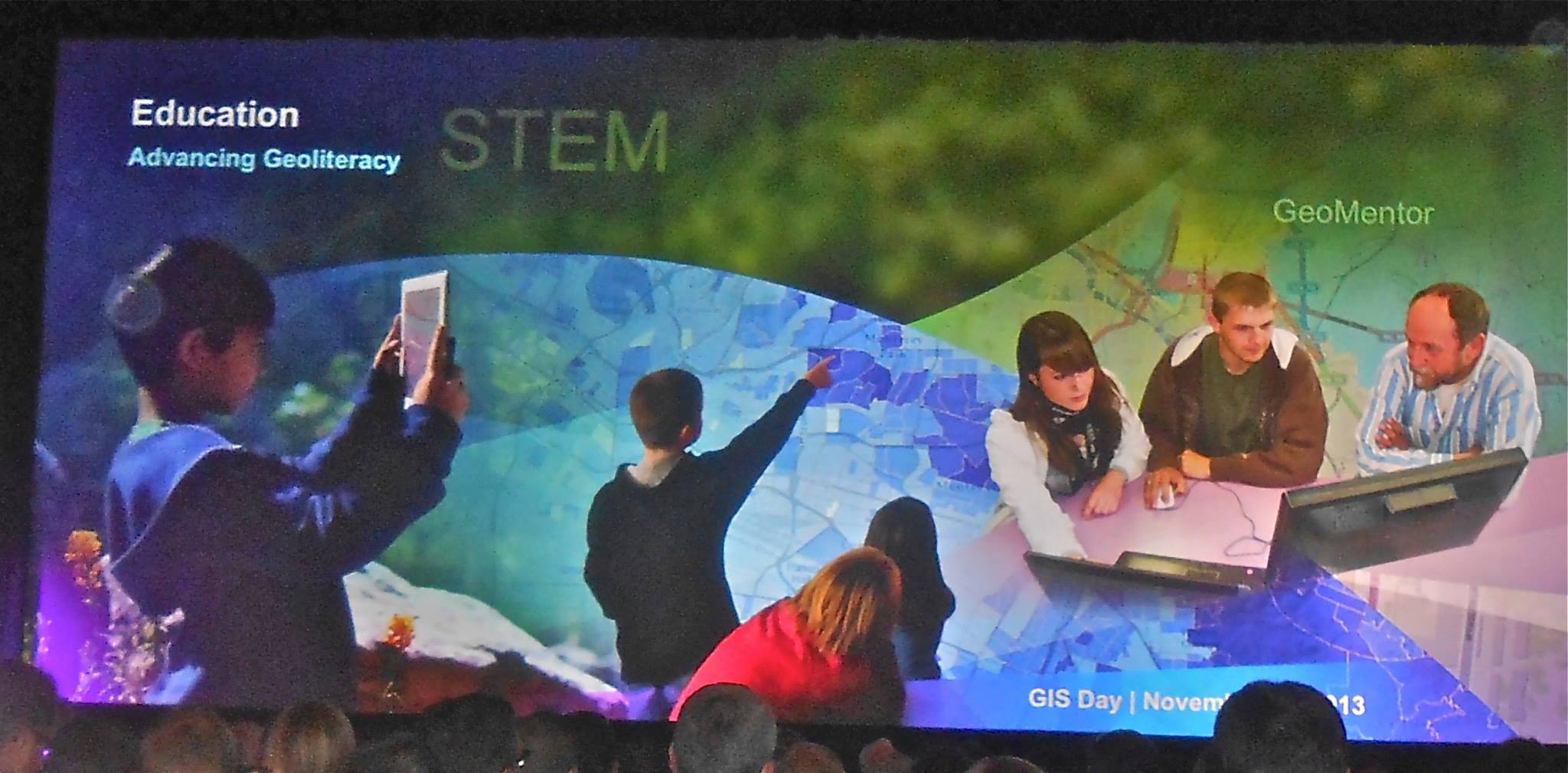
GIS Can Transform Learning: Bracey Sutton at SITE.org AACE Conference

VicSutton80By Vic Sutton

Geographic Information System (GIS) technology has the potential to transform learning, argued long-experienced teacher Bonnie Bracey Sutton at a workshop at the conference of the Society for Information Technology and Teacher Education (SITE), Jacksonville (FL), March 17-21, 2014.

Bonnie Bracey Sutton

Bonnie Bracey Sutton

Geography is presently a low priority in U.S. school curricula, partly because of the emphasis that the ‘No Child Left Behind’ law places on reading and math. The result is that American children’s awareness of where they live, and where their country is in the world, is at an all-time low.

Yet the ability to know where you are, and where you are going, is crucial in life. And mapping is the way that we record what we know about where we are, and where we are going.

Workshop participant Ray Rose recalled that the earliest maps in America were made by people standing on tall hills and drawing what they saw below them.

vic01

There was also discussion about map projections. Most of us know the world from Mercator’s projection, which – as one participant argued – is ‘culturally biased’. Just look, for example, at the size of the African continent on a traditional map, and then compare the size of Africa to other countries or regions.

Other map projections correct this, and provide other perspectives. But as another person commented, “the Mercator projections are what we carry around in our head.”
vic02
Bracey Sutton presented a wealth of resources that educators can use, in the classroom or in informal education, to provide children with tools to map their immediate environment, or to explore wider environments, from their community to their state, country or region.

Nowadays we tend to take GIS for granted, for example when using a GPS to guide us to a destination. But for students to understand it they still have to tackle the basics of latitude and longitude.

And there are any number of alternative map projections. See for example the Gall stereographic projection, which long predated the better-known Peters projection.

But the conclusion is that depicting the earth on a flat surface almost inevitably leads to distortions. GIS can help students to understand how they arise, and – sometimes — how to compensate for them.
vic03

Some Resources:

Do you know the true size of Africa?
Does size matter? US vs Russia
What is GIS?

  • ESRI ~ A geographic information system (GIS) is a computer-based tool for mapping and analyzing things that exist and events that happen on earth. GIS technology integrates common database operations such as query and statistical analysis with the unique visualization and geographic analysis benefits offered by maps.”
  • 20 Minute Video on GIS

Participatory Event 2014: GIS DAY


MOOCs Are Going Prime Time

Tremors 02

MOOCs for Penn State Credits — A Shift with Radical Implications

Good ideas don’t fade away. They have a habit of sticking around, and in time, they become great ideas. MOOCs are like that. The stumbling block was bucks: “Is there money in this thing?” It took a while, but name brand universities are beginning to see the green. You have to wonder why it took so long since the idea has been around from day one. Regardless, the business model that’s been hiding in plain sight is the multi-track option, and it will soon be featured in Penn State’s MOOC on Coursera, “Presumed Innocent? Social Science and Wrongful Conviction.”1 It will offer two options: free and for credit. Here’s a description: “The course…will be open to University students and the public with two track options. The free track will function much like Penn State’s previous MOOCs, while the for-credit portion will require a heavier workload and offer instructor and TA feedback and assessment on completed work in exchange for a fee less than that for an average college course.”

The fascinating part of this is what appears to be a waiving of standard admission procedures. I haven’t read the details on how this will all work out, but it seems anyone anywhere can register for the credit version, and if successful, earn Penn State credits. The only requirement is a fee that’s described as lower than average for a college course. If this is indeed what’s planned, then they’re setting a precedent that could ultimately change the higher ed landscape. Students will soon be able to earn college credits from top universities around the world from the comfort of their home and for a price that many if not most will be able to afford.

The impact on higher ed will be immense. Colleges and universities will need to open up their policies for granting degrees, and their emphasis will probably shift from primarily instruction to include large scale certification options, and this may mean a realignment of staff, with many leaving the classroom for duty as advisors.

Multimedia Web Skills — A Coming Crisis for Teachers

Paul Beaudoin, in “Six Ways to Be a Better Online Teacher,”2 explains how Shoba Bandi-Rao, an assistant professor at Borough of Manhattan Community College/CUNY, has “her students combine e-text, audio, images and video to create their digital stories.” They use “free software such as Wevideo and Window’s Movie Maker.” According to Bandi-Rao, “They shared their projects in class and had the opportunity to comment and receive feedback from their peers.”

This ability to create video presentations and share them online is the 21st century equivalent of posters and term papers. The question is, are our teachers prepared to demonstrate and teach these skills? If not, how do we get them there?

I believe this trend toward multimedia is a matter of when and not if. In preparation, colleges have two basic options: (1) Build up their IT service departments or (2) encourage and insist on teacher competency. The first is probably where most colleges will end up by default since it’s the path of least decisiveness. But the problem is cost, which will mushroom and quickly become prohibitive. The second, teacher competency, is the most sustainable in the long run. The key is to design and fund plans that will not only reward teachers who become skilled in the use of technology but to actively recruit new faculty who are technically adept.

Anant Agarwal: A Massive Contradiction?

Anant Agarwal, founder and president of edX, continues to push the value of on-campus learning as he touts the power of MOOCs3. For Agarwal, MOOCs are part of a blend, an enhancement for F2F courses. But he also sees MOOCs as vital beyond the campus experience. He says, “We also envision the world shifting toward a continuous education system — one that doesn’t stop after four years of college.” When pressed for examples of invaluable on-campus experiences, he offered two: “Universities provide…a space for students to learn how to work collaboratively with each other and gain those critical soft skills, and close interaction with faculty and senior students on research.”

Agarwal is probably representative of most leaders in higher ed when it comes to MOOCs. They want to have their cake and eat it, too. The fundamental contradiction is between the concept of open and closed. Unfortunately, they don’t blend very well. A closed course with an open module (MOOC) is still a closed course. Similarly, an open course with a closed module is also still closed. In the MOOC game, the only ultimate winner is an open course with no closed modules.

Returning to Agarwal’s two examples above, I don’t think it takes much imagination to see how collaboration and interaction are already integral parts of the online learning experience. Examples abound.
__________
1 Katie Jacobs, “Digital learning technologies enable students to become better rounded,” Penn State News, 3/25/14.
2 Campus Technology, 3/26/14.
3 Hayleigh Colombo, “EdX founder – sheer numbers means MOOCs will stay relevant,” Boilerstation, 3/25/14.

Introduction to ‘Jewish Studies and Holocaust Education in Poland’

Jim ShimabukuroBy Jim Shimabukuro
Editor

(Note: Earlier this month, we published an announcement of Lynn Zimmerman‘s Jewish Studies and Holocaust Education in Poland [McFarland, 2014]. As a follow-up, I planned to publish an interview with Lynn. However, after reading excerpts, I realized that she had answered all my questions in the introduction of her book. I asked for permission to publish the introduction, and she gracefully consented. Lynn’s focus “is the educational function and value of a Jewish studies program, of teaching young people about the Holocaust, of going to a cultural festival. How effective is each as an educational tool?…Are they perpetuating stereotypes or breaking them down?…How does each reflect current trends in identity politics?…Can these issues be the foundation for teaching about human rights in general?” Lynn’s probing style takes the issues beyond the covers of her book. -Editor)

Introduction by Lynn Zimmerman

Lynn Zimmerman

Lynn Zimmerman

One evening in 2002 I was listening to This American Life, a public radio program in the United States. A young American woman who was Jewish was talking to Ira Glass, the host, about living in Krakow, Poland. She talked about Polish interest in Jewish culture and the Jewish cultural festival, which has been hosted in Krakow since the early 1990s. This young woman said that she had mixed feelings about the interest in Jewish life and about this festival. She told him that on one hand she was happy that people in Poland were recognizing the contributions of Jews to their culture, history, and society. However, she was also slightly disturbed and even offended by it. She said she felt uncomfortable because at times she felt like she was watching outsiders reenact a romanticized version of culture that no longer existed (Glass, 2002).

Her story piqued my interest. Even though I had been to Krakow several times, I had never been to the festival, partly for the reasons she had mentioned. I thought that it would feel odd going to see other people celebrating a culture that was not theirs and that no longer existed in their country. I have never been to one of the popular American Indian festivals in the United States for the same reason. I had been to Kazimierz, the former Jewish quarter in Krakow, on several occasions, and I felt that I was in a museum or in a place whose past and present did not match. Like this young woman, I felt some discomfort. I knew from reading and talking to others that most of the residents and shop and restaurant owners were not Jewish. However, Judaica and Jewish souvenirs were being sold, and there were several restaurants featuring “Jewish” food.

I did finally attend the festival in 2005. I had similar mixed feelings as the young woman whose story I had heard. The unease started with the Friday Shabbat service at the Tempel Synagogue. This formerly “progressive” synagogue has a women’s balcony so that men and women could sit separately during services, women upstairs and men below in the main sanctuary. This arrangement is more in line today with traditional and Orthodox branches of Judaism, so I assume that the Friday evening service I attended was organized with the requirements of the more orthodox Jews in mind. As a modern Conservative Jewish woman, it was strange to have to sit in the women’s balcony since I am accustomed to egalitarian services in which men and women sit together and participate equally in the services. Not only was being segregated in this way strange for me, the set-up of the balcony was not comfortable. The panel on the front of the women’s balcony in Tempel Synagogue is over a meter high, so although you can hear quite well while sitting, you can see nothing of what is going on down below. To see what is happening in the main sanctuary below, one must stand and look over the rail. Therefore, during the service — and it was a religious service, not a show — there were quite a number of women in the balcony, some sitting, but most standing looking over the rail. Although I was sitting with some Jewish women from the United States, most of the people were Poles who came to see what the service was like. Think about how you would feel if you were attending mass in your church or services in your mosque and there was a group of people there as curiosity-seekers — not just to see the building, but to see what you were doing. It is a disquieting feeling. The other American women I spoke to expressed that same feeling. Not only was I participating in a service in a way that was strange to me, but I also felt as if I was part of a spectacle.

Photo of the Warsaw Festival of Jewish Culture, "Singer's Warsaw," by Radeksz, 9/2/09.

Warsaw Festival of Jewish Culture, “Singer’s Warsaw“; photo by Radeksz, 9/2/09. Click image to enlarge.

Continue reading