Posted on October 1, 2010 by JimS
 By Harry Keller
Editor, Science Education
How do we fix K-12 education in the United States? Will Race to the Top contests do it? Will Investing in Innovation Funds make the crucial difference? Can the Gates and Broad foundations buy great education in this country? Should we break down all large schools into small ones?
An article by Sam Dillon in the New York Times, “4,100 Students Prove ‘Small is Better’ Rule Wrong,” suggests otherwise. The article focuses our attention on the largest high school in Massachusetts, Brockton High School. Its principal, Dr. Susan Szachowicz, brought together a small group of willing teachers to see if they could do anything to fix this really broken school.
The detailed numbers have been omitted from the article, which claims that the school had abysmal scores in 1999. Then, they acted. The 2001 scores were still below acceptable levels but far above the 1999 scores. By 2008, Brockton High was in the top 10% statewide in English test scores and remains there. Continue reading →
Filed under: Uncategorized | 8 Comments »
Posted on October 1, 2010 by JimS
 By Bonnie Bracey Sutton
Editor, Policy Issues
[Note: On Sep. 30, Harry Keller, ETCJ science education editor, shared Sam Dillon’s “4,100 Students Prove ‘Small Is Better’ Rule Wrong” (NY Times, 9.27.10) in the journal’s staff listserv. A discussion followed, and Bonnie responded with an article. -js]
I used to fly into Las Vegas when I was on the Clark County School Board review team. They instituted some Gates initiatives in big, beautiful schools that were county wide. That’s a tall order because Clark County is one of the largest school systems in the country.
They had to build two schools as transportation costs and the limited number of hours in the day defeated them. The kids wanted to do PE and organized sports in their area schools. (The multicultural kids did not sign up.) The schools opened very, very early, and students were there by seven to participate in team sports and that kind of thing.
We were working with experts from all over the country, but Gates seemed to hold the strings for what we could and couldn’t do based on the fact that he provided the money. We used knowledge network maps, and the feeder elementary schools were theme based.
Continue reading →
Filed under: Uncategorized | 2 Comments »
Posted on September 29, 2010 by JimS
 By Claude Almansi
Editor, Accessibility Issues
Mehmet Firat, a Ph.D. student at Anadolu University, Turkey, is gathering metaphors for “university”. This is great per se, and pertinent to several recent discussions on ETC Journal about the role of universities in education.
Mehmet Firiat and his colleagues are still wishing to gather more replies. I am impatient to read their report once they get and analyze them: This is an interesting way to conjure up a multi-subjective image of university. Continue reading →
Filed under: Uncategorized | Leave a comment »
Posted on September 29, 2010 by JimS
 By Stefanie Panke
Editor, Social Software in Education
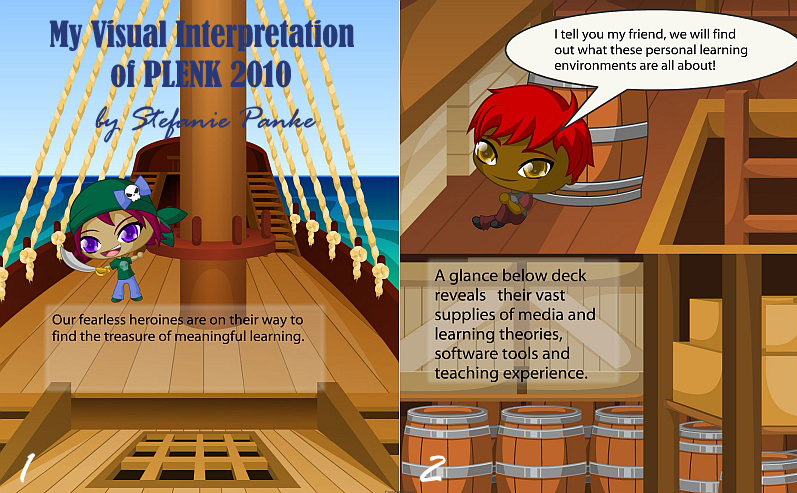
The third week of the massive open online course PLENK2010 centered around emerging technological trends and their impact on personal learning environments. The names for this “next Web” are manifold: Web 3.0, extended Web, Web eX, or X Web. It comprises themes like augmented reality, semantic web, location-based services, mobile computing and learning analytics (e.g., networks analysis).
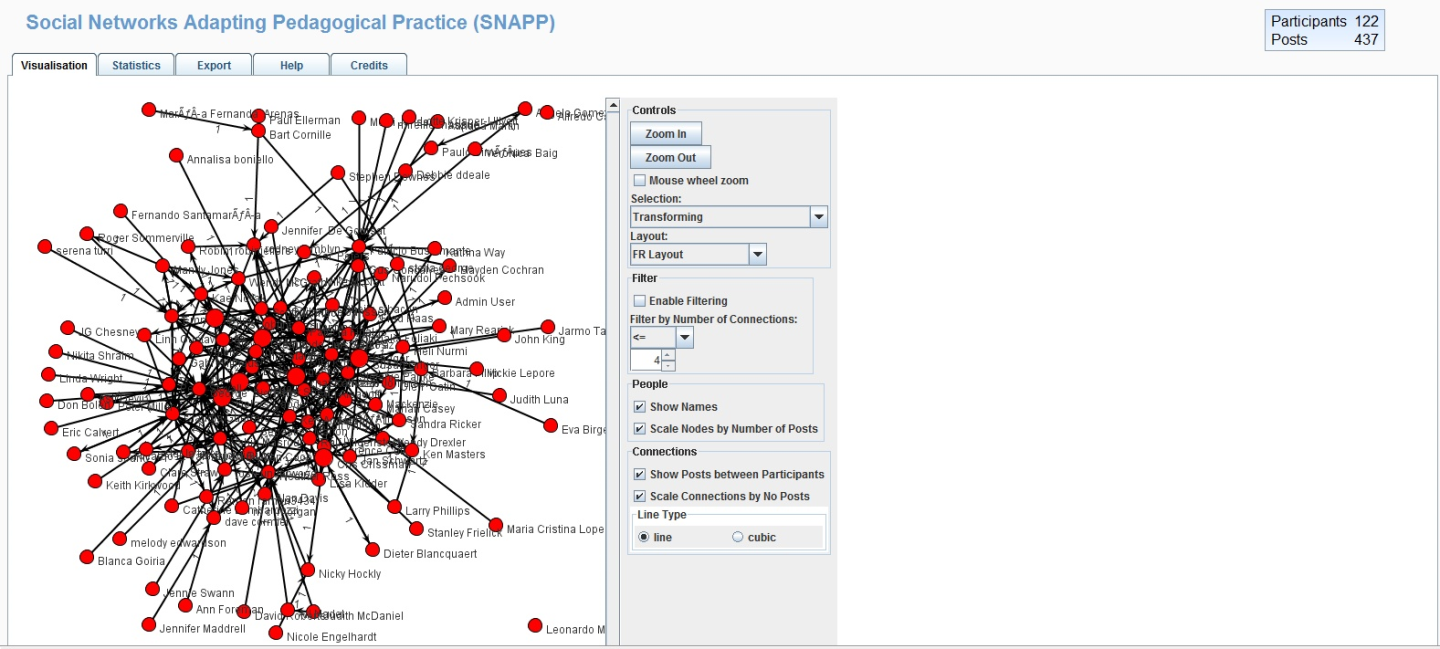
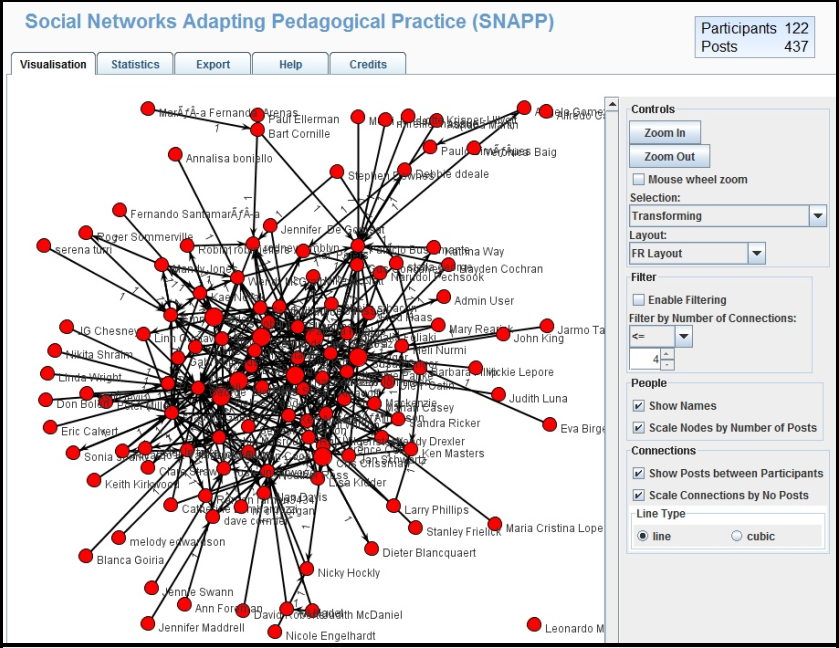
 A vizualisation of the discussion in a first week’s PLENK forum with SNAPP
Continue reading →
Filed under: Uncategorized | Leave a comment »
Posted on September 28, 2010 by JimS
 By Jim Shimabukuro
Editor
Stephen Downes, in a Stephen’s Web post (9.26.10), took umbrage at Steve Eskow‘s ETCJ article, “Annoyance at the Ubiquitous and Protean Notion of ’21st Century Skills‘” (9.24.10), which was a response to Dave Cormier’s “Twenty-six Centuries of Skills” (9.23.10).
Here is Downes’s post:
Steve Eskow takes a run at Dave Cormier, attracts my ire, and ignites a raft of comments. And it is worth stating again that the blog is not a formal essay, you are not expected to put the entire background of your (and others’) thought into a literature review preceding your few paragraphs, and attacking a post for what’s missing, rather than what’s there, is cheap criticism. “It is easy to extract one paragraph and present it without that context as overly sweeping generalization. It is a freshman mistake to do so.”
I read a great deal of Montaigne in my younger years and for a while I too was enamored of quoting Montaigne in order to show that someone’s great ideas had already been thought of by someone else. Then I grew up.
Continue reading →
Filed under: Uncategorized | 9 Comments »
Posted on September 27, 2010 by JimS
By Jim Shimabukuro
Editor
Graham Attwell, in “Open Learning and Contextual Diversity” (Pontydysgu 9.27.10), is critical of some of the ideas in Tom Preskett’s The ‘Open Mode’ – A Step Toward Completely Online (9.24.10). He says, “I think Tom is mixing up a whole series of things here,” and then proceeds to straighten “things” out.
Unfortunately, Attwell’s good intentions are based on statements that are inexplicably confusing. For example, he says, “The move towards Blended Learning was driven by pedagogy and not by a retreat from Technology Enhanced Learning.”
What, exactly, does this mean? One has to wonder if Attwell actually understands the terms that he uses to purportedly set things straight. In fact, “blended learning” and “technology enhanced learning” are one and the same, so is he saying that the move toward blended learning was not driven by a retreat from blended learning? Furthermore, “pedagogy” simply means instructional strategy, so is Attwell saying that the move toward blended learning was driven by instructional strategy? If yes, then what does this mean? Continue reading →
Filed under: Uncategorized | 3 Comments »
Posted on September 27, 2010 by JimS
 By Jan Schwartz
I work with people in alternative health care and career type schools. Hybrid education is excellent in these fields where some of the more kinesthetic skills cannot yet be taught online. I say “yet” because who knows what will be possible in the future?
I teach a practice management class in an acupuncture school and it is a hybrid course. No hands on components (as in skill development with needling) are taught, but the nature of the practice is such that the students like having some face to face time because that is how they will be functioning with clients or patients when they graduate. We meet the first week or two in the classroom (I give them the choice at the end of the first meeting), usually one week in the middle, and then again on the final week. That’s 3-4 times out of a 10-week quarter. Continue reading →
Filed under: Uncategorized | 6 Comments »
Posted on September 24, 2010 by JimS
 By Steve Eskow
Editor, Hybrid vs. Virtual Issues
A cranky, minority opinion on the Dave Cormier (“Twenty-six Centuries of Skills” 9.23.10) and Aaron Eyler (“Ignore the Test” 9-21.10) essays, and perhaps a cranky expression of annoyance at the ubiquitous and protean notion of “21st century skills,” which increasingly seems like an empty bottle that each user fills with his own educational cliches.
Here is the first paragraph of the Cormier article:
In the past several years I’ve been very fond of saying that moving into the 21 century has very much been a return to our roots. We are finding words like ‘tribe’ and ‘community’ ringing through the din of post-war individualism and we are turning to each other with words of trust and collaboration. Some of us are starting to see the established (and, pre-internet, necessary) forms of identifying reliability, competence, insight and creativity as outdated and difficult to work with. We are looking to the whole identity of a person, to the ways in which they have built the work and network they have as method of vetting the people we wish to work and innovate with. We are less interested in degrees, in ‘certificates’, as, for many of us in technology or education, these degrees do not actually mean very much. These are not new things… they are very old things… very old words, coming back to us.
“Our roots”? Not mine! What is “post-war individualism”? Are we really turning to each other with words of of trust and collaboration? Have reliability, competence, insight and creativity changed their meanings post-internet? Are we now really looking to “the whole identity of a person”?
Are we really less interested in degrees?
And so on . . .
Is this kind of gentle and empty generalizing now acceptable in Freshman English?
Are these 21st Century thoughts?
Filed under: Uncategorized | 19 Comments »
Posted on September 24, 2010 by JimS
 By Tom Preskett
Recently I have arrived at the opinion that developing a viable distance learning offering is the way to go for higher education (HE). Much of the e-learning I’ve been involved in has concentrated on developing blended learning where there was previously just face-to-face. This is largely like banging your head against a brick wall. This policy is often seen as a safer, less ambitious step along the learning technologies route.
THIS IS WRONG!
It’s wrong because most of the time the educators and the students don’t really want to use technology. They’ll do a bit for the administration, but for learning, no way. It’s a face-to-face course. Why tamper with it. I am of the opinion that this is misguided, but it’s not a battle worth fighting (for now). Fighting this resentment is unnecessary.
Continue reading →
Filed under: Uncategorized | 5 Comments »
Posted on September 22, 2010 by JimS
By Stefanie Panke
Editor, Social Software in Education
Reporting on the activities and discussions within the Massive Open Online Course, Plenk2010, has become considerably more challenging since my first introduction of the course’s structure and concept. One reason is that the discussion forums of week one have been tremendously busy, producing a total of 427 postings. In many, if not all, the participants are blurring the theme of week one (general aspects and definitions) and week two (personal learning environments vs. learning management systems). An example is the side-debate that has spun around the problem of plagiarism and fake identities for the evaluation and grading of open learning activities.
Continue reading →
Filed under: Uncategorized | 2 Comments »
Posted on September 22, 2010 by JimS

My niece’s daughter is now 10-years old, and she has reached the age where music instruction in school graduates to real band instruments. She was excited when she went in to meet with the music director and be assigned to an instrument. She wanted to play the saxophone, as her mother did. Alas, it was not to be. The band director looked at this tiny slip of a girl and decided that her mouth shape was not right for the saxophone, but it was perfect for the euphonium, and it just so happened he needed a euphonium player in the band. And so her musical dreams were dashed, and she will instead struggle with an instrument as big as she is, an instrument she will not possibly continue to play as an adult.
It reminded me of my son, who also wanted to play the saxophone. Unfortunately, by the time he went in for his appointment with the music director, the students with the earlier appointments had already filled the band’s need for saxophone players, and so my son was assigned to the clarinet, an instrument he hated. At least his music instructor was honest about his need for a clarinet player trumping my son’s need to play the instrument he wanted, unlike the instructor who invented the ridiculous story of my niece’s daughter having the perfect mouth shape for the euphonium. Continue reading →
Filed under: Uncategorized | 2 Comments »
Posted on September 18, 2010 by JimS
 By Lynn Zimmerman
Editor, Teacher Education
Thanks to Jan Schwartz’s Learnings from a MOOC I decided to register for PLENK2010, and thanks to Stefanie Panke’s PLENK 2010: Just Like ‘Watching Football’ I started participating. For me, this experience embodies some of the concerns, confusion, and challenges that people have who want to be technology savvy but are not quite sure about how to get there. It also brings to light how teaching and learning can really become more student-centered through the use of the e-learning environment. Both of these issues, affective issues and e-learning pedagogy, are important to consider in the evolution of technology as a part of educational design.
I started exploring the PLENK2010 site a few days ago, and I have mixed feelings about the experience. There is a lot of uncertainty (for me) in the process which will shape my participation. First of all, there are many people participating as one big group, which I find chaotic. My style is to work alone or with a small group of people with whom I feel comfortable. One of my first tasks, therefore, is to find my comfort zone. Continue reading →
Filed under: Uncategorized | 2 Comments »
Posted on September 18, 2010 by JimS
By Harry Keller
Editor, Science Education
I like video games and introduced my son to them with Wizardry I a very long time ago. For 20 or more years, I’ve been looking at ways to make videos games work in classrooms. So have many others. The recent New York Times article, “Learning by Playing,” explores some recent developments in schools.
This concept, gaming in classrooms, has many facets. Is the game a first-person shooter game (Doom), a resource management game (Railroad Tycoon, various Sim games), a role-playing game, or even massively multiple-player online role playing game (MMORPG, e.g., World of Warcraft)? Or is it a purely educational game? Do students learn more than just eye-hand coordination from games? Is gaming an appropriate use of classroom time? Does the answer change with the students’ age? Are games ready for prime time, and, if not, when will they be? Continue reading →
Filed under: Uncategorized | 9 Comments »
Posted on September 15, 2010 by JimS
By Stefanie Panke
Editor, Social Software in Education
This week marked the start of PLENK 2010, a seven week online course on personal learning networks (PLNs) and personal learning environments (PLEs). The “Massive Open Online Course“ (MOOC) is sponsored and organized by the Technology Enhanced Knowledge Research Institute (TEKRI) of the Canadian Athabasca University. George Siemens (TEKRI), Stephen Downes (National Research Council of Canada), Dave Cormier (University of Prince Edward Island), and Rita Kop (National Research Council of Canada) serve as facilitators. In addition, several invited speakers will attend the weekly live sessions. More than 1300 participants have registered in the Moodle platform so far.
Continue reading →
Filed under: Uncategorized | Tagged: Canadian Athabasca University, concept maps, curation, Dave Cormier, EduCause, Elluminate, George Siemens, Massive Open Online Course, MOOC, National Research Council of Canada, personal learning environment, personal learning network, PLE, PLENK 2010, PLN, Rita Kop, Stephen Downes, Technology Enhanced Knowledge Research Institute, TEKRI, University of Prince Edward Island, VLE, Wordle | 5 Comments »
Posted on September 14, 2010 by JimS
 By Robert Plants
Editor, Schools for the 21st Century
Last week, in the online publication Education Next, noted education columnist Chester Finn was critical of the organization Partnership for 21st Century Skills.
I think, in many respects, his criticism was right on the money and needed. The gist of his comments pointed out that the organization advocates the teaching of thinking skills devoid of content. The idea is not new, and there is sufficient research discrediting that approach. He pointed to Diane Ravitch, Daniel Willingham, E.D. Hirsch, and Jay Matthews as some of the more recent writers and researchers critical of the organization for the same reasons. He noted that the Common Core initiative was doing a much more effective job by infusing 21st century thinking and learning into its current content standards.
Continue reading →
Filed under: Uncategorized | 13 Comments »
Posted on September 7, 2010 by JimS
By Jan Schwartz
In fall 2008, I participated in a semester long MOOC — Massive Open Online Course — through the University of Manitoba. The name of the course was Connectivism and Connected Knowledge; Stephen Downes and George Seimens facilitated it. Of the over 2000 enrollees from all over the world, I think fewer than 30 took it for credit. It was one of the most fascinating educational experiences I’ve ever had, and by the way it was free. For those interested, there is a short explanatory slide deck.
I admit to being primarily a lurker in the early part of this course because I had no idea what connectivism and connected knowledge meant, but by the end of the course I had a pretty good idea. A lurker in this instance is similar to an auditor in a face-to-face class; she is there to soak it all up, but not really to participate. There were published readings each week, but most of the learning came from other participants. We posted on Twitter, blogs, wikis, social bookmarks, and Moodle, which was the “home” platform for the course. There were even some discussions happening in Second Life. (Yes, eventually I started to participate.) In addition there was a once a week synchronous discussion on Elluminate. Continue reading →
Filed under: Uncategorized | Tagged: Connectivism and Connected Knowledge, Elluminate, George Seimens, Harry Keller, hashtag, LinkedIn, Massive Open Online Course, MOOC, moodle, PowerPoint, Second Life, Stephen Downes, Technology Literacy: The Key to Education Reform, Twitter, University of Manitoba, Wordle | 14 Comments »
Posted on September 7, 2010 by JimS
 By John Sener
[Note: This article was first posted as a comment (9.7.10) on Marc Prensky‘s “Simple Changes in Current Practices May Save Our Schools” (7.12.10). It also refers to Steve Eskow‘s comment (9.6.10) on the article. -js]
Sorry, but I do not share others’ enthusiasm for Prensky’s approach. The idea to distribute 55 million tarballs is extremely expensive and highly impractical as Steve Eskow’s post illustrates. In fact, such an effort would be seen as a “Trojan horse” attempt to impose federal control over education, and face broad resistance as a result.
His other specific ideas are nice but hardly original — in fact, no doubt they are being done by hundreds, in some cases thousands, of teachers and thousands, perhaps millions, of students.
The real issue for me is: why do 55 million schoolchildren have to be involved in this? Yes, the BP spill affects everyone; so do thousands of other issues. Wouldn’t sending out 55 million tarballs deprive teachers of the opportunity to experiment and innovate, which Prensky purports to advocate? Please note carefully: Prensky did NOT say, “develop a program to send out tarballs to every teacher who requests one.” No, instead he proposed a blanket “solution” for everybody. The distinction is crucial, and not merely rhetorical, as it reflects an ultimately authoritarian approach to moving forward. Continue reading →
Filed under: Uncategorized | Tagged: BP spill, Harlem Zone, KIPP, Marc Prensky, Simple Changes in Current Practices May Save Our Schools, Steve Eskow, Teach for America | 1 Comment »
Posted on September 4, 2010 by JimS
By Steve Eskow
Editor, Hybrid vs. Virtual Issues
[Note: Earlier today (4 Sep. 2010), Steve Eskow posted the comment below in the ongoing discussion on William H. Zaggle‘s Educational Engineers: The Missing Link in Innovation. -js]
If one looks carefully at the last 60 years of educational history, isn’t it possible to conclude that the ideology of education as a science and engineering as the development of the tools to implement the findings of educational science and measure its results have indeed found their way into mainstream practice and that Charters and Anderson (see Zaggle’s article) were successful as prophets and preachers?
Schools and colleges have instructional “designers.” They insist on teaching faculty to begin such “design” by listing their “measurable objectives” (“objectives” have to be “measurable”).
“Assessment” is now a commonplace of educational jargon. And “assessment ” often – usually – means such “objective” techniques as multiple choice questions.
Is it possible to argue that the attempt to create a science and engineering approach to education have done little good and much harm?
[Note: In an email exchange a few hours later re his comment above, Steve said, “Jim, your note prompted me to look for and, surprise, find my copy of a 1962 book by Raymond E. Callahan, Education and the Cult of Efficiency. See if you can find a copy somewhere. Chapter 2 is titled “Reform-Conscious America Discovers the Efficiency Expert,” and it is all about the importation of Taylor’s “Scientific Management” into the American classroom. Steve. -js]
Filed under: Uncategorized | Tagged: Callahan, Education and the Cult of Efficiency, Raymond E. Callahan, Reform-Conscious America Discovers the Efficiency Expert, Scientific Management, Taylor | 7 Comments »
Posted on August 30, 2010 by JimS
 By Bonnie Bracey Sutton and Vic Sutton
ETCJ: Dr. Idit Harel Caperton, thank you for making the time to talk with us about Globaloria. Your research at the MIT Media Lab and association with Seymour Papert, as well as numerous awards, have made you a legend in the field of educational technology.
The awards include the 1991 Outstanding Book Award by the American Education Research Association and being honored, in 2002, by MIT and the Network of Educators in Science and Technology “for devotion, innovation, and imagination in science and technology on behalf of children and youth around the world.”
 Dr. Idit Harel Caperton
As founder and president of the World Wide Workshop Foundation, you and your team have, since 2006, been pioneering Globaloria, a program to promote digital literacy, especially in areas and with populations that are underserved by current technology. You’ve defined digital literacy as the ability “to use… social media tools as both a reader and writer — that is, as someone who contributes as well as observes.” Continue reading →
Filed under: Uncategorized | Tagged: American Education Research Association, Bloom’s Digital Taxonomy, digital dirt road, Globaloria, Michael Copps, MIT Media Lab, Network of Educators in Science and Technology, Outstanding Book Award, Rahul Tongia, Seymour Papert, teacher professional development, TPD, Vic Sutton, West Virginia, World Wide Workshop Foundation | 18 Comments »
Posted on August 25, 2010 by JimS
By Steve Eskow
Editor, Hybrid vs. Virtual Issues
[Note: Earlier today (25 Aug. 2010), Steve Eskow posted the comment below in the ongoing discussion on Harry Keller‘s Technological Literacy: The Key to Education Reform,. -js]
Jim, this summary statement of yours cuts to the heart of the matter:
…“cramming” the latest disruptive technology (e.g., free, user friendly, yet powerful non-enterprise social networking media) into traditional classroom structures won’t work.
If you are right, some of our writers here who are searching for ways to “blend” learning, to bring the new technologies into the classroom, or somehow attach them to a classroom-organized curriculum and pedagogy, are part of the resistance-to-change movement, although they would bristle at this idea.
Although we are seemingly all apostles of the new ICT, we are really of at least two camps, the Blenders, who think the new technologies and the old classroom can coexist, and the Leavers, who think the new technologies will compound our educational problems until we face up to this clash of technologies issue.
Is there some way we can focus attention on this issue as the overriding one?
Filed under: Uncategorized | 61 Comments »
Posted on August 23, 2010 by JimS
By Jim Shimabukuro
Editor
At my college, two of the gutsiest innovations I’ve ever seen involved administrators. These happened a few years ago, but they still resonate with me. In the first case, he decided to abandon the daily hardcopy announcements that filled our wooden mailboxes. Most of them went directly from our boxes to the trashcan anyway so this was a physical relief for many. From the appointed day, the announcements would be distributed via email.
There was an uproar. “What about those of us who don’t use our email accounts?” or “What about those of us who don’t like to do our reading on computer screens?” and my favorite: “What about those of us who archive them for future reference?” Indeed, as new faculty, we were all issued a two-hole punch and a clipboard with two long metal forks (which looked like huge paper clips standing on end, with one end embedded in the board) that held the announcements via the punched holes. Most of us didn’t know what to do with these, and they quickly gathered dust in out of the way nooks. Continue reading →
Filed under: Uncategorized | Tagged: Campus Technology 2010, Disruptive Change, Josh Baron, Mary Grush | 6 Comments »
Posted on August 22, 2010 by JimS
 By William H. Zaggle
It appears to me that educational engineering is still the missing element in the realization of many key innovations in education. The compulsion of educators to observe ritual is not yet balanced by those trained to employ a process for innovation and convert research into practical applications. Having taught basic engineering creativity and ingenuity as well as innovation skills early in my career at Texas A&M University, I quickly put the two together, leading to the creation of an educational software company in 1986 dedicated to building tools for teachers.
What I have learned after 23 years of experience is that trained educational engineers would have a welcomed place in our global quest for real innovation and real transformational opportunities. Continue reading →
Filed under: Uncategorized | 8 Comments »
Posted on August 22, 2010 by JimS
By Harry Keller
Editor, Science Education
What is technological literacy? Why should you even care?
It seems that technological literacy is one of the latest buzz phrases in education, but how many have bothered to provide a clear definition? From what I’ve seen, many people simply choose their own definitions based on their personal ideas of what the words “technology” and “literacy” mean.
First off, technology has a meaning that varies with time and place. At one time, slate blackboards and chalk were the latest technology in classrooms. They transformed teaching. Today, you could argue that LCD projectors are part of classroom technology along with a host of other gadgets. Outside of the classroom, the range of technology grows to unmanageable proportions and even includes clothes washers.
Let’s take technology, for this discussion, to mean technology in the classroom and require that it have an important computer component. Interactive white boards and iPads will fall into this range as will all sorts of computer software. Continue reading →
Filed under: Uncategorized | 22 Comments »
Posted on August 20, 2010 by JimS
By Jim Shimabukuro
Editor
The problem with innovation is that we don’t see it unless it suddenly stops or disappears. You might say that its importance in our lives is indirectly proportional to its visibility. The more important it is, the less visible it is. It simply becomes a part of our lives, like the air we breathe and the earth we walk on, and we take it for granted. But remove it, and we’re suddenly painfully aware of our dependence on it.
A few examples will do: electricity, indoor plumbing, freeways, cars, the toilet, cable TV, broadband, wi-fi, passenger and cargo jets, container ships, oil tankers, cell phones, GPS, the internet, computers, super markets, malls, Starbucks, eBay, Facebook, Twitter, etc.
These are truly dramatic innovations, and they changed the world and our lives, but they pale in comparison to the greatest, the one that trumps them all by a margin so wide that it, too, is invisible — our triumph over time and space. It’s crept so softly and slowly into our lives that we didn’t notice it. It just happened, like the rising tide or the turning from spring to summer. Continue reading →
Filed under: Uncategorized | Tagged: Chico State, Chronicle of Higher Education, Eduventures, Emerging Technologies in Distance Education, George Veletsianos, Marc Parry, NewsReview.com, Scott Brady, Stacey Kennelly | 17 Comments »
Posted on August 20, 2010 by JimS
By Robert Plants
Editor, Schools for the 21st Century
I opened my newspaper this morning to an article titled “ACT Scores Dropping but More Students Are Prepared for College.” I asked myself how is this possible when other reports say that schools and teachers are not preparing students for future learning.
But I’m getting off my topic, which is the research-based finding that “more than 90% of the variation in student gain scores is due to the variation in student-level factors that are not under the control of the teacher.”
Another interesting note from those who have evaluated value-added methods and particularly the one used in LA is that there is opportunity for as much as 26% error in teacher ratings. If you want to put it another way, 26% is a large labeling error to make regarding someone’s chosen vocation. It sort of opens one to litigation in my mind.
Continue reading →
Filed under: Uncategorized | Tagged: ACT, Arne Duncan, Department of Education, Larry Ferlazzo, Michelle Rhee, NCLB, Praxis, President, scores, The Best Kind of Teacher Evaluation, Valerie Strauss, Washington Post | Leave a comment »





 Educational Technology and Change Journal