When I was four or five in the 1930s, my 20-year-old cousin came to Dallas and lived with us while he was looking for work. As a young man, he liked to play with me, tossing me in the air etc. I was fascinated since my father had a crippled leg and used a crutch and many of his friends used a wheelchair. When my cousin finally got a job, I cried bitter tears. I knew girls grew up and that I could see women still had two legs, but I got the idea that when men went to work their legs were broken or cut off. My mother assured me that my cousin would not lose his leg or legs because he had a job.
Paul Hubbard, a deaf player at Gallaudet University, invented the huddle in 1894.
When I became a teenager and learned some misconceptions about sex, teenaged bullies began to call me a bastard. My mother was an attractive woman, and they could not conceive of her having sex with my crippled father. They knew even less about sex than I did. I had read about the Monroe Doctrine of carrying a big stick and walking softly. I took a small baseball bat and threatened the biggest bully, which stopped me from being called a bastard and enhanced my reputation. Continue reading →
[Note: Judith is both a college professor (PhD) and a lawyer (JD). -Editor]
Under federal USDE rules that took effect on July 1, 2011, every online program, school, university is now required to apply for approval in every state in which it has (or recruits) students. Schools have three years to come into compliance with the new regulations, but as of July 1, they must show a “good faith effort” to meet this requirement. A number of educational journals have been following this implementation (“As Costs of New Rule Are Felt, Colleges Rethink Online Course Offerings in Other States“), but I’d like to look at the consequences down the road a bit further.
According to U.S. law, each state regulates its own education. In the past, this has meant that it could set the standards for the brick and mortar institutions that did business there — that have an actual physical presence in the state. Today’s new rules do not require that the institution have a brick and mortar presence in the state, but if a student is physically present in that state, the school in which the student is studying must meet state standards.
Disclosure: I teach in a fully online M.A. program. My students come from all over the United States. I have had students studying while they lived in Europe or South America. Today, one is attending a seminar in Dublin (physically present in Ireland) and receiving credit. Recently, a student living in Ohio lost her job and moved back to live with her parents in Texas. Another moved with her husband from Vermont to a new job in South Dakota. Life goes on, and adult students frequently choose online education because it allows them the flexibility they need as adults with professional and family lives. Continue reading →
In our Star Schools distance learning (DL) projects, the teachers had office hours where students could have phone conferences with them about any concern. Many students felt comfortable enough with the distant teachers that they called not only about academic issues but other personal needs. One girl from a rural area did well in physics and advanced placement calculus. She made all A’s in these courses, which was a surprise because in her regular courses she was at best a C student. Her online teacher encouraged her to think of college.
No one in her family had ever gone to college and her parents did not want her to go. However, thanks to her work in the Star School courses, she was offered a scholarship. The local school counselor was very skeptical when we recommended she accept the scholarship but eventually worked with us to have the girl enroll. The good new is she did well in college and graduated with honors. I talked with the girl and actually had her testify before Congress. Basically she said no one before the DL teacher had ever said she was smart or tried to help her when she didn’t understand an issue. It was as if she never understood you could ask a teacher a question. Continue reading →
American Education is controlled by a strong belief that local control is essential. The legislative authority is vested in state and not federal governments. The federal government does not mandate that state and local communities have a school system. It simply mandates that if there is a school system all children must be free to attend that system.
After the Civil War, the Supreme Court allowed segregated school systems in the South. They were supposed to be separate but equal, but they were not. There were some schools for Afro-American students that were excellent, but the majority were poor with poorly qualified teachers and often either no or outdated textbooks. In 1954, the Supreme Court in Brown vs. the Board of Edcuation ruled against segregated schools. They did not say that a community or state had to have schools; they did, however, say that if they did, all children must be eligible to attend.
There is a strong belief that local control is the most important aspect of American public schools. However, some communities have larger tax bases and therefore can afford better schools. To offset this inequality, states provide funds to equalize costs among local school districts. However, this does not completely equalize funding across states so the federal government provides compensatory funds. However, even this does not equalize costs. Some states have a significantly larger tax base and consequently a higher per pupil expenditure. Continue reading →
Mildred A. McGinnis* was a pioneer in the rehabilitation of children and adults with aphasia. She was a teacher of deaf children at Central Institute for the Deaf (CID) a part of the Washington University in St. Louis Medical School. After World War One, she worked with veterans that had aphasia and observed that some children had many of the same characteristics as the adults with head injuries and strokes. She became the director of the speech department at CID that served both children and adults.
“Ginty” developed the association method to work with both children and adults. She also trained teachers in applying this method. The association method was a very prescriptive system that relied upon the Caroline Yale phonetic charts and associating sounds and language in very precise ways. She believed in cursive script as opposed to print. She felt the writing of cursive letters reinforced the association with the phonemic sounds. She associated sound, sight and kinesthetic movement with speech and language development. Continue reading →
When I first read Jim Shimabukuro’s article, “A Quick and Dirty Look at Project-Based Learning,” I read it as Problem-Based Learning. I think that’s because he referred to Project-Based Learning as PBL in the body of the article, and I am accustomed to those initials meaning Problem-Based Learning. So, like Jim, I went to Google and found that while there are lots of similarities, there are also differences between the two. I Googled, problem based learning + project based learning.
Aside from the fact that when I see PBL I need to read more carefully, here is what I found. As opposed to Jim’s search, Edutopia did not come up on the first 5 pages of almost 5 million results, which meant to me that this was not going to be simplified easily! Most of the results were .edu addresses so I prepared myself for a slog through the papers.
At one time I was the chief speech pathologist at Washington University in St. Louis Medical School. Back then, we believed that there were fixed parts of the brain that were devoted to specific actions. This is true to a certain degree, but today we believe that different parts of the brain can take over from damaged parts of the brain. Modern technology has enabled us to learn much more about the brain and how it functions and how it can recover after damage.
We know that people with aphasia can often recover to an amazing degree. President Eisenhower recovered enough from a stroke that he spoke well enough to win reelection. Patricia Neal recovered from her stroke sufficiently well enough to appear in television programs as an actress. Continue reading →
Joseph Polisi, president of The Juilliard School, in “Put the Arts Back into Schools,” says, “Today the arts are simply undervalued or completely ignored by many school systems around America. In New York City, teachers, principals, and entire schools are evaluated based on test scores in reading, mathematics, the sciences, but not in the arts” (Education Nation, NBC News, June 21, 2011.)
Joseph Polisi
Polisi says, “It is time that legislators, school administrators, parents and the general public collectively come together to reinstate the presence of the arts in our schools’ curricula. Some of the attributes that we value most in our country – discipline, creativity, imagination, empathy, unconventional thinking – are exactly the qualities that are nurtured and developed by the study of the arts.”
What Joseph Polisi experienced, both personally with his own 1950s education in Queens New York and continues to realize in students who move through the Juilliard MAP program and no doubt what occurs in quality Arts programs around the country, is indeed not highly complex or esoteric. Daniel Pink does a job of explaining that the future belongs to the balanced brained student in his highly acclaimed book A Whole New Mind.
By Claude Almansi
Editor, Accessibility Issues
ETCJ Associate Administrator
The ongoing – June 15 to 24, 2011 – 22nd session of the Standing Committee on Copyright and Related Rights (SCCR/22) of the World International Property Organization (WIPO) is addressing, once again, the problem and removal of copyright barriers to accessing knowledge and information by people who are blind, sight-impaired or have other print disabilities.
In fact, copyright laws are national and — so far — international treaties and legal instruments have systematically aimed at globally reinforcing prohibitions, and rich countries, upholding the position of the content industry, have always opposed globalization of copyright restrictions in favor of people with disabilities, alleging that if they were officially globalized by WIPO, this would lead to further restrictions in favor of other groups.
From David Hammerstein's “I just called to say I want to read” post about a former discussion of a WIPO Treaty for the Blind, Visually Impaired and People with Print Disabilities. Site of the IP Policy Committee of the The Transatlantic Consumer Dialogue (TACD). Sept. 25, 2010.
When I was a teenager in the 1930s I developed a significant pen pal relation with a boy in Devonshire, England, and a girl in Spain. My Spanish was limited so the exchange with the girl was not very well developed. However, the boy and I corresponded monthly until he joined the RAF and I joined the Marines. We were both Boy Scouts so we exchanged badges etc.
After World War II, I was teaching a class and we sent CARE packages to Europe. My students began to correspond with their European counterparts. When we obtained computers and email became available, I encouraged exchanges. We had classes in San Diego exchanging information with kids in Alaska. In the 1980s, I funded the development of a TV series named Somebody Else’s Place by Aida Barrera. Students lived for a week with their counterparts in the series. A Mexican American kid from Texas might live with a German American kid from Milwaukie etc. They did everything including going to school with the host. The program documented all their activities. Continue reading →
The U.S. Congress created captioned films in 1958 to make film available to deaf individuals. It was considered comparable to the American Printing House for the Blind, which was established in 1858. The captioning techniques developed for film used a two-stage process. The first set on films developed the captions out of focus as a dark background, then a white caption was developed over the dark background, ensuring a readable caption regardless of the background where it was placed.
In the 1970s, captioning of television became a need for deaf people. Several different systems were examined. The National Institute of Standards and Technology, known between 1901 and 1988 as the National Bureau of Standards, was looking for a way to broadcast correct time signals and developed a coding system using line 21 in the TV signals.
The NIST did not understand the broadcast industry and that programs were rebroadcast so while line 21 worked, it did not work for correct time so they gave the technology to the Office of Special Education Programs (formerly the Bureau of Education for the Handicapped) in the U. S. Department of Education. The NIST and the Public Broadcasting Service experimented with the line 21 system and developed decoders for its use. Eventually Congress mandated that the decoding system must be built into all television sets. Continue reading →
This article posits an interesting dichotomy, if indeed it’s truly dichotomous. Possibly, this split between formal and informal (or tacit) knowledge is more of a spectrum. On the other hand, I see something akin to it in science education. Other fields are likely to see this divide as well.
Many science courses teach the concepts of science, memorizable bits of information such as vocabulary words, formulas, findings, and procedures. We teach students Newton’s three laws of motion in a form to be memorized and provide equations and definitions to support these laws.
Yet, science remains a way of thinking rather than a compendium of thoughts. I have read that this mode of thought is not intuitive but must be trained through practice. As the article suggests, the learning must involve failure. In my own experience, memorable learning takes place in failures, especially if you persist and eventually achieve success.
Many science teachers believe that they’ve provided the necessary training when they send their students into the science lab to perform experiments. Then, they take great pains to ensure that every student succeeds in performing the experiments. Their efforts may include telling students what to expect as the result of their experiments and writing careful, explicit directions on performing the experiments. In so doing, they are converting potential valuable learning experiences into “verification” labs and “cookbook” labs that do not deliver on their promise. They’ve been destroyed by good intentions. Continue reading →
As we often discuss in these articles, technology can offer innovative uses as a tool for education. Many of the activities of the NN Theatre (click on the Union Jack for English) at the Grodzka Gate demonstrate how technology can be used in creative ways for formal and informal education.
Grodzka Gate: Old and New
Recently I was in Lublin, Poland, where I visited the Grodzka Gate (Brama Grodzka). The gate, overlooking the castle, was one of the main entries into the old city of Lublin. In the period before World War II, Lublin’s population was about a third Jewish. Most of their houses, businesses, and places of worship and study were located in the area around the castle and the Brama Grodzka.
The gate served as the main passage between the Christian and Jewish parts of the city. After the destruction of World War II, the gate fell into disrepair. In 1992, a theatre group took possession of it and in doing so discovered a cultural link with symbolism that they could not ignore. The NN Theatre enlarged its activities from traditional theatre productions to becoming a vehicle for uncovering, preserving, and sharing the past.
Today, I had the opportunity to interview Susan Murphy, an instructor at Algonquin College and co-owner of Jester Creative, Inc. of Ottawa, Canada. This morning, while getting my Twitter fix and blearily sipping my first cup of coffee, I stumbled upon a blog post she wrote entitled “Credit Where Credit Is Due” in which she discusses the importance of remembering and considering the people behind the Twitter feed.
Susan Murphy
To me, this personal connection and the appreciation of the skills and ideas of those around us are the most powerful assets Twitter offers its users, and her post really gets to the heart of how important it is to remember that Twitter is more than just tweets. It is a massive network of people. I find that people who don’t follow back, only regurgitating the ideas of others, or never communicate outside of their small inner circle don’t last long on my list of followers. They seem to miss the humanity that lurks at once beneath the surface and in front of our faces. I contacted Susan (@suzemuse), and she was gracious enough to tell me a bit about what inspired her post and her thoughts on Twitter as it fits in the broader knowledge marketplace. Continue reading →
It may be that great learning is not a result of great teaching, but that great teachers are simply justified in taking some credit for it. I have heard so much about how good teachers inspire or engage students. And so much money is being spent on trying to define effective teaching attributes and somehow transfer them to teachers who are missing them. But the concept of teaching is actually a bit elusive. In his 1966 book The Tacit Dimension, the Hungarian philosopher-chemist Michael Polanyi introduced the idea of informal knowledge, or knowledge that could not be formally taught. He called it “tacit knowledge.”
Formal knowledge is basically the same for everyone, whereas informal knowledge is unique for each of us. Most experts today seem to think that this informal knowledge is the larger part of a person’s knowledge base, typically built from years of collecting experience, insight, and intuition. It may be that this informal knowledge is now becoming the primary focus of the learning process over the more traditional formal knowledge. Continue reading →
We often think of the early development of the computer as coming from the world of science and mathematics. However, much early exciting pioneer work was done in the areas of music and art. Raymond Kurzweil‘s early work with music synthesizers were historic. His were the only digital instruments allowed to be used in Carnegie Hall. He was able to make instruments that had the true tones of the better instruments. His father was an orchestra conductor, and he grew up with fine music.
In the fine arts world, Charles Csuri of Ohio State University has created some of the world’s finest computer art. Charles is a World War II veteran with a Bronze Star, an All American University of Ohio football player and a world-renowned computer artist.
Csuri’s images of the world give us a new perspective in a number of fields such as art, architecture, engineering, and basic science. He has been recognized as one of the world’s new artistic masters. As an octogenarian, he continues to explore and create new and exciting works. He has influenced computer art worldwide.
Charles Csuri is a new and true creative artist of the digital age. His works will most likely live on through the ages, and he will be considered a unique master of our time. Not only his original work but his students’ works, too, will be recognized as masterpieces.
Csuri and my late wife, Margaret, worked together in the 1980s to develop some animated language development tapes. I have known him for some time.
Mathematics is an essential part of the computer science and digital games curriculum. In order to gain employment in the gaming industry, the applicant must have a strong background in physics, calculus, algebra, and other math courses. In Ontario, Canada, where the gaming industry is currently booming, there are not enough students graduating with the appropriate skills and technical background. Canada currently employs over 15,000 people in the billion-dollar industry with over 300 gaming studios nationwide [1]. There are many jobs to be filled but not enough qualified people. This all relates to the “math problem” that plagues much of North America.
The problem can be traced all the way back to early childhood education. University students avoid math courses because they did not take enough math credits in high school. High school students don’t take math courses beyond the minimum requirements because they are either too difficult or not interesting. Elementary school students avoid math because it is simply not fun. Mathematics is not the only subject that students avoid. However, mathematics is very important in many aspects of life, and it is critical in the computer science field and in the gaming industry. Continue reading →
[Note: Frank was the program manager for the U.S. Department of Education’s television series, including Sesame Street, Footsteps, a series on child growth and development for parents, and The Voyage of the Mimi, a multimedia elementary science and mathematics series. He also directed bilingual television programming that included Hispanic, French, Native American, Asian, and Afro-American themes. All programs included captions. -Editor]
During the Carter administration the U.S. Department of Education issued a request for proposals for an upper elementary school multiple-media television series that featured science and mathematics. In addition to the television component, the product was to include books and computer programs in a comprehensive multiple-media package.
Bankstreet College received the award with veteran Samuel Y. Gibbon, Jr. as the executive producer. Two seasons of the series were produced with 26 programs altogether. Each series included a disabled character chosen not for their disability but for their expertise. The first season had a deaf woman that was a communication expert, and the second had a one-legged female scuba diver. The series began to air on PBS in the 1980s. Each program had a dramatic story section and a scientific documentary section that reinforced the storyline. We estimated that more than 60% of the elementary schools in the US used these materials. Continue reading →
In his e-G8 presentation, “Fostering Innovation: How to Build the Future,” Lawrence Lessig asks, “What unites all of these [Netscape, Hotmail, Google, Napster, Youtube, Skype, Facebook, Twitter] innovations?” His answer: “They were all done by kids, dropouts, and non-Americans. Outsiders.”
Well, Lessig pushes the facts just a bit. Facebook was done by a student who ended up dropping out. Microsoft was, too, and is not an Internet business.
Nevertheless, he has a point. The mentality of those who do innovations tends to be the “outsider” mentality, the person who distrusts authority and resists regimentation.
The Internet has opened up the opportunity for such people on a more worldwide basis so we see more non-Americans. Kids, at least those in reasonably well-off households, have more time to experiment with ideas and don’t have the demands of making a living or raising a family. Younger people are more likely to challenge our preconceptions as well. Continue reading →
“Any sufficiently advanced technology is indistinguishable from magic.” -Arthur C. Clarke, British science fiction author, 1917–2008.
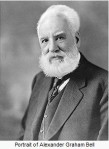
What our children and we think of as common parts of our daily lives were once developed for other purposes. The good part of the human race has always sought ways to help the disabled among us lead more productive lives. The concept of IQs was developed as a way to better understand the mentally challenged among us. The typewriter was originally developed to assist Cerebral Palsied people write. Alexander Graham Bell was a teacher of deaf children when he developed the telephone. His wife, Mabel Hubbard Bell, a deaf woman, was a major funder of early aviation. She funded almost everyone that wanted to fly across the Atlantic Ocean with the exception of Charles Lindbergh.
In modern times Raymond Kurzweil developed OCRs in creating a reading machine for blind people. OCRs have opened up a wide range of new technological devices as well as given blind people unlimited access to the printed world. Ray Charles, an early user of his reading machine, said he could read his own mail and bills and not have to have another person read his most private correspondence. Continue reading →
Lawrence Lessig, a professor at Harvard Law School, was the featured speaker at “Plenary V: Fostering Innovation: How to Build the Future.” The video below was uploaded to YouTube by eg8 on May 25, 2011. The focus of this panel was entrepreneurship, but Lessig’s talk has tremendous implications for educators if we substitute “schools” for “modern democratic government.” In this altered scenario, the counterparts for “incumbents,” or “special interests,” the movers and shakers in the private sector, are the tradition-bound schools. In both cases, the environment is unfriendly to “outsider innovation.”
Lessig’s presentation begins at the 2:05 mark and ends at 12:30.
Lessig points to Netscape, Hotmail, ICQ, Google, Napster, Youtube, Skype, Facebook, and Twitter and asks, “What unites all of these innovations?” His answer is a wake-up call: “They were all done by kids, dropouts, and non-Americans. Outsiders.” Lessig explains that “the internet is … a platform… an architecture with consequences.” One of the consequences is that it invites outsider innovations. The problem is that outsider innovations threaten the incumbent, e.g., “Skype threatens telephone companies. Youtube threatens television companies.” Continue reading →
Humans developed oral aural speech and language to share publicly their private sensory experiences. In the beginning of civilization there was the WORD. About 5000 years ago humans developed a stable form of speech and language. The written form of language was made possible by the creation of a phonetic alphabet. They stored experiences and knowledge in libraries and could transport this information over space and time, handing it down from one generation to the next in scrolls and books. Then they developed the printing press, which made books more accessible.
Perhaps two of the most significant changes came with the development of wearable glasses and the electric light that vastly expanded the time a person could devote to reading. These factors remain critical even in today’s digital world. Wearable glasses on the personal level allow people to read their entire lives. The printing press and inexpensive books and the electric light enable modern schools to be developed. Teachers working with students with textbooks can impart the knowledge of all mankind from generations past to new generations. Continue reading →
Rupert Murdoch has taken on education for the benefit of the world and also for profit — as his recent hires and acquisitions attest. What he says in his speech is not at all diluted, in my mind, by this profit motive, which he left out entirely.
He said, “If we had a gold mine on our property, we’d do whatever it takes to get that gold out of the ground.” This metaphor is obvious, and we ignore it at our peril.
To me, the most telling thing he said was, “The key is the software that will engage students and help teach them concepts and learn to think for themselves.” The “think for themselves” is especially important to the future.
As we might have said 50 years ago, a computer is just a doorstop without decent software. Education has suffered from the software that was provided for it, by and large. Too many schools turned computers into instruments for learning “keyboarding.” Too many classes used computers as substitutes for other simpler technologies and adopted office software for the classroom. That software is not targeted to education by any stretch of the imagination, and it took considerable imagination of some teachers to make it do good things for their classes. But not every teacher was so talented.
Rupert Murdoch, chairman and CEO of News Corporation, presented “Digital’s Next Frontier: Education” at the e-G8 Forum, “The Internet: Accelerating Growth,” which was held in Paris, May 24-25, 2011.
The actual talk begins at the 2:28 mark, and the entire video runs for 23 minutes. From Murdoch’s perspective, the world’s children are human capital. However, our educational systems are broken and wasting our children’s potential. Schools represent “a colossal failure of imagination,” and one of the reasons is their inability to keep pace with change.
The greatest change of all is the digital revolution, which frees people from the “tyranny of time and distance,” and it’s occurring in every field except one — education. He says that a time traveler from the mid-19th century would find that schools today haven’t changed much. The classroom is still defined by a teacher with a book and a blackboard.
I continue to be fascinated with the education of disabled children and the impact of technology. A simple example of technology and the employment of disabled learners is the fast food market’s cash register. A mentally limited individual can be accurate by simply entering the cash register through pictures of items on the menu. Such registers calculate the cost, enter the money, and spit out the correct change. The only skill is the ability to use the pictographic keyboard of the cash register.
All infants join the collective society by learning the coding systems of communications. That is, through speech and language. By the time the average child enters first grade, he or she will have a 4000-word vocabulary. However, the range will be between 2000 and 6000 words. The range is partially determined by how much the parent talks with the child. The child with a 6000-word vocabulary will do well in our modern schools.



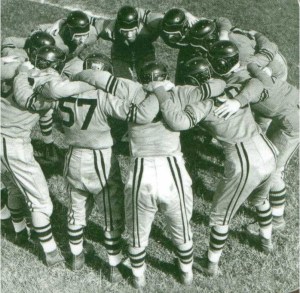 Paul Hubbard, a deaf player at Gallaudet University, invented the huddle in 1894.



















 Educational Technology and Change Journal
