Why Teaching Is No Longer Relevant in Online Courses and MOOCs

Jim ShimabukuroBy Jim Shimabukuro
Editor

Harry Keller raises some hot issues in his comment on “Attrition in MOOCs: Is It a Problem or an Advantage?” The good news is that most are attributable to course design, which exposes a critical difference between traditional and blended courses, on the one hand, and online courses and MOOCs, on the other. In contrast to a series of teacher-led onground classes, an online course is more like a pattern of codes in a complex software program.

As such, it shares a trait common to all programs, and that’s bugs. In other words, it’s a perpetual work in progress. It’s never completely free of bugs. In fact, you don’t know what the bugs are until users expose them or bring them up. To make matters even worse, some of the bugs are intermittent, lying dormant for weeks or months and suddenly popping up when least expected.

This is where debugging in the form of creativity and problem solving enters the picture. In short, setting up an online course is just the beginning of a long-term commitment to debugging and improving the “code” until the course does what it’s supposed to. It’s not a matter of a semester or two but years, and the process is open-ended, never ending.

This means that abandoning a MOOC or online course because it fails in the first go around is like expecting a software program to work perfectly the first time it’s used. It’s never going to happen.

A great online course is great because it’s always evolving even after many years. It never stops growing and changing. By the same token, a poorly designed course can only get better IF the debugging is effective. Thus, teachers, students, and administrators really need to be patient and give the process a chance to evolve.  Continue reading

Trigger Warnings, English Grammar and Style, Ed Tech and K-12 Teachers

Jim ShimabukuroBy Jim Shimabukuro
Editor

warns us that “Students no longer receive their education directly from a person standing in the front of a lectern and the learning experience may now take place virtually or across augmented realities…. Faculty should take proactive steps to address potentially triggering material that they set students to watch or read online, prior to a meltdown occurring.”1 She provides insights into how to integrate trigger warnings into assignments and lectures, e.g., via eblasts and in-line messages.

* * *

If you’re a teacher concerned about your students’ writing or a student searching for a way to upgrade your basic writing skills, here’s a MOOC that might address your needs. English Grammar and Style is an “eight-week course… starting on July 26 [on] how to apply grammar and syntax to ‘produce coherent, economical, and compelling writing.'”2 It’s being offered by the University of Queensland via edX. Last year, it attracted 50,000 students. Thus far, it has attracted 10,000. MOOCs are free, and students can take them in conjunction with their regular classes. They can log in at a time and from a place that’s convenient for them.


* * *

, reporting from ISTE 2015, shared results from a study “released… by the Education Technology Industry Network of the Software & Information Industry Association.” Molnar says, “In general, the study found that the most critical unmet needs for K-12 educators are: Continuous access to adequate bandwidth[;] Access to the level of technology resources common to other professionals[;] Training in technology that is available to other professionals.”3 The dirty little secret in K-12 schooling is that precious little of our education technology dollars trickle down to teachers, who are asked to do more with less every year as the gap between technology and the profession widens. The question everyone ought to be asking is, Where are the tech dollars going?

__________
1As Learning Moves Online, Trigger Warnings Must Too,” The Conversation, 3 July 2015.
2Tim Dodd, “MOOC Watch: Users Flock to Online Grammar Course from the University of Queensland,” AFR, 3 July 2015.
3Educators Report on Uses, Wish List for Student Data in K-12,” Education Week, 1 July 2015.

Technology in Early Education: An Interview with Katie Paciga

Lynn ZimmermannBy Lynn Zimmerman
Associate Editor
Editor, Teacher Education

Katie Paciga, PhD, is an Assistant Professor of Education at Columbia College Chicago. She teaches courses in Language Development, Children’s Media and Technology, and Early Reading and Writing Methods. Her area of specialization is emergent/early digital literacy development. I interviewed Katie about her views on technology and literacy education for young learners.

LZ: What do you think is the most exciting connection between technology and literacy? Why?

KP: So, the way I see it, there is incredible cultural relevance to the whole connection between technology and literacy. That’s really the most important point. Scientists will continue to debate over the value-added (or not added) because we have evolved. While that debate happens, though, most people are using technology as a tool for communication — to consume information, to create new texts, and to communicate messages. The ways we carry out these actions have changed in the past decade in very significant ways. I suppose you could argue that technology has been impacting the ways we communicate from the time of the evolution of the first writing tool to the telephone, radio, printing press, television, and now the computer and Internet. Humans have always communicated, but today there are new vocabulary terms to describe how we communicate and the tools that we use to do so are different as well.

Dr. Katie Paciga

Dr. Katie Paciga

There are always new technological developments, so our strategies for consuming information, creating new messages, and connecting with other people to communicate our messages need to adapt and evolve fairly quickly. To be literate in a technologically advanced society we need to be able to ask good questions, execute searches, evaluate resources, comprehend material we choose to read, and then synthesize information across MANY resources. I guess, in some ways, we have always had to do this to advance knowledge, but the volume of resources and the reliability of the information children (and adults) encounter daily as they seek answers to their questions is much more diverse than it was just two or three decades ago.

Composition can often require a new language (i.e., computer code) if we are to contribute to creating new texts — contributing our own messages to the world. In addition, we need to be persuasive to get our messages heard in society where search engine optimized content gets communicated more readily than material that is not as clickable, shareable, etc. Visual content has become more prominent in texts, too.

The ways we connect to share our messages with one another have also changed with Facetime, Skype, Facebook, Twitter, Instagram, Snapchat, Vine, and the other forms of web-chat and social media. In this way our students’ messages (and sometimes images) are out there for a much wider audience than those in the immediate community.  Continue reading

Attrition in MOOCs: Is It a Problem or an Advantage?

Jim ShimabukuroBy Jim Shimabukuro
Editor

It’s hard to fault research into MOOCs since there are so many more questions than answers. Thus, I was drawn to the news that MIT researchers have developed “a dropout-prediction model trained on data from one offering of a course [that] can help predict which students will stop out of the next offering.”1 Still, I find myself questioning the purpose, which is to reduce the high attrition rates associated with MOOCs. The assumption is that 90% or more stopout is a problem that needs solving.

I’m not convinced that it is. It may be for traditional onground college courses where dropouts impact revenue, but it may not be for massive open online courses where most students are more like window shoppers than serious customers. MOOCs are an open invitation for anyone and everyone on the planet to come in, look around, and sample for free with no pressure to buy. Students can participate from anywhere at anytime during the day, so commuting or traveling to a specific location at a certain time is not an issue. Thus, the investment of time and money is almost nil.

MOOCs are risk free and convenient, and this is their nature and their attraction. The option to engage as one pleases or stopout at any time are strengths rather than weaknesses or problems to be solved. In short, traditional courses and MOOCs are fundamentally different, and attrition may be a problem for one but an advantage for the other.

In the context of massive enrollment, ten percent retention isn’t necessarily a bad thing when it means 100 out of 1,000 or 500 out of 5,000. Thus, MOOCs could be considered successful despite — and maybe even because of — their attrition numbers.

The question of why students step out is worthwhile and should provide useful results, but the purpose should be to improve instructional design to retain students intent on completing the course and not just to reduce attrition. These ends appear to be similar, but they’re not. The issue isn’t retention for retention’s sake but course design that’s optimized for serious students.

What matters is the attrition of students who are serious about completing a MOOC. In this population, what is the retention rate? What are the causes of stopouts? How can these problems be addressed?

We have a lot to learn about MOOCs, and one of the basic problems is figuring out what the right questions are. All too often, our questions reflect our preconceptions of what MOOCs are instead of what they really are. If we see them in the same light as traditional onground courses, then we’ll apply the same standards. If we see them in a different light, then we’ll begin the search for standards that are appropriate.

__________
1Larry Hardesty, “Helping Students Stick with MOOCs,” MIT News, 1 July 2015.

Lessons from Large-scale Digital Curators

Lynn ZimmermannBy Lynn Zimmerman
Associate Editor
Editor, Teacher Education

One advantage of the digital age is that it is easy to save anything. As individuals we save emails, documents, pictures, videos, many more files than we really need on our computers, on remote devices, most recently in the Cloud. We may be more or less organized with our “filing” system so that our digital records are at our fingertips, or not.

For teachers and students alike this ability to store and easily share files can be time-saving and create different ways of interacting with materials and with each other. As we use and save these files, we often assume that they are safe and will be around forever. The same goes for materials we access daily from a variety of websites.

However, imagine that you are responsible not only for your own digital records but for those of an organization, such as a library, museum or a municipal archive. How do you conserve and administer large-scale archives and repositories? How do you provide easy access of these materials to others? Luckily, there are trained professionals who handle the input and output of these large sources of digital information. Their knowledge about archiving and preservation can provide models which can be used in everyday life.

Recently, UNC Chapel Hill, one of the leaders in digital preservation, held the DigCCurr Institute to provide a space for digital curation professionals from around the world to share their ideas and learn about the issues and how to handle some of the challenges of large-scale digital preservation. You can learn more about it at: DigCCurr Institute 2015 Draws Digital Curation Professionals from Across the Country and the World

Virginia Leads Way to Online High School Diplomas

Jim ShimabukuroBy Jim Shimabukuro
Editor

Virginia leads the way to completely online public high school diplomas.1 “Virtual Virginia, the commonwealth’s online high school program, is poised to recruit as many as 100 students to pilot the state’s first full-time online diploma program.” The really good news is that the state is jumping into the virtual with eyes wide open. They’re “set to operate within the program’s existing $4.6 million budget.” They’re also aware that, at this point in time, “the online format suits some students more than others.” They’ve done the homework and learned that “those most likely to succeed in an online school tend to be self-motivated, self-directed students, and their learning style is suited to an environment that involves discussion through posts on message boards.”

It’ll be interesting to watch Virtual Virginia develop in the coming months and years. They’re opening a massive door that remains locked for most school systems in the country. The qualities for success online — self-motivation, self-direction, and active engagement in discussions — are perfectly aligned with those for success in MOOCs and the growing number of affordable online college offerings, which means an open door to college courses and the possibility of earning college credits while still in high school.

The possibilities for learning online are endless, and I wouldn’t be surprised if the last vestiges of classroom walls are eventually removed, allowing students to earn high school and college credits via widely available open learning resources such as MOOCs.

The potential for online resource sharing with high school systems in other states (and other countries) is also real, providing an infinitely richer array of courses, interactive opportunities, and experiences. In other words, geographical isolation will become less an issue, and in the early going, it may be a blessing in disguise, hastening the migration to online options. The challenge for administrators and teachers will be to maintain an open attitude toward schooling.  Continue reading

Charles Moran: A Tribute by Nick Carbone

Jim ShimabukuroBy Jim Shimabukuro
Editor

Nick Carbone‘s “#worthassigning: Five Online Essays by Charles Moran,”1 a touching and enlightening tribute to a pioneering leader in writing and ed tech, is #worthreading. Here are a few excerpts from the article:

Moran: “How the teacher uses a given teaching environment depends upon the character of that environment, of course, but it also depends upon who that teacher is.”

This is a timeless reminder that a teacher-proof, one-size-fits-all model for teaching with technology runs against the grain of what we know about successful teaching.

Moran: “I begin to resent, too, the amount of new work I seem to have to do. For instance, I’ve had to go all the way to my office to get to my computer to put together a writing exercise for the class, print multiple copies on blue paper, and cut the pages in half to distribute to the class. I wrote, ‘All this cutting and copying is time- and resource-consuming!'”

Moran wrote this in the context of technology at the time, and it underscores the importance of perspective in using technology in teaching. When the effort leads to less efficiency by increasing tedium and cost, then we need to step back and re-examine our priorities. This caveat, however, needs to be weighed against perceived long-term benefits. Is the current inefficiency a trial-and-error penalty for greater efficiency in the future?

Moran: “Technology seems to be leading us forward to new forms of writing, but, as used by standardized testing programs, backward to the five-paragraph theme.”

Moran has a way of hooking into the big issues in ed tech, and this is an example. Standardized testing serves a useful purpose, but that purpose can be a huge obstacle to critical reform. If we, educators, allow it to lead our practice, then we lose sight of other purposes that are equally and, arguably, far more important.

Moran: “Among our goals as writing teachers are these: help students discover and use their voices; help them take risks with their writing; help them master the grammar, usage, mechanics, and styles of written English.”

As teachers, we’re consumed by learning objectives, and in our quest for the kinds of objective data that computers are so good at gathering and crunching, we forget that measurability is a primitive gauge and that we really don’t know how to measure the higher order variables in writing such as the importance of one’s genuine voice in developing writing skills and the value of courage in exploring new forms of expression. Overreliance on competencies that can be easily measured ignores the critical importance of competencies that we can’t even begin to identify let alone measure.

Carbone: “It focuses on what is lost when one goes back to not using the technology after coming to rely on it, and so it reverses the anxiety many faculty feel when they start to use technology. Charlie does a great job of making a simple brick and mortar classroom feel strange.”

Carbone, in commenting on one of Moran’s essays, reminds us that the cat’s out of the bag. Once we’ve stepped into a new medium, returning to the old is out of the question. Our world of teaching is forever changing, and we have no choice but to keep moving with the flow.

__________
1 Odds and Ends, 24 June 2015. I received this tip from Bert Kimura (email, 25 June 2015).

Digital Storytelling for Social Change

Lynn ZimmermannBy Lynn Zimmerman
Associate Editor
Editor, Teacher Education

Zanizibar, like a number of developing countries, sees English as one of the keys to increased economic development, in their case through tourism. However, sometimes the question has to be asked: At what cost? One group of high school students in Zanzibar turned to technology to answer that question.


In “Teens Make Film in Broken English to Explain Why They’ll Fail English,”1 Gregory Warner at NPR reported on Present Tense,2 a short film in which three high school students use digital storytelling to examine whether all classes, such as science, math, social studies, etc., should be taught only in English. The young filmmakers talk about the move from all-Swahili education in their primary school years to an all-English education often taught by teachers who have little competence in the language themselves. In their award-winning film, the young filmmakers argue that instead of giving them an edge with improved language skills, they are learning almost nothing at all, neither English nor the content they need.

It is not clear whether a change was made due to this film, but the government in Zanzibar has decided to change the all-English policy and return to using Swahili as “the language of instruction in government schools” and returning English to the status of a foreign language class.

__________
1 25 June 2015.
2 The story on the NPR website also has a link to the film.

edX-ASU Global Freshman Academy: Will It Work?

Jim ShimabukuroBy Jim Shimabukuro
Editor

I really wanted to get excited about this Global Freshman Academy (GFA) idea of completing first-year college courses via MOOCs. It presses all the right buttons. You don’t need to go through the tedious process of applying, submitting transcripts, waiting for a letter of acceptance, etc. And it’s free, in the finest MOOC tradition. That is, if you don’t want college credit. For credit, you pay $200 per credit. Not cheap, but affordable. But it gets even better. You “only pay when you know you have passed the course.”1

But clicking into the details quickly reveals some shortcomings. First, the link to the How It Works video doesn’t work.2 However, the Try the GFA Orientation Course button, directly below, does. In the “About this course” section, clicking on the See more button takes you to a Q&A list, where you finally find some answers to basic questions.

To take the orientation course, you need to click on the Enroll Now button, which takes you to the Create an account page. I didn’t register, but the process seems simple and quick. You have the option to create an account via your FaceBook or Google accounts.

As it stands, the GFA is really just a single course, Introduction to Solar Systems Astronomy, which “is now open for enrollment, and starts in August 2015. Two additional courses will be offered starting fall 2015, with the remaining courses scheduled to be released within the next 24 months.” I’ll let you decide whether this lives up to the hype of a global program that “reimagines the freshman year experience” and “creates a new path to a college degree.” Even after all the courses are in place, there’s no guarantee that the aggregate will form a typical freshman year experience that will allow students to move directly into their second year.

Costs are a bit fuzzy. You have to pay an upfront $45 fee to enroll in the “Verified Track,” required “to ensure you are eligible for credit once the course is over.” And this, I assume, is in addition to the $200 per credit if you decide to go that route. I’m also wondering if the verified track registration is just a ploy for the usual tedious college application process. Furthermore, it’s unclear whether the $45 fee is required for every course and not a one-time fee, but the implication is that you need to pay the $45 upfront for every course to reserve the option to convert to credit. Again, I’ll let you to decide if this is or isn’t a variation on the old bait-and-switch.  Continue reading

Blended Learning, Digital Equity, Skills-based Economy

Jim ShimabukuroBy Jim Shimabukuro
Editor

Phil McRae is among the very few in education who see a problem in hyping blended learning, “where students’ face-to-face education is blended with Internet resources or online courses,” as innovative. He says, “As this broad definition illustrates, it would be difficult to find any use of technology in education that does not easily fit into this boundary.”1 This is not to say that all uses of technology in schools aren’t innovative. Some are. But simply adding web content or activities to classes that are primarily F2F isn’t necessarily new or effective.

Still, the biggest problem with blended approaches, innovative or not, isn’t so much its effectiveness but its impact on completely online courses. For many educators, blended is synonymous with online when it reaches a tipping point, measured in a ratio between F2F and online requirements. When a certain percentage — roughly 80% — of the course work is online, then the class is placed in the same category as fully online courses.

This seemingly innocuous perception is arguably the greatest impediment to the development of completely online courses and programs. The F2F imperative, whether 20 percent or 1 percent, instantly eliminates the possibility of disruption that defines online learning. In other words, the door for nontraditional students who cannot, for whatever reason, attend classes on campus remains closed.  Continue reading

A Sensible Higher Ed Business Model for Online Degrees: Are We There Yet?

Jim ShimabukuroBy Jim Shimabukuro
Editor

Not yet, but we’re getting close.

Devon Haynie, in “10 Most Inexpensive Online Bachelor’s Programs for Out-of-State Students,”1 provides signs that higher ed has reached a milestone in the quest for a business model for online degrees that makes sense for the population that needs it most — students and families of students who simply can’t afford today’s high cost of a bachelor’s degree.

For students from low-income families, the bottom line is tuition that can be paid through minimum-wage part-time jobs. In other words, can they earn enough working 20-30 hours a week to pay their tuition?

In a time when tuition is rising instead of falling, online technology has been the light at the end of a very long tunnel. But until now, that light has remained distant and dim, receding rather than growing closer, with colleges viewing technology as added value to onground traditional courses and calling the mix “blended” while driving the cost of education even higher.

To further stymie the growth of online courses, they make them as unattractive as possible, continuing to charge online students the same fees as their onground counterparts even when they don’t use the same resources. To further stick it to online programs, out-of-state fees are also charged, effectively shutting out the potentially large disruptive population of nontraditional and low-income students.

But all of that is changing. At last.

For example, Mary, a hypothetical student who lives at home with her parents and works 20 hours a week at the counter of a fast-food restaurant in Wai’anae, Hawaii, can now earn enough to pay her tuition at Texas Tech University, where she’s working toward a bachelor’s in Special Education and Teaching. The cost per credit hour is $213, and she needs 120 credits to graduate. The total cost for four years is $25,560, which breaks down to $6,390 a year or $3,195 a semester.  Continue reading

Kadenze, CourseTalk, ECO, MOOC Completion

Jim ShimabukuroBy Jim Shimabukuro
Editor

Updated 6/21/15

As MOOCs proliferate, an inevitable byproduct is MOOC review services such as Class Central and CourseTalk.1 The problem, however, is that their results probably have limited generalizability. In an interview a few days ago, Justin Reich2 reminds us that “the people who respond to surveys about their experience are different than people who take the courses broadly.”3

* * *

Kadenze is a new MOOC platform for art courses. Stanford and Princeton are listed among their partners. “According to a company co-founder, Perry R. Cook, an emeritus professor at Princeton, the platform will be ‘multimedia rich’ and allow students to create online portfolios, upload music files and scanned art, watch videos, and participate in discussion forums.”4 The list of features is impressive, but the need for packaged services such as these highlights the glaring weakness of online instruction in general — the lack of media savvy among most professors in the academic disciplines.

In the current best practice model, online courses are divided into two dimensions: content and delivery. The professor provides the content, and the instructional technology department provides the delivery. This approach is a stopgap, and ultimately unsustainable. It’s the equivalent of hiring a professor to produce content for a course and a second professor to deliver it. But it’s even worse considering it involves IT staff and resources. The cost quickly approaches the prohibitive, and the vast majority of cash-strapped colleges will either back off or provide low-maintenance CMS platforms, which guarantee cookie-cutter courses that are uniformly bland and unimaginative.  Continue reading

Language Is a Barrier to Digital Equality

Lynn ZimmermannBy Lynn Zimmerman
Associate Editor
Editor, Teacher Education

What language do you “speak” when you use the Internet? Why does it matter? In her article in The Guardian (online, of course), Holly Young explores “The Digital Language Divide: How Does the Language You Speak Shape Your Experience?1

Young points out that when the Internet first began, 80% of the content was in English. That figure has now dropped to 30%, and out of the 6,000 or so languages in existence, 10 of them make up 82% of all Internet content. These figures prompted her to ask some questions: Does the language you speak online matter? How is your Internet experience different if your first language is not one of those 10? How does language shape your access to information and your ability to communicate globally?

Young asserts that it definitely does make a difference. Just as language in day-to-day life can shape your connections with others and your common interests, the Internet does the same. People often communicate with those who speak the same language, sharing ideas and information that is common for their language group. Research has even shown that bilingual users behave differently on different platforms in their two different languages.

The author makes many other points about the inequality of information, who is represented, and how some groups are represented by others. She also looks at ways to bridge the divide and explores which languages will survive online.

Why should this issue be of interest to us as educators? Young tells us that “[i]n 2011 the UN declared access to the internet as a basic human right.” However, not everyone has equal access, whether due to inadequate infrastructure or the lack of linguistic diversity on the web. We should think about what we and our students are missing if our access is limited by language.

__________
1 N.d. WebCite alternative.

Gwen Sinclair

(Published 12 June 2018)
Gwen Sinclair
Librarian
Government Documents & Maps Department
University of Hawai‘i at Mānoa Library

She holds master’s degrees in Library Science and Geography from UHM and is an adjunct faculty member in the UHM Library and Information Science Program. Her publications reflect her interest in government documents and federal property in Hawai‘i.

ETCJ Publications
These Boots Are Made for Running
Not in Our Lifetime: Are Libraries Dead?

Whither the College Library?

Jim ShimabukuroBy Jim Shimabukuro
Editor

Updated 6/14/15
When was the last time you stepped into a college library? If you’re like most, that time is somewhere in the distant past, and this is true even if your work takes you or keeps you on campus. Just as the textbook was the portal to knowledge for a course, the library was once the portal to primary sources of information for all courses. That is, before the advent of smartphones, tablets, notebooks, and the internet.

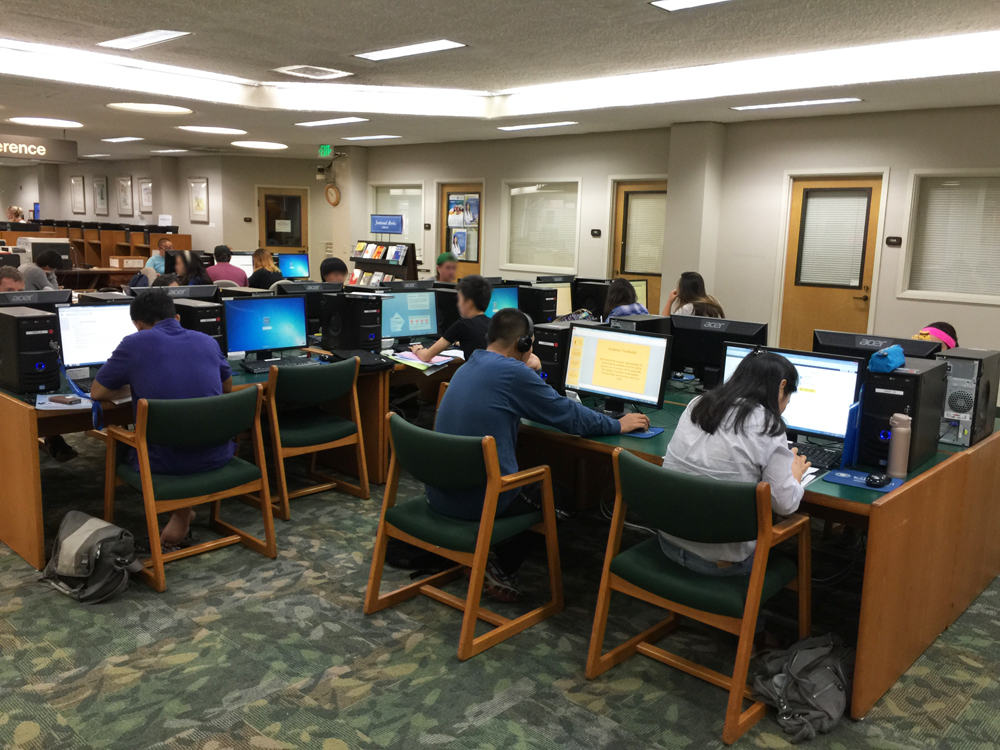
The first thing you notice when you enter is the absence of rows and rows of bookshelves. Instead, the space is filled with study carrels and tables.

The first thing you notice when you enter is the absence of rows and rows of bookshelves. Instead, the space is filled with computer workstations (above), study tables and carrels (see photos below).

Today, all the limitations that we attribute to a hardcopy textbook are reflected in the library. In a world of mobile anytime-anywhere communications and access to information, the library is looking more like a phone booth, a movie theater, a Blockbuster, or, more tellingly, a Borders. Just as the tiny businesses that sprouted along highways faded away when freeways bypassed them, the library is fast becoming a victim of the cyberway, the electronic equivalent of an extreme autobahn.

The library is a study center.

The library is a study center.

In essence, the smartphone that students carry in their pockets and bags has become the interactive portal to not just library information but to nearly all information. This fact alone probably says more about the future of libraries and, by extension, college campuses than all the articles and books ever written about the impact of technology on higher education.  Continue reading

Technology Advice for First Year International Students in US Colleges

Lynn ZimmermannBy Lynn Zimmerman
Associate Editor
Editor, Teacher Education

International students in the United States, whether they are native English-speakers or English Speakers of Other Languages (ESOL), face some unique challenges when attending American universities. Jiongcheng “Arthur” Xu, in “Five Ways to Prepare for Freshman Year at a U.S. College,” encourages incoming freshmen who are international students to take advantage of technology to prepare themselves for their experience. I think two of his ideas are especially relevant for all international students whether they are coming to the US or going elsewhere.

His first suggestion is to practice writing. He rightly points out that the US educational system relies heavily on reading and writing, whether it is traditional classwork or communicating with classmates through FaceBook and texting. Recently, I was at a conference in Croatia, and one young woman shared her experience as an international student who had never used a classroom management system.

She did not realize at first that her instructors expected her to take some responsibility for her learning by logging on regularly and accessing course materials, reading and corresponding either through the site or through email with the instructor and fellow students, and participating in online discussions. Not only is the online learning environment a different paradigm than many international students are accustomed to, but each of these activities requires different writing skills and not always the 5-paragraph essay that students of English are often taught.

Another suggestion that he made was to find university lectures in English online and watch them. Not only will they improve their listening and note-taking skills, they will get an idea of how professors in the US conduct a class. I would also recommend that they try to find recordings of classes in which there is interaction among students. One of the skills that a language learner may need to learn is how much information to give and how long to talk before yielding the floor to another speaker. I have found that sometimes when international students have finally gotten up the nerve to participate in a class, they do not understand the unspoken rules of turn-taking and quantity of speech that is appropriate in certain situations.

What has your experience been with using technology for college preparation, either as an international student or as a teacher of international students?

Creativity Is Thinking Deeper

picture of Harry KellerBy Harry Keller
Editor, Science Education

What is creativity? A typical definition might be “the ability to create new things using your imagination.” Using the word “create” in the definition seems to remove some of the definition, however. Merely changing “create” to “produce” may be more satisfying.

Whichever definition you prefer, it’s clear that imagination is involved as is making something new on the face of the planet, at least new to the creator. Much more important than the what of creativity is the how. How do you become more creative?

Being in a creative job (making new online science lessons that are truly different), having a creative avocation (writing fiction and non-fiction), and having been in creative professions previously for a long time (first scientist and then software engineer), I have some thoughts. Many ideas about being creative have been explained by very many people before. There are endless suggestions ranging from meditation to travel.

To all of these, I’ll add one idea. It’s not a new one, but then none truly are. I happen to like this idea because it fits with my concepts of what a scientist, such as myself, must be able to do. It’s an important part of scientific thinking and of many professions that must see something where others do not.  Continue reading

‘Inside 360’: Behind the Scenes of the Mars One Mission

Amersfoort, 27th May 2015 – Mars One is proud to introduce Inside 360; a series of in-depth articles that present an inside look into the details and feasibility of the Mars One mission. The first article can be found on Mars Exchange. Subsequent articles will be added periodically.

Mars One has taken the first crucial steps in the process of establishing the first human settlement on Mars. In order to address the questions and concerns that have been raised, Inside 360 will foremost provide an in-depth explanation of the individual phases of the mission. Mars One is continuously improving their mission plans based on advice from advisers and suppliers, and Inside 360 will offer the rationale behind decisions made. The ongoing series will additionally feature interviews with Mars One team members and external experts about the different aspects of the mission.

Click image to enlarge.

Click image to enlarge.

“Mars One is still in the early stages of organizing this human mission to Mars,” said Bas Lansdorp, co-founder and CEO of Mars One. “We are looking forward to sharing our developments as well as the studies completed by our suppliers. This way, the aerospace community can share their feedback and we can implement suggestions that improve our mission design.”

Astronaut Selection: Inside 360 will describe the Mars One astronaut selection process and include an interview with Mars One’s Chief Medical Officer, Norbert Kraft, M.D., discussing the selection criteria. Dr. Kraft has researched crew composition for long duration space missions at NASA and has also worked for the Japanese Space Agency and collaborated with the Russian Space Agency.  Continue reading

The Paleo Diet Belongs in Caves: What You Really Need to Know About Diets

picture of Harry KellerBy Harry Keller
Editor, Science Education

Diets provide a great opportunity to exercise critical thinking. Pick any diet and pick it apart. Do this as a mental exercise or, if you teach, with your classes. Chances are that many of your students’ parents have dieted or are dieting. In this article, I am picking on the currently trendy Paleo diet.

The Paleo diet persists. I have a strange theory about diets. The first part is that people don’t like to diet. They like to eat whatever they choose. I suspect that this is especially true of libertarians. The second part is that many people see their food as a health problem and would like to change their eating patterns.

Many years ago, the Grapefruit Diet was very popular. This was great for people who loved grapefruit but not so much for those who found them too sour or too messy. Then, there was the problem that grapefruits are like the proverbial Chinese dinner that left you hungry shortly after finishing it. “Have another piece of grapefruit” just doesn’t work for most people.

Skeleton and restoration model of Neanderthal (La Ferrassie 1). Exhibit in the National Museum of Nature and Science, Tokyo, Japan.

Skeleton and restoration model of Neanderthal (La Ferrassie 1). Exhibit in the National Museum of Nature and Science, Tokyo, Japan.

Anyway, my theory is that diets are successful not if they work but rather when they cater to people’s desires. If you could get away with an ice cream diet, you’d have the world doing it because “everyone likes ice cream.” I haven’t yet seen a broccoli diet even though it would probably work better than grapefruit.  Continue reading

Using GIS and GPS Technology as Teaching Tools?

Lynn ZimmermannBy Lynn Zimmerman
Associate Editor
Editor, Teacher Education

Recently, I was at an education conference in Croatia, and one of the presentations was about using geographic information systems (GIS) and global positioning systems (GPS) technology as teaching tools. The presenters proposed that this technology can be integrated in a variety of ways to create interdisciplinary lessons and projects that are technology-based. Students can learn with the GIS and GPS rather than just learn about it so that they can become producers of knowledge about the physical world around them and not just consumers of information.

One of the connections the presenters made was to the sport of orienteering to promote the development of map-reading skills and navigation. Even though orienteering is usually done low-tech with a compass and a map, higher levels of technology can create a different experience for participants.

“Field-Map birdie” by Claudiusmm – Own work. Licensed under Public Domain via Wikimedia Commons.

Of particular interest for me as a teacher of English as Foreign Language are the ways this type of technology can be used to create authentic (real-life) reading, writing, speaking and listening activities for students. The presenters made a specific point that students’ real life knowledge about nature gained with this technology can easily be represented through the medium of digital story telling, which itself integrates reading, writing, and speaking and uses critical thinking skills as students plan and develop their project.

If anyone has had experience with these types of projects, I’d like to hear about them. Post a comment to this article or email me at zimmerma@purduecal.edu

__________
A preliminary list of resources:
Alec Bodzin, GIS and GPS Links, Lehigh University, 2/12/15.
GIS in Education Resource Sheet,” Utah Rural Schools Association, n.d.
Jennifer Johnston, “Engineering Professor Shares Mapping Technology with Teachers,” MyVU, Vanderbilt University, 8/20/14.
Bianca Bowman, “Teacher Knowledge and Geospatial Technologies,” Conversations on Knowledge for Teaching 2015 Education Technologies: Now and in the Future, n.d.

Deus What?

picture of Harry KellerBy Harry Keller
Editor, Science Education

Yet another “robot” movie has appeared, and another Terminator movie is scheduled for release. It’s the robots who should be saying, “I’ll be back.”

Having already written on robots and artificial intelligence, writing about the latest opus, Ex Machina, may seem anticlimactic. This movie certainly has some excellent optics. Just four characters make up the speaking parts. One more is important to the plot, and only ten are listed in the credits. This is a small movie when measured by personalities on screen. The special effects that make Ava look mechanical are almost astounding and, along with the scenery and sets, make this a large movie.

The premise that a lone genius can create an artificial intelligence that passes muster as capable of human thought is an enoromus stretch. That he also can fit it all into a human framework that can walk bipedally and can perform other human-like actions is beyond imagining. You really must suspend disbelief to watch this movie and seek its philosophical underpinnings.

In the end, it’s the same old story that we’ve seen since Mary Shelly wrote Frankenstein. Man should not play god, and creating new life is extremely dangerous. The movie plays on the morality of choosing to be god and on people’s fears of the unknown, especially when created by a “mad scientist.”  Continue reading

Textbooks, Emoticons, Assessment, Technology

lynnz_col2

Universities seek alternatives to expensive textbooks by Leslie Corbly in Deseret News National 4/25/15
With the increasing cost of textbooks, schools are adopting policies to allow open source textbooks that can be offered free online to students. Research shows that interactive digital texts not only cut costs but improve student engagement.

Some bilinguals use emoticons more when chatting in non-native language in Science Daily 2/17/15
The use of the emoticon (which many people love to hate) by language learners was studied by a research team and compared to the use of nonverbal communication and found a correlation ;-)

New Tablet-Based Interactive ELL Test in Language Magazine 2/20/15
This new tablet-based assessment, which can provide data about ELLs, raises the question about how much information we want a private company to have about our students and whether and how it should be disseminated. These issues are not addressed in the article.

Teachers Mixed on Common Core, Support Blended Learning by Dian Schaffhauser in The Journal 2/9/15
A poll conducted by the Association of American Educators showed that more than 90% of teachers in the US report that they use technology in the classroom and that 67% of them are in favor of blended learning and that students should be required to take at least one online course before graduation. I assume they are talking about high school.

Technology changing teacher’s role in Science Daily 2/16/15
In what should come as no surprise to anyone, a recent Finnish-Swiss-Belgian study showed that “the use of technology changes the role of the teacher from a traditional knowledge provider rather into a facilitator guiding the students’ learning processes and engaging in joint problem-solving with the students. In addition, technology offers a range of new types of learning possibilities.”

The End of Dark Energy

picture of Harry KellerBy Harry Keller
Editor, Science Education

Dr. Peter A. Milne and his associates have found an unexpected and, to the cosmological community, startling result from their surveys of supernovae. This result illustrates both the consistent and varying nature of science at the same time.

Dr. Peter Milne

Dr. Peter Milne

We know from a great many astronomical observations that the universe has been expanding for a little short of 14 billion years and continues to expand. Because of gravity, everyone expected that this expansion was slowing over time with theories and measurements suggesting that this expansion would eventually coast to a very dilute universe drifting apart at ever slower speeds.

In the 1990s, some astronomers separately discovered that the universe is expanding ever more rapidly instead of the expected opposite slowing of expansion using measurements of he brightness of very distant supernovae. They received the Nobel Prize in physics for this work in 2011.

Stars can explode. One common explosion is called a nova. A much more cataclysmic and extremely brighter explosion is a supernova. Supernovae shine with a brightness that can exceed that of all of the hundred billion or so stars in its galaxy. For this reason, we can see them in distant galaxies that are barely visible in our best telescopes. A supernova is a rare event occurring about three times a century in a galaxy the size of our Milky Way. With hundreds of billions of galaxies, however, it’s not too hard to find hundreds each year using modern astronomical equipment.

A special sort of supernova created when the two stars in a binary star system go through a specific series of interactions is known as a type 1a supernova. Because of the steps required to reach supernova status, the brightness of these type 1a supernovae has been considered to be a constant that can be used to estimate distances to very distant galaxies. Brightness declines with distance in a very precise manner.

There remains the possibility that acceleration of very distant bodies in our universe away from each other is a basic property of our space-time structure not detectable at smaller distances of only millions or even tens of millions of light-years, that “dark energy” is just an attempt to recast a phenomenon into understandable terms, just as the caloric theory of heat was long ago. -HK

The measurements of these supernovae were the reason to believe that the expansion of the universe was accelerating. We are seeing these very distant supernovae with light that started its journey over ten billion years ago when the universe was very young. Dr. Milne has discovered that type 1a supernovae are not all the same but fall into two categories of different brightness. Furthermore, the supernovae from the early universe are, on average, less bright than those in the more recent universe.

The lower brightness of the distant supernovae may well be due to less inherent brightness instead of greater distance. This finding destroys a fair piece of that Nobel Prize discovery. Dr. Milne still attests that the universe’s expansion is accelerating, just not so fast, but the vast number of recalculations being done to account for this new discovery will take some time.  Continue reading

Digital Privacy, ELL, Smartphones and GPA, Language and Smell

lynnz_col2
Bill Would Limit Use of Student Data by Natasha Singer in the New York Times, 22 Mar. 2015
Singer looks at some of the issues raised by the Student Digital Privacy and Parental Rights Act, a bill to place limits on how “companies that operate school services — like online homework portals, digital grade books for teachers or student email programs —” can use or disclose “students’ personal information to tailor advertisements to them” and “bar them from collecting or using student data to create marketing profiles.”

Digital curriculum targets ELL learning gap from eSchool News, 19 Mar. 2015
Middlebury Interactive Languages has developed English Language Learner programs which “are modeled after Middlebury Interactive’s world language courses and, like those programs, integrate research-based learning techniques, cultural awareness and project-based activities into blended learning classrooms.”

Increased Smartphone Use Equals Lower GPA Among College Students by Brian Heaton from from Government Technology, 17 Mar. 2015
This study from Kent State University about the effects of smartphone use on grades is sure to cause a stir. Even controlling for certain “known predictors, the group still found the relationship between cellphone use and GPA was ‘statistically significant and negative.’”

Does speaking English limit our sense of SMELL? The ability to identify and describe odours depends on the language you speak by Richard Gray for Mail Online, 30 Mar. 2015
While this article is not technology and educated related, it does look at the science of language from a different perspective as researchers describe the relationship between the language we speak and our sense of smell and our perception of colors.

Robots in Movies

picture of Harry KellerBy Harry Keller
Editor, Science Education

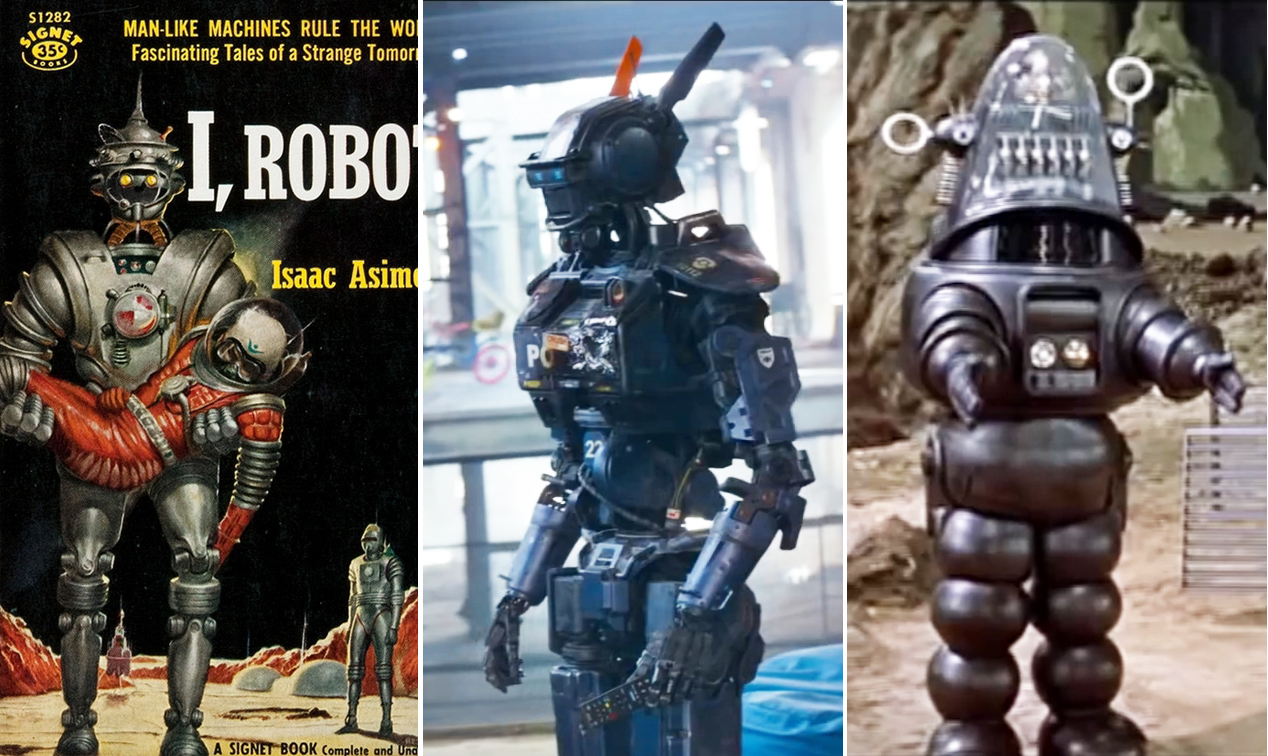
Artificial intelligence has appeared in a great many movies over the years, often as robots. The latest is Chappie, a movie that has been panned by a majority of critics but apparently enjoyed by quite a few movie goers.

Robots (or AI) have been good and bad. The first that I recall was Robby in the first science fiction (SF) movie to adhere to scientific ideas (of the time), Forbidden Planet. This 1956 movie starred Leslie Nielsen when he was still doing romantic leading roles. The character of Robby created quite a stir at the time. He was definitely a benevolent robot who was unable to harm humans. An immense computer system, the hidden evil element of the movie, served as a foil.

robots 03
Most people remember HAL, the AI embedded in the spaceship of 2001, a Space Odyssey. This movie debuted twelve years later and showed how AI could be a force of evil. Few who saw it will forget the creepy voice of HAL (notably one letter apiece short of IBM alphabetically).

I probably will not see Chappie for several reasons based on the reviews and my viewing of the trailers. The concept of artificial intelligence rising to the level of human consciousness bothers me, not for religious but for scientific reasons. However, many students probably will see it if only because of its themes involving street gangs and defiance of authority.  Continue reading