The ‘Fury’ of War Tanks

picture of Harry KellerBy Harry Keller
Editor, Science Education

The new Hollywood movie, FURY, focuses on tanks, their role, and tank crews in World War II. This 2-hour 14-minute film opens in theaters on Friday, 17 Oct. 2014. It stars Brad Pitt, a sure audience draw, playing the somewhat complex leader of the five-man crew of the FURY, a Sherman tank. If you go to this movie, watch Logan Lerman as Normal Ellison. He almost steals the show.

The movie starts in April 1945, near the end of the European part of World War II. VE (Victory in Europe) day is celebrated here as May 8, 1945. It’s spring, and everything is mud, mud, mud. American troops are in Germany by this time, and the famous Battle of the Bulge ended a few months earlier. German troops are now defending their homeland ferociously.

FURY, a Sherman tank.

FURY, a Sherman tank.

The main character of this movie truly is FURY, at least for me, and really did steal the show when I watched. The tank used in the filming was real, supplied by the Tank Museum in Bovington, England, a late-war Sherman with a 76mm gun. That’s the big gun on the turret. The inside shots were done in a specially created set that could open up in several directions for the different shots. The entire set was mounted on a gimbal that could move it for the inside shots where the tank was in motion. If you think that the inside of that tank looks really crowded, you should know that it was made 10% larger than the real thing.

Before discussing tanks in more detail, I should warn potential movie goers that this is a very violent movie with lots of grisly scenes, very grisly, and plenty of profane language in nearly every scene. Interestingly, there is no explicit sex.

For those who don’t mind the above, this is truly a riveting and tense movie. There’s little let up in the tension that begins with the first scene. I found it difficult to turn away from the screen even when the most horrific scenes took place. The characters are interesting but, except for Pitt (playing Wardaddy) and Lerman, they’re not plumbed deeply. Even Wardaddy, who says, “It’s my home” about the tank, never has this aspect explained, except implicitly. We are left to wonder if this attachment came about over time or from a single incident. We also are given no clue as to how he became fluent in German.

One more “character” in the movie is the entire FURY tank crew of five. The examination of the development of this team and its personality helps to make up for not looking more deeply into the individual characters because it’s the team and the tank that count in the end.

My favorite quote, again from Wardaddy, “Ideals are peaceful. History is violent,” sums up the movie. Get ready for a Hollywood ride.

Back to the tanks — we’re still using those old machines today. The first were used in World War I a century ago and were rather primitive. They were little more than mobile armored weapons and personnel protectors to move troops across the no-man’s land between trenches while withstanding the machine gun fire and easily trampling the extensive barbed wire fences for the following ground troops. The WWII tanks were much more powerful and versatile and formed the mainstay of many land operations. In the movie, we see quite a few German officers at the front on horseback. This contrast of horse and tank may be intended to suggest that tanks will soon go the way of the horse.

David 'Sting' Rae, center, with the crew on set.

David ‘Sting’ Rae, center, with the crew on set.

To have a better idea of what the past and present role of the tank is in warfare and what the future may bring, I interviewed David “Sting” Rae, a technical consultant for the movie. Mr. Rae sees a continuing role for tanks in the military. According to Mr. Rae, “The US Marines reinvented the role of the tank in Fallujah during the Iraq conflict where it proved almost decisive in breaking the will of the insurgents and allowing the infantry to take and hold ground.”  Continue reading

U.S.-Russian Collaboration

VicSutton80By Vic Sutton

At a time when relations between the United States and Russia are cooling – if not cold – an innovative programme of the Eurasia Foundation continues to promote exchanges of professionals from both countries.

The ‘U.S.-Russia Social Expertise Exchange’ (SEE for short) was set up to promote co-operation between civil society leaders from the two countries.

Twelve working groups bring together experts in programme areas that include, for example, child protection, collaborative journalism, gender equity, and ‘rule of law and the community’.

Bonnie Bracey Sutton

Bonnie Bracey Sutton

My wife, Bonnie Bracey Sutton, is a member of the SEE working group on ‘Education and Youth’, and I had the chance to accompany her to its last meeting, held on 10-11 October in Washington, DC.

The working group hopes to hold a research seminar in March 2015, to appoint two senior and two junior fellows from each country who will take part in exchanges through February and March 2015, and to organize a ‘Cyberfair’ to showcase its projects, perhaps in November next year.

Bonnie had a fellowship from the Eurasia Foundation, which took her to Saint Petersburg and Samara last February, and I paid my own way to travel with her.

Our greatest surprise was to discover that Russia, despite its leadership in areas like space technology, is a poor country. People take home USD 250-300 a month. Of course, prices are lower than in the U.S, so that is not so terrible in terms of purchasing power.

But we never before visited a country where just about everyone with whom we had a serious conversation wanted to know our home address (if you want to get a visa to visit the U.S. you have to supply a U.S. address).

The U.S. Government has said that despite poor political relationships, social and cultural exchanges between the two countries will continue to be funded. We hope so, and we will see what modest support we can provide to contribute to them.

Blood Red Moon Over Honolulu – 8 Oct. 2014 at 1:28am

Jim ShimabukuroBy Jim Shimabukuro
Editor

I stayed up past 1:30 this morning to get this shot of the blood red moon over Honolulu. The light from the moon, once eclipsed, was very poor. Most of my earlier shots were turning out completely black with no images. I started at 1/200 sec. and worked all the way down the click stops to 1/3 sec. before I was finally able to get a halfway decent image. I had the aperture open all the way to f5.6 the whole time as I walked the shutter speed down.

Blood red moon taken in Honolulu on 10/8/14 at 1:28am. Nikon D5100, f5.6, 1/3 sec., ISO 250, 300mm.

Blood red moon over Honolulu on 10/8/14 at 1:28am. Nikon D5100, f5.6, 1/3 sec., ISO 250, 300mm.

I was using a 300mm zoom, too, so the slow shutter was a problem. I tried to steady the camera by lying back in a beach chair on the south balcony and shooting almost straight up, in the narrow bit of sky between the overhang from the apartment above and the railing. The lens has built-in IS (image stabilization), but most of the photos still ended up with visible blurring around the edges. Anyway, I didn’t futz with the colors in Photoshop. This is the actual red of the moon. However, I did brighten the image a bit to bring out more detail.

The Issue of Part-Time Community College Students

Jim ShimabukuroBy Jim Shimabukuro
Editor

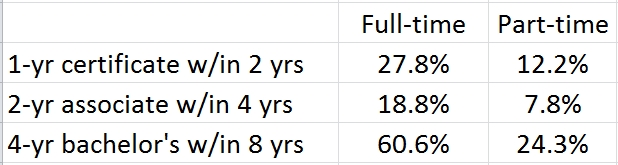
For college students in general, a 2011 survey found that 75% are part-time. Of these, “Even when given twice as long to complete certificates and degrees, no more than a quarter ever make it to graduation day.”1 Another study in 2012, focusing on community college students, found that 59% are part-time. Of these, 42% work more than 30 hours a week, 37% care for dependents 11 or more hours a week, and 40% take evening or weekend classes.2

In comparison to full-time students, part-timers fail at over twice the rate in completing certificate and degree programs. Here’s a breakdown from the 2011 survey:

part-time

Considering their numbers and their low completion rates, it’s a wonder that community colleges continue to do business as usual, with little or no change in practices that date back over half a century.

Thus, I was pleasantly surprised to find, in my college emailbox, an announcement that I’ve been returning to, off and on, for the past few days. It is a call for proposals to address the problem of part-timers. The proposed plan has to either (1) assist part-time students earn 12 credits in an academic year or (2) shorten their time-to-degree. The deadline is close and the form is complicated, so I won’t be submitting a proposal. But I do have some thoughts on this subject.

From a part-time student’s perspective, college is only one of a handful of other responsibilities with higher priorities. S/he has to be able to fit it into her life, and not the other way around. The problem is that colleges are set up for traditional students whose main priority is to complete a program. So, like a square peg, she’s trying to fit into a round hole.

The courses she needs are either filled or offered at a time that’s not convenient for her. Offerings at night or on weekends are slim pickings. Even when she can fit a class in, she finds it difficult to meet deadlines, complete learning activities, or obtain learning assistance. Competing for her time are work and family demands. Furthermore, the commute to campus is all too often time-consuming and, if she drives, the cost of gas and limited parking stalls are an ongoing concern.

The fact that our hypothetical part-timer is among the majority of students who are poorly served should be an incentive to change, from a perspective that’s campus-centered to one that’s student-centered. In other words, colleges ought to be asking, How can we accommodate part-timers with their unique needs?

The title of the 2011 report mentioned above goes to the heart of the problem — “Time Is the Enemy.” The traditional college schedule is the enemy of the part-time student. It’s in one dimension, while part-timers are in another. Put another way, part-timers make up a completely different population that isn’t being served by the colleges as they are now. Put in still another way, part-timers are an open invitation for disruption, for a disruptive approach that will accommodate the needs of a large population of students who are currently being ignored.  Continue reading

Disney Animation Embraces Science

picture of Harry KellerBy Harry Keller
Editor, Science Education

Big Hero 6 marks several firsts for Walt Disney Animation Studios (WDAS). It’s their first action animation with six action sequences. Previous animated movies had two or three. It’s the first WDAS movie to use the new Hyperion system that makes light much more real than ever before. The computer has 55,000 cores and resides in four separate locations.

It’s the first WDAS movie to have six major characters, actually twelve if you count their super alter-egos. It’s the first time WDAS has teamed with the XPRIZE Foundation to create a prize for students. If they win, they will be at the premier in Los Angeles on November 7 and walk the red carpet.

However, these are not the breakthroughs that excite me. This is the first time that the producer, Roy Conli, and the directors, Don Hall and Chris Williams, decided at the outset that this movie would be grounded in reality, that the science would be right. If the story group came to them during the four years that elapsed since the idea first was considered with a story idea that broke the rules of nature, they said no.

However, they did not hesitate in pushing the limits of technology. In some scenes, the g forces would have caused blackouts for real people. If you’re willing to overlook these small violations of the laws of nature and enjoy the ways in which the boundaries of technology are tested, you’re in for a treat. My day at WDAS provided me with only a few short sequences, the longest being 16 minutes, but it showed enough to convince me that this movie is breaking new ground.

Teachers, ask your students what they think about soft (and inflatable) robots? Can anyone create microbots in the real world? How can you do that? What about mental control over robots? Could you have plasma gloves or magnesium fire spitting costumes? Can robotics someday make anyone into a super hero? Explore the science.

Of course, there’s a story here and lots of heart. It’s Disney, after all. And, if you love action adventure as well as animated feature movies, this may be your lucky day.

I really like that science overrides fantasy in this movie. I only wish I had been there to point out places where the boundaries were pushed a bit far and make sure that they did so for good reasons.

The technology behind this movie is another story in itself. Never have so many extras appeared in scenes in an animated movie. It has over 500 different types of extra characters who can appear in the thousands when necessary with each doing its own thing. The city of San Fransokyo was modeled on San Francisco using the assessor records for the city so that you can find the plot where any real house sits, although that house may not look exactly like the real one but will look like homes in the neighborhood. Altogether, about 83,000 individual buildings were created in their external entirety for this movie. The underwater sequence that I saw was amazingly realistic. And so it goes. It took a large team, including 90 animators, two years to make this movie.

For me, a former chemistry professor, seeing one character be a chemist (Honey Lemon) with a sort-of Periodic Table emblazoned on her purse was cool. But, the Table is active, and she presses the element buttons to make incredible compounds really quickly that help to conquer the bad guy or save the good guys. While this purse is not very likely, the stuff it makes is very well animated and looks very real.

Once I’ve seen the movie, I hope to return to these pages with a deeper review of the science and technology that we all can discuss.

Global Literacy XPRIZE Invites Comments

picture of Harry KellerBy Harry Keller
Editor, Science Education

On Monday, September 22, the XPRIZE Foundation announced the Global Literacy XPRIZE in New York City. This newest XPRIZE may, in some ways, be more ambitious than the previously announced $30 million Google Lunar XPRIZE. It seeks to bring literacy to more than 300 million children who cannot read, write, or do arithmetic.

The XPRIZE Foundation, in the last part of its proposed rules, says, “At XPRIZE, we don’t believe that we have all the answers, but we believe passionately in inspiring and incentivizing people to find solutions to our Grand Challenges… But we want to hear from you… You can email us your feedback at global.learning@xprize.org…” This article summarizes my comments and should stimulate readers to provide theirs. If you have comments for the XPRIZE Foundation, please leave a reply here, in the discussion at the end of this article, for all of our readers to see. Likewise, should you have remarks about my comments, I would love to hear from you. The following comments are my own opinions informed by my own experiences. A good argument may well persuade me to change them. In any event, I look forward to an excellent discussion.

xprize1

Quickly summarizing the competition: Teams will compete to develop software solutions to learning literacy that can be applied worldwide using Android tablets with nearby servers. Literacy includes reading, writing, and numeracy. The language to be learned will be English. The software will be open source. The software and content, ready for trial in the real world, must be completed within 18 months of selection of the finalists. The overall time frame from announcement to final award is 4-1/2 years. Read the official guidelines for all details.

I’ll begin by praising the XPRIZE Foundation for this bold effort to eliminate illiteracy across the entire globe. Education may well be our most serious problem today because a well educated world (really educated and not just schooled) will address all of our other problems such as clean water, climate change, terrorism, poor nutrition, preventable disease, ocean health, renewable resources, and so on. The Foundation is approaching problems that others ignore or give up on but that must be solved. Their competitions to date have energized entrepreneurs and those with entrepreneurial spirit to attack serious, nearly intractable problems. The technologies being developed are likely to have an impact far removed from the competition in which they are created.

I think that the “Proposed Guidelines, V.1” for this Global Literacy XPRIZE competition, have a number of controversial parts and am highlighting the ones that I believe should be altered. While the comments below are intended to be constructive, they are also definite, blunt, and tough. I feel that they should be if they are to get any attention. The controversial parts I see are: open source, teaching English, writing, and the Android platform. I wrap up with two comments: a contrarian view and literacy as fire.

1. OPEN SOURCE

The rules require that the five finalists, each of whom receives $1 million dollars and a chance at the $10 million grand prize, place their software source code in open source. This requirement is unusual in XPRIZE competitions. I think that it creates problems. Here is what the guidelines say:

An essential component of the Competition design is a commitment not only to open source software solutions, but also to an open source development process. In order to maximize the potential for the growth of this solution beyond XPRIZE, the Finalist Entries will be released under permissive licenses allowing both commercial and non-commercial use.

Software must be released on the Apache License, 2.0. Content and assets must be licensed under the Creative Commons CC BY (4.0) license. In essence, all work must be made available to anyone anywhere for free. Anyone can use the sources to build a copy and load it onto tablets without paying any fee at all.  Continue reading

Disney and XPRIZE Unite to Encourage Students to Think Science

picture of Harry KellerBy Harry Keller
Editor, Science Education

While this is an unabashed promotion of the upcoming Disney animated feature Big Hero 6, it also is a real XPRIZE for young people. The prize is not millions of dollars but is still really cool.

Six winning students will travel to Los Angeles, walk the red carpet at the film’s premier, go behind the scenes to meet the creative minds at Walt Disney Animation Studios and Walt Disney Imagineering, and join a special “Visioneering” session at XPRIZE headquarters.

big hero 6

Students will enter in either the Junior Division (8-12 years of age) or the Senior Division (13-17 years). They will present their solutions to the world’s biggest challenges. The precise statement is “What one problem would you tackle to change the world? How would you do it? Tell us in a video!” XPRIZE judges will review the submissions and choose twenty finalists. Then, the public and a panel of expert judges will vote to determine the six winners.

Registration opens on Friday, September 19. Have your students put on their thinking caps. You do not have to go to the movie (unless you win). Entry is free. Just create a one-to-three minute video showing how you will use any combination of STEAM (science, technology, engineering, arts, and math) to solve one of the world’s problems. Be creative in defining the problem, in finding a potential solution to the problem, and in presenting your proposed solution.

Clearly, Disney does not require introduction. The XPRIZE Foundation is a matchmaker of sorts. It identifies highly leveraged situations that innovation can solve and that can change the world for the better. It finds sponsors for the challenges it creates around these problems that are not being addressed otherwise for a variety of reasons. Anyone, anywhere can enter. But beware! These are never easy challenges.

See my previous article for more on the XPRIZE Foundation.

I hope that this challenge introduces thousands of young people to the joys of discovery (science) and creation (engineering) while using technology and arts to show that they have great ideas.

I also hope to follow up with an in-depth discussion with the Walt Disney Animation Studios Chief Technology Officer, Andy Hendrickson in the next few weeks.

Seven Fallacies of Teaching Programming in K-12

picture of Harry KellerBy Harry Keller
Editor, Science Education

[See Harry’s related articles: Is Building Apps for Everyone?, Need More Software Engineers? Teach Thinking Skills Better, and  ‘Computer Science’ Contains Little or No Science. -Editor]

Many educators seem to be promoting the benefits and even the necessities of teaching computer science courses before high school graduation. I have not seen any of these people suggest which courses to eliminate to make room for this new course. Despite this, many suggest that computer science (mostly translates to computer programming) be a required subject.

I have seen some say that writing software should begin in kindergarten. Others decry its absence from middle schools. Finally, quite a few lobby for adding it to high school curricula. As you might expect, the origin of each is from practitioners in each. Exposure to the basic concepts of computers, what you might call the “nature of computing,” is a good idea, but the rising din of voices telling us to add computer programming classes throughout our public education system should be tempered by reality.

Much of the pressure comes from just a few arguments and assumptions. Most of these are fallacies. I list some below and explain them.

1. There is a huge job shortage and high demand for computer programmers.

This may be the most recurrent theme for those promoting computer programming in schools. There are two problems with this argument. Large businesses, the ones making the most noise, are inflating their numbers to further this bit of misinformation. Also, the numbers do not indicate the level of programming skill required for these jobs.

The reason for the inflation is simple: H1-B visas. By importing computer programmers from other countries, these huge companies can keep costs down in two ways. They pay those H1-B programmers very low wages. You’ll find the workers sharing small two-bedroom houses with as many as ten people in them. Secondly, low wages for the immigrants help to keep wages of our citizens low as well.  Continue reading

Free Reading and eReaders Can Raise Achievement

Lynn ZimmermannBy Lynn Zimmerman
Associate Editor
Editor, Teacher Education

In Valerie Strauss’s Washington Post blog, Answer Sheet, guest writer Joanne Yatvin, in “Why Kids Should Choose Their Own Books to Read in School” (8 Sep. 2014), makes an impassioned defense of reading for pleasure. Yatvin is “a one time Principal of the Year in Wisconsin and a past president of the National Council of Teachers of English.” In today’s test-driven school climate, free reading has been replaced with reading that focuses on developing test-taking skills. Yatvin says, “Consumed by the urgency to raise students’ reading scores, policy makers and school officials have forgotten that children learn to read by reading.” She goes on to talk about balanced literacy and the benefits of independent reading.

Reading such as that needed for academic work and test taking definitely has a place in schools. Students develop analytical skills by reading for details. However, reading for pleasure and being able to choose your own reading materials also has a place in the classroom. Pleasure reading, also called extensive reading, promotes learner autonomy; improves general language competence, not just reading skills; helps students develop general knowledge; promotes vocabulary growth; helps improve writing; and motivates students to read more.

These claims are supported by research in literacy and in second language acquisition. One of the strongest proponents of free voluntary reading is Dr. Stephen Krashen who sees the importance of light reading as a bridge to more challenging reading. He also contends that not only does reading improve reading skills, it is also necessary for developing good writing skills.  Continue reading

Study Shows College Education Often Worthless

picture of Harry KellerBy Harry Keller
Editor, Science Education

According to a New York Times article (“The Economic Price of Colleges’ Failures,” 2 Sep. 2014), our colleges and universities are doing a terrible job of educating our youth. The conclusions are academic dynamite.

The article, by Kevin Carey, depends on two books by sociologists Richard Arum and Josipa Roksa: Academically Adrift (Jan. 2011) and Aspiring Adults Adrift (Sep. 2014). According to Carey, Arum and Roksa lean heavily on a test of critical thinking and other skills known as the “Collegiate Learning Assessment” (CLA). For this reason, conclusions depend on the value of this particular test instrument, which some have called into question.

Even if the CLA is flawed, it cannot be totally inaccurate, and the findings should indicate a general direction. According to the article, students who graduated from college “improved less than half of one standard deviation” in the test.

All of that time and all of that money resulted in little benefit to the students. Interestingly, the students themselves did not see it that way. They thought they received a good education. The problem, as the second book pointed out, is that the job market does not agree with their self-assessment. According to Carey, “Because they didn’t acquire vital critical thinking skills, they’re less likely to get a job and more likely to lose the jobs they get than students who received a good education.”

Reading between the lines, some colleges still provide a good education, but a great number do not. Note the emphasis on critical thinking skills that stand in strong contrast to the memory skills that so many courses support. The CLA claims to test critical thinking, analytical reasoning, and communications.  Continue reading

The XPRIZE Innovation Competitions

picture of Harry KellerBy Harry Keller
Editor, Science Education

The XPRIZE Foundation is a nonprofit with the purpose of accelerating innovation to solve the world’s most difficult problems. Energy, ocean health, transportation, and space are just a few of the areas that the XPRIZE competitions intend to affect.

If you teach science, you can watch for announcements of new XPRIZEs and use the information to spark the interest of your students in various areas of science and engineering. Have them research the ideas and come up with their own plans for meeting the challenges.

Recent announcements include the Google Lunar XPRIZE, the Tricorder XPRIZE, and the Wendy Schmidt Ocean Health XPRIZE. A quick Internet search will provide you with the details for each, including team selection for those competitions that have progressed to that stage. Millions of dollars are at stake. The Lunar prize has total awards of $30 million.

The Ocean Health XPRIZE will create pH sensor technology to measure ocean acidification across thousands of miles of ocean. You can introduce a great deal of chemical and biological science by investigating this challenge just as though your class were competing.

The Tricorder challenge seeks to make a health sensor like those in the well known Star Trek television series of the 1960s. Ten teams have been selected and are taking ten different approaches to the problem. Just having your classes evaluate each team’s ideas would be a great project. Which will win?

Of interest to those who are not science teachers is the learning category. No prizes have been officially announced yet. Unofficially, the first learning prizes will focus on literacy and will require low-cost and effectiveness to win.

Universal education made possible by technological innovation is a recurrent theme of the Educational Technology and Change Journal. Which areas of technology are already well developed, and which are far behind and must be boosted? The XPRIZE Foundation has a great number of expert advisers to help make those decisions. Will they make the right ones?

I will be following developments closely.

Reading, Vocabulary, Glogster, Funding, ESL Teachers, VoiceThread

lynnz_col2

Cutting to the Common Core: The Positive Side of the Digital Divide by J. Zorfass and T. Gray in Language Magazine: The authors make the case for using digital texts to support the reading process for all learners.

Computer games give boost to English. The University of Gothenburg in Science Daily Success in the world of computer games and a good English vocabulary go hand in hand. A recent study has shown that players who are good at computer games increase their English vocabulary. The study also showed a difference between the genders. Boys spend about twice as much time a week playing computer games as girls. However, girls spend about twice as much time a week on Facebook and other language-related activities.

Tools for achieving oral fluency by Marsha Appling-Nunez in Language Magazine: The author makes suggestions for helping English language learners with their speaking and presentation skills. Glogster is a graphical blog that students can use when doing oral books reports, or other presentations. She also recommends PechaKucha Prezi, which is a method of presenting information using pictures only which requires the speaker to focus on good pronunciation, filler reduction, and vocabulary.

For Public Schools, the Long and Bumpy Road to Going Digital by Kathy Baron in Mindshift: Equipment, software licensing, training. Funding – or lack of it – is the number one issue facing school districts as they convert to the digital learning world.

Preparing Teacher Candidates to Work with English Language Learners in an Online Course Environment by Stephanie Dewing in TEIS News: The author reports on a study she did on the efficacy of an online course for ESL teachers. She found minimal evidence of transformative learning experiences. She proposes several changes in course design to try to produce a context more conducive for transformational learning.

Using Web 2.0 Tools, Such as Voicethread™, to Enhance ELL Instructor and Student Learning by Kelly Torres In TEIS News: Torres advocates using tools such as VoiceThread™, a multimedia tool that can provide a slide show with pictures, documents, and videos to engage students in online course materials by allowing them to see and hear their peers.

Real Aliens: What Will They Look Like?

picture of Harry KellerBy Harry Keller
Editor, Science Education

We live in a very large universe. By all accounts, it’s over 14 billion light-years to the edge from here. That’s nearly 10,000 billion billion miles. Our galaxy contains billions of stars. Our universe contains billions of galaxies. Somewhere out in those vast spaces, there must be, or have been, or will be another advanced civilization.

NASA's Spitzer Space Telescope has captured a new, infrared view of the choppy star-making cloud called M17, also known as the Omega Nebula or the Swan Nebula.

Unfortunately for those yearning to communicate with aliens and fortunately for those who fear alien contact, we are very unlikely — in the extreme — ever to communicate with an alien civilization. Our only real hope lies in violating Einstein’s laws of relativity, and so far they’re as solid as granite.

The vastness of space that makes the existence of aliens, at some time, likely also means that they will be too far away for any meaningful communication. If any are in our galactic neighborhood, they may have broadcast pictures of themselves just as we are doing every day with television, and we may intercept them if we can tease them out of the background noise of quasars, exploding stars, and so on.

Even an image of an intelligent, technologically advanced alien would add enormously to our knowledge of science. Speculation about what an alien would look like may seem like a waste of time, but it can help us if we ever do see one to recognize it.

The topic of what an alien, one with technology, with whom we could, in theory, someday communicate, will look like, act like, and so on has been in science fiction books and movies for many decades. Hollywood tends to reach for the extreme and depict aliens as very frightening. The movie, Alien, is a good example of that trend. Going back very far, there’s It Came from Outer Space.

The science suggests otherwise. Not that real aliens wouldn’t be, well, alien. The likelihood of them passing for one of us is rather remote. If you are teaching science, this concept can begin an excellent and engaging project investigating the possible parameters of alien beings capable of broadcasting images of the themselves. Before heading into the appearance of aliens, consider two separate issues that bear on this topic.  Continue reading

Dinosaurs Among Us?

picture of Harry KellerBy Harry Keller
Editor, Science Education

You may have noticed one of the many articles such as this one that cast doubt on the asteroid (or comet) strike that annihilated the dinosaurs. Oh, the asteroid did the job, they say, but it had some help.

Careful examination of North American fossil records strongly suggests that the dinosaur population was under stress from lower than usual herbivore diversity. What say?! There just weren’t as many plant-eating dinosaurs as usual, which means that dinner for the large meat-eaters was a bit harder to come by.

The Earth was undergoing extreme changes 66 million years ago when the great impact took place. Massive volcanic eruptions in what is now India were the result of a collision of the Indian and Asian continental plates. Climate was undergoing change. And dinosaur herbivore diversity was down.

The above was really no big deal. Dinosaurs had been around for well over 100 million years and had survived many environmental challenges. This was just another that would kill off lots of individuals and perhaps a few species. As a whole, the dinosaurs would come roaring back soon enough, however.  Continue reading

Out of School STEM Learning Summit: National Academy of Sciences

By Bonnie Bracey Sutton
Associate Editor

What I liked about this summit was that it was representative of various places in the US and very diverse. It was interesting that all of the researchers used terminologies that even I did not know, but I learned during the process.

This seminar was basically on extended-learning projects and outside organizations that aim to further STEM education. The authors call these joint efforts “STEM learning ecosystems,” and they can deepen student understanding and engagement and broaden access to a well-rounded education in science, technology, engineering, and mathematics. I had to get used to the terminology and wondered if people who are interested would be scared away by the eduspeak. I think people at the Summit heard the terms often enough to finally be comfortable with “learning ecosystems.”

I looked online because I still, at the end of the day, did not have a fluid understanding of ecosystem in this context. This is what I found that may be helpful so you don’t have to puzzle the term.

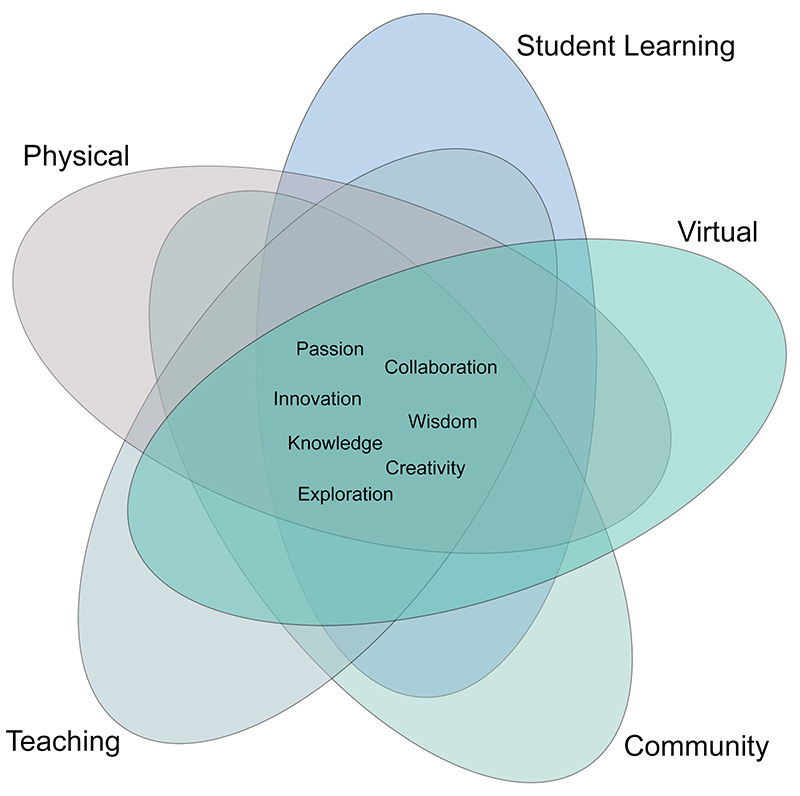
They share this common term: Learning Ecosystem.

Click image to enlarge.

Click image to enlarge.

After school programs come in many varieties. Since we were dealing with understanding of a variety of groups, museums, networks and other providers, I thought that the diagram above would aid understanding.  Continue reading

Thoughts on the Surface Pro 2 After 8 Months

Jim ShimabukuroBy Jim Shimabukuro
Editor

Updated 7/21/14, 7/26/14

(Related articles: “The Surface Pro 2 Will Be the Death of Notebooks” and “Why the Surface Pro 2 Will Be a Game Changer in the Tablet World Series.”)

Steven Brown, in a 15 July 2014 comment, asked, “Curious to hear how it went after 8 months –- any updates?” His question refers to my October 2013 article, Why the Surface Pro 2 Will Be a Game Changer in the Tablet World Series, and the follow-up in November, The Surface Pro 2 Will Be the Death of Notebooks.

Steven, thanks for the question. Microsoft’s recent offering of SP3 means that the SP2 is no longer a viable purchase option — except for those interested in picking up a bargain. Used, they’re currently going on eBay for about half the original price. However, the differences between the 2 and the 3 are small enough to justify this article update.

For me, the critical variable is weight. The quarter pound difference between the 3 and 2 is negligible. To put this in perspective, it’s the difference between my first-gen iPad and the SP2. They’re both equally heavy — or light, depending on your perspective. The SP3 screen size is touted as a breakthrough, but the 1.4″ difference isn’t that impressive considering the bulk that it adds to the overall size. By desktop and notebook standards, it’s still far too small for serious work for prolonged periods.

The 2160 x 1440 resolution seems enormous compared to the SP2’s 1080 x 1920, but it’s negligible considering the pixels per inch, which is 216 vs. 208. The SP2’s resolution is excellent. I’m using it right now, with the power cover, to write this article. I have it connected to a 32″ 1080P monitor via the SP2’s proprietary HDMI adaptor, and the clarity is equal to my desktop’s.  Continue reading

Widget Archive

TCC 2018

 Call for Participation: Registration
 Prelude March 21: Institutional Initiatives in Digital Credentials (FREE)
 Main Conference (Apr 17-19) Registration

HOT@ PLENK 2010

Stefanie Panke: PLENK2010: Weeks 7-10 – The End
Stefanie Panke: PLENK 2010: Weeks 4-6 – Learning Theories, Evaluation and Literacies
Stefanie Panke: PLENK2010: Week 3 – ‘Web XXO’ Emerging Technologies
Stefanie Panke: PLENK2010: Week 2 – Personal Learning & Institutional Learning or ‘A Great Course in Diagram Making’!
Stefanie Panke: PLENK 2010: Week 1 – Just Like ‘Watching Football’
Lynn Zimmerman: PLENK2010 – How Can PLEs Benefit My Students?
Lynn Zimmerman’s account of her first day at PLENK 2010
George Siemens’ (PLENK 2010 facilitator) comment to Stefanie re “curating resources”

Live!
Solar Impulse: Around the World in a Solar Airplane

MOOC MOOC! The interview (9/11/13)

MOOCulus for Calculus Fun: An Interview with Tom Evans (7/11/13)

***

megaphone with writing: Call For Chapters

***

an apple core with text: core issues with John Sener
Do We Really Need a Core Curriculum? (2.22.11)

The Value of Curriculum Cores (3.3.11)

Standardized Tests and Foul Shooting: Look Out, Michael Jordan! (3.12.11)

***

OpenCourseWare
Open Educational Resources – An Invitation to Reflect Your Practice by Stefanie Panke

HippoCampus, Monterey Institute for Technology and Education (sources Ray Schroeder and Sara Bernard)

MIT OpenCourseWare

OpenLearn, The Open University

Open Learning Initiative, Carnegie Mellon

Tufts OpenCourseWare

Stanford on iTunes U

Webcast.berkeley

Utah State OpenCourseWare

On-Demand Online Learning Programs, Kutztown University Small Business Development Center

University of Southern Queensland’s OpenCourseWare

University of California Irvine OpenCourseWare

***

ETC Mailing List
To receive periodic email announcements about the latest articles and discussions on ETC, send your name and email address to jamess@hawaii.edu

***

Links
100 Excellent Open Access Journals for Educators, 11 Nov. 2009

***

Encounters

‘Digital_Nation’ – Two Reviews

Assuming that Teachers Aren’t the Primary Obstacle to Change . . .

Sloan-C’s Virtual Attendance Option: Real or an Afterthought?

Sidewiki – Handy Tool or Destructive Weapon?

‘College for $99 a Month’

USDE 2009 Report on Effectiveness of Online Learning

Blended Learning Is Largely an Illusion

Email your ideas for an encounter to Jim at jamess@hawaii.edu

***

Breaking News

The latest ed tech news selected by ETCJ writers and editors.

Martian Rhapsody: Chapter 2 – Rocks

[Note: See chapter 1, Landing. Also see Harry’s Mars One: Exciting Adventure or Hoax?, especially the long-running, extended discussion at the end of the article. See his other Mars related articles in his list of publications. Chapter 2 is being published as submitted, without editing by ETCJ. -Editor]

Martian Rhapsody
by Harry E. Keller, PhD

CHAPTER 2
Rocks

The four hopeful settlers stare open-eyed at the vista that confronts them. Mars stares back, red-faced and malevolent. They discern nothing friendly or helpful in that stare. Some might see indifference, but they’d be wrong. If ever mankind faced evil, it is here in this impossibly alien and lifeless environment.

Even the dark, sharp-edged rocks strewn across the landscape with apparent reckless abandon seem infused with baleful intent, waiting patiently for countless eons for these soft Earthlings, waiting to cut them and trip them. The surface between the rocks is red, not the red of a poppy or even an Earth sunset, but an intense red that fills the land with emanations of harm. Despite the extreme thinness of the atmosphere, the strangely close horizon does not immediately and sharply turn to the black of space as on the Moon. The red dust of Mars hangs in the sparse air and softens the horizon just enough to give the appearance of red sand reaching up, an almost living thing.

As if sensing the planet’s personality, Chun speaks up, “We have to get that module back so we’re at full strength.”

“You bet!” responds Dawit excitedly, pumping his fist. He is undaunted by the landscape or the problem of the errant module.

“Sure,” says Aleka, “but first we have to put our habitat together.”

“Sorry,” says Chun as she moves into position.

“We all feel the same. All right, we’ve practiced this plenty of times,” says Aleka.

“Seems like thousands,” responds Dawit with a gesture none of the others can see because he’s inside.

“We don’t have all that long before our suits have to be recharged,” warns Balu.

“Right. Let’s rotate and connect,” says Aleka.

“Good thing that missing module connects at the end,” comments Chun.

“The rovers have done a nice job of clearing the site and putting the modules in place,” says Balu.

“I cannot wait to get a plan for the missing module,” comments Dawit over their intercom. Everything is an exciting adventure for Dawit.

Continue reading

Geography? T3G…ESRI in Education

VicSutton80By Vic Sutton

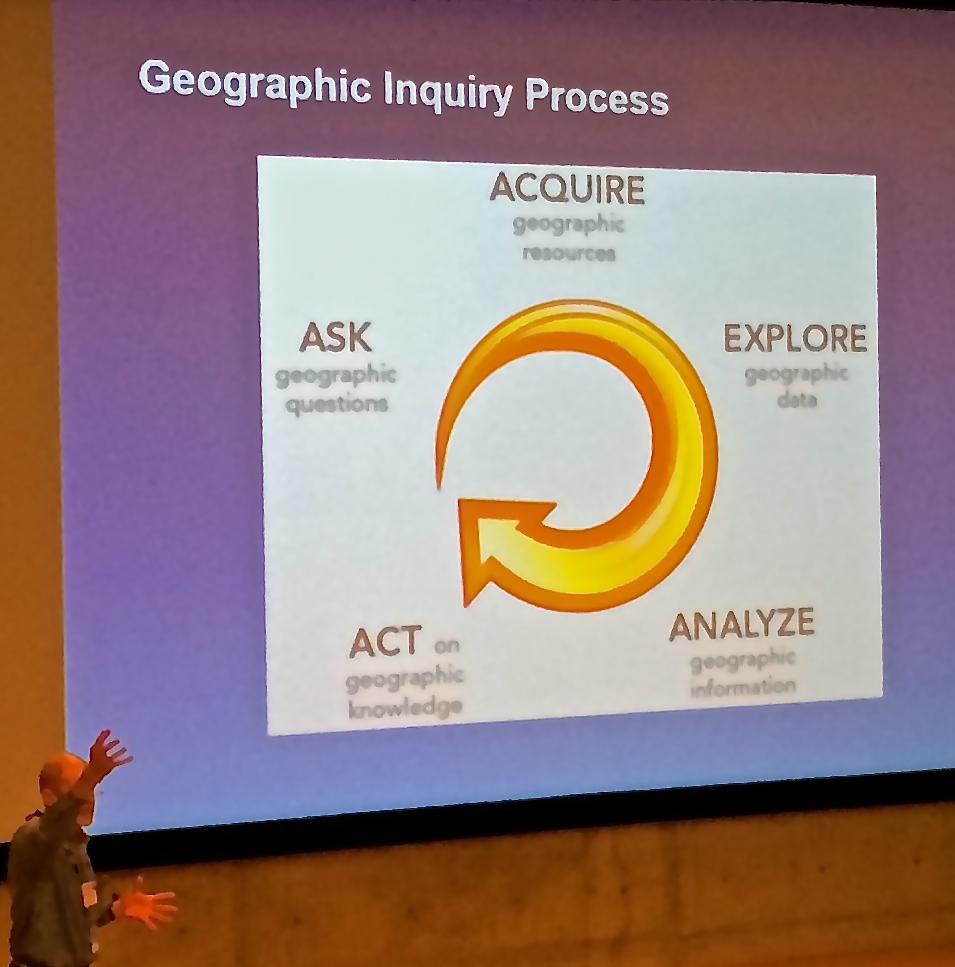
While at a recent workshop at the Redlands, CA, headquarters of the Environmental Science Research Institute (ESRI), I heard the most concise definition of geography yet: “What where? Why there? Why care?”

vic063014 1

My wife, Bonnie Bracey Sutton, had been accepted for a week-long workshop in ESRI’s T3G Institute. I traveled with her, thinking I was heading for a holiday in Southern California – maybe visit the beach and chill out in wine country.

No such luck. As soon as he saw me, Charlie Fitzpatrick said, “I’ll get you a badge.”

Charlie Fitzpatrick is the K-12 education manager at ESRI. Before joining ESRI in 1992, Charlie taught social studies in grades 7-12 for 15 years.

vic063014 2

“T3G” is ESRI’s acronym for “teachers teaching teachers GIS.” So the goal of the workshop was to give a group of some 90 educators the knowledge and hands-on skills to be able to teach other colleagues how to use geographic information system information in their work.  Continue reading

What Does Cyberlearning Mean to You? Cyberlearning Summit 2014

By Bonnie Bracey Sutton
Associate Editor

(Note: See Vic Sutton’s report on this conference. -Editor)

Teachers working in classrooms need ideas and frameworks and support for initiatives beyond the ideas that have been classified as regular education. Sometimes funding is a problem. Powerful partners get you permission to do wonderful things in the classroom.

My first involvement with a network of powerful people, learning ideas and new technologies was with Cilt. You can tell that it was some time ago. We called STEM, SMET. Here is a look at what we started with:

bonnie 062514 01

We investigated, learned, shared and promoted ideas. Concord has wonderful free resources to share, and here is a summary:

The Center for Innovative Learning Technologies (CILT) was founded in October 1997 with a grant from the National Science Foundation (NSF) to stimulate the development and study of important, technology-enabled solutions to critical problems in K-14 science, mathematics, engineering, and technology (SMET) learning. Four “theme teams” focused the efforts in areas of highest promise. CILT events, often workshops organized by theme, provided a collaborative forum in which people in the learning science community met to assess the progress of the field, define research agendas, and initiate new collaborations. Many of these collaborations form seed grants funded by CILT. In addition to these successful CILT programs, CILT has generated many resources for the learning science community, including tools, publications, and NetCourses.

In this day and time, people sometimes do not think that meeting people and sharing in conferences is necessary. But the leaders of Cyberinfrastructure have better ideas. They do a conference and put the ideas online. You have a choice. There are pieces of brilliant ideas, presentations and demonstrations, and even poster sessions for you online.  Continue reading

Cyberlearning Summit 2014: A Quick Recap

VicSutton80By Vic Sutton

[Note: See Bonnie Bracey Sutton’s report. -Editor]

There is reportedly a wealth of research being conducted unto cyberlearning, but there are no clear views about how to translate research results into action in the community context, in particular for schools or informal education.

This emerged from the recent Cyberlearning Summit held in Madison, Wisconsin, on 9-10 June 2014, which brought together some 200 participants — mostly academics, plus some educators, industry representatives and grant makers — to highlight “advances in the design of technology-mediated learning environments, how people learn with technology, and how to use cyberlearning technologies to effectively shed light on learning.”

Bonnie's photos

There was no discussion about quite what cyberlearning is, but it appears to be a fancy name for on-line learning.

The meeting was organized by the Center for Innovative Research in Cyberlearning (CIRCL), funded by the National Science Foundation (NSF), and featured a number of eminently qualified speakers.

Yasmin Kafai, from the University of Pennsylvania, reminded participants of the remark by the late Steve Jobs that “everybody in this country should learn to program a computer, because it teaches you how to think.”  Continue reading

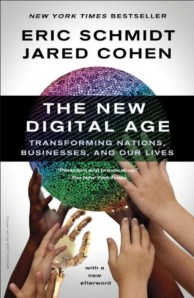
Review: ‘The New Digital Age’ by Schmidt & Cohen

Frank B. WithrowBy Frank B. Withrow

Review: Eric Schmidt and Jared Cohen, The New Digital Age: Reshaping the Future of People, Nations and Business, Knopf, 2013.

The authors visited thirty-five countries and examined the Internet’s impact in each. The new digital age has a significant impact with both positive and potentially negative outcomes. They discuss both possibilities. They focus on the new level of connectivity that the digital world brings to individuals and nations.

NDA2

In perspective, connectivity in mankind has always been the yeast that has led to social and collective growth. In early man, the spoken word allowed groups to share sensory experiences and form collective societies. About five thousand years ago, the written word allowed mankind to share experiences across geography and time. Knowledge could be passed from one generation to another and transferred across geographic boundaries. The printing press increased our ways of storing and retrieving experience and documenting the ways man governed himself. Knowledge was stored and retrieved in libraries.  Continue reading

Mars One Seals TV Deal with Endemol

In a press release this evening, Bas Lansdorp, Co-founder and CEO of Mars One, announced an international partnership with multi-award winning producer Darlow Smithson Productions (DSP, an Endemol company) to follow and screen the selection and training of Mars One astronauts.

DSP will be the exclusive worldwide production partner for the Mars One astronaut selection and training program, which will see 705 candidates, shortlisted from over 200,000 who applied, undergo the assessment processes. The candidates, from all walks of life, will be tested as part of a training program run by a panel comprised of scientists, adventurers and astronauts.

With the astronaut selection process already underway, the first installments of DSP’s production are expected to begin broadcasting around the world in early 2015. Further details will be announced.  Continue reading

Unite or Die

picture of Harry KellerBy Harry Keller
Editor, Science Education

For at least two centuries, education has been divided up into separate compartments. In most recent educational history, the so-called core compartments or “subjects” have been social studies, English (now known as English language arts or ELA), mathematics, and science. Along side these have been physical education and a number of other artistic or artisan activities such as music, drama, art, and woodworking.

A great number of educators have noticed that this separation has made less and less sense as time has passed. Similar issues exist within these disciplines. For example, my own area of science was divided up long ago into physics (the original natural philosophy encompassing motion, light, and other physical phenomena such as electricity and magnetism), chemistry (changes in matter), and biology (study of living things that was mostly limited to classification in its earliest days). Biology has changed enormously and now no longer depends on classification. Understanding chemistry requires plenty of physics and often heavy-duty mathematics. And so it goes.

If we are to educate our youth, we must break down the artificial barriers between the compartments formed so long ago. They make little sense these days.

For example, mathematics and science are kept separate in our schools, and their teachers are trained separately. Yet, mathematics, as taught in grades K-12, is mostly applied mathematics at its heart. It was created for commerce, engineering, and surveying. Calculus was created for science. These connections are lost in most mathematics courses. Once you’ve learned to count, that is, learned the names of the numbers, the rest follows logically as you begin to figure out the world around you. Were science and math merged into a double-period class, it could make much more sense to students — especially if engineering is included in science, and commerce is included in math.  Continue reading

Social Media Tips for Virtual Conference Attendance

By Melissa A. Venable

[Note: Jessica Knott, ETCJ’s Twitter/Facebook editor, has coordinated the publication of this article. -Editor]

Last month The Sloan Consortium’s 7th Emerging Technologies for Online Learning took place in Dallas, Texas. According to the latest Sloan-C View newsletter, there were “more than 700 onsite and 1,000 virtual attendees representing 47 states including DC and 23 countries.”

Saint Leo University provided virtual access to a limited number of instructors, including adjuncts like myself. In my formal request to attend, I made a commitment to “be active on multiple social media platforms and use the symposium hashtag – #et4online – to further engage in live sessions and network with other attendees.” I was fortunate to be selected to attend, and it was this social media commitment that made all the difference in my experience.

Recorded sessions are helpful but don’t provide the energy and interaction of real-time attendance. And there is a lot to be gained from following the social media backchannel of a conference, but formal registration allows for a different level of access to the sessions and other attendees. This article includes a few of my lessons learned as a virtual conference participant.

Prepare to Participate

Are your social media accounts up-to-date? This may be the best place to start. Take a look at the platforms that are being encouraged by the conference organizers and review your profiles before the event starts. If it has been a while since you logged in to an account, it could take some time to review and refresh the information you are providing about yourself. Keep in mind that these profiles serve as your business card in an online networking sense.

Follow the conference itself and the sponsoring organization. In addition to the conference hashtag, this Sloan Consortium event was also active with social media accounts focused specifically on this conference, including Twitter and Facebook. These accounts provided a constant stream of reminders, letting participants know about upcoming sessions, highlighting participants and presenters, and announcing schedule changes.

Set Realistic Expectations

The Sloan symposium offered fewer streamed sessions than onsite sessions, but there were multiple presentation options for each time slot. The streamed sessions took place in Dallas with a live audience and allowed virtual attendees to watch both the presenter and his or her slide presentation simultaneously. Members of the online group were able to interact with each other via text chat and ask questions of the presenter through an online session chairperson who relayed them in real-time. We also connected and exchanged thoughts and resources through our social media accounts.

Take a look at your schedule for the week and identify, in advance, the sessions you would like to attend. Add these sessions to your calendar. I was tripped up when logging into my first session (an hour early), before I realized I needed to calculate time zone differences. The website mentioned this, of course, but sometimes you have to learn on your own, and I instantly connected with other virtual attendees on Twitter who made the same mistake.  Continue reading