Posted on October 18, 2010 by JimS
 By Tim Stutt
Why is it that so many of the games labeled as good for learning are also no fun to play? And how about all those games marketed as being educational when they’re really very thin on content and building thinking skills?
The short answer to both is that we’re asking a lot for game to be both fun and educational, not to mention available on many platforms and affordable to a wide audience.
In “Moving Learning Games Forward: Obstacles, Opportunities, & Openness” (The Education Arcade, MIT 2009), Eric Klopfer, Scott Osterweil, and Katie Salen outline many of the reasons why educational games and software fail. In their view, social and cultural attitudes towards games and the perceived lack of seriousness of gaming amongst the educational community are significant obstacles. Moreover, the time and costs of development are major deterrents to game publishers who are uncertain about the strength of the market for educational titles. Game developers often target the consumer entertainment market since there are fewer barriers to adoption and a wider and more lucrative market. Also, until there is a shift in attitudes and policies within educational institutions towards games, it is unlikely that we will see many excellent products on the market. Continue reading →
Filed under: Uncategorized | 19 Comments »
Posted on October 18, 2010 by JimS
 By Tina Rooks
Imagine the impact on consumer sales if “adequate” replaced words like “ultimate,” “good,” or “best” in the taglines of top selling brands. Now consider the widely publicized expectation of our public education system that all schools must attain “adequate yearly progress.” By definition, adequate is average or acceptable. Certainly neither is the most aspiring adjective.
Successful Fortune 500 companies do not include “acceptable” in their mission statements. Coaches do not encourage a team to be “average” before the big game. Instead, to promote a message of quality that is not conveyed with the lackluster “adequate,” they use phrases such as “exceed expectations” and “set the bar high.”
When did adequate become good enough for our educational system? What impact is this mindset having? And most importantly, how do we break free from this low expectation? Continue reading →
Filed under: Uncategorized | Tagged: adequate yearly progress, National Educational Technology Plan, NCLB, NETP, NETP 2010, No Child Left Behind Act, Office of Educational Technology, PIRLS, TIMMSS, Transforming American Education: Learning Powered by Technology | 7 Comments »
Posted on October 12, 2010 by JimS
 By Lynn Zimmerman
Editor, Teacher Education
In my previous article, “Are Low Returns the Norm for Online Student Evaluations?” (10.7.10), I asked several questions about return rates of online student evaluations. Two people responded, a lower return rate than I hoped for. However, both offered some information that I decided to work into another article addressing these issues in more depth.
As I reported then, my institution piloted a commercial online student evaluation system for evaluating faculty and courses in spring 2010. Five instructors participated, collecting feedback for nine courses. The classes were taught face-to-face and online. The response rate on the online evaluations was 44%. I also have spoken with other faculty who have used various online evaluation systems, including Blackboard, our Learning Management System, which students are accustomed to using. They reported that about 50% of the students who are asked to complete online evaluations do so. That has been my experience as well. Continue reading →
Filed under: Uncategorized | 6 Comments »
Posted on October 11, 2010 by JimS
 By John Sener
I’m glad that the recent Washington Post article, “How to Fix Our Schools: A Manifesto by Joel Klein, Michelle Rhee and Other Education Leaders” (10.10.10), was written since it captures current thinking about schools which has been bothering me for a long time: if schools need “fixing,” when did they break? Who broke them, and were they working just fine before that? If they’re now “failing,” when in the past were they succeeding, and what happened to change that?
Asked this way, of course, the reality reveals itself: schools have never worked fine for every child. They have always worked for some, and not well at all for many others. They need massive improvement, not “fixing.”
The distinction is crucial: saying schools need “fixing” opens the door to all sorts of handy “solutions” to fix what’s “broken” or “failing.” Saying schools need improving at least offers the possibility of seeking approaches which recognize the situation in all its complexity.
Continue reading →
Filed under: Uncategorized | 11 Comments »
Posted on October 9, 2010 by JimS
 By Jim Dator
[Note: This article was first presented as a talk at the annual conference of the Hawaii Telecommunications Association, “Transformation for Next-Generation,” 6 October 2010. -js]
“Next Generation” means “technology” to you. It means “people” to me. So what do you get when you cross your technology with my people? Let’s see.
Two of the theories I use to make what I hope are useful statements about the future are age-cohort analysis and a more sophisticated version of Marshall McLuhan’s famous statement, “We shape our tools and thereafter our tools shape us.” Nothing changed my life more than cheap and abundant oil, the automobile, the jet plane, air-conditioning, space satellites, electronic communication technologies, and bottomless consumer debt. So I constantly am interested in what new technologies are on the drawing board and especially what technologies are about to be rolled out of factories into a Wal-Mart nearby.
Age-cohort analysis is another theory/method I use. It is based on the fact that people born and growing up during the same time span, and in the same cultural space, share ideas and beliefs about the world which are very different from the ideas and beliefs held by members of age cohorts only a few years older or younger than they are.
Thus, when an age cohort with one “worldview” retires and leaves positions of political and economic power, and a new age cohort with a very different “worldview” comes in, the world changes because, holding different beliefs, the actions and policies of the newer cohort differ substantially from those of the older cohorts. Continue reading →
Filed under: Uncategorized | Tagged: Hawaii Telecommunications Association, HTCA, Marshall McLuhan, Transformation for Next-Generation | 3 Comments »
Posted on October 8, 2010 by JimS
 By Bonnie Bracey Sutton
Editor, Policy Issues
We talk often about preparing for the 21st century, but the discussion hasn’t even started in many schools. The latest PCAST (President’s Council of Advisors on Science and Technology) meeting addressed some of these concerns. What do our readers, leaders, and educators think about the crisis in K-12 computer science?
For background, read Jenna Zwang’s “Summit: U.S. Needs More Computer Science Teachers” (eSchoolNews , 7 Oct. 2010) and Running on Empty: The Failure to Teach K–12 Computer Science in the Digital Age (The Association for Computing Machinery and The Computer Science Teachers Association, 6 Oct. 2010). Continue reading →
Filed under: Uncategorized | 2 Comments »
Posted on October 7, 2010 by JimS
By Lynn Zimmerman
Editor, Teacher Education
At our faculty senate meeting this month, a member presented data she had collected from a new online student evaluation system that was piloted in spring 2010. Students use this system to evaluate faculty and courses. Five instructors participated, collecting feedback in nine courses. The one statistic that struck me most forcefully was the 44% response rate. In my experience and that of other faculty I have talked to, about 50% of the students who are asked to complete online evaluations do so.
My colleague’s report dismayed me. For faculty at my university who are promotion/tenure track, student evaluations are a critical part of their documentation. In my department, they are also a critical part of the annual review process. Therefore, I am compelled, when I teach face-to-face and hybrid classes, to give my students paper-pencil evaluations to complete so that I have a higher rate of return. My university (and I) would like to move toward online evaluations, but until higher rates can be guaranteed faculty will be reluctant to use them.
Does anyone out there have research that indicates these low return rates for online evaluations are the norm? What reasons have been identified for students’ lack of response? I know that there are “tips” for how to improve rates. Which ones have you found to be the most effective?
[Note: Please see Lynn’s follow-up article, “What Can We Do About Low Returns for Online Student Evaluations?” (10.12.10). -js]
Filed under: Uncategorized | 2 Comments »
Posted on October 7, 2010 by JimS
 By William H. Zaggle
I often wonder if it is possible to transition to online schools without some amount of blending. Certainly there are some wonderful fully online schools that have managed to slip the surly bounds of earth and learn how to dance in the skies. They came from a place where old expectations were not possible and a new understanding was simply required. I think they were just the leading end of the legacy door stop, and easily fit under the door. The remainder however is doing its job well, keeping the door of the past from closing. As expected, their old perspectives have yet to catch up with their current reality.
If a law came down that said all of K-12 school would be taught online starting tomorrow, what would happen? Who would watch the kids while both mom and dad went to work? What would become of school bus companies and bus drivers? Where would we spend the billions that go today to support the brick and mortar, face to face legacy? Beyond the economic turmoil, the instant transition without blending first would cause a strange combination of new technology and old expectations. At least for a while. Gone would be an Icon of our past, nearly as dear as our vinyl records. Gone would be the hallowed school grounds of our alma mater, our nourishing mother. But how would many of the existing school organizations make the instant transition? Continue reading →
Filed under: Uncategorized | 7 Comments »
Posted on October 2, 2010 by JimS
 By John Adsit
Editor, Curriculum & Instruction
[Note: On Sep. 30, Harry Keller, ETCJ science education editor, shared Sam Dillon’s “4,100 Students Prove ‘Small Is Better’ Rule Wrong” (NY Times, 9.27.10) in the journal’s staff listserv. A discussion followed, and John responded with this article. Others in this series are Bonnie Bracey Sutton‘s “Education Is a Collaborative Process: Teachers and Leaders Have to Work Together” and Harry Keller‘s “Breaking Down Barriers.” -js]
I am about to hit the road again, so I don’t have a lot of time, but I will just say the article drives me crazy.
This school instituted a number of educational reforms. A couple are spelled out clearly, especially the idea of the emphasis on reading, writing, and ‘rithmetic in all classes. Another reform spelled out clearly is the elimination of basics classes. These reforms are nothing new — they have been around for decades.
If you look at the famed success of Garfield High School in Los Angeles, the Stand and Deliver school I have mentioned in recent columns [1, 2], you will see that both concepts were at the heart of their reforms. These reforms — and others — have been shown to work before. The problem is that they are rarely tried for a number of reasons, one of which I will highlight here. Continue reading →
Filed under: Uncategorized | 5 Comments »
Posted on October 1, 2010 by JimS
 By Harry Keller
Editor, Science Education
How do we fix K-12 education in the United States? Will Race to the Top contests do it? Will Investing in Innovation Funds make the crucial difference? Can the Gates and Broad foundations buy great education in this country? Should we break down all large schools into small ones?
An article by Sam Dillon in the New York Times, “4,100 Students Prove ‘Small is Better’ Rule Wrong,” suggests otherwise. The article focuses our attention on the largest high school in Massachusetts, Brockton High School. Its principal, Dr. Susan Szachowicz, brought together a small group of willing teachers to see if they could do anything to fix this really broken school.
The detailed numbers have been omitted from the article, which claims that the school had abysmal scores in 1999. Then, they acted. The 2001 scores were still below acceptable levels but far above the 1999 scores. By 2008, Brockton High was in the top 10% statewide in English test scores and remains there. Continue reading →
Filed under: Uncategorized | 8 Comments »
Posted on October 1, 2010 by JimS
By Bonnie Bracey Sutton
Editor, Policy Issues
[Note: On Sep. 30, Harry Keller, ETCJ science education editor, shared Sam Dillon’s “4,100 Students Prove ‘Small Is Better’ Rule Wrong” (NY Times, 9.27.10) in the journal’s staff listserv. A discussion followed, and Bonnie responded with an article. -js]
I used to fly into Las Vegas when I was on the Clark County School Board review team. They instituted some Gates initiatives in big, beautiful schools that were county wide. That’s a tall order because Clark County is one of the largest school systems in the country.
They had to build two schools as transportation costs and the limited number of hours in the day defeated them. The kids wanted to do PE and organized sports in their area schools. (The multicultural kids did not sign up.) The schools opened very, very early, and students were there by seven to participate in team sports and that kind of thing.
We were working with experts from all over the country, but Gates seemed to hold the strings for what we could and couldn’t do based on the fact that he provided the money. We used knowledge network maps, and the feeder elementary schools were theme based.
Continue reading →
Filed under: Uncategorized | 2 Comments »
Posted on September 29, 2010 by JimS
 By Claude Almansi
Editor, Accessibility Issues
Mehmet Firat, a Ph.D. student at Anadolu University, Turkey, is gathering metaphors for “university”. This is great per se, and pertinent to several recent discussions on ETC Journal about the role of universities in education.
Mehmet Firiat and his colleagues are still wishing to gather more replies. I am impatient to read their report once they get and analyze them: This is an interesting way to conjure up a multi-subjective image of university. Continue reading →
Filed under: Uncategorized | Leave a comment »
Posted on September 29, 2010 by JimS
 By Stefanie Panke
Editor, Social Software in Education
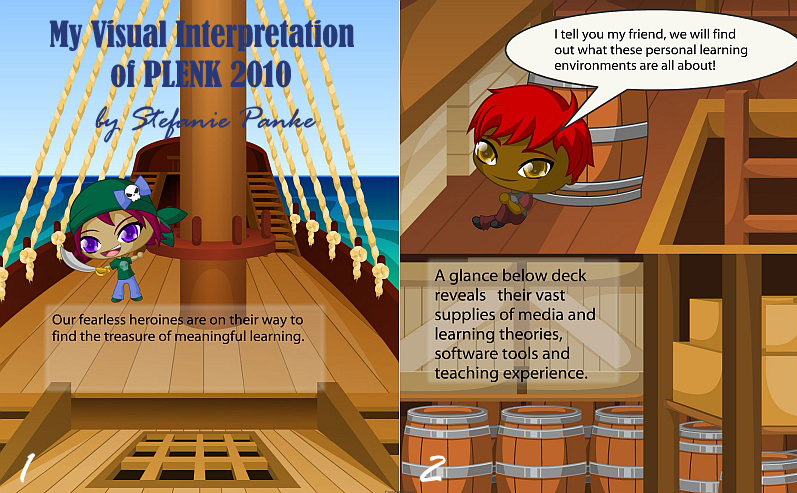
The third week of the massive open online course PLENK2010 centered around emerging technological trends and their impact on personal learning environments. The names for this “next Web” are manifold: Web 3.0, extended Web, Web eX, or X Web. It comprises themes like augmented reality, semantic web, location-based services, mobile computing and learning analytics (e.g., networks analysis).
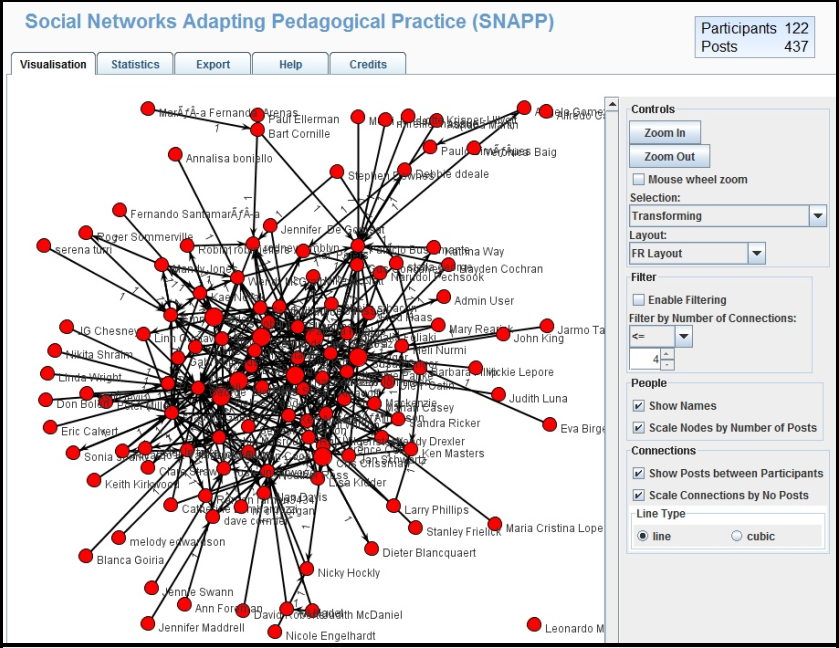
 A vizualisation of the discussion in a first week’s PLENK forum with SNAPP
Continue reading →
Filed under: Uncategorized | Leave a comment »
Posted on September 28, 2010 by JimS
 By Jim Shimabukuro
Editor
Stephen Downes, in a Stephen’s Web post (9.26.10), took umbrage at Steve Eskow‘s ETCJ article, “Annoyance at the Ubiquitous and Protean Notion of ’21st Century Skills‘” (9.24.10), which was a response to Dave Cormier’s “Twenty-six Centuries of Skills” (9.23.10).
Here is Downes’s post:
Steve Eskow takes a run at Dave Cormier, attracts my ire, and ignites a raft of comments. And it is worth stating again that the blog is not a formal essay, you are not expected to put the entire background of your (and others’) thought into a literature review preceding your few paragraphs, and attacking a post for what’s missing, rather than what’s there, is cheap criticism. “It is easy to extract one paragraph and present it without that context as overly sweeping generalization. It is a freshman mistake to do so.”
I read a great deal of Montaigne in my younger years and for a while I too was enamored of quoting Montaigne in order to show that someone’s great ideas had already been thought of by someone else. Then I grew up.
Continue reading →
Filed under: Uncategorized | 9 Comments »
Posted on September 27, 2010 by JimS
By Jim Shimabukuro
Editor
Graham Attwell, in “Open Learning and Contextual Diversity” (Pontydysgu 9.27.10), is critical of some of the ideas in Tom Preskett’s The ‘Open Mode’ – A Step Toward Completely Online (9.24.10). He says, “I think Tom is mixing up a whole series of things here,” and then proceeds to straighten “things” out.
Unfortunately, Attwell’s good intentions are based on statements that are inexplicably confusing. For example, he says, “The move towards Blended Learning was driven by pedagogy and not by a retreat from Technology Enhanced Learning.”
What, exactly, does this mean? One has to wonder if Attwell actually understands the terms that he uses to purportedly set things straight. In fact, “blended learning” and “technology enhanced learning” are one and the same, so is he saying that the move toward blended learning was not driven by a retreat from blended learning? Furthermore, “pedagogy” simply means instructional strategy, so is Attwell saying that the move toward blended learning was driven by instructional strategy? If yes, then what does this mean? Continue reading →
Filed under: Uncategorized | 3 Comments »
Posted on September 27, 2010 by JimS
 By Jan Schwartz
I work with people in alternative health care and career type schools. Hybrid education is excellent in these fields where some of the more kinesthetic skills cannot yet be taught online. I say “yet” because who knows what will be possible in the future?
I teach a practice management class in an acupuncture school and it is a hybrid course. No hands on components (as in skill development with needling) are taught, but the nature of the practice is such that the students like having some face to face time because that is how they will be functioning with clients or patients when they graduate. We meet the first week or two in the classroom (I give them the choice at the end of the first meeting), usually one week in the middle, and then again on the final week. That’s 3-4 times out of a 10-week quarter. Continue reading →
Filed under: Uncategorized | 6 Comments »
Posted on September 24, 2010 by JimS
 By Steve Eskow
Editor, Hybrid vs. Virtual Issues
A cranky, minority opinion on the Dave Cormier (“Twenty-six Centuries of Skills” 9.23.10) and Aaron Eyler (“Ignore the Test” 9-21.10) essays, and perhaps a cranky expression of annoyance at the ubiquitous and protean notion of “21st century skills,” which increasingly seems like an empty bottle that each user fills with his own educational cliches.
Here is the first paragraph of the Cormier article:
In the past several years I’ve been very fond of saying that moving into the 21 century has very much been a return to our roots. We are finding words like ‘tribe’ and ‘community’ ringing through the din of post-war individualism and we are turning to each other with words of trust and collaboration. Some of us are starting to see the established (and, pre-internet, necessary) forms of identifying reliability, competence, insight and creativity as outdated and difficult to work with. We are looking to the whole identity of a person, to the ways in which they have built the work and network they have as method of vetting the people we wish to work and innovate with. We are less interested in degrees, in ‘certificates’, as, for many of us in technology or education, these degrees do not actually mean very much. These are not new things… they are very old things… very old words, coming back to us.
“Our roots”? Not mine! What is “post-war individualism”? Are we really turning to each other with words of of trust and collaboration? Have reliability, competence, insight and creativity changed their meanings post-internet? Are we now really looking to “the whole identity of a person”?
Are we really less interested in degrees?
And so on . . .
Is this kind of gentle and empty generalizing now acceptable in Freshman English?
Are these 21st Century thoughts?
Filed under: Uncategorized | 19 Comments »
Posted on September 24, 2010 by JimS
 By Tom Preskett
Recently I have arrived at the opinion that developing a viable distance learning offering is the way to go for higher education (HE). Much of the e-learning I’ve been involved in has concentrated on developing blended learning where there was previously just face-to-face. This is largely like banging your head against a brick wall. This policy is often seen as a safer, less ambitious step along the learning technologies route.
THIS IS WRONG!
It’s wrong because most of the time the educators and the students don’t really want to use technology. They’ll do a bit for the administration, but for learning, no way. It’s a face-to-face course. Why tamper with it. I am of the opinion that this is misguided, but it’s not a battle worth fighting (for now). Fighting this resentment is unnecessary.
Continue reading →
Filed under: Uncategorized | 5 Comments »
Posted on September 23, 2010 by Claude Almansi
By Claude Almansi
Editor, Accessibility Issues
Context
On September 14, 2010, after Ning had postponed the deadline for shutting nonpaying networks for the umpteenth time, I wrote:
I will not write another full post about Ning until the non paying groups have been deleted, or Ning gets bought by a more efficient firm, or disappears. But I’ve opened a Ning page on the wiki of ETC Journal where I shall attempt to keep track of what happens at Ning.
in a comment to my Why Unjoin Ning Networks that Won’t Pay (Aug. 28, 2010).
And now I am writing one, even though nonpaying groups have not been deleted and no one — to my knowledge — has shown any interest in buying Ning. Motive: a discussion entitled “Deletion of Free Ning Networks?” started by Alex on September 18 in the Ning Creators network. Though it disappeared very quickly, there is a copy archived with WebCite® on the same day: http://webcitation.org/5sq785FZF.
Eric Suesz — senior community manager at Ning — participated in this discussion, stating that “All free Ning Networks are now locked and can’t be accessed.” This is simply untrue. Continue reading →
Filed under: Accessibility, Social Media | Tagged: Accessibility, block, copyright, lock, Ning | 6 Comments »
Posted on September 22, 2010 by JimS
By Stefanie Panke
Editor, Social Software in Education
Reporting on the activities and discussions within the Massive Open Online Course, Plenk2010, has become considerably more challenging since my first introduction of the course’s structure and concept. One reason is that the discussion forums of week one have been tremendously busy, producing a total of 427 postings. In many, if not all, the participants are blurring the theme of week one (general aspects and definitions) and week two (personal learning environments vs. learning management systems). An example is the side-debate that has spun around the problem of plagiarism and fake identities for the evaluation and grading of open learning activities.
Continue reading →
Filed under: Uncategorized | 2 Comments »
Posted on September 22, 2010 by JimS

My niece’s daughter is now 10-years old, and she has reached the age where music instruction in school graduates to real band instruments. She was excited when she went in to meet with the music director and be assigned to an instrument. She wanted to play the saxophone, as her mother did. Alas, it was not to be. The band director looked at this tiny slip of a girl and decided that her mouth shape was not right for the saxophone, but it was perfect for the euphonium, and it just so happened he needed a euphonium player in the band. And so her musical dreams were dashed, and she will instead struggle with an instrument as big as she is, an instrument she will not possibly continue to play as an adult.
It reminded me of my son, who also wanted to play the saxophone. Unfortunately, by the time he went in for his appointment with the music director, the students with the earlier appointments had already filled the band’s need for saxophone players, and so my son was assigned to the clarinet, an instrument he hated. At least his music instructor was honest about his need for a clarinet player trumping my son’s need to play the instrument he wanted, unlike the instructor who invented the ridiculous story of my niece’s daughter having the perfect mouth shape for the euphonium. Continue reading →
Filed under: Uncategorized | 2 Comments »
Posted on September 18, 2010 by JimS
By Lynn Zimmerman
Editor, Teacher Education
Thanks to Jan Schwartz’s Learnings from a MOOC I decided to register for PLENK2010, and thanks to Stefanie Panke’s PLENK 2010: Just Like ‘Watching Football’ I started participating. For me, this experience embodies some of the concerns, confusion, and challenges that people have who want to be technology savvy but are not quite sure about how to get there. It also brings to light how teaching and learning can really become more student-centered through the use of the e-learning environment. Both of these issues, affective issues and e-learning pedagogy, are important to consider in the evolution of technology as a part of educational design.
I started exploring the PLENK2010 site a few days ago, and I have mixed feelings about the experience. There is a lot of uncertainty (for me) in the process which will shape my participation. First of all, there are many people participating as one big group, which I find chaotic. My style is to work alone or with a small group of people with whom I feel comfortable. One of my first tasks, therefore, is to find my comfort zone. Continue reading →
Filed under: Uncategorized | 2 Comments »
Posted on September 18, 2010 by JimS
By Harry Keller
Editor, Science Education
I like video games and introduced my son to them with Wizardry I a very long time ago. For 20 or more years, I’ve been looking at ways to make videos games work in classrooms. So have many others. The recent New York Times article, “Learning by Playing,” explores some recent developments in schools.
This concept, gaming in classrooms, has many facets. Is the game a first-person shooter game (Doom), a resource management game (Railroad Tycoon, various Sim games), a role-playing game, or even massively multiple-player online role playing game (MMORPG, e.g., World of Warcraft)? Or is it a purely educational game? Do students learn more than just eye-hand coordination from games? Is gaming an appropriate use of classroom time? Does the answer change with the students’ age? Are games ready for prime time, and, if not, when will they be? Continue reading →
Filed under: Uncategorized | 9 Comments »
Posted on September 15, 2010 by JimS
By Stefanie Panke
Editor, Social Software in Education
This week marked the start of PLENK 2010, a seven week online course on personal learning networks (PLNs) and personal learning environments (PLEs). The “Massive Open Online Course“ (MOOC) is sponsored and organized by the Technology Enhanced Knowledge Research Institute (TEKRI) of the Canadian Athabasca University. George Siemens (TEKRI), Stephen Downes (National Research Council of Canada), Dave Cormier (University of Prince Edward Island), and Rita Kop (National Research Council of Canada) serve as facilitators. In addition, several invited speakers will attend the weekly live sessions. More than 1300 participants have registered in the Moodle platform so far.
Continue reading →
Filed under: Uncategorized | Tagged: Canadian Athabasca University, concept maps, curation, Dave Cormier, EduCause, Elluminate, George Siemens, Massive Open Online Course, MOOC, National Research Council of Canada, personal learning environment, personal learning network, PLE, PLENK 2010, PLN, Rita Kop, Stephen Downes, Technology Enhanced Knowledge Research Institute, TEKRI, University of Prince Edward Island, VLE, Wordle | 5 Comments »
Posted on September 14, 2010 by JimS
 By Robert Plants
Editor, Schools for the 21st Century
Last week, in the online publication Education Next, noted education columnist Chester Finn was critical of the organization Partnership for 21st Century Skills.
I think, in many respects, his criticism was right on the money and needed. The gist of his comments pointed out that the organization advocates the teaching of thinking skills devoid of content. The idea is not new, and there is sufficient research discrediting that approach. He pointed to Diane Ravitch, Daniel Willingham, E.D. Hirsch, and Jay Matthews as some of the more recent writers and researchers critical of the organization for the same reasons. He noted that the Common Core initiative was doing a much more effective job by infusing 21st century thinking and learning into its current content standards.
Continue reading →
Filed under: Uncategorized | 13 Comments »






 Educational Technology and Change Journal