OT Phishing Scam via Twitter

Claude AlmansiBy Claude Almansi
Editor, Accessibility Issues

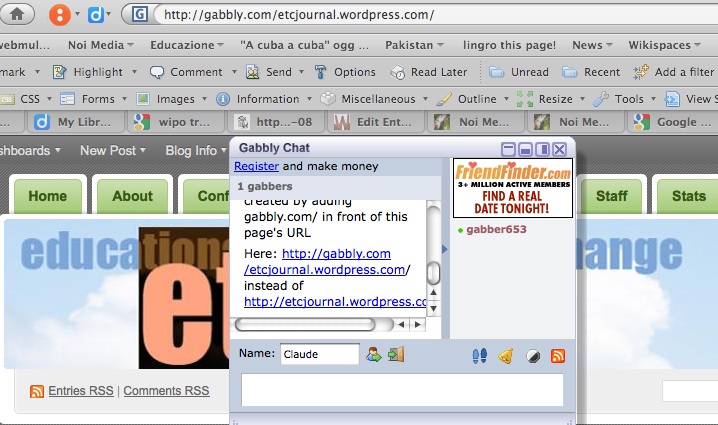
There is a phishing scam going round via Twitter direct messages sent from already compromised accounts. The message says something like “Is this (from) you?”, followed by an apparently legit link, but which redirects to a scam page that asks you to log into your Twitter account.

If you do, the phisher can in turn use your account to send the same message to all your contacts. And so on. The problem is that the phisher can also use your account to send other messages, like: “I’ve been robbed while I was in X on holiday, can you send me some money I’ll repay as soon as I get home”, for instance.

So, just as with e-mail phishing scam, the best way is not to click on the link. But if you’ve clicked, not to enter your account data unless you are rock-sure the request is from twitter. And if you have entered your account data, to change your password as fast as possible, and warn your contacts about the scam.

warning

That’s what I am doing with this post, because I got caught too.  I realized it a few seconds later and changed the password for the ETCjournal twitter account immediately. Although  no direct messages were apparently sent from that account during these few seconds before I did, it seems safer to send this warning.

In general: the tweets from the ETCjournal twitter account are automatically generated from its two feeds, Entries RSS and Comments RSS, via twitterfeed. So any twitter message by ETCjournal that does not bear the mention “from twitterfeed” should be considered a priori suspect.

i3 Funding Process Unfair to Small Businesses

keller80By Harry Keller
Editor, Science Education

The comment period for the $650 million Department of Education’s “Investing in Innovation Fund,” referred to as i3, has ended. An article in Education Week discusses the main thrusts of these comments. For the entire text of the proposed priorities, click here.

Some large urban school districts object to small rural districts being favored. Small rural districts have problems with devoting resources to writing such complex grant applications and with conducting the studies requested in the guidelines. A requirement for 20% matching funds from the private sector, including foundations, has also received criticism because of the very short time frame. Some districts complain of the “adequate yearly progress” (AYP) requirement.

My perspective is that of a small business president. For this purposes of comment, it only matters that I have been working on innovation in education for over ten years and have encountered just about every road block to having schools use my innovative services as you can imagine.

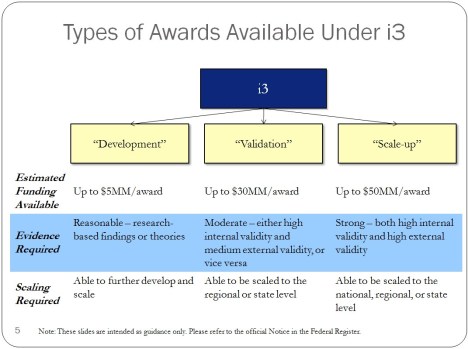
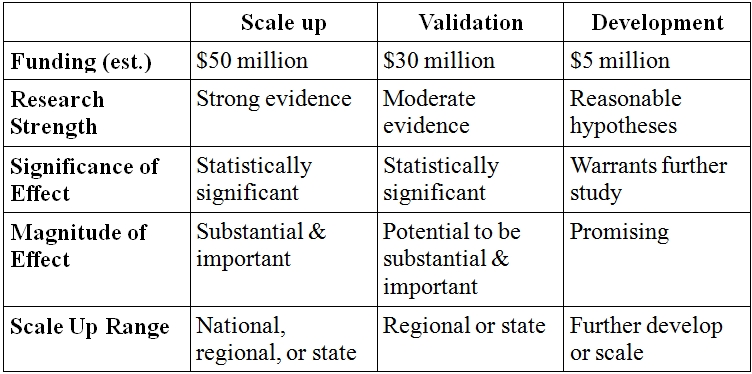
The i3 guidelines allow three different types of proposals: scale-up grants of up to $50 million, validation grants of up to $30 million, and development grants of up to $5 million. The last of these requires a two-stage application process and does not require the high level of studies with proven results that the other two do.

Here’s the description of the scale-up grants. (Emphasis added.)

Scale-up grants would provide funding to scale up practices, strategies, or programs for which there is strong evidence (as defined in this notice) that the proposed practice, strategy, or program will have a statistically significant effect on improving student achievement or student growth, closing achievement gaps, decreasing dropout rates, or increasing high school graduation rates, and that the effect of implementing the proposed practice, strategy, or program will be substantial and important.

Validation grants are described in the following way. (Emphasis added.)

Validation grants would provide funding to support practices, strategies, or programs that show promise, but for which there is currently only moderate evidence (as defined in this notice) that the proposed practice, strategy, or program will have a statistically significant effect on improving student achievement or student growth, closing achievement gaps, decreasing dropout rates, or increasing high school graduation rates, and that with further study, the effect of implementing the proposed practice, strategy, or program may prove to be substantial and important.

types of awards available under i3, explained in a table. Columns: Development, Validation, Scale-up; Rows: Estimated funding available, Evidence required, Scaling requiredClick the image for the PowerPoint presentation.

This is how development grants are explained.

Development grants would provide funding to support new, high-potential, and relatively untested practices, strategies, or programs whose efficacy should be systematically studied. An applicant would have to provide evidence that the proposed practice, strategy, or program, or one similar to it, has been attempted previously, albeit on a limited scale or in a limited setting, and yielded promising results that suggest that more formal and systematic study is warranted. An applicant must provide a rationale for the proposed practice, strategy, or program that is based on research findings or reasonable hypotheses, including related research or theories in education and other sectors.

Only school districts and nonprofit education businesses may apply. Entrepreneurs who provide tools are not eligible.

Note that the largest awards require “strong evidence.” Those districts that choose to submit “scale up” proposals must include innovations with this evidence. “Strong evidence means evidence from previous studies whose designs can support causal conclusions . . . and studies that in total include enough of the range of participants and settings to support scaling up to the State, regional, or national level . . . .”

It’s a very reasonable assumption that most of the new, innovative tools for education will come from small businesses. In the difficult education marketplace, having a new and better way to provide some aspect of education provides an edge over large existing businesses. The large education companies have an established way of doing business and usually will not seek change unless forced to do so by the market.

The i3 guidelines, however, are skewed toward large entities by their requirements for studies, which are quite expensive to carry out.

The i3 guidelines, however, are skewed toward large entities by their requirements for studies, which are quite expensive to carry out. My business has not been able to do a study and most of those I’ve looked at have the same problem. This basic problem seems to pervade many federal and state operations. The large businesses that can afford lobbyists, studies, extensive marketing, and other activities not accessible to their smaller kin get the bulk of federal largesse.

Besides, education studies often have flaws. I’ve seen two studies produce opposite conclusions on the part of the investigators. Generally, education studies compare a new method or device in classrooms with the status quo. Of course, the teachers and students know that they’re doing something differently and react to that fact as well as to the actual new method or device.

The “new math” was studied and found to be the great savior of our student mathematical literacy. What happened? When rolled out at scale, it just didn’t work, and a generation of students was hobbled in its mathematics learning by this idea. Suddenly, it was “back to basics” again.

The i3 study requirement is therefore doubly flawed. Studies do not produce reliable black-and-white results. Understanding their data requires very knowledgeable people and often they will conclude only that the new idea may help students. It’s much too easy to bias the study results in the direction that the investigator wishes.

The second flaw in the requirement is the institutional bias that such requirements have against our greatest innovators, small organizations and individuals. The greatest new idea in education could be out there right now seeking acceptance, crying in the wilderness and unheard by the districts, agencies, and foundations. You can be sure that a number of good ideas are struggling to be recognized.

The i3 program also appears to assume that innovation will come from within schools. But schools tend toward inertia. An entire system of school districts, state departments of education, and colleges of education has been built to keep things stable, to avoid change. Good ideas have originated within schools to be sure. However, this approach of the i3 program ignores our greatest resource, entrepreneurship. The program should reward schools that reach out to the entrepreneurial community to find new, exciting, and innovative ways to improve education.

We do not know yet what we’ll see in the final guidelines. However, none of the comment summaries in the Education Week article suggest a movement toward encouraging entrepreneurship. If we’re to make a real difference in education, we must engage all of our resources including the most powerful agent for change we have. While, as an entrepreneur myself, I am biased, I believe that the facts support my conclusions.

Let’s engage all of our national resources in this important effort.

The Education Budget Crisis: Is Technology the Answer?

Across the U.S., colleges and schools are facing unprecedented budget cuts. A web search will erase any doubts that the problem is exaggerated or just a bump in an otherwise smooth road. Here are a few articles that surfaced in a quick search:

To encourage discussion on this national (and perhaps international) crisis, ETC is publishing three articles:

Link to the Talketc discussion on this article

The Education Budget Crisis: Is It Necessary?

Jim ShimabukuroBy Jim Shimabukuro
Editor

According to the latest headline, the University of Hawai`i system is facing a $76 million budget crisis that threatens “massive cuts to programs, departments and schools”[1]. Yet, the state recently announced that $203 million has been released to the UH for capital improvements.[2]

The same holds true for the public schools. At a time when budget cuts are forcing layoffs, pay cuts, furloughs, and program reductions, the state is releasing $75 million for — you guessed it — capital improvements.[3]

I’m aware that UH is not alone and that countless colleges and universities around the country are facing similar hard times and budgeting practices. Thus, when I refer to UH specifically, I’m also referring to all the other higher ed institutions that are suffering similar fates.

Link to the TalkETC discussion on this article

For me, the fundamental question is, Are physical structures such as classrooms and offices so essential to education that they must take priority over programs and staff? Or put another way, When push comes to shove and we’re forced to choose between the two, do the buildings win?

Perhaps 20 or even 10 years ago, the answer would have been yes. Without campuses and buildings, education would be impossible.

uhmanoa01

But today, with online programs flourishing, the answer has to be a resounding no. Education is already being delivered online via strategies that don’t require expensive classrooms and offices. In fact, nearly all the physical structures that make up a traditional campus are superfluous for totally online classes. Students and professors can work from anywhere: home, dorm, coffee shop — wherever they have an internet connection.

To its credit, the UH isn’t completely oblivious to the potential of online learning. To address the severe budget cuts, the chancellor has begun a system-wide planning process to prioritize efforts, and under “D. Maximizing resources,” we find “Explore greater use of technology–enhanced learning (distance learning) to increase access to learning opportunities and achieve savings”[4]. The fact that this is last among the six priorities in this category is telling, I think.

The problem, I’ve been told, is the state’s funding process, which treats capital improvements as a separate budget item. Colleges and schools aren’t allowed to reallocate CI funds to other uses. Thus, we face the very real prospect of offering students well-maintained as well as new buildings but severely truncated programs.

But what if . . .

What if the funding process were made more flexible and colleges were given the power to use all or most of the CI funds in innovative ways to save or restore the programs that are now in danger of being cut or curtailed?

If this actually happens, how would we ensure that the funds would be used wisely?

My bias is toward pouring the funds into electronic infrastructure, staff reorganization, and resources that would mazimize a college’s completely online strategies and offerings. In my mind, the money’s there for colleges to thrive, but only if they’re willing to take the leap from physical to primarily virtual structures.

Given the freedom to decide, are colleges ready for this leap? Or would they still opt for capital improvements?

Needless to say, gravity is probably strongest in the middle, where the pull is toward a collegial splitting of the funds between CI and online, But the real danger in this kind of non-decision is that we may simply perpetuate the status quo, watering down the real power of the funds and going through the motions of changing without actually changing and ensuring that the we’ll travel all the way back to where we are now.

__________

1. Dan Nakaso, “University of Hawaii in Crisis Over Deficit,” Honoulu Advertiser, 9 Nov. 2009.

2.$203M Going to Physical Improvements at UH,” Honoulu Advertiser, 7 Nov. 2009.

3.Public Schools to Spend $75 Million on Improvements,” KPUA, 5 Nov. 2009.

4. Virginia S. Hinshaw, “Preliminary Recommendations on Prioritization,” University of Hawaii: Communications, 8 Sep. 2009.

Job Security Is a Powerful Argument Against Change

adsit80By John Adsit
Editor, Curriculum & Instruction

As I noted in one of my past articles in which I mentioned the problem the computer giant DEC had with creating critical improvements in its computers, the problem lies in the fact that an incumbent system, created to better accommodate an existing situation, acts to perpetuate itself even after the situation changes. That comes about for two reasons.

The first is simple resistance to change, both psychological and legislative. We have always done something one way, and we are used to it. We also have systems, rules, and regulations that have to be changed, and that requires convincing people who are not experts in the change situation that the change is necessary and beneficial. That has already been mentioned, so I hasten along to the second point, the one on which I wish to dwell.

Link to the TalkETC discussion on this article

Many people may remember the staggering improvements made decades ago at Garfield High School in Los Angeles, a school with almost complete Hispanic enrollments, with 80% on welfare, which went from the poorest imaginable academic success to unbelievable (to the College Board, at least) academic success in only a couple of Jaime Escalanteyears. One small part of that improvement, the efforts of math teacher Jaime Escalante, was depicted in the movie Stand and Deliver. While that movie did a good job depicting Escalante’s work, it failed to show that he was a part of a school-wide revolution, a revolution brought on by earth-shaking changes in the educational process.

One of those changes was instituting a rule that students could not take elective classes if they were below grade level in the key academic areas of reading, writing, and math. As a consequence, the school went from 12 art teachers one year to 2 art teachers the next. That was great for student academic achievement, but it was not so great for the 10 art teachers who lost their jobs. It took a lot of courage for the leadership to override the obvious objections and still make those changes.

I saw the same thing first hand when I was involved with an effort to do something similar, but on a much smaller scale, in a high school. Like almost all schools, such decisions were not made by any one person; they had to be determined by the school’s shared decision making body—in this case the department chair council. All attempts for change proposed by the four key academic departments (English, Math, Social Studies, and Science) had to be approved by the entire council, and those four votes were regularly opposed by the other 17 departments. (Yes, that’s right. Some of the departments represented one teacher or even half a teacher.) Any serious attempt to focus on academic achievement in the core content areas meant a very real threat that we would lose enough jewelry, typing, or vocal music students to cost someone a job. Any proposal that threatened that was a non-starter.

In one whole faculty meeting, an art teacher stood up and said, “I’m against this because it could cost me my job, and if you vote for this, you could be voting to take away my job.” It was the most effective argument anyone made on any side of the issue.

Similarly, when the school board of this very large district considered cutting back on bus transportation, the entire body of employees in the transportation department—a shockingly large number—came out en masse to make sure such a travesty could not be considered.

Whenever any change, such as Jim descries, is considered, we have to remember that a very substantial percentage of people are invested in that status quo, and they will do everything in their power to make sure it is maintained. There are a lot of people whose livelihoods are tied up in capital improvements, and you can be sure they will do whatever they can to keep those funds flowing.

If you want an example, turn on your television today and see how long before you get an urgent appeal from the health care industry trying to make sure that these horrible (to them at least) changes in the health care system are prevented.

Tough Decisions for Extraordinary Times

keller80By Harry Keller
Editor, Science Education

Consider that the board of trustees of a university must be conservative or else that university will not endure. They’re supposed to take the long view and to continue to do things as they have been done for decades or even centuries. Contrast that attitude with corporate America’s narrow focus on next quarter’s results much to our national detriment. Ordinarily, I’d say that the university is making the better decision.

However, these are not ordinary times. For hundreds of years, higher education has, at its root, remained fairly constant. Students live at a university, attend classes given by sages, take tests, and have a social life that they’re unlikely to repeat later in life. The university was intended to be a place apart designed to imbue young adults with certain ideas without the distractions of living in society.

Link to the TalkETC discussion on this article

The Internet now threatens that ages-old constant in a manner not previously seen even with the impact of highways, automobiles, radio, and television. Most of us would agree that the hope exists for a better education world based on broadband communication. We are seeing some experimentation with these ideas in universities Image with text: The virtual gateway to educationnow but not too much. There’s been lots of paper saving and some bureaucracy trimming. Some institutions now deliver online courses. For example, Troy University located in an out-of-the-way area of Alabama makes most of its income from online courses including a contract with eArmyU.

The online courses are taught by adjunct professors, a nice way to say that they were unappreciated and underpaid. The regular faculty, at least those with which I had contact, obstructed efforts to expand the online program. They were not interested in having that online sideshow invade their hallowed halls. As John Adsit suggests, they are very much wedded to the status quo.

Unless they’d like to end up like the music industry, universities had better make plans and investments today. Higher education is a very large industry with lots of money up for grabs. If established universities drop the ball, there are plenty of organizations ready to pick it up. Jim’s bias toward “electronic infrastructure,” etc. is exactly right. Furthermore, universities should be thinking like some planners in Detroit who are considering demolishing entire neighborhoods outside of the city and converting them back to farmland. As lecture halls and classrooms become disused, how should that space best be utilized? What will higher education look like in twenty years?  That’s a short time in the history of many universities.

15th Annual Sloan-C Conference – A Review

John SenerBy John Sener

Disclaimer: I am both uniquely qualified and perhaps ill-suited to write a review of this conference. Uniquely qualified as Director of Special Initiatives for Sloan-C and as one of a handful of people who have attended all 15 Sloan-C conferences; ill-suited because of the possibility of “bias” but also because, frankly, I spent most of my time there as usual talking with colleagues rather than attending conference events. So this will be a more impressionistic review of the conference rather than a comprehensive one. In reality, the conference has gotten so big that it’s not possible for a single individual to provide a complete review.

Link

Up front, one new development is worth noting in particular: tweeting. I started tweeting at conferences earlier this year, but this was the first time for me to do so at a Sloan-C conference, and I did so throughout. The evolution of the tweetosphere even over the past few months is remarkable. People were coming up to me afterwards and thanking/complimenting me for my tweets; I found myself scanning session rooms to find fellow tweeters posting on the same presentation; I was able to get tweeted summaries of other presentations without attending them or being burdened to find print handouts; and I even met someone new because I mistook them for a fellow tweeter — so it’s becoming a notable social undercurrent at many conferences. Oh, and tweets make great notes for preparing articles like this one . . .

Frank MayadasThe person primarily responsible for bringing the Sloan-C conference into existence, Dr. Frank Mayadas, was the keynote speaker. Frank offered a three-part view of the current state of online education: retrospective, current, and future. The retrospective piece was of course gratifying for us “old-timers” who always appreciate the opportunity to reflect on just how far we and the field have come. How in the early days (in my case, pre-World Wide Web) we cobbled together makeshift or relatively primitive products (e.g., Lotus Notes, First Class, Web Course in a Box, Allaire Forums) to create online courses, while remembering the first Sloan-C conference where everyone knew everyone else (95 participants) and there were two presentations for each concurrent session.

Fast forward to the current conference with almost 1400 attendees total, including ~170 virtual attendees, and 40-50 presentations per concurrent session. Online higher education has entered the mainstream and continues to grow at a brisk clip thanks to the development of a lively practitioner community capable of rapid response, along with the growth of a healthy vendor community which has provided tools to fuel online education’s growth. But what about its future? Dr. Mayadas called for online education to reach truly full scale (as also reported in this Chronicle of Higher Education article), which would likely involve additional changes to the current landscape, such as more targeted government support and greater attention to making online education attractive to a much larger proportion of faculty.

Unlike many conferences which are struggling with conference attendance due to budget crises and constraints, this conference actually grew in size relative to last year, with a 5% growth for onsite attendance and 20% overall growth for the conference including virtual attendees. On Thursday morning, I “convened” the plenary session for the virtual attendees, which meant I monitored the computer feed (messages and questions), responded to any transmission issues as well as I could, and relayed any questions or comments to the speaker during the Q&A period. Although it was difficult to know from the messages, it appeared that many if not all of the virtual attendees were finding value in this presentation at least; and as one virtual attendee noted, virtual attendance was good not only for his budget but also for his waistline, as he was eating a lot less food than if he were attending the conference in person. ;-)

Andrew KeenThe speaker, Andrew Keen, has attained some fame due to his book The Cult of the Amateur, and his self-professed aim as a “polemicist” was to provoke thought and discussion through expounding his contrarian positions, for instance:

  • The Internet poses a danger precisely because it makes education too inexpensive (cheap/free).
  • Educators’ authority is based on the authority conferred by their hard-won wisdom and must be maintained; kids don’t really know anything of value (i.e., wisdom).
  • The Internet’s real-time speed prevents thoughtfulness, which is another challenge to educators.

Needless to say, Keen’s talk provoked a fairly lively Q&A session (and evoked strongly contrasting reactions from attendees afterwards). It would have been nice if he had understood his audience a little better; at one point, his speech was proceeding under the assumption that most of his audience were tenured faculty, so he seemed a bit surprised when he actually polled his audience to find that very few (<10%) were in fact tenured faculty. All in all, however, Keen succeeded in his goal to provoke thought and discussion about the issue, even if IMO he missed a golden opportunity to have a more nuanced discussion of the issues with an audience that was more sophisticated about the issues than what I suspect he customarily faces. Then again, perhaps his aim was more on target: over the past several years the Sloan-C conference has evolved into a conference which attracts a large proportion of first-timers, and this year was no exception, with perhaps as many as 50% of the attendees being first-timers (based on a show of hands at a plenary session).

I also attended several concurrent sessions which reinforced for me that online education continues to evolve, expand, even backtrack in a myriad of directions. One of them had a “back-to-the-future” feel for me, as the presenter was advocating a return to modularized learning management systems as an alternative to the current crop of LMSs and their relative inflexibility and drive toward being enterprise-level solutions. The discussion at another session on learning objects reminded me that we were well past the days of attendees looking for wisdom from pioneer presenters; instead, the audience is often at least as knowledgeable as the presenter(s). That session generated a side conversation with an attendee about a particular learning object repository solution her institution was using, so I did that in lieu of attending additional sessions that afternoon.

______________________________

During the panel, I had an epiphany of sorts, realizing the extent to which online education has provided an opening for private sector companies to become more deeply involved in higher education.

______________________________

The next morning, I served on a panel discussing the issue of relationships between higher education and the corporate sector, specifically vendors serving the online higher education market. During the panel, I had an epiphany of sorts, realizing the extent to which online education has provided an opening for private sector companies to become more deeply involved in higher education. Some may react to this insight with a “duh!”, and to some extent I also wondered why it took me so long to realize this. I’d been more focused on the other unanticipated effects of online education on higher education, such as the creation of higher, more concrete standards and expectations for course quality and instructor involvement.

Later that morning, I attended a session which described research showing how the Quality Matters project has positively impacted its users several years later. After the session, I got involved in yet another extended  “shop talk” discussion. No doubt I missed lots of good conference sessions, and indeed that’s now unavoidable. But for me the great value of this conference has been, and continues to be, the quality of interaction with long-time colleagues and meeting new ones. In other words, for me the conference is a non-stop schmoozefest.

Some would say this is a highly ironic observation to make about an online education conference. I would say that an in-person conference is an excellent form of tribal gathering to touch base with those numerous colleagues with whom the primary relationship is an online one. Virtual conferences are on the rise, they already have some advantages, and they will only get better. In-person conferences may be attended less frequently, but they are not going away anytime soon — at least if they maintain the quality provided by events such as the Sloan-C conference.

Effective Leaders Challenge Teachers to Continually Grow

keller80By Harry Keller
Editor, Science Education

John Adsit (Collaborative Leadership Is Essential for Change) has hit on the primary issue with individual teachers. They say, “What I am doing now is working.”  They say that even when it’s demonstrably untrue. It’s a simple litmus test for bad teachers for the simple reason that there’s always a student who could use something different. You never reach perfection in education just as you never have a final theory in science.

Several people have alluded to the necessity for good leadership, leadership that will challenge the teachers who believe that they have reached the final plateau and that everything is working. What happens to businesses with that attitude?  Good leaders must lead and must lead with a vision of what’s coming in the future. They cannot rest on laurels or stick with good enough. Then, they must transmit that vision to their people and find ways to motivate them to improve continually.

Consider that even if a teacher has created the perfect course today, that course will not be perfect tomorrow. Yesterday’s students listened to transistor radios and watched maybe an hour of television a day on 9-inch black-and-white sets. Today, they text constantly and watch hours of incredibly diverse television programming each day. Yesterday, they mailed hand-written letters and waited days for replies. Phone calls outside of the local area were expensive. Today, they have instant communications and can call Europe from the U.S. for free.

______________________________

No matter how resistant to change teachers may seem to be, it’s there in the classroom that change must take place.

______________________________

When your target audience changes, your strategies for creating learning must also change. The perfect becomes imperfect, although the perfect never really was perfect.

Leaders face the problem of predicting the future. Which of many options for improving education do you embrace?  What should you change and what should you retain?  Generally speaking, you must distinguish between strategy and tactics. Find learning strategies that have stood the test of time, that have been working well for a long time. Two examples are discovery and creation. Most people, and especially younger people, love to make new things and to discover new ideas.

Another strategy is paying personal attention to students. Make them believe that you care. Also, challenge students so that they aren’t bored. However, don’t worry about entertaining them. That’s not a teacher’s job. You’ll have to be more specific regarding the particular material that you’re charged with teaching of course.

Changing tactics means finding different ways to involve students in learning. How do you use skills that they have developed and that didn’t exist a few decades ago, skills you may not have? Which old-fashioned ideas still resonate?

No matter how resistant to change teachers may seem to be, it’s there in the classroom that change must take place. If students are bored, the teachers are too. They’d love to have the opportunity to make their jobs more fun and rewarding. Leaders must show them the way so that they become the solution and no longer are seen as the problem. Don’t expect teachers to do this on their own just because a few have. They face many uncertainties and long hours to build change and often are unrewarded and even criticized for it.

Teaching with Technology: Passion, Scholarship, and a Leap of Faith

Bonnie BraceyBy Bonnie Bracey Sutton
Editor, Policy Issues

I always liked that discussion about the body falling down the stairs and how it looked from various perspectives. I consider myself a change agent and that got me called into the office, moved from school to school, and actually allowed me to work for the President of the United States.

The answer is not on the page

KidsNetwork National Geographic and the laser disk programs I had (old technology) made me think in new ways, especially when the kids wanted to know why they couldn’t use the technology that I was using, computers, digital cameras, story boxes, etc. With laser disks, you could capture frames and create presentations. I also had a lumaphone from Hawaii somewhere, and we could see the people we talked to. This was revolutionary. You know what? Even though that stuff is old hat and we have moved on, there are people still looking for the answer on the page.

So what changed was me. I was not looking for the answer on the page. The kids were free to think, read, and use other sources. Dr. Hilda Taba did this without the technology. She used pictures. But that was way before the Internet. There have always been people seeking to create change. Change is chaos to many and quite frightful.

Perhaps you used to be a teacher and you learned what was in the book, so you dropped the book or lost it — easily replaceable — and you could look every kid in the eye while standing your ground. It takes courage to do anything else. I don’t believe I know how classroom management is taught for computer use, nor do I know how people estimate the variables of change over populations not used to being given permission to think, explore, search. That’s a whole discussion for another day.

How do you manage different populations of students using technology?

I learned classroom management for technology through NASA and National Geographic. The Challenger Center and various groups demonstrated and taught as much as they could about different approaches. Earthwatch did some of this too. Everything you teach is not going to be interesting, but there are different ways of teaching.

I made up my own matrix, a game, some books, a classroom display and resources, a field trip, and local and international resources. But I can cheat because I live in Washington, D.C. What expert is not available to me? What gadgets and gizmos, intriguing laser disk lollipops, giant insects, lizards walking on water, astronauts coming in to tell kids how they got started? With the magic of multimedia, though, you can have access to the things that go on in D.C. In fact, most of this stuff have migrated to the web. Now the problem is that there is too much information and too many things to do, and someone has to make choices.

I used the standards that I knew, and the students and I would apply them in reviews of their individual and group projects. Not hard to do except for the first time. I sent home the objectives I wanted to accomplish at the start of every big unit. A mistake?

No. Three things happened. Parents who could help, did. Parents who did not understand or know about the topics asked to come in to learn it and help me. (That was scary, at first.) Kids who were not in my class, unfortunately, wanted in on some of the action. You can see how I was a nuisance.

We did the Challenger Center’s Marsville project in my class. I asked other teachers to be a part of it, but they refused. At that time, I almost had an accident while going home. As I rounded the curve in the neighborhood, I saw a giant Marsville that my kids had built for their friends.

Teaching as a passion

For social studies and geography, I did a study of the Chesapeake Bay, the great shell bay. The Fish and Wildlife Service helped me with field trips; National Geographic had a video and lesson plans, and the map was wonderful. We read sections of the book Chesapeake and learned more than the three paragraphs in the social studies book. We knew the history, the science of the estuaries that lead to the sea, and we seined for crabs, did water turbidity and salinity studies, and examined microscopic organisms. Click here for the lab part — where I work.

school children using microscopes

One teacher told me that when they decide how to do technology and get it right, she would make an effort to learn. I suppose she is still waiting. Another teacher I knew watched me and asked to be a part of the project. So we worked together. This woman was such a good teacher that we joked she could teach the dead to read and write. No kidding, she could get a child up to grade level in about a year. Immigrant kids.

bonnie02

Deloris Davis. What she did was not to do all the work. We had a parent committee who did most of it for us. I never thought of that.

Teachers in Hawaii — I went there to learn about the long canoes. I have a friend from New Zealand who is a book publisher. I studied Hawaii, the islands, and the history in depth because if you are a National Geographic trained teacher that’s what you do.

Lately there is always more to learn

So there is Web 2.0 and the new Blooms Digital Technology and TPACK. You can see why teachers who are used to a book might run screaming from the room.

In Confronting the Challenges of Participatory Culture: Media Education for the 21st Century, Henry Jenkins talks about the new skills:

  • Play— the capacity to experiment with one’s surroundings as a form of problem-solving
  • Performance— the ability to adopt alternative identities for the purpose of improvisation and discovery
  • Simulation— the ability to interpret and construct dynamic models of real-world processes
  • Appropriation— the ability to meaningfully sample and remix media content
  • Multitasking— the ability to scan one’s environment and shift focus as needed to salient details.
  • Distributed Cognition— the ability to interact meaningfully with tools that expand mental capacities
  • Collective Intelligence— the ability to pool knowledge and compare notes with others toward a common goal
  • Judgment— the ability to evaluate the reliability and credibility of different information sources
  • Transmedia Navigation— the ability to follow the flow of stories and information across multiple modalities
  • Networking— the ability to search for , synthesize , and disseminate information
  • Negotiation— the ability to travel across diverse communities, discerning and respecting multiple perspectives , and grasping and following alternative norms.

The school system did not like National Geographic, NASA, Discovery Channel, and others coming into my classroom to film because it made the other teachers feel bad. The teachers did not want to do the work, which I understood. Converting to technology is no easy task. It requires more than a leap of faith and a loss of total control, in some ways, of the classroom. It requires scholarship, diligence, and willingness to learn, and it also takes an inordinate amount of time. Few people appreciate that.

But it also leads to better classroom work. I was invited to leave teaching with early retirement and a bonus. Innovation and that kind of thing was not amusing to the school system where I worked even if I had worked for the President — which seems to have made it worse.

I was not a prima donna or a diva either. I simply love teaching.

Collaborative Leadership Is Essential for Change

John AdsitBy John Adsit
Editor, Curriculum & Instruction

[Note: This article is a response to Steve Eskow’s 22 Oct. 2009 comment on John’s “Teacher Skills Critical for Success in Online Classes.” Steve Eskow: “When I was a college faculty person, I didn’t resist change, I fancied myself a change agent. I did, however, resist change suggested by others, particularly other change agents who looked at my course materials, sighed, and proceeded to suggest changes.” -js]

Steve, what you say is, in my experience, pretty universally true, and it is the ultimate dilemma in staff development. In my reply, I am going to include something from Bonnie’s last post as well.

I was involved with staff development for a number of years. It was my job to do exactly what you said you would not stand for—telling teachers how to do their work differently.

At first I labored under the direction of leaders who used perhaps the most misguided staff development policy of all time. Under the theory of models like the Annenberg Institute’s, the appointed educational leaders of the schools (principals and superintendents) tried to slip into the background and let teachers lead the change process. The idea was that if it appeared to come from within, change would be accepted by others. The opposite turned out to be true, and Annenberg’s own research showed that. Teachers who tried to act as change leaders were universally rejected by their peers, and they either folded their tents and retreated to the periphery of the school, transferred to another school, or dropped out of teaching altogether. I remember all too well the pain inflicted on me by those who openly bristled at my suggestions.

This was made even worse by a process we were required to follow in these attempts, a process that seemed absurd to me and which I fought unsuccessfully. We were supposed to smooth ruffled feathers from the start by telling them they were already doing a great job, but these new techniques, which would require them to change their ways so very much, would make them even better. I thought this would guarantee that they would not listen to us—if I am already doing a great job, why should I change? The National Staff Development Council later showed that I was absolutely right. Effective staff development will only work, it learned, if the people receiving the training could experience the cognitive dissonance that comes from realizing that what they are doing now is not working well.

Robert J. MarzanoAnnenberg’s study showed that those bristling teachers were the primary reason (along with a complementary factor to be discussed later) for the failure of school reforms. In fact, one or two of those bristlers on a staff was enough to derail a reform embraced by nearly the entire rest of the staff. Bob Marzano, then of the Mid Continent Regional Educational Laboratory (MCREL) said in a conference I attended that he could not think of a worse way to implement reform, or a better way to destroy a dedicated teacher.

The Effective Schools research of people like Lazotte pointed toward a solution, one that is mentioned by Bonnie in her last post. The principal (or equivalent) must lead the reform effort. This principal must not impose a vision of reform on the population, but must instead use effective leadership skills (such as those described by DuFour, Fullan, and others) to bring the faculty to a shared vision in which all believe. The bristling resisters had to be dealt with effectively and eliminated from the staff, either by artful persuasion or by removal. I myself participated in a study of schools that were more effective than would be predicted by their the inherent characteristics of the student populations and saw that this was true in every school we analyzed. Believe it or not, every faculty member we interviewed knew by heart and believed in passionately the school’s mission statement, and it was a real mission statement, not the kind of meaningless cant we normally see.

Annenberg’s research showed the same thing. In 100% of the successful schools they surveyed, teachers reported that the primary (by far) reason for success was the way the educational leader was able to deal with teacher dissent and bring the faculty together. In 100% of the failed reform efforts, teachers reported that the primary reason (by far) for the failure was the way the educational leader was unable to deal with dissent and bring the faculty together.

So, a reformer such as myself has little chance of bringing reform to schools that lack such leadership, which is the vast majority.

Given that background, Steve, how do you suggest that change come to teachers who cling to outmoded ideas and bristle when told to do differently?

steve_eskow40Steve Eskow, 23 Oct. 2009, 7:05 am:
A powerful and moving post, John.

All I have to contribute now are some early and unformed thoughts as answers to the question with which you ended your message.

First: I think I would try to rid myself of the vocabulary of teacher resistance, e.g. “teachers who cling to outmoded ideas.” All of us–including people like you and me who cling to constructivism and who would insist it’s not outmoded–are bristlers and resisters when our favorite recipes are challenged, as you document so well.

Based on your account, perhaps we as consultants need to differentiate between “external change agents”–you and me–and “internal change agents”–principals, superintendents, university deans and presidents. Perhaps one commandment for us might be “Thou shalt not undertake to change teachers unless and until there is an internal change agent as advocate.”

And another truism: we may need to do a better job of analyzing the pieces and interconnections of the educational system we’re trying to change to locate the various sources of the resistance to change. Obvious examples: the academic setting: if the building has lecture halls, do they ask to be used, and are we about saying letting them stand empty? If there is a hierarchy of instructional roles, e.g., lecturers and section leaders, which elements of the hierarchy resist the change? Accrediting bodies? National disciplinary bodies which define “standards”? Budget? The teachers to whom we attribute the resistance are one element in an elaborate ecology of forces that create and maintain the status quo, and attributing all the resistance to the teachers alone is patently unfair.

Or maybe not, John.

A beginning, John.

bbracey40Bonnie Bracey Sutton, 22 Oct. 2009, 9:20 am:
What reformers do is to infuse ideas and lend support for the teacher change agents and involve the administration of the schools in meaningful ways. My help was at the highest level. At George Mason, Chris Dede was teaching and he brought a whole class to watch me work, but also invited me to the class to share ideas, frustrations, concerns and anything I wanted to share.

Frank Withrow and other leaders also were there.

Eventually we became a group for change with some funding. You are needed. One teacher can be moved, disposed of in a New York Minute.

John Adsit, 24 Oct. 2009, 9:05 AM:

Steve, I am not sure all of us are bristlers when it comes to change. Perhaps I am fooling myself, but the reason I ended up being a staff developer was my penchant for experimentation with change. When I encountered a new idea, I tried it out. If it worked, I went with it. The instructional processes I taught (with enthusiasm) when I was a staff developer were ones I had never used 5 years before.

A number of books have been published in the last decade that report on research on the effects of different strategies on student achievement. Bob Marzano, for one, has published several. I have read them and taken what I could from them. One of those strategies is the use of graphic organizers for instructional activities, which are apparently quite effective. I have personally always hated them. Hated them. When I read the results of the research, though, I shrugged my shoulders and made sure that strategy was a part of our required instructional design.

What makes teaching so different from other professions? Did doctors continue to use the iron lung after other strategies were shown to be more effective? Did attorneys continue to cite Plessy v. Ferguson after Brown v. Board of Education overturned it?

One of the things I used to hear frequently in protest of change was “What I am doing now is working.” Really? Are all your students learning at a high level? Is there no room for improvement?

A colleague of mine was a major advocate of the traditional lecture as the primary (perhaps only) instructional practice in his classroom. He was, in fact, a very vocal critic of the changes I advocated. One day one of his students openly said that the class was boring. He said, “It is my job to be boring, and it is your job to be bored. That’s how education works.” The fact that his students had the worst record in the history of AP exams (you can’t do any worse than having not a single student take the test during the years you teach the course because of the fear that they will fail) did not deter him from his unshakable belief in the quality of his practices.

I guess I don’t understand that attitude.

24 Oct. 2009, 5:08 AM: [Reply to Bonnie:] That is how it starts. The students taking a class from the likes of Chris Dede are a far different group from teachers at a mandatory inservice workshop.

As I said before, the key element in your experience is the administration, which must understand the reform and know how to lead that change effectively.

thompson40John Thompson, 24 Oct. 2009, 5:29 am:
“What I am doing now is working.” Yes, I hear that all the time. “Why change if I’m already successful?” is the refrain. As a response, I like to highlight Tiger Woods. After he won The Masters golf tournament by a record margin, everyone was singing his praises and how accomplished he was. However, he wasn’t satisfied so he retooled his swing, which was dangerous because sometimes golfers who do that never get back to their previous level let alone to a higher level. But Woods took the risk and was successful after nearly two years of work. His game went to another higher level. After a few years, he did the same. And he did it yet again when he was hurt and came back after a long layoff to recuperate. Here’s the acknowledged greatest golfer in the world and he’s not satisfied with his performance. So how is it that some teachers can smugly assert they are doing everything they can do in their teaching? Plateauing is not an option for Tiger Woods. It shouldn’t be for our teachers either.

Steve Eskow, 24 Oct. 2009, 6:09 am:
Hi John,

First a general comment, then some interlinear commenting.

The general comment is really a question: Is there a bit of bristling in your last message to me?

Steve, I am not sure all of us are bristlers when it comes to change. Perhaps I am fooling myself, but the reason I ended up being a staff developer was my penchant for experimentation with change.

My speculation was this, John, and I am increasingly convinced there is something to it: many teachers do not bristle at change: like you, they have a “penchant for experimentation with change.”

They bristle at change agents.

A number of books have been published in the last decade that report on research on the effects of different strategies on student achievement. Bob Marzano, for one, has published several. I have read them taken what I could from them. One of those strategies is the use of graphic organizers for instructional activities, which are apparently quite effective. I have personally always hated them. Hated them. When I read the results of the research, though, I shrugged my shoulders and made sure that strategy was a part of our required instructional design.

Might it be that in a hypervisual culure one of the overall tasks of the educational system ought to be to balance visuality by emphasizing the language skills–language sans graphics–that make discussion, dialog, and debate possible? Students may have to learn to be comfortable in discussions without Power Point. Like this one.

(You of course are noticing that I am starting to resist–perhaps even bristle a bit.)

What makes teaching so different from other professions? Did doctors continue to use the iron lung after other strategies were shown to be more effective? Did attorneys continue to cite Plessy v. Ferguson after Brown v. Board of Education overturned it?

Here, John, we reach a critical point in our discussion and in our relationship, and I don’t know how to handle it well–so I’ll probably botch it and evoke resistance rather than understanding and agreement.

I’ll deal now only with the matter of education and medicine, and leave the matter of education and the law for another time.

Proposition: education and medicine are profoundly different, and it is a grave error to confound and confuse them.

Education is, at best, a “human science,” not a “natural science,” or a “physical science.”

Dilthey and others distinguished between “understanding”–what is attempted in the “human sciences”–and “explanation”–what is attempted in the natural sciences.

The belief that “educational research” provides us with hard incontestable evidence, e.g., that the research on graphic illustration is as conclusive as the iron lung–is a fallacy.

If it was, John, there would be no more Sages on Stages, all teachers would be Guides by the Side, and Harvard would require Michael Sandel to stop lecturing to a thousand students and become a quiet Guide by the Side.

It probably won’t happen, John.


Bonnie Bracey Sutton, 24 Oct. 2009, 7:09 am:

Well I have been lucky. In my lifetime I met an older woman who pushed me kicking and screaming into study of the out of doors, not just in the book. But she was the supervisor so who was I to say no. She was the change agent. At first I resented the birding, wildflower, and so on courses, but then as I got good, I really enjoyed them and became the summer camp director. No one would have predicted that. I arrived on the first visit in my Chanel suit and Gucchi sandals, and she handed me boots, a big coat, and a bucket. We hiked and she would share what various things were, and we did this over a set of seasons, with proper credit and with some great comforting things at the outdoor lodge.

Then there was the Nanosecond lady. Grace Hopper. I kept thinking she is so old and the men are being deferential to her. She must be really smart. I taught in the shadow of the NSF. How the administrators in the school system razzed us when we did the NSF project, SeeYou SeeMe. There was the most terrible write up and criticism, and so also with the NASA projects. You had to pull teeth to get the supplies and resources or buy them, so I learned to write grants. I forgot who taught me this. Some man, a physics teacher at the museum in Richmond, Virginia. He was a mentor, too, with an unconventional way of teaching physics, and I loved it.

My funniest story is about the professor who got upset about people using wireless in his classroom. It was in the newspaper. He ranted and raved and pulled out the wireless, to no avail. Those students were bored and were surfing the net duing class. If you work with the Supercomputing people and can see them on the grid, you know you have their attention when they stop looking at the computer for a while, but it doesn’t bother you because they can multitask.

There were also supervisors who wanted all of the science materials back in the closet by 4 PM, There were the people who took what I got with the grants and claimed it, so I learned to make my name the total grant recipient. I learned to do this after I won a Mac and the principal declared she was going to put it in the library (they sent it to my home, fortunately).

My latest mentor is Bob Panoff. See http://www.shodor.org — Interactivate. Well, I have a lot of learning to do. I have taken wonderfulworkshops in the computational sciences, and, you know, it’s the way in which people teach that gets your interest and attention. Programming? He says, “What is the story you want to tell?”

Anyway Chris Dede was wonderful. I fought with Seymour Papert who did not understand the restrictions in various schools, but it was a good fight. Got me to go to MIT to share the concerns.

[Steve Eskow:] Based on your account, perhaps we as consultants need to differentiate between “external change agents”–you and me–and “internal change agents”–principals, superintendents, university deans and presidents. Perhaps one commandment for us might be “Thou shalt not undertake to change teachers unless and until there is an internal change agent as advocate.”

And another truism: we may need to do a better job of analyzing the pieces and interconnections of the educational system we’re trying to change to locate the various sources of the resistance to change.

John Adsit, 24 Oct. 2009, 7:26 am:
Steve,

I am not bristling at you. I have heard similar comments so often I rarely associate them with an individual any more. Along those lines though, in my old age my memory for such details is failing me and I must ask a question. Did we have similar exchanges a decade or so ago on WWWEDU?

Faulty research has plagued education for years. I think the greatest harm of all came from the faulty research processes in the Coleman study, which has led several generations of teachers to assume falsely that it does not matter how you teach, for educational achievement is determined by what the student brings to the classroom, not what the individual teacher brings to the student. Subsequent research has shown that the opposite is true, but I doubt if more than a small percentage of teachers is aware of this.

When I speak of the comparison of teaching to medicine, I am speaking primarily of the attitude of the practitioner. Physicians generally assume that no matter how well the procedures or medicines they now use are working, something will eventually come along to improve things. They are thus always on the lookout for such improvements. Teachers use rationales such as the one you provide to deflect all suggestions for change and stay with what they have always done. John Goodlad showed years ago that teachers generally teach the way they themselves were primarily taught, regardless of the educational program they are supposed to be implementing.

Back in the 1970s I was introduced to the idea of group or collaborative learning. I tried it and pronounced it a total failure. Years later I attended a workshop that included that concept once more, but this time they showed how to do it, and they said that if you don’t do it right, it will be a total failure. I realized I had not indeed done it right, for the reasons they showed me. When I used the methods these change agents showed me, it worked wonderfully, and it became a mainstay of my educational technique from then on. The district even had a film crew come in to one of my classes so they could show how effective the process can be.

In the early 1980s, I had to teach writing to a remedial class. I used the best grammar based approach I knew how, and failed utterly to teach them how to write in complete sentences. I concluded they were not capable of writing in complete sentences. Years later a change agent suggested that the grammar-based approach I used was not the best, and when I taught a remedial writing class again, using a totally different approach, I achieved 100% success in getting students to write in complete sentences.

I used to think my instructional approach to teaching Oedipus Rex was my best lesson, once that I would be selected to be evaluated on if given the choice. I would teach it with total pride in a Harvard lecture hall if given the chance. But, just before I was about to teach it one year, change agents suggested a different approach to education, and I immediately thought of a way to do it with Oedipus Rex. The results were so dramatically better than anything I had ever done before that I was stunned. It was, in fact, that experience that propelled me to becoming a change agent.

So, if you embrace change but despise change agents, how is change to occur without them?


keller40Harry Keller, 24 Oct. 2009, 7:51 am:

You [John Thompson] said, “It shouldn’t be for our teachers either.” Indeed, it shouldn’t be for anyone seeking to remain competitive in their activities. I (with some great help) created an excellent online science lab system. However, not a day goes by that I don’t think about how to improve it. My severe resource constraints require me to be more creative and selective about the changes I make, and I continue to make them.

I think that I have the best solution, and I know that without constant improvement, it won’t remain there. If my biased opinion is incorrect, I have even more reason to make it better.

Despite the above, I think that we all should consider the reasons behind teachers not choosing change. Sure, some teachers may just plateau just as those in any activity may do so. However, the entire system thwarts change. Teachers arrive at their first classrooms with visions of all of the good work they’ll be doing. They’d like to try this idea and that idea. Soon, they discover that they aren’t rewarded for good effort or even good results. They may even be punished for innovation. For some the work is its own reward. Some become discouraged and leave teaching. Some others hang on hoping for a better future. Too many get worn out trying to build great education on a foundation of sand and mark time until they retire with a nice pension.

Let’s not be too quick to blame those in the trenches for a system that only partially works. To extend the metaphor, consider the captains and generals, the politicians and citizens, and the environment in which the “battle” is waged. Our education system should be synergistic. Too often, it’s dysfunctional.


Steve Eskow, 24 Oct. 2009, 10:35 am:

Ah, John, how could I hate change agents? That would be selb has, self hate: I’ve been one of those things for a long time.And now I’m working in Africa, where very few teachers care about Marzano.

You may be willing to consider that your personal testimonials (or mine) of transformation are no more convincing to a skeptic than those of car salesman testifying to the quality of the machine he is selling. You’re selling change, and you tell stories of miraculous improvements. I’m sure they’re true, but given your motivation they will be discounted.

Or: you’re explaining why teachers who themselves are actively, even eagerly changing, balk when an outsider tries to sell them on the need for change, and sell them his particular nostrum.

The Coleman Report, with all that star power and all those data collections faulty? Of course it was faulty.It was also a powerful stimulus for an important rethinking of education in the United States.

Incidentally, is the Marzano research faulty? Might it be found faulty tomorrow? If so, what happens to all those teachers and all those courses that are going graphic?

John, it might be useful to consider that just as you’ve heard all the voices of resistance to change, many of the resisting teachers have heard an army of change agents, all with similar messages about sages on stage and guides by the side and constructivism and active learning and digital natives who are pictorial rather than print oriented.

Maybe we change agents have to stop the old sermons and find some new ways to get educators to think about where they are and where they aren’t and how they might get there.

And that new way might not be active learning or constructivism. Are you, am I, able to face the possibility that we may have to abandon our faith in constructivism? Change ourselves and our story?

John Adsit, 24 Oct. 2009, 12:44 PM:

The flaw in the Coleman methodology unfortunately meant that the stimulus it provided for rethinking education may have pushed it in a bad direction.. To summarize very quickly, the study looked at whole school performance and compared school to school, finding that the factors that determined student achievement lay with the student.

The Coleman study did not adequately compare teacher to teacher within a school. More recent studies, especially the Sanders study in Tennessee, have shown a tremendous difference in student achievement from one teacher to another within a school, and they have shown it is not just a good or bad year. Some teachers will have consistently poor or consistently excellent results year after year after year. More important is the overall impact on students. A series of poor or excellent teachers in elementary school can mean the difference between dropping out and going to college.

Today we realize that the most important factor in student success lies in the instructional decisions made by the teacher in the classroom. That is a pretty big shift in thinking, one that is still not embraced by the majority of teachers.


Harry Keller, 24 Oct. 2009, 1:00 pm:

It’s great that someone actually bothered to study what most people instinctively know. The teacher is the primary determinant of student achievement, all student differences being factored out.

[John Adsit:] Today we realize that the most important factor in student success lies in the instructional decisions made by the teacher in the classroom. That is a pretty big shift in thinking, one that is still not embraced by the majority of teachers.


Steve Eskow, 24 Oct. 2009, 6:00 pm:

Harry, John, all:

Might it be all of the above: the school and its setting and climate; the students and their backgrounds and their culture; the teachers and their methods?

In the great US universities,e.g. Harvard, the lecture is a common instructional mode, perhaps the most common instructional mode.

And Harvard spends much time selecting its students for success.

Do we really believe it’s the great teaching methods at Harvard that make for its excellence? That Harvard is great because its faculty practices Marzano’s 9 secrets of great teaching?

Don’t we “instinctively” know that at least some of Harvard’s success is due to the quality of its students rather than the quality of its faculty?

[Harry Keller:] It’s great that someone actually bothered to study what most people instinctively know. The teacher is the primary determinant of student achievement, all student differences being factored out.

[John Adsit:] Today we realize that the most important factor in student success lies in the instructional decisions made by the teacher in the classroom. That is a pretty big shift in thinking, one that is still not embraced by the majority of teachers.


Harry Keller, 24 Oct. 2009, 6:36 pm:
Precisely, Steve.

That’s why Harvard (and Princeton and MIT and Caltech) spends so much effort on student selection.

After all, the courses at these institutions aren’t exactly paragons of excellent teaching. I know. I went to Caltech. The only “good” part of the courses was that they were very challenging. They forced you to think and think hard. The homework was grueling. The tests were unforgiving.

The faculty of these institutions are great but not for their teaching prowess. Many even dislike teaching.

However, primary and secondary education are different animals than post-secondary teaching.

The teacher is the person in the trenches, where the rubber meets the road (to mix metaphors). If all other factors (environment, student capability, family support, etc.) are eliminated, then the teacher is the one who makes the difference. In other words, if you look at the same school with students randomly distributed among teachers in the same subject, you should expect large and significant differences between teachers because there’s no uniformity. Each teacher is allowed to have an individual approach to the same curriculum.

Also, there’s very little control. Without feedback, any system can meander anywhere.

I think I see most of the issues clearly. I don’t have any real solution for the big picture. I continue to work on a small part of the solution for science education and hope that I can make a difference. Science students should have ample opportunities frequently to do science as scientists do no matter what their school or income level or background. That’s my goal.


John Adsit, 25 Oct. 2009, 6:53 am:
Back when America first realized there was a section 504 of IDEA, and teachers were required to accommodate certain student needs in the classroom, I was asked to write an article describing some of the instructional strategies needed to work with students with specified learning needs. I was given a stack of research and recommendations from which to work. To my amazement, I saw that a handful of the same instructional strategies were suggested for the vast majority of these learning needs.

When I asked special education experts to explain this, they told me that all students learn better when those methods are used. The difference is that the “good” students have the self-motivation and personal skills to overcome weak teaching, but the rest of the student must have excellent instructional strategies to succeed.

One study in which I participated as a researcher yields more evidence of this. I was part of a team that looked at student performance within a school (compare student performance entering the school with student performance leaving the school) to see if we could identify the characteristics of schools in which students improved the most during their stay. We were to identify 10 such schools in a very large school district and compare their characteristics. We found a concentration of such schools in one attendance area. (By attendance area, I am referring to a group of elementary schools feeding into a smaller number of middle schools feeding into one high school.) Most of the elementary schools and both of the middle schools in this one area were really doing an excellent job with their students.

As you might guess, the high school, by the most common measures, was doing very well. It sent a very high percentage of its students to elite colleges, like Harvard. The teachers at that high school were very self-confident and proud of what they were accomplishing. But our study showed the opposite. The achievement of their seniors was lower than would be expected in comparison to the achievement of their freshmen. This school’s students were actually losing ground while in those classrooms. They had students of gold walking in their doors, and they had students of silver walking out.

Every one of the high achieving elementary and middle schools in that attendance area used what would be called innovative instructional methods. The high school was quite traditional (lecture) in its instructional approach.

Harvard admits only students who will thrive under any educational experience. The fact that it admits such students does not imply that its teaching is excellent. You also have no comparison. You do not know how these excellent students would perform if Harvard abandoned its lectures and went to different instructional methods. They may do even better with a different approach.

By the way, Harvard medical school dropped its traditional lecture format years ago in favor of a more experiential approach to education. They found that after three years of lecture, their medical students didn’t seem to know anything when they started internships. They switched to a program where students start interning immediately, with great results. I had to study this program’s philosophy as a part of my training.


Harry Keller, 25 Oct. 2009, 7:08 am:

[John Adsit:] Harvard admits only students who will thrive under any educational experience. The fact that it admits such students does not imply that its teaching is excellent. You also have no comparison. You do not know how these excellent students would perform if Harvard abandoned its lectures and went to different instructional methods. They may do even better with a different approach.

John has it exactly right. We don’t know. However, from a strictly statistical estimate, we can expect that some other instructional strategies will work better. The same is true for MIT, which nearly kills their students with huge workloads and class averages that frequently are in the 30s.

I’m not sure where such approaches originate. Is it Darwinian? Is it “what doesn’t kill you makes you stronger?”

I have met MIT grads who have had their self-esteem destroyed. They’re smart but unsure of themselves. That’s a horrible outcome. Other MIT grads are cocky and self-assured beyond reason. That outcome isn’t as bad as the first, in my opinion, but it’s still not rational.

I’m not sure which strategy is best, but I know that MIT could improve theirs.

I’m making the point, in addition to John’s, that even if students survive because they were chosen to be able to survive virtually any educational environment, they may not actually thrive.


John Thompson, 25 Oct. 2009, 8:48 am:
On the other hand…

You can kill with kindness and/or lowered expectations and/or accepting what you see as the inevitable.

Case in point…A number of years ago I taught a one-credit “intro to college” course for freshmen university students at highly respected and tough admissions public higher ed institution. In our conversations during the semester the students related how easy their last half of their senior year in high school was. Apparently their teachers had concluded that there was nothing more to be gained from their insisting that the students continue grinding right through the end of the year. So instead, the teachers had accepted the premise and implications of the supposed “senioritis” syndrome so these otherwise hard driving students had effectively been given much of their last year off. At least this is what the students (pretty much all the students in the class) had admitted. The striking thing was that they expressed resentment and regret for that happening. They would have preferred to continue running right through the finish line instead of ending the race prematurely. But without their teachers mandating such hard work, the students had slacked off and developed bad habits that there dogging them in college.

So to reference another “syndrome,” this seems like what I refer to as the Goldilocks Syndrome. I.e., too hard-too easy-just right, too much-not enough-just right, etc. Where to draw the line? Who gets to draw it?


John Adsit, 25 Oct. 2009, 10:08 am:

Killing with kindness and lowered expectations are not the alternative I am suggesting for poor instructional technique. There are other things you can do.

The extreme Harry describes comes when a teacher sets high standards, leaves the students alone, and then measures the results.

The alternative John describes is to lower the standards, leave the students alone, and measure the results.

I am suggesting something very different:

1. Set high Standards

2. Use strong teaching methods to ensure that students meet those standards

3. Measure the results.

Someday I will write a book about the conspiracy of students, parents, teachers, and administrators in high school, who all work together to make sure that standards stay low, but that is another story—and an extremely long one.

I was once asked to consult with a technical college of nearly the same stature as MIT. There writing program was nearly nonexistent. I wanted to use the instructional methods that I had instituted in a high school that in two years had gone from 20th place in the district writing assessments to 1st place, which was the primary reason I ended up in that role. When they heard what I wanted to do, they were horrified. It would mean too many students would succeed and earn high grades, even though we were maintaining high standards. They needed to make sure that enough students got Ds and Fs to make it appear that they weren’t involved in grade inflation. I pointed out that the grades would not be inflated—the students would have achieved and learned at levels of worthy of As and Bs, but they would have none of it. They needed to make sure that a decent percentage of their students failed so that they could maintain their reputation for toughness.

Setting high standards and then failing those who are not able to get there on your own does not make you a great teacher. Setting high standards and then using your skills to help students reach them makes you a great teacher.


Steve Eskow, 25 Oct. 2009, 12:24 pm:

John, I’m increasingly unsure of your point as you tell these interesting stories.I am tempted to tell personal stories that point in different directions, but I don’t think my stories would help us to agreement.

Do we agree that no single factor can account for educational success? That educational results are influenced by a) the background, motivation, and development of the student; b) the culture of the school: a culture supportive of learning rather than a culture hostile to learning; and c) the skill of the teacher in recognizing a) and b) and adopting a teaching approach responsive to them?

Or are you saying that a) and b) don’t matter, don’t influence outcomes, and that only the skill of the teacher makes the difference?


John Adsit, 25 Oct. 2009, 12:46 pm:
Of course all things count.

What I am saying is that recent research says that the instructional strategies employed by the teacher are the primary factor in education. The others all all factors, too, and sometimes the best teachers with the best strategies cannot overcome all the other factors.

In the past, the belief was that the personal factors associated with the student were so important that the instructional strategies employed by the teacher were insignificant. That belief is still prevalent among educators.


Bonnie Bracey Sutton, 25 Oct. 2009, 6:37 pm:

I always get really upset when the issue of Harvard is raised. How many people get to go to Harvard? Their influence is everywhere, but what are the rest of us supposed to be , chopped liver? My mentor is at Harvard, Chris Dede, but he does not rest on his Harvard reputation, he is out there at FETC, ISTE and other places.

We common people who went to the places that Arnie Duncan talked about are people too,Some of us collect learning experiences that are just as valuable as Harvard’s methodology.I would like to hear from others what they think was valuable as a learning experience.

I would like to know if we only use a few universities too expensive for most of us, and theoretically the best, but an isolated experience as a learning initiative from what is teaching and leanring , and then I question.

If Harvard is all of that, why are we still having minority based institutions ? Minority serving institutions need help but as Arnie Duncan says they need more than that. If Harvard is so great isn’t part of their mission to improve education for the masses? What is their outreach to other groups.

Or do we have an elite organization that pats itself on the back creates initiatives and thumbs away the rest of the teaching instititions?

Regarding students, it is easy to talk and blame the teacher for the lack of student achievement when there are other variables. The perception from the top of what is right. We teach mind numbing math that gets terrible results.

We have this ongoing fight in reading about phonics and other types of reading such as reading as an experiential type of learning. A little girl asked me once why do we have so many ways of teaching phonics from book to book.

For about eight years , science has been neglected in favor of what was tested, in 8 of the states in which I work 20 minutes a week ( probably more time given to announcements and bathroom.. and we want to be first in the world?

I have taught urban, rich, DODDS, ghetto, inner city not ghetto, rural and distant and each population has its needs. Working in inner city DC, I worried more about children’s food, health and living conditions, often finding them sleeping beneath my car , or at my doorstop. There was little in the way of resources in the ghetto schools. More in DODD schools just a really interesting ELL problem, which was over come.

I think the theorists need to put their teaching ideas in practice to show us what works everywhere. There is no universal way to teach that fits all situations. You have to look at the variables of the situation..


John Adsit, 26 Oct. 2009, 5:46 am:
Steve,

I agree with the first part of the message, and I feel it is too bad that you have experienced the last part:

And the notion promoted by some change agents that certain instructional techniques are always and uniformly beneficial are the problem, e.g. the belief that multimediated instruction is always preferable to monomediated instruction, or the insistence that group collaborative instruction is always superior to individualized instruction.

No one I know teaches that. We instead teach that the skilled teacher has a large repertoire of instructional strategies ready to be used. That teacher uses whatever is appropriate to the content, the situation, and the student.


Bonnie Bracey Sutton, 26 Oct. 2009, 5:45 am:
See Stuck in the Shallow End: Education, Race, and Computing, by Jane Margolis


Bonnie Bracey Sutton, 26 Oct. 2009, 6:00 am:
I hear so much talk about the poor teacher. What are the earmarks for such. Teaching is like slavery, by permission, they had permission to service the crops, they did not design the land, create the soil, the weather/climate and or manage the variables of insects, disease or the illnesses that rankled the enslaved and majority population , still they were supposed to pick their bale of cotton. Regardess… Teachers have very limited permission and the more control a school system has the less innovation and creativity there is.


John Adsit, 26 Oct. 200i, 6:07 am:
[Re Stuck in the Shallow End: Education, Race, and Computing, by Jane Margolis] This is a good example of the conspiracy to lower standards I suggested earlier.

There is an assumption that some students are not capable of swimming in the deep end, so they are steered toward lover level classes. The students and parents are generally happy with that, because they have come to believe the same thing and try to avoid the extra work that they believe will not lead to anything positive anyway.

Administrators are happy, too, for they are pressured to improve the percentage of students who graduate. Graduation requires the completion of a certain number of courses, not a certain standard of quality. The schools are thus well served by an academic program that provides enough units to get students graduated. Learning would be a nice actual side benefit, but it is not the goal.

Everyone is working together to make sure students don’t learn.

That is only one segment of the greater conspiracy.


Harry Keller, 26 Oct. 2009, 6:31 am:
As a scientist and not an education researcher, I have to wonder what all of the talk about recent research in education means in light of this comment. It would seem that educators attempt to follow research in choosing what to do in the classroom. The Department of Education, in its new “Investing in Innovation Fund,” has emphasized techniques that have the support of studies.

If each situation requires different approaches, then the research either cannot be universally applied or else must be imperfect in the first place. I know that difficulties should not prevent us from trying. Still, it would seem to be a cautionary note with regard to applying research results blindly.

[John Adsit:] No one I know teaches that. We instead teach that the skilled teacher has a large repertoire of instructional strategies ready to be used. That teacher uses whatever is appropriate to the content, the situation, and the student.


John Adsit, 26 Oct. 2009, 7:45 am:
Different instructional approaches are needed for a variety of reasons. Here are a couple:

  1. Different subjects have different content goals. Some are heavily weighted toward skill and performance, and others have a greater emphasis on content knowledge.
  2. Different students learn in different ways. What works for student A is less effective for student B.
  3. Varying approaches keeps students interested and engaged.
  4. Even within a content area, learning goals are complex and variation in approaches leads to more complete learning.
  5. Different approaches take differing amounts of time, and teachers have to work with an eye to the calendar. A true constructive project takes a lot of time, and the instructor frequently cannot do all learning that way and get the job done. In planning a unit, the instructor will decide that some degree of lecture is needed for some aspects of the learning, some level of practice is needed, and a project might complete the learning process.

Teacher Skills Critical for Success in Online Classes

John AdsitBy John Adsit
Editor, Curriculum & Instruction

The subject of this exchange (“Assuming That Teachers Aren’t the Primary Obstacle to Change . . .“) is near to my heart because it is a problem with which I have struggled for years. I have a somewhat different perspective, though. I chose Bonnie’s post for my reply because of its quotation of the Suzie Boss article.

For many years I have struggled to bring learning activities such as are described in that article to online education. I had to do so in many a different CMS, including WebCT, BlackBoard, eCollege, Moodle, Angel, uCompass, and Desire2Learn. My very first attempts, in 1995, were in pure HTML, writing the code in Pico and corresponding with students in Pine. (Anyone remember those?)

There is no question that the structures of CMS greatly interfered with my ability to do this, and I had to invent many “workarounds” to get something like what I wanted. I was also constrained by the concept of the least common denominator–maybe I had the technology to do something truly innovative, but if my students did not have the computing skills, tools, or bandwidth to participate, I could not use it.

I believe I was successful in doing this to a large extent, but that success uncovered a far larger problem.

When I was managing curriculum, both for an online high school and for a company in the private sector, I led the development of guidelines directing how to implement these kinds of thinking activities into curriculum housed in a CMS. The problem was finding course writers who could do it. I found that it was a rare course developer indeed who understood how to frame constructivist learning activities and authentic learning projects in the first place. If they could not do it in the classroom, there is no way they could do it within the structure of the CMS. For the most part, the teachers we hired started with the notion that a higher order thinking skill activity meant that students had to repeat given facts in a paragraph rather than check them off in multiple choice.

______________________________

It doesn’t matter whether it is a CMS, Web 2.0, or anything yet to be invented. A teacher who does not know how to create meaningful and innovative learning activities in the classroom will not be able to include them in any online environment either.

______________________________

Once we got meaningful activities designed, we encountered the next problem. The teachers who taught the courses we designed had no idea how to facilitate that kind of learning. They expected that they would only have to grade completed assignments, not interact meaningfully and skillfully with the learning process throughout the course. Without such facilitation, the students floundered.

I recently looked at a BlackBoard-based college course in which the students were supposed to work collaboratively on a group project. It was not going well, and the student complained that this online education stuff just didn’t work. When I looked at it, though, I saw that the fault lay with neither online education in general nor BlackBoard in particular. The project was so poorly set up by the professor that it could not possibly succeed, either online or in the classroom. Given 10 minutes, I could have rewritten it into a format that would have worked well.

It doesn’t matter whether it is a CMS, Web 2.0, or anything yet to be invented. A teacher who does not know how to create meaningful and innovative learning activities in the classroom will not be able to include them in any online environment either.

**

Bonnie Bracey-SuttonBonnie Bracey Sutton, 22 Oct. 2009, 9:20 am:

Lots of factors are involved. The way in which teachers are trained, and then there are the divides: the infrastructure divide, the digital divide, the depth of content divide, the cultural idea map on what constitutes knowledge and . . . the tools.

As someone else said, there are so many new ways of working, where is the time to meaningfully evaluate and use what works.

Click here for some suggestions for good practice.

But schools have a culture which is shaped by the leader of the school, most often the principal. So what happens in that space is a result of permission and understanding.

Education Secretary Arne Duncan wants a “revolutionary change” in teacher training, in college programs that train teachers for the classroom, programs that are responsible for educating at least 80% of the country’s teachers. In a speech prepared for delivery today, Duncan said that traditional teacher-preparation programs do not give educators enough classroom experience and do not guide them in using data properly. Officials are predicting about 1 million teaching vacancies over the next four years as veteran baby boomer teachers retire, and teacher training must become a priority.

steve_eskow40Steve Eskow, 22 Oct. 2009, 12:36 pm:

This speedy medium allows for the exchange of half-formed thoughts–even half-baked thoughts–which are subject to recall after others push back against them, so here goes with a half-formed half-baked thought stimulated by John Adsit’s fully thought out post.

The thought was stimulated by John’s reference to “constructivist activities.” I fancy myself a half-baked constructivist, yet I found myself bristling at John’s use of the term.

And after thinking through the other half of the thought, this is what I came up with:

When I was a college faculty person, I didn’t resist change, I fancied myself a change agent. I did, however, resist change suggested by others, particularly other change agents who looked at my course materials, sighed, and proceeded to suggest changes.

That is, teachers may not be resisting change. They may be resisting change agents.

Looking at my old self honestly, I concluded that I would have resented Lisa Lane and John Adsit and Tom and Jim and Bonnie setting up shop as experts who were qualified to look at my courses, find them wanting, and proceed to describe how they should be changed.

(All this before I left the classroom and set myself up as a full-time change agent.)

Was I one of a kind, or one of a very large type?


Bonnie Bracey Sutton, 24 Oct. 2009, 12:03 pm:

I remember most of what you are talking about. My growth and ease in education began with a funded project called Cilt.org. Click here for the link. This will take a little time to look at but it was teachers, professors, research people, companies and even more. We were funded. I participated in several teams. The research findings are there. Time for new funding? Cloud Computing? Participatory Culture? What else?

Assuming That Teachers Aren’t the Primary Obstacle to Change . . .

encounters80Introduction: This encounter began with a comment posted by Lynn Zimmerman to Tom Preskett‘s latest article (“Blackboard Reinforces the Status Quo“). ETC has published variations on this theme in the past, but it seems to be a zimmerman40problem that defies the collective wisdom of educators at all levels. Could it be that we’re barking up the wrong tree? If we assume, for a moment, that teachers aren’t the primary obstacle to change, then who or what is? Why? And what can we do to overcome this obstacle? -Jim S

steve_eskow40Steve Eskow, 21 Oct. 2009, 10:38 am:

I’m trying to recall a period of my professional life when “teacher resistance to change” wasn’t used as the master explanation for the failure to improve education. Education seems almost equally divided between insisters on change and resisters to change.

So: some random, hypertextual questions and thoughts for Lisa, Tom, Lynn–and me.

If an institution dropped an organizing framework like Blackboard or Moodle, and creative instructors used their own knowledge of Web 2.0 or 3.0 to shape their pedagogy, would the students taking five courses have to learn five learning systems?

Education budgets are in shock. Institutions have already moved to drastic economies, including the increasing use of poorly paid adjuncts to do most of the teaching. Will adjuncts using Web 2.0 pedagogies be able to instruct more students, fewer students, the same number?

If an institution using the old organizational structures offers 25 sections of English 101 to Freshman, should those sections teach from a common syllabus, or does each instructor set her own goals and choose her own Web 2.0 pedagogy?

Michael SandelA Harvard prof named Michael Sandel–you’ll find him on YouTube–teaches a course called “Justice” that attracts as many as a thousand students: so many that Harvard has to commandeer its theater building for the course. Apparently the students as well as the prof thinks the course generates “active learning,” despite these numbers. Can a lecture really generate “active learning”? (Sandel is now in the process of putting his course online.)

It’s been said before–by me among others–that it’s more useful to think of the system as eliciting the resistance rather than any one element of the system, like the teacher.

Churchill, you remember, started with the building. “We shape our building,” he said, “and then our buildings shape us.” Lecture halls, classrooms, offices, dorms: those structures resist change at least as insistently as teachers.

When teachers leave the existing system–when campus faculty become part of an all-distance learning initiative, for example–their “resistance to change” often ends.

We need to consider changing our explanations for teacher behavior. And that might require overcoming our own resistance to change.

jims40Jim Shimabukuro, 21 Oct. 2009, 12:49 pm:

Steve Eskow: If an institution dropped an organizing framework like Blackboard or Moodle, and creative instructors used their own knowledge of Web 2.0 or 3.0 to shape their pedagogy, would the students taking five courses have to learn five learning systems?

Good question, Steve. The answer’s yes and no. The underlying issue in online learning seems to be ease of use. On the one hand, CMSs (Course Management Systems) such as Blackboard, Moodle, and Sakai are responses to the problem of learning how to move courses online, either fully or partially. The assumption is that an integrated system, or a CMS, is the best method. It’s the Swiss Army knife approach, the all-in-one. Learn one system, and you have all the functions that you’ll need to teach and learn online.

The problem with this all-in-one approach is that users are locked in to a limited set of features. If we compare teaching to building a house, then a CMS is a closed construction system that provides basic tools and materials. The instructor, as carpenter, quickly discovers the limits of her/his tools and resources. After a while, it’s obvious that the house can take on only a limited number of shapes — and it ends up as a little box in a virtual landscape of boxes that all look just the same.

Teachers are, if anything, fiercely independent. They want to own their courses, and they do so by selecting their own required textbooks and resources and developing their own syllabi and learning activities. They demand the freedom to set up their own schedules, assignments, learning activities, and grading systems. They often demand a specific room in a specific time slot. This is what makes teaching an art and so personally fulfilling. The CMSs, for all their purported simplicity, run counter to this independent spirit.

On the other hand, a completely open system such as Web 2.0 is, at least for the novice, bewildering. Where to begin to build a course? How? In comparison, a CMS is a haven of order and simplicity.

From the perspective of an administrator, a CMS is a simple and logical way to move classes online. The alternative is, apparently, chaos.

But is this true?

I’d argue that it’s not. A quick exploration will reveal that all the functions available in a CMS are also available on the web. The difference is that they are not roofed under a single CMS. In a very real sense, the world’s largest, most flexible, most open, and most powerful CMS is the web itself. Instead of just one format for discussions, you have scores; instead of just one format for submitting or presenting papers and projects, you have countless; instead of just a handful of ways to present course material, you have a nearly infinite number.

The point is that once you’ve seen what’s available in the world’s market place, there’s no going back to the single store in your neighborhood.

From the perspective of IT folks who are assigned the task of guiding neophytes into the brave new e-world, the prospect of putting all their effort into a single closed system versus a nearly infinite variety in an open system is very attractive.

But looked at another way, this one-answer approach is shortsighted and ultimately noneducative. If learning is empowering, then this approach stifles learning. In the end, you have instructors and students using a very limited subset of what the web has to offer, and the transfer of learning from the single CMS to the worldwide web is nil. The web remains a scary, chaotic place, and the users are back at square one when it comes to web proficiency.

Returning to your question, Steve: Yes, the students taking five online classes in a web-wide or open CMS (OCMS) would have to learn five different OCMSs. But the critical difference is that all of the parts of the different OCMSs are on the web and the student will quickly learn how to categorize and use them. It’s like getting your bearings in a strange city or highway system. You learn that they all have the same features, and it’s just a matter of adapting to slight variations.

In the end, the student and teachers learn to be at home on the web rather than in the limited confines of a single, closed CMS (CCMS). It’s the difference between being at home in the world and being at home in your neighborhood. Opportunities for creativity and development are unlimited. The outcome is empowerment of the student and the teacher.

Are there problems in guiding faculty in the use of this open approach? There are, but they are far from being insurmountable. In fact, the process can be quite simple. It’s the same ones we use to teach general skills that need to be applied in different ways for different settings. But that’s for another discussion.

Are there other problems, such as security? Yes, of course, but, again, solutions aren’t all that difficult to develop.

When it comes to technology, freedom of choice is a critical factor. Examples abound. All we need to do is look at our choices of cars, cell phones, entertainment, travel, computers, software, etc. The movement is always toward more options than less. We can expect no less in education, in teaching and learning.

Steve, I was planning to respond to some of your other points, but I’ll need to do that some other time.

bbracey40Bonnie Bracey Sutton, 21 Oct. 2009, 12:55 pm:

I enjoyed the GAID Global Forum in Monterrey, Mexico, because every time a person blamed it on teachers. I queried:

Who decides what the curriculum is that teachers use and what flexibility is there in your system?

Who creates the infrastructure for teaching and learning in digital ways and what is the way, the method of teacher professional development?

Is it like a vaccinatioin — one shot and that’s it, or is it sustained and supported?

Access to information: Is it there? What speeds are there? So many teachers don’t have broadband at home.

What access do teachers have (in the US, too) to broadband and the rich resources on the web? Do they have it in school and at home?

What time is allowed to update practice and to learn new media?

GAID2009

The professors from Latin America were saying that the computer should not replace the teacher. I asked how would that be possible or do you mean you have a problem with elearning initiatives while you are being webcast? Why one technology and not the other?

Infrastructure, content, community of practice and support, sustained support for devices and programs, use of tools like T Pack, understanding of Bloom’s taxonomy, digital understanding of cyberbullying and resources — who makes these decisions and are they known?

There is a lot more. What really gets my goat is that other people tell us how to teach and then when it does not work we get the blame. For example, the last 8 years of no science and all of the groups that have gone to Washington complaining about it.

Ms. Spelling killed the teaching of science with NCLB. Example: the teachers in Washington, DC, following the practices that DC accepted have now been weighed by Ms Rhee and found wanting. So who is to blame when schools don’t have a website or teachers don’t have email. Hello?

Bonnie Bracey Sutton, 21 Oct. 2009, 1:08 pm:

Great questions. I even get bewildered from time to time with so much on my plate. I was single and so time was not a problem. These days I don’t have the time, though I am an eager advocate of what works. Some things are not to my liking, but in a K-12 school system we usually don’t get to make those kinds of decisions.

Some informed practice requires teacher involvement, reflection, and understanding. Everyone tells me teachers can’t program. That is not true, but programing takes an investment of time and support.

Here is an interesting take from an Edutopia Blog: “Let’s Get Real About Innovation in Our Schools,” by Suzie Boss 10/12/09.

Steve Eskow, 21 Oct. 2009, 1:40 pm:

I have to brood some about your provocative comments, Jim.

One question occurs immediately.

Does your thinking about LMS’s and free choice square with your picking a particular blogging program for us to use? I, for one, with my limitations, find much to dislike with the program: I don’t like how it handles replies, and that it doesn’t automatically notify me via email when someone replies to a piece of mine.

Isn’t WordPress exactly the kind of system you criticize?

On the other hand. . .and there’s always another hand:

The system is professional, tested, flexible. . .and allows you and the rest of us to concentrate on ideas rather than systems and technology.

Jim Shimabukuro, 21 Oct. 2009, 2:28 pm:

Steve Eskow: Does your thinking about LMS’s and free choice square with your picking a particular blogging program for us to use? I, for one, with my limitations, find much to dislike with the program: I don’t like how it handles replies, and that it doesn’t automatically notify me via email when someone replies to a piece of mine. Isn’t WordPress exactly the kind of system you criticize?

Good question, Steve. Yes, I think my choice of WordPress (WP) for ETC fits with my views on using the web as an open CMS. ETC uses WP as part of the web — not part of a closed CMS. WP, as used by ETC, is available and accessible to everyone. Anyone can use it to set up a blog for an endless number of purposes. Use it in ETC and become proficient, and the tool is also yours to use for your own purposes. Transfer of learning? Yes, definitely. And it’s free.

I explored four different blogs before deciding on WP. Two were part of packaged systems, a social network (Ning) and a closed CMS (Sakai). The fourth was freely available on the web, Blogger, which is easier to use but not as stable or powerful as WP.

There are other blog programs, but for me, it came down to Blogger and WP. I chose the latter. If there are better open web, free blog platforms, I’d like to explore them.

Is it perfect? Definitely not. But improvements keep coming, and in time, it ought to address many of its shortcomings.

WP doesn’t have the feature you want — email notification of a reply or post — but it probably will someday.

We could shift ETC into the Ning social network (SN), and that would give us the feature you want, I think. I’m not sure how powerful Ning’s blog is. My first impression wasn’t very good. Or we could pour ETC into a Ning discussion forum setup to get the feature you want. But in my mind, we win a battle but lose the war. There are so many more advantages to ETC in the WP environment than in Ning.

This is not to say that WP doesn’t need to beef up its discussion features. It does. But my guess is that WP isn’t fully aware of the potential of discussion in blogs. In time, though, hopefully it’ll learn and turn the discussion feature into a powerful tool that surpasses that found in Ning.

WP’s discussion feature is on a par with most open web blogs that feature posts by selected writers. If a reader comments on an article, he/she doesn’t usually receive notification of comments from other writers. This notification feature seems to be standard for SNs, but not for blogs. But this could change.

I’m not sure if I’ve answered your question, Steve, but if I haven’t, please let me know.

keller40Harry Keller, 21 Oct. 2009, 2:48 pm: In public schools in this country, teachers are the problem and the solution. Because so many classroom decisions are left to the teachers, they can stymie reform and innovation. These days they are underpaid and overworked. When your school sits in a difficult neighborhood and your class size has ballooned, you are a miracle worker if you can have any learning take place. It’s not particularly surprising that they resist new ideas. Besides, many new things get funded for just a year or two. The teachers put in the time to learn about these things and then find that they’ve wasted their time when they disappear.

Teachers are the solution for plenty of reasons that I don’t have time to explore now.

I’m getting ready for CSTA (California Science Teachers Association) and have lots more to do before I leave.

CSTA2009


claude40Claude Almansi, 23 Oct. 2009 12:05 am:

[Steve Eskow, 21 Oct. 2009, 10:38 PM:] If an institution dropped an organizing framework like Blackboard or Moodle, and creative instructors used their own knowledge of Web 2.0 or 3.0 to shape their pedagogy, would the students taking five courses have to learn five learning systems?

[James N Shimabukuro, 22 Oct. 2009, 12:49 AM:] Returning to your question, Steve: Yes, the students taking five online classes in a web-wide or open CMS (OCMS) would have to learn five different OCMSs. But the critical difference is that all of the parts of the different OCMSs are on the web and the student will quickly learn how to categorize and use them. It’s like getting your bearings in a strange city or highway system. You learn that they all have the same features, and it’s just a matter of adapting to slight variations.

Personal experience: in 2007 Università della Svizzera Italiana foresaw an “intensive French module” for their Master course in Intercultural communication, but they have re-used the same URL for the 2008-10 course), to be given in French and English. I was put in charge of this module (which took place Apr. 16-20) rather late, and with indications about number of participants varying from 3 to 15 until the day before it began. Actually, there were four participants, all already inserted in professional life.

When I asked for access to the Master’s Moodle CMS to store info so that students could concentrate on oral activities without having to take notes all the time, the organizers told me I couldn’t because training in the use of the CMS was only foreseen for after the language modules. I thought it was odd to have to train folks in using (managing maybe, but using?) Moodle, but there was no time to argue, so I made a wiki instead (click here to see what it looked like when we started).

When I showed the wiki to the students, their first reaction was, “Why not the Moodle CMS?” I explained, they raised their eyes to the ceiling, then went at the wiki. None of them had ever actively used one before, but it took them under 5 minutes to get the hang of this one. They liked the idea of not having to take notes all the time, particularly the two (a grand 50%) who had broken their writing arm.

I guess nowadays, a new web app is no problem either for younger students who grew up with Web 2.0 things that are all similar due to their XML basis – see Michael Wesch’s classic video “Web 2.0 . . . The Machine is Us/ing Us” (1).

[Steve Eskow, 22 Oct. 2009, 1:40 AM:] I have to brood some about your provocative comments, Jim. One question occurs immediately. Does your thinking about LMS’s and free choice square with your picking a particular blogging program for us to use? I, for one, with my limitations, find much to dislike with the program: I don’t like how it handles replies, and that it doesn’t automatically notify me via email when someone replies to a piece of mine.

(en passant: apart from the RSS solutions I mentioned in the thread about notifications, another work around is to make a comment yourself and check the box for “Notify me of follow-up comments via email.”)

Isn’t WordPress exactly the kind of system you criticize? On the other hand . . . and there’s always another hand: The system is professional, tested, flexible . . . and allows you and the rest of us to concentrate on ideas rather than systems and technology.

Blogs can be used as LMS, but wikis – which nowadays are just as easy to use – are definitely more adapted, because they don’t have the linear constrictions of blogs (2). Moreover, wikis keep the history of changes, so if you or a student bungle/s, you can always revert to the former version – most free wiki platforms enable download as a zipped file in 3 clicks of the latest version of the whole thing, some even of all the history. Fewer bloging platforms offer this possibility.

__________

(1) If you’re already using intranets in your work: re “The Machine is Us/ing Us” video (also see the thread in this list about folks annotating stuff “on” one’s page with tools like Sidewiki and Diigo): there are several Diigo annotations on the video page, collectible in 2 clicks – including one by Wesch himself about adding the video to Mojiti (where the video actually disappeared under several layers of comments, which you could fortunately disable if you wanted to see the video).

(2) These linear constrictions can be bypassed: in 2005, I made a mirror of a Tunisian Human Rights site that was being blocked by censorship in Tunisia, in a blogger.com blog: I made a “table of content” entry I dated something like 2100 so that it’d stay on top, then linked in it to the other entries where I copied the pages of the site. But a blog is short for web log, and logs are intrinsically linear, because they are time-based, like diaries. Wikis *offer the possibility* of a time-based reading, through the history feature, but they don’t impose it.

Patterns in the Design of Ed Media: An Interview with Christian Kohls

Stefanie PankeBy Stefanie Panke
Editor, Social Software in Education

Christian Kohls is a software developer, community manager, and e-learning researcher. Since August 2009, he has worked for SMART Technologies, the international producer of interactive whiteboards. Prior to his current position, he worked at the Knowledge Media Research Center, where we had been colleagues for many years. Christian’s main research foci are patterns for interactive graphics and educational media. In March 2009, he organized an international workshop on e-learning patterns.

He has recently won the best paper award at the E-Learning 2009, the largest conference on e-learning in the German speaking areas. Another indicator of his distinctive contribution to the field of patterns in instructional design is the so called “Shepherding Award” that he received at this years’ EuroPLoP conference in Irsee, for his effort as a conference reviewer.

Christian Kohls

SP: Christian, can you explain what patterns are and what impact they have on designing educational media?

CK: Patterns capture experience about forms of good design or successful practices. Experts have a whole bunch of patterns in their mind, and they apply them in the course of designing media or lesson activities. Somebody who “knows how to do it” knows the right patterns. There is no reason for hype – it’s all about craftsmanship and sharing practical knowledge. And that’s why patterns are important to the design of educational media. Would you go to a doctor who invents a new treatment every time instead of using tried and tested practices? The same is true for educational media: Instructional designers have the professional knowledge to address standard problems. Patterns are an effective way of sharing and communicating this knowledge for two reasons:

  1. First, the pattern format offers a specific reflection on forms or practices. A pattern description reasons about why an established solution is a good solution to recurrent problems and in which context it is applicable. The fit between a solution and the context of a problem is very important and offers a holistic view. A pattern explicitly tells us which forces have influenced the design decisions. In each pattern description you will find context information, a problem statement, a discussion of forces, and the description of a tested solution that resolves these forces.
  2. The second reason that makes patterns useful is their medium level of abstraction. A pattern is neither too abstract nor too concrete. It generalizes enough to reduce the complexity of things a designer needs to know. Only an abstracted form spans a design space which lets the designer adapt to specific needs of a new situation. However, there are limits to the process of abstraction. A pattern that is too abstract loses its “gestalt” and does not provide enough instructions for practical implementation.

SP: When did you first develop an interest in patterns?

CK: I encountered software design patterns when I studied computer science – and I was right into it. The now famous book Design Patterns – Elements of Reusable Object-Oriented Software may have been the most important book for my professional career as a software developer. It addresses a lot of problems that I stumbled into when I tried to design larger architectures. Large architectures soon become very complex, and I lacked the experience of how to deal with such systems. Design patterns gave me answers from experts. Not only did this help me to solve the problems I was aware of but it also uncovered that there were problems I had previously ignored. Design patterns allowed me to understand the problems and become an expert myself. There is a difference between knowing and understanding a problem. Once you understand the problem you can really see how and why the given solutions work.

_______________________________

Many multimedia applications use interactive elements. Can you always tell why the designer has chosen the specific form of interaction? No? Well, me neither. Interactivity should be a means to an end, but very often you get the impression that it is used as an end in itself or to make the product “cool.”

_______________________________

Over time my work focus shifted more and more to the field of education. If you are trained in thinking analytically about computation and programming, all the literature on instructional design, online pedagogy, and learning theory feels like a maze. I was collecting educational patterns in my very own interest: I wanted to learn how to produce and author educational media that have real instructional value. What I found was that very often pedagogical models were too abstract for beginners – that is, they did not tell me what to do practically. On the other hand, I found many case studies and reports that were way too extensive for my purpose. They described a lot of details irrelevant to me. Or, more exactly, as a beginner it’s hard to judge what matters or not when you can’t see the woods for the trees. I felt the need for a structured approach to reflect on the reasons for choosing a specific educational practice. For example, many multimedia applications use interactive elements. Can you always tell why the designer has chosen the specific form of interaction? No? Well, me neither. Interactivity should be a means to an end, but very often you get the impression that it is used as an end in itself or to make the product “cool.” I am interested in what benefits a specific form of interaction offers so I can decide when to use it and when to avoid it. That is why I started writing my own educational patterns about the effective use of interactive graphics. And that’s also when I got in touch with the pattern community for the first time.

SP: What is so special about this particular community?

CK: The pattern community is a great example of a community of practice that really works. Many great books and products are owed to that community. For example, the first Wiki by Ward Cunningham was designed to collaboratively write and share patterns. I think we have a certain spirit in the community: There is a culture of giving and sharing and, yes, we want to make this world a better place. This might sound funny. But seriously, if you create educational media that help people to learn more effectively or to better understand the topic, you have improved the world a little. Patterns are about solving problems – and that’s a good thing, isn’t it? The amazing thing about the pattern community is that it is not only about idealism but about practical work. We reflect a lot about design and then we write down which forms have worked for what reasons. We give this knowledge to the public as a gift. And we get a lot back from other people who are sharing their own experiences. I think gift culture and our common goal to further good design practice is what drives this community.

SP: Can you summarize your personal lessons learned from attending the PLoP conferences?

CK: We use a special format at PLoP conferences, the Writer’s Workshops. In that workshop you are not presenting your paper but other participants are discussing your paper. They point out what they liked and give a lot of suggestions for improvement. I have never experienced a better feedback culture than in PLoPs. In fact, I have learned to give more constructive feedback since I attend PLoP conferences. You will find that even the best paper can be improved, and you will find that even the worst submission has some parts to be praised. And the same is true for every product in the world. You

_______________________________

But not everything that is labeled a pattern really is a good pattern. What we need is to establish quality standards, and I think we can learn a lot from qualitative research methods.

_______________________________

may have noticed that I am fully convinced of patterns. But not everything that is labeled a pattern really is a good pattern. What we need is to establish quality standards, and I think we can learn a lot from qualitative research methods. From my point of view, patterns are theories about good practices, which means we can develop academic standards for pattern mining, pattern writing, and pattern evaluation. Many other members of the community were interested in this idea, and I had some very good discussions. But I have learned that I need to package my scientific reasoning more practically. What we need are patterns to judge the quality of patterns!

SP: Can you name some patterns every instructional designer should know?

CK: I am afraid that we still don’t have one tried and true set of patterns that apply to the wide world of instructional design. This definitely is a task for the community in the next few years. Fortunately, the number of people who write educational patterns is growing. We had workshops on pedagogical patterns on the last EuroPLoPs, the European branch of the community. A good starting point is the pedagogical pattern project which has collected patterns for more than 10 years now. The more recent patterns are found at the EuroPLoP conference web pages.

SP: If somebody is interested in the approach, what is a good starting point to learn more or even get involved in the pattern community?

CK: The best starting point is the website of the Hillside Group. They organize all the PLoPs and offer general information about patterns. Though most of the content is about software patterns, visitors will find many definitions and introductions. If you look for starting points about educational patterns, check out the pattern language network.

Sloan-C’s Virtual Attendance Option: Real or an Afterthought?

encountersIntroduction: The 15th annual Sloan-C Conference on Online Learning will be adding a new virtual attendance option to its October 28-30 event in Orlando, Florida. Hmmm. Will this online “addition” be anything to write home about? Or is it just an afterthought, a pale reflection of the “real” conference? -Jim S

John SenerJohn Sener, ETC writer, on 15 Oct. 2009, 3:54 am:

Sloan-C’s virtual conference option at its San Fran event in June was very well received by its participants. It’s certainly not intended as an afterthought; Sloan-C is very consciously and deliberately moving into this space of virtual conferences, which is driven in part by the high cost of travel and the budget crunch.

Whether or not it’s a pale reflection of the “real” conference depends on one’s perspective about virtual vs. f2f events, I suppose. Recently I’ve been hearing ads by British Airways touting the necessity of f2f contact to conduct business effectively. I interpret that as meaning that virtual meetings must be starting to cut into their business if they feel the need to counterattack the trend in their ads…

claude40Claude Almansi, ETC editor, accessibility issues and site accessibility facilitator, on 15 Oct. 2009, 5:08 am:

I agree with John Sener. Based on participating in 2 virtual conferences recently:

1. Oct. 3: about digital natives, both real-life in Lugano and online.

positive: brilliant moderator for the online part, quick in accepting chat messages, good at drawing speakers’ attention to them (they were all a bit too old and above all set in their ways to know how to multitask between their in-presence do and reading the chat)

negative: the do was only transmitted in streaming video, and at too high a definition, meaning that the moderator kept sending messages: “If the streaming stops, reload the page.”

2. today: work meeting between folks in Lugano, Luzern, Zurich, Brig and Geneva. Real virtual conference, say like Elluminate but as Web app, so no java applets to install.

positive: again, the moderator was good (though there was no connection to be made with a real-life meeting as there was none, and we were all used to video conference softwares, so her job was easier)

positive: the software allowed folks to indicate their connection type (hence speed), and actually everybody used just written chat and audio (not video)

positive: nice whiteboard for slides etc: much better than having them filmed onscreen in a video streaming

negatives: none

So based on these 2 recent experiences (and some older ones) I’d say that when offering an interactive conference both in real life and on the web, success depends on

  • having a separate moderator for the online part
  • using a real online conferencing software rather than just video-streaming the live event + a text chat.

thompson40John Thompson, ETC editor, green computing, on 15 Oct. 2009, 5:12 am:

A growing number of heretofore F2F ed tech conferences (e.g., TCEA, FETC) are now including a virtual attendance component. I suppose it provides another way to reach out to the ed tech community, and perhaps can be seen as a marketing tool, especially when the virtual conference is free. It also attracts attendees who might not otherwise have participated and provides another revenue stream for conferences, many of which are seeing the effects of the strained economy.

Having F2F conferences offer a virtual choice is similar to print media also offering an online edition. And there you’re seeing a gradual shift to online editions being more like the print edition, not “pale” versions. USA Today has recently initiated a free electronic edition for subscribers that is exactly like the print edition, plus add a reduced size Saturday electronic edition to subscribers. The NY Times and Chronicle of Higher Education are two other print pubs that now offer electronic versions to subscribers that are exactly like the print editions.

Interesting to see Sloan-C charging a registration fee for its virtual component, albeit at a significantly reduced level from the F2F conference registration fee. These are changing times for long time institutions such as print pubs and F2F conferences, and those times are exacerbated by the current difficult economic situation. At the very least, Sloan-C needs to be congratulated for taking the initiative.

Disclaimer – I’m presenting at the Sloan-C conference this month.

Blackboard Reinforces the Status Quo

Tom PreskettBy Tom Preskett

According to Lisa M. Lane, in “Insidious Pedagogy: How Course Management Systems Impact Teaching” (First Monday, 5 Oct. 2009):

Course management systems (CMSs), used throughout colleges and universities for presenting online or technology-enhanced classes, are not pedagogically neutral shells for course content. They influence pedagogy by presenting default formats designed to guide the instructor toward creating a course in a certain way. This is particularly true of integrated systems (such as Blackboard/WebCT) . . . . Blackboard “tends to encourage a linear pathway through the content,” and its default is to support easy uploading and text entry to achieve that goal.

I’ve always approached this from the opposite angle and said that VLEs (Virtual Learning Environments) are designed for the current education market rather than to improve or change practice in any way. So it’s file repositories and grading books all the way. Remember, unlike Web 2.0, many of these VLEs are commercial products and, in business, you give the customers what they want, and customers don’t want their pedagogy challenged. You also have to remember that a lot of the collaborative tools have been added on as VLEs react to what is going on out in the real world. But when they are add-ons they don’t really impact the intrinsic design or structure. They could redesign as new versions, but they don’t. Certainly, each “new” version of Blackboard is so simliar to the last that it’s almost indistinguishable. Maybe the consistency is important to them, but it’s a real missed opportunity. By the way, I’m quoting Lisa’s use of CMS, but I use LMS (Learning Management System) and VLE. I steer clear of CMS because it can get mixed up with Content Management System.

A CMS must be designed around a central pedagogy: consistency of interface relies on consistency of approach. It is only important to recognize that the interface of any software reflects its intent.

I’d not thought about it in these terms before. Although I agree with this, I’m not sure that Blackboard is designed with any particular pedagogy in mind. I think it’s more a case of designing around the prevailing perception of what teaching is. Moodle is deliberately different. The collaborative tools are much more prominent, and the grading system is rubbish, probably deliberately so.

Lisa then characterises most educators as “web novices.” She says:

These users were trying to reduce their cognitive load by limiting their use of the software, while Web experts were able to keep their goal in mind easily while searching more deeply.

And:

When faced with a different interface or online environment, novices are inclined to utilize only the aspects they understand from a non-Web context.

It’s a double-whammy. First, you have a majority whose personal ICT (Information and Communication Technology) skills don’t allow them to easily explore and experiment with the full range of what a VLE has to offer. Second, you have a majority who are content, if not happy, with the prevailing pedagogy of current teaching. Thus, there is no desire or compulsion to embrace, explore, or experiment with software that challenges this. I also feel the knowledge of pedagogy within education is pretty limited, but I don’t base this on any hard facts. Anyway, both these issues are massive barriers to the adoption and use of Web 2.0 type tools . If you’ve read my articles in ETC and my blog, then you’ll know how sad that makes me.

More attacks on the Blackboard functionality:

Most professors think in terms of the semester, and how their pedagogical goals can be achieved within the context of time, rather than space . . . . Blackboard’s default organization accepts neither of these approaches in its initial interface.

You can, of course, change this, which is what I often advise my academics to do. But why have it like this? What it does validate and reinforce is the notion that content, course news, and grading is all the VLE is good for. It’s not for teaching or learning, but to retrieve information. It’s a passive rather than active relationship, Web 1.0 not Web 2.0.

She continues:

There is more satisfaction in mastering a few elements than in experimenting. Instructors move very slowly into features of the CMS that support less-instructivist models, and experience with the CMS over time does not necessarily lead to more creative pedagogy, or even to more expanive use of system features.

So we have a situation where educators struggle to get to grips with what a VLE can do AND they don’t really want to anyway. That’s not good.

Investing in Innovation Fund: Criteria May Be a Barrier to Some Innovators

Harry KellerBy Harry Keller
Editor, Science Education

Arne Duncan, the new Secretary of Education and much-praised previous superintendent of Chicago Public Schools, is applying $650 million of his ARRA (federal stimulus) money to a new initiative: Investing in Innovation Fund (i3). At first glance, this program is bold and should bring some much-needed innovation to education, at least in part through education technology and change.

As with any such program, the details will make all the difference. The rules for the i3 program are going out for comment and have already been released in preliminary form. Their thrust is commendable. The rules require that all proposals come from LEAs (essentially school districts), non-profits affiliated with LEAs, or consortia of schools.

Arne DuncanThe program lists four “absolute” priorities. Your proposal only has to meet one of these. In short, they are teacher quality, data use, standards and assessments, and low-performing schools. The program goes on to list four more “competitive” preferences: early childhood programs, college access, disabilities and limited English proficiency, and rural schools. Addressing competitive priorities will gain evaluation points.

The program will provide grants in three categories: scale-up grants, validation grants, and development grants. The size of the grants runs from high to low across these three as does the requirement for evidence for effectiveness of the proposal, which includes research on, significance of, and magnitude of the effect.

All those interested in innovation in education in the United States should be prepared to comment on this major initiative. I see a major weakness of the program as the dependence on experimental studies for deciding which proposals to fund. Perhaps, few alternatives present themselves. Still, I have read a number of studies that purported to prove opposite conclusions. I cannot imagine the equivalent of a double-blind study in education because the instructor and students know that they’re doing something different, and change affects performance.

Then, there’s the expectations. Expecting better results generally creates better results in these studies.

Here’s one definition of “strong evidence” from the draft of the program: “one large, well-designed and well-implemented randomized controlled, multisite trial that supports the effectiveness of the practice, strategy, or program.” This definition leads to the question of who can afford to conduct such a trial?  So, are only wealthy purveyors of education innovation eligible for this sort of grant?  Will the “usual suspects” garner all or nearly all of this federal largesse?

Looking at the criteria for the three grant types yields some interesting information.

Table of criteria for i3 grants

Even if you’re ready to scale to national level, you must have “strong evidence” before doing so. What is “national level” anyway? The draft program requests estimates of costs for reaching 100,000, 250,000, and 500,000 students for validation and development grants. It requests estimates for 100,000, 500,000, and 1,000,000 students for the scale-up grants. Does that mean that national scale is just double regional scale?

As a small business operator, I find myself in a difficult position in the education marketplace, and this program simply underlines my situation. I cannot afford to conduct large studies of my effectiveness. Yet, without such expensive studies, I have trouble attracting enough business or investment to conduct such studies. So, at this time, I have to rely on anecdotal evidence including quite a few enthusiastic testimonials.

For the sake of argument, let’s say that my business has a truly transformative innovation. I can certainly say that it’s new, unique, and exciting without running studies, but let’s assume that such studies would prove the case for my service. The publicity benefits of receiving validation from the Department of Education in the form of one of these grants to a school district for the use of my service would be huge. If my assumption for the sake of argument were true, then schools across the country would reap large benefits too. Yet, I see no clear path to such a result.

I believe that my situation is not unique. Others must have excellent innovations ready to be deployed more widely and are facing numerous obstacles in doing so. Can this government program be amended to provide the opportunity for such innovations to be recognized?  If so, how?

Encounter: Sidewiki – Handy Tool or Destructive Weapon?

encountersIntroduction: This encounter begins with an idea, a “bump,” from Harry Keller, which first appeared in an etcnews-l listserv post on 8 Oct. 2009. To participate in this encounter, post a comment. I’ll append most or all of the comments to this post as they’re published. -js

Harry Keller

Harry Keller, editor, science education, on 8 Oct. 2009, 9:26AM: Has anyone seen Google’s Sidewiki feature?  It’s pretty scary if you begin to think about it as this blogger [Paul Myers, TalkBiz News: The Blog] has in “Google Steals the Web.” Can any of you calm my trepidation regarding this potentially serious problem?

Claude Almansi Claude Almansi, editor, accessibility issues, and ETC site accessibility facilitator, on 8 Oct. 2009, 11:28 pm: Errh, Jim and Harry, am I missing something in this very long and detailed article? In what is Sidewiki new? The same commenting feature is offered by Diigo bookmarking, and Diigo has been around since 2006.

I used Diigo comments on Myer’s article: they all can be viewed by clicking here, even by people who don’t have a Diigo account, as I made them public, whereas only people who have installed Sidewiki on their Google bar can see the Sidewiki comments, according to that article. And people who install a browsing feature on a toolbar should be aware of what it does. I have twittered my bookmark, and I could have my Diigo bookmarks – and thus my public comments – showing on my Facebook page. And I’m not sure Diigo has the filtering-through-algorithms capacity Google Sidewiki has, however imperfect that might be.

So in what way is Google Sidewiki worse than Diigo comments? When I mentioned having added Diigo comments to the e-codices electronic version of Historia destructionis Troiae, the person in charge of the e-codices project did not get his knickers in a twist over my “stealing his content” or “hijacking his server.” He wrote that he had actually been trying to implement something like that for users to comment, just that the Diigo commenting solution was not user-friendly on pictures (true, it works better on text). Maybe he took it serenely because, being a tech person, he really understood how these commenting web apps work. Which apparently the author of the article only does partially.

These social commenting features can be fabulous for learning projects involving several schools, for instance. With Diigo, at least, you can choose to share your bookmarks or individual comments with a group, and Diigo has keyboard shortcuts that make it accessible to the blind. Teachers wishing to do the same with Sidewiki should check if there are the same shortcuts. I’m not going to install the needed toolbar as I already have the Diigo and Webdeveloper ones (not that I am a web developer, but it is very useful to get concrete evidence of why a site makes you queasy).

Harry Keller (10.9.09, 4:17AM): I have never seen Diigo before and hadn’t heard of Sidewiki before reading the article and have never used it. Given those caveats, here’s my take.

For the crowd that has Google toolbar, a huge number of people, they will be asked to add Sidewiki. The pitch will be seductive: social commenting. Sounds great. Most will do so. I’d expect millions of Sidewiki users in short order.

If I don’t have Sidewiki, then comments about my site will be invisible to me. However, any member who arrives at my site will see them all right there along with my intended site. In other words, they don’t have to go to Sidewiki.com to view the comments. They only have to go to smartscience.net, possibly as the result of a Google search. The right portion of my site will be cut off to make room for the Sidewiki, which will not be cut off at all. Those comments will be more prominent than my site. Whenever I send out http://www.smartscience.net to anyone, the possibility exists that they will see any comments. Those comments can be from anyone, including competitors.

It would be very easy for a competitor to use newly created and fake Gmail account to leave false comments about my service on the site. Then, every Sidewiki user who uses my site would see the negative comment and would probably believe it. Sidewiki users might see the comment and repeat it on various other social networks. I would have no recourse except to complain to Google, who could take their time reviewing the complaint and even decide to leave it alone. However, in a very sinister twist, I wouldn’t even know about the sabotage unless I join Sidewiki.

So, the problem has two parts. The first part is that your own URL would deliver Sidewiki, not some other Google-owned URL. The second part is the ease with which those who would do you grief can sabotage your Sidewiki “enhanced” site without your knowledge.

John AdsitJohn Adsit, editor, curriculum & instruction, K-12, on 9 Oct. 2009, 4:42AM: I share Harry’s concern, with a sense of real despair.

Let’s say Google comes to its senses and decides not to do it.

So what? If it can be done, someone will do it. Perhaps the solution is to get Google and other organizations with decent reputations to shun that technology leave it to some organization so unscrupulous that anything that appears in it will have no credibility to the average viewer, who will see it as a nuisance rather than a valuable asset.

Claude Almansi (10.9.09, 5:45AM):

[Harry Keller:] I have never seen Diigo before and hadn’t heard of Sidewiki before reading the article and have never used it. Given those caveats, here’s my take.

For the crowd that has Google toolbar, a huge number of people, they will be asked to add Sidewiki. The pitch will be seductive: social commenting. Sounds great. Most will do so. I’d expect millions of Sidewiki users in short order.

If I don’t have Sidewiki, then comments about my site will be invisible to me. However, any member who arrives at my site will see them all right there along with my intended site. In other words, they don’t have to go to Sidewiki.com to view the comments. They only have to go to smartscience.net, possibly as the result of a Google search. The right portion of my site will be cut off to make room for the Sidewiki, which will not be cut off at all. Those comments will be more prominent than my site. Whenever I send out http://www.smartscience.net to anyone, the possibility exists that they will see any comments. Those comments can be from anyone, including competitors.

It would be very easy for a competitor to use newly created and fake Gmail account to leave false comments about my service on the site.

Same with Diigo.

Then, every  Sidewiki user who uses my site would see the negative comment and would probably believe it.

If they are Sidewiki users themselves – and they have to be in order to view the comments – they’ll be able to tell the difference between web page and comments.

Sidewiki users might see the comment and repeat it on various other social networks.

From what I understood, you can only share your own Sidewiki comments to other social networks.

I would have no recourse except to complain to Google, who could take their time reviewing the complaint and even decide to leave it alone. However, in a very sinister twist, I wouldn’t even know about the sabotage unless I join Sidewiki.

Same with Diigo sticky notes: you don’t see them unless you are signed into your Diigo account.

So, the problem has two parts. The first part is that your own URL would deliver Sidewiki, not some other Google-owned URL. The second part is the ease with which those who would do you grief can sabotage your Sidewiki “enhanced” site without your knowledge.

Sorry if I was not clear: you can view Diigo sticky notes in the Diigo bookmarking page, AND you can also view them on the site they have been made at, just like Sidewiki comments. For example, click here (from <http://lenovosocial.com/discover/social-site-reviews/diigo/&gt;). They are actually far more invasive than Sidewiki, which stays put in a column on the left of the commented page.

So the Diigo sticky notes present exactly the same potential risks as the Google Sidewiki comments. With the added risk that they are more invasive and can be collected by people who don’t have a Diigo account on the bookmarking page as well. I made 37 frigging Diigo sticky notes on the article you sent, btw.

In nuce: the only way to prevent folks from commenting what you write is not to publish it: whether the authors liked it or not, people wrote comments directly on medieval manuscripts, on printed books, now they do on websites too.

BTW, before Diigo and Sidewiki, there was – still is – Gabbly, which allows you to add a chat to any web page by adding “gabbly.com/” in front of any URL – for instance <http://gabbly.com/etcjournal.wordpress.com/&gt;. Click here for an example.

That could be annoying, too, couldn’t it? I remember joking with a friend about creating such a gabbly chat to promote The Pirate Bay on the site of MPAA or RIAA. And I did that one without registering at gabbly. If you register, you can make money from ads as well. Gabbly has been around for years, and so far as I know there have not been any protests about it.

Claude Almansi (10.9.09, 6:16AM): John, from a search about Gabbly, I got to Gooey, which is apparently the mother of all these applications that allow you to write comments on a web page. So the tech has been around since 1999. As to your suggestion, people who have been using Diigo sticky notes for years for entirely legit research and teaching purposes would not take kindly to Diigo removing this great feature because some people just realized that it has been possible to add comments on a web site unbeknown to the site’s author for 10 years and don’t like it.

Moreover, this is the same tech that enables online captioning of videos e.g. at Overstream.net. And if you can add captions, you can also add comments. So should that captioning possibility be scrapped too?

Why don’t you and Harry trust users’ intelligence a bit more? If a user can view sidewiki, it means s/he has it on her/his toolbar and most likely uses it too, so s/he knows how it works. Therefore it is unlikely s/he’ll be so daft as to confuse the Sidewiki content with the content of the page.

Bonnie Bracey Sutton

Bonnie Bracey Sutton, editor, policy issues, on 9 Oct. 2009, 6:22AM: You guys must have a lot more time than I have, but also you are not in DC where I have too many meetings to go to. I will check Sidewiki out.

Harry Keller (10.9.09, 6:53AM): I see the problem as simply that your web site URL, without any added characters — in my case, http://www.smartscience.net — would be delivered with the added comment to all of those with Google toolbars who, upon urging by Google, accepted the invitation to add Sidewiki. That fact might be just dandy for people publishing research papers and those making Internet noise with their blogs (as I have). However, it invites disaster for all organizations, for-profit and non-profit, who publicize their missions, products, and services on the Internet.

Don’t like the Red Cross? Just Sidewiki-swipe it. Upset that your competitor landed that big contract that you should have? Sidewiki-swipe their site with allegations about sexual misconduct or misappropriation of funds or any other negative stuff you can imagine. Assuming that lots of people have Sidewiki, the allegation could quickly go viral and be unstoppable. Such allegations in blogs are shrugged off these days. You have to find your way to the particular blog, after all. A competitor’s blog would have to be found and would not contain really nasty claims about competition because it would reflect poorly on the company.

On the other hand, the ugly comments would appear to every Sidewiki user who happened upon your site in its native, unamended, and true location in web space: its URL.

I really do not like the idea of my own URL being directly contaminated with stuff over which I have no control. Control of your own web site is a central concept of the Internet.

Furthermore, I have devoted my technical resources for ten years to creating a Web 2.0 resource (although it wasn’t called that when I began). Every customer starts at a specific URL in order to use our service. I may be able to take down my marketing URL, smartscience.net, and avoid Sidewiki problems there. However, I cannot take down my production site. Someone could put pornographic references there for any 6th grade student using my service, and it would reflect on me personally. My business would disappear in a heart beat. A decade of outrageously hard work and self-denial would be snuffed out before I even knew what was happening.

As I said before, I don’t know about Diigo or the others, but I suspect that they have not tied into the unvarnished URLs of web sites as has Google so that when your browser hits that site, whether you care or not, the Sidewiki panel appears. You should have to use another URL or specifically ask for comments. My web site is my web site and my URL should display it and it alone.

David G. LebowDavid Lebow, on 9 Oct. 2009, 8:48AM: I remember people speculating about third-party annotation in the early ‘90s with the advent of the Mosaic browser. Even then, people were concerned about “trespassing” as a problem.

The alternative solution to Sidewiki is to provide “owners” of websites and web pages with Java script libraries and APIs that add third-party annotation. Owners could then choose to add social annotation to their web pages while maintaining control over postings.

Claude Almansi (10.9.09, 9:51AM): Hi Harry. Diigo also works on the web site URL, without any added characters. Click here for an example of a screenshot of the Google page for Sidewiki when viewed by Diigo.com subscribers with the Diigo side navigation bar activated and one set of sticky notes opened inside the web site. I have circled in red the points were Diigo.com subscribers have added sticky notes. I did the screenshot opening the sticky notes set with the one by “Magnolia South” for you, because it is the most critical about Sidewiki.

It is true that Diigo is partly safeguarded from people who would use its sticky notes for trolling because its primary purpose is social bookmarking, and trolls are not much into that. But if the Google anti-troll filter proves efficient enough, trolls will well fall back on Diigo.

[Harry Keller:] Don’t like the Red Cross? Just Sidewiki-swipe it. Upset that your  competitor landed that big contract that you should have? Sidewiki-swipe their site with allegations about sexual misconduct or misappropriation of funds or any other negative stuff you can imagine. Assuming that lots of people have Sidewiki, the allegation could quickly go viral and be unstoppable. Such allegations in blogs are shrugged off these days. You have to find your way to the particular blog, after all. A competitor’s blog would have to be found and would not contain really nasty claims about competition because it would reflect poorly on the company.

On the other hand, the ugly comments would appear to every Sidewiki user who  happened upon your site in its native, unamended, and true location in web space: its URL.

Sidewiki users would immediately know that the comments were done by another Sidewiki user, and would take them with the same skepticism as they would if they stumbled upon an external blog entry. (…)

As I said before, I don’t know about Diigo or the others, but I suspect that they have not tied into the unvarnished URLs of web sites as has Google so  that when your browser hits that site, whether you care or not, the Sidewiki panel appears. You should have to use another URL or specifically ask for comments. My web site is my web site and my URL should display it and it alone.

Granted, Gabbly does not tie into the “unvarnished URLs of websites,” as you have to add gabbly.com after http:// to create the Gabbly chat. But – see above – Diigo does, and has done so for 3 years now, whether you like it or not. So far no Diigo user has added sticky notes to your web site, but it might happen, just as with Sidewiki. If it does, don’t take it too hard. If the comments are legit and constructive, let them be. If they are not, ask the administrators of whichever platform is involved to remove them.

Again, please trust people’s intelligence a bit more: even if the comments appear on the left of your website at its unvarnished URL, they are quite clearly external comments that have nothing to do with the site – both with Diigo and Sidewiki.

PS re your Red Cross example: I confess I have been sorely tempted to add a sticky note to their job application page opened with Firefox, which tells you you have to use Internet Explorer. Quoting the staff officer who told me to go to a cybercafe to use IE there if I don’t have it, as there is no single other way to apply for a Red Cross job. I didn’t, because folks using IE would not see that message for non-IE-users, and because, well, I want to use Diigo for constructive things.

Harry Keller (10.9.09, 12:20PM): Hi Claude, I just have to assume, without any other information, that Diigo is potentially evil too. Given that this all is true, then the major difference is that Google is ubiquitous and so, much more dangerous. My issue is with people searching for “virtual labs” and clicking on the link to smartscience.net, seeing the stuff on the side, and assuming that it’s all true or that I’m somehow responsible.

Among means to thwart this problem are some clever java_script code (defeated if user has java_script off) and simply swarming your pages with your own positive comments and so drowning out any others.

Although the potential for this problem occurred with the first search engine, two big things had to happen since the advent of the Internet. First, commercial sites had to be possible. In the early days they would be flamed. Purists believed that the Internet should not contain commercial messages.

The second was the virtual monopoly of one search engine. I used to think it would be Alta Vista. Was I ever wrong. When a company name becomes a verb, you know trouble is just around the corner.

Although tagging of web sites sounds great in theory, it’s really a dangerous way to run things.

Prix Möbius Suisse Rewards Inaccessible Flash Site

Claude AlmansiBy Claude Almansi
Editor, Accessibility Issues

Last Saturday, Oct. 3, 2009, the awards ceremony of  Premio Möbius took place in Lugano (CH). There were two categories: Premio Möbius Multimedia, for cultural CDs and DVDs in Italian, and Grand Prix Möbius Suisse, for Swiss websites about cultural heritage.

Prix Möbius international de la Communauté Européenne, Scienza Tecnica e Medicina, Cultura, Arti e Lettere, Educazione e Formazione permanente, Premio Möbius Multimedia Lugano

Prix Möbius candidates

In the Prix Möbius category, the candidates were:

Accessibility and ease of navigation

As for accessibility and ease of navigation,  the Zurich Kunsthaus and Centre Dürrenmatt sites are the best: they read well in linear version (as spoken by screen readers) and have hierarchical headers, which allow people using a screen reader to quickly navigate from section to section (unfortunately, the Centre Dürrenmatt, being a national museum, has to use the drab template of all Swiss federal and cantonal sites).

Next best is the site of Museum Franz Gertsch; “next” because in order to enter the otherwise accessible and easily navigable rest of the site, you have to click on the word “mehr” (more) in the home page – not a very intuitive process.

Then, on a par, there are  the websites of Fotomuseum Winterthur and Site Archéologique de la Cathédrale Saint-Pierre, which don’t use hierarchical headers, hence are not easily navigable with a screen reader.

The worst by far is the site of the m.a.x. museo:

screenshot of the site as seen with Firefox on a laptop with 1280x800 screen

Screenshot of the site as seen with Firefox on a laptop with a 1280x800 screen.

The site is entirely in Flash. What a screen reader would voice is “Page has three frames and no linksm.a.x.museo colon plus forty-one left paren zero right paren ninety-one six hundred eighty-two fifty-six fifty-six dash Internet ExplorerFrameFrame end.FrameFrame end.FrameFrame end.”

Actually, in spite of the “no links,” there are two links: to the Italian and the English version, but as they are within the Flash movie, the screen-reader cannot identify them. And these two don’t even show on a laptop with 1280×800 screen, using Firefox (see screenshot above).

And the winner of Prix Möbius Suisse . . .

. . . is the site of the m.a.x. museo, www.maxmuseo.ch. Leaving aside its violation of accessibility norms, the motivation for awarding it the Prix Moebius is rather odd: “It achieves an immediate, natural and linguistically coherent synthesis of the museum’s identity and of Max Huber’s world” (my translation). Now all the site says about the museum’s identity and Max Huber’s world is:

. . . the m.a.x. museo was established on the 12th of November 2006 by the wife of leading Swiss graphic designer, the late Max Huber, Aoi Huber-Kono, with the aim of disseminating design culture and leaving his work to posterity.
It is the aspiration of this museum that it will serve as a bridge towards young designers and artists of future generations through various exhibitions, while conveying the message of Max Huber who dedicated his life to design.
We plan to organize exhibitions primarily on graphic design in order to present “design” in general to the world.

Very synthetic indeed – not even a single link to other information about Max Huber in the links section.

Granted, the flash movie is pretty. But is this enough to decree that a site is “the best site for cultural heritage,” as the description of Prix Moebius Suisse maintains?

Two paradoxes

The first paradox is that the jury of Prix Moebius Suisse is chaired by Professor Paolo Paolini, who is in charge of a Master’s course in Design of Interactive Applications for Cultural Heritage. Does he really think the purely-flash site of the m.a.x museo is an example his students should follow?

The second paradox is that Professor Paolo Paolini is co-author, with his colleagues of the Lugano Università della Svizzera Italiana, Elisa Rubegni, Alberto Terragni and Stefano Vaghi, of “Accessibility for Blind Users: An Innovative Framework” (Springer Verlag, 2008), whose abstract says:

. . . The main thesis of this paper, which focuses on blind users, is that technical recommendations (as those of the W3C) are not sufficient to guarantee actual accessibility, that we define as the possibility for the users of “reading” the website and “navigating through it” in an effective manner. A consequence of our approach is the emphasis on design, as a way to achieve actual accessibility, and on usability (by blind users,) as the main evaluation criterion. . . .

Actually, Making Content Understandable and Navigable was already one of the two main themes of the first WC3’s Web Content Accessibility Guidelines (WCAG 1.0). And WCAG 2.0 has a whole section entitled Provide ways to help users navigate, find content, and determine where they are.

If more websites – including the site of the Moebius Awards, www.moebiuslugano.ch, which presently conveys textual info in the .jpg image reproduced at the top of this post without an alternative description and violates accessibility commonsense in too many further ways to list here – at least applied these existing guidelines, people with disabilities would have an easier time reading and navigating them.

So Professor Paolini and his colleagues want to go further than these WCAG, apparently. That’s great. But then, why did he, as chairman of the Prix Möbius jury, allow the award to go to a site that is fully inaccessible to blind people?

Political poisoned gift?

Could there be a political agenda behind the selection of the m.a.x museo site? A kind of “cultural exception” protectionist policy à la French? An unwritten rule to favor local sites [1], no matter how unusable and inaccessible?

If so, this is a very short-sighted and harmful policy, particularly for such flash-only sites:

  • The content of  sites made entirely in flash does not get indexed by search engines, which cannot parse text inserted in a movie anymore than in a .jpg picture. When I tried to find info about a very beautiful exposition of Bruno Munari‘s work the Museum had in 2008 by googling “max museo Chiasso” (without quotes), the first hit was indeed to section www.maxmuseo.ch/en/museo.html of the museum’s site, but that page says nothing about the Munari.
    And if you try the Google cache link for this hit, a message says: “This is Google’s cache of http://www.maxmuseo.ch/en/museo.html. It is a snapshot of the page as it appeared on 16 Jul 2009 22:32:17 GMT. (…) These terms only appear in links pointing to this page: max museo munari.”
  • Sites made entirely in flash do not open at all in cell phones, and that again is paradoxical, considering that the Möbius Awards ceremony on Oct. 3, 2009, started with a round table about digital natives, where speakers underline the present evolution towards cell phones rather than computers for internet use.

Hence awarding the Prix Möbius to such a site lulls the site owner into thinking they have a good thing, whereas they only have a pretty gimmick that cuts them off from search engine results and from cell phone users. Above all, the award is an insult to blind people – and in the case of m.a.x museo Chiasso, to low-sighted people as well, as the navigation links in the flash movie are in very pale grey on white.

__________

[1] Re this possible political bias for Ticinese websites: in 2008, the Prix Moebius for cultural heritage went to kunstpanorama.ch, the sanely textual site of the Luzern Kunsthalle, though they also gave a special mention for cacticino.net,  yet another Ticinese flash website (of the Centro d’Arte Contemporanea Ticino). This is proven by web.archive.org/web/20080511213956/http://www.moebiuslugano.ch/annun.html, i.e., the version of the awards announcement saved on May 11, 2009, by the Internet Archive and by the entries about this 2008 Möbius award in Kultpavillon.ch, the blog of Kunstpanorama.ch. However, the page for the 2008 awards of the Premio Moebius website strangely lists cacticino.net for the Cultural Heritage award and kunstpanorama.ch for the special mention.

Twitter Could Drive You Cuckoo – If You’re Not Prepared

Claude AlmansiBy Claude Almansi
Editor, Accessibility Issues

[Note: This article was first posted as a comment to Lynn Zimmerman‘s “Twitter Could Drive You Cuckoo” (1 Oct. 2009).]

At first, Dr. Alloway’s criticism of Twitter may seem part of a long line that includes Rousseau’s of La Fontaine’s fables in L’Emile, Flaubert’s of novels in Madame Bovary, Orwell’s of Boys’ Weeklies, and further educational damnings of TV, transistor radio, the internet, blogs, Facebook itself. Education pundits tend to damn new things until they become familiar enough to pundit about them.

But Dr. Alloway is not an education pundit. She is an educator concretely helping a group of slow-learning 11-14 year olds to improve their short term memory and reporting what she has seen in this group. Hence the unfairness of Malcolm Parks’s comment to the Higher Ed Morning article about the fact she has no research paper about new media use and short term memory: one doesn’t write a research paper on such a statistical basis.

Some other comments are more constructive, suggesting the exploration of more active and learning-enhancing uses of Twitter. Also possibly relevant: Danah Boyd’s Twitter: “Pointless Babble” or Peripheral Awareness + Social Grooming? (16 August 2009) on the importance of socializing and on the fact that socializing communication – in real life too – contains a lot of phatic roughage, i.e., utterances only aimed at indicating readiness to interact with others. If you have a bad short term memory, telling this “roughage” apart from content communication might be difficult.

But there might be a very concrete usability factor in the different impacts Facebook and Twitter have on Dr. Alloway’s students. For someone who has short-time memory problems, Facebook is easier to use because Facebook messages stay put, whereas they slide away very fast in Twitter. So her students are more likely to be paralyzed into passivity by this rapid flow than their peers who have a better short-term memory and can use the Twitter search engine or a remembered hashtag to participate in a conversation about a given theme.

_____________________________

Education pundits tend to damn new things until they become familiar enough to pundit about them.

_____________________________

To overcome this issue, she might show her students how they can limit the number of people they are following until they get more familiar with Twitter so that their homepage is less crowded and does not move so fast; how to bookmark the RSS feeds of hashtags for conversation topics they’d like to participate in; how to mark a given tweet as favorite and, in general, explore with them the Getting Started topics of Twitter’s help forum – help forum topics don’t glide away, and they can be bookmarked in a browser.

Another possible factor might be young slow-learners’ fear of seeming dumb in a whirl of fast moving Twitter conversations, just as in real-life fast moving ones: people tend to equate quick-wittedness with intelligence and slower thinking with stupidity, and this is possibly even more true for pre-teens and teens.

Here, an educator might show people who need more time both to understand and to utter how to use twitter to bring people to other modes of conversation, for instance, by tweeting links to blog or forum discussions where they can have enough time. This can even be automated: new posts and comments on ETC are automatically announced at http://twitter.com/etcjournal via twitterfeed.com, which translates the entries RSS feed and the comments RSS feed into tweets. Same with many other twitter accounts.

The twitter whirlwind might drive some people cuckoo if they enter it unprepared. But they can be shown how to use its power to steer themselves and others towards quieter conversation venues.

Twitter Bad for the Brain? – Balderdash, Poppycock, Twaddle

John SenerBy John Sener

[Note: This article was first posted as a comment to Lynn Zimmerman‘s “Twitter Could Drive You Cuckoo” (1 Oct. 2009).]

Studies like this, and the related reportage and unsupported speculation, are what could drive me cuckoo. More accurately, taking such reportage (and the related study behind it?) seriously is likely to be far less healthy for one’s brain and working memory than Twitter.

Look closely at what’s going on here. The cited articles make no mention of how Twitter was used in the study. So I spent (wasted?) 30 minutes or so looking for the actual study. Still haven’t found it. That’s your first clue: the assertion that Twitter is bad is mostly, perhaps entirely, an echo chamber.

A Google search did not yield the study; none of the articles I found have a link to it. I did find Dr. Alloway’s web site; that should have been promising — except that I couldn’t find a link to the study there either. I found a couple of references buried on her web site and through Google searches, but none which appear to be the related study either. Much more easy to find on her web site are links to all the media coverage she’s received and the talks she’s giving. That’s your second clue.

It appears from her web site that she’s doing some good research to establish the importance of working memory, among other areas. Bravo for that. She claims that it’s more valuable than IQ as a measure of intelligence (although the study I found measures the efficacy of working memory in terms of increased performance on IQ, literacy, and numeracy tests — hmmm). But even this appears to be a double-edged sword: she is also promoting “JUNGLE MEMORY, a brain-training program based on my research and promoted by Pearson Education, improved from a grade C to a B, and a B to an A after just 12 weeks! It is the only training program scientifically proven to raise grades.” So her web site is long on self-promotion and short on links to actual research.

______________________________

Clearly working memory as defined is an important skill. But why is it THE most important skill?

______________________________

But here’s the thing: What does all this have to do with Twitter being unhealthy for working memory? Where’s the evidence, the data? I found someone who suggested that the study did not actually test Twitter (can’t find that reference now). Dr. Alloway herself noted in a comment on her web site that the conclusions are “based on findings from a pilot study, more to follow once the study is complete.” Hmmm. Someone else on her web site asked four weeks ago for a link to the complete study; no response was posted. The reportage also suggests that Twitter was not actually tested, and that its detrimental effects are pure speculation on Dr. Alloway’s part. As reported in the Scotsman, “Paul Allen, editor of ComputerActive magazine, questioned the study and said technology like Twitter was ‘too new’ to make conclusions about. He said: “‘It sounds very spurious. I don’t see a correlation between the length of a message you send someone and the effect on memory. It could be a really interesting Twitter message.’” Exactly.

But in the meantime, the blogosphere has already run wild, and sooner or later you’ll be hearing someone tell you how science has shown that Twitter is bad for your brain. Just like another British scientist ran amok earlier this year with unsubstantiated speculation about how social networking sites were harming children’s brains.

Fortunately, the British have also provided us with several fine words for dealing with such situations: Balderdash. Poppycock. Twaddle.

To me, the worst part about this is that it totally obscures a deeper, more important question. As Dr. Alloway says on her web site, “Cutting-edge research has shown that working memory—the ability to store and manipulate information—is the most important learning skill a child can have. Working memory is the foundation of good grades and a successful life beyond the classroom. Without it, students would fail at every task, and with it they can dramatically improve their classroom performance.”

Clearly working memory as defined is an important skill. But why is it THE most important skill? It makes sense to say that if you believe that classroom performance as currently defined (store and manipulate information as per the teacher’s requirements) is in fact most important. But if you believe that there are more important skills, and that getting good grades is at least as much about social conditioning as it is about learning, then you would be asking a different set of questions. Ones, sadly, which we are not going to hear in this media blitz of misinformation…

Anita Pincas

Institute of Education, University of London
Faculty Member, Faculty of Policy and Society

Twitter Could Drive You Cuckoo

Lynn ZimmermannBy Lynn Zimmerman
Editor, Teacher Education

In “Study: How Twitter Is Hurting Students” on the Higher Ed Morning web site, Carin Ford gives an overview of several kinds of social networking sites and how they affect our brains.

The article includes a link to another article, “Facebook ‘Enhances Intelligence’ but Twitter ‘Diminishes It’, Claims Psychologist,” by Lucy Cockcroft, which examines the research conducted by Scottish psychologist Dr. Tracy Alloway.

Tracy AllowayAlloway contends that using Facebook helps improve working memory while Twitter, text messaging, and watching YouTube actually weaken it.

The Ford article invites readers to comment on the article and asks: Do you interact with students on Facebook? The reader responses are equally as interesting as the two articles. One response questions the validity of Alloway’s report. Others discuss pros and cons of using Twitter and Facebook in the educational setting.

These links seem to complement the various discussions that have been on ETC recently regarding the use of social networking sites in the educational setting, including Interview: Steve Cooper of TechUofA. TechUofA uses Facebook as a learning management system.

Science Labs and Accessibility

Harry KellerBy Harry Keller
Editor, Science Education

In all of the time I have been working on making real science labs available over the Internet, I’ve spent little time on accessibility. Of course, I made the obligatory efforts with ALT and TITLE tags to images and made sure that font sizes can be set by the user. The question of who would be using the new technology to reap the benefits of doing real science labs was not foremost in my mind until I read an article in the Montana Kaimin entitled “Disability Services Undermanned and Overworked” written by Kimball Bennion.

Here’s the excerpt that grabbed my attention:

Justyn Field, a senior in print journalism, said he dropped a science class he was taking in the 2008 spring semester because he wasn’t able to get to the class’s science lab in the Health Sciences Building.

Field was born with VACTRL association, a birth defect that limits his mobility and also inflicts other internal problems. Field is able to walk a little, but moves mostly with a wheelchair.

Field said he tried to keep the class while doing an online lab that the department put together for him, but it wasn’t comparable to working in the actual lab.

“How do you do an online lab?” Field said. He also had to pay an extra fee for taking the class online.

“It was absolutely atrocious,” he said.

This small story highlights two significant messages. Online technology holds out great hope for access to learning opportunities denied due to disabilities, and it hasn’t fully delivered on this hope.

Consider the issues surrounding a person in a wheelchair taking a chemistry lab. The aisles where students work back-to-back on their experiments are probably too narrow to accommodate a wheelchair. The countertops are too short for a seated person to reach. Some disabilities affect fine motor coordination and make working with dangerous chemicals, well, dangerous. Safety equipment disabledsuch as eyewash fountains are too high to be useful to a seated person. The lab benches don’t usually have knee space underneath and so prevent a wheelchair user from getting close enough to the bench to do the work even if it weren’t so high. As very much a tyro at understanding disability issues in schools, I am sure that I’ve only begun a list that experts can readily expand. I’m making the point that just getting a wheelchair inside the door of a chemistry lab may not be sufficient.

A great online science lab experience could make a world of difference for Justyn Field and many others. The University of Montana made an effort to provide online labs for him. The article doesn’t say what the subject was, and I suspect that it wasn’t chemistry. Still, the same concepts apply, although not so severely, to many other subjects. Mr. Field ended up taking an astronomy class that had access to the lab facilities.

Our schools and disabled students should have excellent online science labs, not the “absolutely atrocious” ones that Mr. Field was subjected to. I have a personal stake in this discussion because I have worked on one solution for the last ten years. We should have great online lab experiences ready for the Justyn Fields of the world. They would also help immensely in cases where sick students must stay at home for extended periods, for juvenile detention facilities that must provide education to their wards, for very small schools in poor rural areas, for alternative education schools with students who have social problems, and for many others.

This all may seem to be a somewhat minor point to many, but it’s not so minor to the very large number of students affected by the lack of access to science labs. They’re being denied the education they deserve.

Review of Traxler’s ‘Students and Mobile Devices’

Tom PreskettBy Tom Preskett

I heard that the best ALT (Association of Learning Technology, UK) paper this year was Students and Mobile Devices: Choosing Which Dream by John Traxler so I thought I’d review it.

Generally, it was very interesting and gives a good overview of the implications mobile devices have for education. There were times when the words “mobile devices” could have been replaced with “Web 2.0” and there were points with which I disagree.

Here some of the key passages with my comments:

“Students no longer need to engage with information and discussion at the expense of real life but can do so as part of real life as they move about the world, using their own devices to connect them to people and ideas…”

That’s a great description, isn’t it. Even if you don’t agree with it, it’s great. When you read it, you need to think in terms of multimedia rather than text. However, for the connect part I don’t think we are there yet. Certainly, my iphone doesn’t connect well enough in enough places to be used in this way.

“Interacting with mobile technolgies is different and is woven into all the times and places of students’ lives. Mobile phones have created “simultaneity of place”: a physical space and a virtual space of conversational interaction, and an extension of physical space, through the creation and juxtaposition of a mobile social space.”

Thinking about it, maybe mobile devices more than Web 2.0 in general will have more success in challenging the domination of the didactic lecture. With mobile technologies woven in, education will have to accomodate them and their social nature will slowly creep into the teaching and learning.

“When we say we can ignore desktop technologies but not mobile technologies we mean that desktop technologies operate in their own little world, mobile technologies operate in the world.”

Again, this is catchy, but I think this goes too far. It’s not as if every office space with a computer exists in another world or is outside reality. Anyway, the point is well made that there is a here-and-now aspect to mobile technologies that can surely be utilised by education.
iphone
“With the possibility of perpetual contact, the mobile phone ends in fact by shaping time as a container of potentially continuing connection.”

With the always on connection and a myriad of methods to do so, the only constraints to staying in contact is the consent of the people involved. There are now no restrictions. It’s worth saying that this isn’t all about mobile technologies because once people reach home most switch to laptops/PCs. What this means for education is that it’s one of the more obvious challenges to the ridiculous notion that we learn in neat sessions according to a timetable Monday-Friday. This is part of the formal vs informal learning debate.

“Mobile devices are also eroding physical place as a predominant attribute of space. The phrase absent presence (Gergen, 1996) describes situations where groups of people physically together, co-located, are all connected elsewhere.”

This is challenging the physical buildings of our education institutions. Some good points in this issue have been made in the CreateDebate: UK Higher Education needs more radical change than a debate about who funds it. It’s worth noting that it’s wrong to attribute all these notions to mobile technologies in isolation. I see them as part of the Web 2.0/socail media ethos — an ethos which has at its heart the natural human inclination to communicate, network, and, above all, socialise. I talk about this in my blog post Use Social Media — Fulfill Your Destiny!.

“Educational provision is built around time and place: the timetable, hand-in dates, the classroom, the year-group, the deadline and the laboratory… the education system, especially the formal university system, is getting out of step with how many students perceive the world they live in and… changes are needed to keep universitites aligned to a changed and mobile society.”

This is worth recording because it echoes a sentiment that I agree with: Higher education is behind the schools when it comes to use of learning technologies. Again with the above, you could substitute the word “mobile” with “Web 2.0.”

“These changes and trends will cause significant shifts in the idea of ownership, specifically the ownership of technology and of knowledge.”

This is an important point that relates to learners taking more control of their learning. However, it needs unpicking. From students’ point of view, they are owning when and where they access their learning so there is freedom and choice in that sense. This is important because of the impact that it should have on the way learning is delivered.

“In its earliest forms, knowledge and learning came from lectures, a linear format from an authoritative ‘sage-on-the-stage’ with no pause, fast forward or rewind, and from books, substantial and linear but segmented and randomly accessed. the delivery of knowledge and learning by networked comptuers meant . . . new heuristics of usablity that prescribed how knowledge and learning should be chunked and presented.”

There are two important issues here. First, a major motivation for change from me. The transmissive mode is flawed because if you miss something then you’ve missed it. And if you’ve missed something at the beginning then that’s it for the rest of the lesson. It’s as if part of the challenge of learning is being able to concentrate fully for the entire time. Any mind wandering (something I do) and, well, that’s tough! Any disruption (more on this later) like communication and you’re out!

The other issue is the attempts at chunking of textbooks that I remember from school. We would skip from chapter to chapter in an attempt to follow a contextualised route through the learning. You would think once a better mechanism for achieving this were invented education would jump all over it.

“Mobiles devices extend and enhance this voice because they allow users to capture content, for example images, sounds, data and voices themselves, form the real world, from events as they happen, specific to when and where they happen.”

It’s important to note that the other big area where mobile devices can really make a difference (apart from the “simultaneity of place” issue) is with multimedia. It really is so powerful to be able take videos and photos on the spot and network this immediately.

______________________________

It’s important to note that the other big area where mobile devices can really make a difference . . . is with multimedia. It really is so powerful to be able take videos and photos on the spot and network this immediately.

______________________________

Now some things I disagreed with:

“There are drawbacks. The first is that these developments reinforce a tendency to view knowledge and other forms of content merely as commodities or assets. The second is that this choice and control are exercised at a purely personal level, allowing individuals to each pursue their own curiosity, constructing their own private libraries and inhabiting their own worlds of knowledge. This erodes the idea of a commonly accepted canon, a common curriculum, of things we all need to know and are assumed to know and replaces it with what some poeple have referred to a neo-liberal nightmare — not dream but nightmare.”

With the first point, I don’t really see the problem. How people view the knowledge or engage with the learning is up to them. We don’t need to control how people think. The second point I disagree with. He views greater learner freedom and a loosening of control over educational institutions over any aspect of the learning process as a bad thing. The opposite is true for me. He’s actually describing a utopian PLE. Strange as this passage seems at odds with the spirit of the rest of the paper.

More on disruption: “There is a weak version of disruption that amounts to nuisance; phone calls in class, texting in exams, photographs that should not be taken, inappropriate ring-tones and so on. There is however also a strong version of disruption. These devices allow students to access and store images and infromation of their own choosing and perhaps create and distribute new images and information independently of the lecturers and of the university.”

I would add communication opportunities to this. What he’s challenging here is the notion of disruption as necessarily bad. — a notion that prevails at present. Certainly, mobile devices are seen purely as a nuisance in current educational structures. The weak version description is what they say, but really the strong version of disruption is what they are worried about — worried that they will have to change and accommodate.

On infrastructure: “Wholeheartedly adapting an approach centred on student devices is challenging and radical for institutional IT units. Their roles would change drastically, depending on the institution and its mission, and on its finances.”

Not much to say except yes. But I don’t think, wholeheartedly, adaptation will happen any time soon. Here and now, wifi has to be standard and of a high quality in education and elsewhere.

Some points about formal/informal learning: “We used to make a distinction between formal learning activities in our universities on our equipment and self-motivated learning activities outside our institutions not on our equipment… If we are to embrace student devices, this simple dichotomy breaks down and the boundary becomes blurred.”

This is informal or learning that needs to, first, be acknowledged and then engaged. The breaking down of the boundaries is only troublesome if you teach by habit rather than design. If you have deliberate and informed learning design then catering for this is manageable.

“Guaranteeing e-safety becomes more problematic when on the one hand we encourage the use of student devices for learning but on the other hand have no ability or authority to control how, when or where they are used, nor any control over the applications, data or networks they support. At the very least, policies of acceptable use must evolve rapidly to address the affordances of student devices.”

I think seeing everything through the prism of control isn’t correct here. It comes from a standpoint where the institutions are at the centre of education rather than the learner, which is wrong. E-safety is so overplayed in education. Yes, we need to take care, but we shouldn’t shut things down on this proviso. Also, I wouldn’t worry about “policies of acceptable use” as these seem to spring up almost before they know how to use something.

About training: “. . . faces staff developers with the enormous challenge of preparing teachers and lecturers to work with a range of devices.”

Yes, and this is a mantra of mine as I can often not get past this area in my context. However, I would say that the goalposts are shifting in this respect. Increasingly, new tools/environments are becoming easy to use and more intuitive. So it’s more a case of getting educator to experience using a tool/environment rather than learning how-to use it. Only by experiencing a tool/environment can they understand what it’s all about. This is particularly true of Web 2.0.

Lecture Your Way to Stardom!

Tom PreskettBy Tom Preskett

Karl Kapp talks about teachers who have gone on to become rock stars in “Teacher . . . Stepping Stone to Rock Star?”  Interesting . . . and surprising they let a young Sting teach at a convent school! Anyway, my point here is the notion of teacher as a rock star is something that is common and can be negative when it comes to challenging the sage on the stage notion and moving towards a more collaborative approach. Sometimes I see it in their eyes: “Do you really think I’m going to give up being the centre of attention?” Of the many barriers to the adoption of learning technologies of the Web 2.0 variety, this is one of the least acknowledged.

KISS Boston 2004

Taking the focus away from the teacher/lecturer isn’t what the all powerful one wants. This is where ego gets in the way, and quite simply there are many who like the sound of their own voice too much. When thinking about a blended approach, how likely is it that someone like this is going to countenance replacing some of the face-to-face with e-learning? Or adopt any kind of learner centric approach that diminishes his or her role from expert to facilitator or guide?

Sting 2009

I am, of course, playing devil’s advocate to some extent. I have more respect for the teaching profession than almost any other, and there are so many brilliant teachers. However, some of the brilliant ones fall into the above category. They need to be more flexible and, in some ways, feel less threatened by new ideas. 

Remember the focus should be on what’s best for the learner — not the teacher.