‘Please Prepare for Cross Check’: A Review of ‘Digital Habitats: Stewarding Technology for Communities’

Stefanie PankeBy Stefanie Panke
Editor, Social Software in Education

In August 2009, I received an email from Etienne Wenger, announcing a book he has written with Nancy White and John D. Smith called Digital Habitats: Stewarding Technology for Communities (Portland, OR: CPsquare, 2009). In a way, this book is a follow up activity on a survey of community oriented technologies that Etienne published in 2001. I was amongst those who downloaded this report, finding an overview of various technology products and – more important – inspiring insights that helped me to understand the role of technology for communities. We were in the process of implementing community features for the portal e-teaching.org, a German Web site on e-learning in higher education. Since then, the concepts of situated learning and legitimate peripheral participation in communities of practice have greatly influenced my work on the design of educational resources.

In a community of practice “learning means to become, that is, to belong differently than we do at the moment” (Lee & Roth, 2003). Since Howard Rheingold’s seminal work on virtual communities (1993), online communities of various kinds and in very different fields, such as marketing, education, community informatics, etc., attract researchers’ and practitioners’ attention alike. A fundamental question across the various perspectives and domains has been up to now how online communities work: How do they come into existence? What are critical success factors? And how can technology be designed to support community development? Digital Habitats develops a conceptual model to describe the skills necessary for choosing, implementing, and maintaining digital tools that enable a communities’ togetherness. The character of the work can be placed somewhere between practitioner’s guide, academic reflection, and visionary pamphlet. The book’s eleven chapters are clustered into four parts: “Introduction,” “Literacy,” “Practice,” and “Future.” The following summary outlines the content of each part and highlights a chapter or concept that I found particularly inspiring.

Cover of the book Digital Habitats: Stewarding Technology for Communities by Etienne Wenger, Nancy White and John D. Smith

Part I

The first three chapters introduce the idea of learning communities, explore how their development is intertwined with technology, and finally define the notion of technology stewarding: “Technology stewardship is an emerging role that describes both a responsibility and a practice – an attitude as well as all the conversations, decisions, and learning that address the design and management of a community’s technology infrastructure” (33).

I was most impressed with the theme of chapter 2, which gives a historical overview of the mutual influence between communities and technology, drawing a bow from the Well to Web 2.0 and from the physicists at CERN to Ward Cunningham’s first wiki, invented to support the pattern community. “Technologies have changed how we think about communities, and communities have changed our uses of technology” (21). Technologies enable communities to form and to act in new ways, offering infrastructures for interactivity and connectedness. At the same time, communities have played a critical role in the invention of new technologies.

Part II

Chapters 4 to 6 introduce three different models on technology’s role for communities. These models constitute a specific kind of media literacy that allows for analyzing the technology needs of a community and pursuing a course of action. The first model includes different aspects of technologies such as tools, features, platforms, and configurations. The second model points out the inherent dilemmas of everyday community life. The third model deals with the specific traits of different communities, their so called orientation. “Communities learn together in different ways: some meet regularly, some converse online, some work together, some share documents, some develop deep bonds, and some are driven by the mission they serve. We say that these communities have different orientations towards the process of learning together. An orientation is a typical pattern of activities and connections through which members experience being a community” (69).

Chapter 5 offers a thoughtful perspective on the technology landscape, building upon three inherent polarities that challenge technology use in a community: Togetherness vs. separation, participation vs. reification, individual vs. group identity.

  • Togetherness vs. separation: Community interaction follows a rhythm of togetherness and separation. The use of synchronous and asynchronous tools and the alteration between them are part of this rhythm.  “How do synchronous tools contribute to a community’s rhythm, both because they enable members to be together in time and because they often leave traces in the form of recordings or transcripts? In an asynchronous conversation, how often do people have to post something to sustain an experience of togetherness?” (57).
  • Participation vs. reification: One could also call this polarity “interacting vs. publishing.” For instance, the writer’s community behind the ETC blog has a lot of discussion and negotiation that is handled through a mailing list. This is the “participation” part, where we interact with one another and negotiate meaning and identity. The “reification” part is happening when we actually write a blog entry or pursue a project: “Literally, reification means making into an object” (57).
  • Individual vs. group identity: Learning together in a community of practice does not require or produce a homogenous group of people, all focused on the same goals. Communities cannot expect to have everyone’s full attention, since the activity level, learning aspirations, and needs vary individually. This creates both a challenge and potential for discourse, both being fueled by technology. “Technology contributes to the tension between individual and community. While a tool may be designed for groups, it is largely used individually, often when one is alone. Technology also increases the complexity of the group/individual polarity. By providing varied opportunities for togetherness, it also opens the possibilities for extreme multimembership” (59).

______________________________

“Technology contributes to the tension between individual and community. While a tool may be designed for groups, it is largely used individually, often when one is alone. Technology also increases the complexity of the group/individual polarity. By providing varied opportunities for togetherness, it also opens the possibilities for extreme multimembership.” –Wenger, White, and Smith

______________________________

Part III

Although the introduction states clearly that Digital Habitats is neither a shopper’s guide to technology products, nor a roadmap to technology selection, this part of the book comes close to filling out these roles. Chapter 7 addresses contextual factors that have an impact on technology choice, such as stage of community development, diversity and complexity, members’ experiences with and attitudes towards technology. Chapter 8 discusses the pros and cons of different acquisition strategies like “build your own,” “get a commercial platform,” “use open source tools,” “go for the free stuff,” etc.  The focus of chapter 9 is the ongoing role of technology stewardship in the daily life of a community. Chapter 10 gives a practitioner-oriented summary in the form of an “action notebook,” comprising checklists, step-by-step guides, questionnaires, and evaluation sheets. Actually, I found this section also interesting from a research perspective. One can use it as a concise instrument to analyze the characteristics of different online communities (see pages 149-152).

Part IV

The final part is an essay on the future of technology stewardship. The two central questions of this outlook are: “Where is the interplay between community and technology going?” and “How should technology stewards develop their practice?”

Chapter 11 identifies four emerging trends that influence out interaction within digital habitats. First, an increased connectivity around time and space is fostered by ubiquitous Web access through wireless networks and mobile devices (“always on”) as well as the new qualities of virtual co-presence in 3D environments. Second, we are facing new modes of engagement for interacting and publishing. The web is becoming a medium of self-expression. At the same time, technology enables mass collaboration on an increasing scale. Both perspectives are brought together through application programming interfaces (APIs) that support a constant remix of web content.  Third, the geographies of community and identity are changing. The complexity of the Web is growing. People can choose from a multitude of communities and resources. The boundaries between different Web sites are becoming more and more dynamic. Due to search engines, every voice popular enough becomes accessible. Individual content aggregation allows for a personal information diet that makes the mix palatable. Fourth, people are using the Web increasingly as a socially active medium. “The combination of distributed production, digital representation, and search capability make the web an active medium where the social and the informational build on each other” (179). Programs exchange and produce information about social relations, supported by semantic web technologies. Our digital footprints are intermingled with the reflections others imprint on us.

Who should read this book?

A review should not only tell you how much I liked the book, but also what you as a potential reader might get out of it. This calls for a clarification of the target group. Luckily, the authors have already done this job themselves, describing three groups of addressees.

  • Deep Divers are interested in exploring the connections between technology and community from an interdisciplinary angle. Their focus lies in applying conceptual models and learning theories to the domain of technology adoption by communities of practice.
  • Attentive Practitioners are interested in developing their practice, whether technology plays a major or minor part in it. They seek practical advice as well as theoretical concepts to communicate their role as technology stewards effectively.
  • Just Do-It-ers are action oriented with a strong focus on getting the job done. Their main interest is in practical tips and tricks while the more conceptual aspects are in the background.

This review reflects a “deep diver” perspective. A practitioner’s summary would most likely highlight different aspects of the book. Whatever description characterizes best your interest in online communities, Digital Habitats is great reading for those who seek a compass to navigate the technology ocean.

For additional information and further discussion, see the accompanying weblog: http://technologyforcommunities.com/

Interview: Steve Cooper of TechUofA

Jim ShimabukuroBy Jim Shimabukuro
Editor

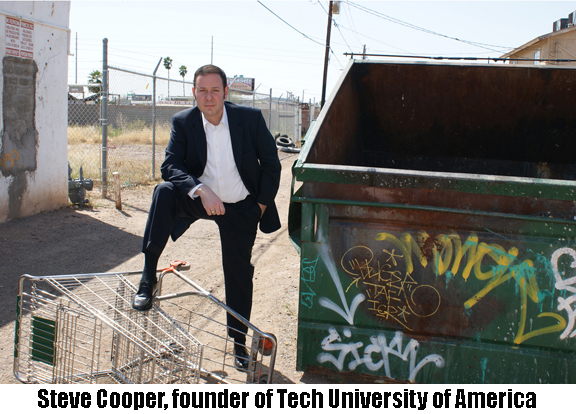
Steve Cooper is founder of Tech University of America (TechUofA) and a former Army education trainer. The following interview was conducted via email from September 8 to 12.

JS: How did you come up with the idea of offering college courses for a flat monthly fee (e.g., $99 for all the classes a student wants to take) and how long have you been doing this?

SC: All of the courses that we are developing will be free and open to everyone. However, only when students want to begin a transcript and earn an academic certificate or degree is there  a $99/month that allows them to take ten courses per year. We only use free etextbooks/resources so there aren’t any other major fees associated with earning a degree.

While building several online university programs I watched as they artificially raised tuition to the student loan cap. I was one of the few for-profit CEOs who didn’t have an MBA or wasn’t a banker so I looked at things much differently. In 2007 when I took over as CEO of a for-profit university, I decided to lower tuition in order to make higher education accessible to more people. We immediately began to enroll students from Africa and several other countries. I found that if you have the same quality of faculty as other well established schools and run a transparent program then people will attend your school if you lower your tuition. At the same time I started to see the popularity of social networking sites explode while the economy started to weaken. I then realized that three things were hot: social networking sites, online learning, and lower or zero-tuition.

Steve Cooper1

Early in 2008, I used to drive over to University of Phoenix Online and sit in the parking lot in search of inspiration. I would sit there for hours watching the sunset, hoping to soak up some of their creative energies, while asking myself, “What would Dr. John Sperling, the founder of University of Phoenix, do today if he were to do it all over again?” I concluded that the first thing he would do is take education to the masses as he did years ago by bringing education from the ivory tower to the community in office buildings then eventually via distance learning. I think one of his greatest keys to success was leveraging existing resources rather than trying to force people to change. For example, he didn’t try to make the corporate offices where they held classes look “academic” nor did he develop some goofy learning management system to deliver their distance learning courses. Rather, they used the existing business offices and Outlook Express. People were familiar with regular office buildings (not intimidating like a college campus) and it was convenient. Also, most adults have used Outlook or Outlook Express so they lessened the learning curve by using systems students would be familiar with — and if they weren’t, chances were that someone they knew could help them — as opposed to building some esoteric and irrelevant elearning system that wasn’t intuitive to adult learners.

So, I eventually thought that if Dr. Sperling were to start over he would bring higher education to the masses. However, today the masses are in social networking sites. At this point I still had not seen a social networking site but realized that if they were generating that much buzz there had to be a reason. I logged into one and instantly said to myself that this is the ideal online classroom! A week later I directed one of my staff members to teach a course in a social networking site, PerfSpot.com, since I knew their leadership and found them to be dedicated to a global reach — and it was absolutely amazing! Social networking sites allow the faculty and students to control their online learning environment (end-user innovation) and can do all the things that conventional learning management systems can’t or won’t allow such as video, audio, showing photos of the users, widgets, etc.

Moreover, using social networking sites to deliver college courses greatly reduces our cost of delivering education since we pay neither learning management fees, which can be as high as $120 per student per course, nor technical staff for support. In essence, it’s a win-win-win because the social networking sites benefit from having more users (our students), we as a college gain by not having any learning management fees, and our faculty and students win because they get to control their learning environment.

JS: Are TechUofA courses accredited? If yes, by whom? If not, is lack of accreditation a problem?

SC: No. Tech University of America is not accredited. We must be operating for two years before we are eligible to apply for accreditation, and we intend to apply as soon as we are eligible in 2011. Since we are a start-up school we have a lot of R&D, yet, at the same time, we are a business so we have to actively seek ways to grow our student body. In order to better serve new schools as well as their prospective students, I believe that accrediting bodies should have a provision that allows for new schools to be conditionally accredited before they start offering courses and then heavily monitor them until they are accredited. In the meantime, we have to operate for two years prior to seeking accreditation, which does offer us time to improve our academic processes while fine tuning the operations of our university.

JS: Are TechUofA classes completely online? Or are students required to participate in F2F (face-to-face) activities at some point during a course? If not, is this lack of F2F contact a problem?

SC: All of our courses and programs are delivered 100% online, and we do not plan on any residency requirements. Recent studies have shown that online learners can attain the same, if not higher, learning outcomes than their F2F counterparts. Having said that, I do think that F2F interaction is obviously valuable. To this end we are exploring several ways that we can integrate various optional study programs that will bring some of our students who live around the world together for meaningful experiential and F2F learning.

______________________________

Steve Cooper: While I fully agree with Chris Anderson, author of Free: The Future of a Radical Price . . . that anything that becomes digital inevitably becomes free, I do think that we will see a hierarchy emerge within online learning: we will have free or very low priced schools, then more expensive programs, and finally exclusive online programs for the very wealthy . . . .

______________________________

JS: Is it possible for a student to complete a degree or certificate at TechUofA? Would this be a TechUofA degree or a degree offered by a college that relies on TechUofA courses?

SC: We will be offering certificate programs as well as associate, bachelor, and master degree programs in business management with several concentrations in fields such as criminal justice, sustainability, construction management, computer science, and sports management. However, we are beginning to partner with several colleges that are interested in using our courses — in these cases students who are enrolled in a partner school and complete our courses would receive credit/degrees from their school, not Tech University of America. In this case we will serve as a blackboard, if you will, with our courses hosted in Facebook, and partner schools will use them at their discretion.

JS: What is the instructor-to-student ratio for your classes? If the ratio is far greater than for F2F classes, how do TechUofA instructors manage the large number of students?

SC: Our student-to-faculty ratio is 1:20 for most courses, and 1:25 for the rest, which is about the average for most online schools, and considerably less than large research universities where ratios of 1:500 are not uncommon.

JS: If students enter a course at any time and exit at any time, I’d imagine that record keeping may be a major problem. Does the instructor monitor all of her/his students? Or is this managed by someone else?

SC: Non-degree seeking students, those who are just using the course materials, may come and go as they please. For our degree-seeking students we have definite start and end dates for each course, and each course is eight weeks in length. Since our courses have less than 25 students, our faculty are able to manage each course.

JS: Are TechUofA instructor salaries comparable to that of F2F institutions? Do you have full- and part-time instructors?

SC: We engage adjunct faculty members to teach our courses. They must have a graduate degree from an accredited school, with practical work experience in their field of study. We also require that our faculty have teaching experience at a regionally accredited school. This allows us to demonstrate that the quality of our faculty is comparable to that of accredited schools.

We use a variable pay model, with each faculty member earning $50-$75 per student. This incentivizes faculty to teach more students per course and is fair because the more they work, the more they earn. At the same time it helps us contain our costs since we are not paying faculty $2,000 when there are only four students in a course. The fact that we do not cap the amount faculty can earn means that they can do quite well. Also, our model encourages faculty to use their own videos in YouTube, social networking sites, etc., which can increase the likelihood that they will be able to secure a textbook contract because faculty who can demonstrate a substantial following these days are highly sought after by publishers. Finally, given that we charge $99 per month, you can see that 50-75% of our revenues go to faculty pay as they are the most critical part of our team.

JS: Does TechUofA rely on staff from countries where salaries and wages are much lower? If yes, is there a problem in quality?

SC: No. However, as we grow our international student body, we will explore hiring staff who reside in countries where we have a large student base so that our staff can relate well to our students, thus serving them better than we can here in Phoenix, Arizona. I must add that I personally am not convinced that outsourcing labor to other countries always saves a considerable amount of money, especially when you consider the inevitable travel, loss of business from language barriers, rising costs associated with outsourcing, etc.

JS: Is TechUofA international? In other words, do students come from many different nations? In U.S. TechUofA classes, are international students charged a higher fee?

SC: We are proud that we have had many inquiries from international students, and in our model everyone pays the same fees. However, we are working on raising money so that we can offer scholarships to people in developing countries so they do not have pay anything to earn a degree from Tech University of America. Also, we are working on building a networking system that allows more fortunate students to sponsor (pay for tuition) for students who cannot afford the $99 a month to earn a degree. We believe this will lead to several meaningful relationships between our students.

JS: Are services such as TechUofA growing in numbers and popularity? Do you foresee a time when the TechUofA way of providing classes will be the dominant means of earning a diploma, degree, or certificate? Will this be at the K-12 or college level? Or both?

SC: Absolutely. Click here for the best overview of this movement which refers to us as EduPunks. Yes, I do see a day when the Tech University of America model will be the prevailing way of providing online courses, and by this I mean using social networking sites as the learning management system rather than Blackboard, using free etextbooks rather than traditional textbooks, etc., but I do not think all schools will have all their courses offered for free and only charge $99 a month for degree seeking students. While I fully agree with Chris Anderson, author of Free: The Future of a Radical Price, and his assertion that anything that becomes digital inevitably becomes free, I do think that we will see a hierarchy emerge within online learning: we will have free or very low priced schools, then more expensive programs, and finally exclusive online programs for the very wealthy that are as expensive as, if not moreso, than Harvard. At the same time I predict that we will only have 50 state schools – one for each state – that has football teams, fraternities, etc., and the rest of the students will attend private, for profit schools, either onground or online, especially given the rise of online high schools. I have been told there are more than one million online high schools students in America.

JS: Is student cheating a problem in TechUofA classes? If not, how is it handled?

SC: Student cheating, plagiarism, program integrity and student authentication are all serious challenges for all schools. The Higher Education Opportunity Act (HEOA) of 2008 requires that a school that offers online courses have procedures in place to ensure that that students who enroll in a course are the same students who take the course and ultimately receive credits. While the HEOA doesn’t apply to us since we will not utilize Title IV funds (federal student loans), we are fully committed to ensuring program integrity. In addition to having a required assignment on personal accountability and plagiarism in our introductory course, have engaged CSIdentity’s Voice Verified product to ensure that the student who enrolls in Tech University of America is the same student who is in a particular course, completes course assisgnments, and ultimately receives academic credit. This is done by randomly verifying the biometrics of their voice throughout their entire course of studies, and the Voice Verified solution is more accurate than a fingerprint.

JS: Is there anything else you’d like to add?

SC: Sure, I think it is important to point out that Facebook, which is central to our model at Tech University of Ameirca, was created by students, for students, and it is fitting that Facebook is finally becoming the leading learning management system. I predict that within 2-5 years, Facebook will buy Blackboard and move all of its users into Facebook..

Is a Virtual Revolution Brewing in Colleges?

John SenerBy John Sener

The idea that US colleges and universities are on the brink of demise, or at least radical transformation, has been around for a long time. It’d be interesting to see how long, exactly, but Peter Drucker seems to be the progenitor of most current thinking. Over the past 20 years, based on his musings on education in his 1989 book The New Realities and accelerating with his 1997 prediction that large universities would become relics in 30 years, commentators have been concerned about the obsolete “business design” of the university (1996), echoing Drucker’s predictions of demise (2005) etc.

This year, the pace has picked up: David Wiley asserted that the “university will be irrelevant by 2020“; commentators are predicting that colleges are facing the same doomed fate as ailing newspapers for much the same reasons; and now we have this article, “A Virtual Revolution Is Brewing for Colleges” by Zephyr Teachout (Washington Post, 13 Sep. 2009).

What is really going on here? Certainly it is ridiculous to take these predictions at face value. Every time one looks at them closely, they dissolve into irrelevance on the surface. This WaPo article is no exception: it goes completely off track by the end of the fifth sentence. “The market” is not the force for change in education; colleges are not like newspapers; education is about a lot more than sharing information; the social ritual of getting a dorm room is not disappearing anytime soon either. Teachout, as with other business-oriented commentators on education, does not understand that education is a complex system animated and sustained by a variety of important competing forces interacting dynamically with each other and operating fundamentally differently from business.

Tellingly, when I first tried to find the article on WaPo, the first article I found was a piece on how the University of Maryland is trying to crack down on drinking. It’s not a pretty scene, but social drinking is a much more powerful and cohesive force in university life than the cost of online learning (wasn’t paper-based correspondence learning cheaper also, BTW?). And anyone who thinks that universities will become “relics” in 18 years or so needs to chill out at a tailgating party. Drucker was brilliant, but even geniuses get it way wrong sometimes.

Teachout’s article, and indeed this entire line of thought, only makes sense to me in two respects (other than being flat out wrong): ( 1) the authors are just trying to get attention by provocative exaggeration, and (2) they are trying to move public opinion by asserting a position that is only casually related to rationality or actual facts. Both these are very much in tune with the times, but the numerous disconnects between superficial attention-seeking headlines or sound bites and the underlying reality bother me.

______________________________

What really bothers me, though, are the possible negative consequences of excessive hype. For example, online education has changed the face of higher education, but has it been “revolutionary” or “radical?” I would argue that it hasn’t.

______________________________

What does it mean, for example, to say that “universities will be irrelevant by 2020”? They have already been irrelevant for decades in some ways, which is why small liberal arts colleges exist and why community colleges, private for-profits like University of Phoenix, et al. have filled the vacuum in those areas that universities have mostly ignored during the expansion of higher education in the US over the past 40+ years. But maybe Wiley was merely aiming to provoke or prod in a particular direction rather than to predict. Perhaps this has become commonplace because, in our “blink“ered” world, subtle or complex messages get lost while only simple messages gain traction. Take, for example, the recent USDE report on online learning. The report’s summary messages don’t match its actual content, and its methodology is deeply flawed. But the basic message (online learning is even better than classroom) is getting out there and starting to cause some pushback.

Teachout’s article does not even rise to the level of “Drucker Lite” quality. The ingredients are there, but the article makes a hash of it. “Colleges also sell information?” Redundant Sociology 101 courses are all that stand between the academy and its imminent “structural disintegration?” The drive to cut costs will come to rule higher education policy? Please.

What really bothers me, though, are the possible negative consequences of excessive hype. For example, online education has changed the face of higher education, but has it been “revolutionary” or “radical?” I would argue that it hasn’t. Are the predicted changes greater than the creation of community colleges, the GI Bill, or the growth of private for-profit institutions? If so, how? If not, why all the fuss? I worry that the hype of such pronouncements may actually retard the progress of needed, substantive change; if big changes are afoot, then other needed changes will be overshadowed and ignored.

Here’s what I would really like to see: a deep, reflective examination of what changes are really needed — what would be truly transformational? Ironically, I find more useful material in the reactions to these articles than in the articles themselves. For example, why does a Smith co-ed believe that the “personal touch” is only possible in classroom and campus interactions? (Has she not heard of Facebook?? OMG… ;-) What does “personal touch” actually mean in this context? Why do so many college faculty believe that they have this magic ability to gauge the ‘aha’ moment of all the students in their classrooms? Because as readers’ comments and writers’ reactions show, a myriad of unexamined, deeply held assumptions are out there. At the same time, Drucker and the line of thought he engendered are on to something: change is happening, mostly nibbles around the edges, but there are some serious issues that need to be resolved pretty soon. My bias is that a more thoughtful approach is better. But maybe these articles are a necessary part of the process?

‘Jam on the American Graduation Initiative’ on Sep. 16

Jim ShimabukuroBy Jim Shimabukuro
Editor

On 16 September 2009, from 8:00 am to midnight EST, Knowledge in the Public Interest will sponsor, with LaGuardia Community College as the lead college, Jam on the American Graduation Initiative, an online asynchronous “national conversation” to engage community college leaders, policy makers, and researchers. Convened by the Brookings Institute, The Education Commission of the States, and Jobs for the Future, the focus of the jam will be on President Obama’s recent announcement (see the YouTube video below) to invest $12 billion in America’s community colleges.

The primary topics for discussion will be (1) What we should know—the benefits and consequences—about what the administration is proposing and (2) How we can organize ourselves to make a difference for every community college in the U.S. The purpose of the jam is to influence the discussion on the president’s proposal. The result, according to organizers, will be a “tool kit for action,” which will be available a couple of weeks after the Jam.

The video runs for 29 minutes. The portion on the American Graduation Initiative begins at the 13:30 mark. The president talks about $12 billion in low-interest loans to rebuild and renovate community colleges, and he specifically mentions classrooms and buildings. But at the 25:00 mark, he mentions the electronic infrastructure that opens the door to virtual learning, and he specifically mentions online education for people with day jobs.

Some ETC editors and writers are planning to participate, and they will be sharing their thoughts with ETC readers in a special article that will be updated throughout the day on the 16th. If you aren’t attending but would like to share your thoughts on the proposed topics, please post them as comments to this article.

‘College for $99 a Month’ – Persons Are Important, Presence Is Not?

Lynn ZimmermannBy Lynn Zimmerman
Editor, Teacher Education

Harry Keller wrote in ”Encounters: ‘College for $99 a Month’” that “persons are important; presence is not. It will be a long time before a real, live instructor can be replaced by a machine. However, some of the work traditionally done by instructors can now be done by machines so that teaching becomes more of a mentoring or facilitating job. It becomes elevated to a real person skill.”

As I read Harry’s posts, I realized one thing that has always nagged at me  about some of the discussions about online learning. As I have read some of the various discussions, I have felt that what I consider the human interaction factor is being ignored. As a student and as a teacher, I want to see, hear, feel, even smell the people I am interacting with. After reading Harry’s post, I realized that I am looking through the lens of an instructor who does not teach large lecture style courses, and that I teach courses which are more focused on process than content. I teach classes of 10-25 students and I am a skilled facilitator of these seminar-style classes with groups of students who want to be or are K-12 teachers, people who need to be able to interact effectively face-to-face with other human beings.

______________________________

As a student and as a teacher, I want to see, hear, feel, even smell the people I am interacting with.

______________________________

However, I can see where a content course with large numbers of students, such as Chemistry 101, would probably be taught more effectively in the online environment. I remember the few large lecture courses I took in college, and I did not perform well in many of them. I would fall asleep or totally zone out. I am sure I would have learned more from a well-designed online course.

However, there’s the rub. John Adsit (‘College for $99 a Month’ – A Step in the Right Direction) referred to schools which are developing high quality online courses. They hire educational theorists who understand how students learn. They hire technology teams to create interactive and engaging multimedia to teach critical concepts. They have project directors who see the whole project through to its conclusion, a process which may take most of a year. They create careful formative and summative assessment programs rarely seen in colleges. A single course costs many tens of thousands of dollars to create.

Unfortunately I don’t think many programs invest the time or money into this kind of design. I have taken online courses which I think were well-designed, and coupled with my self-discipline, I have learned from them, and enjoyed the interaction with other students. I have taken others online courses which were poorly-designed so that I felt more frustration than satisfaction with my learning.

I appreciate the discussion on this topic because I think it really highlights the complexity of the issues that we as modern educators face. I think if we lock ourselves into the idea there is only one modality or one way of delivery we are ignoring the flexibility and versatility that education, with and without technology, can offer.

Is ‘$99 a Month for College’ Really a Cute Little Kitten?

John SenerBy John Sener

In a recent blog post on his Connectivism web site, George Siemens uses the term “cute kitten syndrome” to describe how practitioners commonly treat open education resources — cute, cuddly, beyond reproach — but he offers some constructive criticism anyway.

While reading “College for $99 a Month,” I couldn’t help thinking about cute kittens. Who could be against cut-rate college? We all know how expensive higher education has gotten in the U.S.; the movement to make college more affordable for more people is laudable and much needed. Awww, $99 a month for college, isn’t it cuuuuute? Somebody, though, needs to be thinking about the shots, the litter box, and who’s going to feed it.

Although this is a magazine article with the requisite human interest hooks to heighten reader interest, it’s still a fair question to ask whether or not $99 a month for college, and the business model it implies, really is a cute little kitten in the first place. My take: it is a worthwhile innovation on balance. Catastrophic for universities? This kitten’s got some lumps and warts — the cuteness in this case fades upon closer inspection.

The storyline we’re supposed to absorb appears to be something like this:  the Internet makes cheaper education possible ($99 a month!). Smart innovators are trying to make this happen with the support of eager students and Free Markets. Self-serving faculty and inauthentic, short-sighted accreditors are trying to stop this from happening. But in the long run, consumer choice will win out, and students will learn cheaply! And most everyone will live happily ever after (except for the universities and maybe the accreditors too). The End.

Youngkitten

OK, I don’t want to be too sarcastic here because the article has a lot of good points and some useful information. As a coherent whole, however, I’ve read the thing several times and still can’t make heads or tails of it. The superficial storyline is simple enough to grasp, but its connection to the reality it purports to describe falls apart upon closer examination.

Like Craigslist, StraighterLine threatens the most profitable piece of a conglomerate business: freshman lectures, higher education’s equivalent of the classified section.

Where is the evidence that freshman lectures are the most profitable “piece” of the higher education “business?” Is the comparison between freshman lectures and classified advertising apt? Not really.

The most basic mistake here, of course, is trying to view higher education as strictly a business. Yes, they have revenues and costs. But, name another “business” whose customers are also its products, its performers, and its benefactors. Or one which “sells” every unit it “makes” at a loss, i.e., the gap between tuition and actual costs. (OK, besides most Internet companies.)

Beyond that, the comparison to classified advertising is misleading. According to various sources, classified ads accounted for 40% of total newspaper revenue in 2000; that dropped to 25% in 2008. Does tuition from freshmen account for 25-40% of revenue for IHEs? Figures are hard to find, but if we consider that IHEs have multiple sources of revenue (grants, government & foundation funding, partnerships, etc.) and that freshmen only comprise at most 30-35% of the tuition revenue (far less for universities with graduate programs), it doesn’t appear that tuition from freshmen is anywhere near as important to IHEs as classified advertising has been to newspapers.

Is college getting less affordable for more and more students? Absolutely. Do IHEs guard their underclass revenue streams jealously? You bet they do. I know an instructor who taught the exact same course at the local community college and the nearby university. If a student took the course at the community college, the local university refused to accept transfer credit for the course even though it was supposedly a “sister institution.” Stories like these abound and are one of the reasons we are cheering for solutions that effect change. But is freshmen tuition the soft underbelly of the IHE revenue model? Not feelin’ it…

The only expensive thing left in higher education was the labor, the price of hiring a smart, knowledgeable person to help students when only a person would do. And the unique Smarthinking call-center model made that much cheaper, too.

Has the author priced building construction or football uniforms lately? More to the point, what are the labor costs in intro courses where TAs, large class sizes, and community college-level tuition rates abound? There is an important point here: StraighterLine and others (present and future) offer their services as an improved alternative with a lower cost structure.  But the actual reality is rather more complex than the storyline implies.

______________________________

Big changes need to happen from without and within, but characterizing the existing structures as simply “artificial barriers” is frankly a bit naive and ultimately counter-productive. We can and must do better than that.

______________________________

Where there are cute kittens, there are also usually ugly trolls playing the role of villain and making the kittens look that much cuter. In this article, the ugly trolls are the accrediting agencies:

…the biggest obstacle…was a process called accreditation….And the most prestigious accreditors will only recognize institutions: organizations with academic departments, highly credentialed faculty, bureaucrats, libraries, and all the other pricey accoutrements of the modern university. These things make higher education more expensive, and they’re not necessary if all you want to do is offer standard introductory courses online….The accreditation wall will crumble, as most artificial barriers do.

It’s easy to typecast accreditation agencies as trolls: they’re bureaucracies, they have complex rules and make stupid decisions sometimes. Just get out of the way, you mean accreditation agencies, and let us offer our standard introductory courses in full market freedom! Uh, not so fast. Accrediting agencies are not just “artificial barriers” — they provide tangible and valued benefits (here’s a representative list). “Down with the system!” is just, well, so ’60s and ’70s. Big changes need to happen from without and within, but characterizing the existing structures as simply “artificial barriers” is frankly a bit naive and ultimately counter-productive. We can and must do better than that.

Colleges may have another decade or two, particularly given their regulatory protections. Imagine if Honda, in order to compete in the American market, had been required by federal law to adopt the preestablished labor practices, management structure, dealer network, and vehicle portfolio of General Motors. Imagine further that Honda could only sell cars through GM dealers. Those are essentially the terms that accreditation forces on potential disruptive innovators in higher education today.

Actually, accreditors are more like the EPA in this example. Their policies can be maddening — I waited five years for an EPA-acceptable Smart car to arrive in the US, and then they send us a 40mpg model instead of the 60mpg one? (And of course, we’ll never see a street-legal Smart roadster here.) On the other hand, do we really want hordes of cheap and truly unsafe cars fattening up our traffic death statistics, which is what would happen if there were no EPA regulations?

Likewise, accreditors and their regulations should not somehow disappear from the equation, but accreditors should be looking more closely at alternative models which save students money, and looking very closely at models like StraighterLine. The rest of academe should be too. Is what StraighterLine et al. offer of sufficient quality? If it’s better than 400-person lectures, then why shouldn’t it be acceptable? Are we missing something important by going to the StraighterLine model? If so, should we be looking harder at incorporating it into existing courses? These are good questions to be asking, and I’m glad that StraighterLine is causing enough irritation to bring this issue to greater attention.

In short, we need a less fairytale and more systemic approach to dealing with this situation. Catastrophic for universities? Oops, there goes StraighterLine’s business model along with their clients. Surely Burck Smith and the rest of us can come up with a better, non-catastrophic solution…

div05

steve_eskow40 Click here to see the response from Steve Eskow.

‘College for $99 a Month’ – A Step in the Right Direction

adsit80By John Adsit
Editor, Curriculum & Instruction

Kevin Carey, in “College for $99 a Month,” refers to Christensen and Horn’s application of the concept of “disruptive innovation” in education, in which they predict that online education will someday acquire the necessary quality to upend the existing system. Is StraighterLine such an innovation? Perhaps not yet, but a closer look at Christensen and Horn coupled with the points in Carey’s article show why it is definitely a step in that direction.

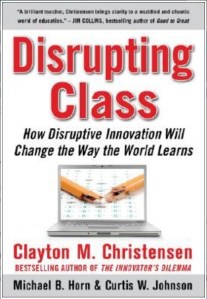
One of the key points that Christensen and Horn make in Disrupting Class: How Disruptive Innovation Will Change the Way the World Learns is that the organization that relies on incumbent technology for its product will struggle to implement the disruptive innovation itself, if it can do it at all. Doing so will require it to devote resources to create an, at first, inferior product to compete against itself in the same market place. A company that competes against itself is torn apart. Carey provides ample evidence of this dynamic at work in the StraighterLine experience with Fort Hayes.

Colleges have indeed implemented online education courses, but for the most part they do so in a way that will not allow true competition. Again, Carey gives ample illustrations of how colleges set rules on online education that limit competition. It is, however, the very structure of colleges that prevents them from creating a truly disruptive innovation in online education. Once again, Christensen and Horn show why.

disrupting_classThey give the example of DEC, a giant in the last era of computing. It defined its corporate structure around the basic design of its very successful computer, creating discrete departments that were assigned the task of upgrading the specific component to which they were assigned. While this meant that DEC could continue to improve that basic design, it also meant that it would be forever locked into that basic design, and new systems built on new interrelationships of parts eventually blew them away. Similarly, colleges and universities that work within existing structures will never create a truly innovative online program.

When a typical college undertakes an online education program, it does so within its existing department structure. This means that individual professors, adhering to the principle of academic freedom, create online versions of their classroom experiences. College teaching is one of the few professions in which practitioners are not required to have any training in their profession, and Carey clearly points out that poor quality college classes and huge lecture halls are all too common. So an online program begins with a professor wondering how to take what is too often a very poor face-to-face instructional model and replicate it in an online setting.

Because the school cannot afford to invest vast sums into a technology that will ultimately compete against itself, the professor is given minimal training in how to use a Course Management System like BlackBoard. The professor has little spare time in which to develop the course, and an inordinate amount of time taken in its creation merely takes away from the amount of money ultimately earned for teaching the course. There is thus no incentive to learn how to use the resources creatively.

______________________________

Colleges and universities that work within existing structures will never create a truly innovative online program.

______________________________

Let’s compare that with an organization that is working outside the existing educational system. At the K-12 level, several, including some cited by Christensen and Horn, are developing high quality online courses. They hire educational theorists who understand how students learn. They hire technology teams to create interactive and engaging multimedia to teach critical concepts. They have project directors who see the whole project through to its conclusion, a process which may take most of a year. They create careful formative and summative assessment programs rarely seen in colleges. A single course costs many tens of thousands of dollars to create.

Of course, such a process would be cost prohibitive within the normal college setting. On the other hand, if such a high quality course is marketed through colleges to students, thus distributing the cost over a wide base, students across the country could have access to an outstanding education at a reasonable cost from any place at any time. Contrary to the beliefs of many, this will not eliminate the need for a quality instructor, for the best of such courses will employ activities that demand the meaningful intervention of a skilled educator. To fill that role, the teaching professor will need to learn to facilitate constructivist, project driven instruction instead of broadcasting facts to the multitudes, but that is a change that should be made anyway.

The existence of programs like StraighterLine show that such innovations are on their way. Predictably, colleges and universities will fight them tooth and nail so that they may maintain their quite profitable status quo, but the change will eventually come.

Encounters: ‘College for $99 a Month’

Encounters: ideas that go bumpIntroduction: This encounter begins with an idea, a “bump,” from Steve Eskow. In an email message on Sep. 2, he referred me to Kevin Carey’s College for $99 a Month: The Next Generation of Online Education Could Be Great for Students—and Catastrophic for Universities” (Washington Monthly, Sep./Oct. 2009). Carey is policy director of Education Sector, an independent think tank in Washington, D.C. Please participate in this encounter by posting a comment. I’ll append most or all of the comments to this page as they’re published. -js

div05

keller40Harry Keller, editor, science education, on 3 Sep. 2009, 4:00AM: This article engendered so many thoughts that I cannot begin to write them all. Note the unfair evaluation criteria; compare with online vs. traditonal A.P. science courses. The disruptive innovation thread is large. What if many StraighterLine clones sprung up if regulatory walls were lowered, and many had lower standards — just like today’s colleges. The social benefits to students of college have been ignored in the article. How much of the tutoring and even teaching will be outsourced offshore? Will the $99 per month be sustainable as a business model? StraighterLine only offers 11 courses now, all oriented to business students; when will they be able to offer degrees? Who will support research in renaissance french pottery <big grin> if universities have to downsize? Will future college professors be able to retire on the job until they really retire as some do today? The protesting professors clearly know on which side their bread is buttered and are reacting to a threat rather than proposing rational solutions to impending change. What will happen to low-enrollment courses; will they be aggregated across states or even nations to keep them viable? Who will teach a course that only provides a small slice of $99 per student? How large will the student load per instructor be? Is the ivory-tower model dying? How will drama and science be taught? For online courses, the major costs are the design of the course (amortizable) and the ongoing cost of the instructor. Interestingly, each corporate online provider must design courses anew. Smaller providers, such as small states, purchase the curricula and resell them packaged with one of their instructors.

And so it goes. This concept goes far beyond the use of “clickers” and “smart” boards in bringing technology to education.

The topic may be too large for us to cover, but if we don’t try, we won’t know for sure.

div05

steve_eskow40Steve Eskow, editor, hybrid vs. virtual issues, on 3 Sep. 2009, 7:14AM: Harry refers to the often-cited “social benefits” of the walled university. Apparently something of educational importance happens when the the 300 students and the lecturer and the images on the screen are together in the lecture hall in real time. Or when the 30 students and the graduate student “discuss” the lecture in real time in a 600-square feet classroom.

Jerry FarberI wish someone in our group with institutional library privileges could get us two articles by Jerry Farber: “The Third Circle; On Education and Distance Learning” and “Teaching and Presence.”

Farber’s first circle is “measurable competence.” That’s what we get in all those studies that come out, it almost seems, every other day. Those “NSD” studies.

The second circle contains those competences that aren’t readily measurable.

And the third circle contains those “benefits” that Harry mentions: the profound educational benefits that Farber and so many other attribute to the face-to-face situation.

The philosophic position behind this “third circle” is often called “the metaphysics of presence,” and this matter of the reality or the mythology of “presence” has, I think, been underreported in the literature of online and mediated and distance learning. ETC could do something about that.

Jacques Derrida wrote much–and densely–about “the metaphysics of presence.” About “logocentrism,” and the power of the Word when present, and , importantly for proponents of mediated instruction, on “phonocentrism,” the assumed differences in impact and meaning of the spoken and the written word.

Perhaps Farber’s articles could help us get a modest shared background on this matter of “presence,” and we might get help from folks in philosophy on Heidegger and Derrida and the implications of “the metaphysics of presence” for the future of online learning.

div05

Harry Keller (9.3.09, 7:22AM): The social benefits happen outside of the classroom. People make lifelong friends and set up future business relationships. They join clubs that foster success after graduation. I would never suggest (at least from my personal experience) any social benefits from sitting in a classroom.

div05

Steve Eskow, (9.3.09, 7:32AM): Harry is not talking, then, about “learning” as the curriculum defines it, but about “social capital.” About the so-called “extra-curriculum.”

(When he was President of Princeton Woodrow Wilson wrote extensively about what he called student excitement and involvement in the “sideshows” and their lack of of interest in “the main tent”: the classroom and the curriculum.

Others here and everywhere attribute important learning enhancement and benefits from “presence”: from the living word, from the face-to-faceness of the classroom as opposed to what they see as the “distance” imposed by distance learning: the lack of this almost mystical “presence.”

Farber is one strong voice speaking for this “presence.” Hubert Dreyfus is another.

I don’t think the issue has found its way into distance learning circles, and it’s at the very center of our work, and yet largely unrecognized and unremarked.

div05

Harry Keller (9.3.09, 8:26AM): Regarding “presence”:

1. I don’t see it. Except for the very unusual show types, having a prof in the room with you gains little or nothing.

2. It’s more useful for the instructor who can gauge the impact of what’s going on by the faces (rapt or blank stares or whatever). Tools available today to online instructors can do even better than face-reading, however.

3. I often had the person who wrote the book (and in one case was writing it daily) giving the lectures. The only advantage to the class was being able to ask questions, but with 180 students, the opportunities to do so were small. Online is better in that respect.

4. Seeing professors out of their element gives little idea of what they really do. However, every first-year student cannot visit the professors as they’re working.

5. Many online students have remarked that they’re cowed in traditional classes but can open up and become involved in online classes.

Persons are important; presence is not. It will be a long time before a real, live instructor can be replaced by a machine. However, some of the work traditionally done by instructors can now be done by machines so that teaching becomes more of a mentoring or facilitating job. It becomes elevated to a real person skill.

div05

Steve Eskow, (9.3.09, 8:49AM): Harry, it seems increasingly clear to me that many of us heavily involved in mediated instruction are unfamiliar with the large and important literature on this matter of “presence” and “the metaphysics of presence,” and unaware of the role it plays in philosophy and practice–and, importantly for our work, in the serious resistance to distance learning.

An interesting and intricate example of the power of presence thesis is MIT: hardly an enemy of technology and technology-enhanced learning. MIT is increasingly technologizing its instruction–but on campus. As far as I know, complee resistance to distance learning for its students. All MIT credit instruction, as far as I know, requires that you be “present.” On the other hand, distance learning students around the world can make arrangements to access the4 MIT “i-labs” program: lab instruction online.

Hubert Dreyfus is a philosopher who has written such important books as WHAT COMPUTERS CAN’T DO. His book ON THE INTERNET is a serious critique of mediated instruction built around the “presence” thesis.

If we want to engage the important critics of distance learning we need to know more about their position and deep concerns. That means, I think, taking their arguments seriously and engaging with them.

Farber’s articles, and Dreyfus’ ON THE INTERNET would give us a start in developing a common background on the “presence” thesis.

Or: we should know more about it before we attack. It’s serious, substantial stuff–not just anti-technology claptrap.

div05

Harry Keller (9.3.09, 10:08AM): I’d like to see the gloves come off in the discussion on this topic. Although our view of the future is hazy and dark, we can consider the effects of various futures.

Replacing the sage on the stage with the net mentor has to be a positive step. Loss of a place (secondary school or college) where people gather together ostensibly to learn but really have learning as the secondary purpose, will have repercussions. What are they? Where do those sports teams go? Will the academic part of a college evaporate leaving behind a sports program as its residue? I’m guessing that some alums wouldn’t mind, but the national fraternities and sororities will. Can they have virtual counterparts?

If students can get high school diplomas and college degrees online, they’ll be at home much more putting more of a burden on the parents. Actually going to college exposes many students to other regions and other cultures. When I went to graduate school in New York City, I had never been East of the Mississippi or ridden on a subway or been to a coffee house. I saw a woman’s purse snatched right across the street from me. I saw Jackie Kennedy going to my own drugstore. I saw Robert Preston walking to a rehearsal on a nearly empty Broadway early in the morning. I met Tom Clancy (of the Clancy Brothers and Tommy …) in a bar once. I saw Gene Kruppa practicing his drums in a nightclub in the middle of the day. All of this stuff has nothing to do with classes. It’s the other part of your education.

We’ve only begun to scratch the surface here. The implications of StraighterLine are very very far-reaching as are those of the entire online movement.

Charlie Fitzpatrick

[posted 8.24.12]
Charlie Fitzpatrick
Esri Schools Program Manager
2001 N 15th St #1403
Arlington VA 22201
email: cfitzpatrick@esri.com
http://esriurl.com/fitzblog
http://edcommunity.esri.com
http://www.facebook.com/schoolGIS

ETC Publications

Mapping Dragons: Esri 2012 Conferences

Are Full Teaching Loads the Answer to the Recession?

jims80By Jim Shimabukuro
Editor

As we tighten our individual and collective belts in the university system where I work, I can’t help but worry about some of the decisions administrators are making to weather the current recession. I’m sharing these concerns in this publication because I sense that the underlying issues transcend the state I live in and weigh heavily in other systems throughout the U.S. and the world.

The decision that has my attention is the insistence on full teaching loads for faculty this fall and elimination of nearly all reassigned time activities. The assumption seems to be that non-instructional activities are expendable. This may be true, but it is not true in all cases. Many activities are actually aimed at exploring and developing innovative ways to accomplish traditional tasks, and in many instances, this involves the use of computer and internet technology. The point is that technology has the potential to cut costs and improve the quality of instruction and services.

The problem with indiscriminately cutting reassigned time funds for those involved in technology activities is that colleges may be simultaneously eliminating the sources of potential solutions and answers. By closing the door on innovation, we may be exacerbating instead of ameliorating the problems caused by the recession.

When I look back on tech-oriented activities that I pursued with reassigned time, I can clearly see the direct relationship between research and cost effective practice.

Like many of you, I’ve been involved in online instruction and college-related projects for many years. I began teaching completely online semester-length classes in spring 1997, over a decade ago, and nearly a decade earlier, in spring 1988, I experimented with a primitive bulletin board system (BBS) in one of my freshman composition classes. This was before the web was more than just an idea. I set up the BBS via a 2400-baud modem connected to an IBM-PC XT with a whopping 10MBs of storage. IIRC, it had the full 640KBs of RAM. The BBS ran off the standard phone lines. I had a 1200-baud modem on my home XT, and the two students who joined me in this experiment had a 300-baud and a 2400-baud modem connected to a Commodore 64 and an XT. I don’t think I’ll ever forget the stream of high-pitched electronic squawk that the modems produced when they made contact.

We hooked the PC-based BBS into a phone line in the college’s study lab and logged in to the board to complete the full cycle of activities for a single assignment that lasted about three weeks. The two students received, as a reward for participating, permission to be absent from class during that period. Despite a steady series of crashes (if anyone in the lab inadvertently picked up the receiver on the phone, the BBS went down), we persevered and were excited about actually teaching and learning online. It was our equivalent to walking on the moon.

For me, the upshot of the experience over twenty years ago was the conviction that completely online instruction was not only possible but cost-effective and potentially highly effective. Still, it took another nine years to convince my department to allow me to teach a fully online course.

The point of this story is that, throughout all these years, I received reassigned time from my instructional duties to pursue these interests. Without the release time, I wouldn’t have been able to do any of it. The result, today, is fully online classes and other cost-effective technology, and in the remainder of this essay, I explain the savings that these represent.

Today, at the start of the fall 2009 semester, I find myself for the first time in nearly twenty years with a full teaching load and zero reassigned time. The mandate is from the top down. All instructional faculty are to teach a full load. An exception has been made for a few, for administrative functions, but the vast majority are left with no time to do more than teach. And for community college instructors, a full load is five classes. (In all fairness to the administration, though, I should say that I would have received a release from one of my classes if paperwork had been submitted in time.)

I’m teaching three different writing classes, all of them online: a transfer-level freshman composition class, two advanced expository writing classes, and two creative nonfiction classes. Those who have taught or are teaching fully online classes understand just how much preparation goes into each class. Far more, by a very wide margin, than that for traditional face-to-face (F2F) equivalents.

This teaching load means little time for innovative activities that directly or indirectly impact instruction. As part of my special assignments in the past, I’ve been developing and experimenting with blogs for student assessment and for planning student services. Much of what I’ve been learning about blogs is finding direct application in my online instruction, and, in turn, much of what I’m learning in instruction benefits my other activities.

For instruction, I no longer use the college’s server for course webpages. Instead, I’ve placed all of my course material in blogs that are provided free of charge by WordPress and Google’s Blogger. In this medium, the amount of developing power and speed over the old webpages is staggering. I do use the college’s Sakai CMS, but for its discussion forums and bulk mail services only. My students use Blogger to share their drafts with classmates.

I’ve been developing an online open textbook for my freshman comp class, and for the last year or so my students haven’t had to spend a dime for required texts. I’ve also created electronic journals to publish selected works from students in my advanced expository and creative nonfiction classes. One is already up and running, and the other is about half done. These, too, are based in blogs, and they allow me and the student editors to quickly select, edit, and publish exemplary papers. Publication costs such as printing, special equipment, and office space? None.

The use of web resources, such as blogs, that are off-campus represents a savings that’s difficult to measure. One of the most obvious is the elimination of reliance on college IT personnel to maintain, secure, and instruct users on the technology. Another is the elimination of reliance on the campus’s server resources.

But there are many other cost-saving results that may not be obvious. Instructors and students who learn to use non-campus technology and resources begin to realize that they can accomplish many other tasks with the same technology, thus placing little or no burden on the college in terms of cost or maintenance. Students will be able to use blogs for their other classes and eliminate the need to use the college’s resources to accomplish the same purposes. Staff will learn to use blogs to accomplish web-based tasks that currently require the assistance of the college’s IT staff and resources. This independence that off-campus technology offers can reduce the cost of campus-based technology, and the savings could be put to good use elsewhere.

Other “invisible” cost-savings that derive from the use of technology developed via released time are related to online classes. Online classes don’t require classrooms. If all of my classes were F2F and met twice a week, they would take up ten 75-minute time slots for an entire semester. This impact on the available classrooms is not trivial in terms of dollars and resources. To make the F2F classes viable, they need to be offered at times when students are willing to commute to campus. If rooms aren’t available in these prime times, the classes have to be canceled. Or new classrooms need to be built.

Traditional classrooms require a tremendous amount of electrical power for air-conditioning, lighting, daily maintenance, security, furniture, and equipment. Because writing instruction is heavily tied to the internet, many F2F classes are run in classrooms equipped with computers. The cost of maintaining computer labs and classrooms is absolutely staggering.

Finally, online instructors seldom use campus offices so the college realizes a savings in this regard. Furthermore, online faculty and students don’t drive to campus as often as others so they don’t add to the cost of maintaining parking facilities.

If administrators devote time to examining the full implications of faculty involvement in developing innovative practices through the use of technology, they may not be so quick to order a blanket cut of nearly all reassigned time. They may realize that, in the long run, the new technology may actually help to reduce costs at a rate infinitely greater than the dollar amounts for reassigned time. They may realize that the cost, today, may literally be an investment in the college’s future.

Encounters: USDE 2009 Report on Effectiveness of Online Learning

encounters9Introduction: This encounter begins with a bump from Judith McDaniel (ETC editor, web-based course design), who posted a comment to Steve Eskow re Evaluation of Evidence-Based Practices in Online Learning: A Judith_McDaniel2_80Meta-Analysis and Review of Online Learning Studies (Washington, D.C., 2009), conducted by the U.S. Department of Education, Office of Planning, Evaluation, and Policy Development.

After reviewing the excerpts or the complete report, please post your extended comments re the findings. Some or all of the comments will be appended to this article as they are submitted.

Here are some of the key findings:

• Students who took all or part of their class online performed better, on average, than those taking the same course through traditional face-to-face instruction.

• The observed advantage for online learning in general, and blended learning conditions in particular, is not necessarily rooted in the media used per se and may reflect differences in content, pedagogy and learning time.

• Most of the variations in the way in which different studies implemented online learning did not affect student learning outcomes significantly.

• The effectiveness of online learning approaches appears quite broad across different content and learner types.

• Studies in which analysts judged the curriculum and instruction to be identical or almost identical in online and face-to-face conditions had smaller effects than those studies where the two conditions varied in terms of multiple aspects of instruction.

• When a study contrasts blended and purely online conditions, student learning is usually comparable across the two conditions.

• Elements such as video or online quizzes do not appear to influence the amount that students learn in online classes.

• Online learning can be enhanced by giving learners control of their interactions with media and prompting learner reflection.

• Providing guidance for learning for groups of students appears less successful than does using such mechanisms with individual learners.

encounters: ideas that go bump

thompson80John Thompson, editor, green computing, on 17 August 2009, at 5:43 am, said:

This discussion on F2F, blended, and online learning reminds me of Matthew Arnold’s quote:

Wandering between two worlds, one dead,
The other powerless to be born.
With nowhere yet to rest my head
Like these, on earth I wait forlorn.

F2F proponents (right up there with the Luddites supporting print publications against digital encroachment) refuse to acknowledge a broken system. F2F served educational purposes well in another age (in a galaxy far, far away). And while there are still excellent F2F synchronous instructors (e.g., Randy Pausch), by and large the student audience has moved on. This government study merely confirms the obvious — almost anything is as good or even better than F2F instruction, at least as too many F2F instructors practice it. For all intents and purposes, F2F instruction is dead. Yet, online still remains in the wings, albeit with one foot on stage.

encounters: ideas that go bump

keller80Harry Keller, editor, science education, on 17 August 2009, at 7:53 am, said:

I also noted the small coverage of K-12 learning.

I did not see any discussion of the self-selection effect. Students in online or blended learning may have chosen to do so. Such students may be more motivated to do well, on average.

I believe that the instructor remains the key to success. Really good teachers manage to get good results regardless of the surroundings. By providing excellent tools to instructors, we can make the good ones very good. Perhaps, these same tools can help us identify and weed out the poor ones — emphasis on perhaps.

Even if online learning does not, by itself, make learning better, it has and will continue to provide incentives for new ideas in education from which these important new tools will arise.

Of course, as a creator of such a new tool, I have a bias.

encounters: ideas that go bump

jims80Jim Shimabukuro, editor, on 17 August 2009, at 11:15 am, said:

We tend to forget that communication is at the heart of learning, and that schools and classrooms are basically a medium or form of communcation. The problem is that we’ve become so accustomed to the classroom that we no longer view it as a medium of communication but equate it with learning. The danger of this equation is the tendency to dismiss other critical media such as the web.

Another way of viewing this dichotomy is the notion of formal and informal learning. For many educators, the distinction is clear: formal happens in the classroom, and informal, outside. Since the web appears to be clearly “outside” the classroom, it’s informal and irrelevant.

Fortunately, students don’t buy into the belief that learning is limited to what happens in the classroom. They understand, intuitively, that the web is a natural medium for communication and learning, and that the distinctions between formal and informal learning are all too often arbitrary and meaningless.

John Thompson, in his comment above, says, “By and large the student audience has moved on” to online modes of communication. I agree. For them, traditional F2F classrooms are becoming, like telephone landlines, anachronisms, sharing the same fate as typewriters, newspapers, and horse-drawn carriages. The web’s instant, anywhere, anytime communication with anyone or with any information source in the world is a given in their daily lives.

Increasingly, for students today, the question isn’t “Online or F2F?” but “Why limit learning to classrooms?” And increasingly, they’ll want to know, “Why do we have to gather in a classroom for instruction that could be delivered much more effectively and efficiently via the web?”

In their lives outside the classroom, students have become expert at informal learning or learning that’s not guided by an instructor. They use their mobile electronic communication devices to get information instantly on the latest news, entertainment, products and sales. If they need information, they automatically turn to the web simply because it’s there and they have access to it from anywhere at anytime. And more importantly, it’s a way to keep in touch with friends, allowing for the creation of social networking that’s unprecedented. Through the web, they can stay in touch with all their friends 24-7. They’re never more than a few seconds apart, regardless of the physical distances between them.

Replacing some of their F2F class meetings with online activities is a way for educators to acknowledge the undeniable impact of web technology in the lives of their students. This adjustment is considered “blending,” and the result is blended instruction. It seems to be working very well, and many if not most claim that it’s superior to both completely F2F and completely online methods. The USDE report seems to support this contention, but the gap between online and blended is apparently closing.

My concern with the term “blended” is its inclusiveness. It includes such a wide range of practices that it has little or no power to define an actual pedagogy.

Like a storm building at sea, online learning is gradually making its way to landfall, and all indications are that it’s strengthening rather than weakening, and when it hits shore, the impact will change the educational landscape.

The significance of the USDE report is not so much in telling us where we are but in showing us where we’re headed. There’s a trend, and its direction is unmistakable and unavoidable. In the meantime, as Harry Keller says above, “Even if online learning does not, by itself, make learning better, it has and will continue to provide incentives for new ideas in education from which these important new tools will arise.”

The coming years will be exciting, but we can’t really see the dramatic changes that are coming. However, we can read the signs and imagine.

encounters: ideas that go bump

john_sener2_80John Sener, ETC writer, on 17 August 2009, at 10:41 am, said:

There is an inherent danger and limitations to these studies, even meta-analyses such as this one. In particular, the danger is in absorbing the report’s summary findings (e.g., “the use of video and online quizzes…does not appear to enhance learning”) and applying it in a blanket fashion, when in reality the report itself describes findings which indicate that a more nuanced interpretation/response is needed. (Why reports like this one are so schizoid about this is one of the things that bugs me about them.)

For example, the actual language of the report states that the existing research on online quizzes “does not provide evidence that the practice is effective,” which means that:

1) The research does not indicate that the practice of using online quizzes is ineffective either.
2) As the report indicates, each study looked at slightly different things. The above comment was based on very few studies.
3) There are several important but unstated qualifiers. For example, one study found that discussions worked just as well as quizzes; that doesn’t mean that the quizzes weren’t effective.
4) Effectiveness depends on other variables. (Duh!) Interestingly, one study found that one LMS platform was better than another (WebCT vs. IDLE), suggesting that “details of their user interfaces” may have been the key variable in that case. As this example shows, there are LOTS of elements that can explain differences — elements that IMO are impossible to control using (quasi-) experimental designs.

Likewise, the Media Elements section of the report provides clues about possible practices related to using video effectively. For example, the Zhang study “found that the effect of video on learning hinged on the learner’s ability to control the video.” Now, read that sentence juxtaposed with the report’s summary paragraph for this section:

‘In summary, many researchers have hypothesized that the addition of images, graphics, audio, video or some combination would enhance student learning and positively affect achievement. However, the majority of studies to date have found that these media features do not affect learning outcomes significantly.’

Do you see the same disconnect that I do? On one level, this is simply an echo of Clark’s findings from 25+ years ago, as the report itself notes:

“Clark (1983) has cautioned against interpreting studies of instruction in different media as demonstrating an effect for a given medium inasmuch as conditions may vary with respect to a whole set of instructor and content variables.”

On another level, the report’s summary findings do NOT point out significant findings such as the Zhang study because, as one of my colleagues has put it, they are asking the wrong questions. But if you take the summary findings at face value, it’s easy to lose the more important and useful findings such as Zhang’s.

Also IMO, here is the report’s real message:

“That caution applies well to the findings of this meta-analysis, which should not be construed as demonstrating that online learning is superior as a medium. Rather, it is the combination of elements in the treatment conditions, which are likely to include additional learning time and materials as well as additional opportunities for collaboration, that has proven effective. The meta-analysis findings do not support simply putting an existing course online, but they do support redesigning instruction to incorporate additional learning opportunities online.”

To me, that means that you’re much better off in looking at the “combination of elements in the treatment conditions” than in taking the report’s summary findings as stated and running with them.

One other important point about this report: it apparently fails to take differences in learning outcomes assessment methods into account. in some cases, they simply report that learning outcomes were the same (or not) without telling us what methods were used. This is a clear yellow flag IMO.

Brian Mulligan

[This bio was first published on 10 Aug. 2012]

Brian Mulligan
Programme Manager
Centre for Online Learning
Institute of Technology
Sligo, Ash Lane, Sligo, Ireland
Online bio: http://brian.mulligan.googlepages.com/
Email: mulligan.brian@itsligo.ie

Brian Mulligan graduated as a Civil Engineer in 1978 from University College Dublin and later with a Masters in Engineering Design. His early employment was mostly in mathematical modelling and simulation and the application of information technology within engineering. He is currently on secondment as a Programme Manager responsible for online learning development in the Centre for Online Learning at the Institute of Technology Sligo where he has lectured since 1984.   He has been instrumental in the rapid growth in online learning in IT Sligo since 2002 and significantly involved in the growth of e-learning in Ireland since 1999, organising the EdTech series of conferences since 2000 and as a founding member of the Irish Learning Technology Association in 2002.  His main areas of expertise are now in web-casting, webinar management, synchronous online training, instructor-led online training, lecture capture and the rapid development of online training.  He is the organiser of the IT Sligo/NDLR Teaching and Learning Webinar Series. He has recently started a blog on education here: “Well I wouldn’t start from here anyway!“.  His personal website is: http://brian.mulligan.googlepages.com/


ETC Publications

Constructing a Sustainable Model for Higher Education: Part 1 – Disaggregation of Teaching

Encounters: Blended Learning Is Largely an Illusion

Encounters: ideas that go bumpIntroduction: This encounter begins with an idea, a “bump,” from Steve Eskow. It was originally posted as a reply to Lynn Zimmerman’s “Computers in the Classroom Can Be Boring.” Please participate in this encounter by posting a comment. I’ll append most or all of the comments to this page as they’re published. -js

steve_eskow80Steve Eskow, editor, hybrid vs. virtual issues, on 24 July 2009, said:

What Lynn is confirming, I think, is that blended learning is largely an illusion.

The “campus” is a collection of spaces designed to feature a standing and speaking “instructor” and a sitting and silent “student.”

The “lecture hall” is designed for lecturing, not for computers.

Again, the “classroom” is designed for a standing instructor speaking to sitting students.

Despite all attempts to to mute or end the lecture, it continues to be–overwhelmingly–the favored mode of instruction in our elite colleges. And it should be: Why pay distinguished scholars to teach and not listen to them?

Perhaps it is time to consider the possibility that the classroom and the computer are oil and water.

encounters: ideas that go bump

claude80Claude Almansi, editor, accessibility issues & site accessibility facilitator, on 25 July 2009, at 11:09 am, said:

“Blended learning” always reminds me of the mush I prepared in a blender, scrupulously following sadistic pediatricians’ instructions to wean my daughter. She contemptuously spat it out. Then our landlady asked me: “Have you tried that revolting stuff yourself?” and had hysterics when I did. Then she suggested tiny pasta with peeled and seeded raw tomato and some parmesan cheese and real olive oil. It worked.

By the same token, maybe computers still do have their place in the classroom, but a separate, not blended one. I once organized an intensive French workshop for which I’d made a wiki, with the precise purpose that students would not be distracted by note-taking during discussions and other active things. There were the active moments, then there were other moments when they wrote about these activities in the wiki, or did other writing assignments, like captioning videos. It worked too.

encounters: ideas that go bump

Steve Eskow, on 25 July 2009, at 2:19 pm, said:

Claude, suppose we added the video captured lecture to the blog and the wiki, and occasional web cam interactgions between teacher and student.s Is there something important lacking in this pedagogy that requires us to bring teachers and students to specially constructed buildings for face-to-face interaction?

(I like very much your gastronomic illustration of “blending,” and will steal it shamelessly. I may change it to what happens when you “blend” two splendid fluids, wine and water.)

encounters: ideas that go bump

Claude Almansi, on 25 July 2009, at 8:10 pm, said:

Replying to: Steve Eskow’s July 25th, 2009 at 2:34 pm comment:

Steve, for foreign language learning, I still believe that F2F can produce better results, as discussing in real time is part of using a language. But I left the wiki online (micusif.wikispaces.com so that the students who took part in the workshop could refer to it during their MA course. And others too: they can use the references to the materials we used and the activities we did with them, and even a link to some abominable snapshots I took with a webcam of what we wrote on flip charts. No videos: I don’t know how to. Had I lectured, I might have made an audio recording (did some of their discussions).

encounters: ideas that go bump

keller80Harry Keller, editor, science education, on 25 July 2009, at 11:11 am, said:

How many lectures have you attended that inspired you? What is the percentage? Most lectures I’ve attended would be just as good as pages in books.

Exceptions may abound. I was always engaged by Richard Feynman’s lectures. Perhaps, it was his engaging grin along with an infectious love of discovery and of explaining things so that his audience could comprehend. Still, the exceptions are rare.

Large lecture halls have been around for centuries. Maybe it’s time for them to give way to smaller venues and to social networking tools. My junior English literature classes typically had 3-5 students attending. Imagine having the professor (not a teaching assistant) almost to yourself.

I have sat in lectures by enough distinguished scholars. I’m talking about CalTech and Columbia. With few exceptions (e.g. Feynman), I could just as well as had a teaching assistant. Having distinction in scholarly affairs does not indicate lecturing talent. Great scholars are not always great teachers. Besides, they get paid for bringing in grant money and making the institution more famous. Undistinguished scholars (read assistant professors) are the ones who really get paid to teach.

So, yes, computers in the classroom take away from the interactive flavor that can be established by good teachers. Classrooms full of computers *look* boring. Computers at home or in the dorm room are another matter.

What will the future of instruction be? We’re in a state of extreme flux. The situation is too fluid to know for sure. It will include computers and the Internet. It will, for a long time anyway, include instructors. I predict that it will not include large lectures except as entertainment, which can be educating at times.

encounters: ideas that go bump

Steve Eskow, on 25 July 2009, at 2:34 pm, said:

Harry, if you were in charge of staffing for a new university, would you hire folks such as Richard Feynman and ask them to teach?
Richard Feynman
(I’m assuming that to take get faculty such as Feynman you’d have to offer them teaching loads no larger than five or six hours a week, right?)

Or would you not hire distingusiehd scholasr and researchers as teachers?

encounters: ideas that go bump

Harry Keller, on 25 July 2009, at 5:54 pm, said:

[@ Steve] Not ever having been a university administrator, I’m not certain what I’d do given the chance. I feel that the traditional role of institutions of higher education is being challenged. For many decades, students at Harvard, Yale, Stanford, et al. have discovered that their famous faculty is rarely seen by them.

These institutions perform two services. One is research and publication. The other is teaching. As much as I decry the University of Phoenix’s excessive concern with their bottom line, they have set out a model of the university solely as a teaching institution.

Universities have plenty of non-teaching researcher/publisher personnel who are called postdoctoral fellows. I was once a member of that tribe. Many professors view teaching undergraduates as a necessary evil they perform in order to hold a job at their chosen school.

The whole concept that undergraduate students will benefit from the crumbs that get scattered from on high makes little sense. What do they get for their high tuition? Mostly, they seem to get associations with their fellow students that will stand them in good stead in the future. The courses can be as good or better in other schools.

To answer your question, I would not be in charge of any part of a new university. If forced into it, I would have to understand fully the goals of that school before I could make such a decision.

It’s just as I harp on regarding science labs in secondary school. You shouldn’t do them until you know why you’re doing them. Teacher impose labs on students just because. Without clear reasons for having them, they’re a waste of time and money.

There are just too few Richard Feynman and Harry Gray types in the world to staff all of the universities that could use their services.

encounters: ideas that go bump

Claude Almansi, on 25 July 2009, at 8:10 pm, said:

Harry Keller’s July 25th, 2009 at 11:11 am comment. Re “I could just as well as had a teaching assistant” – when I had to take the history of the French language course in the 70’s, the professor was on sabbatical and his lectures were being read by his teaching assistant, who’d say things like “here the professor inserts a little joke:…” It was all the more zany as most other professors had agreed to have their lectures they repeated from year to year a) published as “polycopiés”; b) recorded on audio-cassettes, for students who could not attend lectures.

But like you, I also remember great lectures, like you: Jean Starobinski’s, George Steiner’s for instance. But thei impact was also due to the fact that they were combined with seminars where we could discuss with them.

encounters: ideas that go bump

Carrie HeeterCarrie Heeter, editor, games development, on 25 July 2009, at 4:22 pm, said:

Blended learning is the best!

I feel that my fully online courses finally became as good as or better than in person classes when I added one hour of synchronous time per week. My students report valuing the mix, claiming to enjoy it much more than fully online classes.

I never lecture during our precious hour. The online aspects of my blended courses include lots of mini-lectures (10 to 20 minutes of audio, often plus power point or video) and guest interviews (10 to 15 minute edited audio interviews with industry professionals), plus online readings. Individual and group project work also occurs outside of the hour “together.”

I use the hour to answer and ask questions. We often use polleverywhere,com to have small breakout discussions and come back and vote on an intriguing question. We negotiate changes in class assignments, and coordinate forming groups for group projects.

It would impair the quality of the student experience if I were not allowed to blend a dash of synchronicity.

encounters: ideas that go bump

Harry Keller, on 25 July 2009, at 5:58 pm, said:

[@ Carrie] You are reaching the perfect blend of blended instruction. You have figured out what instructors really can do best. You plan the course and then you execute it while making yourself the moderator of the discussions that you engender. The last part is critical for science and, I assume, for many other subjects as well.

Students should be full of questions raised by the curriculum you created. By having them discuss these questions among themselves with an expert helping to guide them, they’ll learn more than from a hundred hours of lectures.

encounters: ideas that go bump

jims80Jim Shimabukuro, editor, on 25 July 2009, at 8:00 pm, said:

Carrie, I think your definition of “blended” is unique. I believe most people would define “blended” as combinations of F2F physical meetings in a classroom and online activities such as participating in forums and logging in to webpages for readings. I also believe that many define “blended” as a smart classroom where instructor and students meet, F2F, and use the equipment to extend the learning environment to incorporate the web as well as social networks that allow all participants to communicate virtually. In some cases, the blended class replaces F2F meetings with online synchronous or asynchronous activities.

Then there are online classes that require a very small number of F2F physical meetings, sometimes as few as 1 or 2. I’m not sure exactly how to categorize these, but I think most would say these are online classes with minimal F2F requirements. Purists, though, might argue that even a single F2F requirement makes this a blended class. The point is that that requirement automatically excludes large numbers of students who cannot meet the F2F requirements. I tend to be a purist, but I’d be hard pressed to come up with a viable justification for my position.

IMHO, Carrie, your classes aren’t blended. They’re completely online but with synchronous requirements. Students and instructors can participate from anywhere without ever having to physically attend a required F2F session. I believe most online instructors require or at least encourage synchronous activities. For my completely online classes, I know that I always enjoy impromptu live interactions in the chat room that’s built into our university’s Sakai course management system. I drop in at times when I know many are online, working on assignments.

But I also know that, at least for my students, a synchronous requirement would be a huge stumbling block, negating the primary attraction that online has for them, which is the freedom to log in when it’s most convenient for them. My guess is that your population of students differs from mine, and this is why synchronous works for you and wouldn’t work for me.

encounters: ideas that go bump

Carrie Heeter, on 26 July 2009, at 6:31 am, said:

Jim,

Actually, my students are F2F together (in Michigan) for the in person part, although I am online, for our synchronous hour. Since my department currently does not offer an online curriculum, the students are physically on campus. I Skype and Breeze in to the group. For my Serious Game Design class, they meet in a lab. For the Design Research class, they meet in a classroom.

However, I do entertain a mixed blended mode for those who live relatively far from campus. Students have the option of coming in person, or coming electronically.

It depends on the class composition each semester, but typically either all or most are F2F in the traditional sense, except that the instructor telecommutes.

C

encounters: ideas that go bump

Jim Shimabukuro, on 26 July 2009, at 8:05 am, said:

Thanks for the clarification, Carrie. I should’ve remembered this from your earlier articles Online Hybrid as Asynchronous, Co-present, and Remote and Adventures in Hybrid Teaching: The First Day Is the Hardest. Your courses are, indeed, unique. Still, the fact that you’re in San Francisco and the students are in Michigan tells me that the course is theoretically fully online — and the only major physical difference with other online classes is that the students happen to regularly gather in the same place at the same time, F2F, for sessions. They could just as easily be scattered throughout the world for instruction to occur, with their peer-to-peer interactions occurring virtually instead of F2F. However, I do realize that the students’ in-person interactions on site are qualitatively different from virtual interactions.

encounters: ideas that go bump

Harry Keller, on 26 July 2009, at 1:16 pm, said:

Carrie, I still think you’ve got the right idea. The tools may be incomplete, but the direction is good. The real advantage for young people to go to universities lies in getting away from their home towns, meeting diverse people, making friendships that will be useful in the future, and stuff like that. As our network tools mature, those goals also may be achievable in online settings.

The courses are just an excuse these days because you can learn course content without “being there.” You may even learn it better.

I went to an atypical school and have to carefully avoid using my own experience as a guide most of the time. I did not obtain the advantages I listed above because: I lived at home; everyone was a nerd and most were white males, and I maintained contact with none of my schoolmates. I am ready to be corrected if I have misread the more usual university environment.

Computers in the Classroom Can Be Boring

Lynn ZimmermannBy Lynn Zimmerman
Editor, Teacher Education

The headline of an article in the Chronicle of Higher Education this week caught my attention: “‘Teach Naked’ Effort Strips Computers from Classrooms.” The article, posted on July 20, 2009, is written by Jeffrey Young and is actually called “When Computers Leave the Classroom, So Does Boredom.”

Young writes that, according to studies, students think lectures and labs depending on computer technology are less interesting than those relying on discussion and interaction. PowerPoint presentations (one of the main areas of complaint), for example, are often used as a replacement for transparencies shown on an overhead projector and make no substantive difference in lesson delivery. An effective use of video technology should be to spark discussion and not be a replacement for a lecture.

Young says students also complain that these interactive classes require more effort than lectures. He says that students who are used to the lecture model are often resistant to this type of participatory learning. I can attest to this from my own computer lab with 1990's computers round a central tableexperience. I teach my face-to-face classes seminar-style with small group and large group activities and discussion. I will never forget one student telling me, “Instead of all this group stuff, why don’t you just tell us what you want us to know.” (Unfortunately, that student is now a teacher who probably lectures to his students.)

Despite its title, the article is not insisting that all technology and all computers should be thrown out of the classroom. It is making the point that the way technology is used in the classroom needs to be reassessed and changed so that it is not just being used to replicate the traditional modes of delivery.

Many of the authors in this journal have advocated just such changes (most recently, Judith Sotir in Two Steps Forward . . . Several Back and Judith McDaniel in What Students Want and How to Design for It: A Reflection on Online Teaching). As McDaniel pointed out, we need to “design for a structure that challenges and rewards.”

I agree that this attention to design is important not only in the online environment McDaniel was referring to but also in the face-to-face classroom with or without technology. As Young says, with stiff competition from online courses, face-to-face courses need to engage students so that they see a reason for being in the classroom.

Two Steps Forward . . . Several Back

Judith SotirBy Judith Sotir

I absolutely agree with Judith McDaniel (What Students Want and How to Design for It: A Reflection on Online Teaching, posted on July 19, 2009) that online learning of any sort requires a different dynamic than traditional teaching techniques. Although technology has moved from an interesting idea in the latter part of the last century to a defining role in this century, I don’t see schools necessarily following suit.

A good example is a recent workshop I did for staff from a local school district. The instructors specifically requested a workshop on “Using Blogs and Wikis in the Classroom” and were willing to give up some summer sun hours to attend. The tech coordinator (or facilitator, since the position of technology coordinator was eliminated and a principal stepped in to fill the gap) was more than willing to set up the workshop. However, when I got to the school (and remember, the TOPIC was blogs and wikis), I found that the firewalls blocked all access to any form of social websites, including blogs and wikis. I spent a good amount of time with the IT department getting access to a limited number of blogs and had to verify the content of those (even my own, by the way) I was given access to.

laptop with the words The Internet crossed out by a red St Andrew's Cross

Even after gaining access, throughout the workshop, that access was spotty, as links were sometimes allowed and sometimes blocked. From the instructor viewpoint, wanting to bring these tools into the classroom was questionable, given that experience. While filtering websites is important to schools, better dialogue is needed to allow instructors the access they need to teaching tools while still maintaining control of questionable content.

As a former school board member, I recall similar issues in the late’ 80s and ’90s with the IT department, administrators, and even board colleagues regarding having access to the Internet itself from the classrooms. While they saw the value of administrators and staff using the Internet, they balked at allowing the same access in the classrooms. I understand well the frustration of instructors who want to use these tools with their students but run into brick walls when they try.

While not identical, limiting access to Internet resources strikes me as similar to banning books. Instead of allowing instructors to develop educational content as needed, a concern from a limited group blocks all access to these sites. A better dialogue needs to be developed, including perhaps even a faculty liaison committee to bring these concerns to the proper channels. Simply assuming that teaching with computers is the same as traditional teaching keeps students from the tools they need to succeed in the real world.

Science Labs Don’t Have to Cost an Arm and a Leg

Harry KellerBy Harry Keller
Editor, Science Education

A recent article in District Adminstration magazine discusses the aging science labs in schools across our nation and the cost of upgrading them all.

The article points out that science standards have been raised recently while lab facilities have been left to deteriorate. It says that the costs of fixing the existing labs run between $150 and $200 per square foot, meaning that an adequate lab space for 24 students will cost around $250,000 to upgrade.

In these days of plunging school budgets, this allocation of funds is simply not possible. When you add in the cost of including science labs in new school construction and count all of the schools around the country that are likely to require upgrades, the cost of fancy science lab facilities can reach hundreds of millions of dollars.

However, there’s another answer. Scale back the full upgrade of the lab spaces so that only inexpensive, safe, and efficient hands-on labs remain. Safety equipment may be partially eliminated. Gas would no longer be required. Bunsen burners come from the 19th century and are really archaic today. Highly chemical resistant desktops could be replaced with less expensive alternatives.

Why can we make this adjustment? Because the primary advantages of hands-on labs are two-fold.

  1. They provide a kinesthetic learning experience, rounding out the other learning in science classes.
  2. They allow students to do experimental design and redesign, providing excellent experience in understanding the nature of science and in developing scientific reasoning skills.

Any other purpose cited for having hands-on labs either can be handled in alternate, safer, and less expensive ways or is not really necessary for high school students. The two purposes listed above are easily achieved in a facility that is no more complex or expensive than a kitchen. While such facilities are more expensive than ordinary classrooms, they fall far below the cost of a fully-equipped science lab.

M_Faraday_Lab

What do you then do to provide the science experiences that can’t be conducted in a kitchen? After all, simulations will not do. They misrepresent the nature of science and can even deliver erroneous results. The data all come from a programmer’s pencil, which cannot represent the real world and may have other flaws as well.

To many, simulations are the “new thing.” Actually, people have been using simulations for a very long time. Uranus and Neptune were discovered with the assistance of simulations. Note that these simulations were not being investigated but were a tool being used to investigate the solar system where the real data was being collected. The recent widespread availability of inexpensive computer time simply meant that simulations could be done with less expense and in less time.

Replacing science labs with simulations has become popular with some for a number of reasons, including cost, safety, and the “gee-whiz” factor of using a computer and seeing animations. None of these are valid excuses for cheating students of the opportunity to investigate the real world.

Instead, we must find newer ways to use the available technology to provide true inquiry science experiences.  Ideally, science labs should allow students to inquire, explore, and discover. Even when this goal is only partially realized, the labs should advance the goals of understanding the nature of science and of developing scientific reasoning skills. Any other use wastes valuable class time.

It’s time to harness our country’s ability to innovate and convert new ideas into great products. My personal efforts have centered on prerecorded real experiments. Others must also have ideas that can bring us better science education for less money. The future will require no less, and we can no longer afford these show-piece science labs that don’t deliver learning value in proportion to their cost.

Green Computing – Clippings from the Web

thompson80By John Thompson
Editor, Green Computing

Green computing. Green IT. Whatever you call it, it still means the same thing – doing what you can to reduce the carbon footprint associated with technology use, whether using technology at home or on the office desk or in the IT department’s lair.

Here are a few snippets from recent Web sites, blogs, etc. Click on the associated link to finish reading “the rest of the story” (as Paul Harvey would say).

Green Computing – Laptop Only Offices

There are ways to go green in IT that might not be obvious. Some businesses may have already made the change to laptops for reasons other than portability and a traveling workforce. Laptops are power savers, and saving power is a green goal. Let’s look at how laptops can help you go green.

http://superbatteryy.blogspot.com/2009/07/green-computing-laptop-only-offices.html

MIS 1 Assignment4: Green Campus Computing

The growing use of computers on campus has caused a dramatic increase in energy consumption, putting negative pressure on CU’s budget and the environment. Each year more and more computers are purchased and put to use, but it’s not just the number of computers that is driving energy consumption upward. The way that we use computers also adds to the increasing energy burden.
http://emilios-blog-emilio.blogspot.com/2009/07/mis-1-assignment4-green-campus.html

Seven Design Considerations for a Green Data Centre

greenexpresIT depart­ments are under increas­ing scrutiny and pres­sure to deliver environmentally‐sound solu­tions. Large data cen­tres are one of the most sig­nif­i­cant energy con­sumers in an organisation’s IT infra­strucure so any mea­sures that can be taken to reduce this con­sump­tion (and there­fore also car­bon diox­ide emis­sions) will have a pos­i­tive impact on an organisation’s envi­ron­men­tal foot­print.

http://expressiongreen.com/2009/07/19/seven-design-considerations-for-a-green-data-centre/

Green Campus Computing

Green computing is the study and practice of using computing resources efficiently. The primary objective of such a program is to account for the triple bottom line, an expanded spectrum of values and criteria for measuring organizational (and societal) success. The goals are similar to green chemistry: reduce the use of hazardous materials, maximize energy efficiency during the product’s lifetime, and promote recyclability or biodegradability of defunct products and factory waste.

http://juvz14.blogspot.com/2009/07/what-is-green-computing-green-computing.html

Google banks on data centre with no chillers

Google has taken a radical new approach when it comes to cooling data centres. The search giant has opened a unique data centre in Belgium that has no backup chillers installed but, instead, relies totally upon free air cooling to keep its servers cool.

http://www.computerworld.com.au/article/311616/google_banks_data_centre_no_chillers

The Sustainability Potential of Cloud Computing: Smarter Design

If you listen to venture capitalists and tech gurus, cloud computing is “the new dot-com,” the “biggest shift in computing in two decades” or even the “Cambrian explosion” of the technology era. Among its other heavenly attributes, the cloud is being touted for its ability to address the enormous need for energy efficiency of IT’s own footprint.

http://ow.ly/15IfwE

Greening the Internet: How Much CO2 Does This Article Produce?

Twenty milligrams – that’s the average amount of carbon emissions generated from the time it took you to read the first two words of this article. Now, depending on how quickly you read, around 80, perhaps even 100 milligrams of CO2 have been released. And in the several minutes it will take you to get to the end of this story, the number of milligrams of greenhouse gas emitted could be several thousand, if not more.

http://www.cnn.com/2009/TECH/science/07/10/green.internet.CO2/index.html

Sustainable Desktop Computing

To achieve a sustained reduction in energy consumption associated with desktop computers we recommend groups across the collegiate university to work through these five steps:

Step 1: Estimate. First estimate how much electricity your desktop computing infrastructure will consume if computers are (a) left on all the time or (b) switched off at the end of the day.

Step 2: Research. Many groups within the university and around the world have implemented projects to reduce IT-related greenhouse gas emissions and costs. OUCS is working with these groups to write up a variety of approaches in the form of case studies.

Step 3: Implement. There are many tools you can implement to reduce IT-related electricity consumption. How you achieve this within your group will depend on the needs and skills of your users, and the hardware and software infrastructure you own.

Step 4: Communicate. You will need to encourage as many people as possible to “do their bit.” Behavioural change is likely to be a significant and critical part of any initiative that aims to improve environmental performance.

Step 5: Share. In step two we suggest you read about the work of other groups. In this last step we encourage you to share your experiences by documenting your approach in the form of a case study.

http://www.oucs.ox.ac.uk/greenit/desktop.xml

grass2

Happy reading “the rest of the story.” Where/how did I find this material? Using Tweetdeck, I set up Twitter searches on “green computing” and “green IT,” although almost all the URLs were found in the “green computing” (without using quotation marks) search. Using “green it” (with and without quotation marks) yielded mostly junk results. There was redundancy in the resulting tweets as people send retweets of the same information, plus there were soft/hard sells for related products. But you also find such information as cited above. You also might want to view my archived “Webinar, Blueprint for Green Computing,” found at the inaugural Virtual FOSE show’s site, http://virtual.fose.com/. It is a free registration.

Besides all this material, I hope that the resulting comments to this blog posting will contain more such green computing sites chockfull of more good information.

What Students Want and How to Design for It: A Reflection on Online Teaching

Judith_McDaniel2_80By Judith McDaniel
Editor, Web-based Course Design

I just finished teaching my Women in Western Culture course online for the third time. The course materials span from prehistory—in the form of various creation myths in diverse cultures—to modern art and literature. It’s a quick overview with a theme: How were women seen in each of these instances and did the literature create or reflect women’s positions in the culture? Topics for discussion include the effect of religious myth on gender stereotypes, gender expectations of men and women, gender biases in language, among others. This is a class that I have taught at least a dozen times in a face-to-face format over the last 15 years. In the summer of 2008, I designed the class for online presentation for the first time.

Here are a few of the comments from students at the end of this summer term. I offer them not to compliment myself but to lead into an examination of what these students appreciate in a university level course and how we can design experiences that will take them there.

Preference for online format—personal interaction and group dynamics:

  • Ellie—I would definitely recommend a class like this, whether it was a boy or a girl. I think that an online class like this may be an even better experience because people can express their feelings and reactions to certain readings without having to worry about the reactions of their classmates. I am very glad I took this class.
  • Grant—I’m glad I’m not the only one who felt like it was easier to post my opinion online than in a classroom. When I started posting I was sort of nervous about posting my ideas, but after a little while I felt a lot more comfortable with it than I would have in a classroom. I’m not sure what it is exactly, but I guess just not having to see everyone’s responses immediately kinda changes things.
  • Ashley—I would definitely recommend this class to a friend. I would tell them to take it in an online format over a classroom format. This class requires your opinion and not everyone is comfortable in expressing their opinion in a classroom format because they don’t want to be judge. The online format makes you worry less about other peoples judgments which makes it easier to express your opinion.
  • Hoi Ying—I agree with you that this class is perfect for web-delivered. Since some of the topics that we discussed were relatively controversial, it was better for us to discuss it online, where we would not see each other’s races and sexes. I know I certainly would be too embarrassed or timid to voice my opinion in the classroom.

How do we design for anonymity and protection of opinions?

We don’t. To a large extent, this is one of the gifts of the online format. Students don’t see one another and any intimacy they develop (and they do grow to know and like one another in varying degrees) is based on their expression of ideas and exchange of ideas. The one important role for an instructor in this regard is making sure that appropriate online etiquette is described, modeled, and enforced.

Significant learning from online interactive discussions:

  • Arlene—The most surprising thing that happened consistently over this semester, was not necessarily in relation to the readings, but to the responses that my classmates had for each discussion. I was so surprised by the numerous postings, holding such high quality and different responses. There were definitely remarks made that I had never considered before reading their posting. All I can say for my fellow classmates is job well done, you made it easier for me to discuss the readings – whether it was giving me a new perspective or answering a question that I simply couldn’t answer. Actually, to be completely honest, I enjoyed every day that we had discussions because I could write what I thought and have the ability to comment on the totally opposite idea that someone else had. There were definitely some good discussions from this semester.
  • Keith—The thing that surprised me the most was that the course wasn’t about women’s oppression in the business world or the objectification of women in the media but the course was more about the oppression of a woman’s ability to think and act for herself. The most important thing I learned was to listen to not just women but to other people as they express their opinion because i never know when they may bring up a topic or have an idea that I never thought about. This will help me with being a doctor and being a better human being.
  • Carley—When you mentioned that each classmate has very different ideas and opinions that they bring to the discussion, and it helps you form your own ideas, I can honestly agree. In the beginning of the class I would always read what everyone said before me but I realized that wouldn’t help me when it came to my turn to write my initial post. I think it really helps to go with your gut instinct of what you pulled to the reading. It brings more conversation, cause you might find people agree and disagree with you but it helps you learn.

Annie Leibovitz

How do we design for interactive discussions?

The first time I taught this course, I was pretty pleased with myself when I looked at the discussion forums I had created. And then I wasn’t. Student responses were perfunctory, not expansive. I required them to “respond” to one or two other postings, which they did in very limited ways: “Oh, great idea!” or “I guess I hadn’t thought of that.” I went back to the drawing board with the discussions remaining and was more specific. “Respond to an opinion that disagrees with yours.”  That was better, but an even greater improvement came when I asked them to “Respond to an opinion that disagrees with yours and ask a question about the source of that opinion.”

I also developed a rubric to give the students along with the syllabus: “How will I be graded in these online discussions?” A response that is social rather than an intellectual engagement will receive no points. A perfunctory response that indicates the reading has been done will receive one point. The highest level (5 points) requires engagement, a reference to the reading for the post (or previous posts), and a question that will further the discussion. It did not take long before most students became very good conversationalists.

Hard work that is rewarding and rewarded:

  • Brittany—It was somewhat difficult because I worked everyday of this course, but it was not impossible to do in any way, shape or form. It definitely kept me on my toes though! In fact, I read more for this course than I did all last semester…I learned a lot, but each of us had to put effort into this class, it wasn’t to be taken lightly or for an easy grade. This course was structured to learn and grow, which is honestly what I believe happened for us all. I have not read one posting that said my fellow classmate learned nothing during this semester.
  • Cameron—I agree this class was a lot of work but I feel that McDaniel did her best to structure this class in a way that all people are able to do the work especially when they work everyday. This was also the best history class I have taken and would also recommend it to anyone

How do we design for a structure that challenges and rewards?

When I am designing a course for web delivery, I spend more time than otherwise attempting to balance the amount of time and work a student will need to commit. I want the reading to be fairly even across the course, which is hard when I have some poems, some short stories, and some novels. I bring in feature length films, video excerpts, both short (3 minutes) and longer (up to 20 minutes). I try to alternate straight reading assignments with time spent in interactive research on the web.

I use no lecture material in this course. All of the information is included in the prefaces to the discussion prompts, the background for the Essay responses, and in my interjections during the students’ discussions—just to make sure they have all of the pieces I want them to be considering. Moving away from the lecture format was both scary and freeing for me. After 30 years doing it one way, I had to be reassured over and over that students would have an equivalent (if not better) learning experience as I began to adopt this new format.

Discovery through original research:

  • Corey—I also found it interesting to learn about the Bloomsbury group. I had no idea that a group like that with such sexual differences existed in a time era that anything out of the ordinary would classify you as different.
  • Erika—I was actually really excited when I saw today’s assignment because I already had an idea of who I wanted to talk about! I come from a family of photographers (My grandfather was a published photographer) so it has been a passed-down passion. The female artist I wanted to reference and discuss was Annie Leibovitz. She has taken many famous photographs that many people may not know that they were hers. Annie became interested in photography in high school and then went to learn at the San Francisco Art institute and then started doing photography while living in the Philippines during the Vietnam War. She returned to the states in 1970 and became a photographer for Rolling Stone magazine, which she worked for until 1983. Her most famous photograph was that of John Lennon and Yoko Ono where Lennon is curled up next to Ono.

How do we use the web and its resources for original research online?

What I have learned since I started teaching online, which I had not been aware of in quite the same way before, is what extraordinary resources are available for teachers and students. I need to make sure the quality meets my standards, but I would never be able to find a better intellectual resource, for example, than the Itsukushima_toriiwebsite produced by a Brandeis University professor on a Shinto shrine in Japan—the history, the present day use, the myths that support it, and the art work that has grown up around it.

In this Western Culture class, I had three original research projects: one on creation myths, one on women artists from 1975-2009, and one on the social and historical background of Virginia Woolf’s novel, Mrs. Dalloway. I think the danger for a course designer is to become trapped in the idea that “equivalency” means using all of the same tools but somehow just shifting them from the classroom or library to the web. To some extent, we can do that, but if we do that we are missing a huge potential learning experience for our students. To me, encouraging our students to live that classic goal of higher education, the life of the mind, means giving them engaging research to do and a forum in which to discuss it with peers and mentor(s).

And in conclusion:

  • Sarah—I think the most important thing I learned from this class is being a better writer. Having to write a paper each week, and a discussion each day really improved my writing skills. I found out that I really enjoyed talking to people in our discussions, and finding ways that I could add to the conversation. I think this type of learning is very important because you learn from your other classmates. They might have found something in the text that you missed or didn’t understand. I also really liked this class cause it breaks you out of your shell and requires you to converse with other classmates. Overall I think this class has brought great improvements to myself as a writer. I’m not as afraid to write papers each week.

Google Book Search Settlement Unfair to Non-US Authors

Claude AlmansiBy Claude Almansi
Editor, Accessibility Issues

Of Books and Vegetables

I first thought of calling this post “Of Books and Vegetables” because, when I half woke up the morning after I sent a letter of objection to the Google Book Search Settlement, I remembered Ms B. and the building site for a middle school in Cortona. The building activity had stopped just after the ground had been cleared, due to blocked funds. So for two years,  Ms B., who lived on the other side of the street, used it  to grow very tasty tomatoes and zucchini No one objected to this private exploitation of  the site: it would have been silly to waste its potential, and Ms B. generously shared her vegetables with friends and neighbours. When the funding issue was solved, the building started again and her vegetable patch was bulldozed.

I chose a more conservative title because the analogy with Google scanning out-of-print works in libraries is imperfect: if a big canning industry, instead of Ms B., had started to grow vegetables on the building site,  the borough of Cortona would probably have tried to levy a rental for this use. But the principle remains: it is silly, even immoral, to waste potential revenue – especially if its exploitation will serve the public.

Challenging or objecting?

So I did not object to the Google Book Search Settlement for the same proprietary reasons as the eminent cultural personalities who signed the Heidelberg Appeal (English textGerman text with signatures):

Comic where someone says: Well, I'll be cross-eyed, Billy Goat! Cattle rustlers! This explains th' strange noises in th' ghost town above --- No wonder it was called Whispering Walls

Actually, I did not mean to object: at first I only challenged the Settlement Registry’s classifying as  “not commercially available” the Google scan of  Theatre of Sleep, an anthology my late husband Guido Almansi and I had edited and published with Pan Books in 1986 – and for which, after his death in 2001, I was the remaining mentioned copyright holder.

The physical book has indeed been out of print for years, but it contains many excerpts from in-copyright and commercially available works, which we had obtained permission to use in – and only in – the Pan Book version. Even if the Settlement foresees the possibility for right holders on such excerpts to claim them and forbid Google to display them, some right holders might not know about the Settlement, or not remember exclusive permissions granted decades ago; besides, the search engine of the Settlement registry often does not find the authors of such excerpts. Under our initial transactions for Theatre of Sleep, I am answerable to these right holders – no pact between parties who had nothing to do with these transactions can change this.

Another reason not to allow Google to display even the rest of the anthology under the Settlement’s conditions was the absolutely unacceptable digital restriction of what – paying – users would be able to print or copypaste from Google books. Such digital restriction measures just don’t work: in Copying from a Google Book, I show how easy it is to do so even with theoretically thus restricted works. And if users pay for an e-book, they should be able to do what they want with it for personal use. So I made an unprotected e-version of what was legally offerable in Theatre of Sleep, and uploaded it  in archive.org/details/TheatreOfSleep, an in-progress version because I will re-add in-copyright texts when I get permission again.

Foreign authors and the Settlement

I could have left things at that, without objecting to the Settlement. But Peter Brantley of the Internet Archive pointed out in an e-mail that many people who are hit by the Settlement and utterly dislike it do not object because it is too complex and they have no legal training. This is my situation too, so I included the excessive complexity of the Settlement in my objections.

Theatre of Sleep An anthology of literary dreams - Guido Almansi Claude BéguinThen there was another reason for objecting. Guido and I also did an adaptation of Theatre of Sleep for the Italian readership – Teatro del Sonno – which was published by Garzanti in 1988, is out of print, and has been scanned by Google. For that one we had ceded the copyright to Garzanti, mainly because we did not want to send the permission requests all over again and Garzanti could do that more easily.

But Garzanti has not yet claimed Teatro del Sonno under the Settlement. Its editorial director explained to me that Italian publishers have chosen to wait for the result of the Final Fairness Hearing about it, in case it results in its invalidation: due to the imprecision of the Registry’s search engine, checking what Google has and has not scanned is very time-consuming. Though they are very displeased with the Settlement, Italian publishers are not objecting either, apparently. Above all, they are not systematically informing their authors about the Settlement.

Considering what little info non-US media gave about the Settlement, we are left with the impression that it was a US-only affair. However, this lack of information puts non-US authors at risk. As Mary Minow explained in Google Book Settlement, orphan works, and foreign works (LibraryLaw Blog, April 21, 2009):

The largest group of non-active rights holders are likely to be foreign authors. In spite of Google’s efforts to publicize the settlement abroad, I suspect that most foreign rights owners of out-of-print books will fail to register with the Registry.  There are a couple of reasons for this.  For one, they may not know that their book is still protected by copyright in the US.  In addition, they may assume that international network of reproduction rights organizations would manage their royalties, and not understand the need to register separately. . . .

If there is an injustice being done in the settlement, it is with foreign authors.

Also, if foreign right-holders do not object to the Settlement, how is the US Court to know that they disapprove of it?

Letter of objections

Hence my letter of objections, below. Not because I think they are representative of non-US objections, but because I believe it is important that non-US right-holders object to the Settlement if they disapprove of it, even if their reasons are very different. The deadline for doing so is Sept. 4, 2009, and for the modalities, see 24. How can I object to the Settlement? in the Settlement’s FAQs.

Direct download links: PDFODT

Links

I have gathered / am gathering some bookmarks about the Settlement in diigo.com/user/calmansi/googlesettlement. Several of those, in particular about its repercussions outside US, come from the very useful Google Settlement Information, Documents, News &  Links page in Michael W. Perry’s Inkling Books.

Credits

By order of appearance:

‘At-Risk’ – Concerns About Its Effectiveness

Judith_McDaniel2_80By Judith McDaniel
Editor, Web-based Course Design

[Note: Judith McDaniel originally posted this as a comment to Carrie Heeter’s “Review of ‘At-Risk’: A Simulation Training Program for College Staff.” We’ve decided to publish it as an article to stimulate further discussion on this and similar simulation programs. -js]

Carrie – thanks for the interesting summary and analysis of At Risk. I had several responses myself after trying out the same “free” sample interaction that you did. Let me see if I can summarize some of my discomfort with this product.

First, I don’t think I have had a class at the university level with only 20 students in it since the 1980s. So for me, one necessary assumption is that most instructors are going to be dealing with far larger classes than the one represented here – at least double, probably triple or more. That makes this entire process problematic for me since it assumes that I will be talking to these students about their work outside of class – and in very large classes that seldom happens.

I am concerned too that my role as an instructor, not a therapist or counselor, not be confused – by me or by my students.

a frontal lecture where all the students are using laptops

Further, the self-reporting of changed attitudes is interesting. I did not have the same experience that you did with feeling more comfortable. But that aside, self-reporting, no matter how well-meaning, is not evidence that the program works. Changed behavior in terms of frequency of reporting would be more relevant, but of course that takes years and $ investment.

I also found the “flags” for what we should notice in our students to border on the ludicrous. Does a student come to class looking tired and with messy hair? Yes, that describes about half of a freshman class in early November. Is a student anxious or withdrawn or sullen or non-participative? Yes, inevitably when there are 100 or more students in a class, that describes some of them. I have never found that to correlate to a need for referral . . . that I would have known.

And, finally, that is my last discomfort. I did have a student who disappeared last semester two-thirds of the way through class. She had been doing really well. Emails did not get a response. Finally, the last week of the class, she reappeared. She had been hospitalized after a suicide attempt and was back. I am still working with her to finish her Incomplete. But could I have referred her sooner? I honestly can’t imagine how. Would having taken this training have let me identify her? Not from what I have seen of it.

Meet the Endless Summer – A Review of ED-MEDIA 2009

Stefanie_Panke80By Stefanie Panke
Editor, Social Software in Education

The 21st annual World Conference on Educational Multimedia, Hypermedia & Telecommunications (ED-MEDIA) attracted 1200 participants from 65 countries. A diverse crowd, including K-12 teachers, university faculty members, researchers, software developers, instructional designers, administrators and multimedia authors, came together at the Sheraton Waikiki Hotel from the 22nd to 26th of June with a common goal: to share the latest ideas on e-learning and e-teaching in various educational settings and at the same time enjoy the aloha spirit of tropical Oahu, Hawaii.

Organized by the Association for the Advancement of Computing in Education (AACE), the annual conference takes place at varying locations in the US, Europe and Canada. Thanks to funding by the German Academic Exchange Agency, I was able to join my colleagues in Hawaii to present two current research projects on social tagging and blended learning and en passant absorb the international flair and information overflow that go together with a packed conference program.

ed_media09

The attendees experienced a full program. In addition to various invited lectures, 210 full papers and 235 brief papers were presented, complemented by numerous symposiums, round tables, workshops and an extensive poster session. The conference proves to be exceedingly competitive with an acceptance ratio for full paper submissions of 37%, and 56% for brief papers. Eleven submissions were honored with an outstanding paper award. My favorite was the work of Grace Lin and Curt Bonk on the community Wikibooks, which can be downloaded from their project page.

Beginning with Hawaiian chants to welcome the participants at the official conference opening and the local adage that “the voice is the highest gift we can give to other people,” audio learning and sonic media formed a recurring topic. The keynote of Tara Brabazon challenged the widely held perception that “more media are always better media” and argued for carefully developed sonic material as a motivating learning format. She illustrated her point with examples and evaluation results from a course on methods of media research (see YouTube excerpt below). Case study reports from George Washington University and Chicago’s DePaul University on iTunesU raised questions about the integration into learning management systems, single-sign-on-procedures and access management.

Among the invited lectures, I was particularly interested in the contribution of New York Times reporter Alex Wright, who reflected upon the history of hypertext. The author’s web site offers further information on The Web that Wasn’t. Alan Levine, vice-president of the Austin based New Media Consortium, clearly was the darling of the audience. Unfortunately, his talk took place in parallel to my own presentation on social tagging, but Alan has created a web site with his slides and hyperlink collection that gives a vivid overview on “50+ Web 2.0 ways to tell a story.”

A leitmotif of several keynotes was the conflict between open constructivist learning environments on one side versus instructional design models and design principles derived from cognitive psychology on the other. Stephen Downes advocated the learning paradigm of connectivism and praised self-organized learning networks that provide, share, re-use and re-arrange content. For those interested in further information on connectivism, an open content class starts in August 2009. This radical turn to free flowing, egalitarian knowledge networks was not a palatable idea for everyone. As an antagonist to Downes, David Merrill presented his “Pebble in the Pond” instructional design model that — similar to “ADDIE” (analysis, design, development, implementation, evaluation) — foresees clear steps and predictable learning outcomes. Tom Reeves, in turn, dedicated his keynote to a comprehensive criticism of multimedia principles derived from the cognitive load theory, picking up on an article by Kirschner, Sweller & Clark (2006), “Why Minimal Guidance Does Not Work . . . .” The audience, in particular the practitioners, reacted to this debate true to the Goethe verse “Prophet left, prophet right, the world child in the middle.” As Steve Swithenby, director of the Centre for Open Learning of Mathematics at Open University (UK) posted in the ED-MEDIA blog: “Well, actually, I want to do both and everything in between. I can’t see that either is the pattern for future learning – both are part of the ways in which learning will occur.”

With blog, twitter feed, flickr group and ning community, the conference was ringing with a many-voiced orchestra of social software tools. Gary Marks, member of the AACE international headquarters and initiator of the new ED-MEDIA community site, announced that he has planned several activities to foster interaction. So far, however, the few contributions are dedicated to potential leisure activities on Hawaii. The presentation “Who We Are” by Xavier Ochoa, Gonzalo Méndez, and Erik Duval offered a review on existing community ties of ED-MEDIA through a content analysis of paper submissions from the last 10 years. An interactive representation of the results is available online.

Twitter seems to have developed into a ubiquitous companion of conference talks. Whether the short messages add to the academic discourse and democratize ex cathedra lectures or divert the attention from the presenter, replacing substance with senseless character strings, is a controversial discussion. Accordingly, twitter received mixed responses among the conference attendees and presenters. In the end, 180 users joined the collective micro-blogging and produced approximately 2500 postings — an overview may be found at Twapper. As a follow-up to this year’s ED-MEDIA, participants were invited to take part in an online survey, designed by the Austrian/German twitter research duo Martin Ebner and Wolfgang Reinhardt. The results will hopefully further the understanding of the pros and cons of integrating microblogging in e-learning conference events.

The AACE used ED-MEDIA as an occasion to announce plans for future growth. Already responsible for three of the largest world-wide conferences on teaching and learning (ED-MEDIA, E-LEARN and SITE), the organization extends its catalog with two new formats. A virtual conference called GlobalTime will make its debut in February 2011. Additionally, the new face-to-face conference GlobalLearn targets the Asian and Pacific regions.

Is ED-MEDIA worth a visit? The sheer size of the event leads to a great breadth of topics, which often obstructs an in-depth discussion of specific issues. At the same time, there is no better way to gain an overview of multiple current trends in compact form. Another plus, all AACE conference contributions are accessible online through the Education and Information Technology Library. The next ED-MEDIA will take place in Toronto, Canada, from June 28 to July 2, 2010.

Review of ‘At-Risk’: A Simulation Training Program for College Staff

heeter80By Carrie Heeter
Editor, Games Development

I vividly remember the day I received email from a graduate student who had gone missing from my online class, announcing that he had “just gotten back from the loony bin.” He wrote that he had checked himself in to a mental hospital and was now back and ready to start making up late assignments (with one week left in the semester). Over the years as professors each of us comes to realize our students are enrolled in classes other than just the ones we are teaching, and beyond that they have real lives, jobs, and families. Our official job is to teach well, to inspire, and to grade fairly while juggling our own impossible to meet demands of work and life. Unofficially, the unfolding joys and concerns experienced by everyone’s whole self may enrich or undermine teaching and learning.

At-Risk is a simulation training program designed to addresses one specific, potentially lifesaving dimension of this complex milieu.

At-Risk was created by Kognito, in partnership with the Mental Health Association of New York City (MHA-NYC). MHA-NYC programs help raise awareness about mental health problems and encourage people to seek treatment. The At-Risk training simulation teaches college faculty to identify mental health problems among their students and to refer mentally distressed students to the college counseling office for assistance.

poster with 3 small people in front of 1 taller person and the words: at-risk - identify students in mental distress - refer them to the campus counselling center

In the simulated 20 person class, 6 students have been flagged as potentially experiencing mental distress. As the instructor, your goal is to talk with each of those students and, if appropriate, refer them to the counseling center. You can review each student’s grades, behavior in the class, and appearance. You are told at the beginning that three of the six are at-risk, but you are not told which three. The training simulation lasts approximately 45 minutes. It is 2D web based and includes many lengthy narrated explanations before and after the interactivity.

At-Risk uses “conversation menus” organized by category to offer choices of what to say next. The animated student responds, choices of what the instructor says next are presented, and the simulation offers encouragement or criticism about the conversation choices.

I played through the free online demo of one of the six students. Wendy’s problems were exaggerated and extreme. She is a 4.0 student who is so nervous she comes in to talk about every assignment. Heart palpitations caused her to go to the health clinic, causing her to skip the class presentation. As I played through the simulation, I argued with myself about whether it is reasonable for professors to call a meeting with 4.0 students who are nervous about speaking in class, even if the student is very nervous. I made a note to myself to check whether my university counseling center still exists, after the latest round of budget cuts, and what services they offer.

I also found that experiencing the simulated conversation was helpful and informative, even though I was trying to figure out what the simulation expected me to choose. It was useful to choose and hear spoken exactly how to bring up the counseling center. If sending students there has a chance of helping them cope better with life and with school, that’s something I would be willing to do. And now I have a better sense of how it’s done. The simulation was more useful in convincing me of the importance of identifying mental health problems and in showing me how to refer people than reading a brochure would have been.

clip-art-like image of a class where students at risk are marked by a white triangle above their heads

I also naively expect socially useful serious games to be free. At-Risk is definitely not free. Licensing fees are way beyond what any individual faculty member would consider paying. I am not familiar with how universities prioritize nontrivial expenses like this for 45 minutes of online simulation, especially in times of deep budget cuts. The online free demo for one of the six students was informative and useful. Playing the other five conversations would not add five times more value — just playing one was enough to get the most important message: referring students is not hard to do and could help them a lot.

Serious game design needs to be accompanied by research to determine whether the serious goals have been met. Kognito has taken this important step. They are studying their own product and using the findings in marketing. And yet, product specific efficacy studies are not an expected domain for academic scientific research. The research findings offer a window onto desired and achieved impacts of the At-Risk simulation. I contacted the company for details about the sample size that I didn’t see online. They responded that 42 colleges and universities (who were not paying customers) were invited to use a trial subscription. The first 35 individuals who completed the training at each institution were automatically invited to complete an anonymous online survey. Respondents who were full time practicing psychologists were excluded from study results which, instead, focus on faculty and staff reactions. A total of 375 respondents are represented in the results. No response rate percentage is known.

Key findings from the Kognito.com online research report:

  • Over 80% reported that At-Risk increased their awareness that identifying and referring students is part of their job role and that At-Risk made them more likely to engage in identifying and referring at-risk students.
  • 87% of respondents indicated they were better prepared to identify, refer, and approach at-risk students, and 82% felt better prepared to help a suicidal student.
  • 99% of respondents said the simulated conversations were realistic representations of conversations they were likely to have with at-risk students.

If I had been a respondent, I would have answered the way the majority of respondents did, based only upon playing the demo.

For more information about the simulation see http://www.kognito.com/atrisk/

A Review of ‘The Opportunity Equation’

Harry KellerBy Harry Keller
Editor, Science Education

In 2009, a commission formed jointly by the Carnegie Corporation of New York and the Institute for Advanced Studies released a report titled “The Opportunity Equation.”  This report, in the strongest terms, called for improving mathematics and science education in the United States. Furthermore, it set out a series of recommendations on how to achieve this improvement.

In the executive summary, the report states:

The nation’s capacity to innovate for economic growth and the ability of American workers to thrive in the global economy depend on a broad foundation of math and science learning, as do our hopes for preserving a vibrant democracy and the promise of social mobility for young people that lie at the heart of the American dream.

The report immediately suggests that three very important societal goals depend critically on our ability to educate our young people successfully in mathematics and science. If we do not do so we may lose

  1. our competitiveness in a global economy,
  2. our democratic way of life, and
  3. hope for a better life for our children.

These are very serious statements. However, the question remains: If we concentrate much of our resources on the goal of improving mathematics and science education, will other educational goals suffer?

When the No Child Left Behind act was passed by Congress, it focused specifically on basic mathematics and English skills. With all of the mandatory testing required, curricula were revamped to spend more time on these subjects. Necessarily, less time was spent on social sciences, science, and the arts. In my opinion, that was a poor decision. It ignored, without any rationale, the importance of motivation for students being taught rudiments. It also diverted resources. For example, I visited one school whose computer labs were given entirely over to programs that drilled students on these basics and so were unavailable for science teachers or others with valid reason to use this resource.

Text image: The Opportunity Equation - Transforming Mathematics and Science Education for Citizenship and the Global Economy

In response to my earlier question about other educational goals suffering if we concentrate our resources on improving mathematics and science education, my answer is no. I believe that a balance can be achieved if we view schooling differently. The commission came to a similar conclusion:

For the United States, the “opportunity equation” means transforming American education so that our schools provide a high-quality mathematics and science education to every student. The Commission believes that change is necessary in classrooms, schools and school districts, and higher education. The world has shifted dramatically — and an equally dramatic shift is needed in educational expectations and the design of schooling.

The report goes on to suggest more specific changes. Here’s where many of my colleagues and those in the education community at large may dispute the commission:

Mobilize the nation for excellence and equity in mathematics and science education. Place mathematics and science at the center of education innovation, improvement, and accountability.

Yes, there’s a problem, but is it really that grave?  Note that the numbers of postdoctoral students in science and engineering include well over half with temporary visas, according to the National Science Foundation’s report on enrollments in 2007. Our own schools aren’t producing graduates interested in continuing their schooling to its logical conclusion in science and engineering. I was once a postdoctoral fellow and can appreciate the sacrifices these people must make to complete their education and be ready to take their places among the top ranks of science researchers in the world. They certainly will make more money elsewhere. For example, I was working in industry when I made the decision to move back to academia, and I had to take a 50% salary cut!

There are more statistics that carry with them all of the built-in problems of statistics. Mark Twain suggested the problem when he said that there were lies, damn lies, and statistics. Different people focus on different aspects of statistical reports. I have looked over some of these reports and see a growing problem. Anecdotally, a local paper publishes two columns regularly. One is called “Mind Games” and contains math and logic problems. The other is the astrology column. The former runs on alternate weeks. The latter runs every week. The former delivers useful mental calisthenics. The latter provides pablum to a deceived public. It’s truly sad to see superstition rank higher than reality.

Once you agree that our schools really do have to improve the math and science product they create, then you start looking for a solution. Can you really put math and science at the center of your school’s educational curriculum as the commission suggests?

I hold a slightly different view. Of course, I’m biased by being a scientist.

A Curriculum Based on Social Science and Science

I would like to see a curriculum that uses social science and science as its root. Both engage students in real-world ideas and challenges. Both are important to a functioning democracy and to a nation that can compete in today’s world. Both provide opportunities for learning the more “basic” skills of mathematics and communication. Both can engage students in artistic expression. Science certainly can engage students in learning mathematics, not for itself, but for the benefits it can bring to studying the world. By the way, I’m not suggesting that we eliminate multiplication tables. Arithmetic must be learned the hard way. But beyond the elements of arithmetic, the motivation for learning any more mathematics should come from real-world oriented goals.

I’m very inexpert in the social science area and so will say little. I imagine that great art can illuminate the social sciences very well. I know that communication skills are very important to social sciences as they are to science as well.

How would you rearrange a school like the one I envision?  You might extend the time spent on science and social science and have the teachers who previously taught mathematics and English in unique classes join the other teachers appropriately to support the learning of the other subjects. It would be a variant of team teaching.

Whatever the approach, we as a nation must agree to devote substantial resources to preserving those three crucial things that will allow us to continue to exist essentially as we have: competitiveness, democracy, and a better future for our children. The alternative may well be decay into just another country.

Web 2.0 – Challenging Didactic Teaching

tom_preskett2_80By Tom Preskett

Web 2.0 and didactic teaching may not seem directly related, but Web 2.0 challenges the way we teach across the board, and the impact will be felt as much in higher education as anywhere else. In general terms, in England, didactic delivery of lectures is prevalent. I’m happy to be challenged on this, but that is my experience. Whatever my motivation for starting this job (as a learning technologist), my motivation for continuing is very much to do with trying to change this status quo. There are others, but this is dominant.

Why? This is difficult to get to the heart of. But it might have something to do with my experiences of education. What worked best for me. What was negative for me. It might have something to do with the fact that where I perceive bad teaching, it usually involves didactic, transmissive models. Didactic teaching is also the setup lecturing200that requires the least planning, sometimes no more than deciding on the content. In some ways, it’s lazy teaching. People who don’t want to think about how they teach, will be didactic.

Coincidentally, these people will also not want to hear about learning technology. I never saw myself as championing particular pedagogies, but the various collaborative models lend themselves to everything that is positive about Web 2.0 and, therefore, my way of thinking. I have used the phrase “Web 2.0” rather than “learning technologies” because some learning technologies are concerned with presenting content (albeit in a flexible way) rather than offering different ways of delivering and learning. Web 2.0 gives us the right social, collaborative, creative idea.

So how does Web 2.0 or any learning technology challenge didactic teaching? The simple answer is that when you show educators any learning technology, they are forced to think about how they teach. For higher education in England, the didactic, transmissive model is prevalent so this is being challenged. So, by making people think about how they teach, you are breaking down the status quo as I called it earlier. It’s worth noting that I’m not convinced our educators think about how they teach enough. My role is not ostensibly about challenging teaching methods; it’s about learning technology. But the didactic approach is often the issue underlying resistance to change.

This is where the obvious impact of Web 2.0 on all of our lives is important. The more the impact, the harder it is to ignore. The more obvious the benefit, the harder it is to ridicule. Just look at Twitter and the Iran elections.

What Can Colleges Learn from Online K-12 Schools?

Jim ShimabukuroBy Jim Shimabukuro
Editor

K-12 school systems, such as California Virtual Academies (or CAVA), are providing completely online programs. Obviously, colleges are very different from K-12 schools, but are there lessons to be learned from the school model? At a time when budgets are being slashed, colleges are forced to look closely at their online programs as a possible means to reduce instructional costs. If existing programs aren’t as effective as they ought to be, colleges may want to examine K-12 models for elements that could be adapted to college programs.

In this article, I provide resources and links to information about CAVA and how California public schools are approaching completely online learning. After reviewing the information and, perhaps, conducting your own research, please join the discussion on the question, What can colleges learn from online K-12 school systems such as CAVA? To post a comment, click on the title of this article. This will take you to a page that displays the article, the ongoing discussion, and a box to compose your comment. Alternately email your comment to me at jamess@hawaii.edu, and I’ll post it for you.

The California Virtual Academies

The California Virtual Academies is a completely online K-12 charter public school system. CAVA is fully-accredited by the Accrediting Commission for Schools (ACS) of the Western Association of Schools and Colleges (WASC). In place of an actual campus, the State loans students a complete computer system and textbooks, and pays for broadband connection. “There are no buildings to heat or maintain so costs per student are low. Kids are assigned a teacher and software links them to their class and curriculum. There is also daily attendance and homework.”

According to the general FAQs, “The K-8 program is self-paced and flexible within the parameters specified by state law. The high school program is a combination of self-paced work and scheduled lessons and activities.”

Audio excerpts of Len Ramirez, KPIX reporter, from the video:

Click here for the video.

(Sources: Len Ramirez, KPIX reporter, “Virtual High School” [CBS News 4.7.09] and “More Calif. Kids Schooled at ‘Virtual Academy’” [CBS5  3.9.09]; the California Virtual Academies site)