‘The Shallows’ – The Web Is Changing Our Brains

Lynn ZimmermannBy Lynn Zimmerman
Associate Editor
Editor, Teacher Education

The Shallows: What the Internet Is Doing to Our Brains by Nicholas Carr is one of the books we are considering for the One Book program at Purdue University Calumet. Our criteria for the selected book are loose. It has to have fairly broad appeal. It should spark discussion. It should lend itself to a variety of programming activities so that reading the book becomes a campus-wide event, not just a classroom activity. When the selection committee meets to decide, Carr’s book will be one of my top recommendations.

Nicholas Carr

Nicholas Carr

Because The Shallows is about a timely topic, one that students and faculty alike are interested in, it will have broad appeal. The book is also relevant for a wide range of disciplines, psychology, philosophy, history, communication studies, and computer science to name a few. From Socrates to current learning theory, Carr looks at how the medium of transmitting information is as important as the message (McLuhan, 1964) and how the medium shapes and influences our cognitive processes and our worldview. Carr contends that the brain actually changes and adapts to these different media so that we not only cognitively process things differently but our brain physically makes space for and handles informational transmission differently.  Continue reading

Babson 2013 Online Education Survey Report Released

Jim ShimabukuroBy Jim Shimabukuro
Editor

I. Elaine Allen and Jeff Seaman, co-directors of The Babson Survey Research Group, Babson College, MA, announced this morning the release of their 2013 report, Changing Course: Ten Years of Tracking Online Education in the United States.

The authors describe their tenth annual survey as an independent and “collaborative effort between the Babson Survey Research Group and the College Board” that is generously supported by Pearson and the Sloan Consortium.

In their announcement, they include some highlights:

  • Over 6.7 million students were taking at least one online course during the fall 2011 term, an increase of 570,000 students over the previous year.
  • Thirty-two percent of higher education students now take at least one course online.
  • Seventy-seven percent of academic leaders rate the learning outcomes in online education as the same or superior to those in face-to-face.
  • Only 30.2 percent of chief academic officers believe that their faculty accept the value and legitimacy of online education — a rate that is lower than recorded in 2004.

After their 2011 report, I published a review, “Sloan-C’s Definition of ‘Online Course’ May Be Out of Sync with Reality” (22 Jan. 2012), in which I questioned the survey’s definition of “online course,” which, in my opinion, is impractical and ultimately self-defeating. The 2013 survey retains the same definition. The explanation also remains the same: “To ensure consistency the same definitions have been used for al[sic] ten years of these national reports.” Since the authors claim that their report is independent and that Sloan-C’s role is supportive, criticisms, if any, should be directed at Allen and Seaman. In their closing, they make this clear: “We welcome comments.  Please let us know how we can improve the reports at bsrg@babson.edu.”

Teaching Science — A Former Classroom Teacher’s View

[Note: This article was originally an email reply to Harry Keller. Bonnie had published a reply, “The Sad State of Teaching Thinking in Our Nation’s Schools” (3 Dec. 2012), to his article, “Need More Software Engineers? Teach Thinking Skills Better” (29 Nov. 2012). In his email to Bonnie, Harry attached a draft of a book he’s working on, which clarifies some of the ideas in his article. –Editor]

I don’t have any answers and I have not had time to read your draft. I have been consumed with family responsibilities and some of my emails have gotten lost while running two households. Sorry about that.

I was always punished for teaching thinking, until I was picked by President Clinton to be on the NIIAC. OK, and with the Lucas Foundation, which was also a boost. But my heart is sad. I see the same things going on in schools now, and worse practices. Not sure about Common Core and how it will be enacted.

The tests you hear about are the tip of the iceberg. There are internal, school-level, grade-level, county and practice tests.

I was a gifted and talented teacher. It was because I was determined to make school better, interesting and a compelling place to go. So  I learned not to gate kids. I thought I knew math but found that I was very poorly prepared, that most people taught with their hand in the back of the book (for the answers), and that most schools allowed only one way to do math — the approach used in the book. A student, who was brilliant, took me to task when he understood number systems and then invented his own. It is really not that hard, but you have to get it. I took lots of courses that required thinking, creating, inventing — and understanding math. I understood cuisenaire rods and visual math. My 4th graders tested at the top in standardized math tests. All of them.  Continue reading

Internet English, NSF’s Cyberlearning, Trace Effects 3D, STEM and Minorities

lynnz_col2

Learn English online: How the internet is changing language by Jane O’Brien BBC News Magazine, 12.13.12
O’Brien reports that English will continue to dominate Internet use but because many of the users are non-native speakers, the way English is used is quickly evolving. She cites examples of Spanglish (Spanish + Englihs), Hinglish (Hindi+English) , and Konglish (Korean + English) that are developing forms and vocabularies much in the way pidgins, such as Creole, developed over time.

Federal Effort Aims to Transform Learning Technologies by Sean Cavanagh in Education Week, 1.3.13
The National Science Foundation’s fairly new program, Cyberlearning: Transforming Education, is designed to support research on advanced learning technologies. The purpose is to link scientific theories of learning with technology to “spawn myriad new technologies and ideas, rather than any single product.” Promoting mobile access and integrating a student’s learning experiences through dashboards are just two of the ideas that are being explored.

A Video Game to Improve Your English from Times of Malta.com, 12.30.12
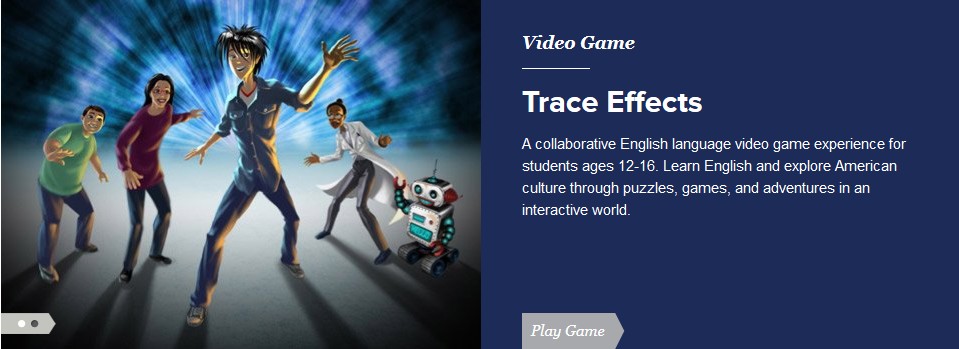
Trace Effects 3D is the latest offering from US Department of State’s Bureau of Educational and Cultural Affairs to help students learn English and about American culture. The Educational and Cultural Affairs website offers a wide range of materials and resources for students and teachers including webinar series, distance education programs and other interactive features.

Trace Effects

I watched the first episode of Trace Effects. It is set up in chapters and looks like a graphic novel. The voices are clear and talk slowly, and there is captioning so learners can read along. Once you finish a chapter there are tasks to perform, which require moving Trace (the main character) and having him interact with other characters.

Continue reading

‘Stickies’ – A Prewriting Tool for Writers

Jim ShimabukuroBy Jim Shimabukuro
Editor

I’m visual when it comes to verbal. With topics that are complex and new, I automatically doodle before actually sitting down at my computer to write sentences and paragraphs. With paper and pencil, I map out the relationships between and among ideas or units of thought. I usually begin with a word that rises to the surface of my mind. I write it down on whatever’s handy. Backs of envelopes or scraps of paper are the usual. I add another word that I associate with the first and position it in a way that reveals their logical relationship.

I add small rectangles around the words and connect them with lines and arrows to suggest causal links, or I use circles that overlap or contain smaller circles to show various set relationships. I continue to construct the picture by dropping in idea words and sketching in their logical connection to the parts and the whole. Some words surface but don’t seem to fit anywhere at the moment so I plop them on the side. Later, I work them into the evolving picture or erase them if they don’t seem to fit in anywhere. As you can imagine, with paper and pencil this means a lot of erasing and redrawing.

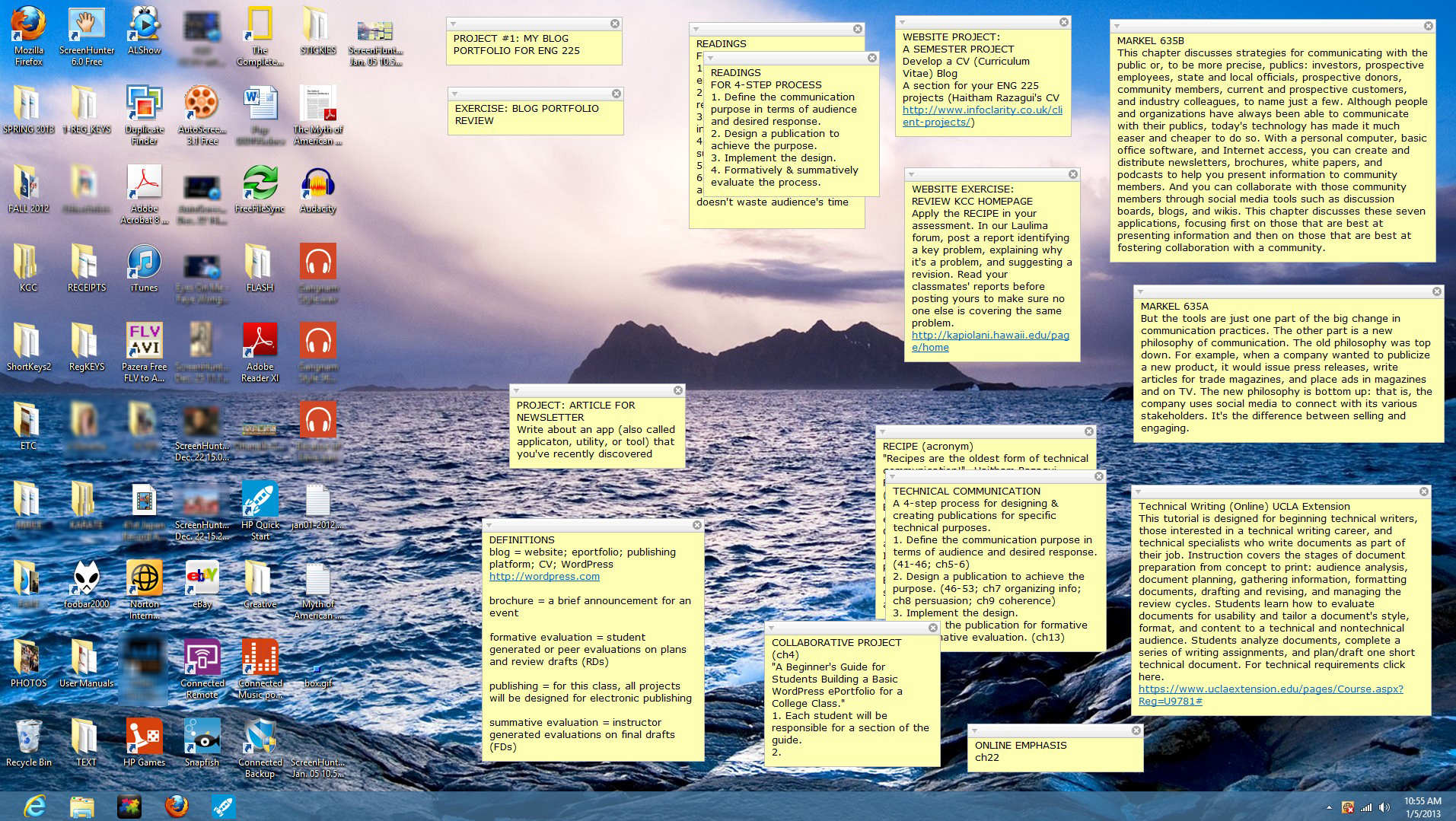
Stickies3My 32-inch desktop screen with Stickies.

In grad school, I found a huge blackboard at a thrift shop a couple blocks away from my apartment. I lugged it back to my small room and screwed it into one of the walls. It filled nearly the entire wall. I was in doodle heaven. This became my thinking pad. I could quickly sketch idea maps with chalk and revise with an eraser as I went along. I could step back at any time to see the whole picture, and step in to futz with the parts. When it was complete, I sat down with my typewriter (no personal computers back then) and wrote the paper.   Continue reading

Are Schools Ready for Today’s Five-Year Olds?

Frank B. WithrowBy Frank B. Withrow

Over the Christmas Season I have had the opportunity to spend some time with my great grand children. It makes me wonder if schools and teachers are ready for today’s digital kids. Alina, my almost five great granddaughter, is fluent in both English and Spanish. I might also say she manages my dog better than either Anne or I do. She commands and George follows. Therefore she must also speak dog.

However, what is more impressive is her command of her iPad. She told me my iPad was old fashion since it did not have a camera. So much for being the first to have a technology. She demonstrated for me her favorite programs on her iPad that can take pictures. She knew what she wanted to show me and how well she could use her favorite games and stories.

ipad hands2

She likes my Eloise stories on my website because they are in both English and Spanish. She also likes an art program and she draws very good pictures with it.

Her three year old sister is comfortable with the iPad if not the Master user. She did not look down on my iPad but found some of my artwork of cartoon characters that she found delightful.

Both little girls were completely at home with the technology and by the time they reach preschool will be Masters of the iPad. Alina wants Anne and dog George to visit her at her  home. I am assuming she would welcome the old man also. She was able to locate, using the GPS, the directions from our house to hers. So we have no reason not to visit them.

They got a set of engineering building blocks for Christmas, and they build several structures with Uncle Bill on the living room floor. There were illustrated plans, which Alina followed.

My kids and grandkids like to play Scrabble and have bitter challenges that they look up in the old faithful unabridged dictionary. Scrabble yes, dictionary no. It gathered dust on the side table. Challenges were immediately looked up in their iPhone dictionaries.

We have a German made vacuum cleaner that needed a new bag. The kids immediately found three stores in the area on their iPhones. The GPS system on their iPhone directed them to the store for replacements.

The little girls also played matching games on their iPad.

I must ask the question: Are preschool teachers and schools ready for iPad five year old experts? The digital world belongs to them. It is their second nature.

Verbling, Touchscreens, Tablets, Smartphones etc.

lynnz_col2

Online Education Programs Tackle Student Cheating by Ryan Lytle from US News & World Report
Lytle reports on various issues involved in online courses such as cheating on tests and plagiarism. Representatives from several universities point out that these are not just issues in the online classroom and offer their suggestions for reducing the problems. Sometimes the solution means making a choice between academic integrity and access. A university student commented that she thinks the most effective way to avoid cheating and plagiarism is for faculty to “to take a hard stand against students who violate class policies.”

Students learn better with star trek-style touchscreen desks from PopSci
A three-year study from the UK shows that students using interactive technology developed better math skills than their peers who were taught using traditional methods. The results suggest that using touchscreen desks improves students’ critical thinking abilities.

Language Learning Service Verbling Launches Google Hangouts-Powered Classes, Adds Support For 9 New Languages by Rip Empson from Tech Crunch
Empson overviews the launch of Verbling, an online language learning website that pairs learners and native speakers for video chats.

How tablets are invading the classroom by Simon Hill from Digital Trends
Hill gives an overview of the various tablets and the trends in integrating them into the classroom. Digital textbooks and tests are just two of the trends he focuses on, as well as the growing number of users who have their own tablets. At the end of the article he asks readers to respond to the question of whether they are the answer for integrating technology into education and which seems to be the best fit.   Continue reading

Whither MOOCs in 2013?

Jim ShimabukuroBy Jim Shimabukuro
Editor

In 2013, after the hype has settled and the glitter has dulled, we’ll have a clearer understanding of MOOCs and what they mean for higher ed. As 2012 comes to a close, we’re beginning to see glimpses of a growing awareness that Coursera, edX and similar platforms are basically crude constructs that attempt to push traditional practices into the virtual learning environment. As aggregates of new and old technology, they are, at best, makeshift hybrids that don’t quite fit into the new world of online education.

Carole Cadwalladr, Observer (UK) feature writer, took a Coursera course and included her experience in “Do Online Courses Spell the End for the Traditional University?” (Observer, 11.10.12). Her initial impression is, “They’re just videos of lectures, really.” Later, she shares her amazement at the level of interaction and instructor participation in live forums. However, her initial comment, that they are basically videos of lectures, resonates.

cadwalladr_crema 280

Max Crema, a student at Edinburgh University, reaches the same conclusion. In his interview with Cadwalladr, he tells her that “he’s already used online lectures from MIT to supplement his course.” And “the problem with lectures,” he reminds us, “is that they are about 300 years out of date. They date back to the time when universities only had one book. That’s why you still have academic positions called readers.” Crema’s stark observation of the relationship between videos, books, and lectures underscores the fact that all three are more similar than different and share common ground as modes of presentation.   Continue reading

Chromebooks for Teachers Through 12/21 for $99

bonnie icandy

The following are excerpts from the Chromebook and Donors Choose sites:

Through 12/21, Google is providing an exclusive opportunity through DonorsChoose.org for public school teachers to request the Samsung Series 5 Chromebook for the heavily discounted price of $99 each, including hardware, management and support. The Chromebook is a new type of web-based computer designed to make learning with technology easier, and will be available in Lakeshore’s eSchoolMall catalog.

Chromebook

Chromebooks for Education are fast, intuitive, and easy-to-manage computers that connect students and teachers with the power of the web. Chromebooks provide fast access to the web’s vast education and collaboration resources, while offering easy centralized management at a low cost. Click here to read more.

UPDATE: As of December 10th, 11pm eastern time, we’ve received a tremendous response to this offer. With a limited quantity of discounted Chromebooks available, we cannot accept additional submissions at this time. If you’d like to be notified if additional Chromebooks become available, read on for instructions. Click here* to read more.

__________
* WebCite alternative.

Girl Develop It: A Safe Environment to Learn Coding

By Jessica Knott
Associate Editor
Editor, Twitter

Fields ensconced within the walls of academia grow more technical by the day. As Andrea Zellner of Michigan State University points out in a recent GradHacker post (“Learning to Code,” 14 Nov. 2012), programming skills have become increasingly important in disciplines outside of computer science, especially for those teaching online. If you’re like me, the idea of learning to program is daunting. I’ve taken programming class after programming class, to mixed results. Zellner’s article had me thinking about the struggle to gain technology skills and how faculty members and teachers, already strapped for time, must feel in their pursuit. I asked for insight, and my Twitter network delivered yet again.

Antaya and Zellner

Erin Antaya (@gypsymama75), with a 10-year background in education and counseling and experience working for her family’s business and Biggby Coffee, turned me onto a group called Girl Develop It (@girldevelopit). Girl? Develop It? How had I never heard of this before? With more research, I discovered they are everywhere, and Erin, along with the founders of the Detroit Chapter of Girl Develop It (@GDIdet), Michelle Srbinovich and Erika Carlson, were kind enough to speak to me about what it all means.

Carlson and Srbinovich

Erin took to meetup.com and found the class offered at WDET in Detroit. “It was awesome,” she says. “The class [was] a safe and comfortable environment to ask questions and network.” According to Srbinovich, the story behind the Detroit chapter is amazing. In March 2012, she wanted to learn to code before the year’s end and set about finding the means to learn. In the process, she found Girl Develop It, and, she says, “The prospect of having an in-person introduction to web development and a female support system was exciting, and I knew it would give me extra motivation to continue learning.” Knowing others would feel the same she started her own group. The Detroit chapter was born.   Continue reading

TIME 2012 Person of the Year – MOOC

Jim ShimabukuroBy Jim Shimabukuro
Editor

[Updated 12.4.12: criterion added.]

It’s that time of the year when we begin to wonder who or what will be the Time 2012 person of the year. Keep in mind that the criterion is “the person who most influenced the news this year for better or worse.”
QuesCover

My heart says Pussy Riot.

PussyCover

My eyes and ears say PSY.

PSYcover

But I can’t ignore the elephant in the room.

ElephCover

The MOOC.

elemooc.

The Sad State of Teaching Thinking in Our Nation’s Schools

[Note: This article is a response to Harry Keller’s “Need More Software Engineers? Teach Thinking Skills Better” (ETCJ 11.29.12). -Editor]

I usually do not disagree with Harry. But I can tell him that he has no idea of the weaknesses of math and science in the grades where students begin to think about careers, hobbies and joining clubs. Education is a voyage of discovery. Some people never invest out of boredom or inadequate opportunity. They may be seduced by the media, but for things other than education and learning.

We also live in a world that supports entertainment and sports over academic performances for the most part. We glorify sports at all levels and also the entertainment industry most of which is very shallow. The news hardly reflects anything of importance of a thinking nature.

Education is like fashion. It depends on the whim of the politicians in Washington and the local school leaders. And there is no punishment for mistakes like those of the No Child Left Behind era when those of us who were teaching thinking-based learning were pushed into using test-based evaluation and modifying anything innovative, creative or science-based.

I went to Catholic schools where we were tested in the beginning of the year and the end of the year so the legacy of who was teaching well or not teaching well stopped at the source, the teachers from grades 1-to-8 who did the work and did the teaching.We did not have PE or science. I hate it that I missed the opportunity to grow into loving science until after my formal training. Thank god for museums and museum educators and courses for teachers. I had the Smithsonian as a learning playground.

We have in the US this testing that purports to measure a whole year and it starts in midyear, February in many instances, when in fact there are chapters and levels of knowledge still to be taught. I have been told that the statistics make up for the fact that we have not taught subject x, but I do not believe it.  Continue reading

Need More Software Engineers? Teach Thinking Skills Better

picture of Harry KellerBy Harry Keller
Editor, Science Education

We’ve seen much hue and cry about our schools being unable to meet the demand for “computer scientists.” What industry really misses is software engineers. The term “computer scientist” is misleading because the skill set of those who write computer programs is one of engineering. Science expands the boundaries of knowledge about the natural universe. That’s why just about every computer scientist worthy of the name is in academia.

Software engineers design computer software, and software coders are the technicians of computer software who implement those designs. Software architects work at a level above the engineers and consider much broader aspects of software creation. It turns out that really good software engineers can do architecture, design, and coding.

Should our high schools be preparing our young people for these careers specifically? Are our math classes geared to producing mathematicians? Are our English classes designed to produce novelists, playwrights, and journalists? Do our history classes create the next generation of historians? These rhetorical questions all have the same answer: no.

What is the most important skill that a software engineer can possess? It’s a strong analytical mind capable of advanced abstraction. No amount of practice with toy programming languages or simple subsets of industrial-strength programming languages will provide students with those thinking skills. However, good math, science, and even history classes just may do the trick if the talent is already there. Other courses can buttress this learning if they stop being memory courses.  Continue reading

The Real Issue in Ed Tech May Be Maintenance

In the earliest days of technology use in schools, particularly computing, it was understood that the school would provide and maintain the equipment. Today that is changing, and some schools are expecting students to come equipped with their own computing ability, maintaining equipment for only students with a proven financial need. Obtaining the equipment is less of a challenge than many might think; the real issue may turn out to be maintenance. With students having to provide their own tech support, reliability of service may become an important issue.

This problem was brought home to me with all too much clarity over the past few months. As I write a highly shortened version of what happened, imagine that I am a student trying to deal with assignments under my school’s technology requirements. I take a lot of trips in which total luggage weight and space is a real concern, and I decided my best option would be a tablet. I researched the reviews and settled on a top rated model, an ASUS Transformer, a tablet with the ability to be used like a laptop with a keyboard. Since I did not see it as a critical part of my life, I foolishly spurned the store’s additional full replacement warranty and stayed with the basic ASUS warranty.

When the tablet would not turn on one day, I used the ASUS email tech support. A couple of days later I got a reply telling me to go into the settings and make a number of changes. I replied that the solution they offered required me to turn on the tablet first, which I could not do. After a couple of days I got a new set of instructions for doing something completely different in the settings. I again tried to make them see that changing the settings was not possible unless the computer was turned on. Eventually I talked to a human being on the phone, and after a bit of an exchange he was able to see that point. Continue reading

Blame Poorly Designed Technology Instead of Teacher Training

picture of Harry KellerBy Harry Keller
Editor, Science Education

[Note: This article was originally posted as a comment, on 11.25.12, in response to Lynn Zimmerman’s Formative Assessment and Blended Learning, Texting, Bullying, MOOCs. -Editor]

Zimmerman: “They found that teachers and pupils lack sufficient training in how to use technology as educational tools.”

What about technology being easier to use? All of the blame does not go to training.

When you realize that professional development (PD) classes for teachers provide them with required credits for retaining certification and give them time off from teaching while having no requirement for success in these classes, you can see that teachers will sit in them and bring nothing from them back to the classroom. That’s your training.

Teachers are people, too, just like students are. Without motivation and good pedagogy, PD is just a day of vacation. For these reasons, we cannot pin our hopes on training. Technology should be easy enough to use that teachers who are motivated can learn to use a given new technology in under an hour. However, applying it by inserting it into curricula may take longer, even much longer.

Moreover, educational technology should already be an “educational tool.” Technology that must be stretched, bent, and twisted to fit into classrooms does not properly belong there. And, just because a teacher becomes enamored of some technology does not mean that the students will benefit. IWBs (interactive whiteboards) are a case in point here.

The best educational technologies will fulfill two crucial goals: (1) easy insertion into a curriculum and (2) positive transformation of teaching/learning in classes, i.e., better learning outcomes. These are in addition to the obvious ones such as ease of use and low cost. BTW, the improvement in learning should be due to the technology, not the shiny new thing syndrome.

Formative Assessment and Blended Learning, Texting, Bullying, MOOCs

Schools changing texting policies from eSchool News
Texting is one of the best ways to communicate with young people, but due to misconduct issues, many schools do not allow teachers and staff to communicate with students via texting. A school in Ohio sees the benefits of texting as a means of communication so is addressing the issue by sending home permission slips.

Addressing Bullying: Schoolwide Solutions by Nicole Yetter  from Education Week
This article reports on the 2011 “State of K-12 Cyberethics, Cybersafety, and Cybersecurity Curriculum in the United States” report published by the National Cyber Security Alliance and sponsored by Microsoft. This study found that schools needs to take a more active role in educating “students to be safe in today’s digitally connected age.”

Technology is not used effectively in schools is a report from The Information Daily.com
The National Endowment for Science, Technology, and the Arts (NESTA) in the UK has found that, despite schools spending millions of pounds on technology, it is not being used effectively. They found that teachers and pupils lack sufficient training in how to use technology as educational tools.

New frontier for scaling up online classes: credit by Justin Pope, AP Education Writer
MOOCs have opened up university courses to anyone who wants to take them. However, students do not receive university credit upon completion of these free courses. The sheer volume of students, grading, and concerns about cheating  are some of the issues that Pope explores.

Formative Assessment Is Foundational to Blended Learning by Michael Horn and Heather Staker from THE Journal
After explaining what formative assessment is – ongoing assessment – Horn and Staker look at the importance of formative assessment in the blended environment.  They assert that “formative assessment software appears to work best in blended learning environments if it helps students direct their own learning.”

Help Sandy Victims – Emergency Education Directory

Nov. 19, 2012
Hi Jim,

As the New York-New Jersey metropolitan area continues to struggle in the wake of Hurricane Sandy, it’s important to remember the far-reaching implications of putting life on hold in the middle of November. In New York City alone, over 75,000 students missed school last week, as 48 schools were left devastated by the storm and dozens were left without heat or power. Although not as urgent as providing housing, food, or fuel, those students’ educations must also be restored.

Photo from Huff Post 11.1.12

That’s why Noodle Education Inc., a New York-based education search provider, is setting up the Emergency Education Directory. Noodle will help connect students in the affected areas with volunteer educators willing to donate their time to teaching, tutoring, and guidance, as well as facilities with heat, power and resources to house displaced students and teachers for these sessions.

Supporting Noodle Education is the Education Industry Association (EIA), which represents and will help recruit more K-12 education companies to be listed on the Emergency Education Directory.

Already, Sandy has caused an estimated $50 billion in damages in the Northeast. A concerted effort by education providers will aid the recovery effort by helping students in the region stay on track with their schooling.

The more educators and students made aware of the Emergency Education Directory, the more effective the program will be. We think this issue would be of great interest to your readers and hope you will aid us in getting the word out.

Please let me know if you have any questions, or if I can connect you with Richard Katzman (rkatzman@noodle.org), Noodle’s point of contact on this matter. [Nov. 14 press release.]

Best,
Sylvie I. Calman
Account Executive
The Cutler Group
sylvie@cutlergrp.com

Are Games Such As ‘Angry Birds’ Appropriate for Kids?

Lynn ZimmermannBy Lynn Zimmerman
Associate Editor
Editor, Teacher Education

I am what Marc Prensky would call a “digital immigrant.” I did not grow up with computer technology but have learned to use it as it appears on my horizon. Some of this use has come from necessity, such as when the company I worked for bought Apple IIes to use for some data tracking. As more and more computer technology appeared on the scene, I embraced some of it while ignoring or rejecting others. I never played video/computer games, for instance, and wouldn’t know one end of a joystick from the other. On the other hand, I cannot imagine life without the Internet and Google.

However, I have started playing some computer games, such as solitaire and some other free card games on my computer and on the Internet. I am a user of Words for Friends through my FaceBook account. However, I have never really played what I consider to be video/computer games until this summer when I bought an Android tablet so I could have a small, light-weight device for checking my email when traveling and for downloading e-books. Around the same time, I heard a story on Dick Gordon’s The Story in which he interviewed the designers of Temple Run. It piqued my interest, I think in large part because one of the designers was a woman (gender differences in technology use and development is a story for another day).  Continue reading

Flipped, Blended, Distracted

Schools provide teachers with the training tools for flipping the classroom by Wylie Wong from EdTech Magazine
In order for innovative ideas such as flipped classrooms to work, teachers and administrators have to understand how to use the technology as well as technology integration.

Is the technology ‘ready’ for blended learning? By Michael Horn from Forbes
Horn asserts that blended learning and technology have not caught up with one another. Different needs and different models contribute to the challenges.

To Make Blended Learning Work, Teachers Try Different Tactics By Katrina Schwartz
from MindShift
In another article about blended learning, Schwartz talks about how blended learning is often an attempt to use traditional teaching methods with new technology. Some teachers easily integrate technology into their lessons and their classrooms, while others have less success. Some teachers are overwhelmed by the new technologies while others thrive on the challenges it presents for taking leaning in different directions.

Teachers: Technology changing how students learn  by Matt Ritchel from The New York Times
Two independent studies with teacher participants, one by the Pew Research Center and the other by Common Sense Media, seem to show that while teachers think the Internet and other technology has had a positive impact on student research skills they are concerned that technology contributes to students’ short attention span and their ability to focus.

Teachers concerned about students’ online research skills  from eSchool News
In a slight contradiction of the New York Times report, this article, also reporting on the Pew Research Center project, says that while teachers think that student access to research tools is improved, they are not necessarily good consumers of what they find. There is so much information available that they can become easily distracted and lose focus.

Chubb’s ‘The Best Teachers in the World’ Disses MSOs

[Note: This article first appeared as a comment to Withrow’s ETCJ article on 11.8.12. -Editor]

I was not going to respond to Frank B. Withrow‘s “Education in the 21st Century: The World Is Our Classroom.” Then I went to this meeting, and, since the recent election, I have been thinking. I know Frank. I know that he is speaking to all of the educators, but in Washington, lots of people sit on stages and affirm that there are certain practices that will change the world. I believe in Frank’s ideas and leadership. The nation turns a blind eye to the plight of children in rural, distant, unconnected and urban schools while seeking a digitized curriculum.

I don’t find it amusing that lots of the “experts,” if they have children, quickly explain that their kids go to Arlington, Montgomery, or Fairfax Schools. Never mind that lots of DC schools are in terrible need of modernity, and a few STEM schools don’t change the equation. The learning landscape is not even in DC and other places.

They just took librarians or media specialists out of DC elementary schools. I left teaching in DC years ago because of the lack of resources (Anthony Bowen is now a police station thanks to Rhee, but it is clean and no longer reeks of urine when the heat is on).

We lived through Rhee. Few have noted the ravages of her plan. Then I read Michael Keany’s “A Plan to Get the Best Teachers in the World” (11.10.12). Keany says:

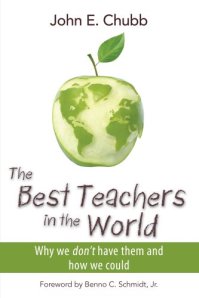
In his new book, The Best Teachers in the World: Why We Don’t Have Them and How We Could [Hoover Institution, Nov. 2012], Education Sector’s John Chubb explores strategies for how the United States can cultivate and retain the best teachers in the world, all with an eye toward raising student achievement. Jeff Selingo, an Education Sector senior fellow, sat down with Chubb to discuss the book at a recent Education Sector author talk.

Continue reading

Twitter for Professional Use – Part 4: Participating in a Live Event

By Melissa A. Venable

[Note: ETCJ’s Twitter editor, Jessica Knott, has been working with Melissa to develop this series. See Part 1: Getting Started, Part 2: Channeling the Streams, and Part 3: Curating the Chaos. -Editor]

This final installment in this series offers guidance on using your Twitter account to join live conversations and monitor ongoing professional events. After setting up and learning to manage your account, a good next step is to join active groups and discussions that use hashtags to set their conversations apart from the rest.

What Is a Hashtag?

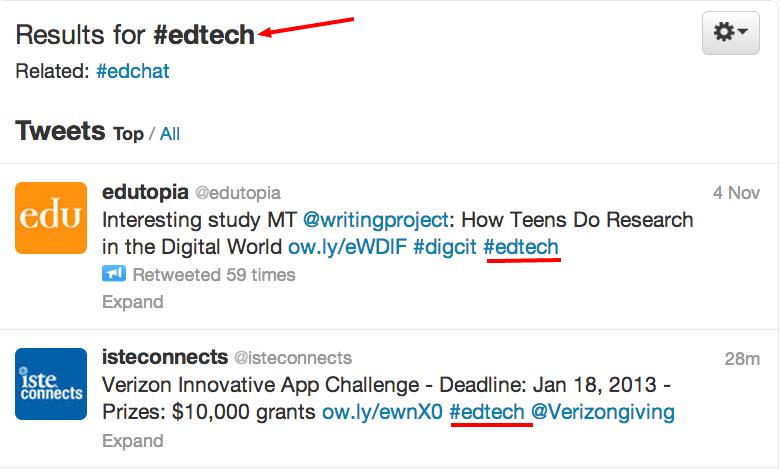
Adding the “#” symbol to series of letters and numbers creates what is known as a hashtag. These are searchable in the Twitter system and can function as filters to create a list of tweets that include the hashtag. By inserting a hashtag into a tweet, you add your message to the conversation, joining all the others who have chosen to add that same hashtag as well.

Anyone can create a hashtag and start a conversation. Like tags and keywords, they help you sort through the seemingly endless flow of information to identify related topics of interest. Use Twitter search to find recent tweets related to #edtech, #highered, or #election2012 as examples. Notice that searching by keyword (highered) or hashtag (#highered) allows you to see all of the messages with the hashtag, including those from accounts you don’t follow.

Join a Live Conversation

Twitter chats are real-time text chat conversations in which participants tweet their questions and responses. Chats go beyond just using the hashtag to participating at scheduled times. Anyone can join in by simply adding the chat’s specific hashtag to tweets during the session. There are several established chats focusing on education topics, such as #lrnchat and #edchatContinue reading

An Interview with Tim Holt, Author of ‘180 Questions’

By Bonnie Bracey Sutton
Associate Editor

[Note: Article updated on 11.10.12 — graphics added. -Editor]

Give a little of your background so we know who you are. Describe your work and how you assist teachers.

I’ve been in education for about 27 years now. I started as a classroom teacher and was a middle school science teacher for over a decade. I then moved on to administrative positions in my school district: I have worked in gifted and talented education, I’ve been an evaluator in education research, and most recently and for the last eight years I’ve been the Director of Instructional Technology for the El Paso Independent School District. My job is to try to try get teachers to use technology in the classroom with their students. I have a really great team of people that go out and train teachers on how to integrate technology into their lessons. Along the way I’ve been the President of the Science Teachers Association of Texas as well as President of the Technology Education Coordinators SIG, which is a statewide group in Texas of Instructional Technology Directors. Most people that know me from outside of Texas know me from my blog, which is now residing on Tumblr and is called HOLTTHINK.

What made you write 180 Questions: Daily Reflections for Educators and Their Professional Learning Communities?

For the longest time I thought just having a blog would be a good enough place to share my ideas and share what I was doing, but after a while I started thinking that a book would be a good place to put ideas that had to do with a very specific topic. The blog I have is kind of self-reflective and bounces all over the place from instructional technology to politics to different kinds of education topics, whereas the book is centered specifically on thinking about Professional Learning Communities or PLCs. What I wanted to do in this book was to give educators the opportunity to start doing a lot of reflection, which is something I think is sorely missing from a lot of professional development these days. What I see happening in professional development is people going in, getting trained on something, which they may or may not use, and then there is no follow-up, there is never anything that happens afterwards so you never know whether that training was useful or not useful.

The purpose of the book was to look at how we look at ourselves as educators. When I was growing up, every evening my parents had this booklet called The Upper Room, which was a daily devotional that had a little message with a meaning, and a prayer. Every night at dinner my father would read the daily passage, which they picked up at church each Sunday. I don’t even know if they still make it anymore, but I liked that idea of having something that made you think or made you jump out of your comfort zone on a daily basis. So that was kind of the genesis for the idea of doing 180 Questions. The “180” comes from the length of a typical school year here in the United States.

Continue reading

Placement Tests and the Unravelling of College Developmental Programs

Jim ShimabukuroBy Jim Shimabukuro
Editor

With so many developmental programs in statewide community college systems (SWCCSs) reliant on high-stakes placement exams such as COMPASS and ACCUPLACER, the recent reports out of Columbia University’s Community College Research Center (CCRC) must have come as a shock. For decades, these tests have been impacting students’ academic careers, and now a set of studies has surfaced to question the validity of their use in predicting performance.

At issue is much more than the efficacy of placement tests. Because the scores are the thread that runs through, binds, and defines the entire developmental structure, there’s really no telling what will happen as Judith Scott-Clayton and her colleagues tug, bit by bit, at the loose end that they’ve discovered. Scott-Clayton, an assistant professor of economics and education and senior research associate with CCRC, which is part of Teachers College, is the prominent figure in this effort to take a long hard look at a system that seems to be broken because of a fundamental flaw — placement testing.

In one of the studies, “Development, Discouragement, or Diversion? New Evidence on the Effects of College Remediation” (National Bureau of Economic Research, Aug. 2012), Scott-Clayton and Olga Rodriguez (also Teachers College) cite a finding that “remediation does not develop students’ skills sufficiently to increase their rates of college success” (2). Furthermore, they say that many students “diverted” into developmental courses could have done well had they gone directly into the college-level courses:

First, we find that potentially one-quarter of students diverted from college-level courses in math, and up to 70 percent of those diverted in reading, would have earned a B or better in the relevant college course. Further, our analysis of impacts by prior predicted dropout risk suggests that diversionary effects are largest for the lowest-risk students, and we fail to find positive effects for any risk subgroup. (3)

In fact, these students who weren’t at risk in the first place may be at greater risk of dropping out as a result of this needless diversion.  Continue reading

Oakland Unified School District Uses GIS to Further Academic Achievement

By Jim Baumann
Esri Writer

Oakland, California, lies directly across the bay from San Francisco. During the California Gold Rush in the mid-eighteenth century, it served as the main staging point for miners and cargo traveling between the Bay Area and the Sierra foothills. Today, the city continues to serve as a major cargo terminus, and its seaport is the fourth busiest container port in the United States.

Due to the economic opportunities provided by the Gold Rush, the city was a destination for immigrants looking for greater prosperity. As a result of this and successive migrations, Oakland is now known for its ethnic diversity, with significant populations of African-American, Hispanic, Asian, and Caucasian residents. While valuable from a cultural perspective, this poses certain challenges for local government, particularly the Oakland Unified School District (OUSD), which must accommodate the diverse needs of its students, who speak more than 70 languages at home.

OUSD includes 61 elementary schools, 16 middle schools, 20 high schools, three K–8 schools, and one 6–12 school, as well as special education, independent studies, and early childhood education centers. It is the seventieth largest school district in the United States, and there are about 38,000 students in its K–12 programs. Chronic absenteeism is a major concern for the district, with nearly 40 percent of students in the East Oakland areas dropping out of high school before graduation. OUSD works with the Urban Strategies Council (USC), a nonprofit organization located in Oakland, to collect and analyze data related to school attendance and other social issues in the city.

Implementing a Community Data Portal with ArcGIS for Server

USC has used Esri‘s ArcGIS software for more than 20 years, applying it to a wide range of urban policy and reform initiatives affecting Alameda County, where Oakland is located, including health care services, affordable housing, violence prevention, education analysis, urban planning, disaster mitigation, and school absenteeism. It recently launched InfoAlamedaCounty Map Room, a free data portal that provides access to public datasets to the community for research, application development, civic engagement, and analysis.

Continue reading

Not Satisfied, but Hopeful, About Online Science

By Dan Branan, Ph.D.
NANSLO Lab Director
Colorado Community College System

John Adsit wrote a recent article (“No Satisfaction in Finding on Online vs. Traditional Science Classes,” 22 Oct. 2012) commenting on a study by the Colorado Department of Higher Education’s study showing, among other things, no significant difference in long-term college grades and GPA when comparing community college students who had taken their introductory science courses online with those who had taken them in the traditional community college classroom (Epper, 18 Oct. 2012). I had initially posted a response to John’s article, and was asked by the editor of ETCJ to expand it into an article, which I greatly appreciate. In short, it seems to me that John has largely missed the mark with regard to the Colorado study and its implications.

For many years, as an online educator in the community college system in Colorado, I have listened to traditional colleagues claim as a fact that students taking online science courses are not as well-prepared and, in fact, are at a disadvantage, compared to traditional students. The traditional model was held up as the standard, without proof, even though, as John points out in his post, there have been studies indicating that the traditional educational model does not work as well as it should in the first two years of college.

John’s initial response to the Colorado study is to merely sneer at the demonstrated equivalence of online vs. traditional science classes at the community college level by stating that “students in general learned very little in the first two years of college,” relying on the excellent analysis in Academically Adrift. While I cannot dispute the findings in that report, I do have an important question about its true meaning: Do we have proof that college education has ever been different? While it may indeed be a cause for alarm, could it be that the first two years of college are a time when students undergo a wide range of mental and personal transformations in readiness for the culminating two or three years before they earn their degree? Isn’t it true that the first two years of college are often filled with fairly bland courses in preparation for study in one’s chosen field of interest?

After all, the U.S. still possesses an undergraduate educational system that many students from around the world envy. According to a report last year from the Institute of International Education, the number of international students enrolled at U.S. colleges is 32 percent higher than it was a decade ago, and this is largely due to undergraduate enrollment of Chinese students.  Continue reading