Posted on May 13, 2011 by JimS
 By Jim Shimabukuro
Editor
Introduction: On May 12 and 13, I had the opportunity to interview Jessica Knott, a PhD student in Higher, Adult and Lifelong Education (HALE) at Michigan State University. She is also an instructional designer with TechSmith Corporation’s Camtasia Relay team. She serves as ETCJ’s editor on Twitter and writes a column, “ETC, Twitter and Me.”
Jim Shimabukuro: I just logged in to the TEDxLansing website. Please tell us about the event and, more specifically, about your live online course.
Jessica Knott: I’m super fortunate to live in a vibrant city filled with doers, and TEDxLansing is kind of an embodiment of that. I’ve been on the core planning committee for the past two years and am consistently amazed at the big ideas and bright spots that are unearthed in the state of Michigan, which is consistently looked upon as bleak. TEDx events are local, and highlight what can be as well as what is. They’re incredible.

Lansing (or, East Lansing, rather) also happens to be the home of Michigan State University, where I am a PhD student in Higher, Adult and Lifelong Education (HALE). I focus on distance learning and instructor presence, and how organizational changes and the shifting landscape of higher education affects how we communicate with our students. EAD 315 is offered to HALE students and gives them the opportunity to create and teach an online or in-person course in student leadership theory and development. However, it’s more than just a workshop or seminar. This class is a challenge in every way. Students with no teaching experience are mentored through the process from start to finish, and students who already know the ropes have some freedom to explore and try new things, while creating a solid, challenging course for students requiring a four credit summer course. This is my second year teaching it, and I’ve already learned a lot about my teaching style and working with undergraduate students. Continue reading →
Filed under: Uncategorized | 7 Comments »
Posted on May 13, 2011 by JimS
 By John Sener
[Author’s note: this article elaborates on an idea described in a previous article.]
Anyone who truly believes the common wisdom that our education system is “broken,” “failing,” and needs “fixing” should try answering these questions:
- When did it break?
- Who broke it?
- Was it working just fine before that?
- What did it look like then?
- If it’s now “failing,” when in the past was it succeeding?
- What did that look like, and what happened to change that?
When you ask these questions, the reality becomes apparent: education has never worked fine for everyone. It has always worked for some and not well at all for many others. The current system needs some repair work here and there, but to say that the entire education system is broken or failing and needs fixing to achieve “success” is at best misguided; at worst, it’s misleading, even pernicious nonsense.
This is so for three important reasons:
First, saying that education is “broken” and “failing” opens the door to would-be “fixers” of education who offer handy “solutions” that bring neither resolution nor success. Children’s author Richard Scarry created a character who helps us understand how this works. Mr. Fixit is “fix-it” incarnate — but as millions of children worldwide wisely know, Mr. Fixit has, shall we say, an inflated sense of his capabilities. He can fix some simple things, but most of his fixes go awry: a once-leaky boat that won’t ever leak (or float) again, a vacuum cleaner that only works on the ceiling, a talking doll that says “Dadda” instead of “Mamma.” Would-be “fixers” of education produce results that are similarly dubious and often a lot more expensive. Continue reading →
Filed under: Uncategorized | 5 Comments »
Posted on May 11, 2011 by JimS
By Jim Shimabukuro
Editor
DVD players have advanced so far that they’re beginning to take over functions that we normally associate with home PCs. For example, I bought a Sony BDP-BX37 unit for a little over $90 a few days ago. With an ethernet connection to a cable router, I can now bring many web resources to the widescreen, high-definition (HD) TV.
Except for newscasts from time to time and special documentaries, I seldom watch TV programs. Instead, I use the TV primarily for viewing DVDs. Thus, when my old, pre-Blu-ray DVD player finally died, I went shopping. I was amazed at the wide range of models, price drop, and value for the buck. I was especially impressed with the LAN (local area network) capability and USB port.

When I got the unit home, I couldn’t wait to try it out. I inserted the cables — HDMI to the TV and ethernet from the router. I also plugged a keyboard into the front panel USB port. The onscreen setup went smoothly, prompting me through a few simple steps.
My first test was YouTube, to explore the unit’s web capability. At the YouTube screen, I used the keyboard (instead of the buttons on the remote) to type in a search term. I selected videos at random from the ones that emerged. They played without a problem. The default viewing frame is very small, about 20% of the screen. Clicking on the remote’s center button (in the circular direction controls) zooms in to full-screen mode. In full-screen, results are generally poor with standard low-resolution videos. Those with higher definition are fair to very good. Continue reading →
Filed under: Uncategorized | 2 Comments »
Posted on May 4, 2011 by JimS
 By Bonnie Bracey Sutton
Editor, Policy Issues
[Note: This article grew out of a comment that Bonnie posted, on 4 May 2011, in response to Jim Shimabukuro’s “The Web As a Platform for Teacher Revitalization.” -Editor]
I know how lucky I am. Chris Dede was a mentor. Before he taught at Harvard, he was a professor at George Mason University. Back then, he sometimes visited my classroom, bringing students with him, and sometimes I got to be a part of his classes.
Chris was one of the mentors in the Christa McAuliffe NFIE (National Foundation for the Improvement of Education) program, and he worked with five of us, representing various diversity components: Native American, international, digital divide, supercomputing, and futuristic education. We were groomed to help classroom teachers and had frequent meetings with these experts, who shared resources, ideas, and thoughts with us.
The NFIE was funded by the NEA from member contributions on behalf of the astronaut who died in the shuttle accident. It is a private foundation within the NEA. Chris was my knight in shining armor in the NIIAC (National Information Infrastructure Advisory Council). I could present ideas to teachers, but I was just a teacher. Chris had a PhD. They listened to him, though they may have been amused by the things I said. He was my resource for the duration of the time I was on the council. Continue reading →
Filed under: Uncategorized | Leave a comment »
Posted on May 3, 2011 by JimS
By Jim Shimabukuro
Editor
In her comment (5.2.11) on John Sener’s “Fighting the High Cost of Low Teacher Respect” (5.2.11), Bonnie Bracey Sutton makes a few points that got my attention.
The first is: “The Internet sort of gets rid of a layer of supervisors.”
Supervision is a problem that teachers rarely if ever broach — and for good reason. Criticize it, and they’re out of a job. Supervision can be both good and bad. When it’s good, it’s empowering. That is, it supports the teacher’s efforts to realize her instructional goals through her preferred approaches. It keeps the teacher in charge of her pedagogy. Yet, along with that freedom comes the responsibility to meet school-wide objectives. The teacher is treated as a professional, highly trained and capable of making her own decisions about how best to achieve goals and objectives.
Supervision, when it’s bad, is overbearing, invasive, counterproductive, and ultimately dehumanizing. The assumption is, to put it bluntly, teachers are stupid and lazy. They need to be told what to do, how to do it, and when to do it. They need constant watching and prodding. The teacher is viewed as a technician or, worse, a machine, a component that needs to be programed, plugged in to a classroom, and periodically serviced and updated. From the supervisor’s perspective, the best teachers are those who are easily programed and maintained. Continue reading →
Filed under: Uncategorized | 2 Comments »
Posted on May 2, 2011 by JimS
By John Sener
[Note: On May 1, Bonnie Bracey Sutton, ETCJ editor on policy issues, posted a link to Dave Eggers and Ninive Clements Calegari’s NY Times op-ed, “The High Cost of Low Teacher Salaries” (April 30), in the journal’s private listserv for possible discussion. On May 2, John Sener, ETCJ writer, posted a version of the following article in the discussion. -Editor]
I almost wish this article had been titled “The High Cost of Low Teacher Respect” because the issue is about more than just low salaries, as the actual article demonstrates. It is good to see teacher advocates fighting back directly with a “put your money where your mouth is” argument, though. You want results like Finland, South Korea, Singapore? Do what they do. Linda Darling-Hammond has been making a similar argument recently. Unfortunately, the argument presented in this article is weakened by a number of flaws:
- The current prevailing ideology in American educational reform is that the “free market” (more accurately termed the “rigged market,” but that’s another conversation) can do things more efficiently. This article really doesn’t address that argument. In part, it’s because it’s so hard to counter a free market ideology that operates on the level of belief (as opposed to actual results), and it’s exceedingly hard to disprove a belief. Continue reading →
Filed under: Uncategorized | 5 Comments »
Posted on April 27, 2011 by Claude Almansi
 By Claude Almansi
Editor, Accessibility Issues
ETCJ Associate Administrator
In his lecture, “The Architecture of Access to Scientific Knowledge: Just How Badly We Have Messed This Up” (at CERN, Geneva, CH. April 18, 2011), Lawrence Lessig discussed YouTube’s new copyright school. (See 35:42 – 39:46 in the subtitled and transcribed video of his lecture.) The YouTube Copyright School video he showed and commented was uploaded by YouTube on March 24, 2011, then integrated into what looks like an interactive tutorial, also entitled YouTube Copyright School, with a quiz on the side.
More information about this “school” was given on the YouTube Official Blog in “YouTube Copyright Education (Remixed)” (April 14, 2011):
If we receive a copyright notification for one of your videos, you’ll now be required to attend YouTube Copyright School, which involves watching a copyright tutorial and passing a quiz to show that you’ve paid attention and understood the content before uploading more content to YouTube.
YouTube has always had a policy to suspend users who have received three uncontested copyright notifications. This policy serves as a strong deterrent to copyright offenders. However, we’ve found that in some cases, a one-size-fits-all suspension rule doesn’t always lead to the right result. Consider, for example, a long-time YouTube user who received two copyright notifications four years ago but who’s uploaded thousands of legitimate videos since then without a further copyright notification. Until now, the four-year-old notifications would have stayed with the user forever despite a solid track record of good behavior, creating the risk that one new notification – possibly even a fraudulent notification – would result in the suspension of the account. We don’t think that’s reasonable. So, today we’ll begin removing copyright strikes from user’s accounts in certain limited circumstances, contingent upon the successful completion of YouTube Copyright School, as well as a solid demonstrated record of good behavior over time. Expiration of strikes is not guaranteed, and as always, YouTube may terminate an account at any time for violating our Terms of Service.
Continue reading →
Filed under: Accessibility, Multimedia | Tagged: Accessibility, Authors' Guild, CERN, copyright, Education, IFPI, Lessig, school, YouTube | 1 Comment »
Posted on April 21, 2011 by JimS
 By Lynn Zimmerman
Editor, Teacher Education
For a number of years, our undergraduate teacher education program at Purdue University Calumet offered an educational technology course, early in the program sequence, which taught technology skills in isolation. That is to say, students were taught how to use certain technology tools that would be useful for them as teachers, but the projects they designed were for an “imaginary” audience of students that they would teach at some point in the future. Over time, this course morphed from teaching computer basics, such as the Office Suite, to using technology and programs designed specifically for teachers, such as Kidspiration and Web Quests. As technology has evolved, so have the ideas for how to implement them in the classroom at the K-12 as well as the university levels. Research on educational technology design has shown that to be most effective the integration of pedagogy and technology must reflect integrated goals.
 Emily Hixon
Recently, our approach to teaching the undergraduate educational technology course changed again. It is now being offered later in the program in conjunction with the methods block of courses. I asked Emily Hixon, Assistant Professor of Educational Psychology and Instructional Technology, to give us some insight into the new course that she has developed, which teaches our pre-service teachers to integrate technology into a real-world teaching situation. Continue reading →
Filed under: Uncategorized | 9 Comments »
Posted on April 20, 2011 by Claude Almansi
 By Claude Almansi
Editor, Accessibility Issues
ETCJ Associate Administrator
On April 18, 2011, Lawrence Lessig gave a lecture entitled “The Architecture of Access to Scientific Knowledge: Just How Badly We Have Messed This Up” at CERN in Geneva, CH (see announcement). He has now uploaded the video of this lecture at youtube.com/watch?v=2me7hptVGzI, with the following description:
Lecture at CERN, Geneva, Switzerland, 18 April 2011: A new talk about open access to academic or scientific information, with a bit of commentary about YouTube Copyright School.
(YouTube Copyright School: youtube.com/copyright_school – see also YouTube Copyright Education (remixed) on YT’s official blog, April 14, 2011)
In view of the interest of this lecture for researchers and educators, I have started a subtitling page for it at Universal Subtitles: universalsubtitles.org/videos/jD5TB2eebD5d. If you are interested in collaborating in this subtitling, here are a few practical indications:
Continue reading →
Filed under: Uncategorized | Leave a comment »
Posted on April 19, 2011 by Claude Almansi
By Claude Almansi
Editor, Accessibility Issues
ETCJ Associate Administrator
The International Review of Research in Open and Distance Learning (IRRODL) has dedicated a special issue to “Connectivism: Design and Delivery of Social Networked Learning” (March 2011), edited by George Siemens (Athabasca University, Canada) and Grainne Canole (Open University, UK).
This special issue is not meant as a definitive sum on connectivism but rather, as Terry Anderson, editor of IRRODL, put it in his announcement on the Instructional Technology Forum mailing list:
… a challenge and request that we spend more effort into trying to understand if connectivism has approaches and delivers important insights and practical designs into the increasing networked learning context in which we function.
Continue reading →
Filed under: Social Media | Tagged: challenges, Connective learning, law, MOOC, Online, OPEN, PLENK | 7 Comments »
Posted on April 16, 2011 by JimS
By Jim Shimabukuro
Editor
At some point in the process of change, the talk becomes the walk and the medium is the message. In education, we’re finally getting there.
For the longest time, the vast majority of conferences on the latest Internet technologies have been held in face-to-face or onground venues in large cities. Teachers have only one way to participate, and that is to travel to the conference site. There, as they have for the past twenty years or more, they gather in auditoriums and listen to experts on leading edge technologies and strategies for using them in blended or online classrooms. Ironically, the experts, who gush about the latest social media such as Twitter, Facebook, and blogs, use notebooks, PowerPoint, and handouts in their lectures, and the participants, by and large, take notes as they have for the last century and a half.
No one thinks it strange that information about the latest online media is presented in a medium that Socrates would have found familiar. The disconnect between medium and message makes sense when the gap between innovation and practice is wide and the majority in the audience are on one side and presenters, on the other. Continue reading →
Filed under: Uncategorized | 2 Comments »
Posted on April 8, 2011 by JimS
 By Tom Preskett
Last week I taught a session (with a couple of colleagues) called “Structuring an Online Course: Guidance and Example.” My contribution to this session was a Prezi presentation.
What I’ve attempted to do is group together different sections of the process with a view to helping educators organise their thinking on this issue. The hard part of this is knowing what to leave out. I see this as a work in process because I hope to get clearer about the issues and the relationships as I gain more experience. The point of this practically focused framework is to help a higher education (HE) institution in 2011. (I work at the excellent Institute of Education.) The point is that many academics need help with the basics – basics that aren’t well defined or universally agreed upon. By “basics” I mean the key decisions that need to be made, the main structural decisions to take.
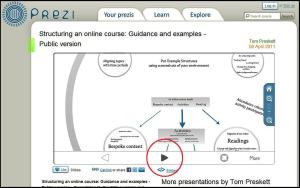 Click the image to go to the presentation, and click the arrow to view it.
Some may disagree with the phrases used in the structure, but the point is to provide a framework from which to work. Of course, it needs context. I work with individuals to give this context. However, I’m interested in the academic staff who aren’t banging down my door to have these conversations and are only at this particular session. It’s something for them to take away. I want to make the maximium impact I can – an impact that covers the foundations of what they need to know. If this is all the time I get with them, then I don’t want to waste it focusing on a small piece of the pie before they have had a chance to see the whole and how the different slices fit into it. Continue reading →
Filed under: Uncategorized | 2 Comments »
Posted on April 7, 2011 by JimS
By Jim Shimabukuro
Editor
After viewing Shigeru Miyagawa‘s “StarFestival: A Return to Japan,” Bonnie Bracey Sutton, said, “This work is so important to the understanding of people as people…. It is brilliant sharing of culture” [1]. (Click here for the ETCJ announcement of “StarFestival.”) I agree. Shigeru’s interactive multimedia presentation is brilliant because it speaks to us at many different levels in many different ways, and all of them are important.
When most people see minorities, they see “different” but often don’t fully understand or appreciate that difference. “StarFestival” addresses this issue as an offering in MIT’s Visualizing Cultures series, founded in 2002 by MIT professors John Dower and Shigeru, which “weds images and scholarly commentary in innovative ways to illuminate social and cultural history.” The series “represents a substantive offshoot of MIT’s OpenCourseWare,” and Shigeru “was a member of the committee that first developed this groundbreaking project, which has inspired counterpart initiatives on the Web worldwide.” Continue reading →
Filed under: Uncategorized | 1 Comment »
Posted on April 6, 2011 by JimS
By Bonnie Bracey Sutton and Jim Shimabukuro
Bonnie Bracey Sutton, on March 26, 2011, emailed her friend, Shigeru Miyagawa, and asked about the possibility of sharing some of his curriculum work. Shigeru heads MIT’s Foreign Languages & Literatures; he is also Professor of Linguist ics and Kochi-Manjiro Professor of Japanese Language and Culture; chair, MIT OpenCourseWare Faculty Advisory Committee; co-director with John Dower, Visualizing Cultures.
 Shigeru Miyagawa
On April 2, Shigeru replied:
At your suggestion, we put up the online version of StarFestival — in a hurry. StarFestival, or Tanabata in Japanese, is celebrated all over Japan, but my hometown of Hiratsuka, where this story is based, and Sendai, the city hit by the recent earthquake and tsunami, are the two major cities for the festival. As you know, StarFestival is about reconstruction after a calamity, in our case, the U.S. bombing of Japan. George Takei is the voice of the show.
The URL is: http://ocw.mit.edu/ans7870/21f/21f.027/star_festival/index.html. This can also be found in Visualizing Cultures under “About Visualizing Cultures,” by scrolling down to the list of the VC team. The tinyurl for Twitter is: http://tinyurl.com/MITStarFestival
When you log in to “StarFestival: A Return to Japan,” the setup will remind you of an interactive game. In the opening screen (below), you would click on the PDA, on the ground, to get started. The caption reads: “Playback the Professor’s personal memos, conversations, and ‘you-are-there’ videos recorded onto his PDA (above) as he rediscovers his hometown, the coastal village of Hiratsuka. Follow the path of his four-day journey culminating in the celebration of ‘Tanabata,’ the Star Festival.”

Continue reading →
Filed under: Uncategorized | 1 Comment »
Posted on April 6, 2011 by JimS
By Claude Almansi
Editor, Accessibility Issues
ETCJ Associate Administrator
[Note: This announcement is from a post (6 Apr. 2011) by Elizabeth Stark in the A2k listserv.]
The Berkman Center at Harvard University and Stanford Law School are pleased to announce a new initiative in which we invite the world to submit their ‘Ideas for a Better Internet.’ We are seeking out brief proposals from anyone with ideas as to how to improve the Internet. Students at Harvard and Stanford will work through early next year to implement the ideas selected. Interested parties should submit their ideas at http://bit.ly/i4bicfp by Friday, April 15. Please spread the word far and wide, and follow us on Twitter at http://twitter.com/Ideas4BetterNet.
——————————————————————————————
Ideas For A Better Internet
The Berkman Center for Internet & Society at Harvard University and Stanford Law School are pleased to announce ‘Ideas for a Better Internet,’ a joint initiative aimed at fostering innovation around the most pressing issues currently facing the Internet. We invite anyone — interested individuals, scholars, entrepreneurs, organizations, and others with great ideas — to submit a proposal. Continue reading →
Filed under: Uncategorized | Tagged: Better Internet, Call, Harvard, Internet, Stanford | 1 Comment »
Posted on April 4, 2011 by JimS
By Allan C. Jones
[Note: This is an expanded version of an article that Allan first published in his Facebook page. Bonnie Bracey Sutton, ETCJ editor for policy issues, invited Allan to submit this article. -Editor]
The problems with America’s K-12 public education system are not caused or exacerbated by the presence of teachers’ unions and won’t be solved by allowing more charter schools. The best way to improve America’s K-12 public schools, despite some recent vitriolic blaming, is to transform the present schools. Recently the OECD (Organisation for Economic Co-operation and Development) published the results of the 2009 PISA exams. For anyone who is not familiar with PISA, the OECD self-definition is:
The Programme for International Student Assessment (PISA) is an internationally standardised assessment that was jointly developed by participating economies and administered to15-year-olds in schools. [1]
We’ve all heard how poorly our 15-year-olds are doing in comparison with the rest of our competitor countries across the world on the PISA exams (17th in reading, 23rd in science, and 30th in math). Union detractors immediately jump on the poor test results to promote their agenda that includes the need to remove bad teachers and the stifling effect unions have in that process. It is a part of the larger effort to get rid of public sector unions altogether. The union detractors fail to look beyond the test scores and explore the detailed analysis that the OECD provides. Let’s look at all of the information and the conclusions that it leads to. Continue reading →
Filed under: Uncategorized | 4 Comments »
Posted on April 3, 2011 by Claude Almansi
(Last updated 7/23/17 03:55PM)
By Claude Almansi
Editor, Accessibility Issues
ETCJ Associate Administrator
[Note added 4.5.11: My apologies to Claude and our readers. I accidentally released this article a few days ago before it was ready, and in doing so I caused quite a confusion. Claude’s erudition in a wide range of fields is legend in ETCJ, and her sense of irony and humor as well as wit, combined with her passion in standing up for her beliefs, make her one of the most entertaining, enlightening, and popular writers on our staff. In asking her to expand on this piece, my intent was to make her works even more accessible to readers who may not share her level of expertise. -Editor]
Note: The first version of this text was only a brief note about the odd disappearance after a few hours of an article describing the interest the German tax authorities are taking in the affairs of the Swiss branch of IFPI (International Federation of the Phonographic Industry), more particularly in the relations between the Swiss IFPI and IPGate.
However, Jim Shimabukuro, our chief editor, rightly pointed out that this note was difficult to follow in its concision. So this is an expanded version, with more about the background of that disappeared article, and something about the educational relevance of this matter. My former title does not fit this revised version, so I have changed it; but as the draft has already been indexed by search engines, I kept its original URL.
Apologies to those of you who thought that this piece had been deleted, maybe due to pressure exerted by IFPI: I only set it on “private” while I was editing it. Thanks to Franklin Trankett who e-mailed me about possible misinterpretations of its temporary disappearance.
Continue reading →
Filed under: Uncategorized | Tagged: "Argauer Zeitung", censorship, IFPI, Infogate, taxes, zuerifluestern | 2 Comments »
Posted on April 1, 2011 by JimS
By Lynn Zimmerman
Editor, Teacher Education
For several semesters my undergraduate students have participated in online discussions with students from other countries. My students are education majors, and most speak English as their first language. Those who are not native English speakers have sufficient proficiency in the language to be successful college students in the US.
I have collected data about the activities in the form of questionnaires and have saved the discussions themselves for analysis. Recently I attended a linguistics conference, and while it is not my field, I decided that I wanted to take advantage of the wealth of linguistic data that I had. I chose to analyze one very narrow slice of the discussions, phatic expressions in the form of greetings and closings. One of the research questions I was trying to answer was: Can phatic expressions give an indication of whether the participants regard an online discussion as writing or speaking? My conclusion was that the students seem to approach these activities as informal writing activities. At the end of my presentation, I asked for questions and comments.
One person’s comments and questions prompted me to write this piece: Why should I try to classify it as either? Why not just recognize it as a third type of writing which is specific to this medium? I am still trying to wrap my head around this concept. I am what Prensky refers to as a digital immigrant, and I think my perspective and mindset is coming into play here.
To me, there is a distinct difference between oral and written communication. However, in today’s digital world, perhaps these distinctions are becoming blurred or are changing. Perhaps people who are developing their communication skills through digital media see online discussions as another way of communicating that is a distinct form or genre of writing. I’d like to hear other people’s thoughts on this notion.
Filed under: Uncategorized | 31 Comments »
Posted on April 1, 2011 by JimS
By Nancy Willard
Trust is a story about a young girl who gets involved with an online sexual predator. The movie is a fictionalized account of a true story. Like many “true story” movies, this situation is not typical. Research of actual arrests has documented that these kinds of incidents are very rare.
Unfortunately, the movie has the potential of spinning a significant amount of unwarranted fear about the risks young people face online, as well as ill-advised approaches to “protect” them. Research related to online risks consistently demonstrates that the overwhelming majority of teens make safe choices online and know how to avoid or respond to these kinds of situations.
 There are two major concerns associated with the Techno-Panic this movie is likely to spawn:
- This movie could stimulate the distribution of inaccurate fear-based messaging around the risks associated with online predation. Risk prevention professionals know that seeking to transmit fear-based messaging and simplistic rules are ineffective approaches to prevent risk behavior.
- This movie could generate a significant amount of fear about online sexual predators, which could create barriers to the integration of web 2.0 technologies in schools, which is so important in the transition to 21st century learning.
Continue reading →
Filed under: Uncategorized | 5 Comments »
Posted on April 1, 2011 by JimS

Raymond Rose, Rose & Smith Associates, Inc.
Henry Neeman, University of Oklahoma
Bonnie Bracey Sutton, The Power of US Foundation
Vic Sutton, Emaginos
Executive Summary
The 2010 National Educational Technology Plan says “…technology is at the core of virtually every aspect of our daily lives and work…. Whether the domain is English language arts, mathematics, sciences, social studies, history, art, or music, 21st-century competencies and such expertise as critical thinking, complex problem solving, collaboration, and multimedia communication should be woven into all content areas.”
The US has, since the late 1990s, been trying to describe what a 21st Century education should look like. Futurists are trying to divine the skills that will be needed for jobs that do not yet exist, employing technologies that have not yet been invented. However, a careful look around can allow us to see many areas that have been virtually unnoticed by those who are focused on 21st Century Skills.
Supercomputing – sometimes called high performance computing – is not a new technology concept, but the supercomputers of 25 years ago were about as powerful as a cell phone is today, and likewise the supercomputers of today will be no better than a laptop of 10 to 15 years from now. As the world of the biggest and fastest computers has evolved and these computers have become increasingly available to industry, government, and academia, they are being used in ways that influence everyday life, from the cars we drive, to the food in our cupboards, to the movies we enjoy.
Continue reading →
Filed under: Uncategorized | 5 Comments »
Posted on March 28, 2011 by JimS
By Bonnie Bracey Sutton
Editor, Policy Issues
Introduction: “Dr. Henry Neeman is the Director of the OU Supercomputing Center for Education & Research and an adjunct assistant professor in the School of Computer Science at the University of Oklahoma. . . . In addition to his own teaching and research, Dr. Neeman collaborates with dozens of research groups, applying High Performance Computing techniques in fields such as numerical weather prediction, bioinformatics and genomics, data mining, high energy physics, astronomy, nanotechnology, petroleum reservoir management, river basin modeling and engineering optimization. . . . Dr. Neeman’s research interests include high performance computing, scientific computing, parallel and distributed computing and computer science education” (Oklahoma Supercomputing Symposium 2011).

ETCJ: In plain English, what is Supercomputing (SC)?
Henry Neeman: Supercomputing is the biggest, fastest computing in the world right this minute, and likewise a supercomputer is one of the biggest, fastest computers right this minute. The reason we say “right this minute” is that computers are always getting bigger and faster, so if something is a supercomputer today, it won’t be a supercomputer a few years from now. In fact, the biggest fastest supercomputer of 15 years ago would be a laptop today, and the biggest fastest computer of 25 years ago would be a cell phone today. Here’s an example: In 2002, OU got our first big cluster supercomputer. It could do slightly over a trillion calculations per second, which made it one of the fastest supercomputers in the world. It took up 132 square feet of floor space, weighed 5 tons, and cost almost a million dollars. Today, that same computing speed can be had in two graphics cards — and next year, it’ll be less than one. Continue reading →
Filed under: Uncategorized | 10 Comments »
Posted on March 26, 2011 by JimS
 By Judith McDaniel
Editor, Web-based Course Design
Sloan-C came out with a “Quality Scorecard for the Administration of Online Education Programs” last week.
I’m not an administrator and can’t speak to the efficacy of those measurements, but I am an online instructor who is very concerned with the quality of online course design and with the quality content of the courses we design.
I quickly pulled up the scorecard to see whether or not it could be useful to me. I ignored the sections on Institutional and Technology Support. Important, yes, but my concerns are more with the logic of a course design, with the involvement of students in what they are learning, and with my ability to assess that learning.
I don’t know what I was expecting, but not this:
1. Guidelines regarding minimum standards are used for course development, design, and delivery of online education.
We can use guidelines or not, but if the standard is too low or incoherent, the course will not be very good. I had hoped to see those guidelines specified. Continue reading →
Filed under: Uncategorized | 5 Comments »
Posted on March 26, 2011 by JimS
 By Harry Keller
Editor, Science Education
In a recent speech, President Barack Obama referred to our country as currently facing a “Sputnik moment.” He called for more innovation in education and more emphasis on STEM (science, technology, engineering, and mathematics – a currently popular buzz word) education. Secretary of Education Arne Duncan has been creating competitions for better education between states and between school districts. One of the emphases he’s put into these is science education.

What does all of this whoopla really mean? What are the real stakes? Why should the average citizen care? Start with education in general and understand its import.
Education is the soul of a society.
I put that single sentence in a paragraph alone because it’s so important. Today’s citizens function as they do and contribute what they do to our society due to the education they’ve received. I don’t merely mean their formal education but all educational experiences including at home, in religious establishments, on television, in magazines, and, in modern times, from the Internet. Over millenia, education has been the responsibility of the elders toward the new generations. While other species may train their young, we have the unique ability to build upon the knowledge passed on to us. With the invention of writing, that ability multiplied manyfold. Continue reading →
Filed under: Uncategorized | 8 Comments »
Posted on March 26, 2011 by JimS
By Jim Shimabukuro
Editor
At the Aligning the Ubiquitous Campus Conference 7.0 (Nov. 17-19, 2010, Wyndham Conference Center and Hotel, Plainsboro, New Jersey), three Brookdale Community College (Lincroft, New Jersey) staff members made a presentation that should have had a seismic impact of at least 9.0 on the higher ed community. I wish I had been there — or at least had the chance to review the transcript or the recordings, if there were any. Instead, all I have is the preview,* but that’s enough to rock my world.

[Update from Aimée Su, manager of NJEDge Conference 2010: Click here to see the Brookdale video, and here for other videos from the conference. (email 3.29.11)]
The three are Greg Liano, Associate Professor, Mathematics, Ben Broder, Director of Technical Services, and Patricia Kahn, Executive Director Information Technology Services, and the title of their presentation was “Cloud Computing at Brookdale Community College — The Solution to a Multitude of Challenges.” I’m not sure if their intent was to present their solution as a model for change, but it serves this purpose very well. In the following list, I added the text in bold to emphasize the phases of change:
Continue reading →
Filed under: Uncategorized | 9 Comments »
Posted on March 25, 2011 by JimS

I am a teacher, and information is what I usually share. In America we have beautiful people in the media with no content knowledge. I call them “minute models.” They read content without knowing what in the world they are talking about.
I have been to five conferences at ground level this month and then some — and I do not include workshops. Thus, I have relevant information, unlike a lot of what we read in the press. The reports from the press are clearly beautifully written, but the information is often WRONG or critical information is not reported. The press does not tackle the most important information, but perhaps people who live in a technology bubble do not understand this.
Is anyone talking to you about Broadband?
Here are some excerpts from Scott Aronowitz’s article, “National Broadband Map Suggests U.S. Schools Need More and Better Investment in Technology Infrastructure” (THE Journal, 02.24.11), about the state of broadband in the US:
- “Ensuring high-speed broadband access for all students is a critical national issue and foundational to realizing our education reform and improvement goals.”
- The map shows that as many as two-thirds of schools surveyed provide Internet connection speeds of 25 Mbps or less to their students, faculty, and staff. . . . For educational broadband to offer optimal impact on technology use and comprehension, as well as on overall learning, schools need to offer connection speeds of between 50 Mbps and 100 Mbps.
- “The National Broadband Map shows there are still too many people and community institutions lacking the level of broadband service needed to fully participate in the Internet economy.”
- Significant improvements in broadband access are critical in rural and remote areas, “where opportunities for a wider variety of courses, especially in science, are fewer.”
- “Students everywhere need access to rich educational tools and resources; teachers need access for professional development and to engage in professional learning communities; administrators need high-speed broadband access to conduct online assessments and to access data for effective decision-making.”
Continue reading →
Filed under: Uncategorized | 2 Comments »






 Educational Technology and Change Journal