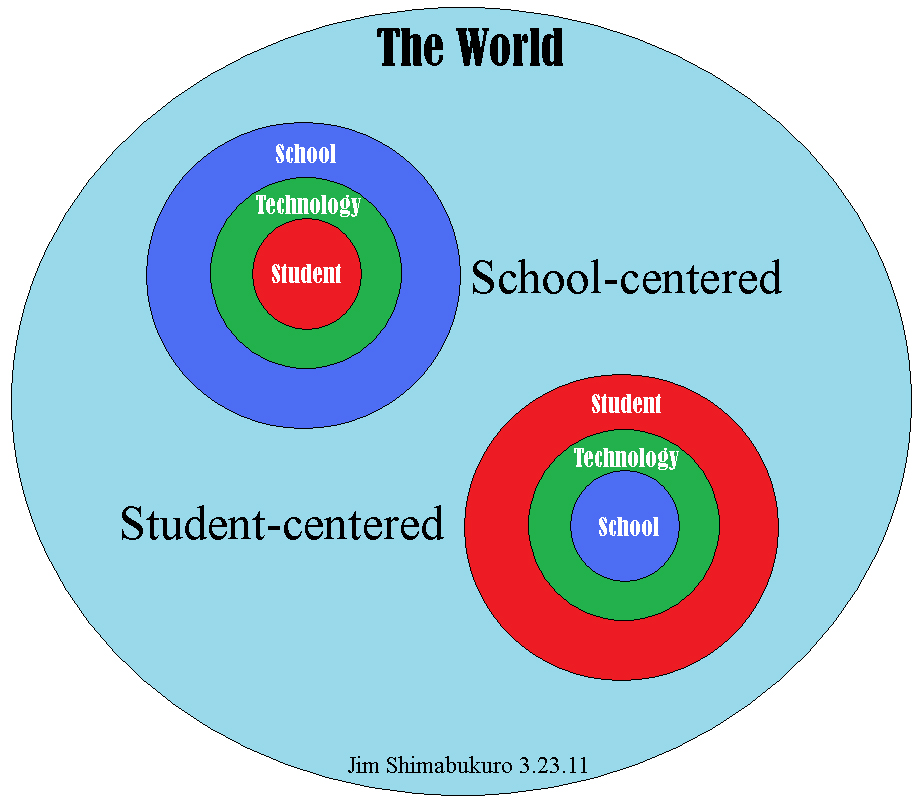
In “What Is Your Mental Model for 21st Century Education?,” William Zaggle asks, “What is your mental model of the way technology ought to fit into the teaching and learning process?” In my model, there are two competing models. In one, the emphasis is on the school. In the other, on the student. I think we can roughly divide most educators into one or the other.
Click the image to zoom in.
In the school-centered model, planning begins with the realities of the school. Technology is retrofitted into the school or the school is enlarged to accommodate technology. The student is then interfaced with the technology. In this model, “student-centered” simply means that students are factored into a school-based equation. Continue reading →
The concept of mental models has been around for a while now. It seems to have matured especially in the area of computer science and engineering where modeling is necessary for the design and construction of devices. Having a firm mental picture of how something works and relates to the external world is crucial in maximizing its performance. Yet mental models apply to more than just technology (Jonassen & Henning, 1999) and are crucial in understanding how we function and interact with the world around us. For example, they could be very useful to educators today who are struggling to find a way to adopt or adapt ICT into their schools and colleges.
Mental models provide an internal framework for managing knowledge and describe how we know what we know. Many of us, as educators, understand how important it is to connect to students’ analogical learning and reasoning through structure-mapping (Gentner & Gentner, 1983). But actually getting down to how someone visualizes the operation of a complex system is difficult. There are no brain viewers that instantly map the way someone is piecing together an idea. This is, of course, complicated by the fact that everyone’s system is always more or less different from others’. Continue reading →
“So we know that I’m not the most politically correct person so don’t take this offensively.”
So begins the infamous video. I don’t know the young lady personally and so cannot comment on her specifically, but I would like to take a moment to dissect that sentence because I think it reveals a lot about parts of our culture in general, and I believe it shows why incidents like this, within social media, can provide a positive value for our society.
By saying people know she is “not the most politically correct person,” she is essentially saying that she frequently makes comments like this. She then says that the fact she does means that people should not be offended by it. That last part makes no sense at first glance. For example, if I frequently burgle houses, does that mean you should not be upset if I burgle yours? However, I feel the true reasoning behind that statement can be understood by an analysis of the phrase “politically correct.”
As the term is used, it means more than merely conforming to socially accepted norms of speech in reference to certain sensitive topics. People who use the term do not do so neutrally. They deride those who use politically correct language, and they pride themselves for not being politically correct. The implication is important: politically correct people hide the truth — what they really believe — behind a mask of political correctness. People who are offended by straightforward talk are too sensitive and afraid to face that truth. The full implication of the term is that society in general feels a certain way about certain topics but is prevented from speaking freely about it because of a politically-based need to conform to an unreasonable code of conduct. Continue reading →
As educators interested in the impact of web media on students and learning, we had to be alarmed and, perhaps, a bit intrigued by all the attention surrounding the video (click here for the transcript), by UCLA junior Alexandra Wallace, which was posted in YouTube on 11 Mar. 2011. In her own words, this started as “an attempt to produce a humorous YouTube video.”* But moments after it was posted, she began receiving threatening messages and realized, too late, the serious consequences of her actions.
I saw the video and took it for what Ms. Wallace intended — an attempt at humor that’s slightly over the edge. I saw neither hate nor malice in it. In fact, like many observers, I thought the real hate flew in the opposite direction, toward Ms. Wallace. I’m concerned about her and her family’s welfare and safety and hope that cooler heads will prevail. Continue reading →
By Claude Almansi
Editor, Accessibility Issues
ETCJ Associate Administrator
The National Federation of the Blind is requesting the US Department of Justice to “investigate civil rights violations . . . against blind faculty and students” by New York University and Northwestern University and four school districts in Oregon.
Motive: their adoption of Google Apps for Education, a limited series of Google applications (mail, calendar, docs, spreadsheets and sites) that educational bodies can put under their domain name, and where they can control what their staff and students do, but which present serious accessibility issues for the blind. Continue reading →
Upon further consideration, I’ve decided to join the crowd and embrace the common wisdom about PISA, SAT, and other standardized test results. What changed my mind was when I realized how awesomely powerful the principles that drive the acceptance of these results really are. You see, simply by applying them, I can prove to you that I am a better basketball player than Michael Jordan.
Don’t laugh. I have the test results. Some time ago I saw something online somewhere which showed MJ participating in a friendly free throw shooting contest. He made 16 out of 20. Pretty good, but I figured I could do better. So I went out to my local gym and practiced and practiced and practiced until, finally, I achieved my aim: I made 18 out of 20! There was a witness who could vouch for me. I’ll send you the video if you like. (Or you could do what most people do with PISA scores and simply take my word for it.) Continue reading →
Didactic Strategies and Technologies for Education Incorporating Advancements
Paolo M. Pumilia-Gnarini, Elena Favaron and Luigi Guerra Editors
A project promoted by http://lascuolachefunziona.it, with the scientific support of the Educational Technologies Research Group, Faculty of Educational Sciences, University of Bologna.
To be published by http://www.igi-global.com
I’ve been reading the ETCJ discussion about the “Net Generation” and whether or not they’re really any different from other generations and wondering why Mark Bullen is spending so much energy trying to prove that they’re not different and claiming otherwise is “dangerous.”
The discussion began a few days ago when Jan Schwartz introduced readers to a webinar by Bullen, Separating Fact from Fiction in the Digital Generation (19 Jan. 2011), and in her article, she credits him for saving her from the “danger” of proliferating the myth about the “Net Generation.” With all this talk about “danger,” I decided I had to make time for the webinar.
If I had to place myself in a generation, I’d have to say I’m in the TV generation. I was in grade school when TV antennas began sprouting on roofs in the neighborhood. That was the ’50s, and that tiny glowing window to the world was magic. For the first time, I had visual access to the world that film and printed material could only hint at. Overnight, the world shrank to the size of a base pad in our living room. Continue reading →
The Victorian era writer John Ruskin once observed that the fantastic creatures from Greek mythology were all created from different parts of familiar animals, with nothing in them created by the imagination. The modern era writer Woody Allen, noting the same thing, proposed his own mythical creatures, one of which had the head of a certified public accountant. The conclusion Ruskin drew was that humans are incapable of imagining something they have never actually experienced, and the best they can do is patch together new arrangements of that with which they are already familiar.
I believe this is one of the most important reasons that it is so hard for the teaching of thinking skills to take hold in education. Teachers and curriculum designers who were never asked to think in their own educations cannot imagine how to include it in their own teaching. More importantly, they have no idea how to assess it.
This was made painfully clear when I was asked to intervene in the unsatisfactory development process for an online world history course. Despite the fact that the developer had been given clear directions that thinking skills were to be a focus in the course, there was no thinking to be found so far. All assessments were fact-based multiple choice. The developer seemed not to understand what was wrong with that, and she eventually produced what she thought was wanted. For example, she had a short answer question in which students were to write out what the Phoenicians believed about something, as if putting a fact in words required more thought than identifying it on a list of multiple choice items. Continue reading →
In January this year I participated in a webinar offered by IT Sligo (Ireland) titled, Separating Fact from Fiction in the Digital Generation. The webinar leader was Mark Bullen from the British Columbia Institute of Technology (which meant the webinar was at a reasonable hour for the west coast of the U.S.). It was an eye opener for me because I had been sucked in by the popular books, Teaching Digital Natives: Partnering for Real Learning (2010), by Marc Prensky and Grown Up Digital: How the Net Generation Is Changing Your World (2008) by Don Tapscott.
I have a tendency to grab on to these types of books, and if everything sounds logical I go with it. I guess that would be okay if I didn’t pass the information on to others as if it were the whole truth and nothing but the truth. In my industry, career education, elearning is still very new, and in some cases nonexistent, so that’s the danger in passing on information that is, at best, suspect. Fortunately, that did not happen — but only because I watched that webinar! Continue reading →
By Claude Almansi
Editor, Accessibility Issues
ETCJ Associate Administrator
Note: This post arises from my personal experience with one “free” online course for teachers provided by an Italian nonprofit association. Hopefully, other similar offers are managed with more care. However, in case not all of them are, here goes, as a cautionary tale.
Didasca’s course about “Google Apps Education”
Last year, the Italian Didasca association launched its first free online course for teachers about Google Apps for Education. If you know how to use an office suite to produce content, doing so with Google Docs or its version for schools, Google Apps, is a no-brainer. However, using such collaborative online tools with minor students presents some specific issues, in particular privacy issues, which I assumed the Didasca course covered.
My previous article described my struggle to decide whether or not we really need a core curriculum.
While writing that post, I had an interesting discussion with a colleague about how colleges and universities offering cybersecurity education are struggling to deal with the proliferation of multiple standards such as CNSS, DoD 8570, and DHS’s “IT Security Essential Body of Knowledge” among others.
This issue also illustrates some of the shortcomings of trying to define a core curriculum. Various constituencies need different knowledge “cores” which reflect their particular needs and interests. Standards become outdated and need replacing over time, but the needed changes are often slow in coming even in a vitally important field such as cybersecurity, partly because the knowledge itself is changing so fast.
Even so, we agreed that determining a knowledge core which is common to all the relevant standards in cybersecurity education would enable colleges and universities to develop programs which meet those multiple standards. They could create different specializations to meet different standards’ “core” requirements. (To our knowledge, there are efforts underway to do this, but it does not currently exist.) This won’t eliminate all problems; some standards may have conflicting requirements. But it would certainly make things easier. Continue reading →
I’ve talked previously about the principle of offering practical advice. This is referring to the level of abstraction you employ when talking about the design of the learning experience. My gut feeling is that, because researchers are often employed in Learning Technology positions, the tendency is to be too abstract. This is a completely anecdotal assertion.
Aside from this, what are the qualities I need to possess to have the maximum positive impact? By positive I mean giving people a good understanding of key issues with regard to LTs and allowing them to make informed decisions on their appropriate use. Here’s a list of qualities that I think are important:
Good communication/good teaching:
I’m realising more and more that being a good communicator and teacher is priority number one for this job. I need to be able to communicate my message in a variety of forums and a variety of contexts. I need to be able to communicate well and where possible teach well so that I make maximum advantage of each opportunity. I’ve been reading a lot recently on what it means to give practical advice on LTs, particularly with regard to designing a whole course. I think an important principle is making order out of simple but disparate concepts and ideas. It’s very common for discussion to flit around lots of different issues so if you can give order, structure and context for all of this then that’s really useful. Continue reading →
Jessica Knott, in “The Open Source LMS: Look Out, Big Kids,” asks, “What trends are you seeing on your campus? Are you more likely to use a centrally supported learning management system or strike out on your own and teach from a blog?” For the first question, my answer is “More of the same LMS-based approach. Nothing new.” For the second, my answer is “A mixed approach” — combining open web social networking applications such as blogs with a few LMS applications.
Today, when we think of completely online college classes, we think LMS (learning management system). Period. End of discussion.
Then we wonder why there’s so little innovation occurring in these classes, why so many innovative college teachers have tried and abandoned online classes and returned to blended, and why online offerings are growing at such a slow rate.
The reason is simple – at least from my perspective. Compared to the blended classroom, the LMS-based online classroom is stale and sterile. Like little boxes on the hillside, they all look just the same. Boring. Continue reading →
I am struggling to settle on an answer, to be honest – you might say I’m lacking a certain “esprit de core” in terms of being an advocate for a core curriculum.
It’s pretty clear that I am not the only one struggling with this issue. In
“Eight Ways to Get Higher Education into Shape” (Washington Post, 20 Feb. 2011), higher education correspondent Daniel de Vise identified “reviving the core curriculum” as one of “eight ways to get higher education into shape.”
But de Vise’s rationale for the value of this “big idea” is pretty muddled. For instance, he seems to be confusing “core” with “required,” as in this comment: “The core may be making a modest comeback. A growing number of colleges are building required courses and texts into new first-year experience programs, senior “capstone” projects, honors colleges and other school-within-a-school initiatives.” Continue reading →
Introduction: Parry Aftab, J.D., is the executive director of WiredSafety, a site where victims can receive one-on-one assistance when they have been bullied online. She is the author of a number of books on Internet safety, including A Parent’s Guideto the Internet (1997) and The Parent’s Guide to Protecting Your Children in Cyberspace (2000).
ETCJ: What is cyberbullying? How is it different from traditional bullying?
Parry Aftab: Cyberbullying is “any cyber-communication or publication posted or sent by a minor online, by instant message, e-mail, website, diary site, online profile, interactive game, handheld device, cellphone, game device, digital camera or video, webcam or use of any interactive digital device that is intended to frighten, embarrass, harass, hurt, set up, cause harm to, extort, or otherwise target another minor” (WiredSafety).
My short definition of “cyberbullying” is: “When a minor uses technology as a weapon to intentionally target and hurt another minor, it’s ‘cyberbullying’” (WiredSafety).
With one exception, all cyberbullying must be intentional. It requires that the cyberbully intends to do harm to or annoy their target. (In the one exception to this rule, the student is careless and hurts another’s feelings by accident. This is called “inadvertent cyberbullying” because the target feels victimized even if it is not the other student’s intention. Since it often leads to retaliation and traditional cyberbullying, it is considered one of the four main types of cyberbullying.) Continue reading →
As a supporter of the “edupunk” movement and a former learning management system (LMS) administrator, I am interested in LMS development, support, and use. In the past month, two blog posts in particular (the first consisting of two parts) have caught my attention, and I wanted to share them, for others who find themselves in the same boat as I, with an eye toward the future of online teaching tools and philosophy.
The first blog post, “The Evolving LMS Market, Parts I and II,” was written by Michael Feldstein and looks closely at the shifting market shares in the LMS space, based upon data from the Campus Computing Project’s annual survey. Feldstein delves into several interesting paradigm shifts, especially the market share gains that we’re seeing in open source learning management systems. Perhaps the biggest takeaway I find in this post is this gain, especially the ANGEL plateau following the Blackboard acquisition announcement. What are customers, educators and the learning community speaking out against? Is it the corporation or the product? Is it the support or their dwindling voice in the development process? Is open source simply seen as being more affordable? This blog post offers much to think about, from the teaching and learning perspective as well as the administration and IT perspective. Continue reading →
By Claude Almansi
Editor, Accessibility Issues
ETCJ Associate Administrator
Introduction: Nancy Willard, M.S., J.D., is the director of the Center for Safe and Responsible Internet Use. She is the author of two books, Cyberbullying and Cyberthreats: Responding to the Challenge of Online Social Cruelty, Threats, and Distress (Research Press) and Cyber-Safe Kids, Cyber-Savvy Teens, Helping Young People Use the Internet Safely and Responsibly (Jossey Bass). A new book, Cyber Savvy: Embracing Digital Safety and Citizenship, will be published later 2011 by Corwin Press.
ETCJ: What is cyberbullying? How is it different from traditional bullying?
Nancy Willard: Cyberbullying is a term that has been applied to situations where young people use digital technologies to engage in hurtful behavior directed at each other. The term “traditional bullying” generally refers to repeated hurtful behavior where there is an imbalance of power. Unfortunately, at this point in time, both terms, “bullying” and “cyberbullying,” are being applied to a wide range of hurtful behavior — arguments, conflict, drama, and the more significant ongoing or imbalance of power situations.
By Claude Almansi
Editor, Accessibility Issues
ETCJ Associate Administrator
Several mainstream media have mentioned and at times quoted from the video statement Julian Assange recorded in the UK for a rally in support of Wikileaks in Melbourne on February 4, 2011. These media reports are easily retrievable with a search engine, and here is the video, captioned in English:
This story is from Cory Doctorow’s new collection, “With a Little Help”. Visit craphound.com/walh to buy the whole audio book on CD, a paperback copy in one of 4 covers, or a super-limited hard cover.
This story, and the whole text of “With a Little Help”, are licensed under a Creative Commons Attribution, Share Alike, Non Commercial license.
Copy it, share it, remix it. As Woody Guthrie said: “This song is copyrighted in the US under a seal of copyright number 154085 for a period of 28 years, and anyone caught singing it without our permission will be a mighty good friend of ourn, because we don’t give a dern. Publish it, write it, sing it, swing to it, yodel it. We wrote it , that’s all we wanted to do.” (From the intro to all the recorded readings of the stories collected in Cory Doctorow’s “With a Little Help,” 2010)
Dandelion business model
From C. Doctorow: "Think Like a Dandelion". BoingBoing. Under a BY-NC Creative Commons License
Science fiction has often used human interaction with the all-knowing computer as a plot device. Generally, computers have been portrayed in the genre as either evil masters of the world or the benevolent caretakers of the human race. These stories immediately came to mind when I read the NY Times story that Academic Earth linked to on its Facebook page. It examines the notion of the thinking computer that completely takes the place of the human teacher.
The article, “Online Courses, Still Lacking That Third Dimension,”* written by Randall Stross, was published on February 5, 2011. He states, “WHEN colleges and universities finally decide to make full use of the Internet, most professors will lose their jobs… A genuine online course would be nothing but the software and would handle all the grading, too. No living, breathing instructor would be needed for oversight.” He then goes on to explain how at this point in time this type of totally computer-run course is not generally feasible in most programs. He also goes on to explain how certain types of courses may lend themselves to such a model, while others do not. Continue reading →
As a scientist, you’d think I’d really be in favor of science fairs. A recent article by Amy Harmon in the New York Times (“It May Be a Sputnik Moment, but Science Fairs Are Lagging,”* 4 Feb. 2011), among others, laments the decline of science fair competitors. The Los Angeles County science fair, it says, has dropped to 185 participating schools, down from 244 a decade ago.
Teachers who support these event, who organize them, find venues, recruit judges, and so on do so without pay and may spend hundreds of hours preparing them. I should know because I did the same thing for the Department of Energy’s New England Regional Science Bowl. So I definitely intend no disrespect to these motivated and hard-working teachers when I say that the value of these events is marginal. Too many science fair projects are done partly or mostly by parents. Too many show a lack of understanding of what science is. A few remarkable projects demonstrate incredible dedication and creativity for the young people who do them. Continue reading →
By Guy Inaba
Educational Support Specialist
Kapi’olani Community College Library
[Editor’s note: One of the drawbacks of teaching completely online is that I seldom have an opportunity to drop in on Guy Inaba at our college library. He’s one of those who’s always at least three steps ahead of everyone else when it comes to advances in technology. I never leave our informal sessions without learning something new. In his first ETCJ article, Guy shares an email exchange that we had recently. -js]
On Jan. 11, 2011, at 12:31 PM, I emailed Jim Shimabukuro about a workshop presentation that we had worked on. I signed off with “Power of digital media – Nice!”
On Jan. 14 at 10:19 AM, Jim replied: Speaking of tech — I remember your introducing me to flash drives years ago. Yesterday, I picked up an 8GB flash drive for under $20 at Don Quijote.
On Jan. 19 at 6:11 PM, I replied: Hi Jimmy. Just got some interesting info from CES (2011 International Consumer Electronics Show) — Victorinox Swiss Army will put it out in a few months. Click on the pictures for the various styles. Don’t have a price on these but nice design for the tech person. Tech is really moving forward. -Guy Continue reading →
Eric Gorski, in “Students Not Learning a Lot in College, Tracking Study Finds” (denverpost.com, 1.19.11), reviews Richard Arum and Josipa Roksa’s study, Academically Adrift: Limited Learning on College Campuses (University of Chicago Press, 1.15.11). From the perspective of a K-12 educator who has done some work at the post secondary level, this study brings to mind a number of scattered thoughts that I will hopefully bring together at the end of this article.
Let’s start with a key quote from the review:
The research of more than 2,300 undergraduates found 45 percent of students show no significant improvement in the key measures of critical thinking, complex reasoning and writing by the end of their sophomore years.
One problem is that students just aren’t asked to do much, according to findings in a new book, “Academically Adrift: Limited Learning on College Campuses.” Half of students did not take a single course requiring 20 pages of writing during their prior semester, and one-third did not take a single course requiring even 40 pages of reading per week.
I don’t see anything in this review that I would not have predicted based on my experiences decades ago while working as graduate teaching assistant in a major competitive university. While I was there, the chancellor emphasized that the faculty was to focus our time on research, not teaching. Teaching was something to do in one’s spare time. The required reading lists for courses generally focused the research area of the teacher and often had little to do with the title of the course.
This is the start of the second week of instruction, and already the online classroom trolls are spreading their fear and panic among unsuspecting classmates. As a group, educators tend to think of trolls as infectious agents that prowl professional discussion forums. We seldom think of them as a problem in the completely online class. But they’re there, and all we need to do is look for the symptoms.
The most common e-student troll is one who posts misinformation about class activities and policies. The perpetrator can be male or female, but in this example, let’s say it’s a male. He posts an emotional message in a forum, claiming that the directions for completing learning activities are confusing and misleading and cites misinformation to support his claim. Before the instructor can respond or even after s/he does, a large number of students react with panicky posts and comments as well as email to the instructor. In short order, the class is in chaos with fear and panic spreading like wildfire.
Ironically, before the panicky post, all the students were in the process of completing the activity without any problems. They understood what needed to be done and were doing it. All it took was the one flaming message to create instant pandemonium. The fact that this can happen says something about the online learning environment. It’s vulnerable to trolling.






 By Jim Shimabukuro
 Click the image to zoom in.















 Educational Technology and Change Journal