Breaking News


Special Issue on “The US National Education Technology Plan
By Bonnie Bracey Sutton
May 11, 2011

Did everyone see this? This is important because it is reflection on the National Educational Technology Plan
Just published in E-LEARNING AND DIGITAL MEDIA, Volume 8 Number 2 2011 ISSN 2042-7530 http://www.wwwords.co.uk/elea/content/pdfs/8/issue8_2.asp

SPECIAL ISSUE

The US National Education Technology Plan – Transforming American Education: Learning Powered by Technology
Editors: MICHAEL A. PETERS & DANIEL ARAYA

Michael A. Peters & Daniel Araya. Introduction. Transforming American Education: learning powered by technology, pages 102‑105 doi:10.2304/elea.2011.8.2.102 VIEW FULL TEXT

Robert B. Kozma. ICT, Education Transformation, and Economic Development: an analysis of the US National Educational Technology Plan, pages 106‑120

Kathleen Scalise & Mark Wilson. The Nature of Assessment Systems to Support Effective Use of Evidence through Technology,pages 121‑132

Michael B. Horn & Katherine Mackey. Transforming American Education, pages 133‑144

Leonard J. Waks. Transforming American Education: revolution or counter-revolution?, pages 145‑153

Nalova Westbrook. Media Literacy Pedagogy: critical and new/twenty-first-century literacies instruction, pages 154‑164

Raymond M. Rose. The National Educational Technology Plan Doesn’t Live Up to its Call for Revolutionary Transformation, pages 165‑169

__________

New York State Regents on Verge of Bold Step
By Harry Keller
May 10, 2011

The New York State Board of Regents has an item on the agenda for its next meeting on May 16 and 17 that could change the landscape for science instruction in that state and then reverberate throughout
all states. Here’s the recommendation for this item.

It is recommended that the Regents direct department staff to convene a group of science, technology, and education stakeholders including teachers and leaders from school districts, institutions of higher education, and business and industry to:

  • review and evaluate the science laboratory requirement;
  • consider and appraise current available research on teaching and learning in science;
  • make recommendations to the Board of Regents regarding amendments to current clause 100.5(b)(7)(iv)(d) of the Commissioner’s Regulations.

Click here for the full agenda.

This agenda item was scheduled for the previous meeting in April, but did not come up then. The committee recommended by Dr. John B. King, Jr., the item’s author, will include all stakeholders including teachers, leaders from districts, institutions of higher learning, and even businesses. The step being taken in forming a committee represents a huge change for New York State and signals the potential for more far-reaching change across the nation. The New York State Board of Regents has been adamant for decades about this topic. Other states have also created similar obstacles to using online science labs in schools. They may follow New York’s lead.

Many will decry, as they have for a very long time, the potential for loss of the experience of working with lab equipment directly. If not carefully crafted, the change could well result in cost-savings at the expense of a degradation of student science experience. New York State must walk a narrow line if they’re to allow online lab experiences without sacrificing quality science education.

After so many decades of holding firm against any change in the 1,200-minute requirement, New York has allowed for the possibility of change. That crack in the dam of science lab requirements will create a flood of opportunity for online science lab development and, possibly, a new way of presenting science courses.

__________

Robert Morris University’s Twitter Communication Project

In past columns, we’ve looked at how Twitter can be integrated into individual classrooms, but Web and Social Media Designer Douglas Derda and the social media team at Robert Morris University (RMU) are taking Twitter and social media to a whole new level, transcending university borders to get community members excited about what they have to offer. Continue reading

Online Self-Publishing: Wave of the Future?

Lynn ZimmermannBy Lynn Zimmerman
Editor, Teacher Education

This interview with one of my colleagues, Anastasia (Staci) Marie Trekles, who teaches IT (Instructional Technology) at Purdue University Calumet came about as a result of a comment she had made on Facebook. She wrote: “I just got a plug for my book from John and Adam on No Agenda – how awesome!” Continue reading

Making Sense of Social Networks: An Interview with Zizi Papacharissi

Stefanie PankeBy Stefanie Panke
Editor, Social Software in Education

Dr. Zizi Papacharissi, who received her PhD from the University of Texas in Austin, is one of the leading scholars of social media and online communication. Her work focuses on the social and political consequences of online media. She heads the Communication Department at the University of Illinois in Chicago. Zizi is presently completing an edited volume on online social networks, titled A Networked Self: Identity, Community, and Culture on Social Network Sites. In the interview, she talks about self-presentation, social capital and the prospects of social networking communities for academic learning, teaching and research. Continue reading

UNESCO, World Anti-Piracy Observatory and YouTube

Accessibility 4 All by Claude Almansi

Content:

Continue reading

End of Free Ning Networks: Live Online Discussion: Apr. 20th

Claude AlmansiBy Claude Almansi
Editor, Accessibility Issues

Ning social networks have been very popular, particularly among educators for whom they meant a free – without ads for K-12 classes – learning environment, with blogs, forums, photo and video galleries, personal pages for members and the possibility to create sub-groups.

But on April 15th, Ning’s new CEO, Jason Rosenthal, announced that they were going to end Ning’s free offer: see Ning Update: Phasing Out Free Services by John McDonald, Ning Creators‘ forum. This is a severe blow,  as there is no simple way to back up a Ning network. Continue reading

Ebook Readers vs. Ipad for Education?

Tom PreskettBy Tom Preskett

I’m doing a project on ebook readers at the moment, and it’s led me to follow closely the advent of the iPad. My interest is the potential impact on education. At the moment, the contest is in the commercial/entertainment market. Once things settle down, education will be looked at.

From what I’ve been learning, you can’t just give students and educators an ebook reader as is right now and expect it to transfer to education successfully. Looking at it just from a book replication point of view, I feel it has to, at least, perform certain tasks well and efficiently. Continue reading

Social Media Doesn’t Threaten Literacy!

Tom PreskettBy Tom Preskett

You can read a lot about the threat of new media to literacy and the printed word. Harold Jarche’s blog post, “Literacies,” is an example. Often there is a link made between the ability to engage in deep and meaningful learning, on the one hand, and reading large bodies of text, on the other. Or rather, there’s a link between an inability to learn and the fast-pace of media in the Web 2.0 world. Well, I just don’t buy this. In fact, it’s rubbish. Continue reading

E-rara.ch: Ancient Books, Public Domain and Moral Barriers

Accessibility 4 All by Claude AlmansiContents

Continue reading

The Challenge for Our Schools: Thomas Friedman and Education

Retort by Harry Keller with a distilling retort on the left

Today, in his New York Times Op-Ed (Webcite alternative), Thomas L. Friedman made this comment:

Good-paying jobs don’t come from bailouts. They come from start-ups. And where do start-ups come from? They come from smart, creative, inspired risk-takers. How do we get more of those? There are only two ways: grow more by improving our schools or import more by recruiting talented immigrants.

This respected economist and commentator has closely linked our education system to our future success as a nation. He also argued for more immigration, more H-1B visas with longer durations. Continue reading

Social Networking and the Secondary Student

Meeting the Needs by John AdsitMost discussions on this site dealing with the use of social networking in education are devoted to post secondary education. This column will look at the unique challenges of using any form of social networking in secondary education. The differences are significant, partially because of the ages of the students and more importantly because of the role of boards of education. Social networking in the secondary level has to solve some problems if it is to be used successfully. Continue reading

Thomas H. Huxley on Teaching Science

Retort by Harry Keller with a distilling retort on the left
Frederick W. Westaway wrote on many subjects, especially about teaching science. He wrote the definitive volume, Scientific Method, Its Philosophy and Its Practice, for example. In 1929, he spoke clearly to us today about science education in his book, Science Teaching. He quotes Thomas H. Huxley, also known as “Darwin’s bulldog,” at length about science education. This Huxley quote from Westaway’s book dates to 1869! Continue reading

iPad – Breakthrough or Misstep?

Totally Online, by Jim Shimabukuro
The iPad debuts today, and, as an educator, I can’t help but wonder if this will be the breakthrough portable communication device that will hasten the release of students and teachers from the grip of classroom walls. Continue reading

Headphones, Computers, and the Web

Jim ShimabukuroBy Jim Shimabukuro
Editor

Note: The primary reason for selecting this subject for the second article in ETC’s “Extracurricular” series (see John Adsit’s “The Great Technology Controversy Follows Me into the Caves“) isn’t so much to share information about what I consider an enjoyable hobby but to underscore the fact that the entire pastime is built on computers and the web. All of the equipment was researched and purchased on the web – out of necessity because, for the vast majority of enthusiasts, it’s not available in stores within driving distance. I think I can fairly say that this hobby wouldn’t be possible without the internet and that it owes its survival and growth to a community that’s defined virtually rather than geographically. -js Continue reading

MOOC Sightings: Links to Series

Jim Shimabukuro

Jim

Series began on 20 Feb. 2015

MOOC Sightings 007: The Battushig Factor in College Admissions

MOOC Sightings 006: Universities Are ‘Middle-men Selling a Product That Is Past Its Sell-by Date’ 3/23/15

MOOC Sightings 005: Wharton School and Universiti Teknikal Malaysia 3/11/15

MOOC Sightings 004: Outside the Box with Ontario’s Judy Morris 2/28/15

MOOC Sightings 003: FutureLearn, Microdegrees, ‘Open Internet’ 2/24/15

MOOC Sightings 002: Oxford Professor Declares MOOCs the Loser 2/22/15

MOOC Sightings 001: UNC and Cornell 2/20/15

What’s the Buzz? Buzz

A Google search for the term Google Buzz returns 72,400,000 hits. Google Buzz Twitter returns 53,100,000. This is considerable, given the relative new shininess of the Google Buzz functionality. But isn’t Buzz just like Twitter in Google? Is it a Twitter killer? What the heck is it? Continue reading

Threat of Lawsuits on Social Networking Sites

Meeting the Needs by John AdsitOne of the dangers we face in using social networking sites is our lack of control over them, their content and the way participants interact. Because the law on this is still emerging, we face the potential for unknown legal repercussions. An example of this has just come about as a social networking site devoted to scuba diving, scubaboard.com, has been sued, along with over 100 of the people who post on it, for content that would be considered tame in most social networking sites. Continue reading

Thoughts on ‘Innovating the 21st-Century University: It’s Time!’

Tom PreskettBy Tom Preskett

I’ve read and re-read Innovating the 21st-Century University: It’s Time! by Don Tapscott and Anthony D. Williams (Educause, 2010) to try and absorb its key messages. Here are some quotes from the article, followed by my comments.

Universities are losing their grip on higher learning as the Internet is, inexorably, becoming the dominant infrastructure for knowledge — both as a container and as a global platform for knowledge exchange between people — and as a new generation of students requires a very different model of higher education. Continue reading

YouTube, Geoblocks and Proxies

Accessibility 4 All by Claude Almansi
Skip to updates

Geoblocking as censoreship measure Continue reading

Tech Support – Abandon All Hope Ye Who Enter

Meeting the Needs by John Adsit
Advocates of technology in education, especially those who, like me, advocate for online education, need to consider the problems that the modern concept of tech support can cause. Tech support within a school campus is very different from tech support for the student or teacher working at home. If I were either an online student or teacher during the past year, I would have had serious problems due to technical difficulties, and the nature of these is such that it brings me real concern for anyone in such a situation in general. Online programs will have to consider processes to deal with this. Continue reading

The Great Technology Controversy Follows Me into the Caves

adsit80By John Adsit
Editor, Curriculum & Instruction

[Note: ETCJ editors and writers live full lives, and from time to time, we’ll be publishing some of their extracurricular pursuits. See Jess Knott’s “Smackademia – the Best of Both Worlds!,” the second in this series. -Editor]

I made my first online class in 1995, and since those days much of my life has been spent trying to convince nonbelievers that computers could improve student learning if used properly. Those years were filled with many less than pleasant arguments, and like many people I looked to my recreational life to get away from such battles. Unfortunately, I now find that my chief area of recreation, scuba diving, is filled with those same battles. The controversy of my work life has doggedly pursued me into my recreational life. Continue reading

Sloan-C Survey 2009 – 25% of College Students Are Taking Online Classes

Totally Online, by Jim Shimabukuro

Last month, The Sloan Consortium published I. Elaine Allen and Jeff Seaman’s Learning on Demand: Online Education in the United States, 2009, its seventh annual report on the state of online learning in U.S. higher education. Click here for the full report, which is available as a PDF file. Online courses are defined as “those in which at least 80 percent of the course content is delivered online.” Continue reading

Do You Speak Livemocha? An Interview with Clint Schmidt

Stefanie PankeBy Stefanie Panke
Editor, Social Software in Education

Livemocha is a social network service that supports language learning through audio-visual lessons and peer tutoring tools. Launched in September 2007, the platform has over 5 million registered members from over 200 countries. Lessons are provided for 36 different languages. While the standard lessons are freely accessible for registered users, the platform also offers “premium content” for a fee. Livemocha is more than just “Rosetta Stone on the Web.” A unique selling point of the educational Web community is its collaborative approach to language learning: Members of the Livemocha community do not only learn a foreign language, they also tutor other community members in their native language. Users are encouraged to form learning tandems and offer feedback on their partner’s speaking or writing exercises. The Livemocha platform supports this peer learning practice through comment features, voice recording and social awareness tools. Continue reading

Successful Learning: A Matter of Both ‘What’ and ‘When’

Meeting the Needs by John AdsitI recently addressed the value of using learning objects to address student needs for prerequisite skills in online instruction. I suggested developing a library of learning activities that could be tapped into whenever a student had an identified learning need that was interfering with present learning. Not too long ago an online education company considered the idea of using independent learning objects of this kind to create new courses just by mixing and matching the objects as needed. They also considered building a course entirely with such lessons, letting students select the lessons they needed in the order they felt they needed them. This, they felt, was the epitome of student-centered learning. Continue reading

Textbook Tweets – Integrating Twitter into a Telecommunications Design Class

Dr. Carrie Heeter, a professor of Telecommunication, Information Studies, and Media at Michigan State University has been integrating Twitter into her graduate Design Research class this spring in two very different ways. She is moderating a class Twitter ID (@tc841) set to follow experts in the field. Heeter retweets particularly important content to students and to the vibrant professional community of design researchers on Twitter.

Heeter is using Twitter in an unusual way to enhance live class discussions of assigned readings. She calls it “Textbook Tweet Time.”

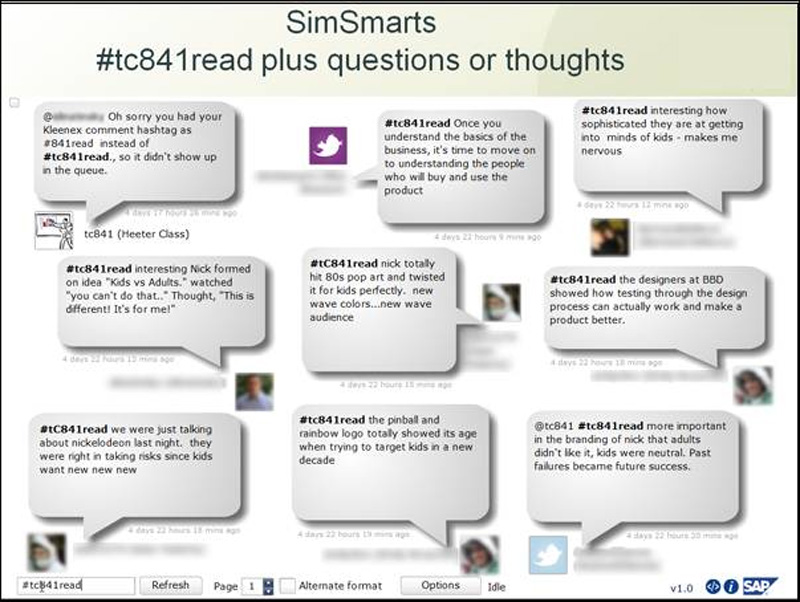
As a graded part of live class participation, Heeter’s students are assigned to come prepared to tweet interesting insights they gleaned from the week’s readings from the Twitter ID they created for class participation (this can be their personal Twitter ID or one created exclusively for class). Using the PowerPoint Twitter tool from SAP, Heeter configures and projects a PowerPoint slide to search for the hash tag #tc841read. The search is continuously updated so new tweets show up within 10-20 seconds.

Dr. Carrie Heeter

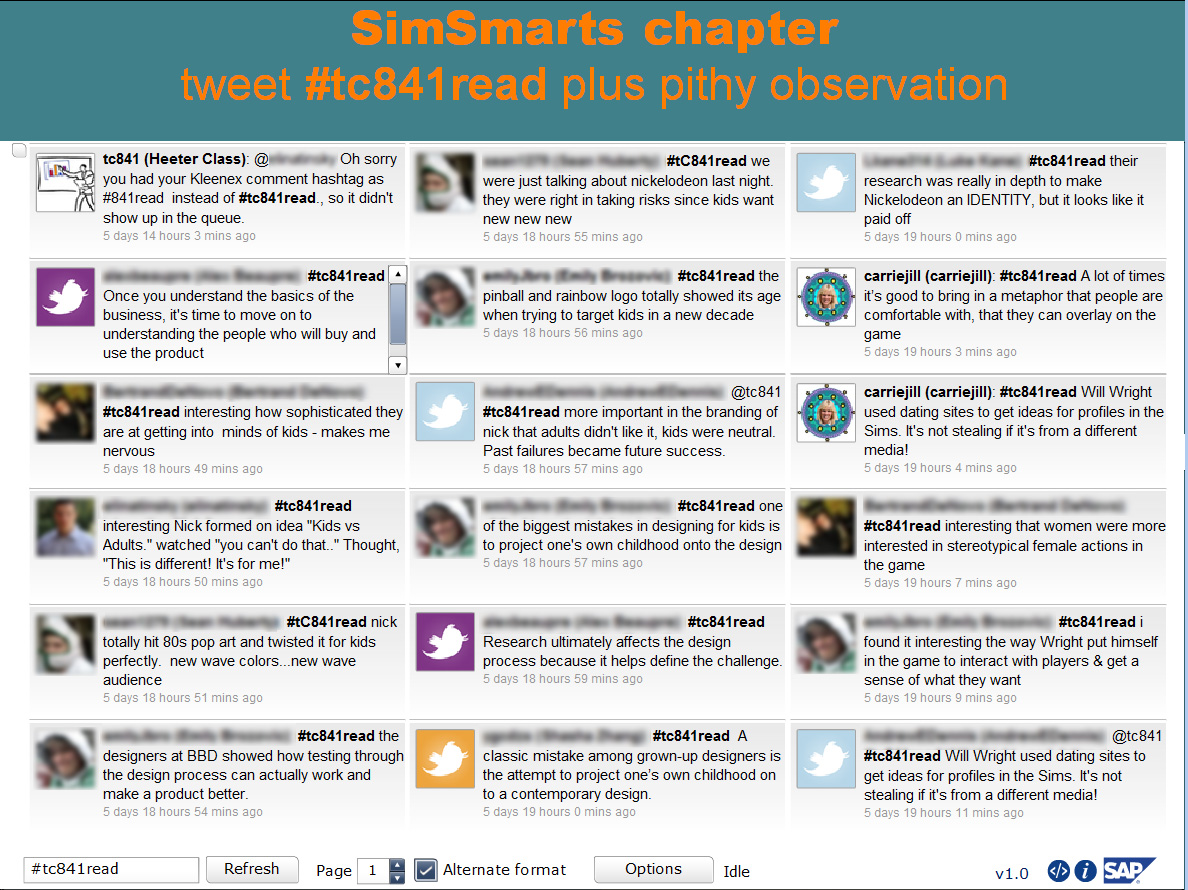
Students must include that hash tag in the tweet in order for it to show up on the slide (and in order to receive credit for participation). The PowerPoint Twitter Tool can be toggled between two alternate formats – one shows the 9 most recent tweets in dialog boxes, along with the twitterer’s ID and photo. The alternate photo shows the most recent 18 tweets. The examples below are from Textbook Tweet Time about Will Wright’s chapter, “Sim Smarts,” in Design Research by Brenda Laurel.

As tweets appear in class, Heeter calls on the tweeters to describe their post. The class discusses each post, then moves on to another tweet. The class tweets about and discusses one chapter at a time, to limit number of tweets and to focus the discussion.

Heeter finds that “the tweets give each student a platform, almost like handing them a microphone. The students explain and expand upon their tweet, and discussion ensues.” The tweets focus class discussion and ensure 100% participation (in this small graduate class). There is a permanent record of the tweets, which facilitates grading of live class participation and motivates attention to the readings before class.

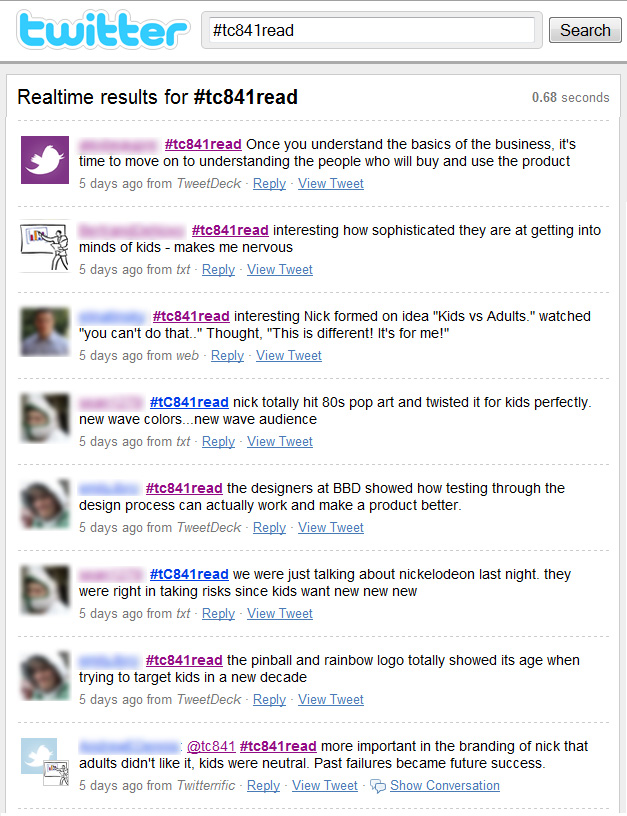
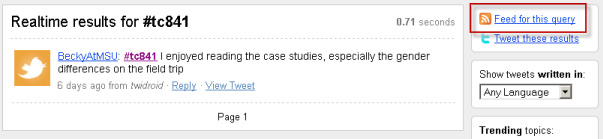
Learners can also view the search results for #tc841read on Twitter search (located at http://search.twitter.com). This view does not limit the number of tweets that are returned unlike the PowerPoint tool (shown above). Heeter subscribes to the RSS feed for that Twitter search, creating a permanent record of the class tweets on her desktop. Heeter says, “Because I can search and archive the tweets, grading classroom discussion becomes more systematic, thorough, and objective. I gain a sense of what matters from the readings, and some feel for how deeply different students are delving in to the readings. The tweets motivate preparation for class and then serve to reinforce the important points; and they give each student a turn.”

Twitter is a public space, leading to the potential for privacy concerns. In Heeter’s design, the students can use their personal Twitter account for class or they can create a unique twitter ID just for TC841. She says, “They control their anonymity in their choice of twitter ID.” For example, one student’s Twitter ID is six letters, all consonants and unpronounceable. Another student is a deceased movie star. Still others use their real names.

Some students post a picture of themselves as their Twitter icon while others post a graphic or picture of something other than themselves. Still others are simply a variation on the default Twitter icon – a white bird silhouette with a color background. “I have one orange student, one purple, and one light blue,” says Heeter. “I know the Twitter ID that each student is using for class so I call on them by their real name (or for fun, sometimes by their silly Twitter name). Their tweets are public, but depending on the set up choices they have made, they are more or less anonymous.”

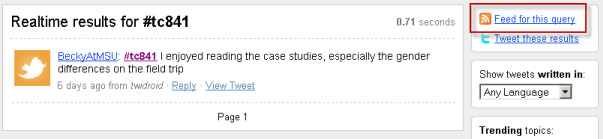
By navigating to http://search.twitter.com and searching for #tc841read, Heeter can click on the feed for the #tc841 query button to have a folder in her default RSS reader collect and save all textbook tweets.

Heeter feels that using tweets for classroom discussion and collaboration is working well, though she notes that “for larger classes I would need more control.” As it stands, with the number enrolled, she finds “this particular interface happens to be perfect as is right now in this class.”

Heeter lives in San Francisco and teaches in East Lansing. The design research class is a hybrid class with between one hour and 90 minutes of live class and the rest online. Heeter participates via Skype and Breeze connect. Students can either come to the classroom or Skype and Breeze from any remote location. Of course, the instructor need not be remote for Textbook Tweet Time to be an effective component of synchronous class discussion.